Category: Government

  • Who Let the Dogs Out?

    Shelter, Rescuers Partner to Find Homes for Strays

    Bob Ennis, Shelter Manager for Pets, Inc. and new Fairfield County Animal Shelter Director James Hill with one of 29 dogs taken from the Fairfield shelter in the last 10 days by two rescue organizations, Pets, Inc. and Ozzie to the Rescue, and placed in safe havens where they will receive shots, be altered and cared for until they can be adopted. Clearing of the dogs from the shelter was facilitated by The Hoof and Paw Benevolent Society.
    Bob Ennis, Shelter Manager for Pets, Inc. and new Fairfield County Animal Shelter Director James Hill with one of 29 dogs taken from the Fairfield shelter in the last 10 days by two rescue organizations, Pets, Inc. and Ozzie to the Rescue, and placed in safe havens where they will receive shots, be altered and cared for until they can be adopted. Clearing of the dogs from the shelter was facilitated by The Hoof and Paw Benevolent Society.

    WINNSBORO (Sept. 1, 2016) – The dogs are on the move in Fairfield County. More specifically, they are on the move out of Fairfield County’s animal shelter and on their way to rescue organizations that will find them permanent homes.

    After a meeting with members of The Hoof and Paw Benevolent Society last week, James Hill, Director of Fairfield County Animal Control, has seen the number of dogs sitting in the shelter’s intake kennels dwindle to nearly zero.

    “The last four days have really made an impact on the shelter,” Deborah Richelle, president of Hoof and Paw, told The Voice last week. “The last four days have been amazing to me. We’re hoping that it gives the folks at the shelter the feeling that ‘yes, it can be done.’”

    Hoof and Paw proved to be the conduit between the shelter and two prominent rescue organizations – Ozzie to the Rescue in Rock Hill and Pets, Inc. in West Columbia. These two outfits helped clear dogs from the shelter’s intake kennels, Richelle said, and will find for them permanent homes while they wait in no-kill shelters.

    Pets, Inc. had previously assisted the Fairfield County shelter, Richelle said, but with Hill taking over last month that relationship had to be reestablished. Now that it has, the wheels have remained in motion.

    Ozzie to the Rescue was quickly able to take eight dogs off the County’s hands, Richelle said, while Pets, Inc. took the rest.

    “Pets, Inc. has been a big help to us,” Richelle said. “They have taken all the dogs that (Ozzie) couldn’t take. They are a huge asset to Fairfield County, because they have a much larger audience (of potential adopters) in West Columbia.”

    “Pets, Inc. has helped us out tremendously, just in the last two weeks” Hill said. “They’ve already taken more than 20 dogs. And they are not selective – they take all dogs.”

    The assistance of these two rescue groups has reduced the number of animals euthanized at the shelter, Hill said, an issue that was of great concern to Hoof and Paw. Richelle said the shelter put down about a dozen dogs in the last month.

    Another area of initial concern for Hoof and Paw, Richelle said, was the limited hours the shelter is open. Richelle said the County might be able to adopt out animals more easily if the hours of operation at the shelter made more sense. At present, the shelter is open 10 a.m. – 6 p.m. on Monday, Wednesday and Friday; 10 a.m. – 2 p.m. Tuesday and Thursday. The shelter is closed on the weekends; and Saturday, Richelle said, is Prime Time for adopting pets.

    Hill is making adjusting those hours of operation a priority. Beginning Sept. 12, Hill said, the shelter will now be closed Sunday, Monday and Thursday, and will operate Tuesday, Wednesday and Friday, 10 a.m. – 6 p.m. Most importantly, the adoption center will be open Saturdays, 8 a.m. – 4 p.m.

    Hill said Animal Control has made other improvements as well in recent days.

    A new web hosting database, he said, will help his department track animals that have been taken in and adopted out or sent to rescues. Hill said his department is also establishing a database of non-profit rescue groups to which daily mass emails will be sent cataloging the animals in the County’s custody.

    “We want to keep all the rescue groups in the loop as to what we have,” Hill said. “The earlier we can get that information out there, the more exposure the animals have.”

    Hill said Animal Control has also reestablished its student volunteer program through the School District’s Career and Technology Center. Students in the Small Animal Care class will get credit hours volunteering at the shelter, Hill said.

    Hill said he also wants to have input into plans the County Council undertook earlier this year to recommend changes to the County’s animal control ordinance, specifically to address tethering which is not currently addressed in the ordinance.

    Hill said he also wants to implement a ‘responsible pet owner’ program in the county’s elementary schools.

    Richelle, meanwhile, said Hoof and Paw would like to hold a food drive for the shelter.

    Richelle also encourages people interested in acquiring a pet to shop first at their local shelters, instead of buying dogs for their breed.

    “Now the challenge is to keep the momentum going,” Richelle said.
     

  • County Issues Sixth GO Bond

    WINNSBORO (Sept. 1, 2016) – Fairfield County Council issued its sixth general obligation (GO) bond in three years, this one in the amount of $306,000, issued Aug. 14.

    The new bond, like the five previous GO bonds, is being issued to pay off, in a circuitous fashion, a $24 million bond that was issued in 2013, not by the County but by a non-profit facilities corporation that was created by the County in March 2013 for the purpose of purchasing and repairing specific economic development projects for the County that the County could not otherwise afford to purchase and repair.

    The County used this legal but unorthodox scheme to borrow a larger amount of money than it could otherwise legally borrow without a voter referendum.

    In order to create an artificial revenue stream large enough to buy back the purchased and repaired specific economic development projects from the facilities corporation through an installment purchase plan, Council passed an ordinance on April 15, 2013, that allowed it to issue an unlimited number of GO bonds. The revenue from those GO bonds will be used to make the installment purchase payments to the facilities corporation over about 35 years. The facilities corporation will use those installment purchase payments to pay off the $24 million bond.

    After the first GO bond was issued Feb. 12, 2014, surprised residents complained that the County’s scheme to make payments (to the shell corporation) to pay off the $24 million bond debt with a string of GO bonds had not been explained to the public. While Parker Poe, the County’s bond attorney, later claimed in a public meeting that the plan had been fully explained to the public, those ‘plan’ explanations were about how the revenue from the $24 million bond would be spent, not how the facilities corporation process worked and how the County would levy multiple GO bonds over many years to pay off its debt to the facilities corporation.

    And the GO bond ordinance was short on details about the bonds – such as how many would be issued, for how much and how long.

    So long as the bonds issued do not exceed the County’s 8 percent debt limit, Council can issue bonds without the voters’ permission. Even so, the state statute provides a 20-day window that would have allowed the voters of Fairfield County (had they known Council was passing the GO bond ordinance) to initiate a petition that could have forced a referendum on the ordinance, effectively halting the issuance of the GO bonds.

    But while the ordinance was passed in a public meeting, a review of the recordings of the meetings verify that it was not explained. Elected officials and newspaper accounts may have further derailed any petition effort by wrongly identifying the ordinance passed on April 15, 2013 as the $24 million bond, not the GO bond ordinance which was subject to the initiative petition.

    Adding further confusion, then County Administrator Philip Hinely and then Director of Economic Development Tiffany Harrison were quoted in The Voice as saying the $24 million bond would not increase taxes. But a chart obtained in 2014 from the County through a Freedom of Information Act request showed that it is actually the GO bond debt (that is continually levied each year to make the installment purchase payments on the $24 million bond) that keeps the County’s debt millage at an elevated level of approximately 10 mills (or about $1.27 million) each year until about 2042, at which time the debt millage will begin to decrease steadily, reaching zero by 2047.

    While the County borrowed $24,690,000 to pay for economic development projects, it will repay $43,200,663 for the principal and interest on that bond debt, according to the bond document.

    Although the former County officials initially aligned the payments for the $24 million bond debt with the dates the County would realize additional income from the second and third units at the V.C. Summer nuclear plant, then Interim Administrator Milton Pope noted during a joint meeting of the Fairfield County Council and the Fairfield County Legislative Delegation in 2014 that the semi-annual installment purchase payments on the $24 million bond do not depend on income from the V.C. Summer nuclear plant. Pope said it was planned from the beginning to pay off the $24 million bond with property tax revenue from the issuance of multiple GO bonds over a period of about 35 years.


  • County Opens Vet Services for Bid

    WINNSBORO – Fairfield County is putting its veterinary services out for bid.

    “We’ve always used Dr. Robert Chappell,” Davis Anderson, Deputy County Administrator, said. “But we wanted to have an official contract and give anyone who wanted to put in for it to opportunity to do so.”

    The County is seeking a vet to provide services at the County Animal Shelter and Adoption Center. Services include in-house vaccinations, surgery (to include spaying and neutering), triage and tests and treatment of livestock involved in animal cruelty cases.

    The vet would handle primarily small animals, Davis said, while the County would continue to employ S.C. Equine Associates for veterinary services for horses.

    The official notice to bid can be found on page 14 of this edition. A detailed job description can be found on the County’s website at: http://www.fairfieldsc.com/_fileUploads/RFP%201816%20Veterinary%20Services.pdf

    Proposals will be accepted by the County until 2 p.m., Sept. 7.


  • ‘Peddlers’ May Soon Need License

    Manor Tweaks Fees, Chamber OK’d for Grant

    BLYTHEWOOD (Aug. 25, 2016) – Town Council Monday night kicked around the possibility of enacting a special license for peddlers doing business inside the Town limits. Jim Meggs, the Town’s attorney, said the license would actually cover what he called “itinerate merchants” rather than peddlers. Peddlers, he said, refers more to door-to-door sales and solicitations, whereas an itinerate merchant was a temporary, mobile business.

    “We were concerned with folks who come to town, set up shop on a piece of property, in a trailer or some other kind of a setting, and offer goods and services for sale,” Meggs said, “but not from a fixed place of business and a permanent attached building with all of the required facilities that you would normally see in a qualified fixed place of business.”

    As an example, Meggs provided Council with the regulations followed by Midvale, Utah. The Midvale regulations are extensive, Meggs said, requiring everything from background checks to off-street parking and access to rest rooms. The simplest approach, he suggested, would be for Council to regulate the Town’s zoning districts and allow temporary, mobile businesses to conduct trade there.

    Michael Criss, Town Planning Consultant, suggested that Council also consider including food trucks in the regulations.

    According to documents provided by the Town, Council is considering a two-tiered licensing structure. For regular activities (more than two sale periods of more than three days each per year), Council is considering a $40 fee for the first $2,000 of sales, plus $1.45 per each $1,000 in sales over $2,000.

    For seasonal activities (not more than two sale periods of not more than three days each year, with a separate license required for each sale period), Council is considering a $40 license for the first $2,000 in sales, plus 40 cents per each $1,000 in sales over $2,000.

    But tracking sales of peddlers and itinerate merchants, Mayor J. Michael Ross said, is a trick unto itself.

    “A lot of those places come in and I don’t know if they ever report any sales,” Ross said, “whether it be to the state government or us.”

    Council took the material as information to be discussed in depth at a future meeting.

    Chamber Grant

    Council also agreed to partner with the Chamber of Commerce in applying for a grant from the S.C. Municipal Association to convert the space currently being used by the Chamber in McNulty Plaza to a shared work space for small businesses that cannot afford to rent an entire space of their own.

    Mike Switzer, Executive Director of the Chamber, said the Town’s $12,500 economic development grant already provided to the Chamber, would more than cover the 5 percent match required by the Municipal Association grant.

    Manor Report

    Steve Hasterok, Director of Doko Manor, told Council that the first quarter of fiscal year 2016-2017 was about $1,000 shy of projections, mainly because of several cancellations of events.

    Saturdays are still strong, he said, and are almost entirely sold out for the next year. Fridays and Sundays, however, were weak. In an effort to drive Friday and Sunday bookings, Hasterok said he had cut rates for those days by 20 percent.

    “Even with this 20 percent price cut I can still make a profit,” Hasterok said. “I can make a good profit.”

    To combat late cancellations, he said, he has raised the security deposit from $300 to $500. Hasterok said the Manor had employed a two-tiered security deposit structure – $300 for 100 people or less and $500 for 101 people or more – which he said was causing problems.

    “What I found with the $300 security deposit is people play games,” Hasterok said. “They would pay the $300 deposit and then all of a sudden they’d have 170 people show up.”

    People would also pay the $300 deposit to reserve the space, he said, then go out shopping for a better deal. Three weeks later, they would cancel.

    “By raising the security deposit to $500, they have to be a little more committed,” Hasterok said.

    Board Appointments

    Council also approved the appointments of Pamela Dukes to the Board of Architectural Review, and Cynthia Shull to the Planning Commission.


  • Board OK’s $2 Million Bond

    WINNSBORO (Aug. 25, 2016) – During last week’s Fairfield County School Board meeting, Superintendent Dr. J.R. Green asked the Board to approve a $2 million General Obligation (GO) bond to renovate Kelly Miller Elementary School.

    The District’s Finance Director Kevin Robinson told the Board that passing the $2 million GO bond “would result in a 3 mill drop in the School District’s debt millage.”

    However, when pressed by Board member Paula Hartman (District 1) to explain how adding a $2 million bond would reduce the District’s debt millage, Robinson clarified that the drop in millage this year will actually result from a reduction in the amount of the District’s payment on a previous GO bond. He said the payments (on a $20 million GO bond passed by the Board in 2013 to build the Career Center) were structured to be high the first three years and lower beginning this year. Green said he expects the bond payments for the Career Center to remain low through 2025 and that the $2 million bond will be paid off in one year.

    Also contributing to the drop in the District’s debt millage, according to Green, is that the District is not using all the funds that were designated for capital projects in the 2013 GO bond. Only $15.6 million of the $20 million bond went to the Career Center. The remaining $4.4 million was earmarked for other capital projects.

    When the Career Center bond was passed in 2013, Mike Gallagher, the District’s financial advisor on the bond issue, said the $20 million GO bond would bump millage rates to 34 mills for the first two years, then drop to about 24 mills.

    “The expectation when we passed the bond was that we were going to stay at 23.6 mills through 2025,” Green said. “That would give us the capacity to have a certain amount of funds for capital improvements in addition to funds for the career center payments. Since we are not going to use all the capacity we have for capital improvements this year, we will have a further millage decrease.”

    While Green did not say how much the millage would decrease, he did say that even with the issuance of the $2 million bond the millage would be at about 20.5 mills this year and probably until 2025.

    “If we don’t borrow the money ($2 million GO bond), would the millage drop more than three mills?” Hartman asked.

    “Yes,” Robinson said, but he did not say how much the debt millage would drop in 2016 if the District does not pass the $2 million GO bond.

    “Where are we with the Middle School renovation?” Board member William Frick (District 6) asked. “Are we still looking to do that as a capital project or with a GO bond?”

    “We will use the $2.25 million surplus that we transferred into the capital account last year,” Green said.

    “So it should not be necessary to go outside these capital funds for additional money?” Frick asked.

    “The architects always tell you what the project will cost, but it doesn’t mean anything until a contractor tells you they’ll do it for that,” Green said.

    Frick also questioned why a letter sent to Board members stated the bond will be for $2 million, but the resolution says $2.5 million.

    “The way the millage stands (at 23.6), based on last year, the bond could generate enough for $2.5 million, but that’s not necessary,” Robinson said. “What’s necessary is $2 million.”

    Green said the Kelley Miller renovation would include the addition of six rooms for band, music, art, dance, science and in-school suspension. The next step, Green said, is to put the project out for bid and he expects construction to begin around the end of the year.

    After the renovation of the Middle School and the Kelly Miller School, Green said he would like to build a new field house.

    The Board approved the bond 6-1, with Hartman voting against.


  • Council Approves Finance Hire

    BLYTHEWOOD (Aug. 25, 2016) – When the Town of Blythewood brought its accounting duties in-house earlier this year and purchased the software to do so, the expectation was that the Town would save around $80,000 a year. But Monday night, Town Administrator Gary Parker told Council that the accounting duties were too much for a single person to handle and recommended the hire of an administrative assistant in the finance department.

    “We thought we were going to save $80,000 a year, roughly, by adding the accounting software,” Councilman Tom Utroska said during Monday’s Town Council meeting. “Of course, as usual they (software company) over-promised and the results under-performed and it takes more people. Instead of saving roughly $80,000, we’re going to save somewhere around $40,000. At least we hope.”

    Parker said the original plan when purchasing the accounting software was to hire a finance director. The salary for the position, he said, would have been around $72,000, including benefits. That salary, plus the $7,500 a year maintenance costs of the software, would have virtually wiped out any real savings. Parker and Council later dropped the idea of hiring a finance director, Parker said, and instead put the accounting and finance duties on Chris Keefer, the Town’s Finance/HR Assistant.

    “Well that was completely unrealistic,” Parker told Council. “It’s impossible for any one person to do all those things by herself.”

    Parker said the Town would now shell out $40,000 in salary and benefits for an administrative assistant in finance.

    “The bottom line is we thought we were going to save $80,000,” Utroska said. “To make it work, instead of saving $80,000 a year, hopefully we’re going to save $40,000. And I say hopefully, because these accounting programs unfortunately usually over-promise and under-produce. It’s a fact of life, when you buy something like this they tell you it’s going to work in a certain way, you really need to take it with a grain of salt, and maybe more than a grain.”

    But Parker said the software itself was working well. The problem was the workflow.

    “To be fair to the software, the software has worked,” Parker said, “but the tasks to bring accounting in-house are much more than any one person can handle.”

    In his memo to Council dated Aug. 22, Parker said Keefer has had HR and finance duties as part of her job for the past several years. With the transition of accounting in-house, more extensive and detailed finance duties have been added, including accounts payable, general ledger accounting and payroll. This is in addition, Parker wrote, to Keefer’s work with the Doko Meadows Foundation Committee, scanning and filing administrative documents, and website and social media tasks, among others.

    “There’s no sense belaboring it,” Utroska said. “Unfortunately, we’re going to have to go with it.”

    Council voted 5-0 to approve the position.


  • Future of Courthouse Unclear

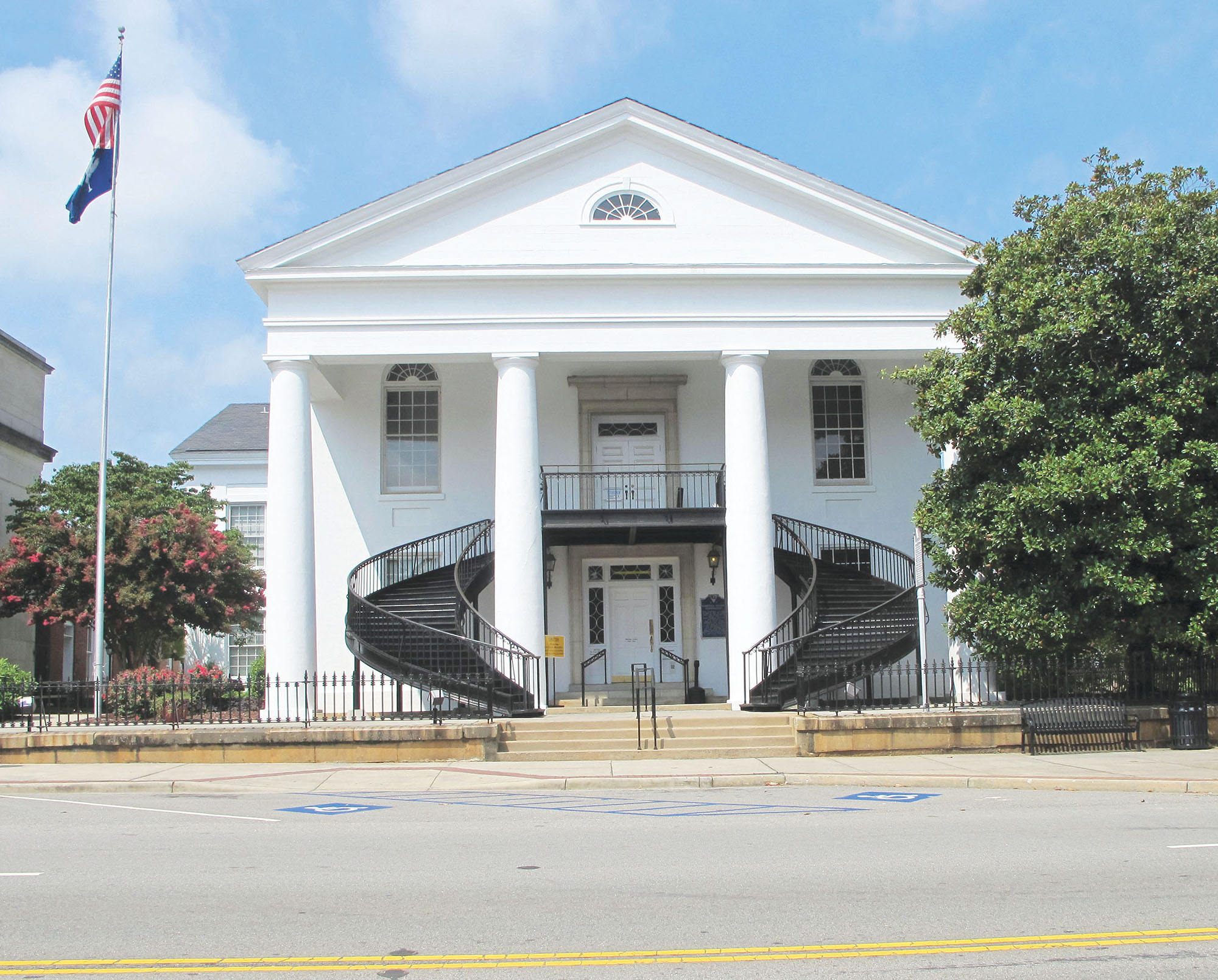
    FF Courthouse copyWINNSBORO (Aug. 25, 2016) – With a light agenda Tuesday night, the most interesting discussion of the meeting happened during County Council Time on the new hot topic in the County – whether to build or not to build a new Courthouse, and what to do with the current historic Robert Mills Courthouse if the County decides to build a new one.

    Acting on a tip from a concerned Fairfield County citizen, WLTX-Channel 19 aired a short news spot on the subject last Friday evening. Councilman Billy Smith (District 7), who was interviewed for the program, said he posted a link to the station’s story on his Facebook page and it lit up with more than 6,000 views and 1,400 clicks.

    Citizen interest in the Courthouse conundrum picked up last June after an Ad Hoc Committee for the temporary relocation of the Courthouse, made up of Council Chairwoman Carolyn Robinson (District 2) and Council members Kamau Marcharia (District 4) and Dan Ruff (District 1), voted to recommend that Council build a new Courthouse on S. Congress Street in downtown Winnsboro on land the County owns. That property is a vacant lot next to First Citizen’s Bank. A week later, full Council voted to ask County Administrator Jason Taylor to look into the feasibility of the Committee’s recommendation.

    That didn’t sit well with some in the community who worried about what would happen to the current Robert Mills Court House.

    On Tuesday evening, Smith suggested an alternative to the vacant lot location.

    “What would it cost us to renovate Mt. Zion for the temporary Courthouse?” Smith asked. “This is something we would need to talk to the Town of Winnsboro about and contact some firms about just as we are with the new facility on S. Congress to get some estimates. While we’re still in the discovery phase, I’d like us to look at all our options. If we’re looking at some of the figures I’ve heard to construct a new facility, I think it would behoove us to at least look into Mt. Zion. Before we move forward on something else, I’d like to at least find out if Mt. Zion is a viable option.”

    Smith’s proposal followed Chairwoman Robinson’s comment that Council, earlier this summer, obtained permission from the Clerk of Court, 6th Circuit Court Judge Brian Gibbons and Chief Justice of the Supreme Court Don Beatty to locate a new Courthouse building on S. Congress Street. She then asked Deputy Administrator Davis Anderson to update the audience on the history of the current plans to renovate the Courthouse, which were initiated in February of 2011.

    According to the renovation timeline, by March of 2014, consultants Mead & Hunt had recommended the Council renovate the HON building to accommodate a temporary Courthouse while the Robert Mills Courthouse in downtown Winnsboro is renovated. But the $3.5 million price tag on the renovation of a building the County would leave behind after about two years was rejected by the current Council in September 2015.

    The current Courthouse, designed by Robert Mills and built in 1823-1824, has major mechanical and environmental problems, Robinson said. The air conditioning system in the building is 50 years old and is prone to growing mold. Robinson pointed out that, for all his historic grandeur and value, the building doesn’t have adequate wiring for all the computers and electrical needs of a modern Courthouse.

    “That’s where we are,” Robinson said as she concluded the timetable.

    Ruff agreed with Smith.

    “I think we need to look at all options,” Ruff said. “I’d like to hear from people who come up with ideas we may not have looked at. This is a big deal and we need to take our time and be diligent about this.

    Sunday Alcohol Sales

    Council continued to fast track Sunday alcohol sales in Fairfield County by passing second reading to determine whether the S.C. Department of Revenue may issue temporary permits to allow the sale of alcoholic beverages for on-premises consumption and beer and wine at permitted off-premises locations on Sundays in the unincorporated area. Council must pass third reading by Sept. 9 in order to have the Sunday alcoholic sales on the Nov. 8 ballot.

    Rezoning Properties

    Council passed second reading to reclassify property owned by Tammy C. Faile at 547 Miles Road in Great Falls from B-2 (General Business District) to RD-1 (Rural Residential District). It also passed second reading to reclassify property owned by Danny Holt at 1922 State Highway 34 East in Winnsboro from I-1 (Industrial District) to RD-1 (Rural Residential District.

    Purchases

    Council voted to purchase five stretchers for EMS at a total price of $67,067.98; a 2017 Chevrolet Tahoe PPV, 4×4 SUV (EMS) for $37,108.00 and three 2017 Chevrolet Caprices at a total cost of $40,058.46 for each vehicle.

    Council passed a resolution for Enhanced Rail Passenger Service in support of transportation options for the state and it also voted to approve an agreement between Fairfield County Council and Fairfield County Sheriff’s Office supporting the Sheriff’s Office to obtain goods at no cost from the state/federal military surplus to include armored vehicles and/or Humvees as needed.


  • County Council Grapples with Community Grants

    WINNSBORO (Aug. 18, 2016) – Community Enhancement Grants, which were terminated by County Council last year, came under fire again last week during a Council work session; not only from some Council members but from the County’s financial staff as well.

    Comptroller Laura Johnson reported that many who received the grants either did not turn in their receipts or turned in ‘bogus’ receipts that did not match how the money was to be used, causing staff extra work and stress.

    “I tried to do my best to call and leave messages (to get the receipts),” Johnson told Council. “In 2015 Council gave the $500 grants out first, then when we asked for the receipts, that was very difficult. I called people five and six times and that was a lot of work.”

    After the County started asking for receipts before actually giving out the money, collecting the receipts put her staff in a difficult position, Johnson said.

    “We found ourselves having to justify why we could not reimburse them,” she said. “Sometimes they became angry and they tried to justify why their receipts did not match the use on the application when it’s clear they didn’t match.”

    While the grants were discontinued last year, the County has continued to earmark $2,500 per district ($17,500 total) for “the support of community based programs that develop or promote the improvement of quality of life activities for youth, adults and seniors.” But the application process itself has been on hold.

    “The way we left it, is we would come back and try to fine tune it this year,” Councilwoman Mary Lynn Kinley (District 6) said.

    Kinley, who said she is in favor of reinstating the $500 grants, suggested funneling the money to churches and other organizations to purchase school supplies or to provide assistance to individuals in the community who volunteer with youth and the elderly. Kinley took a dim view of requiring recipients of the grants to organizations that have 501(c)3 status.

    “I don’t know that we can just give money to private individuals,” Councilman Billy Smith (District 7) told Council. “I think we’d need to check with the County attorney about that. I really think this (the grants program) is not something we should move forward on. I just found out about this meeting at noon yesterday and I appreciate the financial staff putting together this fact sheet (a report on the pros and cons of the grant program in past years). We need to base our decisions on sound factual information, not politics.”

    Smith read a list of organizations in the county to which he said the County government already provides almost $1 million each year.

    “Currently, these allocations make up right at four percent of our annual budget. I term this program ‘incumbent campaign enhancement grants,’” Smith said. “I think it is political and campaign based. If it weren’t, then why do we care which district the money goes to?”

    “It sounds like some bigotry going on here with the churches and stuff,” Councilman Kamau Marcharia (District 4) told Council members. “I think when we give money to the churches to help the youth, it keeps them off the street. We have a bad disposition with our youth and our police officers in this country, county and state. We need to help these young folks be more mindful and responsible for what they are doing. You don’t do that by slamming the door and not doing anything for them in rural areas where they never have the opportunity to see the ocean, the mountains or just travel the state.”

    He also questioned why the program had come under fire the last two years.

    “We’ve been doing this for the last six – seven years, and never had a problem with it till the last two years. Never a problem. . . . I would like to see those accusations about receipts,” Marcharia said.

    Johnson explained that prior to the last two years, receipts were not required.

    “There was no application process,” Smith said. “The money was in the discretionary fund and Council members gave the money out in their districts. So there were no complaints. The only ones who knew what was being given were the Council member and the group receiving it. No one was complaining.”

    “Two years ago Council began requiring receipts,” Johnson said. “The $500 would be awarded, then the receipts had to be turned in by March 30. The next year Council required the receipts to be turned in before the grant money was given out.”

    Johnson said last year $17,500 was set aside for grants, 22 organizations applied for grants and Council approved funding for 16 of those. But she said only 10 were reimbursed for their expenditures because the applicants either did not turn in receipts or their receipts were not in compliance with the ordinance.

    Johnson said one organization applied for a grant in 2015 for a health and welfare project.

    “They were approved for $500 based on turning in their receipts for what they said they were going to use the money for,” Johnson said. “The receipts were for biscuits for a devotional service, for attending a gospel program and eating dinner at Fatz Café. I sent a denial and spent 30 minutes on the phone with a representative from that organization. They got pretty heated. I’m sorry, but I finally said, ‘I don’t know how biscuits at McDonald’s is healthy. Eating at Fatz Café and going to a gospel meeting are not health and welfare.”

    “I was on the phone from 5 to 7 with another organization for the same thing,” Johnson said. “We have to check the dates on receipts because some are old, not even in the fiscal year. We have to go through each receipt to be sure if it’s in line with the application.”

    “I would be interested to know how much salary and time our staff spends in addition to the $500 grant,” Smith said. “If we stuck to school supplies, I think we could all be agreeable, but if we are only doing school supplies, why couldn’t the County just buy it in bulk, saving us a lot of money. And it would not look like it’s coming from a Council member in that district as a campaign tactic.”

    County Administrator Jason Taylor said he would be in favor of the County purchasing the supplies and then letting the schools determine which children are in need.

    “While the goals of this program are honorable, it’s just not working. If we buy backpacks and fill them with school supplies, that could more efficiently accomplish what we are trying to accomplish,” Taylor said. “Applying for grants as they are doing now is causing us a lot of work in the process. Streamline it and cut to the chase. Give them school supplies.”

    Councilman Marion Robinson (District 5) said he couldn’t support the grants as they were handled in the past, but wanted to hear how other counties might be handling things like this.

    “Our staff should not be spending time and money playing nursemaid when we’re trying to give someone free money,” Robinson said.

    Marcharia made one last stand for the application based process.

    “I think churches have more of a personal contact and would know if they need backpacks, pencils or what,” Marcharia said. “You don’t just buy in bulk and say here, come get it.”

    Kinley suggested that the school district be asked “to put some money in the pot, too,” for the supplies.

    Asked by Chairwoman Carolyn Robinson (District 2) when they wanted to resolve the issue, Johnson suggested by June 30 of next year because she said there is a lot of work to do to change the application process.

    “I’d say after the November election,” Smith said. “I don’t want it to be a campaign thing.”

    “It’s going to be a campaign thing,” said Marcharia, who is running for re-election in November.


  • Rezoning Vote Creates Confusion

    RIDGEWAY (Aug. 18, 2016) – There was a motion. There was a second. And there was a 3-2 vote by Town Council on Aug. 11 to approve Russ Brown’s request to rezone .82 acres at the fork of Highway 21 and Highway 34 from residential to commercial.

    But as of press time, it was unclear whether or not Brown’s request actually passed.

    Just in case, Herbert Robertson and Robert E. Johnson, who live near the property, sent the Town a letter protesting the rezoning that may or may not have passed on Aug. 11.

    “Opposite side of the tracks. That’s the only thing that’s different between Russ Brown here and the rest of us in attendance,” Sara Robertson, another nearby resident, told Council during the public comment segment of the Aug. 11 meeting. “We, just like Mr. Brown, are hardworking individuals, and we’re trying to protect and maximize our return on our investment, just like he is. However, to have our own Town Council to once again entertain this request to rezone this small parcel of land for one individual at the expense of a whole neighborhood is very disturbing.”

    Robertson presented Council with a petition that she said contained the signatures of 50 people who were opposed to Brown’s rezoning request. But Brown, during his turn at the podium, said the time for opposition to his request was during the Planning and Zoning Commission’s July 12 public hearing. The Commission voted to recommend Brown’s request for C-2 zoning on a 5-2 vote.

    “There was zero opposition at that meeting. It was posted in the paper and a sign was on site,” Brown told Council. “The opportunity to come to the meeting was there.”

    But Robertson pointed out that the Commission had strayed from the Town’s zoning ordinances by recommending the C-2 classification. Indeed, according to Article 10, Section 1007, only the Council or the Commission – not an individual – can initiate a zoning change of a lot less than 2 acres. The exceptions being for the extension of existing district boundaries or the addition of C-1 zoning contiguous to existing I-1 zones.

    Patty Cookendorfer, Zoning Administrator, told Council the oversight was discovered during a Planning and Zoning workshop held two weeks after the public hearing.

    Mayor Charlene Herring said “several missteps” had occurred during the process. Those included, she said, an error on the sign posted on Brown’s property. The sign, she said, reflected a request for C-1, not C-2 zoning.

    “I know there’s been a little bit of question about the sign itself, being C-1 or whether it was C-2,” Brown said during his comments, “but at the same time, the zoning change was posted as commercial. Obviously, you knew it wasn’t a request to keep it residential.”

    Herring also noted the minimum lot size requirement of a C-2 request, as well as the petition in protest of the zoning change, both of which caused some confusion.

    According to Article 10, Section 1005, “In case of a protest against any proposed zoning change signed by the owners of 20 percent or more of the area of (a) the lots included in such proposed change, and (b) those lots contiguous to the area in question, such amendment shall not become effective except by the favorable vote of three-fourths of all the members of town council.”

    “What does this mean?” Herring asked Council. “Is it (contiguous) something that is right next to (a property)?”

    Councilwoman Angela Harrison said the Town’s ordinances indicated that the meaning of “contiguous” was “properties in the area;” however, a review of the Town’s zoning ordinances reveals no such definition. In fact, while the ordinances define many terms included within, there is no definition at all for “contiguous.”

    The ordinances do say that “Where words have not been defined, the standard dictionary definition shall prevail.”

    The standard dictionary definition for “contiguous” is “touching; in contact.” The second listed definition, meanwhile, is “in close proximity without actually touching; near.”

    “I’m a little bit confused by our own zoning ordinances,” Herring admitted. “I thought I understood them, but I don’t know that I really do.”

    Herring suggested that Council table the request until a lawyer could interpret the ordinances for them.

    Councilman Heath Cookendorfer reminded Council that the Commission’s role was only an advisory one, and he moved to approve a C-1 zoning for Brown, which he said would still fit Brown’s needs but would get around the 2-acre minimum lot size that a C-2 would require.

    Doug Porter seconded the motion, which carried 3-2. Harrison and Herring voted against the request.

    But Harrison said because there was a protest, the request needed a three-fourths vote to carry.

    “What is three-fourths of the (five-member) Council?” Herring asked.

    According to the S.C. Municipal Association, three-fourths of a five-member council is four.

    “That’s the reason I wanted to have a lawyer look at this,” Herring said.

    The protest letter sent to the Town on Aug. 12 called Council’s decision “unlawful” and said the 3-2 vote was invalid. According to the Town’s zoning ordinances, the appeal must first go to the Board of Zoning Appeals within 30 days. The Board must then hold a hearing. The appeal may also go directly to Circuit Court.

    “If they can’t see past getting this lot rezoned they might as well put a wall up around town,” Brown said this week. “Growth is coming to Ridgeway.”


  • County Council grapples with community grants

    WINNSBORO – Community Enhancement Grants, which were terminated by County Council last year, came under fire again last week when they were revisited during a Council work session; not only from some Council members but from the County’s financial staff as well.

    Comptroller Laura Johnson presented a ‘pros and cons’ report that described the previous application process approved by Council in 2015 as challenging for her staff.

    According to Johnson, approved applicants were given $500 grants. After they spent the money they were to turn in their receipts  for the purchases.

    “But when we asked for the receipts, that was very difficult. I had to call people five and six times. It was a lot of work.”

    She said the next year Council required receipts to be turned in before the grant money was given out. Johnson said many applicants who were approved for grants either did not turn in their receipts or turned in ‘bogus’ receipts that did not match how the money was to be used, causing staff extra work and stress.

    “I tried to do my best to call and leave messages,” Johnson told Council. “But we found ourselves having to justify why we could not reimburse them. Sometimes they became angry trying to justify why their receipts did not match the use on the application when it’s clear they didn’t match.”

    While the County earmarked $2,500 per district ($17,500 total) last year for “the support of community based programs that develop or promote the improvement of quality of life activities for youth, adults and seniors,” the application process itself is on hold.

    “The way we left it, is we would come back and try to fine tune it this year,” Councilwoman Mary Lynn Kinley (District 6) said.

    Kinley, said she is in favor of reinstating the $500 grants to churches and other organizations to purchase school supplies or to provide assistance to individuals in the community who volunteer with the youth and the elderly.

    Councilman Billy Smith (District 7) told Council, “I really think this (the grants program) is not something we should move forward on. I just found out about this meeting at noon yesterday and I appreciate the financial staff putting together this fact sheet (the pros and cons report). We need to base our decisions on sound factual information, not politics.” He went on to explain, “I think it is political and campaign based. If it weren’t, then why do we care which district the money goes to?”

    Smith read a list of organizations to which he said the County government already provides almost $1 million or almost four percent of the general fund each year.

    “It sounds like some bigotry going on here with the churches and stuff,” Councilman Kamau Marcharia (District 4) told Council members. “I think when we give money to the churches to help the youth, it keeps them off the street. We have a bad disposition with our youth and our police officers in this country, county and state. We need to help these young folks be more mindful and responsible for what they are doing. You don’t do that by slamming the door and not doing anything for them in rural areas where they never have the opportunity to see the ocean, the mountains or just travel the state.”

    He also questioned why the program had come under fire the last two years.

    “We’ve been doing this for the last six – seven years, and never had a problem with it till the last two years. Never a problem. . . I would like to see those accusations about receipts,” Marcharia said.

    Johnson explained that prior to the last two years, receipts were not required.

    “There was no application process,” Smith explained. “The money was in the discretionary fund and Council members gave the money out in their districts. So there were no complaints.”

    Johnson said Council set aside $17,500 for grants last year.

    “Twenty-two organizations applied for grants, and Council approved funding for 16 of those. But only 10 applicants were reimbursed for their expenditures because the other applicants either did not turn in receipts or their receipts were not in compliance (with the ordinance),” she said.

    Johnson gave as an example an organization that received a $500 grant for a health and welfare project.

    “The receipts were for biscuits for a devotional service, for attending a gospel program and eating dinner at Fatz Café,” Johnson said. “I sent a denial and spent 30 minutes on the phone with a representative from that organization. They got pretty heated. I’m sorry, but I don’t know how biscuits at McDonald’s are healthy. Eating at Fatz Café and going to a gospel meeting are not health and welfare.”

    “I would be interested to know how much salary and time our staff spends in addition to the $500 grant money,” Smith said. “If we stuck to school supplies, I think we could all be agreeable, but if we are only doing school supplies, why couldn’t the County just buy that in bulk, saving us a lot of money. And it would not look like it’s coming from a Council member in that district as a campaign tactic.”

    County Administrator Jason Taylor said he would be in favor of the County purchasing the supplies in bulk and then letting the schools determine which children are in need.

    “While the goals of this program are honorable, it’s just not working. If we buy backpacks and fill them with school supplies, that could more efficiently accomplish what we are trying to do,” Taylor said.

    Councilman Marion Robinson (District 5) said he couldn’t support the grants as they were handled in the past, but told Taylor he wanted to hear how other counties might be handling things like this.

    Marcharia made one last stand for the application-based process.

    “I think churches have more of a personal contact and would know if they need backpacks, pencils or what,” Marcharia said. “You don’t just buy in bulk and say here, come get it.”

    Kinley suggested that the school district be asked “to put some money in the pot, too,” for the supplies.

    Asked by Chairwoman Carolyn Robinson (District 2) for a timetable for resolving the issue, Johnson suggested by June 30 of next year because she said there is a lot of work to do to change the application process.

    “I’d say after the November election,” Smith added. “I don’t want it to be a campaign thing.”

    “It’s going to be a campaign thing,” said Marcharia, who is running for re-election in November.