Category: Government

  • Tax Notices on the Way

    WINNSBORO (Dec. 1, 2016) – Forget to pay your property taxes? Hoping to get a good deal because someone else did? Then next week is your first opportunity to settle up or clean up as Fairfield County’s delinquent tax notices make their first run in The Independent Voice.

    Approximately 600 listing of properties will appear next week in these pages and will run for two more weeks after. Property owners with outstanding bills will have this chance to make good with the Tax Man. But about three weeks after the final run of the notices in The Voice, the Auctioneer takes over.

    That’s when savvy fortune hunters will have the opportunity to bid at the County Courthouse on properties whose owners did not pay The Man. Winning bidders will see their money go into an escrow account where it will earn interest for one year. Delinquent property owners will have that year to come up with those back taxes. If they do, the winning bidder keeps the interest. If not, the winning bidder becomes the new property owner.

    Just like a late-night T.V. infomercial.

    So make sure to pick up next week’s edition of The Independent Voice to find your property or find your best deal. Notices will appear in the Dec. 8, Dec. 15 and Dec. 22 editions.


  • Sno-Ball Rezoning Fails

    BLYTHEWOOD (Dec. 1, 2016) – Rimer Pond Road residents and their neighbors live to fight (commercial zoning) again.

    On Monday night, Council voted 5-0 in support of the residents who spoke out against a request by Pelican Sno-Balls for Multi-Neighborhood Commercial zoning (MC) at 10711 Wilson Blvd., at the entrance to Rimer Pond Road.

    The MC zoning designation would have allowed not only the ice treat store, but a myriad of other retail business uses, including convenience stores, beer and wine sales, apartment buildings and, under certain conditions, service stations. The property, which is surrounded by Rural (RU) zoning, is currently zoned for office use and was most recently occupied by the 3-G Windows and Doors office.

    “We continue to show up here to speak out against commercial zoning in our neighborhood,” Rimer Pond Road resident Trey Hair said during citizen testimony regarding action items on the agenda. “The Town Hall has already stood up against Pelican locating in the Town Center based on its (franchise’s) brightly colored buildings. But more important to us is the zoning change. We would be left with commercial zoning where we never wanted it.”

    David Whitner, who lives on Shoal Creek Road just off Rimer Pond Road, agreed.

    “Keep it rural,” Whitner said. “That type of zoning is not something we want to see in our neighborhood.”

    “We are opposed to this up-zoning near our road because it will progress and the up-zoning will rapidly be out of your hands,” Michael Watts told Council members.

    Other residents, including those from Dawson’s Creek neighborhood which is located behind the property up for re-zoning, voiced similar opinions.

    Pelican owner Brian Keller also addressed Council saying he owns Pelican stores in Elgin and Spring Valley and that both are extremely popular. While Keller he said he had talked to a lot of people on Rimer Pond Road who were in favor of his business opening in the area, he lamented that none of those residents showed up at the meeting.

    While Keller acknowledged that a main objection from the Board of Architectural Review, Town Hall and neighbors in the area of the property up for re-zoning, had to do with the bright blue, purple and pink colors used by the Pelican franchise on its buildings and signs, he told Council that he was 100 percent sure the franchise would agree to tone the colors down if he could first get the MC zoning passed.

    Councilman Eddie Baughman brought the focus back to zoning, pointing out that MC zoning allows apartment buildings like the ones going up in Blythewood.

    “With MC zoning, we could be allowing an apartment building to go up right outside of the town,” he said.

    Councilman Tom Utroska agreed.

    “When you change the zoning,” Utroska said, “you can’t just change it right back.”

    While Councilman Larry Griffin, a proponent of growth, suggested that if there had never been any zoning changes in the town, residents might not have some of the things they enjoy today, he said he was torn on how to cast his vote.

    “How much and where do we want that growth to go and what do we want it to look like is the real question,” Griffin asked.

    “I think you’ve hit it right on the head,” Mayor J. Michael Ross said to Griffin. “As I look at it, it’s not, ‘Do we want a Pelican Sno-Balls store?’ It’s a zoning map and zoning district classification that would allow this type of business, but it would also allow a lot of others. So are we ready to do that down that close to Rimer Pond Road? So, when I cast my vote, it’s not against Pelican Sno-Balls, but are we ready to start what might be an entire commercial development down on Highway 21 right in front of the entrance to Rimer Pond Road?”

    Ross also said he was sorry that the Town Center District would not accommodate the Pelican store, “but we have regulations as to what we want (the town) to look like,” he added.

    Turning to Griffin, Ross said, “I think you said exactly what we are voting on – whether or not we will open this up to allow this type of business or other businesses like this business in that area.”

    On a verbal roll call, Council members unanimously rejected the MC zoning request.

    Historic Designation of Academy

    Council voted 4-1 to designate the interiors of Blythewood Academy’s auditorium and gymnasium as historic features of those already designated historic structures. Council also recommended changing the classification of both buildings from Class II to Class I structures. The change requires the building’s owner (Richland 2 School District) to get prior approval from the Town’s Board of Architectural Review before making any changes to the buildings.

    Utroska was the lone dissenting vote, suggesting that it might be inappropriate for the Town to control what could be done with the interior of the building.

    Jack Carter, Director of Operations for Richland 2, addressed Council to confirm that the District is fine with the changes.

    YMCA Use of Doko Park

    Council unanimously approved an ordinance granting a license to the YMCA for the use of the soccer fields in Doko Meadows during certain hours of certain days with the specification that the regular $15 hourly rate would be prorated for additional hours used.

    Amphitheater Bid Approval
    Unanimous approval was given to accept the low base bid by AOS Contractors ($415,893) to construct an amphitheater stage, pavilion structure and concrete pad in front of the stage. While Digging Deep Construction submitted the lowest bid for both the base bid and the alternates (installation of interior radial sidewalks that connect to the road and handicap parking areas), Utroska suggested that the Town stay within their budget for now and go with the work that could be completed with the base bid.

    Chamber Holiday Party Sponsorship

    Council voted 4-1 to spend $400 to sponsor a table (6 tickets) for the Blythewood Chamber of Commerce’s holiday party on Dec. 9. Utroska voted against.

    A-TAX Approvals

    Council voted unanimously in favor of the A-Tax Committee’s decision to approve $6,496 for the Town’s Christmas Parade, which is being organized this year by volunteers from the Transfiguration Catholic Church and the Knights of Columbus, and $20,000 for the Diamond Invitation Baseball Tournament in March.


  • County OK’s CDBG Priorities

    Chairwoman: Strategic Plan Grammatical Mess

    WINNSBORO (Dec. 1, 2016) – Although the deadline was extended not once, but twice, County Grants Coordinator Steven Gaither told County Council Monday night that only about 700 people had responded to the recently completed Community Development Block Grants (CDBG) Needs Assessment Survey.

    Nevertheless, Gaither presented Council with the survey’s findings and asked Council to approve the survey and rank the priorities so the County would be ready for 2017 grant funds.

    Prior to Gaither’s presentation, Ridgeway resident Randy Bright said during the first public comment segment of the meeting that he didn’t think the survey was promoted very well.

    “In talking to the population at-large, I didn’t find that many people were aware of it, so I would like to hear what sort of participation we got out of this,” Bright said. “It wasn’t even working the first time I tried it (on the County’s website). We have a survey, it doesn’t work and then it’s halfway fixed, and not many people know about the survey; we want good democracy, we want to satisfy the will of the people.”

    Economic development topped the survey’s priority list, Gaither said, with an emphasis on job creation and job retention in the county.

    Infrastructure, specifically water and sewer, was second on the list.

    “Water is not a luxury, it’s a necessity,” Gaither said. “Everyone needs it.”

    Third on the list, Gaither said, was the apparent need for a multi-use community facility in the county, one available to young people and senior citizens, as well as people with disabilities and special needs.

    Responding to a question from District 7 Councilman Billy Smith, Gaither said Council would have to approve the results of the survey by the end of the year at the latest in order for the County to be able to qualify for 2017 CDBG grants.

    “We need a vote from Council ranking the top priorities that Fairfield has pursuing CDBG grants,” County Administrator Jason Taylor told Council. “As it’s laid out right now, economic development is the first priority, infrastructure is second and public facilities is third. Council is not bound to that, but we do need a vote by Council at some point ranking their priorities.”

    Although a motion and a second were put forward to accept the results, Smith said he would like to wait until Council’s Dec. 12 meeting to accept the findings.

    “This is the first time we’ve seen this,” Smith said. “We haven’t had a chance to look at this yet, so if the members who motioned and seconded it would be willing to pull that back until our next meeting, I think that would be appropriate for us to move forward.”

    But Councilman Kamau Marcharia (District 4) said the information in the survey was actually nothing new to Council.

    “I haven’t looked at it either, or the details, but these are subjects we have been discussing,” Marcharia said. “Unless it’s been changed in any kind of way, we should be thoroughly familiar with the three things that have been offered.”

    Council approved the findings 6-1, with Smith voting Nay.

    Strategic Plan

    Speaking during the second public comment portion of the evening, Bright asked Council to formulate a plan of attack before proceeding with execution of their latest Strategic Plan.

    “I think one of the problems in the past with our surveys and our strategic plans is we really didn’t plan to execute it,” Bright said. “We couldn’t quite figure it out. I’ve got a lot more confidence in this Council in doing that, but I would like to see us move forward to making plans so that we set forth goals and strategies before we start delving out into the plan.”

    Chairwoman Carolyn Robinson (District 2) said that at the moment, the County is struggling with T.Y. Lin International to get a copy of the plan that isn’t filled with errors and omissions.

    “There’s a lot of verbiage in there, a lot of comments – a lot of mistakes,” Robinson said. “Blythewood does not sit in the county of Fairfield. So many of our commerce department stuff that we have in industry in our parks was not listed. Misspelled it. I’m just going to tell you straight up: I told him (David Gjertson of T.Y. Lin) a couple of weeks ago when he was here going through it, if I were his English teacher he would have a zero on that whole thing, because when I marked it up I had more yellow marks in it than there were black marks. That’s a sad state of a report to come to us, for that much time to have been spent with it.

    “We paid too much money for that,” Robinson said, “and the least they could do is hire somebody to spell check. ‘Barrier’ – B-A-R-R-E-I-E-R. You find those kinds of things in there – most unacceptable for a county that is paying you to do a report.”


  • Cobblestone Residents Reach Boiling Point

    BLYTHEWOOD (Dec. 1, 2016) – A group of 50 or so Cobblestone Park residents unleashed their fury on Town Council Monday evening for having amended zoning in March 2015 to allow developer D.R. Horton to add 143 additional homes and six roads to the Primrose section of Cobblestone Park.

    Residents speaking at the meeting said the recently initiated development was a surprise to them and is destroying green space that Horton sales representatives promised (when they purchased their homes in 2014 and 2015) would be preserved. Some said they paid premiums of up to $20,000 for those lots, but that the developer’s promises are not in writing.

    One after another, residents told Council that the developer is now clearcutting trees, leaving the neighborhood open to noise pollution from I-77, blasting rock near their homes to carve out spaces for foundations for the new homes, destroying the current residents’ privacy from I-77 and other homes and leaving the current infrastructure vulnerable to increased traffic and seeping ground water.

    The residents’ angst over the construction and road expansion was matched only by their angst with three Cobblestone Park neighbors who sat on Council at the time of the zoning amendment. Two of those Councilmen – Tom Utroska and Bob Mangone – voted to allow the new development.

    The third Council member/neighbor, Mayor J. Michael Ross, was required by the S.C. Ethics Commission to recuse himself from voting since he owned a lot in the area affected by the rezoning. Also worrisome to the neighbors was the fact that the three sitting Councilmen lived in the front of the neighborhood while those affected by the rezoning live in the back section.

    The Town’s attorney, Jim Meggs, defended the Councilmen, saying that all three requested a decision from the S.C. Ethics Commission and were advised that Utroska and Mangone, who has since moved away, were not subject to recusal.

    Resident Madelyn Mills told Meggs that the residents’ own attorney informed them that he believed the two Councilmen should have recused themselves.

    Meggs asked Mills to have their attorney call him, saying that he (Meggs) felt her passion.

    “You do not feel my passion,” Mills shot back. “You can’t possibly feel my passion. You can’t possibly know how we feel.”

    Mills, fighting back tears, also said the group’s attorney believes Council’s executive session for ‘legal matters’ at the April 26 meeting prior to the vote for the rezoning was illegal.

    Following the meeting, Cobblestone Park resident Lenore Zedosky handed The Voice a copy of a letter she sent to Council dated Nov. 18, that drove home Mill’s assertion. The letter stated, “The S.C. Freedom of Information Act (gives) limited reasons why the Council may hold a meeting closed to the public (executive session). A discussion of D.R. Horton’s request to build more houses in the subdivision, even though he was lessening the total residences by eliminating townhouses, does not fall within any of those reasons.”

    Mills also expressed worry that the blasting being carried out by D.R. Horton near their homes could affect their homes’ foundations.

    “On April 26, you opened a can of worms that is affecting us, not the people at the front (of the neighborhood),” resident Doug Shay told Council. “I couldn’t sleep last night because of the noise from I-77.”

    Resident Phil Orr reviewed for Council a list of multimillion dollar court cases nationwide that he said Horton had recently lost or settled because of problems similar to those in Cobblestone Park. He said the group is now going to reach out for help from the Governor’s office, the S.C. Attorney General’s office, area TV stations and other local and statewide organizations.

    “But,” he told Council, “you have the unique opportunity to right the wrong of the proposed expansion of new homes in areas that were promised to remain as undeveloped green space in our neighborhood.”

    The most stinging rebuke came from resident Joe Lupia who accused Council members of a quid pro quo in connection with a wetlands he said exists in the area where Horton plans to build the homes.

    “How did it get from a wetlands to 143 homes?” Lupia asked, “What did the Town of Blythewood get for this?”

    Lupia also said the Town should try to find out whether the stone being blasted in his neighborhood is Serpentine rock which produces asphalt when exploded.

    “It could be,” Lupia said.

    While speakers during public testimony are usually limited to three minutes, none of the several Cobblestone Park speakers were interrupted, with some speaking up to 10 minutes.

    Following their presentations, Ross thanked his neighbors for their comments, saying simply, “We hear you.”

    Asked following the meeting if there was any possibility that Council could intervene in a process that had been set in motion by the April 2016 zoning amendment, Meggs said he would reserve his answer for his client (Council).

    “D.R. Horton must still come to the Planning Commission for preliminary plat approval,” Town Administrator Gary Parker said, “and the Commission can dictate road locations and interconnections and a few other things as stated in Chapter 153 of the Town Code.”

    Utroska told The Voice that he was doubtful Council would be able to reverse what is allowed by the current zoning.

    The next Council meeting is Dec. 19.


  • Pelican Requests Rezoning

    The Forest Acres franchise of Pelican Sno-Balls.
    The Forest Acres franchise of Pelican Sno-Balls.

    BLYTHEWOOD (Nov. 23, 2016) – A request to rezone a property on Wilson Boulevard near the intersection of Rimer Pond Road to Multi-Neighborhood Commercial (MC) to accommodate a Pelican Sno-Ball restaurant is on Town Council’s agenda Monday night, Nov. 28. It arrives on Council’s desk with a recommendation from the Planning Commission against the rezoning.

    The Commission voted 3-2 on Nov. 7 against recommending Pelican’s request for the more intense commercial zoning. Commissioners Michelle Kiedrowski and Sean Pilker, both Cobblestone Park residents, voted in favor of the commercial rezoning.

    When no residents were in attendance to speak against the rezoning, Commission Chairman Bryan Franklin asked Town Administrator Gary Parker if the neighbors had been notified of the rezoning request. Parker said they had not at that point.

    Commissioner Cynthia Shull asked what other commercial ventures would be permitted on that property if Pelican was granted the commercial rezoning and decided not to move there or later moved away. Town Planning Consultant Michael Criss explained that any business or recreation permitted outright in the Town’s MC zoning classification could occupy the property once it is rezoned. Buildings up to 20,000 square feet would be allowed outright for many kinds of businesses including drug stores, laundromats, grocery stores, stores selling beer and wine, convenience stores, dry cleaners and public recreation facilities as well as a myriad of other retail stores and restaurants. With a conditional vote from Council, gas stations, car washes and apartment buildings could be allowed. Hotels and motels could be permitted as special exceptions.

    Bryan Keller, owner of two ice specialty stores in Elgin and Columbia, had already appeared before the Board of Architectural Review (BAR) on Sept. 19 to find out if Board members would approve the use of several different bright colors on the exterior of the building the franchise hopes to rent at 10117 Wilson Blvd.

    Keller said he had been discouraged last year by Town Hall zoning officials from trying to open a Pelican’s Sno-Balls franchise in downtown Blythewood because of the company’s trademark bright purple, pink and blue building colors.

    Parker explained that the colors weren’t the only problem, that the business would also require a zoning change to at least MC if it locates on the Wilson Boulevard property. Several residents from nearby Rimer Pond Road who oppose commercial zoning in the area were in attendance.

    “It was made clear to us that the location in downtown was not going to happen,” Keller told the BAR. “So we’ve expanded our search (for a building).”

    That building is the former 3-G Windows and Doors building that was renovated about five years ago and operated under a Multi-Neighborhood Office zoning designation.

    BAR members who are charged with safeguarding the Town’s aesthetics, took a collective deep breath when Keller passed around photos of the proposed color options.

    “The 3-G building has a very nice renovation,” Board member David Shand pointed out, “and I think your color scheme would take away from the look.”

    After much discussion about the colors that all concerned agreed were garish, Matt Marcom, the Pelican Sno-Balls franchise representative, said there is some flexibility with color.

    “We can’t change the color scheme, but we can change where the colors go, the amount of color and saturation levels,” Macom said.

    “It is the gateway to the town and the entrance to Rimer Pond Road,” Board member Jim McLean reminded Keller. “I don’t think this Board can maintain its continuity and approve these colors.”

    Macom then said he could possibly get approval for a white building with only brightly colored trim, wall menus and signage.

    “I understand. What you’re trying to prevent is what we’re trying to bring in,” Macom said.

    The properties on all sides of the 3-G property are currently zoned Rural (RU). The Dawson’s Pond and Dawson’s Creek residential neighborhoods border the back side of the property.

    During public comment, Michael Watts said he and other Rimer Pond Road neighbors in attendance shared the Board’s concerns about the colors.

    “But our biggest concern is up-zoning the property to a more intense commercial zoning. We’re opposed to commercial zoning in this area,” Watts said.

    Town Council will meet at 7 p.m., at Doko Manor in the Town Park.


  • Board OK’s Education Foundation

    BLYTHEWOOD – During the Nov. 15 School Board meeting, Superintendent J.R. Green discussed his ongoing plans to construct teacher housing in Fairfield County and called on the Board to establish an Educational Foundation that, he told the Board previously, would benefit a teacher housing initiative in Fairfield County.

    At last week’s meeting, Green and Board member William Frick (District 6) talked about that benefit in terms of financing, spending about a half hour on a detailed report on how an apartment complex for teachers in North Carolina was financed at zero interest through an Educational Foundation.

    It appeared to be a snapshot of what could be done in Fairfield County and, at the end of the meeting, the Board voted 5-2 to establish the Educational Foundation. However, in an interview with The Voice earlier this week, Green said the zero-interest financing that made the North Carolina teacher housing financing possible is not available to the Fairfield County School District.

    During the meeting, Green reported that he and four Board members – Silvia Harrison (District 1), Henry Miller (District 2), the Rev. Carl Jackson Jr. (District 5) and Frick – traveled to Hertford, N.C. earlier this month to tour the apartment complex and find out more about the project and the financing.

    But Green was not specific that the type of financing used for the N.C. teacher housing could not be used for a teacher housing initiative in S.C.

    Frick explained the N.C. housing project’s financing process. He said it was not acquired by the Hertford School District, but by an Educational Foundation, a 501(c)3 charitable corporation, that is independent of the Hertford School District’s Board of Trustees. The Educational Foundation’s Board acquired the zero-interest financing from the N.C. State Employee Credit Union, which routed the funding through its own special foundation set up for the purpose of supporting such projects, Frick said.

    According to newspaper reports about the financing of the N.C. project, the Credit Union’s own foundation (not the Educational Foundation) holds the lien until the loan is repaid. The loan payments are made by the Education Foundation Board from rent it collects from the tenants.

    “The property the N.C. housing project sits on is owned by the school district, which rents it to the Educational Foundation for $1 per year,” Frick added, saying the school district pays the Educational Foundation $20,000 a year to manage and oversee the day-to-day operation of the housing project, including interviewing the housing applicants, collecting rent and calling the plumber for emergencies.

    Green said the Fairfield School District owns 90 acres between the District office and the high school and that if the teacher housing project is built there, only three or four of those acres would be used.

    Both Miller and Jackson said they were impressed with the N.C. project, noting that it was within walking distance of one of the schools.

    Frick said that another benefit of the Educational Foundation is that people who wish to make donations to the school district might be more encouraged to do so through the foundation.

    Annie McDaniel (District 4) asked how the chairman of the Hertford Educational Foundation Board was selected.

    Green said he was not sure, but guessed that, “the chair was appointed by some people affiliated with the (School) District and some people affiliated with the Foundation.”

    Green told the Board that he would want to appoint the Foundation’s Board members. He later told The Voice that the Board members will then elect their chairman and other officers.

    McDaniel also asked about the cost of applying for a 501(c)3 corporation.

    Green said the Fairfield County School Board would pay the approximately $1,000 cost, which would include attorney’s fees, for the Educational Foundation to apply for 501(c)3 status.

    When asked by McDaniel what role the School Board would play in the Educational Foundation, Green said it would have no role.

    Although discussion about the zero-interest financing for teacher housing in N.C. was lengthy, Green did not actually say that financing was being considered for Fairfield County teacher housing, nor did he identify another source of financing he might seek.

    The Board voted 5-2 to establish the Educational Foundation. McDaniel and Hartman voted against the measure.

    “I support an Education Foundation for Fairfield County School District, but there are a lot of questions that should be answered before we move forward to establish it,” McDaniel said.

    Earlier this week, The Voice asked Green if he was planning to seek the zero-interest type of credit union financing used in N.C. since that was not made clear at the meeting.

    “No. I am looking to do conventional financing through a traditional financial institution,” Green said.

    Green told The Voice that the N.C. financing package for the teacher apartment complex in Hertford is “very unique” and not available to the Fairfield School District or in S.C.

    “That situation in North Carolina is something that that particular credit union is doing to help transform education in their community. They are not doing it as a business to make a profit,” Green said.

    Asked what the relationship would be between the School District and the Educational Foundation, Green said they would be two separate entities.

    “The School District’s Board establishes the Foundation, but after that, the District has no oversight or control over the Foundation,” Green said, noting that the Foundation would obtain the financing and repay it to the loan institution out of the rental revenue. He said that, like any housing financing, the housing complex would be the collateral for the loan.

    Asked if Educational Foundations in S.C. can finance construction projects, Green said he thinks they can but did not know for sure. He said he would look in to it.

    Green said he was not familiar with any school districts (in S.C.) that have secured financing (like N. C.’s) through an Educational Foundation to construct teacher housing.

    “The circumstances are different here. It’s just not available in South Carolina,” he said.

    Green said the District’s attorneys are moving forward to set up the Educational Foundation for Fairfield County.

    Barbara Ball contributed to this story.


  • Amphitheater Tops Agenda

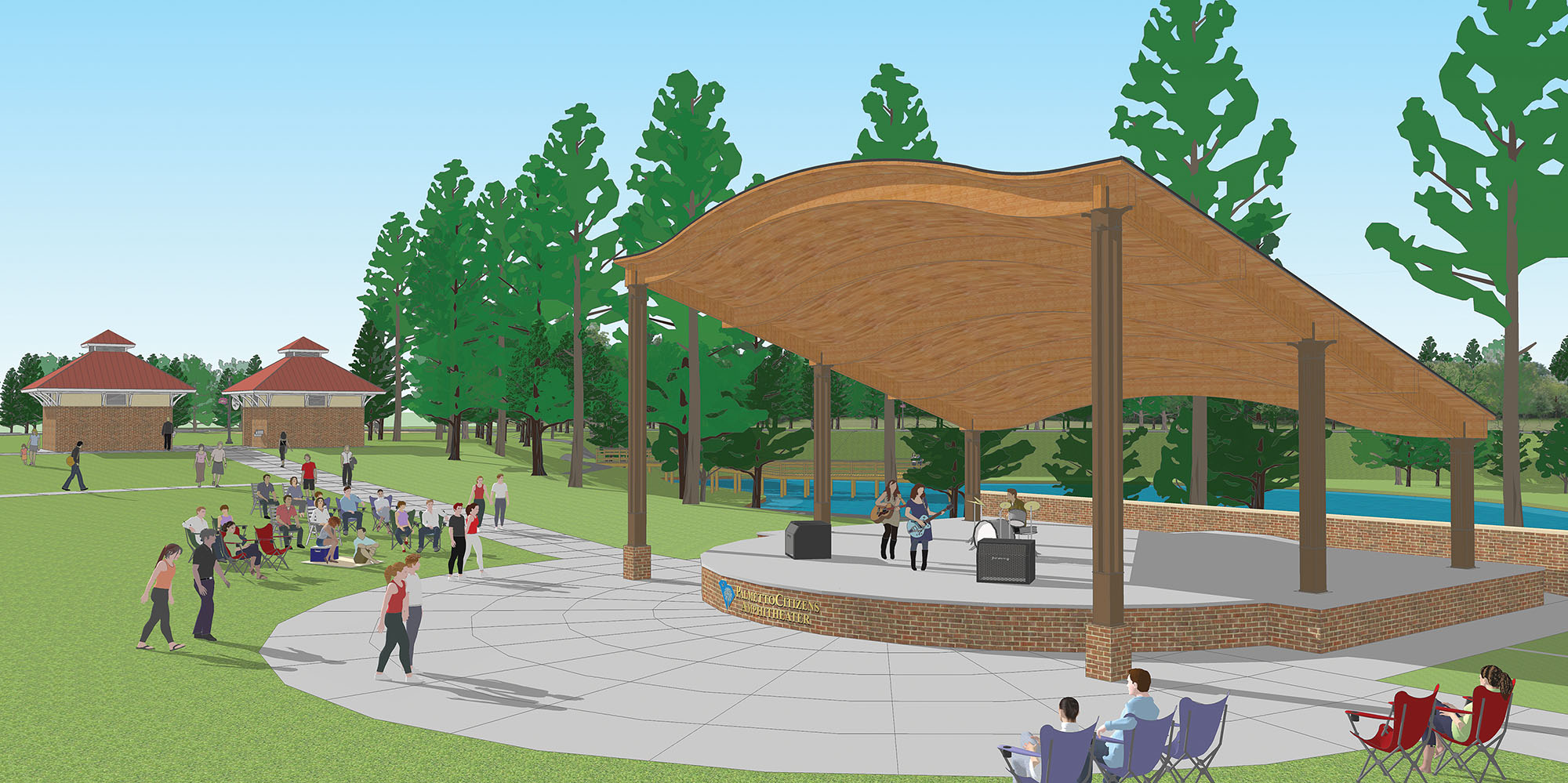
    Artist's rendering of the proposed amphitheater at Doko Meadows Park.
    Artist’s rendering of the proposed amphitheater at Doko Meadows Park.

    BLYTHEWOOD (Nov. 23, 2016) – After four bids were opened last September for construction of an amphitheater in Doko Meadows, Council has had several delays bringing the bids to a vote. That vote is expected to take place at Monday evening’s Council meeting.

    The base bid includes the amphitheater stage and pavilion and the concrete pad in front of the stage. The add alternate bid includes installation of the interior radial sidewalks that connect to the road and the handicap parking areas.

    The low base bid was submitted by AOS Contractors at $415,893. Their bid for the sidewalk alternative came in at $54,884, for a total of $470,777.

    The low bid for both the base bid and the add alternative was submitted by Digging Deep Construction. Their base bid came in at $426,900 with the alternative adding $40,280 to the price, for a total of $467,180.

    Rick McMackin’s Landplan Group South was selected by Town Council last June as the architect for the design of the proposed amphitheater and is responsible for site prep/demolition, grading, stage retaining walls, concrete stage pad, dance pad, electrical, sound, lighting, landscaping and oversight of the construction of the band shell. McMackin’s contract is for $383,820.

    Town Council gave its approval last May to an agreement with Palmetto Citizens Federal Credit Union for the right to name it the Palmetto Citizen’s Amphitheater. The nearly $400,000 band shell is funded with a grant and pledges from across the community, including $125,000 from the credit union for the naming rights and $25,000 from Fairfield Electric Cooperative.

    According to Town Administrator Gary Parker, the amphitheater, which is estimated to seat 2,000 to 3,000, is expected to be completed by mid-summer of 2017.


  • Parade, Tourney Get A-Tax Funds

    BLYTHEWOOD (Nov. 17, 2016) – The Accommodation Tax (A-Tax) Committee convened on Nov. 9 with only four members present – three of them newly appointed to the Committee – but enough for a quorum to hear two applicants seeking funds for the 2016 Blythewood Christmas Parade and the 2017 South Carolina Diamond Invitational baseball tournament.

    Paul Richter addressed the Committee on behalf of two groups that will be organizing the parade this year – the Knights of Columbus Council 13713 and the Transfiguration Church. Richter, a member of both groups, made the pitch for the parade, asking for $6,496, which he said should cover 80 percent of the parade’s expenses this year. The other 20 percent ($1,624), Richter said, is expected to come from entry fees, which are $25 per entry. Schools and elected officials are exempt from entry fees.

    Richter said the parade committee will come primarily from within the two organizations and that the parade will be returning to an all-volunteer cast of workers this year. Last year it was organized by the Blythewood Chamber of Commerce.

    There will be three levels of parade sponsorships – gold ($250), silver ($175) and bronze ($100). Richter explained that $3,000 of the A-Tax award from the Town had been budgeted for the purchase of sponsor gifts consisting of plaques, coasters and note cards from the State Museum.

    “The beneficiary of the sponsor proceeds will be the Christian Assistance Bridge (CAB),” Richter said. “They will receive all of the proceeds beyond the parade expenses.”

    Richter said he did not know how many sponsors to expect because the Chamber did not maintain a list of how many parade sponsors there were last year.

    The Committee unanimously approved the full $6,496 award.

    Rick Lucas, representing the 2017 South Carolina Diamond Invitational, requested a $20,000 A-Tax award, which he said would amount to 51 percent of the event’s revenue. Another $19,600 in revenue will come from entry fees, concessions, merchandise, admission and program advertisements for a total revenue of $39,600.

    Lucas said the tournament expects to spend $31,300 for lodging and meals for the teams, advertisement, promotion and other tournament expenses, leaving a net income of $8,300.

    Lucas said that the tournament exposes players to collegiate and professional scouts and is primarily a fundraising event for the Blythewood High School baseball program. Lucas said that 80 percent of the $20,000 requested will be directed back into local businesses.

    The Committee approved the full $20,000 award for the Invitational.


  • Council votes to rescind C1

    RIDGEWAY – As Russ Brown awaits the rezoning of .82 acres at the fork of highway 21 and 34 in downtown Ridgeway, Town Council last week, following their attorney’s instructions, rescinded their Aug. 11 vote to OK the rezoning and sent the request back to the Planning Commission for reconsideration.
    Brown’s request for rezoning from R1 to C2 cleared the Planning Commission 5-2 on July 12, but was amended by Council, with Brown’s approval, at their Aug. 11 meeting to a C1 request. That amended request passed first reading 3-2. Second reading, which came on the heels of a formal protest by nearby property owners, failed 1-3.
    Attorney Danny Crowe advised Council that they had erred in considering an amended request and advised them to rescind those votes. Council should have only considered the C2 request recommended by the Planning Commission.
    But Rick Johnson, Ridgeway’s new Zoning Administrator, told Council during their Nov. 10 meeting that he could see no way Brown’s property could meet the criteria for C2 zoning.
    “It is .82 acres, which is not large enough to support the 2 acre rule,” Johnson said. “There are exceptions to that that could be met, and in this case the exception that could be considered is extension of existing district boundaries. The property is not contiguous to any other C2 property, and for that reason as Zoning Administrator I cannot recommend that property be rezoned to C2.”
    After Council voted to rescind their previous vote on the matter and send it back to the Planning Commission, Mayor Charlene Herring said Brown could appeal the Zoning Administrator’s decision to the Board of Zoning Appeals. Brown could also withdraw his original C2 request and reapply for a C1 zoning classification, in which case, Herring said, Brown would not have to wait the standard six months.

    Water Tank

    During public comment, Jon Ward presented Council with a letter from the Merchants Association asking Council to rethink plans for replacing the existing water tank.

    “The Merchants Association is very concerned about the water tower coming down. We do not want to see it come down,” Ward said.

    Ward said the water tank was an icon that was a draw to visitors.

    “It’s old, yes; but it needs to stand where it is,” she said. “I think the Merchants Association has recommended that an alternative location be considered for that. Once you lose something historical, of an historical nature, it cannot be replaced.”

    Councilman Doug Porter later said alternative sites would be considered, but noted that a new tank was necessary.

    “We’re just going to have to deal with this,” Porter said.

    Herring said the Town had received a Rural Infrastructure Authority grant for $500,000 to replace the tank. The Town would have to front $97,550 for engineering services, geotechnical services, DHEC fees and contingencies. An alternative site could add to those costs, she said.

    “We know the community has concerns about removing the tower, even though you can’t fill it all the way up, there’s holes and you can’t wax it anymore,” Herring said. “If you tried to repair it, you’d create more holes.”

    Herring asked the Water Committee to investigate the possibilities of placing the new tank at a different site and what the difference in costs might be.

    Councilwoman Angela Harrison recommended that the Town research a utility bond to fund an alternative site, if such a move proved too costly. She also asked for a public hearing to determine how Ridgeway’s residents felt about the matter.


  • In Wake of Exodus, County Ups Public Safety Salaries

    WINNSBORO (Nov. 17, 2016) – On Monday evening, Fairfield County Council learned more about the County’s increasing inability to attract and retain employees in its safety sensitivity departments – the Sheriff’s Office, County Detention Center and 911 Services.

    This comes on the heels of the Administrative and Finance Committee being advised last month of a critical shortage of paramedics in the County and the need to take immediate steps to stem the flow of paramedics leaving the County for better pay in surrounding counties or risk its Emergency Medical System (EMS) losing its Advanced Life Saving (ALS) license.

    The meeting was filled with anecdotal evidence from the safety sensitive departments of certified employees with many years of experience recently leaving for much higher paying jobs in adjoining counties.

    Deputy County Administrator Davis Anderson suggested it would take an annual infusion of a half million dollars to bring the County’s safety sensitive salaries up to speed with competing counties’ salaries.

    “These positions are critical. If we can’t keep them staffed, people in the County may die. People may lose property,” County Administrator Jason Taylor told Council. “It’s important to be able to attract and keep good people in these positions. We’re having trouble doing that.”

    The problems are multiple and mounting according to Anderson.

    “Safety sensitive employees are not just hired by running an ad in the paper. These employees have to be certified by the S.C. Criminal Justice Academy (SCCJA),” Anderson said. “They have to go down to the Academy for a number of weeks, be trained, tested and certified. If they don’t pass certification, they don’t get hired.”

    “If we send them to the Academy and they don’t pass and can’t work for us, then we’ve wasted that money (to send them),” Fairfield County Sheriff Will Montgomery told Council.

    Further complicating Fairfield County’s ability to draw from the pool of eligible applicants is that candidates for these positions must have clean records. Plus there is a statewide shortage of paramedics, prompting employers throughout the state to offer better pay and more incentives, even signing bonuses for the more promising applicants. Not only is the pay better elsewhere, but the hours and shifts are shorter.

    “Fairfield County paramedics work 720 more hours a year and earn 30 percent less than paramedics in Lexington, Richland, V.C. Summer and other places,” Director of Fairfield County Emergency Medical Services (EMS) Mike Tanner explained last month.

    Paramedic annual salaries in surrounding counties range from a low of $31,000 (Fairfield County) to $56,000 in surrounding counties. They can leave Fairfield County and go to V.C. Summer and make $20,000 more, Tanner said.

    Salaries for Sheriff’s deputies in Fairfield County start at $30,625 compared with Lexington County at $39,474. While the Detention Center and 911 entry level salaries are in the $29,000 range, slightly above the average of salaries in surrounding counties, some of those counties pay almost $40,000, which is an enticement for qualified and certified employees from Fairfield County.

    “Paramedics are the primary emergency health care providers in this county. They are the ones who save your life,” Tanner told Council. “But last month alone, we lost 30 percent of our paramedic staff.”

    He said the problem has reached critical mass with 11 full time and 15 part time paramedic positions currently open in the County.

    “(Our ambulances) were fully staffed only one day in September and four days in each of October and November. There were three days when half of our ambulances were shut down due to staffing problems,” Tanner said.

    The Sheriff’s Office has three openings; the Detention Center has three openings and eight non-certified officers with only one year of experience; 911 Services has one opening and three employees not certified. The Association of Counties has determined that 911 Services needs to add seven more employees to the 13 current employees to be fully staffed.

    Much of the blame for the County’s safety sensitive salaries lagging behind surrounding counties’ salaries was placed squarely at the feet of the County’s former Interim Administrator, Milton Pope.

    “We didn’t just now think about this,” Anderson told Council. “We brought this up in the budget process last year, but the prior administration did not move it forward to Council. (These employees) have not been given cost of living increases in the last five years.”

    To solve the problem, Anderson suggested increasing salaries in all four departments. He proposed raising entry level pay for paramedics from $31,000 to $34,000 and ranging up to $61,000. The total cost of this adjustment would be $187,778.40 annually. Sheriff’s Office entry level salaries would go from $30,625 to $34,000 with another $1,000 upon completion of SCCJA, an additional $3,000 for all current certified deputies and an additional 1.025 percent increase for current deputies with five years of service. Total annual adjustment would be $229,485.42.

    The Detention Center entry level rate would go from $31,000 to $32,000 upon completion of SCCJA with a $300 per year experience factor for a total annual cost of $37,162.70. Entry level salaries for 911 Services would go from $29,184 to $30,184 upon completion of SCCJA and a $300 increase per year of experience. Emergency Medical Telecommunicators would receive $1,000 for certification to be qualified to give medical instructions over the phone. The total annual increase for 911 Services would come to $40,873. Total for all departments for a fiscal year would be $495,559.72.

    Councilman Billy Smith (District 7) said he wished these presentations had been made to Council last year.

    “These are the core functions we are charged with. To see that we have fallen this far behind is certainly not comforting,” Smith said.

    “People wanted to cut taxes; so do we cut these programs? What would the citizens cut out in order not to assist the great things you (safety sensitive departments) do?” Councilman Kamau Marcharia (District 4) asked, turning to Taylor. In addition, Marcharia said he wanted to see all the County’s employees considered for the raises.

    “We did a salary study last year, analyzing every County department,” Anderson said. “When I advertise for an administrative assistant, I get 40 applications. When I advertise for a correction officer I get one applicant. What we’re talking about here is market value.”

    When asked by Smith where the $495,559.72 would come from to shore up the salaries, Taylor said it would take less than 5 percent of the fund balance to cover the annual costs. But the cost for the remainder of the current fiscal year, he said, would only be $289,076.50.

    Without further discussion, Council unanimously passed Smith’s motion to provide the funding.

    Anderson said the new salaries would become effective the last pay period of this month.

    Courthouse Bids

    Taylor informed Council of three responses to the bids for renovation of the Courthouse: Alliance Engineering, Mead & Hunt and Godwin, Mills & Caywood. He suggested that, while staff usually reviews the bids, Council might want to invite each of the bidders to present their plans at a Council meeting, considering the enormity of the project.

    Asked by Smith how the County would pay the bill for the project, Taylor said it would come out of the ($24 million) bond money.

    “I think there is a sufficient amount to move forward with the planning process,” Taylor said. “You’re looking at a two-year planning process (design, planning and permitting). Within that time I think we might have enough additional revenue come in to fund the project,” he said, explaining that construction will be bid separately.

    Infrastructure Grant

    Taylor said the County had received a $500,000 grant from the S.C. Department of Commerce for infrastructure in phase II of the Commerce Center on Peach Road.

    Sunday Alcohol Sales

    Taylor also gave an update on the County’s referendum on Sunday Alcohol Sales, which passed on Nov. 8. He said the law should go into effect fairly quickly.

    “After the election results are certified and the S.C. Department of Revenue receives that information, it will put us on the list,” Taylor said.

    Agreement Amendment

    Council passed unanimously second reading to authorize an amendment to the master agreement governing the I-77 Corridor Regional Industrial Park to expand the boundaries of The Park for the addition of a project code-named Project Alimex.