Category: Government

  • CTC OK’s Sidewalk Funds

    WINNSBORO (Feb. 2, 2017) – The County Transportation Committee (CTC) gave their official OK last week to kick in $43,800 for new sidewalks in the town of Ridgeway. The sidewalks will run from downtown to Elbow Circle, which is second on the CTC’s 2017 list of roads to be paved.

    The CTC agreed in principal during their Sept. 29 meeting to a $50,000 contribution, minus funds for sidewalk repairs near the Ridgeway Post Office. The CTC, during that same meeting, approved up to $9,000 for sidewalk repair. During the Jan. 26 meeting, Ridgeway Councilwoman Angela Harrison reported that the cost of the repairs had come in under budget, at $6,200.

    Ridgeway is seeking an additional $50,000 from County Council for the new sidewalks. Bill Coleman, CTC Engineer, said the CTC’s portion of the funds would be meted out in two equal allotments – half before June and the other half after June.

    The CTC’s approval was contingent upon the County also allocating their half of the funds.

    The CTC also agreed to go in half with the County on a ditching machine for the digging and maintenance of roadside ditches. The estimated cost of the machine ranges between $65,000 and $70,000, Coleman said. The CTC agreed to pitch in up to $35,000, also contingent upon the County’s approval of an equal share.

    2017 Road Paving Bids

    While the CTC last year approved the priority list of roads to be paved this year (see below), last week they approved the contract on the work itself, going with Lineberger Construction of Lancaster for the approximately $1 million job.

    It was the only bid the CTC received on the work, Coleman told the CTC.

    “Why only one bid?” Commissioner Clifton Hendrix asked.

    “I can’t answer that,” Coleman said, “except that contractors are busy and prices are up.”

    Coleman added that the job itself was not very attractive to contractors.

    “A lot of these roads are 200-300 feet, then you’ve got to go 10 miles to get to the next one that’s 300 feet,” he said. “It wasn’t a good job.”

    2017 Priority List

    High Hill Lane (District 4, 303 feet); Elbow Circle (District 1, 1,938 feet); Rainbow Cove Road (District 2, 386 feet), Cypress Drive (District 3, 901 feet); Bob’s Point Lane (District 4, 2,275 feet); Shoemaker Lane (District 5, 1,356 feet); Valencia Road (District 7, 1,000 feet); Deck Drive (District 1, 520 feet); Hickory Nut Lane (District 2, 312 feet); Stoney Trace (District 3, 3,030 feet); High Hill Road (District 1,604 feet); Creighton Road (District 5, 984 feet); Horse Creek Road (District 7, 2,340 feet); Pineneedle Lane (District 1, 520 feet); Skylark Lane (District 2, 338 feet); and Rosewood Lane (District 3, 3,249 feet).


  • Rimer Pond Road Faces Commercial Rezoning…Again

    Two notices recently popped up at the intersection of Rimer Pond Road and Longtown Road West announcing two hearings for a request for commercial zoning for 5.23 acres across from Blythewood Middle School. The first hearing is scheduled for the Richland County Planning Commission on Monday, Feb. 6. The second is scheduled for the Richland County Council on Tuesday, Feb. 28. (Photo/Barbara Ball)
    Two notices recently popped up at the intersection of Rimer Pond Road and Longtown Road West announcing two hearings for a request for commercial zoning for 5.23 acres across from Blythewood Middle School. The first hearing is scheduled for the Richland County Planning Commission on Monday, Feb. 6. The second is scheduled for the Richland County Council on Tuesday, Feb. 28. (Photo/Barbara Ball)

    BLYTHEWOOD (Feb. 2, 2017) – Residents on Rimer Pond Road and the surrounding area are once again faced with a request for commercial zoning on their road.

    A sign staked at the corner of Rimer Pond Road and Longtown Road West gives notification by Richland County that a 5.23-acre parcel across the street from Blythewood Middle School is scheduled for a public hearing on a request by Hugh Palmer to rezone the parcel for commercial use. The rezoning request will come before the Richland County Planning Commission on Monday, Feb. 6 at 1 p.m. At that hearing, the Commission will make a recommendation to Richland County Council for approval or denial of the request – a request with a history.

    Since April of 2015, Patrick Palmer – a developer/commercial realtor and longtime member of the Richland County Planning Commission – and his dad, Hugh Palmer, have launched several efforts to get commercial zoning pushed through the Planning Commission and County Council for the parcel, which is owned by Hugh Palmer. Patrick Palmer is the real estate broker for the property. The Palmers have said they want the commercial zoning designation so they can provide surrounding residents with commercial conveniences such as a pizza restaurant, dry cleaners and other businesses.

    But the Palmers’ opponents, the residents who live in that area (Rimer Pond Road, LongCreek Plantation, Cooper’s Pond, Round Top Community and Eagles Glen), have fought the Palmer’s commercial zoning requests, saying they neither need nor want commercial zoning or commercial entities in their rural neighborhood, testifying repeatedly before the Commission and County Council that they are already well served by nearby businesses in Blythewood and on Killian Road. For the better part of three years, the residents have fought the Palmers tooth and nail, showing up in large numbers at Commission and Council meetings to speak out against the zoning request.

    The score so far – Residents: 2, Palmers: 0.

    Against strong neighborhood opposition, Hugh Palmer withdrew his request after the Planning Commission recommended denial (4-1) in June 2015. On the eve of Thanksgiving in November that same year, after another recommendation of denial (5-5) from the Commission, County Council failed to pass the Palmers’ request for commercial zoning when the vote ended in a tie, rendering a denial of the request.

    But with close to $2 million riding on commercial rezoning of the property, the Palmers are not giving up. Again they are calling on Patrick Palmer’s fellow Planning Commissioners to grant him and his father a commercial zoning designation on the property, which is advertised for $350,000 per acre.

    Residents say the timing for the hearing, on a weekday afternoon, causes a hardship on those who would like to oppose the rezoning.

    According to the County’s zoning history of the parcel, it was part of a larger 36-acre parcel that was zoned Rural District (RU) in 1977. Palmer later had the entire parcel rezoned from RU to Residential Single-Family Medium Density (RS-MD) District and sold 31.23 acres for residential use, keeping the 5.23 acre point of the property that contained a cell tower. It is that point that the Palmers want rezoned to Rural Commercial (RC).

    The County planning staff (not the Planning Commission) has, for the third time, recommended approval of the commercial zoning, citing the district’s zoning summary that says, “RC zoning is designed to bring commercial services to residents in the more isolated agricultural and rural districts who are located beyond the limits of commercial services.”

    The summary also states that the RC district is designed to be located at or near intersections of major collector roads.

    “All the (zoning) guidance points to this intersection as a parcel needing rezoning,” Hugh Palmer told the Planning Commission in 2015. “The documents that the County has passed have put this area as an area for change per the comp plan.”

    Planning Commissioner Heather Cairns disagreed at a previous hearing.

    “If all it takes is an intersection for there to be commercial development in what is an otherwise totally rural area, I’m sort of horrified,” Cairns said. “That means we won’t ever have integrity in our rural areas. It may be an intersection, but this area is already well served by commercial development a couple of miles away. This area is not underserved by commercial development.”

    Commissioner Beverly Frierson agreed, saying that the properties along Rimer Pond Road are not isolated from commercial services.

    “These residents,” Frierson said, “would be adversely impacted (by commercial zoning.) There are already stores and conveniences nearby.”

    The rezoning request will be heard by the planning Commission on Monday, Feb. 6, at 1 p.m., in County Council chambers, 2020 Hampton St. in Columbia (at the corner of Hampton and Harden streets) and is the second item on the docket. The agenda and information packet about the property can be found at richlandonline.com. Click on ‘government,’ then ‘commissions,’ then ‘planning commission,’ then agendas.

    The public can attend the meeting and speak for or against the rezoning request.


  • Charges pending in dog starvation

    WINNSBORO (Jan. 26, 2017) – A Winnsboro woman will soon be facing charges after County officials were forced to euthanize a dog that she had allowed to virtually starve to death.

    “The dog was in dreadful condition,” Bob Ennis, Director of Fairfield County Animal Control told The Voice Tuesday. “We did all we could. We had the vet (Dr. Robert Chappell) come out, we gave it medication. We gave her a blood transfusion – her blood count was in terrible shape. But in the end, we had to put her down.”

    Acting Chief of Public Safety Maj. John Seibles said Tuesday that a warrant had been signed on Katera Latrice Alexander, 28, for a charge of animal cruelty. Seibles said his office was giving Alexander the opportunity through this weekend to turn herself in, after which time if she had not done so the warrant would be served.

    According to the incident report, a delivery driver alerted Public Safety on Jan. 13 of an apparently malnourished, weak and distressed dog tied up on the front porch of Alexander’s home in the 300 block of Forest Hills Drive. Just after 5:30 p.m., a Public Safety officer found the dog – a brown female pit bull, approximately three- to four-years old – cowering under the front steps of the home. The dog was tethered to the front porch by a length of cable, approximately 15-feet long.

    The dog was emaciated, the report states, with the outlines of vertebrae, ribs and hip bones pressing through the skin. A bucket for water sat on the porch, but it was turned over on its side and empty. There was no food bowl available for the dog, the report states. Instead, there was a milk jug with a hole cut into the top sitting on the porch near the dog’s house. Inside the jug, according to the report, was what appeared to be milk with a layer of grease floating on top.

    When Alexander arrived home a short time later, the report states, she told the officer that the dog had been sick for more than a month and would not eat. The officer then produced a pack of crackers and offered them to the dog, who devoured them almost instantly. The dog quickly went through a second pack, “so it appeared to be very hungry,” the report states. The dog also lapped up a large amount of water when the officer filled her water bowl.

    Alexander reportedly told the officer that she had given the dog deworming medication, but that it did not help. She showed the officer an empty box of worm medicine, which she said had “just run out.” Someone told her, she said, to give the dog milk and grease as a remedy, but the officer noted that it did not appear as though the dog had consumed any of the concoction. Alexander also told the officer that she had not taken the dog to a veterinarian “because she could not afford it,” the report states.

    When the officer asked Alexander to show him the food she had been feeding the dog, she said she did not have any. She had only been feeding the animal table scraps, she said. She also told the officer she suspected her neighbors, who had also been feeding the animal, may have poisoned the dog.

    Alexander agreed to allow Fairfield Animal Control to pick up the dog and take it to the Adoption Center, but by the time the County took possession of the animal it was too late. The County euthanized the dog on Sunday.

    Seibles said Dr. Chappell’s report stated that the dog suffered from “obvious animal neglect,” and was “severely anemic” as a result of malnutrition.

    “When an animal is that malnourished,” Ennis said, “it affects the internal organs. We gave it medication, but there was no improvement and the dog became lethargic. It was in just dreadful condition.”


  • Ridgeway Seeks Arch Bargains

    RIDGEWAY (Jan. 26, 2017) – With all three bids for the final stabilization and restoration of the old school arch coming in over the $12,000 allotted in a Municipal Association grant for the work, Town Council may be faced with some tricky decisions.

    “What do we really want to do with the arch?” Mayor Charlene Herring asked Council during their Jan. 19 special meeting. “One thing is we want to make it is useable, we want to make it look more attractive than it is, but not take away from the character of the arch and the historic nature of it. If we look at these quotes, maybe we can go back and look at some of the things we requested.”

    Ralph Golden presented the lowest bid on the project at $15,720. W.C. Construction’s offer came in at $18,274, while H&H Construction bid $26,200.

    The Town’s grant proposal also included fencing for the area, as well as lighting. Those items, Herring said, may have to be eliminated from the project in order to finish the brickwork.

    “My hope is somebody will make the recommendation that we take the lowest bid, which is $15,720, and give the mayor permission to go back and review the area and see if we can’t bring it under $12,000,” Herring said. “If we can do that then we move forward with that and we do have other parts of this grant we wouldn’t be able to do – the fencing, the lighting.”

    The priority, she said, was stabilizing the arch.

    When the old Ridgeway School was demolished a decade ago, local resident David Waters purchased most of the structure’s original brick from the Town. In 2015, Waters offered to sell back to the Town as much brick as they required to restore the arch. Minor stabilization of the arch was completed last year. During the Jan. 19 meeting, Councilman Heath Cookendorfer said only a small portion of the brick purchased from Waters had been used in that phase of the project. A great deal of brick remained, he said, that had not yet even been moved from Waters’ property to the arch site. The additional brick, he said, may help in bringing down the estimated cost presented by Golden.

    Council gave the OK to Golden’s bid, while also authorizing Herring to attempt to negotiate a lower price in light of the additional brick.

    Bids for fencing, meanwhile, ranged widely. Guardian Fencing submitted a high bid of $6,482, while Fence It was only slightly off that mark at $6,338. Both companies offered what Herring described as “commercial-grade” aluminum fencing. The lowest bid by far came from JMS Fencing at $1,252.

    Herring said JMS did not visit the site and take measurements, but instead based its pricing on estimates of the size of the site taken over the phone. The fencing offered by JMS, she said, was also of a lower quality than the commercial grade offered by Guardian and Fence It.

    The grant has $3,000 earmarked for fencing, Herring said, but as the grant also allows for the transfer of funds from one line item to another, and with such a transfer likely in the face of the steep bids on the brickwork, the Town will have to do some negotiating in that arena as well.

    “Basically, we don’t know if we have enough money,” Herring said. “This is what I would like to recommend: that we look at going with the bid that has the best quality . . . and meet with the lowest bidder and see if we can get things to come down, make the area smaller, see what they can do, and if that doesn’t happen, then look at the (JMS) aluminum fencing.”

    Cookendorfer moved to contact JMS Fencing to determine what their price would be for a commercial-grade fence. Councilman Donald Prioleau seconded the motion, which carried 4-1.

    Councilwoman Angela Harrison voted against the motion. Harrison said she was against the idea of fencing altogether, as it sent a “keep away” message for a place that was meant to attract people.

    2017 Priorities

    In a work session held before Council’s Jan. 19 meeting, Council hashed out their Strategic Plan priorities for the coming year.

    Extending the Town limits through annexation topped nearly every Council member’s list of suggestion, and Council agreed to make that a goal this year under the plan’s “Organization” header.

    Under “Services and Utilities,” Council included the extension of water lines, the repair and upgrade of those water lines and adopting a system of automated meter readers.

    Under “Public Safety,” Council, as in previous years, agreed to seek funding to hire a second police officer, while also made installing security cameras downtown a priority. Councilman Prioleau, who offered the security camera suggestion, said he once voted against having cameras downtown but that he has since accepted their value.

    “My high school alumni in Winnsboro has cameras, and I didn’t realize how valuable they were,” Prioleau said. “A citizen in that area had someone ride by on a bicycle and take her pocketbook out of her car and our cameras caught that.”

    Council also agreed, under the “Economic Development” header, to install public rest rooms downtown, to free up additional business space downtown and to research ways to bring additional housing to Ridgeway.

    Preservation and restoration of historic buildings continued to top the “Historical and Cultural” section of the plan, to include restoration of the old Ridgeway School’s Teacherage and the second floor of the Old Town Hall on Palmer Street. Council also agreed to research funding for the publication of a book on the history of Ridgeway.

    Under “Public Relations,” Council agreed to look into the production of a video loop highlighting the history of Ridgeway and its downtown businesses that would play on a cycle on the recently approved computer kiosk in the Visitor’s Center.

    Finally, the community garden again made the list under “Community Action,” as well as the idea of a community Health Day.

    Council meets again on Feb. 9 at 6:30 p.m. in The Century House.


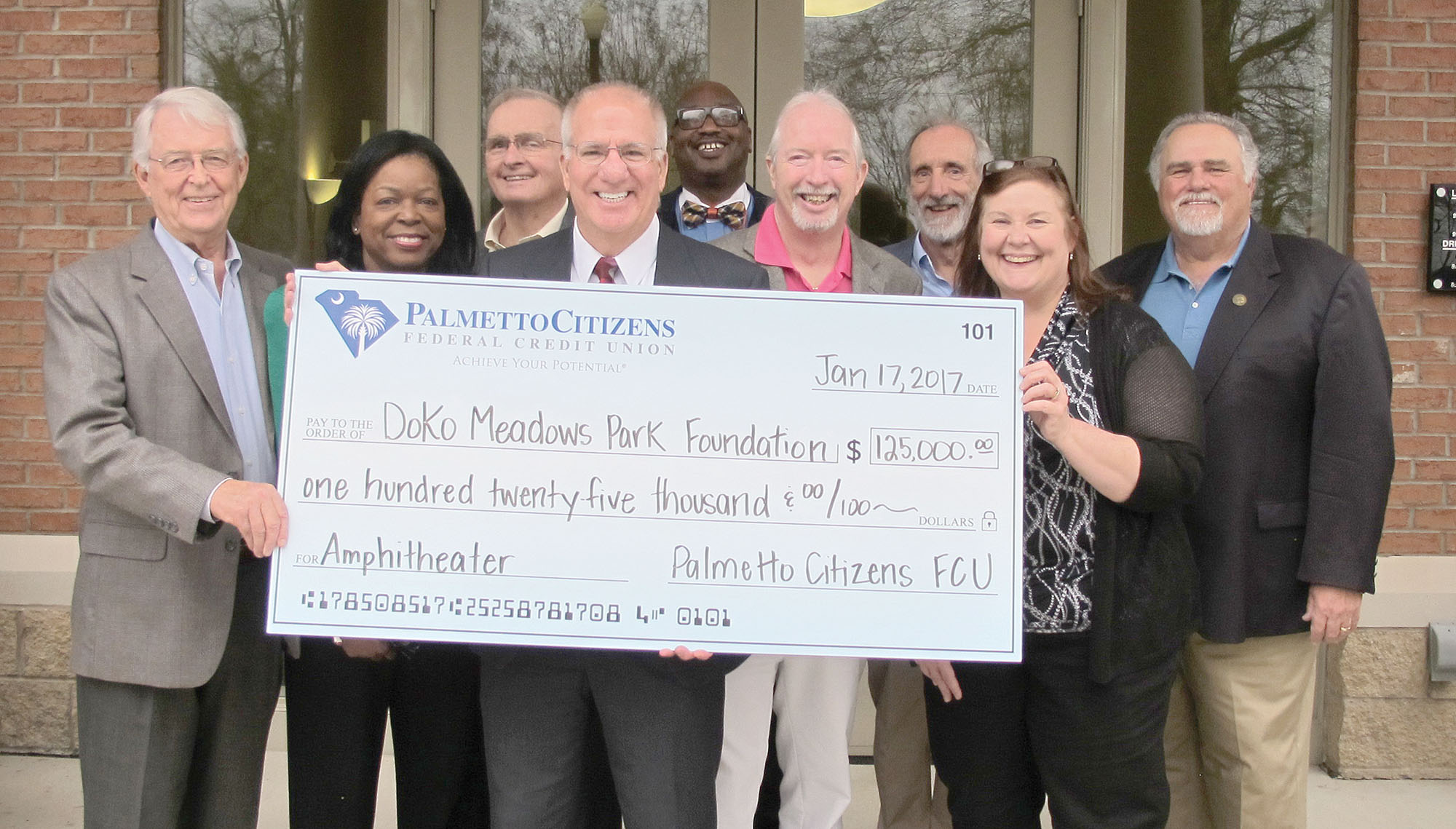
  • Credit Union Ponies Up for Naming Rights

    Nick Wodogaza, center, President of Blythewood’s newly opened Palmetto Citizens Federal Credit Union, presents a check for $125,000 for the naming rights to the Town’s new amphitheater to Jim McLean, left, Chairman of the Doko Meadows Park Foundation; Foundation members Martha Crawford and Buddy Price; Wodogaza; Town Councilmen Larry Griffin, Eddie Baughman and Malcolm Gordge; the Town’s financial assistant Chris Keefer and Mayor J. Michael Ross.  (Photo/Barbara Ball)
    Nick Wodogaza, center, President of Blythewood’s newly opened Palmetto Citizens Federal Credit Union, presents a check for $125,000 for the naming rights to the Town’s new amphitheater to Jim McLean, left, Chairman of the Doko Meadows Park Foundation; Foundation members Martha Crawford and Buddy Price; Wodogaza; Town Councilmen Larry Griffin, Eddie Baughman and Malcolm Gordge; the Town’s financial assistant Chris Keefer and Mayor J. Michael Ross. (Photo/Barbara Ball)

    BLYTHEWOOD (Jan. 26, 2017) – During a check presentation ceremony last week, Nick Wodogaza, President of the town’s newly opened Palmetto Citizen’s Federal Credit Union, made good on the bank’s pledge of $125,000 for the naming rights to the Town’s planned amphitheater in Doko Meadows Park. Town officials and donors broke ground last week for construction to begin on the amphitheater.

    The outdoor entertainment venue was planned as an integral part of the Town’s Master Plan that was approved by Council in 2010. A non-profit foundation was established in 2015 to bring in donations and grants to fund construction of the facility.

    The foundation received its first major contribution, a $25,000 check from Fairfield Electric Cooperative, in January 2016. That was followed by a $75,000 check from Central Carolina Community Foundation in March to purchase concert-quality sound and lighting systems.

    Last June, Palmetto Citizen’s Federal Credit Union, which opened a branch office in Blythewood last week, sealed the deal on the amphitheater’s naming rights with a $125,000 offer.

    “We are so happy to be here in Blythewood now, and we hope that our contribution to the amphitheater will make a difference for the community,” Wodogaza said during the groundbreaking ceremony for the amphitheater last week.

    Foundation Chairman Jim McLean said the Foundation raised 80 percent of the funds to build the amphitheater in less than a year. Individual donations include a $100,000 donation from Blythewood’s Joyce Martin Hill. McLean said the Foundation only needs $60,000 more to cover the cost of the base bid of $415,893 to construct the amphitheater stage, pavilion structure and concrete pad in front of the state.

    Construction is expected to be completed by mid-May.


  • Council, Mayoral Races Take Shape

    WINNSBORO (Jan. 26, 2017) – Filing closed at the Fairfield County Office of Voter Registration and Elections last Friday for candidates taking aim at Winnsboro’s Mayor’s office and a pair of open Town Council seats.

    Current Mayor Roger Gaddy, who only a few weeks ago had indicated he would not seek a third term, recently had a change of heart and filed his paperwork before the noon deadline Friday. Gaddy, of W. High Street, finds himself in a three-person race with Winnsboro businessman and former Councilman Bill Haslett, of State Highway 213, and Ophelia Irby, of S. Garden Street.

    While Irby is a newcomer to municipal politics, Haslett made a run for mayor in 2013. He was bested by Gaddy in that race 344 votes to 232.

    Absent from the lineup for the mayor’s race was Mid-County Water director Herb Rentz. Rentz had, only a few weeks ago, told The Voice that he intended to make a run for mayor. That changed, however, with Gaddy’s decision to enter the race after all.

    Filing for the District 2 Town Council seat were Tony Armstrong, of Sand Creek Drive, and Janice Bartell, of Hunstanton Drive. The District 2 seat is currently held by Stan Klaus, who also served District 2 from 1997 to 2009 and returned to the seat in 2013 by edging out Sonya Kennedy, 81 votes to 50. Klaus has been in the hospital battling illness in recent months and is not seeking re-election.

    Long-time District 4 Councilman Jackie Wilkes, who won his fourth term in 2013 over Pam Smith, 175 votes to 103, is also not seeking another four years on Council. Filing to fill his seat Friday was Winnsboro businessman John McMeekin, of Evans Street. McMeekin will be unopposed for the District 4 seat.

    Winnsboro will hold its municipal elections on Tuesday, April 4.


  • JWC Board Member Responds to Mail-Outs

    JENKINSVILLE (Jan. 26, 2017) – “My name is Peach, and I’m the guy that wrote the letter,” Preston Peach said, rising from his seat on the Jenkinsville Water Company (JWC) Board to address the 100 or so JWC members assembled for the company’s annual meeting at the former Jenkinsville fire station on Jan. 11.

    The referenced letter was one of two written by Peach and mailed in late December, along with a JWC newsletter, printed in color on glossy paper, to 800-plus members of the water company. The first letter was mailed with the newsletter in an envelope pre-printed with the company’s name and address in the upper left corner. It appeared to be mailed by the company.

    In the letter, Peach randomly praised the water company’s leadership, defended the Board’s various decisions and actions, lamented what he called “complaints at every Board meeting from one person” and criticized The Voice’s news reports on JWC Board meetings as “mischaracterizing the conduct of the Board and the water company itself.”

    After The Voice reported, on Dec. 15, that a Freedom of Information Act lawsuit had been filed on Dec. 5 against the JWC by customer Donald Melton, Peach sent out a second letter on Jan. 5, directed primarily at The Voice for its “negative front page (lawsuit) story.”

    “Using the words ‘alleges,’ ‘claims,’ ‘according to,’ etc., to shield (itself) in publishing accusations from another person that are unproven, is not a defense for defamation,” Peach wrote. He signed the full-page, single-spaced letter, “Sincerely, Preston Peach, Jenkinsville Water Company Board member.”

    This letter was also mailed to the company’s 800-plus water customers in an envelope pre-printed with the company’s name and address. Like the first letter, it appeared to have been mailed by the company.

    A letter to the editor, published in The Voice on Dec. 29, questioned whether Peach mailed his letters of personal opinion on the JWC’s dime.

    In a 20-minute soliloquy during the Jan. 11 annual meeting, Peach took the opportunity to address the uproar from all corners as to who paid for the mailings.

    “I paid for all the postage, all the printing, all the envelopes, even the colored newsletter on glossy paper that went out (to JWC customers). All out of my own pocket to the tune of over a $1,000,” Peach told the audience whose skepticism was audible in the crowded room.

    “I ordered 2,500 envelopes over the internet,” Peach told The Voice on Tuesday during a phone interview. He said he had the envelopes emblazoned with the company name and address to look official. Then he wrote a newsletter for the company and had it and the two letters printed at Copy Pickup on Millwood Ave. in Columbia. He said he paid for the postage as well.

    Peach told The Voice that he did it to help the company out.

    “The Board members are trying to make the water company work and we are being sued right and left. It’s costing us time and money,” Peach said.

    He also pointed out that after the lawsuit was filed against the JWC for alleged Freedom of Information Act violations, the company has tried to do the right thing. It has issued agendas, he said, and, unlike last year at the annual meeting, did not elect new Board officers in executive session this year.

    “But our bylaws call for us to elect our officers in executive session, so we aren’t doing anything wrong to do it that way,” he told The Voice. “Our bylaws say that after the meeting is over, the Board members are to elect officers from among themselves. That means in executive session. We are going by our bylaws.”

    Article V, Sec. 1 of the company’s bylaws states, “. . . the Board of Directors shall immediately, following the annual Members’ meeting, elect a President and Vice-President from among themselves and a Secretary and Treasurer who need not be Members of the Board of Directors. . .”

    The next meeting of the JWC will be Feb. 6, at 6 p.m., in the former Jenkinsville fire station next to the water company.


  • Town Tackles Street Vendors

    BLYTHEWOOD (Jan. 26, 2017) – With more mobile street vendors rolling into town these days, Town Council is considering an ordinance that will require those vendors to roll out of town during nighttime hours when they are not open for business.

    Town attorney Jim Meggs said Council members had brought the issue to his attention recently, asking him to create an ordinance that would limit or eliminate overnight, long-term parking for trailer-type street vendors in the Town Center District (TCD).

    “That use is not deemed to be consistent with the objectives of the (TC) District,” Meggs said.

    “We now have a coffee vendor,” Mayor J. Michael Ross added, referencing the increasing number of vendors in the town. “When we initially talked with them (coffee vendor), they were going to take the trailer away each night. But now it sits there. It’s another example of how a vending stand comes in and is just left there. It’s frustrating.”

    Meggs presented Council with a draft ordinance that would amend the TCD regulations in the zoning ordinance to require the removal of ‘vending stands’ from the TCD every evening when the vending stand is closed for business.

    The draft suggested that vending stands open for relatively short durations (less than 30 days in a calendar year) would not be affected.

    The draft defined a ‘vending stand’ as any hut, trailer, stand, cart, tent or vehicle not permanently affixed to real property, including any signs or other accessories related to such and which operates under one itinerant merchant for more than 30 days in any calendar year within the town.

    “I’d like to see this on our next agenda,” Councilman Tom Utroska told Council

    “Street vendors can bring business to town, but they need to be controlled,” Town Planning Consultant Michael Criss told Council.

    According to Town Clerk Melissa Cowan, who issues business licenses for the Town, vendors pay a $40 fee for an initial business license and the following year must pay an annual fee based on their gross income of the previous year.

    “Vendors who serve cooked food also have to pay a 2 percent hospitality tax, which they collect from customers,” Cowan said.

    First reading for the vendor ordinance will be held at the Jan. 30 Council meeting at 7 p.m., at Doko Manor.


  • Effort Emerges to Save Water Tower

    Water Tower copyRIDGEWAY (Jan. 19, 2017) – Although Town Council has yet to nail down a definite site for a new water tank, the fate of the old water tower standing over downtown Ridgeway has been the subject of some concern among merchants and citizens.

    During Council’s Nov. 10 meeting, the Merchants Association asked Council to preserve the old tower and seek an alternate site for the new tank. Last week, during public comment, Dee Dee Ruff told Council she agrees with the Merchants.

    “The historic nature of our current tower is part of what we sell as merchants,” Ruff said. “When you think about replacing this tower, think about what we have; and I’d also like you to think about what we could have in the future.”

    Ruff said the future of Ridgeway’s water sales lies closer to I-77, where Fairfield County is buying up parcels for a proposed mega-industrial site. A new water tower closer to the interstate, she said, could support industrial and residential growth in the future.

    Lee Dixon, of the Fairfield County Revitalization Commission, presented Council with a proposal to help in preserving the old tower. Dixon said his organization would, at no cost to the Town, garner bids and facilitate funding for the restoration of the water tower; provide consultation to the Town regarding the selection of contractors and scheduling of project estimates; serve the Town as consultants to discuss and research all findings; and ensure that the project meets all municipal, county, state and federal guidelines.

    Dixon asked for a period of between 30 and 90 days to complete the proposal to restore the tower as a non-working historical landmark.

    “I’ve spoken to two tower restoration companies already – one out of North Carolina – and they are ready to give us soft bids,” Dixon said.

    Funds to complete the project would come from grants or private or corporate donations, Dixon said.

    “The whole point would be that the Town would then be relieved of the cost of restoration,” Dixon said, “also no cost for me to do the work to facilitate this subcontracting and finding out is it being done through the proper channels of municipal government, whether it’s in a grant situation or whether the council requires a certain regulation or code.”

    During Councilman Doug Porter’s Water Committee report, Porter said the condition of the existing water tower was exceptionally poor, but, he added, he was glad to hear Dixon’s proposal.

    “It’s safe to say that the old tank will stay there,” Porter said. “There’s no worry about it coming down.”

    Porter said the Committee has explored several alternate sites for the new tower, including behind the existing tower on S. Palmer Street, beside the new fire station, behind Aimwell Cemetery on N. Dogwood Ave. and behind the Century House.

    To erect a new tower behind the existing tower, Porter said, would cost approximately $22,000 more just to connect with the water main.

    But, Porter said, “we don’t want to mess up the skyline with another tank nearby.”

    To build it beside the fire station would cost an additional $25,000 to $35,000 to run the lines from the fork at highways 21 and 34 to the new tower. Building it behind the Aimwell Cemetery would involve purchasing an acre of land from the church and running lines to the main. The Town owns the property behind the Century House, Porter said, and the water main is on the Century House side of the road.

    The Town recently received a Rural Infrastructure Authority grant for $500,000 to replace the tank. The Town would have to front $97,550 for engineering services, geotechnical services, DHEC fees and contingencies.

    “It’s an 18-month grant,” Mayor Charlene Herring said. “It will take 18 months. Only two tank companies in the U.S. build these. Then it takes them about a year to do that. The real issue is, do we have the money if we find another site? Remember we already have to pay $95-98,000 for this grant anyway. Do we have additional funds? The County says they will do the piping and whatever. We hope. So it’s almost like we’re maxed out on what we can spend.”

    Council will hold a work session tonight (Jan. 19) at 6:30, followed by a special meeting.


  • New Amphitheater Brings New Concerns

    BLYTHEWOOD (Jan. 19, 2017) – As Council, contractors, major donors and friends of the park spent the better part of Tuesday celebrating the eminent rise of the amphitheater in the park with a ground breaking, ribbon cutting and big check photo op, Town Administrator Gary Parker suggested they will also soon have to tackle some of the worrisome realities associated with having an amphitheater in the park and its proximity to the Manor.

    “Over the last few months, the Town staff has met three times on various matters to do with the amphitheater,” Parker told Council at an early morning workshop Tuesday. “We would like to get some direction from Council about the facility’s availability and rental. Is it only for local groups or is it to be marketed to outside private, for-profit groups as well?”

    Parker asked who would be using the facility – faith-based, civic, non-profit, government, corporate users and commercial performers? He also asked about hiring professional management.

    “We need a plan,” Steve Hasterok, Events and Conference Director, told Council. “Our amphitheater is going to be very accessible from all angles. We don’t have fencing or gates. So I have some questions about security. It’s built in tiers and we have lots of skate boarders in the park. So that’s a worry.

    “And how are we going to market it?” Hasterok asked. “To make a profit, or do we just cover our costs?”

    “As I recall,” Councilman Tom Utroska said, “this was going to be a public forum. There were comments from the citizens and from the media asking what affect it would have on a performance when the train goes by,” he joked. “When I was on the Park Committee, the intent was for local use. If we want it to be a business enterprise, then we can. If we want to keep it as a public forum, then we can keep it that way.”

    Hasterok also questioned what kind of security the amphitheater would have.

    “Will we have our own security here on weekends? Even during the week, it will be an unprotected facility. We will have very expensive equipment over there, lighting, boom lights, things like that.” Hasterok said.

    “If we have to have security when there is nothing going on, then we have totally defeated our original idea. Unless someone comes up with some funds to pay for it, we’re bordering on the ridiculous,” Utroska said. “If it’s going to be public, we need to think about getting sponsors.”

    Hasterok said his greatest concern was how the amphitheater would interact with The Manor.

    “On Saturdays and Sundays when people are paying $3,000 or $4,000 to rent The Manor, what’s the interplay between it and the amphitheater? We have weddings on Saturdays and Sundays. We need to get ready, because we’re already getting inquiries from community groups about renting the amphitheater,” Hasterok said.

    “Why don’t we focus on it being a community venue at first – learn as we go before we see if there is a commercial demand,” Parker said. “I think professional groups will be interested.”

    Mayor J. Michael Ross agreed.

    “I’m not ready to commit money to a marketing manager,” he said. “We have sister towns and communities that have already dealt with these issues. We need to learn from them.”

    Construction of the amphitheater is expected to be completed by May.