Category: Government

  • Residents to get seat at table

    COLUMBIA – When Rimer Pond Road and LongCreek Plantation area residents spoke at a County Council public hearing last month, Council listened. But apparently more than just Council was listening. In response to a long simmering resistance by residents to commercial zoning on Rimer Pond Road as well as zoning issues in other areas of the County, including Lower Richland, the County has announced that it is going to rewrite its Land Development (zoning) Code to better suit the citizens who already live In those areas, Ashley Powell, Manager of Richland County Planning Services told The Voice on Tuesday.

    “This will be the first time in recent history, and maybe ever, that the land development code in Richland County has been completely scrapped and rewritten from ground zero,” Powell said.

    In a press release on Tuesday, Tommy DeLage, Assistant Zoning Administrator for Richland County, invited County residents to a series of upcoming workshops that will be aimed at gathering information from citizens to start shaping the framework for the code rewrite.

    “We want as many citizens as we can get to be involved in the rewrite process,” DeLage wrote.

    The first set of three workshops over a two-year span will cover the same information, but will be held in different areas to accommodate more residents. The meeting closest to Blythewood will be held on Monday, March 27, from 6 – 8 p.m., at Longleaf Middle School, 1160 Longreen Pkwy, just south of LongCreek Plantation.

    The meetings will be attended by County planning staff and under the direction of the County’s Development Services Department with assistance from McBride Dale Clarion of Clarion Associates, the planning group that helped update the County’s comprehensive land use plan in 2015.

    The first half of the meeting will consist of a presentation explaining the rewrite and what to expect, Powell said, “In the second half, we’ll break out into group work sessions, spread out maps, look at the different areas of the county and hear feedback from the citizens. They may say, ‘You know, this is an area where we feel like the proposed zoning doesn’t work well and we feel you really need to pay close attention here,’” Powell said. “And we’ll be furiously taking copious notes to guide the process so that when we’re doing the rewrite, we’ll know we’re coming up with something that’s really functional and what the people who live there want.”

    In terminology, Powell explained the comprehensive land use (comp) plan has in it the County’s future land use element.

    “It’s a vision of how we see growth trending. The Land Development Code is the zoning law regulating how land can be used. It’s what punches that comp plan (vision) into action (law). But right now in some areas, like Rimer Pond Road, the people who live there are not liking what the county has planned for their area in terms of zoning, Powell said.

    The land along Rimer Pond Road and vicinity is zoned mostly Rural (RU) and Low Density Residential (LD-RS.) But the comp plan, which calls for surburban growth in that area, all the way to Langford Road, doesn’t mesh with what’s on the ground –  primarily farms and large acre, wooded home sites.

    At Council last month, and for the last 25 years that Rimer Pond road residents have been fighting commercial zoning on the road, the citizens cry has been, “But we don’t want it.” “We don’t’ need it.” That’s not how we want to live.” Yet the requested zoning was in the County officials’ plan and approved and defended by the County’s planning staff as being in concert with the comp plan guidelines. But it was not the zoning desired by the residents who lived in the area. They felt it didn’t meet their needs.

    “So when the residents are saying, “We don’t want that. We like it like it is,” Powell said. “We want to find out what’s working and what’s not working. The purpose of the rewrite is not to amend the comp plan, but what we are hearing resoundingly from the community is that something we proposed in the comp plan, we got it wrong. We’re a little off base. So we have to go back and amend and I think Rimer Pond Road is a perfect example of that, because we have called it one thing in the comp plan and every time a rezoning comes up, staff has approved it base on the comp plan. But the neighborhood has said resoundingly, “No, this is not what we want. This is not what we see our neighborhood becoming.

    “We want to protect the character of the neighborhood that the people moved out there for,” Powell said. “We need to amend based on the feedback we get from the people.”

    Powell said Rimer Pond Road has been a learning experience for the County.

    “I sat in on the Rimer Pond Road case recently and am familiar with what some of the complaints are there. We are looking for a land development code that speaks directly to informed citizens so that it reflects the character of what is actually there and what the community envisions will be there in the future,” Powell said. “We’re looking for community input. We want people to come to the meetings and say, ‘This is how I want my area to grow. This is what I want it to look like.”

    For more information, go to weplantogether.org
  • Ridgeway Faces Do-Over on Book Deal

    Plans Constitute Improper Use of H-Tax

    RIDGEWAY (March 2, 2017) – Town Council’s decision during their Feb. 9 meeting to dip into hospitality tax funds in order to publish a history of Ridgeway, then dump profits from the sale of the book into the Town’s general fund is going to have to be pulled, Mayor Charlene Herring confirmed Friday, after The Voice discovered such a diversion of H-tax funds was prohibited by statute.

    “The current statute does not provide for the transfer of funds from the hospitality tax to another fund,” Scott Slatton of the S.C. Municipal Association said, “unless it is for operational expenses related to hospitality tax programs.”

    Ridgeway can use H-tax funds to publish the book, but Slatton said all monies generated from its sale would have to go back into the H-tax fund.

    Noting that it was one of Council’s strategic priorities for 2017, Herring told Council on Feb. 9 that she had found an outlet that would publish 125 copies of an approximately 100-page history of Ridgeway for $2,271. She asked Council to approve using hospitality tax funds to cover the cost of the publication. The book could be sold, she said, for between $20 and $25, netting the Town a profit of $229 to $854, after the hospitality tax fund had been repaid.

    Although Herring suggested the profit should also go into the hospitality tax kitty, Councilwoman Angela Harrison’s motion, which was approved unanimously by Council, called for the profits to go into the Town’s general fund.

    Councilman Heath Cookendorfer was absent from the Feb. 9 meeting.

    “What we will have to do is go back and undo that,” Herring said Friday after learning of the error, “which will be fine with me and I think fine with Council.”

    Herring called the error a “harmless” oversight.

    Police Car Lighting

    During their Jan. 19 meeting, Council approved a bid of $2,407.15 to rewire the police car with up-to-code emergency lights, but on Feb. 9 Mayor Charlene Herring said that quote had proven to be inaccurate. The correct quote, she said, was for $3,367.87 from a company in Lexington.

    Council rejected a slightly lower bid – $3,174.22 – from a company in Spartanburg County.

    “Why we need to consider the $3,367 bid, this company is in Lexington, S.C. The other company is in Roebuck, which is a little above Spartanburg,” Councilman Donald Prioleau told Council, “so to carry the car to have the equipment installed, carry the car back … you’re talking a difference of $193. The travel time will eat that up, so I think we need to go with the Lexington, S.C. bid.”

    Council unanimously approved the higher bid.

    Audit Report

    Herring also told Council that the Town had received a clean audit report and asked Council to submit in writing any questions on the audit for review at Council’s March 9 meeting.


  • Board Considers Funding U.K. Field Trip

    WINNSBORO (March 2, 2017) – When the School Board approved a trip to England for eight STEM students at Fairfield Central High School last fall, Superintendent Dr. J.R. Green told Board members at the time that the students would be raising all the funds for the trip through fundraisers.

    At Tuesday evening’s meeting, however, a parent’s group from the STEM school at FCHS told Board members during public comment time that the eight students had only been able to raise $22,000 and asked the Board to kick in another $13,000 for a total of $35,000 for the trip.

    Asked by Chairwoman Beth Reid (District 7) what the cost is for each student, the parent spokesperson said it is $3,600 per student. The trip is scheduled for this summer. The parent told the Board that the trip is for educational purposes and would include visits to Stonehenge and other sites that would enhance the students’ enthusiasm for learning.

    Henry Miller (District 3) said he applauded the students “for putting some skin in the game,” and said he thought the trip was worth the Board putting up the balance needed for the eight students.

    “I’ll investigate some funding and get back to the Board with a recommendation,” Green told the parent group. But the spokesperson for the group said they had to have final payment in by March 1.

    “That won’t work,” Annie McDaniel (District 4) said.

    “Will we have enough time (to get the money approved) before March 1?” Miller asked.

    Green said that was the first he had heard the payment was due on March 1.

    “Let me see what I can work out. I’ll get back to the Board,” he said. “I’ll figure out the details and I assure you we’ll get it worked out.”

    McDaniel suggested that there may have been students who wanted to take the trip from the beginning but didn’t have a way to raise funds.

    “So now that we’re going to bridge the gap for these eight students, should we help those who wanted to go but did not think they could get funding?” McDaniel asked.

    “Why some students chose not to go on the trip when the fund raising efforts began, I can’t speak as to what their motivations were,” Green said. “I think it would be problematic at this point in time to go back and find those students. If they have not raised money, then I don’t know how it will be received by the students who raised $22,000.”

    “I think we need to find out if those other students didn’t participate because they didn’t have a way to raise funds. If these students thought they couldn’t raise the money and now we’re going to fund the rest of this money for these eight students, then why could we not do that for those (other) students? We paid for the chorus to go to Disney World how many times?” McDaniel asked.

    “If those students don’t have passports, it might be too late to get them now,” the parent spokesperson added.

    No decision was made about the funding, which was not on the agenda. Green did not say how or when he would get back to the Board about the issue.

    Also on the Board’s agenda was a report that the District had spent $45,119.13 for 35 trips ‘over $600’ each for teacher training.


  • Residents Beat Back Rezoning Attempt

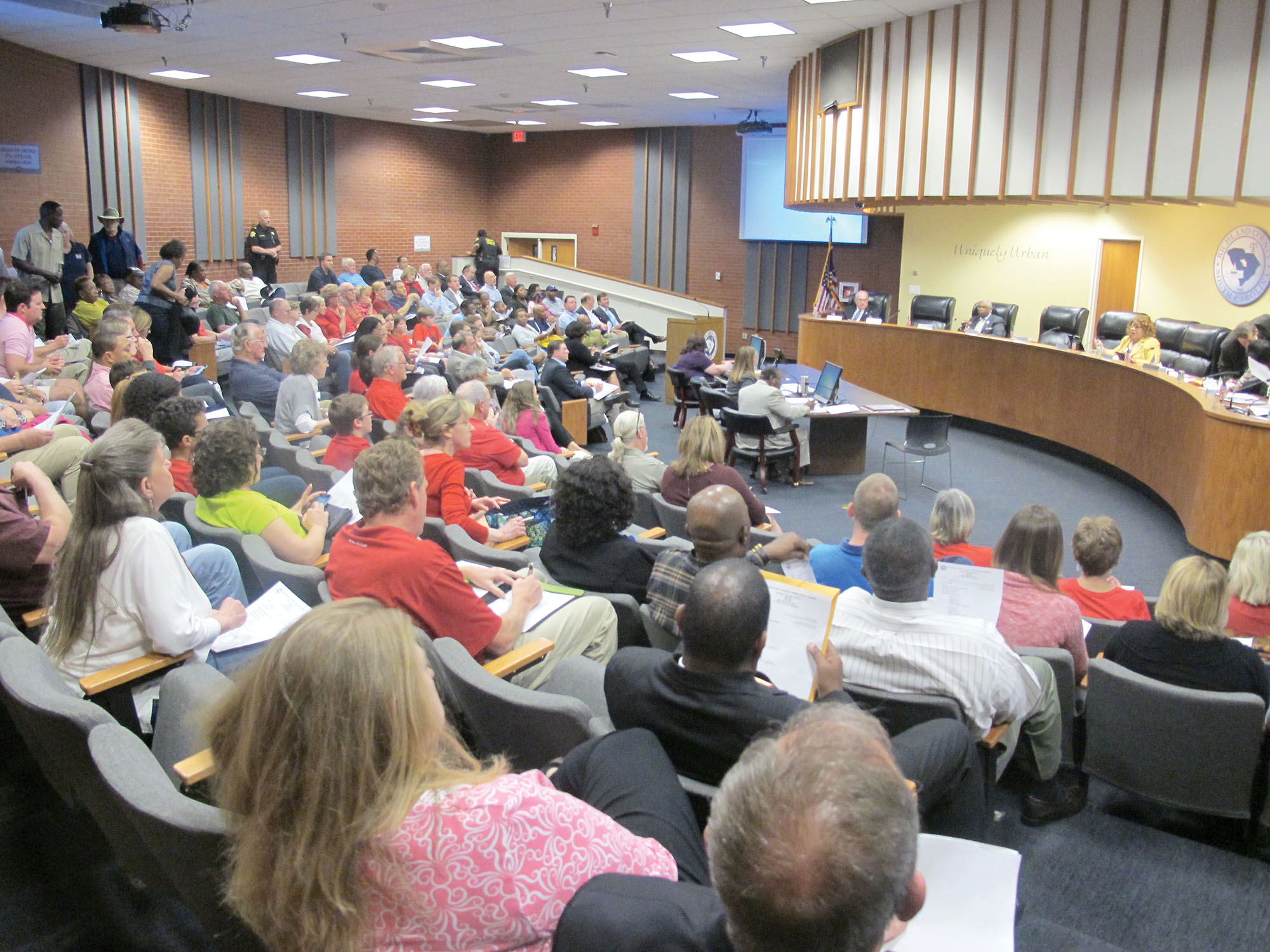
    Rimer Pond Road residents pack County Council chambers Tuesday evening. (Photo/Barbara Ball)

    COLUMBIA (March 2, 2017) – The third time was not the charm for developer Hugh Palmer Tuesday night when he again came before County Council requesting a Rural Commercial (RC) zoning designation for a 5.23-acre parcel he owns at the intersection of Rimer Pond Road and Longtown Road West in Blythewood.

    After almost an hour of passionate pleas from 30 or so residents in the Rimer Pond Road/LongCreek Plantation area asking Council to deny Palmer’s request to bring commercial zoning to their rural neighborhood, the road’s own County Council representative, Gwen Kennedy, made a motion to approve Palmer’s request. When Chairwoman Joyce Dickerson, who also represents a portion of Blythewood, called for a second, Council fell silent and the motion died for lack of a second.

    Dickerson then called for a second motion for denial and 10 of the 11 Council members raised their hands to deny Palmer’s request with Kennedy casting the lone vote against the motion for denial.

    Dickerson called for a break in the proceedings as the crowd of more than 100 residents, hugging and congratulating each other, left the chamber, leaving it almost empty.

    During the Hearing, Palmer sat with his son, Patrick Palmer, a member of the Richland County Planning Commission, and lobbyist Boyd Brown who told Council members he was there to help Hugh Palmer win their votes. Patrick Palmer recused himself earlier in February when the issue came before the Commission. The issue when before the Commission ended in a tie vote that resulted in no recommendation being sent to Council.

    Hugh Palmer has brought his rezoning request before Council twice previously, both times facing hundreds of residents in opposition, including Blythewood Mayor J. Michael Ross. In June of 2015 Palmer withdrew his request when it was apparent that he did not have the votes. Later that year, in November, Council denied the request with a 5-5 tie vote.

    Hugh Palmer was on fire Tuesday night as he warned Council members during his two minutes at the microphone that his request was the victim of misinformation being spread on Facebook.

    “I’m not proposing a landfill, a sewage treatment plant, a large grocery store or shopping center as some have claimed,” Palmer said.

    While those claims had not been made by anyone during public hearings at either the Planning Commission or County Council, he did not say who made them or where they were made.

    “I propose small retail development that would serve the needs of and be convenient to the surrounding area, to the people that already travel this area every day,” he said. “This area is changing, whether these folks in here like it or not.”

    Palmer told Council his request falls within the boundaries of the County’s land use plan, has County staff’s approval and meets Rural Commercial (RC) standards.

    “Those should be the questions that matter here tonight,” he said, dismissing the pleas of those present who live in the area.

    While Brown, speaking for Palmer’s rezoning request, held up a petition that he said was signed by 125 people in the community who supported the rezoning, some opponents of the rezoning frequently reminded Council that the 125 petitioners didn’t show up at the hearing. County Council does not accept petitions.

    Although Palmer told Council the goal of his request was to bring commercial conveniences to the neighborhood, speaker after speaker repeated, “We don’t want it. We don’t need it.”

    “We enjoy the rural setting,” Christopher Henchy of Eagles Glen said. “No one on Rimer Pond Road wants commercial development on our road.”

    Fifteen-year resident Kathy Johnson spoke against the rezoning and related an anecdote of how her car’s low fuel light came on at the intersection where Palmer is seeking rezoning.

    “I was close enough to Blythewood that I was able to drive three miles to get gas before I ran out. I think we’ll be OK,” Johnson assured Council.

    LongCreek Plantation resident Jay Thompson challenged County staff’s approval of the request and their conclusion that RC zoning was compatible with the Palmer property.

    “RC zoning is not compatible with the Rimer Pond Road land use plan,” Thompson said. “The nearest RC zoning is to the west of Blythewood on Winnsboro Road.”

    To make his point that commercial zoning would bring crime to the Rimer Pond Road area, Trey Hair handed out to Council members neighborhood crime maps off the internet that showed only a handful of crimes committed in a one-mile radius of Rimer Pond Road over a one-year period. A map of the same time frame and radius of a nearby commercial intersection was almost solid with symbols showing where crimes had been committed.

    “RC zoning is described by the County as serving areas that are isolated or underserved,” Rimer Pond Road resident Ken Queen said. “We are neither. We have everything we need within three miles. One person’s wants and desires should not take precedent over hundreds of people who live in this community and oppose (this zoning),” he said.

    The neighborhood’s representative in the State House, Joseph McEachern, spoke supporting the residents in their fight against the commercial rezoning.

    Because the request was denied, it is not eligible to come back to Council for a year.


  • Vendor Regulations Postponed Again

    Council Seeks to Add DHEC Permits, Insurance, Zoning Requirements

    BLYTHEWOOD (March 2, 2017) – Town Council Monday night made another abortive pass at an ordinance regulating itinerate merchants and vending stands within the Town Center District (TCD). Unlike last month’s attempt, however, when Council faced considerable public backlash for its efforts, Monday night a handful of citizens – including one merchant who would be directly impacted by the proposed rules – spoke out in favor of some form of regulation.

    “There really needs to be regulation so roadside services, roadside stands that come up, whether they’re selling food or products, that they’re fully compliant with all the town’s regulations,” Tom Duka told Council during the Citizens’ Testimony portion of the meeting. “When somebody builds an actual brick-and-mortar structure to have a store or restaurant or facility, they’re making a definite investment, but some of these vending stands that are coming through town are very temporary in nature. We want to make sure that people who make an investment in town by actually complying with the zoning, by complying with the building regulations, are the ones who are most protected, as long as they are following regulations as well.”

    Scott Opolyn, owner of Scotties Restaurant, told Council he was concerned that mobile food vendors may not have obtained their appropriate inspections from the Department of Health and Environmental Control (DHEC). Opolyn also said any new regulations should ensure that mobile vendors are properly insured and that they meet the town’s zoning regulations.

    “I personally think that having food trailers that would come here is great, but you don’t want to make Blythewood a Gypsy city, either,” Opolyn said. “Which means we have to set rules and regulations.”

    The key word in defining an itinerate merchant, Opolyn said, is “mobile,” and Council’s proposed ordinance would require such merchants to remove their vending stands from the TCD at the close of each business day. But a loophole could appear, Opolyn said, if Council failed to also regulate hours of operation.

    “If they’re open 24-hours a day, seven-days a week, well I guess there’s nothing to move,” he said. “But it still comes down to cleanliness. How are they going to clean their trailers? They’re mobile. They don’t carry a lot of water. Where do they use the bathrooms? What about the people who are eating there and drinking there if they’ve got to go? You don’t want them urinating in a jar and pouring it outside their trailer. It’s not a public toilet. This is where we live.”

    Matt Beyer, owner of Grace Coffee Company, said he was not opposed to Council regulating mobile vendors. The iconic coffee trailer at 208 Main Street, which has found itself at the center of the debate, would be directly impacted by any new laws governing itinerate merchants and vending stands.

    “I think there should be some regulations,” Beyer said. “You should regulate us, to a degree. I think we all in this room need to figure out how to work it out and create a win for all of us.”

    Although the company was indeed a mobile enterprise when they opened for business three months ago, Beyer said, they have since become fixed to their spot on Main Street.

    “We look mobile, but we’re not anymore,” Beyer said. “What we have inside, it’s not just a hassle to move, it’s not possible. So it’s either we’re here or we’re not.”

    Councilman Tom Utroska, who was absent from last month’s meeting when the initial first reading on the ordinance was postponed, said Monday night that he had “a real issue” with the proposed rules.

    “Let’s say we have somebody that comes in a purple and red and orange truck that wants to park in the Town Center District,” Utroska said. “We won’t let people build buildings that look like that, but we’re going to say it’s OK to park your truck there. It kind of seems like it’s a slap in the face to the business owners. I think there needs to be some standards.”

    Utroska also said he felt Council should ensure that mobile food vendors have any necessary DHEC permits, and that mobile vendors of any sort should have liability insurance.

    The proposed ordinance presented Monday night included one minor addition to the version presented last month – a grandfather clause that would allow any vending stand in lawful operation at the time of first reading to continue to operate without regard to the daily removal requirement. But Utroska said he thought existing vendors should be given 60 days to comply.

    “I don’t think we give them perpetuity,” he said. “I am not happy with this ordinance. It doesn’t say anything about them having to have a DHEC permit, it doesn’t say anything about insurance. It doesn’t say anything about the Town Administrator being able to decide whether or not you can park in a certain location, that the color may not fit in with the zoning. There’s a lot of things I don’t see in the ordinance.”

    Jim Meggs, the Town’s attorney, reminded Council that the original model ordinance he had presented to them included a veritable laundry list of detailed regulations, but Council had rejected that as too stringent. The version presented last month, he said, had been pared down to simply requiring vendors to pull up stakes are the end of each business day.

    “Somewhere there’s a happy medium,” Utroska said. “I think there has to be some modicum of restriction. I do think they have to move every day. And if their colors are so garish they wouldn’t be allowed, they shouldn’t be here.”

    Mayor J. Michael Ross asked Utroska to work with Meggs to develop a broader ordinance. A third version, Utroska agreed, should be ready for Council’s March 27 meeting. Council’s agenda for Saturday’s annual retreat also includes discussion of the ordinance. The retreat begins at 9 a.m. at The Manor.


  • Town Gets Clean Audit

    WINNSBORO (March 1, 2017) – The Town of Winnsboro received a clean audit report during their Feb. 7 meeting from Bill Hancock, of the Brittingham Group, LLP.

    “There’s no news here,” Hancock joked with the media following his report to Town Council.

    While Hancock noted that the Town was approximately $45,000 over budget on expenditures, he also pointed out that the town took in nearly $78,000 more than budgeted.

    “It should be noted that a lot of those decisions (expenditures) weren’t made until you realized that you were over budget (in revenues),” Hancock said, “so the bottom line in that column, the Town was about $33,000 in the black for the year.”

    Winnsboro’s utilities showed a positive change in its net position of a little more than $2 million, Hancock said; however, Town Manager Don Wood clarified that that money was dedicated to debt service on the Broad River raw water line project.

    “The main reason we showed this surplus was, not this past year but the year before, the local revenue bond was completely paid off,” Hancock said. “That took more than $1 million of debt service off our backs. You’re seeing the fruits of paying those debts off and not going deep into debt right away with another project. But that’s coming. We’ve got plans for raw water lines and other projects that may require a lot of this capital.”

    Verizon

    Council also gave the OK to Verizon Wireless to allow the company to inspect the water tank at the Walter Brown Industrial Park on Cook Road in order to determine its suitability for a wireless communications antenna.


  • County Issues Seventh G.O. Bond

    WINNSBORO (Feb. 23, 2017) – Fairfield County Council has issued its seventh general obligation (GO) bond since February 2014. The bond, in the amount of $614,000, was recorded by the Fairfield County Clerk of Court on Feb. 9, 2017.

    Like the six previous GO bonds, this one will go toward paying off the $24.06 million bond that was issued not by the County but by a non-profit shell corporation called the Fairfield Facilities Corporation (FFC).

    The FCC shell was created by Council with a one-time vote on March 15, 2013 for the sole purpose of issuing the $24.06 million bond to pay for certain economic development projects Council wanted at the time, but could not afford.

    Council was not at that time legally able to take on $24.06 million of debt without a voter referendum or a revenue stream sufficient to pay it back.

    But a loophole in the FCC arrangement allowed the FCC to pay for the County’s economic development projects and then allow the County to purchase those projects back from the FCC through a mock installment purchase plan over 35 years.

    While the County is not, technically, paying off the bond directly, according to the bond document, the County’s installment purchase payments to the FCC are equal to the amount of the payments the FCC makes on the $24.06 million bonds.

    The loophole further allowed the County to make these installment purchase payments with an artificial revenue stream created from an unlimited number of GO bonds Council is allowed to issue under an ordinance it gave final approval to on April 15, 2013.

    So long as the GO bonds issued do not exceed the County’s 8 percent debt limit, Council can issue an unlimited number of the bonds without voters’ permission according to the April 2013 ordinance.

    Even so, the state statute provides a 20-day window (after a GO bond ordinance is passed) that would have allowed the voters of Fairfield County to initiate a petition that could have forced a referendum on the ordinance that could have halted the issuance of the GO bonds.

    But while the ordinance was passed in a public meeting (by title only at each of three readings),

    Council members at that time and newspaper accounts may have derailed any petition effort by wrongly, publicly and repeatedly identifying the ordinance passed on March 15, 2013; April 8, 2013 and April 15, 2013 as the $24.06 million bond, not the GO bond ordinance that was subject to the initiative petition.

    Adding further confusion, then County Administrator Philip Hinely and then Director of Economic Development Tiffany Harrison were quoted in The Voice as saying the $24 million bond would not increase taxes.

    But a chart obtained in 2014 from the County through a Freedom of Information Act request showed that it is actually the GO bond debt (that is continually levied each year to make the installment purchase payments on the $24.06 million bond) that will keep the County’s debt millage at an elevated level of approximately 10 mills (or about $1.27 million) each year until about 2042, at which time the debt millage will begin to decrease steadily, reaching zero by 2047.

    While the County borrowed $24,690,000 to pay for its economic development projects, it will repay $43,200,663 for the principal and interest on that bond debt, according to the bond document.

    Although the former County officials initially aligned the payments for the $24 million bond debt with the dates the County would begin to realize additional income from the second and third units at the V.C. Summer nuclear plant, then Interim Administrator Milton Pope noted during a joint meeting of the Fairfield County Council and the Fairfield County Legislative Delegation in 2014 that the semi-annual installment purchase payments on the $24 million bond do not depend on income from the V.C. Summer nuclear plant.

    Pope said it was planned from the beginning to pay off the $24 million bond with property tax revenue from the issuance of multiple GO bonds over a period of about 35 years.


  • Blythewood Mourns Mazyck

    Sabra Mazyck

    BLYTHEWOOD (Feb. 23, 2017) – The Blythewood community lost a longtime public servant with the death of Sabra Mazyck last week. Mazyck, 65, Chairwoman of the Town’s Board of Zoning Appeals, died unexpectedly in her sleep Wednesday morning, Feb. 15, at her home in Lake Ashley from lingering complications related to the brain surgery she underwent two years ago.

    Mazyck served on various boards in the Town government beginning in 2004. Appointed to the Planning Commission for two terms, Mazyck served one term as Chairwoman. She was later appointed to two terms on the Board of Zoning Appeals, serving the last three years as Chairwoman. As a quasi-judicial board, the BZA is charged with following stringent guidelines for approvals of appeals, and while Mazyck was calm, quiet and soft-spoken, she soon gained a reputation for having a tough-minded resolve in following the letter of the law when making decisions regarding those appeals.

    “We are still in shock over the sudden loss of Sabra,” Mayor J. Michael Ross told The Voice on Monday. “I’m so glad I got to see her last week during our Black History month celebration at The Manor. Sabra defined what a truly involved citizen looks like in a small town. I hope we told her enough how much we appreciated her service and leadership, especially on the Board of Zoning Appeals. Our prayers and thoughts are extended to Zeke and their family members. She will be dearly missed in our little town.”

    The flag at Town Hall was lowered to half-staff last week in Mazyck’s honor.


  • Town-County Water Talks Signal New Era

    WINNSBORO (Feb. 23, 2017) – Representatives from the County government met Tuesday night in an extended executive session with Winnsboro Town Council and Margaret Pope of the Pope Zeigler law firm to break the ice on the county’s long-term water and sewer needs.

    Emerging from the closed-door session, County Administrator Jason Taylor and Deputy Administrator Davis Anderson were reluctant to go into detail about the discussion.

    “I can’t talk about executive session stuff,” Taylor said. “I’m always willing to work with the town of Winnsboro on a number of issues, though.”

    Mayor Roger Gaddy, also careful not to divulge any privileged information, said the talks may bode well for improved relations between Winnsboro and the County in the future.

    “The County came to us to discuss the possibility of working together for the long-range planning of the community,” Gaddy said.

    That “long-range planning,” according to the agenda item noting the topic for the executive session, involves water. And, Gaddy said, sewer as well.

    While Tuesday night’s discussion was reminiscent of Winnsboro’s 2013 effort to establish a county water authority – an effort that was derailed primarily because of a lack of interest from the County to participate – Gaddy said it was “way too soon” to resurrect that plan.

    “There are probably other ways to cooperate other than that (a water authority),” Gaddy said, “but it certainly has opened the door for further deliberations and communications about infrastructure and the community that need to be solved to help with industrial recruitment and further growth of the county and community.”

    Gaddy said the next step toward a unified County-Town front on growth and infrastructure would be a joint meeting between Town Council and County Council.


  • Rimer Pond Road Zoning Battle Looms

    BLYTHEWOOD (Feb. 23, 2017) – Residents from the Rimer Pond Road/LongCreek Plantation area are expected to make their umpteenth trip down to Richland County Council chambers Tuesday evening to continue a years-long battle to keep their rural residential neighborhood free of commercial zoning.

    For the last three years, the battle has been fought over the same property, a 5.23-acre parcel across from Blythewood Middle School. The parcel is owned by developer Hugh Palmer, the father of longtime Richland County Planning Commissioner and commercial realtor Patrick Palmer.

    Hugh Palmer is asking that Council rezone the property to Rural Commercial (RC), a zoning designation that could, the Palmers say, allow such businesses as pizza restaurants and dry cleaners. It is the third time the rezoning request has come before Council in the last two years. In 2015 it was tabled, and later that year a tie vote resulted in denial of the request. Because it was denied, Palmer had to wait a year to reapply for the rezoning.

    When the issue came before the Planning Commission earlier this month, a split vote (3-3) resulted in no recommendation for or against the rezoning being forwarded to County Council. More than 75 people opposed to the rezoning attended that meeting and 34 spoke out in opposition to the rezoning.

    The County’s planning staff (employees of the County) recommended, as it has previously, that Palmer’s commercial rezoning request be approved, pointing out that, according to the County’s zoning summary, the RC District is designed “for areas within Richland County where residents of the more isolated agricultural and rural residential districts and residents located beyond the limits of service of the towns can receive convenience merchandising and services.”

    But residents, addressing the planning commission, pushed back, repeating again and again as they came to the microphone, that the area is neither isolated nor located beyond the limits of service.

    “Within a four-mile radius of my home, there are four pizza restaurants, three dry cleaners, a Dollar Store, a Dollar General, three large grocery stores and at least five service stations,” said LongCreek Plantation resident May Vokaty. “There are plenty of commercial resources available to this area.”

    LongCreek resident Jay Thompson disagreed with the planning staff’s suggestion that the requested zoning is in compliance with the county’s objectives for land use.

    “I hold in my hand a map of future land use. If you look at this map, this neighborhood is shown as medium density, not rural. That directly contradicts this proposed zoning for Rural Commercial. It does not fit.”

    Trey Hair of Rimer Pond Road pointed out that there is no commercial zoning anywhere on the road.

    “The only beneficiary of this zoning change will be the applicant who stands to make a large sum of money from the property,” Hair said.

    “The Palmers are the ones who came to Rimer Pond Road 10 or so years ago and changed the parcel from Rural zoning to Residential Medium Density (RS-MD),” Rimer Pond Road resident Ken Queen said. “We didn’t want that, but the Palmers wanted it. They never even came out to meet with anyone in the neighborhood and they have not this time.”

    Some of those who addressed the Commission hinted at the planning staff’s motives in recommending approval of the rezoning request again and again.

    “The Planning Commission is tasked to oversee the strategic growth of our County, to keep the big picture in mind and not make decisions based on personal requests that are not in the interest of the community,” Rhett Sanders said.

    “That a single person could do this to a neighborhood is unbelievable,” LongCreek Plantation resident Benny Solton told Commissioners.

    Hugh Palmer could not be reached for comment.

    County Council is scheduled to vote on the issue at 7 p.m., Tuesday, Feb. 28 in Council Chambers of the Richland County building at Hampton and Harden streets in Columbia. Those who wish to speak for or against the rezoning request should arrive a few minutes early to sign in.