Category: Government

  • Vendor OK’d, KFC Grilled

    BLYTHEWOOD – A loophole in the Town’s code of ordinances has paved the way for the owner of Grace Coffee, a vendor housed in a small turquoise and white mobile home on Main Street in downtown Blythewood, to do, on Monday evening, what no other business in town has been able to do – receive a certificate of occupancy (COA) without meeting the Town’s architectural review standards. The business owner, Matt Beyer, did not attend the Board of Architectural Review (BAR) meeting.

    It appears the Town’s ordinance regulating architectural review in the Town Center District does not have well-defined regulations for mobile vendors.

    “We were asked to give a COA without guidelines,” BAR Vice Chairman Jim McLean told The Voice. “We (the BAR) did not want to do that because a COA is permanent. We grappled with it, and we did all we could do, considering the Town has no architectural review standards in place for mobile vendors,” McLean said. “The Town was caught off guard.”

    Instead, the BAR agreed to grant a one-year conditional COA to the business to give the Town Council time to draw up standards for mobile vendors.

    At issue is the definition of ‘structure’ in the Town’s code of ordinances.

    “Structure’ is very broadly defined in the code, yet this mobile vendor is a ‘structure,’ and because it is in the Town Center District, it must have a COA from this Board for its exterior appearance,” The Town’s Planning Consultant Michael Criss told the Board.

    While brick and mortar buildings in the Town Center District must adhere to guildelines for paint color, lighting, whirlygigs and other exterior architectural features, Grace Coffee was not required to meet any of those standards, Criss said.

    However, McLean said the coffee vendor’s COA is based on how it currently stands and that it cannot make further (substantive) changes in its appearance going forward without coming back to the BAR.

    Newly installed Board Chairwoman Pam Dukes then asked how the sign allowances would be applied to Grace Coffee.

    That, too, turned out to favor the vendor over the town’s brick and mortar businesses.

    “It’s clear what the regulations are for permanent structures that are affixed to the ground,” Criss said. “The landlord gets one monument sign freestanding out in the front yard and one wall sign on the facade facing the street.”

    Those signs, according to the Town’s code must meet specific size and quantity guidelines.

    “But it’s not crystal clear what the sign limitations are on a mobile unit such as a trailer,” Criss said.

    Grace Coffee usually has four signs displayed – one at each entrance, one on the trailer and a menu sign in front of the trailer.

    “Suppose they were frying chicken in there,” McLean asked, referencing a discussion the Board had earlier in the meeting with Kentucky Fried Chicken officials who are looking to make major exterior renovations of the KFC in downtown Blythewood.

    “I’m trying to go back and grab the fairness. We just turned down Kentucky Fried Chicken about what they can and can’t do (with signage),” McLean said, pointing out that brick and mortar businesses in the Town are held to higher standards.

    The discussion has been ongoing ever since Grace Coffee pulled in to town last December and set up shop in the parking lot of Bits and Pieces consignment store.

    “When we initially talked with them (Grace Coffee), they said they were going to take the trailer away each night. But now it sits there,” Mayor J. Michael Ross told Council in January. “It’s another example of how a vending stand comes in and is just left there. It’s frustrating.”

    At the February meeting, Beyer added another dimension to the mobility issue, telling Council members that the stand was no longer mobile, that it could not be moved.

    During the coming year, prior to the expiration of Grace Coffee’s one-year COA, the issue of standards for mobile vendors is expected to come before the Planning Commission for recommendation to Town Council.
  • Ridgeway votes to buy Cotton Yard

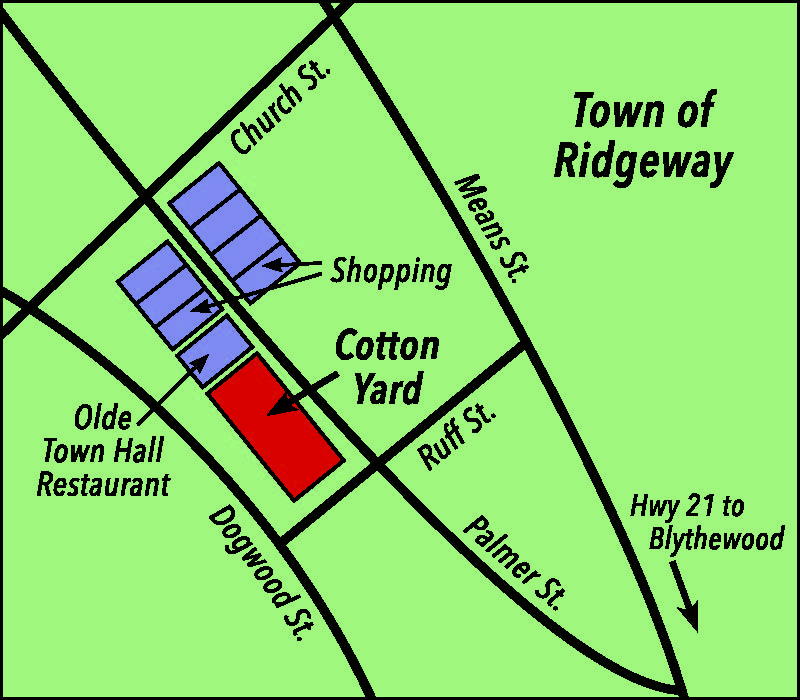
    RIDGEWAY – Ever since 2014, when former Town Councilman Russ Brown accused Mayor Charlene Herring of poking the bear (Norfolk Southern Railway Company) with an email inquiry concerning the Town’s use of Cotton Yard property, the Town has had to pay rent on the property which sits next to the Olde Town Hall Restaurant. Prior to that, the Town had not only used the Cotton Yard for festivals and parking for shoppers, but built a police station and fire station on the property.
    Increasingly worried as to whether the Town would continue to be allowed to use the Cotton Yard property, Council hired an attorney to approach Norfolk Southern about purchasing the front portion of the Cotton Yard property where the police and fire stations were located.
    The answer came in the form of an email on April 12, from a Norfolk representative to the Town’s attorney in the matter, Jim Meggs.
    “Would the Town of Ridgeway be interested in purchasing the whole parcel? It is not in the best interest of Norfolk Southern to sell only the front of the parcel, losing the street frontage. We could agree to letting the whole parcel go for $35,000,” the representative wrote.
    After considering the offer during executive session last week, Council voted in public session to accept it.
    Councilman Angela Harrison told The Voice that she was not sure how long the purchasing process would take

  • Pauley sworn in

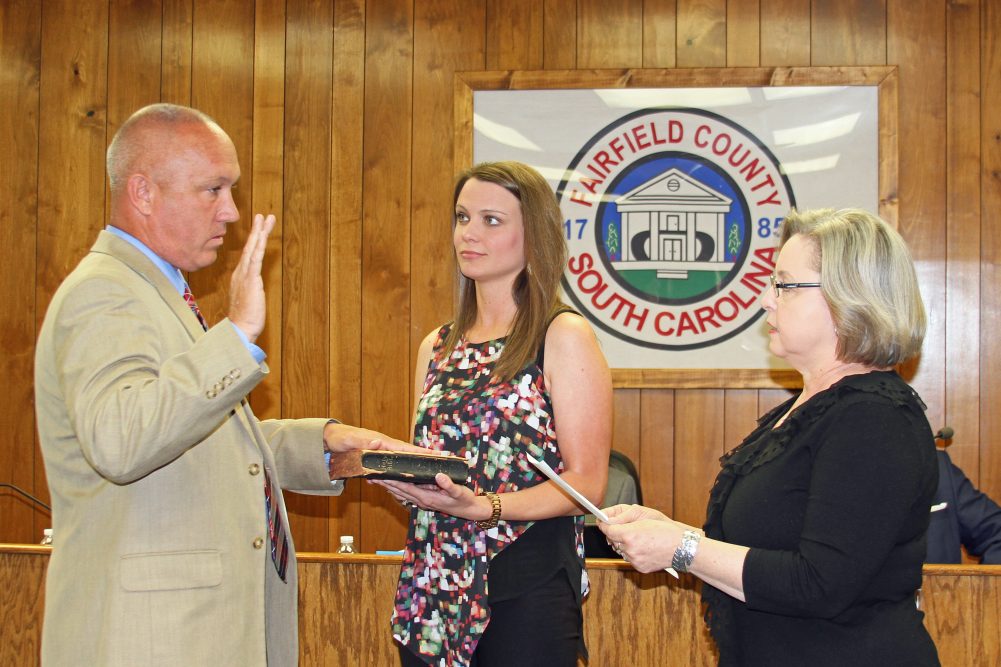
    Douglas Pauley, who was elected to represent District 5 of Fairfield County Council in a special election last month, was sworn into office Monday evening by Clerk of Court Judy Bonds, right. Pauley’s wife, Emily, holds the Bible during the ceremony prior to the Council meeting. The special election was held after former District 5 Councilman Marion Robinson resigned his seat last fall for health reasons.


  • Correction

    In the April 6 issue of The Voice, the new nuclear reactor units were identified incorrectly (Taylor: Everything is still moving forward). It should have been stated that Unit 2 was initially expected to come online in 2017 and Unit 3 in 2018.


  • County town goal: joint utility system

    In separate Council meetings, the Town of Winnsboro and Fairfield County Council have formally decided to throw in together to create a Joint Utility System for the town and county.

    At the County’s March 27 meeting, Council gave Administrator Jason Taylor the go ahead to begin negotiations with the Town on a proposed joint cointract, but no contract has yet been signed.

    County Council voted to engage Columbia law firm Pope-Flynn to facilitate the negotiations, and Winnsboro Town Council voted to do the same at their April 5 meeting.

    Pope-Flynn will represent both the Town and County in talks to explore the possibility of a combined utility system, Winnsboro Mayor Roger Gaddy told The Voice following last week’s meeting.

    “Whether it’s water and sewer or just water,” Gaddy said following the meeting, “both the Town and County will have to put some money into the project.”

    “For Fairfield County to move forward, we’re going to have to address our public infrastructure needs and deficiencies,” County Council Chairman Billy Smith told the Voice this week. “And with The Town of Winnsboro as our greatest capacity provider and the County with the most resources, that means working together,” Smith said.

    “Fortunately, everyone seems to understand this need and to be willing to work together now, so we’ve got a great opportunity in front of us. Right now, we’re in the early stages of figuring out how to best work together, how to formalize that relationship and what all to involve. This could be a great thing for our County, but it will take a lot of work,

    and we want to be sure we get it right.

    Asked how soon concrete plans could begin to be put in place between the County and Town, Smith said he didn’t know.

    “That depends on what all is involved after negotions are completed and a contract is finalized. Unfortunately, I don’t have a measure on how long that will take,” Smith said.


  • Council rethinking R-5, R-8 zoning

    After the Blythewood Planning Commission took a stand last week against a request for high density zoning in the town, Town Council plans to discuss at Thursday’s work session whether to amend the Blythewood zoning ordinance text to repeal R-5 and R-8 zoning districts. Both are high density.

    The issue was on the agenda at last month’s regular Town Council meeting for first reading and was passed by a vote of 4-1 with Councilman Malcolm Gordge voting against it,

    Town Planning Consultant Michael Criss explained that the proposed ordinance to amend would eliminate large developments of small-lot residential subdivisions within the town limits. He also said this

    ordinance must be reviewed by the Planning Commission and recommended to Town Council prior to Council voting on a second reading.

    ‘The major concerns are that we have gotten developers, developments and neighborhoods that have so many houses in them, and we don’t have infrastructure to take care of it. We have tried to eliminate some of the smaller lot districts and request that they be a certain size,” Mayor J. Michael Ross told council members.

    “It eliminates somebody from coming in that has a D-1 (20,000 square ft. minimun lot size) and requesting an R-5 (5,000 minimum lot size), R-8 (8,000 square ft.) or R-12 (12,000 square ft.).

    The work session is scheduled for 9 a.m., Thursday, April 13 at The Manor.


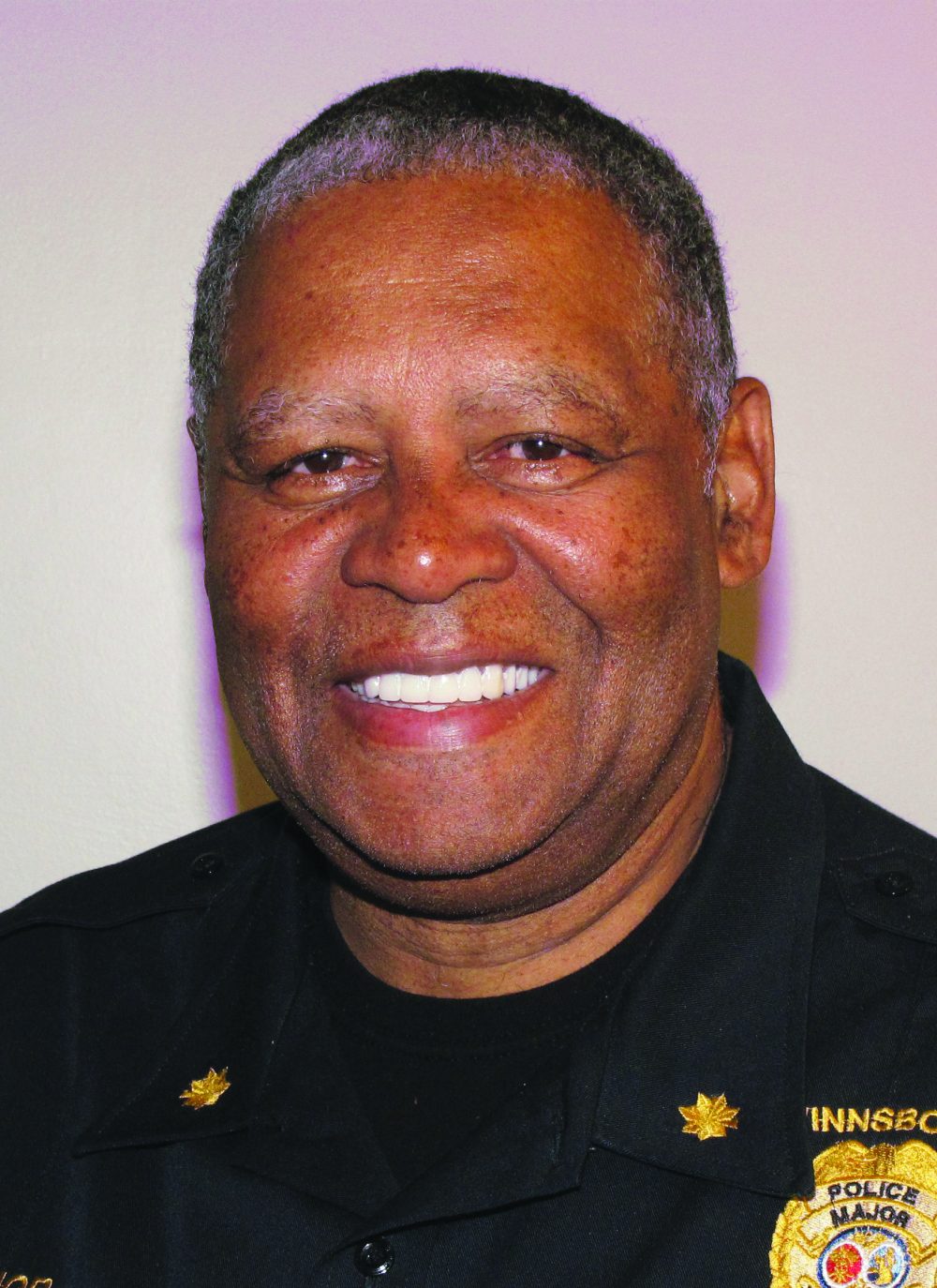
  • John Seibles named Police Chief

    John Seibles has been named Chief of Police for the Winnsboro Department of Public Safety. Seibles was appointed interim chief last October after his predecessor Freddy

    John Seibles

    Lorick, Sr. was arrested in a prostitution sting in Columbia.
    Lorick was charged with first-degree solicitation. His trial is slated for April 26 in Richland County.
    Winnsboro Town Manager Don Wood hired Seibles for the permanent position  on March 23.
    “I had applied for the position and, you know, it’s a small town and you hear little rumors, but the confirmation came and I guess I was not necessarily that surprised, but kind of sort of,” Seibles told The Voice last week.
    Seibles’ 42-year career in law enforcement began in the Fairfield County Department of Corrections and included a stint with the Town of Winnsboro from 1978-1982 and later with the Fairfield County Sheriff’s office. He also served 10 years as Director of the Fairfield County Detention Center and after his retirement he returned to the Winnsboro Police Department in 2003 as a Resource Officer.
    Seibles said his initial focus as Police Chief will be to upgrade his department, maintain the most up to date equipment and have more extensive training for his officers as well as finding the most qualified officers.
    “I think if we have the equipment, make sure we employ the most qualified people we can get, and make sure they’re trained in all areas, then I think we can provide a valuable service to the community,” Seibles said.
    Seibles said a strong working relationship between the Town Council and Police Department will be pivotal to fulfilling his desires for the department.
    “I am confident that we have a strong enough relationship to make that happen,” Seibles said. “I appreciate them (Town Council) so much,” Seibles said. “I enjoy the relationship, and they’re just awesome.”

  • Taylor:Everything is still moving forward

    After Westinghouse filed for Chapter 11 bankruptcy last week, there are questions about the fortunes of nuclear units 1 and 2 which are under construction and already behind schedule.

    WINNSBORO – After Westinghouse, the primary contractor for the two new V.C. Summer nuclear units, filed Chapter 11 bankruptcy in New York last Friday, options for continued construction of the units appear dim to grim. However, Fairfield County Administrator Jason Taylor told The Voice in an interview on Tuesday that, as far as the County is concerned, everything is moving forward for the present time.

    “We’ve heard all the rumors that everyone else has heard,” Taylor said, “but SCANA has kept us informed. We were told that Westinghouse would be declaring bankruptcy and that Fluor (Daniels) would be coming in to take over construction of the two new units from Westinghouse. We were told that while we would be hearing that large numbers of workers are being layed off from time to time, that’s normal because as one job, like welding, is finished, many more workers are hired for concrete work or another job.”

    Information released Tuesday by the S.C. Office of Regulatory Staff (ORS) listed some of the options being considered under a written plan being formulated by ORS. Those options include:

    -continue with the construction of both new units;

    -focus on construction of one unit and delay construction of the other;

    -continue with construction of one unit, abandon the other and seek recovery of the abandoned unit;

    -abandon the construction of the project.

    Taylor conceded that the significance of the bankruptcy on the County’s future could loom huge.

    “We’ll continue on. It (delayed or discontinued construction) will not devastate us as far as our continued operations. But it would have a huge impact on what we plan moving forward. Those nuclear reactors are critical to our citizens for jobs and to our tax base,” Taylor said. “We are very sensitive to all of this. The new units are critical to the future of Fairfield County.

    “We don’t want to lose any business, but especially not this one. With the agreements we have in place, the units have a big impact on the County’s future,” Taylor said. As for our planning process going forward, we’ve thought a lot about going in certain directions with our current budget. If those units were to go away, we would have to change our focus. Right now, we’re looking to plan projects and growth based on revenue that will be coming from the nuclear power plants.”

    The two new units were originally expected to come on line in 2017 (unit one) and 2018 (unit two.) Last year SCANA announced that the first unit is now not coming on line until 2021 and no date is set for the third unit. It was reported in The State newspaper that the project is $4 billion over budget and years behind schedule.

    Still, Taylor looks to the bright side.

    “The revenue from those units will allow our us to do a lot of things – we could pay off the GO bonds, invest in infrastructure. It’s all affected by revenue,” Taylor said. “We’re always concerned about economic development in general. It’s our largest industry, so it concerns us when things aren’t going as positively as we hoped they would. But, for now, we have no reason to think anything is going to change,” Taylor said. “Not from what SCE&G has told us.”

    An interim agreement between Westinghouse, SCE&G and Santee Cooper was filed with the New York Bankruptcy Court as part of the bankruptcy filings and approved on March 30. That agreement allows work to continue on the units during the transition period which has initially been set at 30 days according to a statement from ORS.

    “This agreement with Westinghouse allows progress to continue to be made on-site while we evaluate the most prudent path to take going forward,” said SCANA Chairman and CEO Kevin Marsh. “Fluor will continue as the construction manager during this period and they will continue to work towards completion of the units.”


  • Cameras to watchdog Doko Park

    The town has installed surveillance cameras in Doko Meadows Park after several incidents of vandalism and the arrest of a Blythewood man for second degree harassment of female joggers in the park.

    James Keegan, 40, was arrested Sept. 9, 2016 after several people reported that he was intimidating female joggers in the park. Keegan will have his day in court sometime this month after electing to have a jury hear his case.

    According to the incident report, Richland County Sheriff’s Deputies were dispatched to the park around 6:15 a.m. on Sept. 9, after three female victims complained of a suspicious grey or blue Chevy pick-up truck with a Braves license plate, following them around as they jogged around the park.

    As police were on their way to the scene, they witnessed Keegan’s vehicle make a left turn out of the park, then park his car on McNulty road. The officer confronted Keegan who, according to the incident report, began giving conflicting statements, but did indicate he had gone to the park recently.

    The incident report stated that Keegan was arrested, “due to the pattern of intentional, substantial and unreasonable intrusion into the daily routines of victims that served no legitimate purpose.”

    Allegedly the same vehicle had been described in other reported harassments for up to three months prior to Keegan’s arrest.

    Cecil Mosely, Director of Public Works for the Town, told the voice that there have been a number of incidents of vandalism in the park the last couple of years and the Town Council recently authorized the installation of cameras throughout the park.

    “The cameras, themselves, have proven to be fairly vandal-resistant after teenagers tried to destroy one. The kids were actually identified on the camera they tried to destroy,” Events and Conference Director Steve Hasterock said. “We have cameras throughout the park as well around Doko Manor.”

    “We are serious about protecting the park from problems,” Major Michael J. Ross said, “and when we catch perpetrators, we prosecute.”

  • Gaddy wins 4th term

    Dr. Roger Gaddy handily secured a fourth term as Winnsboro’s mayor with 272 votes, a little more than 62 percent of the 444 votes in Tuesday’s election. His only opponent, Bill Haslett, received 165 votes which amounted to a little more than 37 percent of the votes cast.

    Newcomer to politics, Janice Bartell, longtime Winnsboro business woman and owner of Vanity Stylon Hair Salon, received 88 votes to beat her rival, Tony Armstrong who received 16 votes. Bartell, who will represent District 2 on Town Council, replaces Stan Klaus who chose not to run due to health issues.

    John McMeekin, who ran unopposed in District 4 to replace Jackie Wilkes, received 196 votes. McMeekin is a former businessman in Winnsboro who for many years owned a furniture store on N. Congress Street.

    Gaddy, who had decided late to run for his office a fourth time, said he was happy to continue to be the town’s mayor and looks forward to new horizons for the town that he expects to improve with a new and better working relationship with County officials.

    “I’m looking forward to improving the infrastructure of Fairfield County and to being competitive with Richland County and Lexington in a lot of areas that we can now control. It’s an exciting time. There’s  not been a lot of cooperation between the County and the Town in the past, and I’m looking forward to us working together now. It bodes well for the future of the town and the county,” Gaddy said.

    “There’s no doubt we did the right thing going to the Broad River for water. I think it showed the County that the Town will take the lead to do what needs to be done,” he added.

    “We’re very glad to have Janice Bartell on Council. As a woman and as a downtown business person, she will bring new insight to Council. John McMeekin ran a business downtown for many years, and he’s smart. They will both bring a lot to Council,” Gaddy said.

    “In recent years we’ve had drought and water shortages which caused some problems for us,” Gaddy said. “Although we haven’t had money for things that would make an impact on the town, during my 12 years as mayor, we have never had a financial crisis.

    “I’m looking forward to the next four years,” he said.