RIDGEWAY – Town Council will will hold a public hearing and take a final vote Thursday night to amend the budget for the 2017-2018 fiscal year by 30.46 percent.
The Town’s current revenue will be amended from $744,200 to $970,900. However, the difference of $226,700 is not newly generated revenue, administrative consultant David Hudspeth told The Voice on Tuesday.
“This money is currently in the Town’s bank account, but not allocated in the budget,” Hudspeth said. The transfer was necessary, he said, to put it into the Town’s budget so it could be used.
Much of this additional revenue comes from the Town’s savings account. At the Dec. 14 meeting, Hudspeth recommended cashing in the Town’s CD’s and moving the proceeds into the general fund.
While Ridgeway Town Council voted 3-1 last month to purchase the Cotton Yard for $73,000 +, Councilman Donald Prioleau told The Voice afterward that, had he been present for the vote, he would have joined Councilman Heath Cookendorfer in voting against the purchase.
Prioleau said because of a prior commitment he had to leave the meeting before the executive session and had not thought the issue would come up for a vote that night since it was only on the agenda for executive session.
“I don’t think we need to be spending that kind of money right now,” Prioleau said. “And when we spend that kind of money, we need to give the public better notice. I understand that there has since been talk that the Pig on the Ridge steering committee is all for this and is considering throwing a lot of money into it, but that’s not exactly correct,” Prioleau said. “We said we would be interested in helping out on a depot-style building with an outdoor platform and maybe room inside for community gatherings, but the library thing came up much later. The only sketch I’ve seen of a library is not a depot-style building. And I am not interested in that,” Prioleau said.
“I also want to weigh in on the library location,” Prioleau added. “I’m all for a new library but as much as we need merchant space downtown and as congested as Palmer Street already is, we need to think about moving the library next to the park and ball field. A lot of children use the library and that would be a better location, near the park and it would not take up merchant shopping and parking space.”
Another member of the POR steering committee, Tom Connor, agreed that the park would probably be a better location for the library.
“I think the steering committee is most interested in a depot style building and also we would like to see a nice clock built in the downtown, in the Cotton Yard area,” Connor said.
The next Town Council meeting is set for Thursday, Jan. 11.
WINNSBORO – Before going into executive session Monday evening to discuss a contractual matter concerning a Memorandum of Understanding and proposed deed agreement between the County and the Town of Winnsboro aimed at renovating Mt. Zion for use as County office space, County Administrator Jason Taylor laid out the sticking point. To go forward with the project, Council would have to allow Taylor to sign a deed requiring the County to accept Mt. Zion from the developer should the renovation project prove, in the end, not to be feasible.
During the first public comment period, residents Shirley Green and Yvette Howard urged Council not to accept the deed to Mt. Zion. Their myriad reasons included: that the project would be wrought with challenges, that a Confederate monument faces the main entrance to the complex on College Street; that protests to the monument would be a major hindrance to economic development and that moving the County’s administration building would blight the Mill Village.
Taylor readily addressed the monument, saying the Town had agreed the confederate monument could be moved. When pressed for assurance of that, Taylor said he would have a document drawn up to request the Town to sign, giving up the monument at the same time he signed the deed.
Councilman Billy Smith said that while the Heritage Act, a S.C. statute, prohibits public bodies from moving monuments of any kind, there is no prescribed penalty for them doing so. Smith also said the property where the monument stands, which is separate from the Mt. Zion grounds, could also be transferred to 1st and Main, a private company seemingly not governed by the statute. And if, in the end, Smith said, the project does not move forward and the building must be demolished, the County will still own the land.
Taylor addressed the more pressing issue for the County.
“It has long been known that at some point in the near future, the County must address the need to improve and provide additional space for both the Courthouse, Sheriff and administrative functions,” Taylor said.
He said rehabbing the existing administration building would cost an estimated $2.5 million just to replace the roof and all the mechanical systems. He cited problems with the building including near-waterfalls down the back stairs during hard rains. That $2.5 million would not include more space or replacing an antiquated, possibly unrepairable HVAC system that, Taylor said, could go anytime. Taylor said it would cost $17 million to build a new courthouse on Congress Street, then relocate much of the courthouse staff to it before beginning renovation of the existing courthouse.
“With the abandonment of the two nuclear reactors,” Taylor said, “we cannot afford that. Renovating either the administration building or Courthouse, we are looking at considerable disruption to operations and significant cost associated with temporality relocating staff and services while the work is being done.”
Taylor said repurposing Mt. Zion’s school building poses a solution. He said it would increase the County’s office space by 10,000 square feet, cost less than renovating current offices and help revitalize downtown Winnsboro. He said a previous study commissioned by the County identified Mt. Zion as a catalyst for redevelopment, saying it would help improve the community and spur new growth.
“To explore this possibility, we began working with 1st and Main Development, a company that specializes in historic renovation and reuse,” Taylor said. “They have a successful track record of using historic tax credits to affordably redevelop old buildings. With their expertise and taking advantage of the tax credits, they can [renovate] the building far cheaper than we could.”
“The County’s lease agreement (rent-to-own) with 1st and Main would allow us to get the space we need in a timely manner and at a price that would not burden our budget or preclude our ability to pursue other important economic development and community projects,” Taylor said.
After a lengthy executive session Monday night, however, Council seemed no closer to reaching an agreement on signing the deed.
“There was no vote on the deed tonight because, collectively, we need a couple questions and concerns more fully addressed before making a decision,” Smith told The Voice following the meeting.
“These concerns are mainly centered on the nearby confederate soldier monument and what the State’s short-sighted Heritage Act does and does not allow pertaining to monuments on public grounds,” Smith said. “As long as all involved parties remain interested after the County is able to gain more information on these matters, the Council does plan to hold an up or down vote on the proposed deed agreement.”
BLYTHEWOOD – Town Council’s annual day-long working retreat may be a little larger than usual this year, and a little different. Mayor J. Michael Ross said on Monday that he and Council are making an all-out effort to include resident participation in this year’s event.
“The public has always been invited to our retreats,” Ross said. “But not many of them ever attend. This year, we want them to attend. Even if they cannot come for the whole day, maybe they can set some time off in that day to stop by and let their voices be heard. We can’t do what the people want if we don’t hear from them and know what they want,” he said.
The retreat will be held on Saturday, March 10 at Doko Manor. The day will begin at 9 a.m. and continue until approximately 4 p.m. or until all items on agenda have been addressed. This year will be somewhat different as an emphasis will also be on citizen involvement.
That involvement will be an item on the Jan. 24 agenda, Ross said.
“We’re going to look at including a citizen comment section after each discussion item during the retreat. And, as always,” Ross said, “there will be ample time during the meeting for open citizen comment, so whether a citizen comes for morning session or afternoon session they will be encouraged to engage with council.”
As further accommodation for citizen involvement, Council is arranging a community lunch from 12 noon – 1 p.m.
“We’re asking our local restaurants to help us out with a ‘taste of Blythewood,’ luncheon that day,” Ross said. “We want to sit and eat together and talk about the next year and five, even 10 years of ideas for the future of Blythewood.”
While residents are encouraged to contact Town Hall with any subjects they would like to be discussed by Council at the retreat, Council has already sketched out a preliminary list of topics.
“We’re going to talk about the plan of Columbia and Richland County to form a consolidated government and what that will mean for us,” Ross said. “It might be beneficial to our 29016 Blythewood neighbors to annex into the Town so they can vote and to pre-empt Columbia and Richland County’s plan that could possibly force the annexation of those neighbors into Columbia,” Ross said.
He also wants to talk about creating a new baseball/softball complex in the Town to host tournaments.
“Blythewood has some of the best players and coaches in the country, as evidenced by our recent State Championships and World Series successes,” Ross added. “The fact that they are training/playing on fields built in 1979-1980 should embarrass us all.”
“The Planning Commission will soon be updating the Comprehensive Land Use Plan for our community,” Ross said. “This could include any insights we have from the Central Midlands Council of Governments regarding the realignment of Blythewood Road and Langford Road and maybe some renderings of what McNulty Road could look like after the Penny widening projects are completed.”
Ross said the list also includes discussing a multi-use trail plan and a vending stand ordinance.
“Another thing may be pre-budget development for some proposed budget items/projects that some members of the community would like to see come to fruition,” Ross said.
Another topic that Ross suggested might be on the table for discussion is an economic development report on potential development of businesses on Blythewood Road vacant lots.
“We just want folks in the community to make plans to join us. Let us know you’re coming so we’ll know how to plan. But please attend,” Ross said. “We’ll be shaping the next year and years to come.”
Members of the community can email their ideas for discussion topics to townofblythewoodsc.gov or call Town Hall at 803-754-0501 and ask to speak to Julie Emory.
BLYTHEWOOD – After approving a three-month extension in November on the Holly Bluffs surety bond at the request of developer DR Horton for storm water work, Horton came back to Council on Dec. 19 requesting an additional six-month extension so it could make additional repairs to the storm water facilities (inlet/catch basin) at the same intersection – the corner of Bumble Bee Court and Summers Trace.
In a letter to Town Hall, Brian Hallman, Land Development Project Manager for DR Horton, stated that the developer had been on track to complete all necessary repairs within the first three-month extension but that other work is now required.
“Since then, we have learned that Richland County wants us to redesign the intersection of Summers Trace and Bumble Bee Court,” Hallman wrote. “There is an issue with the original design that is causing the intersection to hold water during rain events. We are currently working with our engineers and the county to come up with a design solution to fix this problem.”
Hallman told Town Hall that he didn’t believe Horton could complete the work by the end of January and asked for an additional six-month extension.
“We certainly want to see the work completed,” Town Administrator Gary Parker told Council, “and there is no harm to us in extending the time. We will either have to grant another extension of the surety bond or collect the bond amount.”
However, Michael Criss, the Town’s Planning Consultant, said he would favor another three months instead of six months to help press the developer to finish the project.
As it turned out, when DR Horton came to the council meeting on Dec. 19, Council discovered that Horton’s paper work was lacking in details about the work to be performed and tabled the item until the next town council meeting which is scheduled for Jan. 22, 2018, at 7 p.m., at Doko Manor.
RIDGEWAY – Following executive session at the Dec. 14, 2017, Town Council meeting, Ridgeway Council voted 3-1 to purchase the Cotton Yard property from Norfolk Southern Railroad for the contracted price of $73,000. However, that price does not include surveying, attorneys’ fees and other fees that could bring the total cost of the property closer to $90,000, a source with knowledge of the transaction told The Voice.
Councilman Cookendorfer voted against the purchase, and Councilman Donald Prioleau left the meeting prior to the vote. Mayor Charlene Herring, Councilwoman Angela Harrison and Councilman Doug Porter voted for the purchase.
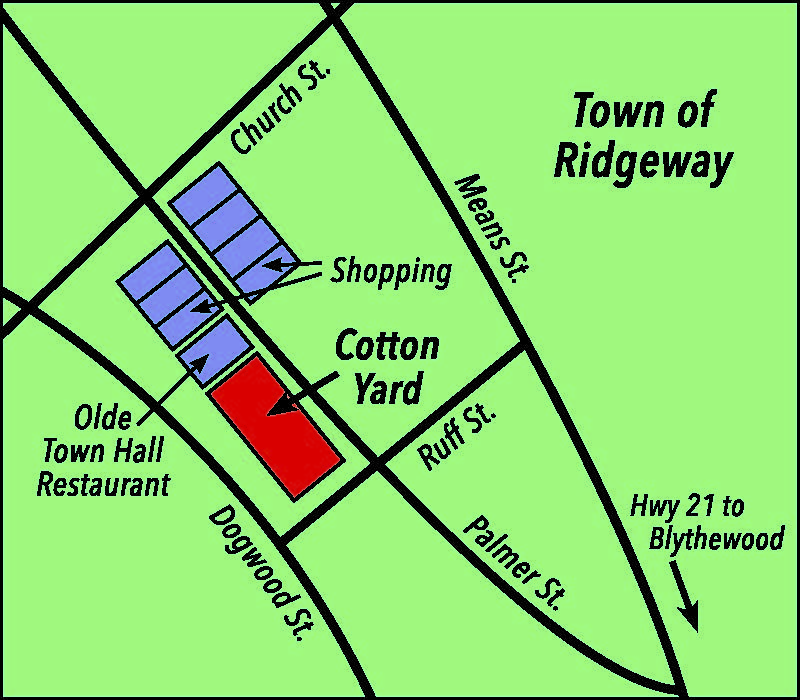
The approximately 1/2 acre Cotton Yard lies just off Palmer Street and between Olde Town Hall Restaurant & Pub and Ruff Street. | Graphic/Ashley Ghere
How the Town came to be staring down the barrel of a $73,000+ purchase price of a property that it had utilized for free for decades dates back to 2014, when then-Councilman Russ Brown and other council members accused Mayor Charlene Herring of officially contacting Norfolk-Southern about a company parking trucks on the lot without notifying Council. The lot is directly in front of her residence.
Rufus Jones, former mayor of Ridgeway and a political opponent of Herring told The Voice that he sometimes parks his sod truck on the lot.
Herring said she had received questions from members of the community about trucks parking on the lot. She did not identify those community members.
“But there were also citizens who were against contacting Norfolk-Southern, and Council members here were against contacting Norfolk-Southern,” Brown told Herring.
It was reported in the Dec. 19, 2014 issue of The Voice that Cookendorfer said that Council had, indeed, agreed to break off discussions with the railroad at a previous meeting.
Mayor Accused of Poking Giant
“We were done with it,” Cookendorfer said, accusing Herring of contacting Norfolk-Southern against council’s wishes.
“That’s what woke the sleeping giant to where we’re at today with basically [Norfolk-Southern’s] demand to take on [a] lease. That’s something we should have discussed as a council,” Cookendorfer said.
Herring countered that she made initial contact with Norfolk-Southern several months earlier after unnamed citizens came to her with concerns about cars for sale parked on the property as well as a truck on the lot.
“If citizens contacted you, under protocol you should have brought that to the council and council would say if we were going to contact Norfolk-Southern,” Councilman Donald Prioleau said.
Herring said that in the future, she would adhere to protocol, but followed that by asking, “As a right of a citizen or a mayor, why can’t you contact the railroad? This is in the heart of our town.”
“September [2014] it was brought up in this room we said ‘do not bother Norfolk-Southern anymore, because they will put up a fence’.” Brown said. “They’ve threatened to do it before, and they’ll still do it if you bother them. Don’t toy with the railroad.”
Herring said she told Council at the September meeting that she would be pursuing questions about leasing the property from the railroad and no one objected.
“In September you didn’t have the lease,” Brown said. “The lease was presented in October. But that had already got to the point where Norfolk-Southern sent a lease because there was communications back and forth.”
Herring said the Town had to have a copy of the proposed lease in order for the document to be reviewed by an attorney.
“Again, in the capacity of mayor, you went to an attorney without Council (knowing about it),” Brown said.
But Herring said she also informed Council that an attorney would be reviewing the lease, and no one had objected to that either.
Don’t Bother Norfolk-Southern
“But this conversation came from you, in the capacity of mayor, (talking) to Norfolk-Southern, which led to them providing a lease,” Brown said. “We, at every single meeting when Norfolk-Southern was brought up, we all said don’t bother Norfolk-Southern.”
Brown said the proposed lease had sat idle with the Town for a month. Then, during the October meeting, Council reviewed the document and opted to not move forward with the lease. The day after the meeting, Brown said, Herring contacted Norfolk-Southern via email.
“Telling them we were not going to pursue a lease,” she said.
“After we said not to communicate,” Brown said. “And then they sent their email back, basically giving the Town the ultimatum that if we do not lease the property, accept responsibility for the lot, accept liability for the property, then they will have the lot fenced off and the buildings removed.”
Herring said Norfolk-Southern is currently reviewing all of their properties, and eventually Ridgeway would have been forced into an official lease. Several buildings, including the world’s smallest police station and the fire station, had been constructed on the property without permission from the railroad, and Herring said it simply was not right for the Town to continue to use the property without the blessing of Norfolk-Southern.
“Eventually this would have happened,” Herring said. “And this came sooner because I did ask some questions. But eventually it would have happened.”
Herring said the railroad company needed an answer as to the Town’s choice of direction on the lease, and she was only doing the courteous thing by letting them know Ridgeway was not interested in signing a lease.
“Again, back to the form of government discussion we just had,” Brown said, “we’re not a strong mayor form of government, and as a council we chose to let it lie.”
Cookendorfer said it would have been preferable to let the railroad force the issue instead of the Town taking the lead.
“I think ya’ll are making the issue at the wrong point,” Herring said. “You made an issue about the form of government and I understand that, and I will tell you sometimes Charlene Herring errs because she is very compassionate about this town and wants to get things done. And I agree, we are a council and we will act as council. I think you’re pulling at straws now and you’re trying to blame (me) instead of doing the right thing. I’ve got the point and I think we need to move on. If you don’t want to sign the lease, don’t sign the lease.”
“You call it compassion, I call it total disregard for Council,” Brown said. “It’s not the end of the world that we’re going to have to lease the lot, but how it was handled…”
Herring reiterated her point that had she not received questions from citizens about the lot she never would have contacted Norfolk-Southern in the first place. But Brown once more pointed out that an entirely different group of citizens had urged the Town to keep mum on its use of the property. At that point, Roger Herring had heard as much as he could stand from his seat in the audience.
“The Rufus Joneses of the community!” Roger Herring, a former Council member and husband of the mayor, erupted. Brown told Roger he was speaking out of order, but Herring continued his defense of the mayor.
“You don’t do the community organization she does,” Roger Herring said, even as the mayor brought down the gavel. “You (Council) don’t do what you’ve already agreed to do!”
As the mayor attempted to restore order to the small Council chambers, Roger Herring stormed out, slamming the door of the Century House behind him.
“Now, do we need any further discussion on it?” the mayor asked.
“I just wanted to bring it up now,” Brown said, “so the people who are going to be paying for that insurance and paying for that lease when they pay their taxes and their water bills, they know where their money is going and why.”
From Lease to Purchase
Since 2014, the Town has paid Norfolk-Southern $1,000 annually for insurance and lease of the Cotton Yard. Recently, however, Council changed its position on the Cotton Yard. It hired an attorney last year to approach Norfolk Southern about purchasing the front portion of the Cotton Yard property where the police and fire stations are located.
The railroad company’s answer came in the form of an email on April 12, 2017, from a Norfolk representative to the Town’s attorney in the matter, Jim Meggs.
“Would the Town of Ridgeway be interested in purchasing the whole parcel shown on the attached [exhibit]? It is not in the best interest of Norfolk Southern to sell only the front of the parcel, losing the street frontage. We could agree to letting the whole parcel go for $35,000,” the representative wrote.
After considering the offer during executive session on April 13, 2017, Council voted in public session to go forward with the offer. However, while it was noted in the June, 2017 Council meeting that the town had allocated $40,000 for the railroad purchase, survey and legal fees, the sale has never materialized.
Purchase Price Jumps
The railroad company has now jumped the price to $73,000 and it is estimated that legal fees, surveying and other extras could increase the total cost of purchasing the property by another $15,000 – $20,000.
While Council has held numerous executive sessions on the purchase of the Cotton Yard, there has been no public comment about why the price has more than doubled.
Councilwoman Angela Harrison reported to The Voice in an email on Thursday that no further vote, ordinance or resolution is needed on the purchase, that the vote on Dec. 14 was the final vote. The next Council meeting is scheduled for 6:30 p.m., Thursday, Jan. 11 at The Century House.
NOTE: This story includes excerpts from another story that appeared in a December, 2014 issue of The Voice.
WINNSBORO – On Nov. 21, Winnsboro Town Council voted to accept a Memorandum of Understanding (MOU) between Fairfield County and 1st & Main Development of Durham, N.C., regarding the revitalization of the Mt. Zion property.
The MOU was proposed by Councilman Billy Smith last summer, but before it could be voted on, Council was distracted for several months by the VC Summer abandonment. The MOU, which did not require Council approval, was later signed by County Administrator Jason Taylor on Nov. 11.
According to the MOU, the Town of Winnsboro would deed the 3.27-acre Mt. Zion property and buildings to 1st & Main Development for the purpose of rehabilitation. The plan, according to the MOU, is for 1st & Main to be given 180 days to come up with a plan to develop the property. There is also a provision for additional days, should the project be on track but needed a reasonable extension of time. After the property is developed, the County would begin leasing it back from 1st & Main for use as a government complex. Through the lease agreement, the County would eventually own the rehabilitated property.
The MOU states that “[Town] Council believes it is in the best interest of the citizens of Winnsboro that surplus public property with historic significance to the Community, be revitalized and put to private uses that blend with the residential neighborhoods while creating jobs and bringing quality commercial enterprise to the Town.”
While Winnsboro Town Council has voted to accept the MOU between the County and 1st & Main Development, there is a significant bump in the road before the property deed would be binding. The deed, as it has been written by the Town of Winnsboro, stipulates that if, for some reason, 1st & Main Development does not move forward with the rehabilitation of the Mt. Zion property, ownership of the property would be assumed by the County.
“That deed would have to be approved by a vote of County Council before it could be signed by the County Administrator,” Council Chairman Billy Smith said. “I don’t know what the outcome of that vote will be, but I’m not in favor of the property becoming the County’s should the project not materialize.”
Smith was said he was not sure when the matter would come to Council for a vote.
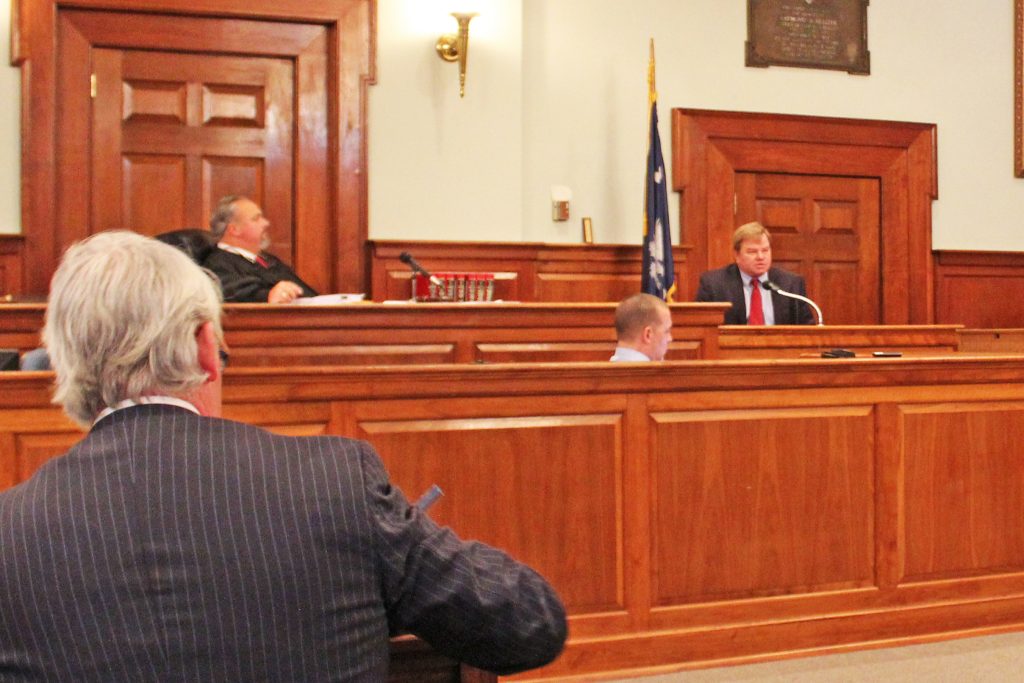
WINNSBORO – Fairfield County faced off with attorneys for South Carolina Gas and Electric (SCE&G) last week in Common Pleas Court in Winnsboro before Sixth Judicial Circuit Judge Brian Gibbons.
Lawyers for the County called for the immediate issuance of a temporary injunction against SCE&G based on what the County says is the power company’s failure to comply with the terms of the County’s fee-in-lieu contract with SCE&G. The county also asked for an immediate, temporary restraining order to prevent SCE&G from abandoning the project at V.C. Summer nuclear plant and not protecting the assets at the plant.
Fairfield County’s Director of Economic Development, Ty Davenport, explains the economic impact of the VC Summer abandonment on the County.
At the heart of the County’s concern is getting access to the plant so it can assess all aspects of the property.
Terry Richardson, Jr. of Richardson, Patrick, Westbrook & Brickman law firm, one of two law firms representing the County in the lawsuit, said the County is only asking to hold the status quo until it can assess the property. He said the County has been trying to get access but that SCE&G hasn’t responded.
Judge Gibbons determined that it is the County’s right, according the Fee-in-Lieu agreement to have full access for the purpose of assessing the property.
Richardson said the County is eager to go in the following Monday (Dec. 18) to begin the assessment. Gibbons said he planned to have a ruling on Thursday, Dec. 21, and asked Richardson to have the evaluations and assessments back to him by Wednesday, Dec. 20.
“We were ready to take our county assessor, Randy Roberts, and a team of assessors from the State Department of Revenue in with us on Tuesday,” County Administrator Jason Taylor said on Wednesday. “But even though SCE&G promised to give us access, they have not given that access yet. We don’t know when we will be allowed in. A lot of things are happening in Columbia right now. We need to talk to the attorneys to see what the outcome of this thing is going to be. We were supposed to have the information back in to Judge Gibbons today (Wednesday, Dec. 20) and be back in to court for his ruling tomorrow, so I don’t know when that’s going to happen,” Taylor said.
Richardson said there is immediate concern, as well, that SCE&G is turning in its nuclear license for the two reactors, a $9 billion issue for this county.
“That would have tremendous ramifications for the County,” Richardson told the Court. “We want to get our County people out there evaluating that property and take a look at it, inspect and evaluate it. We need all that to be done before the license is turned back, before there is complete and total abandonment of the site. There may be pollution issues, permits may be needed,” Richardson said. “We want to hold the status quo.”
According to sources who asked not to be quoted, there is speculation that SCE&G could soon be turning its license over to Santee Cooper.
“The license is a huge asset and we want to slow the process down before they turn it in,” Taylor said. “We hope to work with the governor and the state for a good outcome.”
The County’s lawsuit alleges breach of contract, fraud negligent misrepresentation, breach of fiduciary duty and unfair trade practices. The County claims that SCE&G’s expressed intention to abandon the project and dispose of the properties, plus abandon regulatory permits and licenses by year’s end in order to gain a tax advantage, deprives the County of determining what potential tax and license fees could be due from the property within its jurisdiction and may leave dangerous or potentially dangerous conditions to the County’s citizens.
Judge Gibbons told attorneys for both parties that his ruling, when it is given, will be only temporary.
The McDonald McKenzie, Rubin Miller and Lybrand law firm is also representing the County.
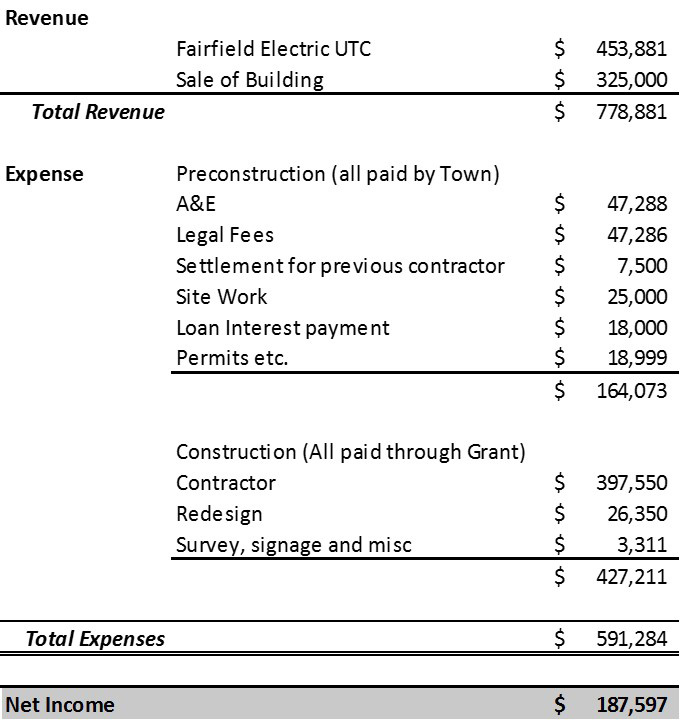
BLYTHEWOOD – Town Council finalized the sale of the Doko Depot property Tuesday evening and issued information that showed the Town had a net income of $187,597 from the sale.
“From January, 2017 until September, 2017, we were involved in serious discussions with a local restaurateur to purchase the property,” Mayor J. Michael Ross said. “Unfortunately, those negotiations did not come to pass. So we approached a Columbia developer, Wheeler and Wheeler, LLC. After much consideration, Mr. Wheeler came up with a plan as well as prospective tenants and we are in the process of accepting his contract for sale,” Ross said.
Financial Summary
The proposed sale price is $325,000 for the building and land underneath and included covenants and restrictions on the current and future uses of the property. While the property is in the Town Center District (TCD), all of the TCD uses are not available to this property.
The previous Town Council and Administration approved the concept of designating a portion of the Doko Meadows Park as a business park. The first step in development was to attract an upscale restaurant which, Council hoped, would in turn stimulate other private developers to invest and construct office and/or retail in the area.
The initial plan was to construct a 5,000 square foot building and lease the facility to Sam Kendall’s, a successful restaurant in Camden. Next, the Town approached Fairfield Electric Cooperative and requested assistance through their grant program available through the Utility Tax Credit Program. The Town would borrow the balance needed to complete the building.
The Town’s received grants totaling $456,881.29 from annual Coop allocations in 2013 and 2014. Santee Cooper loaned the Town $900,000. That brought the project revenue to $1,356,881. While Town staff began pre-construction matters and final negotiations of the lease with Same Kendall that was to cover all costs borne to include the building, improvements and all other costs absorbed by the Town, there were other costs.
The Town paid $47,286 for architectural and design, $32,000 in attorney fees for the loan and $25,500 for site work. A contractor was selected and was prepared to begin.
In early 2014, newly elected Town Council members questioned the feasibility of the Town bearing the liability owning the debt and looked to the prospective buyer to do a take out at completion. Negotiations failed, and the Town elected to abandon the project as designed.
“We repaid the Santee Cooper loan principal as well as the interest payment for the year it held funds,” Ross said. “We paid $900,000 plus the $18,000 interest payment.”
The Utility Tax Credit assigned to the Town could not be returned without a severe penalty payment. In 2016, Council decided to use the $456,881 to build a spec shell building. A survey of the community concluded that a restaurant would be the most popular choice for the building.
The size of the building was reduced to meet the new budget. Lyn Rich Construction began work in the early fall of 2016 and the building was completed in late spring, 2017 at a final cost of $397,550.
RIDGEWAY – Upon the recommendation of the Town’s interim administrator David Hudspeth, Ridgeway Town Council passed first reading (3-1) last week to amendment the 2017-18 budget to transfer $500,000 from the General Fund to create a $300,000 Capital Expenditures Fund and transfer $200,000 to the Water Fund. Hudspeth’s recommended budget would also increase the Professional Services line item from $6,000 (for the auditor) to $26,000 to include the auditor’s fee plus funds for legal fees (over $4,500 so far for attorney’s advice regarding town hall dog) and Hudspeth’s professional fees ($16,000 for 30 days of work).
The amended budget was prompted after Council had spent more than $113,000 since June, 2017, from a capital improvements fund that did not exist. Councilman Heath Cookendorfer voted against the amendment and Councilman Don Prioleau left just before the vote and did not cast a vote. Mayor Charlene Herring and Council members Andrea Harrison and Doug Porter voted for the amendment.
Other recommended amendments to the budget include adding $100,000 to the budget for grant matches and designating $100,000 of the new $300,000 Capital Expenditures Fund for fiscal year 2017-18 for projects already considered. The remaining $200,000 in the Capital Expenditures Fund is designated by Hudspeth for “Future Capital Improvements” even though it is included in the FY 2017-18 budget.
Liquidate Town’s CDs
To accommodate these and other amendments to the budget, Hudspeth recommended liquidating all the Town’s CDs, about $409,000, as they become mature and transferring the resulting cash into the unrestricted General Fund which would be $294,600 as amended.
“I think the checking account balances are pretty low,” Hudspeth said. “Liquidating those CDs will allow you to put money in your checking account.”
Referring to the $300,000 Capital Expenditures Fund, Hudspeth said, “That’s what you can spend without worrying about payroll and other things you have to pay regularly. You want to have a healthy capital fund.”
In addition to liquidating the $409,000 in CDs, Hudspeth also suggested cashing in the $55,469 Pig on the Ridge CDs and putting the cash in a separate account. However, those funds would still be in the General Fund and could be spent for anything that comes out of the General Fund.
“I don’t agree with cashing in the CDs,” Cookendorfer told Hudspeth. “Once we cash them in, they’re gone. I would like to see the Pig on the Ridge funds actually restricted. Being in the General Fund, it can be borrowed if we run short on other things. I don’t like that. We need to quite buying shutters and some of those things and concentrate on some of the expensive things like the water tower and other things that we really have to move on.”
The final vote on the amended budget will be held at the January meeting, 6:30 p.m., Jan. 11 at the Century House.
Other Business
In other business, Council passed second and final reading on an ordinance to amend the Town’s Code of Ordinances to modify Section 5-1006, Observance of Truck Routes Required: Exceptions. Council also passed the first of two votes to lease the shop behind Old Town Hall Restaurant to the Barclay School for $250.
WINNSBORO – A lawsuit filed on Nov. 29 by the attorneys for Fairfield County for a temporary injunction against SCE&G/SCANA is scheduled to be heard in Common Pleas Court in Winnsboro on Friday.
The suit calls for the immediate issuance of a temporary injunction based on SCE&G/SCANA’s failure to comply with the terms of the County’s fee-in-lieu contract with SCE&G/SCANA, and also an immediate, temporary restraining order to prevent SCE&G from abandoning the project at V.C. Summer nuclear plant and not protecting the assets at the plant.
The lawsuit alleges breach of contract, fraud, negligent misrepresentation, breach of fiduciary duty and unfair trade practices.
The County claims that SCE&G/SCANA’s expressed intention to abandon the project and dispose of the properties, plus abandoning regulatory permits and licenses by year’s end in order to gain a tax advantage, will deprive the County of determining what potential tax and license fees are or could be due from the property within its jurisdiction and may leave dangerous or potentially dangerous conditions to the County’s citizens.
The suit contends that if regulatory permits or licenses are abandoned, that may deprive the County of the benefit of others completing the project and assuming SCE&G’s obligations to the County per the parties’ agreement.
In a statement issued on Nov. 21, the County stated that, in July of 2010, the County and SCE&G entered into a fee-in-lieu of taxes agreement. That gave the utility preferential tax treatment by the County in exchange for future payments of fees by SCE&G to the County once the new nuclear units were generating power.
In reliance on the agreement, according to the statement, Fairfield County undertook a number of long term financial obligations including the issuance of $24 million in bonds to finance multiple construction projects and upgrades in anticipation of SCE&G’s operation of the plants.
The County states that SCE&G’s decision to abandon the projects has left the County with significant obligations that would not have been undertaken but for the company’s representations to the County, according to the statement.
Also, according to the statement, the decision will cost the County millions of dollars of lost revenue from the abandonment of the fee in lieu of taxes agreement.
“The Council owes it to the citizens of our County to do whatever we can to recoup the financial losses created by SCE&G’s decision to abandon the project,” Smith said. “The goal of this litigation is to get the County closer to the position it would have been in had SCE&G/SCANA acted in good faith, diligently completed these projects and not chosen to abandon the construction of the plants,” Smith said.