Category: Government

  • Winnsboro Town Council OKs water for BW senior center

    Winnsboro Council OKs water capacity for proposed Senior Center in Blythewood

    WINNSBORO – A 64-room senior living facility proposed for downtown Blythewood crossed a major hurdle Monday night when the Town of Winnsboro voted unanimously to approve a Water Capacity Availability and Willingness to Serve Letter for The Pendergraph Companies. The letter approves 11,520 gallons per day (GPD) for the facility.

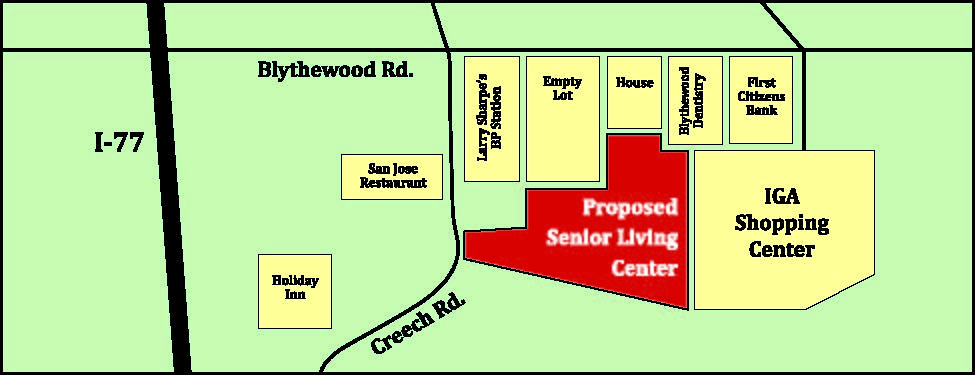
    The facility, to be named Blythewood Senior Living, is proposed for a five-acre site on Creech Road between the Russell Jeffcoat offices and the IGA and behind Larry Sharpe’s BP service station and three other lots facing Blythewood Road.



    According to Tom Ulrich, the project manager for the proposal, the water capacity is based on 32 two-bedroom apartment homes and 32 one-bedroom apartment homes. Ulrich told The Voice following the meeting that the facility would be for residents who live independently.

    “The rooms will all be in one building, like a hotel,” Ulrich said.

    Ulrich came before the Blythewood Town Council in the fall of 2017 to give Town Hall a heads up that his company was considering bringing a senior living facility to the town. Ulrich told The Voice that the company has been in discussions with Town officials for some months.

    “I wrote a reference letter for the developer stating this would be great for our town,” Mayor J. Michael Ross said, “but that we are not advocating for any more affordable living apartments. We are very excited that this facility might come to Blythewood.”

    “The project looks very positive from the developer’s perspective,” the Winnsboro’s utility attorney, John Fantry, said. “They’ve already built one of these facilities in Lancaster County. Now they’re taking that vision to Blythewood. They are currently doing due diligence for financing on a tract of about 52 acres on Creech Road. The developer will be coming back to us when financing is worked out. This particular request is to provide assurance to their financing process that Winnsboro does have the capacity to serve the proposed facility’s water needs,” Fantry said.

    Ulrich said he expects the project to be complete by the end of 2019.

    “We should have our water from Broad River by then,” Mayor Roger Gaddy said. “We oughta have all kinds of water to sell.”

  • Deadlines tighten on vendor regulations

    BLYTHEWOOD – On Monday night, the Planning Commission once again tackled the question of what policies, procedures and guidelines the Town government should put in place for itinerant vendors who want to set up shop in the Town Center District.

    And, once again, the Commission punted.

    Commission Chair Donald Brock opened the issue by questioning whether the discussion should be put off until the Blythewood Chamber members could have a seat at the table.

    Commissioner Rich McKendrick, however, questioned whether it is appropriate that the Chamber be in the mix during a regular meeting of the Commission. He suggested a workshop might be the more appropriate place to include so-called stakeholders on the issue.

    “I’d say the Chamber position would be to get as many businesses into town as possible for more revenue,” Brock said. He also suggested earlier in the meeting that the Commission should question whether they, ultimately, even want itinerant merchants doing business in the town.

    “Once that question is answered, it will steer us in the direction of where we want to go,” Brock said.

    While Town Planning Consultant Michael Criss listed some of the pluses of street vendors (they add interest and pedestrian traffic to the TCD), he also said there are concerns about the aesthetics of unregulated vendors and referenced Grace Coffee.

    “However, the coffee vendor (Grace Coffee) was approved for a Certificate of Approval (COA) last year [April, 2017], by the Board of Architectural Review (BAR),” Criss said.

    A loophole in the Town’s code of ordinances paved the way for Grace Coffee, a vendor housed in a small turquoise and white mobile home on Main Street in downtown Blythewood, to do what no other business in town has been able to do – receive a COA without meeting the Town’s architectural review standards.

    It appears the Town’s ordinance regulating architectural review in the Town Center District (TCD) did not have well-defined regulations for mobile vendors.

    “We were asked to give a COA without guidelines,” BAR [then] Vice Chairman Jim McLean told The Voice. “We (the BAR) did not want to do that because a COA is permanent. We grappled with it, and we did all we could do, considering the Town has no architectural review standards in place for mobile vendors,” McLean said. “The Town was caught off guard.”

    Instead, the BAR agreed to grant a one-year conditional COA to the business to give the Town Council time to draw up standards and an ordinance for mobile vendors. That year will be up on or about April 17, 2018 and the Commission is no closer to forwarding a draft ordinance on the issue than it was a year ago.

    At issue, according to Criss, is the definition of ‘structure’ in the Town’s code of ordinances.

    “Structure’ is very broadly defined in the code, yet this mobile vendor is a ‘structure,’ and because it is in the TCD, it must have a COA from this Board for its exterior appearance,” The Town’s Planning Consultant Michael Criss told the Board in April, 2017.

    While brick and mortar buildings in the Town Center District must adhere to guidelines for paint color, lighting, whirly gigs and other exterior architectural features, Grace Coffee was not required to meet any of those standards, Criss said.

    However, McLean said the coffee vendor’s COA is based on how it currently stands and that it cannot make further (substantive) changes in its appearance going forward without coming back to the BAR.

    Newly installed Board Chairwoman Pam Dukes then asked how the sign allowances would be applied to Grace Coffee.

    That, too, turned out to favor the vendor over the town’s brick and mortar businesses.

    “It’s clear what the regulations are for permanent structures that are affixed to the ground,” Criss said. “The landlord gets one monument sign freestanding out in the front yard and one wall sign on the facade facing the street.”

    Those signs, according to the Town’s code must meet specific size and quantity guidelines.

    “But it’s not crystal clear what the sign limitations are on a mobile unit such as a trailer,” Criss said.

    Grace Coffee usually has four signs displayed – one at each entrance, one on the trailer and a menu sign in front of the trailer.

    “Suppose they were frying chicken in there,” McLean asked, referencing a discussion the Board had earlier in the meeting with Kentucky Fried Chicken officials who are looking to make major exterior renovations of the KFC in downtown Blythewood.

    “I’m trying to go back and grab the fairness. We just turned down Kentucky Fried Chicken about what they can and can’t do (with signage),” McLean said, pointing out that brick and mortar businesses in the Town are held to higher standards.

    The discussion has been ongoing ever since Grace Coffee pulled in to town in December, 2016 and set up shop in the parking lot of Bits and Pieces consignment store.

    “When we initially talked with them (Grace Coffee), they said they were going to take the trailer away each night. But now it sits there,” Mayor J. Michael Ross told Council in January of last year. “It’s another example of how a vending stand comes in and is just left there. It’s frustrating.”

    At the February, 2017 meeting, Grace Coffee’s owner Bret Beyer added another dimension to the mobility issue, telling Council members that the stand was no longer mobile, that it could not be moved.

    While a one-year temporary vender ordinance was passed in March, 2017 and Grace Coffee’s one-year COA is set to expire in April, and the Planning Commission is charged with coming up with draft standards [ordinance] for mobile vendors for recommendation to Town Council before those one year terms expire, expectations are growing slim that a new, permanent vending ordinance will be in place to meet those deadlines. The issue is not expected to be brought up for discussion again until Town Council’s annual retreat on March 10.

  • Six candidates file for RW election

    RIDGEWAY – With the filing deadline ending on Feb. 2, four candidates have declared for the two open seats on Ridgeway Town Council and two have declared to run for mayor.

    These candidates will be on the April 3 ballot: Council – Roger Herring, Rick Johnson, former mayor Rufus Jones and Dan Martin; Mayor – Councilman Heath Cookendorfer and Councilwoman Angela Harrison. Terms are ending for Cookendorfer and Doug Porter.

    Both the council seats and the mayor’s seat are for four year terms. The election is nonpartisan, and no party affiliation will be placed on the ballot.

    The election will be held on Tuesday, April 3, at the Ridgeway Fire Department, 170 S. Palmer Street. Polls will be open from 7 a.m. – 7 p.m. that day.

    Those desiring to vote in the upcoming election must be registered by March 5, 2018, at the Fairfield County Board of Voter Registration, 315 S. Congress Street in Winnsboro.

    For more information, call 803-337-2213.

  • SCE&G asks for venue change

    WINNSBORO – South Carolina Electric and Gas Company has filed a motion for a change of venue for the lawsuit Fairfield County filed on Nov. 29, 2017 against the utility for a temporary injunction.  The matter is to be heard on Thursday before Judge Paul Burch.

    “SCE&G is asking to have the trial moved to Lexington County since they’re based in Cayce,” Fairfield County Administrator Jason Taylor told The Voice on Wednesday. “That would be more convenient for them, but we, of course, don’t want to do that. Fairfield is where the incident occurred, this is where we work and live and there would be many inconveniences for our council members if it were moved,” Taylor said.

    Council members signed affidavits on Monday stating their particular inconveniences, health problems and other reasons why it would be difficult for them to travel to Lexington County for a trial.

    “We’ve submitted the affidavits to our attorney, and he will submit them to the judge on Thursday,” Taylor said. “Hopefully, the judge will rule on Thursday, but at this point, we don’t know.”

  • County OKs deed for Mt Zion

    WINNSBORO – County Council voted 5-2 Monday night to accept transfer of the deed for the Mt. Zion property from 1st and Main Development Group, should the renovation of Mt. Zion prove, in the end, not to be feasible. Mikel Trapp and Neal Robinson voted against the County accepting the deed.

    During County Council time, however, Robinson said, “I’m definitely for the renovation of Mt. Zion because I see the potential. We definitely have to move forward with it. This [current administration] building is falling apart. I helped put out two fires here when I was with the Sheriff’s Department,” he joked.

    Robinson said he received many emails concerning the vote.

    “And I got more emails for the renovation than I got against it,” Robinson said.

    Trapp said he needed more information on the project.

    The vote paved the way for the County to explore the possibility of restoring the dilapidated school building to accommodate a county complex that would include 10,000 square feet of office space over what the county now has. The cost of that exploration would be borne by the developer who has 180 days to come up with a plan and a price for the project with an allowance for extra time if needed. If the County agrees to the proposed plan and price of the renovation, the developer will proceed with the project, bearing the entire cost to completion.

    At that point, under a lease/purchase agreement, the County will lease the facility from the developer until the renovated property is paid for, after which time the County will own the property and building.

    “Should the County not decide to go forward with the project,” County Council Chairman Billy Smith clarified following the meeting, “the deed would transfer to the County and it would be the County’s responsibility to demolish the building, if desired.”

    Smith also said there had been discussions with Town of Winnsboro officials who had expressed a willingness to share in the cost of the demolition of Mt. Zion, estimated at around $200,000, if necessary.

    While two residents, Shirley Green and Renee Green, spoke during public comment time, asking Council to not accept the deed and to not go forward with the renovation, resident Pat Curlee spoke in favor of the renovation.

    “Construction of an administration building is not an economic driver for downtown Winnsboro,” Shirley Green said. “The administration building is already in the town…Everything is hypothetical…if the plan is acceptable, if the plan is cost effective. It’s a construction scheme,” she said, also alluding that the County would be purchasing the property without knowing the price.

    “That couldn’t be further from the fact,” Smith said during County Council time. “The plan is to have a proposal from 1st and Main Development Group and at that time we will learn the price of what we’d be getting ourselves into and we would vote, at that time, up or down, whether to proceed with the project. And, in my mind, community development is economic development, and this is absolutely good, positive, community development for the town as well as the county,” Smith said.

    Renee Green addressed integrity and suggested the County should not spend money on construction or destruction of Mt. Zion, but should expand the current administration building. She also suggested the County might not be able to move the confederate monument that occupies space adjacent to the Mt. Zion property.

    “That monument is not even on our land. It is on state land,” she said.

    Smith countered Green’s claim, stating that the state does not own the land the monument sits on.

    Both Trapp and Councilman Dan Ruff sought documented assurances that the monument will be moved if the County goes forward with the plan.

    “We are committed to moving the monument, and the Town has said that they would be willing to allow us to do so,” County Administrator Jason Taylor said.

    “If there is a way to compromise and everyone can be happy, we can set an example that we are trying to work together to make something good happen,” Ruff said.

    Smith agreed. “Everyone on this council has said they would do everything they could, as a part of this project, to have the monument moved,” Smith said.

    A & F Committee Report

    Following the regular Council meeting, the Administration & Finance Committee voted to move forward to accept the deed of ownership for Garden Street Park from the Town of Winnsboro.

    It also voted to defer a vote on whether to accept ownership of the swimming pool in Fortune Springs Park from the Town until the next meeting to gather more information about the cost and timing of renovating the pool.

    The committee also agreed to recommend that Council adjust the pay scale of EMS employees, revise the County’s procurement manual and establish procedures to expend funds appropriated by Fairfield County in its annual fiscal budget for collaborative capital public works projects.

  • $48,000 A-Tax funds awarded

    BLYTHEWOOD – Council approved the Accommodations Tax (A-Tax) Committee’s recommendations for a total of $48,000 for four events to be held in the Town in March and April. Bravo Blythewood requested three of the awards.

    Of the $48,000 awards, $20,000 went to The University of South Carolina for two-day rental of two video boards ($10,000 each) for the Southeast Conference Equestrian Championships to be held at One-Wood Farm in Blythewood on Friday, March 30 and Saturday, March 31.

    Martha Jones, president of Bravo Blythewood, requested the funds for the University. She said the two giant video boards would be situated in the two main arenas to show what is happening in the other arena(s). The participating teams, she said, will include USC, Texas A&M University, University of Georgia and Auburn University with more than 120 athletes and their families representing over 35 states, Canada and the Bahamas.

    Jones said 3,000 people are expected to attend over the two-day period.

    Theatre Blythewood

    Council also awarded $4,000 toward theater production costs of $18,000 to establish Theatre Blythewood, a small professional theater that Jones said will “allow for using community people at all theatrical levels as well as professional performers.” Theatre Blythewood will operate under the Bravo Blythewood umbrella.

    Jones said the remaining $14,000 of revenue to cover the $18,000 production costs will be provided through ticket sales ($4,900) and sponsorships ($9,100).

    The launching of Theatre Blythewood will begin April 12 – 22 with the production of seven performances of ‘Collected Stories,’ written by Pulitzer Prize winning playwright Donald Margulies and performed at Westwood High School.

    A second production of ‘Thoroughly Modern Millie,’ is set for April 28 and will be produced in conjunction with Freeway Music. Jones said that production may possibly be held in the Palmetto Citizens Amphitheatre.

    Jones said the production budget for ‘Collected Stories’ is $14,641 and the production budget for ‘Thoroughly Modern Millie’ is $3,360 for a total cost of $17,801.

    Jones said, she did not know at this point how much of the production expenses for ‘Thoroughly Modern Millie’ would be contributed by Freeway Music.

    “We expect there will be other production costs besides the $3,360, so we would be talking to Freeway Music about those expenses,” Jones told The Voice.

    Spring Market

    Council also approved $4,000 for the Blythewood Artist Guild’s Spring Market to be held Friday, March 30 and Saturday, March 31 next door to the IGA. Jones said she expects 500 to 1,000 attendees during the two-day event. Jones said $3,000 of the award will go to advertising and the remainder for electricity, cleaning supplies, paper goods, pipe and drape and business license.

    Diamond Invitational Tournament

    Council also unanimously approved $20,000 to fund the lion’s share of $30,500 that was listed as the ‘total project cost’ for the annual South Carolina Diamond Invitational baseball tournament to be held this spring at Blythewood High School. A breakout of the SCDI’s budget as submitted to the A-Tax committee lists revenues (ticket sales, A-Tax funding, sponsorships and other) at $40,000 and expenditures at $36,000. Steve Hasterock, speaking on behalf of the SCDI’s primary contact person, Rick Lucas, who was not present, said approximately 4,500 people are expected to attend the tournament and that 90 percent of them will be tourists.

  • Earnest money kinks Doko sale

    Doko Depot

    BLYTHEWOOD – While Town Council struck a deal more than two months ago to sell the Doko Depot building and the property it sits on to a Columbia developer, Wheeler & Wheeler, it turns out the deal is not done yet.

    Council voted Dec. 16 to authorize Mayor J. Michael Ross to sign the contract which called for Wheeler & Wheeler to make a $16,250 earnest money deposit on the $325,000 sale prior to a 60-day inspection period. Now Wheeler’s lawyer has reported to the Town’s attorney Jim Meggs that Wheeler wants to back out of the original earnest money schedule.

    “I had a call from Mr. Wheeler’s lawyer complaining about the $16,250 earnest money,” Meggs reported to Council Monday night. “He said Wheeler doesn’t want to tie up $16,250 for 60 days. [He wants to] split the earnest money into two chunks – $5,000 initially [5 days after receipt of a fully executed agreement] and the balance ($11,250) at the end of the 60-day inspection period, when the contract is closed,” Meggs said.

    “But we’ve lost some time,” Meggs said.

    While Meggs suggested the Town allow Wheeler & Wheeler to split the earnest money into two parts, he said the amended contract would shorten Wheeler’s inspection period to 45 days and would not be delayed for everybody to sign the contract or for second reading of the amended ordinance.

    In regard to depositing the two earnest money payments, Meggs said, “We would specify that the effective date of the contract is tomorrow (Jan. 23) and that the 45 days inspection period commences tomorrow as well,” Meggs said.

    Council voted unanimously to approve the amended contract.

  • Blythewood Town Council names new Administrator

    BLYTHEWOOD – Blythewood Town Council has named Brian Cook, the Zoning Administrator for the City of Columbia, as the Town’s new Administrator. Cook replaces Gary Parker who announced in November that he plans to retire sometime in March.

    Cook

    Cook grew up in Charleston and graduated from the College of Charleston with a Bachelor’s degree in Sociology. He has worked for the City of Columbia since 2012. Prior to that, he spent seven years with Richland County in Planning and Development.

    Cook also spent six years as a police officer with the City of Charleston and at the Medical University of South Carolina.

    Council voted unanimously on Jan. 10, to extend to Cook a two-year, $75,000-a-year contract.

    “We’re excited for you to be here,” Mayor J. Michael Ross told Cook. “I know you’re going to hit the ground running.”

    While Cook lives in Cayce, he said he spent the weekend driving around Blythewood looking at homes and properties.

    “I’m not married, but I have two awesome daughters, Kate, who is in high school, and Sara, a middle schooler,” Cook told The Voice on Tuesday. “I spent some time working on projects in Blythewood when I was with the County, and I’ve always liked it out here,” he said.

    Cook reports to work Feb. 10.

  • Winnsboro Town Council plans Fortune Springs pool repairs

    WINNSBORO – Town Council voted Tuesday evening to move forward with discussions with the County about a collaborative effort to remodel/repair the Fortune Springs swimming pool so it will be ready for summer swimmers.

    Fortune Springs Park

    Town Manager Don Wood announced that the Town had received a bid from Genco Pools & Spa to remodel/repair the pool as it is for $180,000.

    “If we downsize it,” Woods said, “the cost would be $120,000.”

    “We’re reaching a point where we need to make a decision on this so the pool can open,” Mayor Roger Gaddy told Council members. “We’ve had conversation with the County about them taking over the pool and putting it under their recreation. They manage the vast majority of ball fields and recreation in the county.”

    Gaddy said the Town has had conversation with Russell Price, the County’s new recreation director, and that Price is in the process of preparing a presentation to County Council.

    “We’d like to find out if the County is interested in this,” Gaddy said. “And we’d like to expedite the decision. The Town can’t afford to keep the pool the same size as it is, but the County has indicated that it would like to keep it the size it is. So we need to get a decision on this. We don’t want to decide to downsize the pool and then find out that the County wants to keep the pool the size it is,” Gaddy said.

    “Time is growing nigh for rehabbing that pool and getting it ready for the summer,” Gaddy said.

    At the Finance Committee’s request, Council voted unanimously to move forward with talks with the County.

    Wood also updated Council on the waterline.

    “You may have noticed we’ve had numerous truckloads of pipe coming in. I hope this is all of it,” he joked. “We just got an invoice for $2.1 million for pipe.”

    Council voted to go into an executive session to discuss legal/contractual matters concerning Mt. Zion.

    Following executive session, there was no discussion and no vote.

  • Ridgeway Councilman wants vote rescinded; Mayor’s economic interest questioned

    RIDGEWAY – After a controversial 3-1 vote by the Ridgeway Town Council on Dec. 14, 2017 to purchase the Cotton Yard from Norfolk-Southern Railroad for $73,000 plus an estimated $11,000 for associated costs, that vote is now under the microscope with the possibility of being rescinded.

    That possibility was raised at the Jan. 11 council meeting when Mayor Charlene Herring called for approval of the Dec. 14 meeting minutes. Councilman Heath Cookendorfer, citing a potential economic interest on the part of Herring when she voted for the Cotton Yard purchase, called for those minutes to be tabled and for the Dec. 14 Cotton Yard vote to be rescinded and re-discussed at the Feb. 8 meeting.  Herring’s vote was one of the majority three votes for the purchase.

    Cookendorfer, who voted against the purchase, said Herring’s home, The Ivy Veranda, which is directly across the street from the Cotton Yard, was registered as an event business with the S.C. Secretary of State in June, 2017. He made the argument that Herring’s event business depends on the Cotton Yard for parking, thus giving Herring an economic interest in the vote.

    As he began his presentation to Council last week, Cookendorfer said he had contacted [Steve] Hamm, an attorney with the South Carolina Ethics Commission, who, “confirmed that, based on the information I provided him, that the motion [to approve the Cotton Yard purchase] included a vote that violated S.C. law, Section 8-13-700 which talks about someone voting that has a potential economic interest. Section A & B talks about a…”

    Councilwoman Angela Harrison interrupted Cookendorfer, asking for a copy of the document.

    Cookendorfer said he would give her one.

    “Can I ask, what’s the conflict of interest?” Harrison asked, again interrupting.

    “I’m getting ready to…” Cookendorfer said before being interrupted by Harrison a third time.

    “Who has a conflict of interest?” Harrison demanded.

    “I’m sorry, we’re…”

    Harrison and Herring began talking over Cookendorfer.

    “I’m getting ready to tell you…” Cookendorfer continued before being interrupted again.

    “Well, we don’t need you to. I can read, so…” Harrison countered.

    “Anyone who has a business can park there,” Herring interrupted.

    “Right,” Cookendorf said. “If I can get through this, I’ll be more than happy to answer any questions.  Mr. Hamm asked me if the mayor had parking space for her business,” Cookendorfer said. “The answer was ‘No.’

    “Yes, I do,” Herring interrupted.

    “Do you have spaces for 40-50 cars?” Cookendorfer asked.

    “Probably not 40-50,” Herring said.

    Cookendorfer read from documents that he said were submitted to Hamm who, Cookendorfer noted, is a close friend of Herring’s. Herring acknowledged that he is.

    Those documents contained two pieces of information Cookendorfer said supported his claim that Herring had an economic interest in the Cotton Yard vote:

    1) an event advertisement from the Ivy Veranda Facebook page stating that, “Plenty of parking is available in the adjacent Cotton Yard,” and

    2) a copy of a statement that Herring submitted to Council on Dec. 8, 2016, recusing herself from voting on an ordinance to rent portable restrooms for the Cotton Yard for a special town event, in which she cited her economic interest.

    That recusal stated, in part, “I, Charlene Herring, Mayor of Ridgeway, recuse myself from voting because of conflict of interest. My husband and I are members of the Merchants Association.”

    Cookendorfer said the Dec. 8, 2016 recusal set a precedent for Herring to recuse herself on the Dec. 14, 2017 Cotton Yard vote.

    A brochure advertising The Ivy Veranda states that it is the “ideal place to host your intimate Southern style wedding reception.”

    “He [Hamm] asked, ‘By purchasing that land, will it be used for her business and other businesses?‘  I said, ‘Yes.’”

    “He then asked if anyone parks [in the Cotton Yard] currently. I said, ‘Yes,’” Cookendorf said.

    “If Ridgeway ever decides to discontinue its [Cotton Yard] leasing agreement, then that could potentially affect parking spaces available for your business,” Cookendorfer said to Herring. “So, because it could affect parking for your business, it could affect your business,” Cokendorfer said. “This means there’s an economic interest.”

    Cookendorfer said Hamm referred to S.C. Statute, Sec. 8-13-700 which states:

    (A)         No public official…may knowingly use his official office…to obtain an economic interest for himself, a family member, an individual with whom he is associated or a business with which he is associated.

    (B)          No public official…may make, participate in making or in any way attempt to use his office…to influence a governmental decision in which he…is associated, or a business with which he is associated has an economic interest.

    The statute continues with step–by-step details of how a public official with an economic interest should recuse him/herself.

    “Again, this is something that he [Hamm] concluded from the same information I’m handing you. He [Hamm] recommends that we rescind the vote and bring it back up for discussion. You’re welcome to talk to him,” Cookendorf said. “We can ask Mr. Hamm for a written recommendation. In the meantime, we can talk about this in open session.”

    “We’re not going to have this discussion, ok?” Harrison snapped. “The discussion will be, let’s call our attorney. We have legal advice for a reason, so let’s just take it from here.  We don’t need to rescind the motion,” Harrison repeated.

    “We don’t need that parking,” Herring interrupted, “and I can take that out [of the advertising].”

    “So you’re going to leave the motion and contact our attorney?” Cookendorf asked.

    “Yes,” Harrison snapped again. “They’ll understand it.”

    While Harrison, Herring and Porter fought on against tabling the Dec. 14 meeting minutes, in the end, Councilman Donald Prioleau made a motion to table them until the Feb. 8 meeting, and Council voted 5-0 to do so.

    Harrison added, however, that she wanted to correct a line in the Dec. 14, 2017 minutes from, “Councilman Prioleau left for an emergency…” to “Councilman Prioleau ‘said’ (Harrison’s emphasis) he left for an emergency.”

    Following the meeting, The Voice asked Herring if she had already signed the Cotton Yard contract, as authorized by Council on Dec. 14.

    “Some of us have,” Herring answered after thinking about it for a few seconds.

    However, contacted by email and phone, the other four council members, Harrison, Cookendorfer, Prioleau and Doug Porter told The Voice that none of them had signed the contract. That only the mayor was authorized to sign it.

    The Voice emailed Herring last week, asking if she planned to contact the Ethics Commission about whether her business constituted an economic interest in the Cotton Yard vote or to only contact the Town government’s attorney for advice about the issue. At press time, Herring had not answered the email.