Category: Government

  • Lawsuit filed against Councilman and County

    WINNSBORO – Former Fairfield County Recreation Director, Lori Schaeffer, has filed a lawsuit against County Councilman Douglas Pauley and Fairfield County.

    The complaint, filed with the Fairfield County Clerk of Court on Feb. 12, 2018, alleges that Pauley illegally interfered with Schaeffer’s employment and was involved in her termination last fall such that he either insisted upon her termination and/or was the source of the complaint used to justify her termination.

    Schaeffer alleges that the County violated a “clear mandate of public policy such that Pauley could interfere and did interfere in her employment, which is prohibited by the letter and spirit” of the law.  She states that because Fairfield County has a Council/Administrator form of government, its Council members are forbidden from meddling in the day-to-day affairs of that government and from supervising county employees other than the county administrator.

    The suit also cites S.C. Code 4-9-660 which states: “Except for the purposes of inquiries and investigations, the council shall deal with county officers and employees who are subject to the direction and supervision of the county administrator solely through the administrator, and neither the council nor its members shall give orders or instructions to any such officers or employees.”

    Schaeffer, who was hired by the County as Recreation Director in October, 2007, states that Pauley, immediately upon becoming a Council member in April, 2017, “began to nit-pick and micromanage” her work. She alleges that Pauley hassled her, “about miniscule items including an issue with baseball uniforms being late to arrive, the start time for the County’s baseball schedule, schedules generally, and later a wall at the County’s recreation center playground.”

    The suit also cites the following and other ways that Schaeffer alleges Pauley interfered with her work.

    – During the County’s 2017 budget meeting, Schaeffer alleges that she was disproportionately questioned by Pauley regarding the intricacies of her department budget in comparison to other department heads. The suit states that Pauley also asked Schaeffer, but not other department heads, questions that were not germane to the budget.

    – During a meeting with Pauley in Deputy County Administrator Davis Anderson’s office, Schaeffer alleges that Pauley stated to her that “they want you [Schaeffer] and [another person] terminated from the County.”

    – Schaeffer alleges that Pauley interjected himself into her employment when, she states, an unforeseen issue arose due to unpronounced changes in Little League Baseball Rules which precluded three boys from competing in state all-star competition for the 9-10 age bracket due to their age. Schaeffer’s lawsuit states that the boys were permitted to compete in the next bracket up. The suit states that Pauley specifically told Anderson that the issue was disgraceful and that something had to be done about Schaeffer and her department.

    – Pauley, Schaeffer alleges, requested that one of her subordinates be terminated.

    – Schaeffer alleges that when she secured bids that were approved by Anderson and Taylor for a grant-funded scoreboard, the purchase was put on hold when Pauley interjected himself, stating that he could get the scoreboard cheaper.

    – On or around September 5, 2017, Pauley questioned whether proper hiring procedures had been followed in regard to a recreation employee, the suit alleges. Schaeffer states that her employment with the County was terminated on the basis that one of her subordinate employees had failed to perform background checks for a Little League football coach.

    The suit states that the County is liable for Schaeffer’s termination which, it states, violates state law and that she is entitled to recover from the County all damages associated with her termination.

    Schaeffer further states that Pauley is liable for tortious interference with her contract and that she is entitled to damages, from both Pauley and the County, for her diminished earning capacity, lost wages, lost benefits, embarrassment, shock, humiliation, pain and suffering, reputational loss and loss of good will.

    The suit, which requests a jury trial, also states that Pauley’s actions were willful and intentional and asks for punitive damages.

    Asked to comment on the lawsuit, County Administrator Jason Taylor said he had not yet met with the attorney yet.

    “It’s an on-going lawsuit and I really can’t comment at this time,” Taylor said. “Our insurance through the County Association covers us in these kinds of actions.”

    Fred Williams with the law firm Gignilliat, Sabitz and Bettis in Columbia has been assigned to represent the County.
  • Tanner: County at risk as more EMS employees exit

    WINNSBORO – Fairfield County was facing a critical personnel shortage in its emergency services department a year and a half ago, with paramedics and emergency medical technicians (EMT’s) chasing better pay in neighboring counties.

    But a salary increase passed by Fairfield County Council in November, 2016 stopped the bleeding – that is, until Richland County recently upped the ante by again raising the pay for its EMT’s and paramedics.

    “Richland is offering a 10 percent pay raise for EMT’s and paramedics, immediately opening eight new positions, budgeting for 48 new positions next budget year with a $2.5 million budget increase for equipment and supplies,” Tanner said. “Starting pay for Richland’s new paramedics is 19 percent higher than Fairfield’s, even with last year’s increase. With 75 percent of our EMS employees living out of the county, we’re in a difficult spot,” Tanner said.  “While we must be doing something right for them to drive 30 miles over here to work, our employees work 14 hours a week more and make $19 a week less than those in Richland and Lexington Counties,” Tanner said.

    As a result, Tanner said it is increasingly difficult for Fairfield to attract and retain paramedics and emergency medical technicians (EMT’s). He said the shortage has become critical, putting the County’s residents at risk.

    To that end, Tanner asked Council to raise hourly rates for EMT’s from $8.55 to $9.85; paramedics from $13.42 to $15.81; sergeants from $14.77 to $17.66; lieutenants from $16.11 to $18.50 and captains from $17.45 to $19.35.

    County Administrator Jason Taylor said the overall increase would cost the county $357,000 annually.

    Tanner explained the potential crisis for the County.

    “We’ve had to shut down substations, and that has increased response time, affected patient care and could cause us to lose our advanced life support (ALS) care.” Tanner said.

    “DHEC (Department of Health and Environmental Control) requires us to have a paramedic on the truck 95 percent of the time [to maintain ALS service],” Tanner explained. A truck with only basic life support (BLS) service, manned only by EMT’s, cannot perform procedures involving IV’s, defibrillation, intubation, chest tubes, and invasive procedures or administer medication, Tanner said. Paramedics, he said, can perform these and other life-saving procedures.

    “There aren’t many calls we can send a BLS truck to and maintain our DHEC certification. There is a massive difference between BLS and ALS service,” he said.

    “I’ll show you the impact that would have on this county,” Tanner said, backing up his claim with examples of the kinds of life-threatening calls the department makes on a daily basis.

    “EMT’s can do nothing for low sugar diabetics in crisis except put them in the back of the truck, take them to Richland and hope the patient doesn’t die or get permanent brain damage on the way. A paramedic can immediately treat the diabetic on the spot and may not even have to transport them to the hospital. In car wreck situations, when only EMT’s on the truck, a patient with broken ribs can die on the way to the hospital when tension pneumothorax builds from punctured lungs. In that same situation, a paramedic can perform pleural decompression, can manage pain and the patient arrives in stable condition and is taken to surgery,” Tanner said.

    “To run all six trucks every day in the county we must be fully staffed with at least one EMT and one paramedic per truck.

    “Because of the shortage of paramedics, in November we were fully staffed for only 9 days. We were down one truck for 16 days and down two trucks for five days. In December, it got worse and by January, those numbers had deteriorated to the point that we were fully staffed for only one day. That means that an area of Fairfield County was not covered for 30 of 31 days. We’re that short staffed now. We were down to 14.5 days at five stations, 14.5 days at four stations and one day we were down to three trucks running in the county,” Tanner said.

    “When you’re down like that, is it caused because you don’t have lower ranking staff?” Councilman Neil Robinson asked.

    “We can put an EMT in the truck but without a paramedic in the truck 95 percent of the time, we will lose our ALS license,” Tanner said. Last year, Tanner told Council that it is critical to keep the trucks staffed.  “If we can’t keep them staffed, people will die. Paramedics are the primary emergency health care providers in this county. They are the ones who save your life,” Tanner said.

    To the County’s credit, Tanner said, Fairfield EMS has the best equipment and substations of all the surrounding counties.

    “[Long-term], we have a mentoring program in the school system and have reinstated the Explorer Post program to create home grown employees. Our benefits are great,” Tanner said. “We just need to keep up with the competitive pay market.”

    “If we made it competitive a year ago and employees are searching for the higher paying jobs, if we grant it now, what’s to say we won’t find ourselves in this same situation a year from now?” Councilman Douglas Pauley asked.

    “There’s no guarantee,” Tanner said. “But I believe you get what you pay for, and I think every citizen in Fairfield County deserves the best shot at life by getting the top quality paramedic to come save them in their medical or trauma crisis.”

    “But my main concern is their dedication to Fairfield County,” Pauley said. “Do we offer longevity for staying in the county to offset raising the salaries?”

    “We are working for long term solutions. But we don’t just compete against Richland and Lexington Counties. A private service on the DHEC website offers a $20,000 signing bonus to paramedics and $10,000 to EMT’s,” Tanner said. “That’s why we are trying to get more home-grown employees who are dedicated to staying in the county. I think we have a long-term solution in place, but we have to bridge the gap to get there.”

    “I recommend we postpone this until we have further information on it,” Robinson said.

    “The Administrative and Finance Committee recommended the pay raise, not to compete with other counties, but to raise it enough to keep the people here that we’ve got and get some new ones,” Douglas, a member of that committee said.

    “Neil, what is it you need to know?” Douglas asked Robinson. “He’s here now. You can ask him what you need.”

    “I’m not comfortable with the increases,” Robinson said. “I think we need to revisit it.”

    “Mr. Robinson, is your concern, and you and I talked about this earlier, is your concern not with [pay for] the EMT’s and paramedics, but with the leadership positions?” Smith asked.

    “Throwing money at EMT’s is what we’re doing,” Robinson said. “If we’re going to continue to throw money, let’s do it where we need it the most.”

    “I made a personal phone call to Lexington County and got some salaries of EMT’s, paramedics, lieutenants and captains, and their figures were substantially less than the finance committee gave me,” Pauley said. “So, I, too, would like more information before we make a decision on this.”

    But Tanner came armed with current pay stubs of paramedics and EMT’s from Richland and Lexington Counties to back up his requests for higher salaries.

    “The Director of Lexington County EMS told me yesterday that he does not have an EMT who makes less than $60,000 a year. He’s in charge of payroll and budget and there’s no reason for him to give me false information,” Tanner said. “As for salaries at the top, I would get half the increase that paramedics and EMT’s would get. But there needs to be a separation of pay between the paramedic in the field and the people with the most responsibility. Otherwise, why wouldn’t I just go back in the field where there is less responsibility?”

    Council voted 4-3 to defer a vote on Tanner’s request. Council members Dan Ruff, Neal Robinson, Bertha Goins and Douglas Pauley voted to defer the vote. Mikel Trapp, Jimmy Ray Douglas and Chairman Billy Smith voted against the deferral.

  • Rimer Pond continues to fight Commercial

    BLYTHEWOOD – Residents in the Rimer Pond Road area will be headed to Richland County Council Tuesday, Feb. 27, at 7 p.m. to once again fight commercial zoning on Rimer Pond Road.

    Neighborhood Commercial (NC) zoning is requested by Columbia resident Hugh Palmer for 5.23 acres his family owns at the intersection of Rimer Pond Road and Longtown Road West, across from Blythewood Middle School. Palmer’s son, Patrick Palmer, a commercial realtor with NIA Avant, had the acreage listed for sale for $350 million about two years ago, but Palmer told The Voice that he has since taken the listing down.

    Tuesday night will be the fourth time in as many years that the residents in LongCreek Plantation, Eagles Glenn and other neighborhoods along Rimer Pond Road have come to Council chambers to fight Palmer’s commercial zoning requests for that same property. But it will be the first time the residents will not be allowed to address Council members prior to Council’s vote. That scenario is due to a maneuver by their own Council representative, Gwendolyn Kennedy, who initiated moving the vote to a second public hearing where residents will not be allowed to address Council at all.  Residents this will make the uphill battle even tougher for them.

    Council’s first vote was set to take place immediately after the residents addressed Council during a public hearing on Dec. 19. But after they had finished speaking, Kennedy, who is the only member of Council who voted against them last year on the commercial zoning issue, called for a deferral of the first vote to the Feb. 27 public hearing. Had she made her motion to defer prior to the residents addressing Council, they would have been allowed to speak at the Feb. 27 public hearing.

    “Not being able to address Council before they vote, and remind them why we do not want commercial zoning in our area, puts us at a huge disadvantage,” Rimer Pond Road resident Trey Hair said. “The maneuver blindsided us and is to Palmer’s advantage. Even if we had seen it coming, there was nothing we could have done to prevent it. When we have been able to talk to Council members before a vote and explain why we don’t want commercial zoning on our road, why it would soon eat away our residential community, they have seen us through. Since we won’t have that chance this time, it’s scary,” Hair said.

    “We’ll just hope the better angels and Council look out for us once again,” another resident on the road, Michael Watts, said.

    At issue is that there is no commercial zoning on Rimer Pond Road which is the gateway to several neighborhoods including LongCreek Plantation, Eagles Glen and Coopers Pond. Besides the neighborhoods, Rimer Pond Road is lined with family farms, churches and large acre residential properties.

    While Hugh Palmer has hired a lobbyist to sway council members and tried to convince Council and residents that the Neighborhood Commercial (NC) businesses planned for the site will be neighborhood friendly, residents say the reality is that once the commercial zoning is in place, the property owner, whoever that turns out to be, is free to bring the highest NC use allowed by the zoning, including a convenience store with gas pumps.

    Residents also cite other corner lot owners in the area who have let it be known that once a commercial zoning is approved on the road, they will be waiting in line to ask for commercial zoning as well.

    At a community meeting in LongCreek Plantation last week concerning the proposed commercial zoning, residents quoted Richland County Sheriff’s Office statistics about how crime follows commercial zoning uses and how crime increases incidents that involve law enforcement at schools when they are next to or across from commercial entities.

    While residents will not be allowed to speak at Tuesday night’s meeting, some Council members have said they have been inundated with emails from the community. And residents say they also plan to make their presence known Tuesday night by wearing red. Blythewood Mayor J. Michael Ross, Councilman Eddie Baughman and others in the community who do not live on the road say they plan to attend Tuesday night’s meeting.

    “We want them to at least know we are there,” said longtime Rimer Pond Road resident Mary Lee. “Hopefully they will see us, remember our cause and vote for us.”

    The commercial zoning request will come before County Council on Feb. 27 at 7 p.m. in Council Chambers in the county building at Harden and Hampton streets. Call 576-2172 for a meeting packet.

  • Update on SCE&G lawsuit

    WINNSBORO – Last week attorneys for South Carolina Electric and Gas Company (SCE&G) argued in the Sixth Circuit Judicial Court for a change of venue for the lawsuit filed against them by Fairfield County.

    Attorneys for Fairfield County argued that the trial should remain in the county where the incident (the abandonment of reactors two and three at V.C. Summers nuclear plant) occurred.

    A decision from Judge Paul Burch is expected by next week.

    Attorneys for SCE&G said in court that it would be necessary to move the trial to Lexington County since some county officials, including County Administrator Jason Taylor, Senator Mike Fanning and certain County Council members had poisoned the public by saying negative things about SCE&G which created the situation where the people of Fairfield could not be expected to rise to the level of giving a fair judgement.

    The County’s attorneys argued, essentially, that the people of Fairfield County have a right to trial here in Fairfield County.

    “Even if the trial is not held in Fairfield County where the plant is, by law it must be held in the circuit which includes Fairfield, Lancaster and Chester counties. Holding the trial in Lexington County is not an option,” McKensie said. “Legally it must be held in the county or at least in the circuit.”

  • Resident returns to rezoned land

    WINNSBORO – Recognizing extenuating circumstances, Council voted 7 – 0 on the second of three readings to amend the Fairfield County Land Management Ordinance No. 599 in order to rezone a .036-acre property on Bishop Squirewell Road in Ridgeway from R-1 (Single Family Residential District) to RD-1 (Rural Residential District.) The property was recently purchased by Angela Young who told Council that she was from Fairfield County and had come back after 48 years and bought property in Ridgeway for a mobile home.

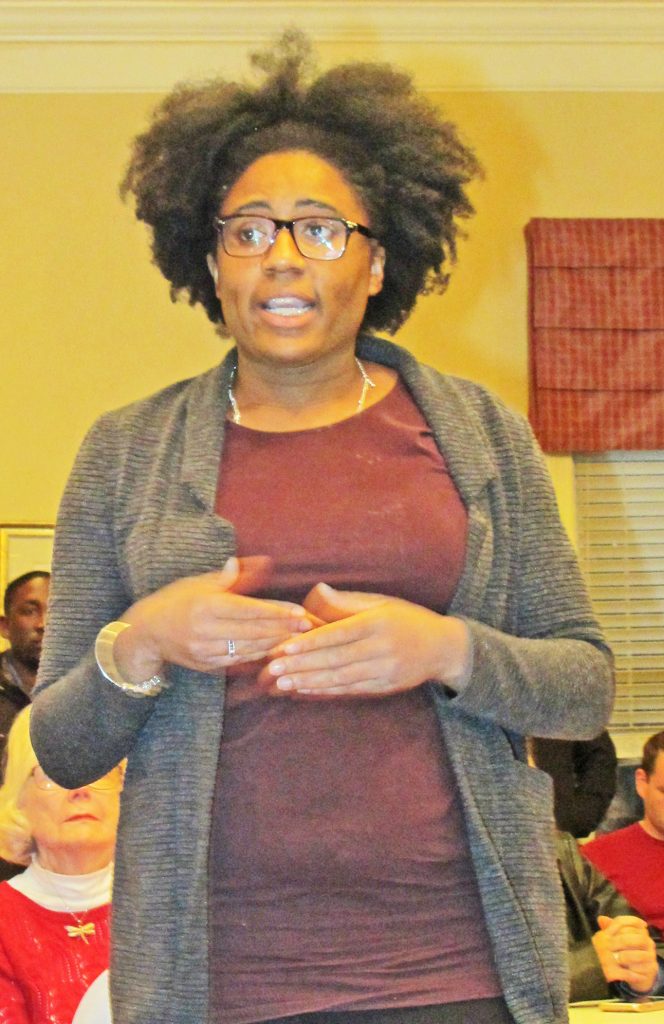
    Young

    “I had no idea that the property had been rezoned from what it used to be. When I went to the zoning office, they sent me to the assessor’s office where I paid all the taxes that needed paying. That office gave me a permit to move the mobile home on to the property,” Young told council. “I was then sent back to the zoning office and they sent me to the Department of Motor Vehicles (DMV) to get the mobile home registered in my name. I did that and took my paperwork back to the zoning department.” It was at that point, Young said, that she was told the property had been rezoned and that the new zoning would not allow a mobile home.

    “I had already moved my mobile home onto the property and then I was told it was there illegally. During all the processes I went through, no one ever told me that the property had been rezoned in 2012. I would like to get the property rezoned back to what it was before then, because I bought the property to put a mobile home on it, and the assessment office knew that because they gave me the move-in permit for it,” Young said.

    “I would like for you to rezone the property for my mobile home. That’s the only place I have to live. I’ve been living with my nephew and then my sister,” Young said. “My sister is getting tired of me and I’m getting tired of her,” she said, drawing laughter from council members and the audience. “I’m hoping everyone understands where I’m coming from. I’m asking you to do the best you can to help me,” Young said.

    Chairman Smith and County Administrator Jason Taylor expressed their concern to Planning Director Tim Roseborough that Young was able to get through the process without being told that her property had been rezoned. Roseborough confirmed Young’s story of the process.

    “It concerns me that we would let it go that far without picking up on that (zoning),” Smith said.

    Councilman Douglas Pauley welcomed Young back to the County and Councilwoman Bertha Goins apologized to Young for what she had been put through.

    “We’ve had things like this in the past regarding rezoning for mobile homes,” Smith said. “Sometimes we’ve allowed them to do that and sometimes we haven’t, depending on the area. I think we would generally look upon this case in not an unfavorable way. That said, there are some extenuating circumstances – the property was rezoned and sometimes folks don’t know about it. I’m not pointing a finger at anyone, but when folks come in to the Planning and Zoning Office,  we [need to] make sure the first time they come in, that we check [zoning] and not let it go two and three times down the road. Under these extenuating circumstances, I support both this second reading and third reading to rezone this property for Mrs. Young.”

    The motion passed unanimously to rezone the property to RD-1 as requested by Young.

  • Rimer Pond faces an uphill battle

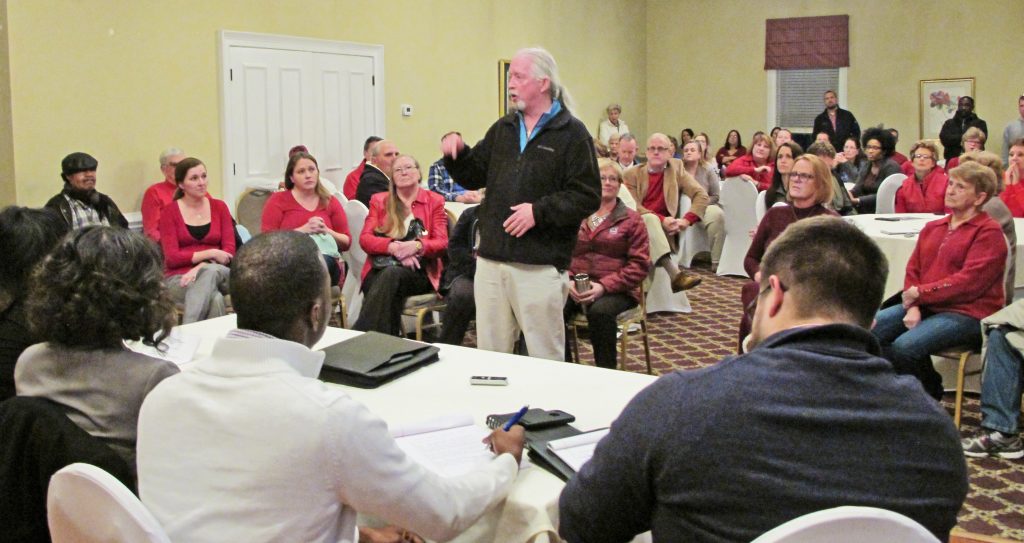
    Town Councilman Eddie Baughman lends his support to almost 200 community members who oppose commercial zoning on Rimer Pond Road. They met at the Windermere Club to help their County Council representative Gwendolyn Kennedy understand their plight. | Barbara Ball

    BLYTHEWOOD – Almost 200 residents in the Rimer Pond Road, LongCreek Plantation and Eagles Glen neighborhoods showed up, many wearing red in solidarity, at the Windermere Club last week to express to their County Council representative the myriad reasons they do not want commercial zoning on Rimer Pond Road.

    Columbia resident Hugh Palmer has requested Neighborhood Commercial zoning for 5.23 acres his family owns across from Blythewood Middle School. Neither Palmer nor his son Patrick attended the meeting. Patrick Palmer, who recently resigned after serving 12 years on the Richland County Planning Commission, actively promotes the rezoning request and had the property listed with his real estate company two years ago for $3.5 million.

    Richland County Councilwoman Gwendolyn Kennedy, who represents the area where the commercial zoning is requested, did attend and heard two hours of impassioned pleas from residents. Blythewood Town Council member Eddie Baughman and Mayor J. Michael Ross also attended and called on Kennedy to keep commercial zoning out of the area.

    Asked at one point by Jerry Rega, the meeting organizer, if there was anyone at the meeting who wanted to speak in favor of commercial, no one did.

    Patrice Matthews said a convenience store could be in her back yard.

    While the residents were of one accord, they had a tricky course to navigate. Although Kennedy represents the area, she is the only one of the 11 County Council members who voted against the residents last year when the issue came before Council.

    Until this meeting, Kennedy has not accepted or responded to invitations to meet with the residents. Many residents who emailed Kennedy said they never got an answer. Kennedy confirmed at the meeting that she leaves that to her 10-year-old grandson.

    Speaker after speaker told Kennedy they did not need or want commercial conveniences brought into their area.

    At one point, Kennedy asked the incredulous audience, “Have these thoughts been expressed previously?”

    “Once this property is zoned commercial of any kind, one of the criteria for future zoning will be, ‘Commercial zoning is next door or close by.’ Then you have to consider it,” one speaker said to Kennedy. “And the properties on the corners around this property are just waiting.”

    LongCreek Plantation resident Tracy Courson handed out pages of annual security statistics compiled by the Richland County Sheriff’s office that show how students under 17 are more likely to be involved in incidents involving the police when schools, even elementary schools, in proximity to commercial entities.

    Examples of schools not located next to commercial entities include Blythewood Middle School with 7 such incidents and Round Top Elementary with 14 incidents. Examples of schools that are next to or across the street from commercial entities include Sandlapper (52 incidents), Dentsville Middle (91 incidents) and Rice Creek Elementary (67 incidents).

    LongCreek Estates resident Patrick Whiddon rattled off the numbers of murders, shoplifting and robberies that occurred at the Sharpe Shoppe, Domino’s and Circle K, all in the Lee Road/Longtown Road commercial area; as well as crimes committed at  commercialized corners on Hardscrabble with Spinx, CVS and Walgreens.

    “I work in law enforcement,” said one attendee, “and more crimes happen in areas with commercial buildings.”

    “While Mr. Palmer says gas stations are not allowed under Neighborhood Commercial zoning, which is the zoning he is requesting for the property across from Blythewood Middle School,” Woodlake Farms resident Shannon Fields said, “convenience stores with gas pumps are allowed. It’s the same thing.”

    “This property that Mr. Palmer wants to zone commercial is in our back yard,” Patrice Matthews said. “Once you bring commercial zoning next to homes, you open the gate for other things besides homes, churches and schools to come in to our neighborhood. It’s a slippery slope. I’m nervous about it.”

    One Coatsbridge resident who said the Palmers’ property borders her property said her family is military and her husband is deployed.

    “My children and I are there by ourselves for long periods and I would not feel safe living next to a convenience store,” the woman said, her voice trembling. “This is not what we want for our family or our community. You were elected to help provide safety for us, take care of us. If you vote for this commercial zoning, you are not taking care of us.”

    Another woman pointed out that there are many empty commercial buildings strewn about the outskirts of the neighborhood, and that more commercial businesses are not needed.

    “We don’t want another Hardscrabble nightmare on Longtown Road,” Mary Hoffman said. “There are already many empty stores and offices nearby. We don’t need commercial zoning out here. We love that it’s still semi-rural, and we want to keep it that way,” Hoffman said.

    Blythewood Councilman Eddie Baughman, who also serves as Mayor pro tem, said commercial development on Rimer Pond Road would not improve the quality of life for anyone in the room.

    “These folks’ commercial needs are provided for in Blythewood, the Sandhills, on Killian Road and Hardscrabble. We, as the Town of Blythewood, support these residents. They don’t want or need this proposed commercial zoning,” Baughman said as he was drowned out by thunderous applause.

    Scott Galloway asked Kennedy what the decision maker will be for her when she votes.

    “I base my decision on how it [commercial zoning] will affect the community and how it will benefit Richland County,” Kennedy said. She said the County staff had shown her the feasibility of going ahead with Palmer’s rezoning and what needs to be done in the area.

    Asked how the commercial zoning would benefit the county, Kennedy said she would hear what County Zoning Administrator Geonardo Price had to say on that at a separate meeting. Pressed for an answer, Kennedy said the things that would be good for the county were written on a paper she held in her hand.

    When asked to reveal what things were on the paper, Kennedy declined to answer.

    Asked if she had heard from any residents in the affected area who were in favor of the commercial zoning requested by Palmer, Kennedy was hesitant, then said she had not.

    “You have the chance to do the right thing and vote for the people or you have the chance to vote for the landowner who stands to make $3.5 million,” Hair said to Kennedy.

    “I encourage the community to flood County Council members with emails every day,” Ross said after thanking Kennedy for her attendance. “Do it over and over, telling them that you don’t want, don’t need commercial zoning out here. It just does not fit.”

    Because Kennedy waited until after the residents had spoken to defer the vote on the matter during a County Council public hearing on Dec. 19, residents will be in the unique position of not being allowed to address Council prior to its first vote on the requested commercial zoning during the Tuesday, Feb. 27 meeting.

    “That is a huge blow to our efforts,” Hair said. “But all the council members except Ms. Kennedy voted with us last year and, really, Council has been with us every time this issue has come before them. They have never let us down, and we are trusting that they will be with us again, and Ms. Kennedy, too.”

    The commercial zoning request will come before County Council on Feb. 27, at 7 p.m., in Council Chambers in the County building at Harden and Hampton Streets. The agenda and packet for the meeting should be available from the County the week prior to the meeting. To obtain a copy of the agenda and the entire meeting packet via email, call Tommy Delage at 576-2172 or email him at delaget@rcgov.us or call 576-2190.

  • Appointment to CMCOG causes stir

    WINNSBORO – The County Council meeting got off to an uneasy start Monday evening when Shirley Green, the second of three speakers during the first public comment session, suggested that an appointment was “about to take place that will raise eyebrows…because of an unethical situation of a council person appointing his landlord to the Central Midlands Council of Governments board (CMCOG).”

    “Others feel that more than one councilman should recuse himself from voting on the appointment,” Green continued. “We heard at the last council meeting that only one council member and the Fairfield County administrator had seen a deed that transferred Mt. Zion to Fairfield County before the vote was taken at the meeting. I have a rubber stamp,” Green said, waving a rubber stamp in the air. “You can use this if you choose not to debate ethical ramifications of your decisions.”

    A few minutes later, as the agenda called for board and commission appointments, Council Chairman Billy Smith announced that he was recusing himself from the CMCOG appointment and that his statement of conflict of interest was filed with the Clerk to Council. Smith said he rents from the person being considered by council for appointment to the CMCOG. Smith then handed the gavel to Vice-Chairwoman Bertha Goins and left the room during the proceedings for that agenda item.

    Without any discussion on the matter, Council then voted 6 – 1 to appoint realtor Wanda Carnes, to the Board of Directors of CMCOG, with Councilman Mikel Trapp casting the lone dissenting vote.

    The CMCOG Board represents 15 governments in the central midlands and is generally made up of elected officials from those governments. Fairfield County has one government official, Smith, and two realtors, David Brown and Wanda Carnes, on the board. Carnes will serve a three-year term on the board.

    But the issue of Carnes’ appointment didn’t end there.

    “Someone has emailed council members saying things without finding the truth of what is being said,” visibly agitated Councilman Jimmy Ray Douglas said as he read from a prepared statement during County Council time defending Carnes.

    “Wanda Carnes is a good friend of mine and she and her husband, Lonnie, are happily married. If this person knows something that Lonnie should be told, Wanda will be happy to give this person his number.” Douglas said.

    In a unanimous vote, Council also appointed Donna Miner and Benjamin Proveaux, a pilot, to the Aeronautics Commission.

  • County goes after opioid costs

    WINNSBORO – After receiving legal advice in executive session Monday evening regarding potential opioid litigation on behalf of Fairfield County, Council returned to public session and voted to join a lawsuit being brought by Savage, Royall & Sheheen L.L.P of Camden.

    “This firm is filing suits on behalf of a number of counties to recover losses occurring from us having to deal with the opioid epidemic,” County Administrator Jason Taylor said. “They are going after drug companies because of the cost of such things as sheriff’s calls, ambulance calls and all other costs resulting from opioid use.”

    Taylor said the suit is not a class action suit, but the law firm is suing on behalf of the individual counties. As to what extent Fairfield County is affected by opioid use, Taylor said the law firm will begin gathering statewide statistics and looking at national statistics and extrapolating those downward.

    “Then they will look specifically at Fairfield County,” Taylor said.

    According to the National Institute on Drug Abuse, opioids are a class of drugs that include the illegal drug heroin, synthetic opioids such as fentanyl and pain relievers available legally by prescription, such as oxycodone (OxyContin®), hydrocodone (Vicodin®), codeine, morphine, and many others. These drugs are chemically related and interact with opioid receptors on nerve cells in the body and brain and can produce euphoria in addition to pain relief, according to the Institute.

    The Voice left a voice message on Wednesday with the Sheriff’s department asking about the overall extent of the use or misuse of opioids in Fairfield County, but the department had not responded at press time.

  • Davis sworn in

    Photo: Martha Ladd

    WINNSBORO – Newly elected Fairfield School District school board member Darreyl Davis is sworn into office by Fairfield County Clerk of Court Judy Bonds during ceremonies at the Court House last week. Holding the Bible is Davis’ wife, Tamika.

  • A Step Towards Justice

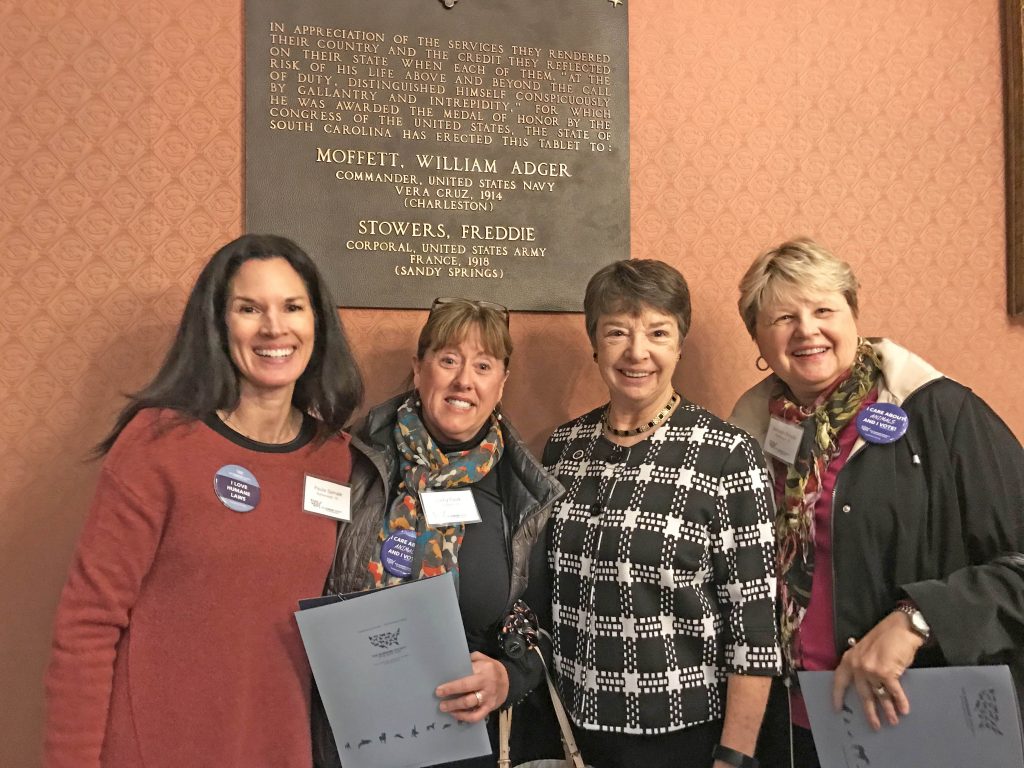
    COLUMBIA – Fairfield County residents and Hoof and Paw Benevolent Society board members Paula Spinale, left, and Kathy Faulk and Blythewood resident and board member Deborah Richelle, right, joined Rep. MaryGail Douglas at the Humane Society Lobby Day at the State House in Columbia last week where they witnessed the Senate’s vote to pass the animal welfare bill S841 that addresses tethering, shelter restrictions and myriad issues of animal cruelty.