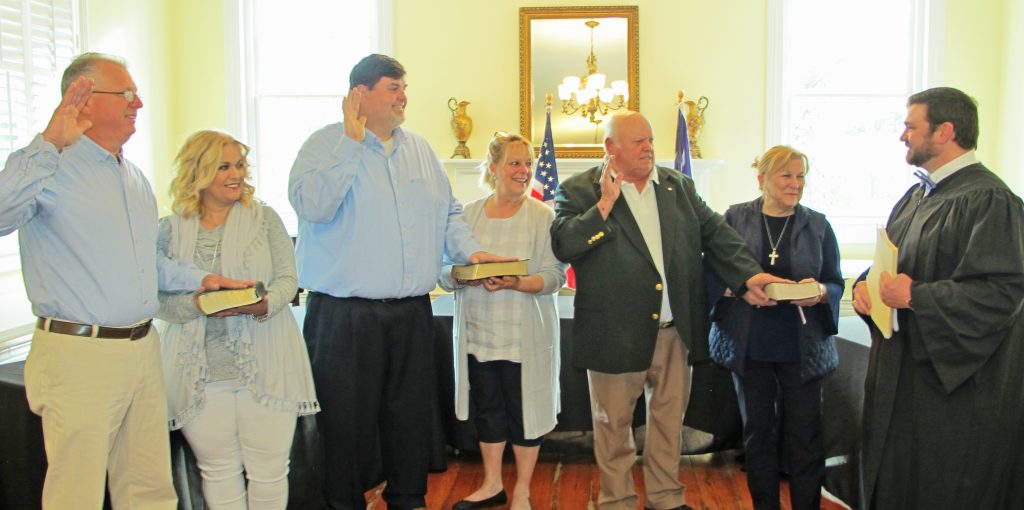
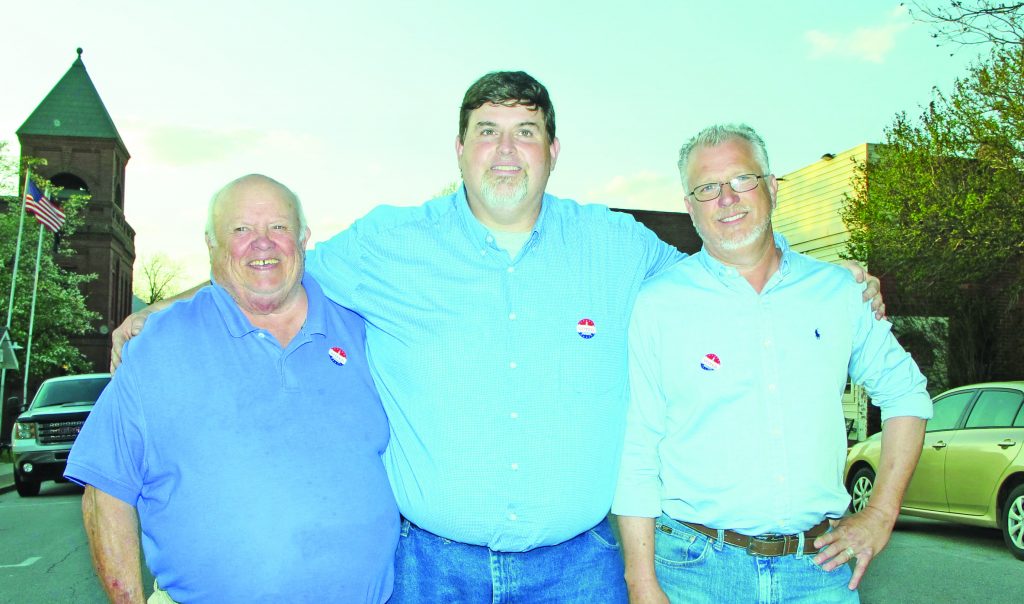
RIDGEWAY – Ridgeway’s newly elected mayor and town council members were sworn into office Friday evening at the Century House by Ridgeway Municipal Judge Adrian Wilkes. From left are Councilman Dan Martin with Robbie Martin holding the Bible; Mayor Heath Cookendorfer with Patti Cookendorfer holding the Bible and Councilman Rufus Jones with Gloria Keeffe holding the Bible. The mayor and the two council members will each serve four-year terms. The next meeting of the Ridgeway Town Council will be Thursday evening at 6:30 at the Century House.
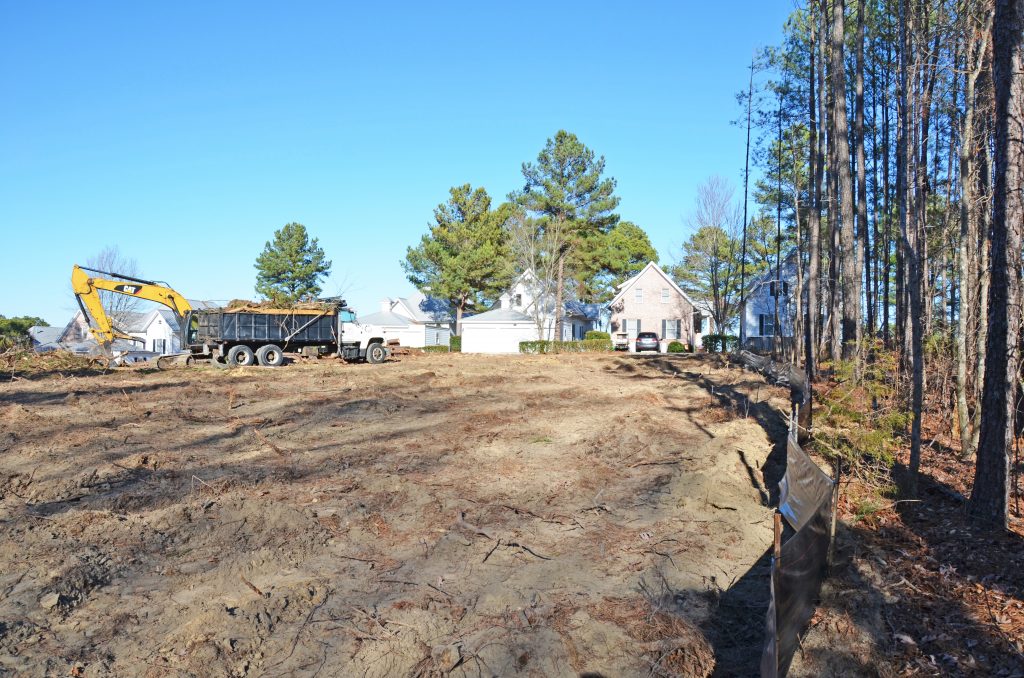
This photo was taken on Jan. 14, 2018, shows a clear cut in progress on five contiguous wooded lots between Links Crossing Drive and Golden Spur Lane in Cobblestone Park. | Michael Criss
BLYTHEWOOD – During its February meeting, Town Council voted to adopt an amendment to the town’s tree preservation ordinance that would remove an exemption that Town Attorney Jim Meggs suggested is being interpreted by developers as permission to clear cut lots without a tree removal permit from town hall.
On Monday night, the Planning Commission saw things from the developers’ perspective and unanimously recommended that Council reverse its decision and vote against adopting Meggs’ amendment when it takes a second and final vote on the issue at its April meeting.
For years, Blythewood’s town administrator, with input from the town attorney, planning consultant and planning commission, has been interpreting the town’s tree preservation code to mean the town government can enforce tree removal permits on undeveloped, platted, single-family residential lots in established subdivisions or new neighborhoods like Abney Hill Estates, Phase 2.
But when Michael Criss, the town’s planning consultant, recently tried to stop developer D.R. Horton from clear cutting five lots in Cobblestone Park next to the mayor’s home, the town’s attorney, Jim Meggs, examined the town’s tree preservation ordinance more closely and decided the ordinance contained a weakness that allowed another interpretation of the ordinance, one that developers were using to clear cut lots without a permit from town hall.
That weakness, Michael Criss told the Planning Commission on Monday evening, is found in section (H) of the ordinance and states that, those projects are exempt from the permitting process for tree removal if they have received major subdivision or site plan approval prior to the effective date of this subchapter and amended major subdivision and site plans.
“If Mr. Meggs’ interpretation of the current code is correct and would prevail,” Criss told the Commissioners, “the town’s hands are tied in enforcing permits for tree removal on undeveloped lots in most of our neighborhoods in the town – Ashley Oaks, Abney Hill Estates, Cobblestone Park, Blythe Creek, Lake Ashley, etc.”
To remedy what Council termed a loophole in the ordinance, Meggs’ drafted amendment surgically removes exemption (H) from the ordinance.
Jesse Bray, representing D. R. Horton, pushed back against that amendment.
“We’ve cleared [clear cut] dozens of acres in Cobblestone and it wasn’t an issue, but now it seems to be an issue because it’s next to the mayor’s house,” Bray told the Commissioners. “You throw around ‘flaw’ and ‘loophole’. It’s not a loophole. It’s in your ordinance. D. R. Horton is not trying to get away with anything. We’re the largest builder in the U. S. We don’t skirt rules,” Bray said.
“Look at the plot plans…we have a 60-foot x 120-lot, the average lot size in Cobblestone. It has a 15-foot setback, a five-foot side set back and we’re allowed to clear a 20-foot buffer around the 50-foot x 50-foot home site. That leaves you ten feet in back. If we have a swale for drainage, that comes out of the ten feet,” Bray told the Commissioners.
Complicating the issue is that the current tree preservation ordinance, which was adopted in 2015 with the intent of preserving trees, would have done just that had the General Assembly not interfered.
“In its wisdom, the General Assembly voted in 2010 and again in 2013 to protect developers hard hit by the 2008 recession by extending the life of the existing local development permits for nine years,” Criss said. “That kept permits alive that dated as far back as 2007. Since then, Blythewood has adopted stricter tree preservation regulation and stricter storm water management regulations. But just about all of the town’s projects now fall under the General Assembly’s grandfathered rules,” Criss said. While the grandfathered rules continue projects previously permitted for roads and infrastructure, they can also thwart the town’s current ordinance by enabling previously permitted mass-graded projects to remove all trees from individual lots as well as roadways, storm drainage areas, etc.
“Under the current ordinance, we felt the individual lots were protected from clear cutting in Cobblestone Park,” Criss said. “The town attorney felt there was a weakness in the ordinance and he is trying to fix it with this proposed text amendment.”
Town Council is expected to take its second and final vote at the April meeting.
WINNSBORO – Rep. MaryGail Douglas faces competition for her seat in the S. C. House of Representatives, District 41, in the June 12 Democratic Primary.
Douglas, who represents Fairfield and Chester Counties and parts of Richland County, is seeking a fourth term. Annie McDaniel, a member of the Fairfield County Board of Trustees, is also running for Douglas’ seat on the Democratic ticket. United Citizens candidate Fred Kennedy has also filed. Kennedy will not be on the ballot in the primary.
Running unopposed for the Nov. 6 election are Fairfield County Auditor Peggy Hensley; Treasurer Norma Branham and Probate Judge Pam Renwick.
RIDGEWAY – In a deeply divided race for mayor and two council seats, three candidates who ran as a block won as a block, tipping the balance of power in the Ridgeway town government.
Councilman Heath Cookendorfer, with 71 votes (54.20 percent), bested Councilwoman Angela Harrison, with 59 votes (45.04 percent) to capture the mayor’s seat.
Newcomer Dan Martin, with 77 votes (30.43 percent), and former mayor and councilman Rufus Jones, with 66 votes (26.09 percent), won the two vacant council seats over Rick Johnson, 59 votes (23.32 percent), and Roger Herring, 51 votes (20.15 percent).
There was one write-in vote for Rufus Jones for mayor. Of the town’s 229 registered voters, 131 (57.21 percent) turned out to cast their ballots.
Among the issues at stake in the race were the future of the current four members of the Pig on the Ridge steering committee and Bella the dog whose tenure at Town Hall had been on the block for more than a year.
“It feels good to be in a position to get Ridgeway back on track,” Cookendorfer told The Voice following the election. “I’m thankful for those who voted for me and for those who supported me. I want to thank my running mates, Dan Martin and Rufus Jones, and I’m proud of how they ran their campaigns. We’re going to work together and with the council. We need cohesiveness so we can move Ridgeway forward. Go Ridgeway!”
Martin echoed Cookendorfer’s desire to bring the town together after a campaign that divided much of the town.
“What Ridgeway needs most right now is unity between residents and council,” Martin said. “It was clearly a divided race, and we have some people who are hurting. This is Ridgeway, and I hope we can all come together now, heal and move forward. We will do our best, I promise, to help make that happen.”
Rufus Jones, mayor from 2000-2004, made a political comeback that, he said, made him feel really fortunate.
“Our goal, all three of us, is now to help our town come together,” Jones said. “I appreciate, more than you know, everyone who supported us and everyone who came out to vote. My goal is to do a good job for Ridgeway. And if I don’t, tell me.”
Debby Stidham, Director of Voter Registration said the canvas and certification of the votes will take place at the voter registration office at 10 a.m. Friday.
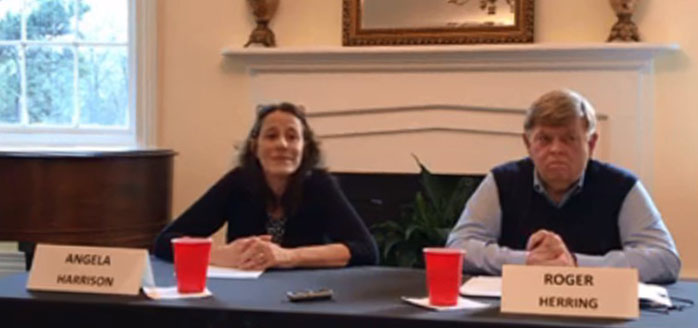
Angela Harrison, mayoral candidate, and Roger Herring, council candidate | Photos from Angela Harrison’s Facebook Live
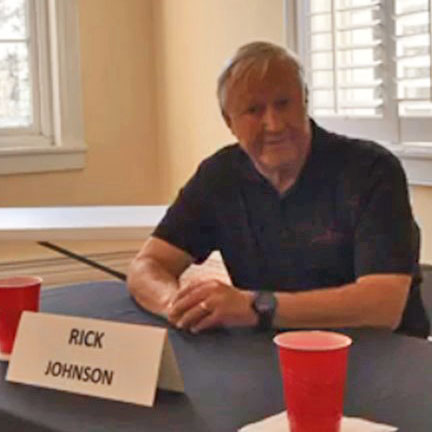
RIDGEWAY – Of the six candidates in the upcoming Ridgeway election, three of them, Angela Harrison, Roger Herring and Rick Johnson, participated in a candidate forum held last Thursday evening at the Century House and sponsored by the Fairfield Chamber of Commerce. The other three candidates, Heath Cookendorfer, Rufus Jones and Dan Martin, held a community barbeque on Saturday, March 24, where they talked with voters informally about their candidacies.
Rick Johnson, council candidate
Attorney Mike Kelly, a member of the Chamber, served as moderator for the forum, first asking general questions posed by the Chamber and then taking questions submitted from the audience. The forum can be viewed on Angela Harrison’s Facebook page.
Since The Voice does not publish again prior to the election on April 3, the following FACT CHECK of some of the answers given by candidates to audience questions at the forum are published here.
Question: Historically, the majority of the recording and classification of town procedures and disbursements have been handled by one person [in town hall]. The likelihood of honest mistakes is real. If elected, would you continue with the current one-person solution or would you implement a more current, transparent solution?
Answers:
Angela Harrison (mayoral candidate): “From reading the audits from 2006 to the present, it has been recommended in every single audit that we not have a one person system. So I would like to see that change.”
Roger Herring (council candidate): “We need more than one person…our audit recommends that this [having only one person] be changed. It hasn’t been.”
FACT CHECK:
The Town audit makes no statement or recommendation about how many employees the town should have or, specifically, that the Town should not have a one-person system. Instead, the audit states, “during our audit we did not identify any deficiencies in internal control that we consider to be material weaknesses.”
The town actually has three employees in town hall, not just one, according to Town Councilman Don Prioleau, in order to provide internal control over the Town’s financial reporting (receiving, recording, depositing, and disbursing money) – a full time clerk, a part time assistant clerk who works at least 40 hours per month and a part time interim administrator who works at least one day per week and sometimes more. According to Prioleau, internal controls over financial reporting in the Town Hall are handled in the following manner:
Town Clerk takes in money.
Assistant Clerk makes the deposits.
Administrator opens bank statements.
Town Clerk reconciles bank statements.
Assistant Clerk verifies bank statements with the financial report.
Town Council Member (usually the Mayor) and one employee sign all checks.
Question: Would you implement procedures [for the Town government] to allow more public access [to Town government information]?
Answers:
Angela Harrison: I definitely think we need more public access. You don’t have to file an FOIA [Freedom of Information Request] with me. Just ask me. I will hand it to you…When you have a question, just call me, email me, Facebook me. I’ll always give you any document that I have.
FACT CHECK: On Friday, March 30, the day after the forum where Ms. Harrison made this statement, The Voice emailed Ms. Harrison to ask for a copy of the Town’s 2017 audit. Ms. Harrison answered via email that her copy was missing two pages. The Voice emailed back that was fine, and asked for the audit without those two pages. Ms. Harrison did not respond. The Voice made two more requests and four days later, at publishing time, Ms. Harrison has neither responded further to the request nor handed over the document.
Rick Johnson (council candidate): “Yes. You as a citizen ought to be able to come in here and ask how much money does Ridgeway have in the bank, and somebody ought to be able to tell you that. I don’t understand why that’s a real problem.”
FACT CHECK: Contacted by The Voice as to whether he had experienced this problem, Mr. Johnson said, “There is no problem that I know of. I have no specifics on this. I haven’t been involved in Ridgeway government so it’s hard for me to know this stuff.”
Question: How would you implement any changes in the way festivals are run in Ridgeway?
Answers:
Rick Johnson: “I know the [POR] steering committee has always managed it and they do a really great job making it a successful event. However, I think there needs to be oversight by council because the revenue raised by this festival…the oversight needs to come from this council. There’s a difference between a steering committee and this council’s responsibility as lordship over funds and making sure funds are disbursed properly, that things are purchased properly. There’s a fuzzy line there. It has created a problem…”
FACT CHECK: When asked by The Voice, specifically, what problems have been created by the Pig on the Ridge steering committee, Mr. Johnson said, “I don’t know of any specific issue or problem…I’m not saying anyone has done anything wrong or that there’s even a problem. I don’t know of a problem. I have no clue who has oversight over the Pig on the Ridge festival. I don’t know enough about Pig on the Ridge and how it operates to answer the question.”
Roger Herring: “There are too many holes in the festivals that have gone wrong. There should be more accountability for all of them. I think those in charge of the committees who put them on think it’s their festival and they can do whatever they want. But it’s not. So many things of accountability that have gone past, unnoticed and undone. We need new people involved.”
FACT CHECK: When The Voice contacted Mr. Herring to ask him to identify, specifically, what has ‘gone past, unnoticed and undone,’ by the POR steering committee, Mr. Herring declined to comment.
According to Town Hall, Councilmen Prioleau and Heath Cookendorfer and all four members of the steering committee, Town Hall receives all revenue for the POR festival, makes all deposits, keeps all records, writes all checks and Council approves all purchases, expenses and donations. Town Hall (the mayor, specifically) has taken out, kept records for, signed for and cashed all CD’s purchased with revenue from the POR festival. Town Hall creates and issues annual reports and monthly summaries on the festival’s finances for council, the auditor and the media. Those reports are available in Town Hall.
Question: (Addressed to Ms. Harrison) All Pig on the Ridge funds are in the Town government’s control…Why, then, do you say it is the Pig on the Ridge steering committee’s responsibility to report on the Pig on the Ridge festival funds?
Answer:
Angela Harrison: “If it were the town’s responsibility [to report on the POR festival financials], then the town council would have known about the false information filed [by the POR steering committee] with the Secretary of State.”
Response:
Mr. Tom Connor, one of the four members of the POR steering committee, stated (from the audience with permission from the moderator) that Ms. Harrison’s use of the term ‘false information’ inferred that the Pig on the Ridge steering committee had intentionally filed incorrect information with the Secretary of State.
Response:
“I never said that,” Ms. Harrison responded.
FACT CHECK – Mr. Connor gets the point here. According to Webster’s Dictionary, the term false information means to “deliberately and often covertly spread in order to influence public opinion or obscure the truth.”
BLYTHEWOOD – Town Council held a public hearing Monday night concerning Council’s desire to amend Ordinance 155.390 (Landscaping and Buffer Requirements) by repealing section (H) which exempts certain projects from the ordinance requirements.
Council and residents say section (H), which was adopted in 2015, is an unintended loophole in the ordinance that allows developers to abuse the ordinance to the point of clear cutting lots.
Earl McLeod, Executive Director of the Building Industry Association of Central South Carolina said the amendment would be tantamount to changing rules in the middle of the game and threatened to lawyered up if the ordinance is amended.
Section (H) states that those projects are exempt “which have received major subdivision or site plan approval prior to the effective date of this subchapter and amended major subdivision and site plans.”
Council is reviewing the ordinance to be sure it is clear in regard to section (H).
The issue arose recently over lots that D.R. Horton clear cut in Cobblestone Park. Residents there said they woke up one morning to find the trees on lots next door to them gone.
“This was not the intent of our ordinance which was to protect the trees and landscaping in our town,” Mayor J. Michael Ross said.
The stated purpose of the ordinance is to prevent “indiscriminate, uncontrolled and excessive destruction, removal and clear cutting of trees upon lots and tracts of land…”
The intent of the subchapter is long and detailed: “to promote the health, safety and general welfare of the public; to facilitate the creation of a convenient, attractive and harmonious community; to conserve natural resources including adequate air and water; to conserve properties and their values; to preserve the character of an area by preserving and enhancing the scenic quality of the area; and to encourage the appropriate use of the land…and to provide shade,” among other things.
All residential, commercial or industrial lot owners wishing to remove trees of certain kinds and sizes must comply with a list of rules and regulations, the ordinance states.
But representatives of the building industry were on hand to push back against the proposed amendment.
Shay Alford with Essex Homes said he is concerned about implications on a broader scope, to projects already permitted and in existence.
“We go through a strenuous process to achieve permitting. That is an agreement we have with the Town. If you change the rules of the game, that creates a series of complications and hardships for us that were unintended, perhaps, but still exist,” Alford said.
While Jesse Bray with D.R. Horton chose not to speak, he said he agreed with Alford.
McLeod was blunt, telling Council that they might want to consider the consequences of amending the ordinance.
“State law provides for vesting for a project once it is permitted in that a developer can rely on the rules in place at the time of permitting,” McLeod said. “That’s an issue you need to be concerned with…To change that midstream would certainly be open to litigation and none of us want to go there,” he said.
While town attorney Jim Meggs suggested to Ross, “We would want to talk about the legal aspects in executive session,” the mayor didn’t back down from defending the Town’s reasons for wanting to abolish the exemption.
“The people of Blythewood who live here in these developments are the ones who are not happy seeing all the trees taken down,” Ross said. “When we adopted this ordinance, we did not think there was an exemption in there. We missed that. But when the public comes to you from whatever neighborhood and says, ‘We don’t like the lots being clear cut,’ we have let them down. We answer to them, too. There are two sides to this.”
The issue has been sent back to the Planning Commission for a recommendation before Council holds second reading.
BLYTHEWOOD – As controversy heated up over a proposed traffic circle that would impact the Blythewood Road entrances to Cobblestone Park, Palmetto Citizens Bank, the Food Lion shopping complex and two properties owned by Blythewood businessman Larry Sharpe, Richland County Penny Tax officials took a step back this week to again receive citizen input on the issue. But, at the end of the day, David Bailey, one of several members of the county-hired program development team who met with citizens Thursday evening, was less than yielding.
“We can look at it again, but that’s not going to change what works best at this intersection,” Bailey said.
Larry Sharpe, left, and David Bailey of the traffic development team discuss the traffic circle. | Barbara Ball
The County had planned to formally present its case for a final draft of the traffic circle during a public hearing at Muller Road Middle School on Thursday, but decided to forego the formal presentation at the last minute and, instead, hosted what Bailey explained as an informal question and answer session with residents after it became obvious in recent weeks that many of the residents do not want the traffic circle.
Cobblestone Park resident Bethany Parler repeated at that meeting a worry she expressed earlier this month at the Town Council’s annual retreat – that the circle will not solve the traffic problem in that area and might even contribute to a bigger problem.
“If you look at the plans,” Parler said, pointing to one of several renderings and diagrams set up in the school gym, “you will have to turn left out of Cobblestone, then shoot across two lanes of moving traffic, then merge to the right to get on to the interstate while cars are merging onto the circle from Community Road.”
David Bailey, a representative of the program development team hired by the County, did not disagree with that scenario.
While Parler, Sharpe and others reminded Bailey that the circle was not part of the referendum (Master Plan) for the town, Bailey agreed with that also.
“But the referendum identified that Blythewood Road should be widened from I-77 to Syrup Mill Road and it does not get down into the specifics of how each intersection should be improved within that corridor,” Bailey said. “So as part of our engineering study, we’ve looked at each intersection to see if a signal needs to be added and what other improvements could be made to improve traffic and safety. We determined that a traffic circle would be the better improvement at the intersection of Cobblestone and Community Drive,” Bailey said.
Sharpe suggested holding off on the project and evaluating it a little more in light of the growth that would be coming to that area imminently.
“You have all this industrial area [between I-77 and Ashley Oaks] and much of it almost under contract, you have Cobblestone, D. R. Horton is building another 300 homes in back and another developer is coming in with 200 homes [on Blythewood Road near Cobblestone Park],” Sharpe said. “I don’t see, with all this traffic, how a traffic circle will help. In the mornings, there is no break in the traffic for cars to get onto the circle. It’s all bumper to bumper.”
“If traffic is going to back up from I-77 to Syrup Mill Road, it’s going to back up whether we have a circle, a traffic light or no traffic light. We can’t help worst case conditions,” Bailey said. “But this traffic circle will help by slowing traffic down and making people yield. It will give breaks in the traffic,” Bailey explained.
Town Council discussed on Monday evening the possibility of holding a special workshop on the issue sometime in April, and Mayor J. Michael Ross said public input would be invited.
“I think we are going to have to come up with some alternatives, some other ways to deal with traffic in this area,” Ross told The Voice following Thursday evening’s meeting at Muller Road Middle School. “Maybe we can come up with something.”
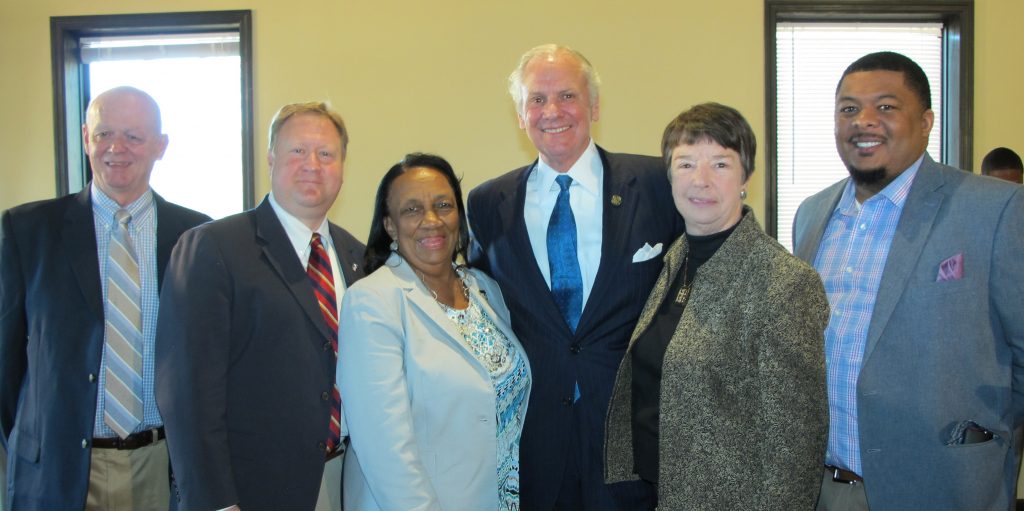
Welcoming Governor Henry McMaster to Fairfield County are, from left, Councilman Jimmy Ray Douglas, County Administrator Jason Taylor, Councilwoman Bertha Goins, Representative MaryGail Douglas and Councilman Neil Robinson. | Barbara Ball
WINNSBORO – The Fairfield County Commerce Center on Peach Road was the site of Governor Henry McMaster’s announcement last Friday of a federal program that proposes to give extra incentives to companies who invest in new jobs and business in impoverished areas throughout the state. These areas are designated as Opportunity Zones.
Accompanying McMaster were Senator Ralph Norman and S.C. Commerce Director Bobby Hitt.
McMaster made the announcement in Fairfield County where, last summer, the V.C. Summer nuclear plant abandoned the construction of two nuclear reactors, leaving 5,000 people without jobs.
McMaster said there will be 135 Opportunity Zones in the state, at least one in each of the 46 counties.
“This gives us the extra punch, the extra opportunity, that will transform economic growth and development,” McMaster said. He said these Opportunity Zones will bring a new era of prosperity in South Carolina.
Hitt told Fairfield County officials that companies are lined-up to do business in the state. The zones are expected to be approved by the Department of Treasury in the next 30 days. The program is part of the tax reform Congress passed at the end of 2017.
When communities are classified as Opportunity Zones, more tax cuts are offered to businesses who open businesses in those zones.
WINNSBORO – During its regular bi-monthly meeting Monday night, County Council passed final reading on an ordinance establishing procedures that will require municipalities in the county to now put up matching funds when requesting funding from the county for public works projects.
The ordinance applies to capital improvements on a one-time, non-reoccurring basis that serve a defined public purpose such as downtown revitalization, recreation or public safety. The ordinance specifies that the funds must be expended to achieve the overall public need and good.
The collaborative ordinance will require matches from the towns of at least 15 percent and as much as 50 percent of the request.
“We did not previously require matching funds from the towns,” Council Chairman Billy Smith said. “For instance, when the Town of Jenkinsville requested $50,000 from the County several years ago for sidewalks, we gave them the whole amount. With this ordinance, we will require a percentage of the requested funds to be matched by the requesting town,” Smith said. “This is a common practice with funding agencies.”
The first grant issued under the new ordinance is expected to be a $180,000 grant to the Town of Winnsboro for repairing the Fortune Springs swimming pool, Smith said. The Administrative and Finance Committee voted Monday evening, following the Council meeting, to recommend that Council require a 50 percent match ($90,000) from Winnsboro.
Another request on the horizon is one that was made last year by the Town of Ridgeway. The Town is seeking a total of $500,000 for an extensive sidewalk project and has applied for a $400,000 grant from the SCDOT Transportation Alternative Program (TAP) which requires matching funds of 20 percent ($100,000) from the Town. Of that $100,000, the Town has applied for $43,000 from the Fairfield County Transportation Committee (CTC) and $57,000 from Fairfield County. Under the County’s new collaborative ordinance, Smith said Ridgeway will be asked to match 15 – 20 percent of that $57,000.
“That’s not much for the Town to pay for $500,000 of sidewalk improvements to the town,” Smith said.
WINNSBORO – Attorneys for Fairfield County and Councilman Douglas Pauley have asked the Court of Common Pleas in Fairfield County to dismiss a lawsuit filed Feb. 12 by former Fairfield County Recreation Director Lori Schaeffer.
Schaeffer’s suit alleged that Pauley illegally interfered with Schaeffer’s employment and was the source of the complaint used to justify her termination by the County.
In documents filed with the Fairfield County Clerk of Court, Attorneys J. Paul Porter and Elizabeth M. Bowen, of Cromer Babb Porter & Hicks in Columbia, countered that Pauley, as a member of Fairfield County Council, was not a ‘third party’ capable of interfering with any alleged contract between Schaeffer and the County.
Schaeffer’s suit alleges that she had not received any employment discipline from her hire through 2016, except for one disciplinary action directed to her entire department in the summer of 2017. The County and Pauley answered that “…disciplinary notices contained in Plaintiff’s personnel file speak for themselves.”
The County and Pauley also stated in their answer to Schaeffer’s allegations that her “employment was terminated effective Sept. 28, 2017, based on a blatant lack of application and inefficiency.”
The answer also stated that Schaeffer later characterized her termination as a resignation by e-mail correspondence dated Oct. 11, 2017.
In addition to dismissing the lawsuit, the County and Pauley requested that the Court award them costs, attorneys’ fees and such other and further relief as the Court may grant.
 RIDGEWAY – In a deeply divided race for mayor and two council seats, three candidates who ran as a block won as a block, tipping the balance of power in the Ridgeway town government.