Category: Government

  • Chamber financials reflect inconsistencies

    BLYTHEWOOD – Whenever the Greater Blythewood Chamber of Commerce Executive Director Mike Switzer requests additional funding for the chamber, council members generally have been willing to cough up more money.

    As Blythewood council members plan to discuss increasing the total annual funding to the Chamber by more than $15,000 to $57,500, during a budget workshop Thursday, May 24, a review of public records, as well as a former chamber employee, signal several inconsistencies in chamber financials, raising questions about how accommodation tax funds and a town hall grant are actually being spent.

    At Town Council’s April 23 meeting, for example, the Greater Blythewood Chamber of Commerce Executive Director, Mike Switzer, said the chamber needed additional funding to cover non-specific, additional costs incurred in running the visitor’s center.

    “A lot of this deficit is startup costs of putting the extra hours into getting it (the center) up and running,” Switzer said. “The situation we have is the doors are open from 9-5. Before we signed the lease, we were already in there a year and our hours were 10-2. That’s what we could afford.”

    According to its most recent federal tax return, the chamber claimed a deficit of $4,885 just months after reporting a $5,755 surplus.

    Switzer called the numbers and their relation to visitor’s center finances “apples and oranges.”

    Payroll doesn’t add up

    In May 2017, Switzer requested $33,000 to run the visitor’s center, telling council members that $18,000 of that money would be spent on a part-time employee at a cost of $15 per hour for 20 hours plus FICA.

    Council voted to approve the $18,500 specifically for that employee.

    When contacted by The Voice, that employee, who is no longer employed at the visitor center, said she was only paid $10 per hour, not $15, for an annual payout of only $10,400.

    A visitor’s center report provided to council last January raises more questions.  The report, which is broken down into two columns (2017 July 1 – Dec. 31) and (2018 Jan. 1 – June 30), shows a total revenue for fiscal year 2017-18 of $18,500 and expenses of more than $26,000 causing a deficit of $4,885 for July 1 – Dec. 31, 2017 and an anticipated deficit of $2,758 for Jan. 1 – June 30, 2018 for a total of $7,643. A $300 addition error in each column of expenses would, if corrected, bring the deficits even higher. Council voted 4-1 on April 23 to give the Chamber the additional $7,643 to cover the two deficits.

    That’s where the report becomes difficult to follow. The visitor’s center payroll expenses are listed at $8,332 in each of the half-year columns. But the former visitor’s center employee said she only received $5,200, not $8,332 for the six month period ending Dec. 31, 2017. And the report anticipated another $8,332 the first half of 2018, leaving $3,132 in employee payroll unaccounted for in each half of the year for a total of $6,264.

    When asked by The Voice, Switzer was unable to provide a breakdown of the $8,332 listed for payroll. There is also no explanation of how a fourth of the Chamber’s rent, insurance utilities, accounting and other expenses including office supplies and other items that were previously charged to the Chamber are now charged to the $18,500 that was earmarked for the visitor’s center employee.

    In another instance, the chamber received $8,750 in accommodation tax funding for The 2017 Big Grab. Switzer charged $4,318 to staff expenses, breaking it down among three employees: the visitor’s center employee, $426; Switzer, $1,558 and Kitty Kelly (Switzer’s assistant), $2,234. But when contacted by The Voice, the visitor’s center employee said she was never paid the $426.

    Budget incongruities aren’t limited to visitor’s center funding. Mismatching revenue figures provided by the Chamber are apparent in funding to promote the 2017 solar eclipse.

    Eclipse the Park budget records list T-shirt revenues at “$5,000 (approximate),” although financial data obtained by The Voice pegs that figure at $9,991.

    Sponsorship revenues showed a similar gap, with $750 listed in budget records and actual revenues of $4,500, documents show.

    On May 4, The Voice issued a Freedom of Information Act request for annual budgets and profit and loss statements for the visitor’s center and chamber for the past five years.

    “There will be costs associated and I will get those to you as soon as time allows,” Switzer said via email on May 8. “We have, as always, a lot of work going on right now.  I will bring all of this to our next board meeting on the 15th and get back to you after that.”

    The Voice had not received the requested documents at press time.
  • County grants full Chamber funding

    WINNSBORO— In a span of two weeks, the Fairfield County Chamber of Commerce went from facing an inactive status to being fully funded.

    Fairfield County Council voted unanimously Monday night to appropriate $87,507 to the Chamber, satisfying the group’s annual funding request, but with some caveats.

    The Chamber had to provide the county with a plan for how it plans to spend the money.

    It must also allow the council chairman to appoint a council member to the board. The appointee will have voting powers, but will not be an officeholder, such as secretary or treasurer.

    “I appreciate folks at the Chamber stepping up and giving that to us,” Council Chairman Billy Smith said. “That was a big step.”

    After the meeting, Smith said the conditions boiled down to providing accountability for Fairfield County taxpayers.

    “We asked [the chamber] to come in and speak with us in regard to those type of concerns,” Smith said. “What I expected to be routine-type questions and answers turned into routine questions and strange answers.”

    Two weeks before the vote, the Chamber told The Voice it had voted to become “inactive” effective June 30, citing “limited financial support” as a driving reason.

    The vote to become inactive was held in a meeting that was not advertised as required by state open meeting laws.

    Citing concerns over the Chamber’s plans, Council members signaled they would slash annual funding from $87,500 to $25,000, and gave the Chamber a May 9 deadline to detail how it would spend council funding.

    The ultimatum paid off.

    Smith said he thinks the Chamber is now heading in a positive direction, noting former Chamber president and CEO Terry Vickers, appointed to temporarily lead the Chamber, is working to turn things around.

    “The chamber is a great asset to the county and it would be greatly missed,” said Councilman Dan Ruff.

    The council’s vote also drew praise from at least one member of the public.

    “I’m seeing more accountability. You’re holding people accountable, you’re holding each other accountable,” Ridgeway resident Randy Bright said during public input. “You held the chamber accountable and you got good results.”

  • FMH employees air concerns about leadership

    WINNSBORO—At Monday’s meeting, council members listened intently as the director of Fairfield Memorial Hospital’s Rehabilitation Center openly criticized hospital leadership during public input.

    “We question and don’t quite understand decisions made by administration, such as finances, priorities at this stage of the game and treatment of employees,” Laura Willingham, the hospital’s rehabilitation director, said. “Of course we’ll do what we’re asked to do. But it’s still disconcerting.”

    Willingham also emphasized the need to keep a rehab facility in Fairfield County as opposed to having rehab patients travel to Columbia for service.

    Smith commended Willingham for speaking publicly.

    “I think probably since I’ve been on council, it’s the most brave thing I’ve heard spoken to  us,” he said. “When we question some of the hospital administration, we’ve been chastised. I hope there are no reprisals against you.”

    Councilman Cornelius Robinson also signaled support for the rehab center.

    “Rehab is something that we need in Fairfield County,” Robinson said. “Each one of us is definitely thinking about it.”

    Sexual harassment suit filed

    Willingham’s address was unrelated to a developing legal matter involving Fairfield Memorial Hospital – a sexual harassment lawsuit filed by a former employee.

    Tabitha Williams, a former certified nursing assistant, made that claim in a lawsuit Feb. 22 in Kershaw County Circuit Court. The litigation was removed to federal court in March.

    The lawsuit says a human resources employee made several unwanted sexual comments to her shortly after he started working at the hospital in October 2016.

    The comments came during conversations at work, on the phone and via text message, according to the litigation.

    Williams further says the employee tried to “lure” her into a sexual relationship. The lawsuit calls him a “sexual predator.”

    She said the man fired her in August 2017, “ostensibly for reasons related to job performance,” the suit continues.

    “He began a period of inappropriate and aggressive communications with Plaintiff in and out of the workplace,” the suit states. “Plaintiff is informed and believes that her termination resulted from her refusal to engage in sexual activity with Defendant.”

    In its response, the hospital denies the allegations.

    The hospital’s response says Williams refused to cooperate in an investigation of her claims. It further states Williams was fired for poor performance and attendance issues, court documents state.

    Williams is seeking damages for lost pay, embarrassment and humiliation, punitive damages, legal fees and other unspecified damages.

    No trial date has been set, though in April a deadline of Jan. 2, 2019 was set to complete mediation.

    County Mulls FMH purchase

    While the diagnosis doesn’t look good for Fairfield Memorial Hospital, efforts to resuscitate parts of it by buying some health care properties are underway.

    At Monday night’s meeting, some hoped the county would vote to purchase several parcels associated with the hospital property. That was one of three items on the agenda for discussion in executive session, but a vote did not materialize.

    Council Chairman Billy Smith predicts a vote will come soon.

    Smith said the county is interested in purchasing parcels encompassing the rehab center, as well as a couple of private practice offices. He hopes a third party will take over operations.

    “We’re close to making a decision. I was actually hoping for a little bit more in executive session tonight,” Smith said. “Certainly we hope to set it by the next meeting.”

  • Council wraps up budget requests

    WINNSBORO – Council wrapped up its fourth budget workshop recommending several changes in agency allocations as well as a proposal to encourage the county’s elected officials to buy in to a merit based system of salary increase.

    After considering agency requests and County Administrator Jason Taylor’s budget recommendations over the last six weeks, Council is looking at continuing to pay $15,150 for Behavioral Health Services’ annual audit. It will also begin paying $11,000 for the Council on Aging’s annual audit. Council will also provide lawn maintenance at Behavioral Health Services’ new facility which is not county owned. Councilman Billy Smith said the County generally only provides lawn maintenance for agencies occupying county owned buildings.

    Of the $65,000 recommended by administration for Disabilities and Special Needs, Council is pulling out $19,000 DSN requested for a new van. Smith said he recommends withholding that amount since the agency still has several vans with low mileage.

    No consideration was given to allocating $4,000,801 requested by Fairfield Memorial Hospital or $1,043,000 recommended for the hospital by administration. With the exception of the current rehab departments, the hospital is expected to shut down operations by the end of 2018 when construction of a new standalone Emergency Services facility is expected to be completed on the bypass by Providence Hospital.

    The full $87,500 the County allocates each year for the Fairfield Chamber of Commerce was been placed in a holding pattern earmarked for tourism after the Chamber’s interim director failed to present a plan of action for the agency for the 2018-19 fiscal year two weeks ago.

    “We’re leaving it in tourism for Council for a future date to decide how to allocate that money,” Taylor said.

    “The latest word is that the Chamber has gone inactive, so it would not make sense even for us to allocate $25,000 at this point,” Smith said. “So we’re going to put that in a new line item right now?” Smith asked Taylor.

    “The money will be there should the Chamber come forward with a plan that you all find acceptable. If it is not acceptable, then that money could be reallocated for another project to be tourism related,” Taylor said. [Note: since the budget workshop, the Chamber’s new interim director has submitted a plan of action that is being considered by the County.]

    Looking at salary increases for county employees and elected officials, Smith suggested said he would like to see the county’s elected officials buy into a merit based system of salary increases.

    “If elected officials buy into the merit based program, then we would give them a full three percent increase to be dispersed throughout their departments as they see fit. If they don’t want to do that,” Smith said, “then we’ll allocate two percent for them to be used across the board.”

    Council is expected to vote on the 2018-19 fiscal year budget at the May 14 meeting to be held at 6 p.m. in council chambers.

  • Switzer requests $7,643 for Visitors

    BLYTHEWOOD – After receiving $18,500 earlier this year to operate the town’s Visitor Center, the Greater Blythewood Chamber of Commerce says it needs nearly $7,700 more.

    In April, the chamber asked the Town of Blythewood for $7,643 in additional funding to cover expenses associated with the Visitor Center which opened a year ago.

    Blythewood Town Council approved the appropriation at the April 23 meeting, designated state accommodations tax revenue as the funding source.

    The funding request comes on the heels of the chamber claiming a deficit of $4,885 months after reporting a $5,755 surplus, according to federal tax records obtained by The Voice.

    Mike Switzer, executive director of the Blythewood chamber, told council members last week that the deficit is due to additional costs incurred in running the visitors center.

    Switzer, however, characterized the $5,755 surplus and $4,885 deficit as “apples and oranges” in a subsequent email exchange with The Voice.

    “The numbers from last night were strictly visitor center numbers, not total chamber numbers,” Switzer said.

    On April 23, Switzer told council members the $4,885 deficit has accumulated over the past six months. He anticipates an additional shortfall of $2,758 in the next six months, accounting for the $7,643 request.

    “A lot of this deficit is startup costs of putting the extra hours into getting it (the center) up and running,” Switzer said. “The situation we have is the doors are open from 9-5. Before we signed the lease, we were already in there a year and our hours were 10-2. That’s what we could afford.

    “When we were asked to take over the Visitor Center, we were asked to operate it 9-5,” Switzer continued. “We’re just three part-time people rotating it. We’re trying to keep it open.”

    Council members approved the full funding request by a 4-1 vote. Mayor J. Michael Ross dissented.

    Ross said he supported funding the chamber, but only enough to cover the existing deficit of $4,885.

    “I support you, I just don’t support the total number here,” he said. “I’ve always been on the conservative side.”

    Other council members were generally supportive of granting the chamber’s full request, though some expressed a desire for the chamber to be more self-sustaining.

    “You can’t get bailed out every year,” said Councilman Eddie Baughman. “That money, I’d like you to stay within that working frame.”

    From surplus to deficit

    No visitors center expenses are listed on the chamber’s 2016 federal tax return obtained by The Voice. The reporting period is from July 30, 2016 to July 1, 2017, prior to the chamber taking over the center.

    But tax records also show a surplus of $5,755 in 2016, with total annual revenues of $75,477 and expenses of $70,381. Net assets carried over from 2015 accounted for the remaining $689, tax records state.

    Although Switzer characterized chamber and visitors center finances as separate, council documents do not make that distinction.

    A memo included in the April 23 agenda packet states the Town of Blythewood already provides $18,500 to the chamber “for the purpose of operating a Visitor Center.”

    The $18,500 in funding also comes from a-tax revenues collected within the city limits. South Carolina charges a 2 percent accommodation tax on hotel rooms and vacation rentals.

  • Chamber Board meets secretly; votes to become ‘inactive’

    WINNSBORO – The elephant in the room was not mentioned during the Fairfield County Chamber of Commerce’s monthly breakfast on Wednesday. That elephant was the surprise announcement on Monday that the Chamber Board voted for the Chamber to become ‘inactive’ as of June 30, 2018.

    While Facebook pages lit up with the news, neither the Chamber’s Board Chairman, nor any of the Board members mentioned the issue at the breakfast.

    Following the breakfast, when two Board members were asked by The Voice when and where the Board had met to vote for the ‘inactive’ status, neither would divulge the information. Board member Lou Ann Coleman accused The Voice of harassment for asking the question. In an email later that day, Coleman did respond that the vote was held during a meeting at the Chamber offices on April 19. However, no meeting had been posted for a Chamber Board meeting on that date.

    The S. C. Freedom of Information Act, Sec. 30-4-60 states, “Every meeting of all public bodies shall be open to the public unless closed pursuant to Sec. 30-4-70 of this chapter. In Sec. 30-4-80, it further states that notice must be given of meetings of all public bodies.

    “The South Carolina Freedom of Information Act requires not just governmental entities, but ‘any organization, corporation, or agency supported in whole or in part by public funds or expending public funds,’ to abide the Act’s transparency requirements,” S.C. Press Association attorney Taylor Smith said. “The Act provides that such organization must have meetings open to the public and that the public be notified of the time, location and agenda for the meeting. The failure to notify the public of an upcoming meeting of an organization is a violation of the South Carolina Freedom of Information Act,” Smith said.

    “After carefully evaluating its feasibility, the Board of Directors unanimously voted to take this action,” the Board’s press release stated. “The primary factors that led to this decision included limited financial support, reduced participation during the traditional Chamber structured events, as well as limited volunteers,” the release stated.

    Asked to clarify whether the Board planned to disband the chamber on June 30, 2018, a source on the Board who asked not to be identified said the chamber will still file with the Secretary of State as an organization, but that it will become inactive as of June 30. Until that time, activities will go on as normal, the source said.

    The source also said all Chamber employees will be let go as of June 30, but that the Chamber will remain in an inactive state after June 30, the end of the Chamber’s fiscal year.

    Asked by The Voice to clarify ‘inactive,’ Shull answered in an email, “Inactive means not in operation.”

    In the email, Shull also stated that the newly hired Interim Director of the Chamber, Chris Timmers, who was hired March 1, would not be employed through June 30. On that same day, in a Facebook post, Board member Lou Ann Coleman posted that Timmers “is no longer employed by the Chamber. Ms. (Susan) Yenner is.”

    Asked to clarify Mr. Timmers’ employment status further, whether he would continue receiving a salary until June 30 even though he is no long employed, or if he received a separation package, Shull has not, at press time, responded.

    The Chamber is funded primarily by the County, at $87,500 annually, and by the Town of Winnsboro for Town sponsored events at $35,000 annually. In reference to the Chamber’s reported ‘limited financial support,’ County Council Chairman Billy Smith said he was surprised to hear that was a factor in the Board’s decision to go inactive.

    “No, the County has not cut the Chamber’s funding,” Smith said. “We have contemplated the idea of reducing it, but only because their representatives couldn’t answer basic questions Council members had about their plans for the future during our second budget work-session.

    “In a letter from Council that was delivered to the Board on April 17, Council offered the Chamber every opportunity to keep their County funding the same as it has been in the past. I offered assistance on planning. Now, I really don’t understand the suggestion of ‘limited financial support,’” Smith said.

    “Between County funding, the money the Town of Winnsboro gave the Chamber for the first time this year, and the proceeds from their golf tournament (which they said they aren’t going to do anymore),” Smith said, “ I’d think the Chamber had more financial support now than at any time before, at least in recent history.”

    Asked if he had seen a decrease in attendance at Chamber sponsored events, Chief John Seibles with the Winnsboro Department of Public Safety, which oversees safety of the festivals in the Town, including Rock Around the Clock and the Pumpkin Festival, said the crowd at last year’s Rock Around the Clock was large and orderly.

    “It [Rock Around the Clock] was larger than in past years and it ran smoothly as I recall,” Seibles said.

    Board Chairman Harper Shull has not returned phone calls from The Voice at press time.

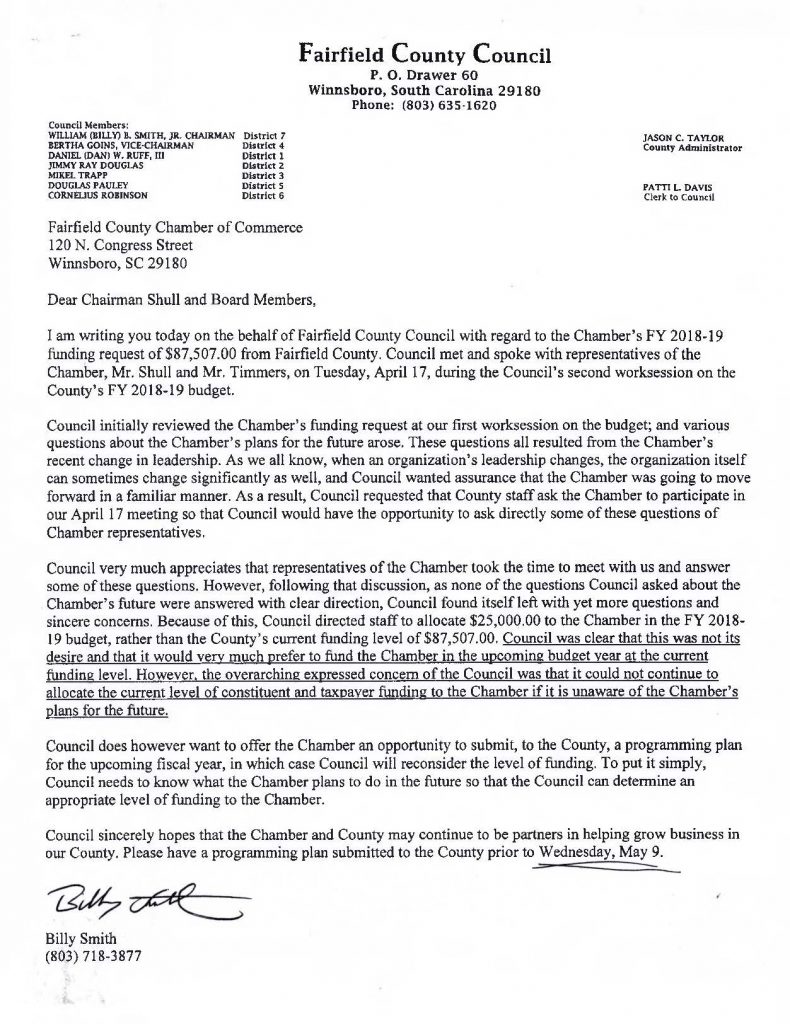
    County Council Chairman Billy Smith sent the following letter to Chamber Board Chairman Harper Shull following Chamber Interim Director Chris Timmers’ presentation to Council during a budget workshop on April 17.

    Related: FC Chamber Board votes to become inactive, Council gives Chamber notice

  • Feaster appointed Fairfield Magistrate

    Feaster

    WINNSBORO – Blair resident Russell Feaster was appointed Fairfield County Magistrate Judge by Senator Mike Fanning on April 18. The magistrate seat became available when former magistrate, Russell Price, was named Director of the Fairfield County Recreation Department.

    Feaster, a Blair native, holds a degree in Business Administration from Voorhees College and served 19 years with the S.C. Law Enforcement Division (SLED), retiring as an inspector in 2009. Feaster retired from the South Carolina Army National Guard in 2012 with the rank of Colonel after more than 31 years of service. He received numerous military awards and honors, and was the first African American inducted into the Palmetto Military Academy Hall of Fame in 2006.  Feaster is currently employed by Savant Learning Systems as Captain of South Carolina Field Operations.

    Feaster is a member of St. John AME Church, where his wife, Reverend Yvonne B. Feaster, is the pastor. The Feasters are the parents of four children.

    Feaster recently formed The Feaster Foundation, a non-profit, 501c (3), organization whose mission is to uplift, inspire and encourage youth to realize their full potential through education, spiritual growth and personal development.

    Additional magistrate seats will be up for appointment next year, Fanning said.

  • County plans to move forward with traffic circle

    BLYTHEWOOD – After multiple community and council meetings over the last year about a proposed controversial double-lane traffic circle that would impact the entrance to Cobblestone Park and the retail, restaurant and office businesses located on University Village Drive in Blythewood, the pot was still boiling Tuesday during a Blythewood Town Hall meeting held on the issue at The Manor.

    With more than 50 people in attendance and many of them addressing the issue, the problem is not solved, but   Richland County government appears to be digging its heels in to proceed with construction of the traffic circle as well as widening Blythewood Road to five lanes.

    The proposed $10.5 million project is part of the Richland Penny Tax program and extends less than a mile along Blythewood Road from Syrup Mill Road East to the Southbound I-77 ramps.

    The posted project overview on the richlandpenny.com website shows the existing roadway would be widened to a five-lane section with two travel lanes in each direction and a two-way left turn lane, which is a paved 15-foot median.  Ten-foot shared-use paths are proposed on each side of the roadway for the length of the project to accommodate bicyclists and pedestrians.  A double-lane traffic circle is proposed near the intersection of Community Road and the entrance to Cobblestone Park.

    During a public project meeting held at Muller Road Middle School on March 22, by representatives from the Penny Tax Program, a large group of residents, primarily from Cobblestone Park, turned out to question the safety and effectiveness of the traffic circle.

    Responding to a phone call from The Voice inquiring about the results of resident input on comment cards after the Muller Road meeting, Project Manager Ben Lewis was clear.

    “The plan is to move forward with Option A – the 5 lane, offset, shared use option,” Lewis said.

    Twelve residents spoke at the Tuesday night meeting with the majority being Cobblestone residents speaking out against the creation of the traffic circle.

    “It appears the Penny Tax Committee has chosen an inadequate, short term fix for a longer term issue,” Cobblestone resident and former Town Councilman Tom Utroska said, reading from a two page letter in which he addressed a number of issues including how tractor-trailers would negotiate 270 degree turns on the circle without causing major backups.

    Another Cobblestone resident, Bethany Parler, said she was concerned about the large number of out-of-area visitors to the Cobblestone golf club and restaurant who would not be familiar with how to negotiate the traffic circle which requires drivers leaving Cobblestone Park to cross two lanes of traffic on the circle before turning left toward I-77.  She urged the Town of Blythewood concentrate on the McNulty Road to Main Street, Langford Road traffic problem and move the Blythewood Road project to number two on the agenda.

    There was a moan from the audience when Mayor J. Michael Ross suggested the hypothetical possibility of a fatal traffic accident happening while the project was on hold.

    Courtney Levett, another Cobblestone pointed to the traffic circle installed on Piney Grove Road in Columbia where, he said, there had been a lot of damage to the curbing and 3 foot tall reflective sticks by traffic trying to negotiate the turns.

    “I would like Richland County to delay their decision until this can be further explored,” he said, indicating that he felt that the issue had divided the town.  His suggestion to let the Town vote on it was met with applause from the audience.

    But Ross countered.

    “Almost three thousand people live in the town limits,” Ross said, “and the only people who’ve called me have been my [Cobblestone] neighbors.  These projects are to better the whole town of Blythewood,” Ross said.

    Former Blythewood High School teacher of the year Allison Byrd cautioned the County about how they use tax dollars.  She suggested pausing the traffic circle project until a study could be done on the installation of a traffic light at Syrup Mill Road to slow down traffic.

    Larry Sharpe, who owns large parcels on each side of the section of Blythewood Road that would be impacted by the traffic circle an opposes the project, talked about the influence that industrial growth on Community Road and near Syrup Mill and H.R. Horton’s continued building in Cobblestone would have on the traffic circle.  He also talked about the problem that would be created with motor homes or trailers and boats trying to navigate the circle.

    But not all Cobblestone residents were opposed to the project, including Buddy Price, a 19-year Blythewood resident.

    “Every year it has gotten worse, and it is getting less and less safe,” Price said.   He said he would have preferred a stop light be installed but he expressed support for the plan and encouraged the council to move forward quickly.

    Mike Switzer, Executive Director for the Blythewood Chamber, said he hopes the plan will go forward.  He said he had spoken with the businesses on University Blvd. Drive and the Food Lion Shopping Center and that they were concerned with their customers being able to get out onto Blythewood Road.

    “Cobblestone residents have a back way to those merchants,” Switzer said. “How would you feel if the merchants closed?” he asked.  “The Town will lose a lot of revenue if that happens.”

    At the suggestion of Ross, David Beatty and Ben Lewis from the Transportation Penny project followed up on questions that had been raised during the meeting.

    Beatty shared the history of the Penny Tax Resolution all the way back to its inception in 2012.

    “There were just 2 projects for this area and it is very restricted. We can’t create new projects beyond those covered in the referendum,” Beatty said.  “The current DOT traffic count is 11,000 a day and is projected to be 16,000 a day in 20 years.”

    Ben Lewis, the project manager for the Blythewood project, said that federal standards don’t currently warrant a signal at the intersection of Syrup Mill Road and Blythewood Road as previously suggested.  He also said it is not possible to put a signal instead of a traffic circle at the Community Road and Blythewood Road intersection because there is a minimum spacing requirement between signals of 1300 feet and it is only 730-750 feet to the traffic circle area from the signal at the I-77 ramp.

    “The benefit of a roundabout [traffic circle] is that it slows speeds,” Lewis explained.  “It reduces severity of accidents by 80% according to DOT statistics and 100% in South Carolina.”

    Regarding Utroska’s suggestion to restrict tractor-trailer traffic, Lewis said SCDOT makes those calls and that the heavily populated urban areas are most likely to be qualified.

    Richland County Council Chair Joyce Dickerson encouraged the Blythewood Town Council to be open-minded regarding the traffic circle.

    “When projects go on hold,” Dickerson warned, “the money will be spent somewhere else.”  She cited an Irmo area traffic circle project that had citizen concerns when proposed, but that, she said, had turned out to be very successful.

    “As Richland County grows, what you put in place now will work down the road,” she said.

    Looking back to the council meeting in May of 2012, Ross suggested that if they had known how things would have turned out, that council would likely have taken the McNulty Road project as their first choice.

    “But that isn’t possible now,” he said.

    The next step, Lewis said, is be to begin rights-of-way acquisitions.  He said plans are still to begin construction in the fall or winter of 2019.


    Related articles:  Traffic circle opposition picks up speedBlythewood traffic circle causing angstTraffic Circle Talks Continue 

  • Council gives Chamber notice

    WINNSBORO – When the new leader of the Fairfield County Chamber of Commerce failed to satisfy Council’s concerns last week, during a budget workshop, regarding the Chamber’s plans for the upcoming budget year, Council threatened to reduce the funding it provides for the Chamber from $87,500 to $25,000 unless the Chamber provided a financial roadmap for how it plans to spend that funding in the 2018-19 fiscal year.

    “I’m not opposed to continuing our full funding for the Chamber,” Council Chairman Billy Smith said, “but we need a plan to know what they’re going to do with it.”

    Chris Timmers, who was introduced by the Chamber Board as the Interim Director of the Chamber during a member breakfast on March 2, introduced himself as Executive Director of the Chamber when he came before Council during the April 17 workshop. Asked by The Voice following the meeting to clarify Timmers’ job title, Board Chairman Harper Shull said Timmers had not been hired to be the Executive Director.

    “He is the Interim Director,” Shull said.

    After announcing to Council that March 31 was the Chamber’s 73rd anniversary, informing Council that Providence Health was clearing ground to construct a new emergency facility in Fairfield County and that Lake Wateree is sold out and being developed to the max, Timmers said the Chamber had McMaster Enterprises, which is owned by Bill McMaster, Shull’s employer, to thank for having rent-free office space. Timmers said that was way the Chamber has saved Council money.

    However, Council has never funded office space for the Chamber according to several Council members. Prior to moving into its current offices at 120 N. Congress Street, which were offered by McMaster, the Chamber occupied rent-free offices in the Town Clock tower which is owned by the Town of Winnsboro.

    Timmers said the Chamber’s programs include the S.C. Railroad Museum, the Big Grab Yard Sale, Arts on the Ridge and Ag & Art. However, when asked about the Chamber’s involvement with the Railroad Museum and Arts on the Ridge, Susan Yenner, secretary of the Chamber, said those are not financially supported by the Chamber, but are included in the Chamber’s promotional material.

    When Council Chairman Billy Smith inquired about the amount of funding provided to the Chamber by the Town of Winnsboro and what that funding is used for, Timmers looked to Chamber Board Chairman, Harper Shull, for answers and then sat down.

    Shull said the Town provided the Chamber with about $35,000 last year, but that it was a one-time deal and was to be renegotiated each year. As for how that money was spent, Shull looked to Chamber Secretary Susan Yenner in the audience for guidance. Yenner, who has been managing the Chamber’s day to day business since former President/CEO Terry Vickers resigned last October, said the money went to such events as Pumpkin Fest and Spirit Fest, before Shull picked back up and continued.

    Shull expressed a dim view of whether the Chamber should be taking any money from the town government for events in the town.

    “We’re not exactly sure how we go forward with that just because there is a, I won’t say a conflict of interest, I mean, it’s the county seat of Fairfield County, and maybe previously we spent too much time in downtown Winnsboro versus the County as a whole,” Shull said.

    “Well, I think if the Town is giving you the money, it’s appropriate you spend it there,” Smith said.

    Shull also suggested changes that might be coming to the Rock Around the Clock festival, including an admission charge. He also announced that Sam Edenfield would not be able to run the car show aspect of the festival this year.

    “We had some feedback last year about Rock Around the Clock. We had a lot of mayhem,” Shull said. “We like to keep law and order as much as possible.”

    Chief John Seibles of the Winnsboro Department of Public Safety said he does not remember there were any problems at the festival last year.

    “It was a lot larger than in past years and it ran rather smoothly as I recall,” Seibles said.

    When Smith asked about the Chamber’s annual golf tournament fundraiser that he discontinued this year and questioned how the Chamber planned to make up for the $8,000 it would lose without the tournament, Shull said the tournament was solely on the back of Winnsboro Petroleum, which is owned by McMaster, and other corporate sponsors.

    “It became a lot for me to ask Coca Cola and Budweiser [for sponsorships],” Shull said. He also said the tournament had to be held out of county because there is no golf course in Fairfield County. He said the Board is tossing around another event that could be held in the county.

    At the end of the six-hour budget workshop, Council appeared satisfied with the administrative recommendations for allocations for all the agencies supported by the County, except for those recommended for the Chamber and for Fairfield County Disabilities and Special Needs. Council suggested omitting funding for a $19,000 vehicle for DSN, saying that some of DSN’s vehicles still had low mileage.

    “I wasn’t too impressed with some of the answers we received from the Chamber of Commerce tonight,” Smith told Council. “If they are not even sure they’re going to continue doing the things that we all know they have been doing, I think that leaves a question for us. If they don’t know what they’re going to continue to be doing, then how do we know how to continue to fund them?”

    “Are they going to be doing away with Rock Around the Clock?” Councilman Doug Pauley asked.

    “It kind of sounds that way,” Smith said. “I understand the Chamber is in a transitional period, but it seems the boat is rather rocky at the current time. Before we pass along any taxpayers’ monies, I’m just concerned about what the Chamber is going to do in the future,” Smith said.

    County Administrator Jason Taylor met with the Chamber Board the morning following the meeting, explaining what Council is looking for in the way of a spending plan for the coming fiscal year. The Chamber’s response is due to Taylor no later than May 9.

    In another funding concern, Council questioned Fairfield County Sheriff Will Montgomery’s request for funds in excess of Taylor’s recommendation. Montgomery requested additional funds for raises for his department that exceeded administrative recommendations. Smith said he would like to hear more details from Montgomery about the additional funding request.

    Council held a third budget workshop on April 24 and final reading on the budget will be held at the regular meeting on May 14.

  • Builders push back over tree clearing

    BLYTHEWOOD – Talk about a frog strangler.

    As rain pelted Blythewood on Monday, stormwater gushed into the streets and onto lots in the Cobblestone Park neighborhood in Blythewood, causing several lots to flood. It’s become a common theme after any heavy rainstorm, residents say.

    Some homeowners think the root cause is traced to trees they say homebuilder D.R. Horton has been clearcutting in preparation for additional home construction.

    “We really don’t want to see any more lots that are left with zero trees,” said Bob Zedosky, who addressed Blythewood Town Council during public input Monday evening. “What happens when you cut down all the trees is, if you’re brave enough, put on your hip boots and go on these lots,” Zedosky said. “Be prepared to sink in … with mud and stuff. It’ll be a nice, muddy mess.”

    Zedosky and other Cobblestone Park residents want council members to reverse a section of the town’s landscape and tree preservation ordinance that, the town attorney says, can be interpreted to exempt developers from the town’s tree preservation requirements. Council members already have passed first reading on an ordinance repealing the exemption.

    On Monday, Council voted 4-1 to postpone second reading until May 10, with Councilman Bryan Franklin dissenting.

    Developers, however, oppose lifting the exemption. They sympathize with the flooding issues, which they characterize as temporary, but also insist lifting the exemption impedes their ability to do business.

    Jesse Bray with D.R. Horton, the developer building out Cobblestone Park, said the proposed ordinance singles out the homebuilder.

    “Developers and others will start looking elsewhere before doing business,” Bray said. “They want to know what the rules are from the start.”

    Shane Alford with Essex Homes took things a step further, playing what he said were audio recordings of council members showing support for the original ordinance that allowed the exemptions.

    Alford likened the effort to rescind the exemption to “finding soccer goals on the field at the end of a football game. We do not want rules to change halfway through the game. It may jeopardize the investment that we have,” he said. “It is our opinion that for the town to operate in a principled and thoughtful manner, repealing this covenant between it and the public would be wrong.”

    Blythewood Mayor J. Michael Ross, who supported removing the exemption, responded with a sporting analogy of his own.

    “So much water came from those lots because there’s no vegetation there. It ran into the drain on the opposite side of the street,” Ross said. “The fields have been torn up and there are no fields for anyone to watch any sport.”

    Tensions have been simmering for years since the ordinance exempting developers was enacted in March 2015.

    In 2017, two Cobblestone Park families sued D.R. Horton and the town, saying prior covenants were breached when D.R. Horton began subdividing lots near their homes for residential development.

    The suit contends that their properties were supposed to border a nine-hole golf course or greenspace if a golf course wasn’t built.

    The suit is still pending. On March 1, a circuit judge issued a temporary injunction barring development of the lots as the case proceeds.

    As for the landscaping and buffer ordinance, council members said they plan to revisit the issue during the council’s budget work session May 10.  An executive session for the receipt of legal advice concerning the proposed ordinance is likely to be added to the agenda, Ross said.


    Related Articles:  Town threatened over tree law