Category: Government

  • BW Town Council passes first reading on budget

    BLYTHEWOOD – Town Council passed first reading of its 2018-19 budget Tuesday evening. The proposed $1,565,632 budget reflects $202,111 in building permits and fees, an increase of $17,111 over last year. Council also sees business licenses inside the town increasing from $94,871 to $113,351 and business licenses outside the town increasing from $80,188 to $92,491.

    Town Hall salaries include a three percent cost of living and a three percent merit based pot. A sum of $9,250 is set aside in the budget for boardwalk security cameras in the park and $3,500 for supplies for the amphitheater.

    The annual economic development grant for the Greater Blythewood Chamber of Commerce will increase from $15,000 to $17,500, and is funded out of the general fund.  The Town’s contingency fund is set at $119,877. Council has proposed to increase the visitor’s center funding from accommodation tax to $20,500 from $18,500, and the Historical Society’s funding from $20,500 to $21,500. Council also proposes to fund The Greater Blythewood Chamber of Commerce with $10,000 of accommodation tax revenue for The Big Grab in September, an increase of $1,250 over last year.

    A public hearing and second and final vote on the budget will be held during the June 25 council meeting.

  • Running fast

    Photo: Susan DeMarco

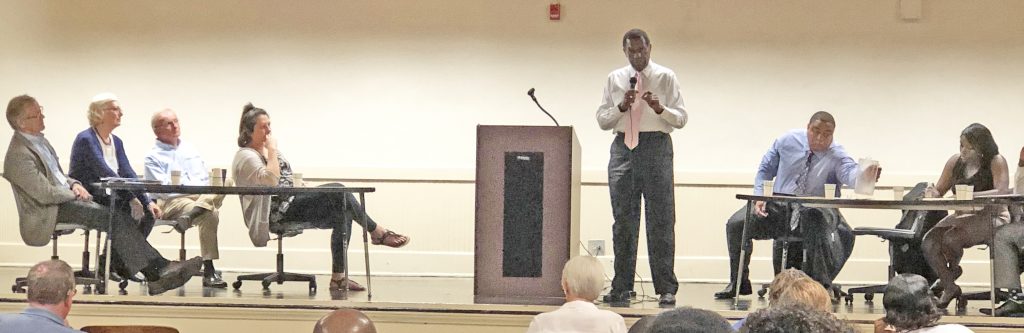
    BLYTHEWOOD – Blythewood Democratic candidate forum organizer Stuart Andrews, left, emcee Arlene Andrews and moderators Buddy Price and Jamie Harkness listen as incumbent SC House Rep. Joe McEachern (District 77) answers a question during the forum last Thursday at Blythewood Academy. Other candidates for the House seat included:  Kambrell Garvin, John McClenic and Deyaska Spencer.  Participants for the US Congress, House District SC-02 were Sean Carrigan and Annabelle Robertson.

  • Goins blasts JV annexation vote June 5

    JENKINSVILLE—A controversial effort by the Town of Jenkinsville to annex 143 properties is drawing the ire of at least one Fairfield County Council member.

    District 4 Councilwoman Bertha Goins, whose district includes Jenkinsville, issued a scathing indictment of the town’s government and the Jenkinsville Water Company, both of which are run by Greg Ginyard.

    During the council comments portion of Tuesday night’s meeting, Goins urged residents to reject the annexation measure.

    “Enemy and evil took it [Jenkinsville] over and took it down,” Goins said. “Twenty years of hate and bitterness should be enough for Fairfield County.”

    Ginyard couldn’t be reached for comment Tuesday.

    The Voice did ask Ginyard about the annexation vote following the Jenkinsville Water Company meeting in May. His only response was, “It’s in your paper.”

    If the annexation vote passes and is ratified, the town’s borders would grow by a factor of four and the value of taxable property would multiply fivefold, from $2,467,200 to $12.3 million, an analysis of public records found.

    Goins didn’t identify any Jenkinsville officials by name Tuesday night, but her disdain for the JWC and town leadership was made perfectly clear.

    “I’m going to stand against the annexation. I’m going to encourage people to vote against it. We’re divided enough by it,” Goins said. “I’m really ticked off about evil in the community.

    “Twenty years ago a snake came in the community and poisoned the community. I’m going to leave it at that,” Goins continued.

    Goins’ address comes on the eve of the June 5 vote.

    The town is utilizing the “25 percent” method to attempt the annexation, requiring the least amount of public support. Under this method, the vote can proceed with only 25 percent of the 143 property owners petitioning town government.

    In a prior interview, Ginyard declined to say why the town is utilizing the 25 percent method.

    Ginyard did say he supports annexation because he thinks a larger town will make it easier for Jenkinsville to generate economic development.

    The vote was originally scheduled for May 1, but was rescheduled to June 5 since state law mandates that annexation votes be taken within the boundaries of the municipality seeking annexation, said Debby Stidham, the county’s director of voter registration and elections.

    Stidham said the May 1 vote was previously scheduled to be held at the town’s volunteer fire department. But, she said, the town’s traditional voting hub technically lies outside Jenkinsville town limits.

    Now the election will be held at the old volunteer fire department and EMS station on S.C. 213. Polls will be open from 7 a.m. to 7 p.m.

    Stidham said her office hasn’t received any complaints or concerns from voters. She said communications with town officials have been strictly logistical in nature.

    “It’s actually been quiet. So far I’ve not had anybody calling and asking anything,” Stidham said. “I hope that means people are interested and know what they need to know.”

    The deadline for voters to cast absentee ballots by mail expires June 1 at 5 p.m.

    After that, voters can cast absentee ballots in person at the Fairfield County Voter and Registration Office through June 4.


    Related articles:  Jenkinsville prepares to annex 143 propertiesLetter to the Editor: No to Annexation June 5,  Notice of Annexation Election: Town of Jenkinsville,

  • Fencing Funds

    Photo: Barbara Ball

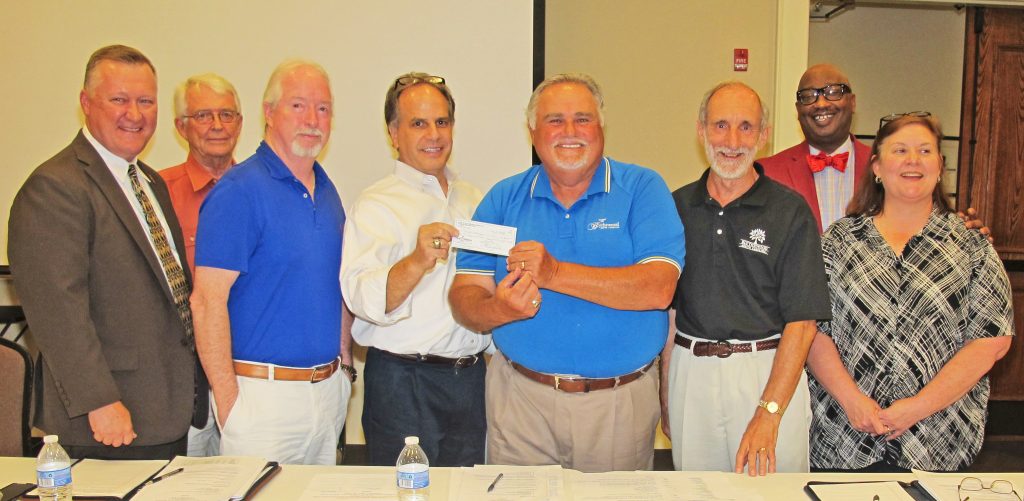
    BLYTHEWOOD – Doko Meadows Park Foundation (DMPF) President Paul Moscati, center, presented a check for $40,000 to Mayor J. Michael Ross and council Tuesday evening for fencing for the Palmetto Citizens Amphitheater. Councilman Bryan Franklin, left, DMPF board member Jim McLean, Councilman Eddie Baughman, Moscati, Ross, Councilmen Malcolm Gordge and Larry Griffin and DMPF board member Chris Keefer.

  • Council considering $56K for Chamber, Visitor’s Center

    BLYTHEWOOD- Asking for more accommodation tax and general fund money has become a common theme for the Greater Blythewood Chamber of Commerce, and Council continues to up the numbers every year.

    In 2017, Chamber Executive Director Mike Switzer sought additional funds of nearly $71,000 before scaling that number back amid town council protest.

    Of the $71,000, $33,000 was earmarked for the Blythewood Visitor’s Center which operates under the Chamber. Switzer ultimately received $18,500 which was to be dedicated to pay for an employee for the Center. And just last month, the chamber requested and received an additional $7,643 for the visitor’s center, citing projected deficits due to increases in hours worked, but no specifics.

    Now, Switzer is asking Council to increase the economic development grant the chamber receives from the Town from $15,000 to $20,000 in next year’s town budget. He also wants the Town to increase the annual accommodation tax funding for the visitor’s center from $18,500 to $25,000 and an increase in funding for the Big Grab from $8,750 to $12,500.

    Blythewood Town Council, initially at least, wasn’t willing at all to entertain $25,000 for the visitor’s center, preferring instead to leave funding at the current $18,500.

    “I kind of get tired, and there’s not many people who come in and do this, when you keep coming and asking,” Mayor J. Michael Ross said during the May 10 budget work session. “When you don’t get to a certain number, you want more. That doesn’t seem fiscally responsible to me,” Ross continued. “You have to look from within.”

    As the meeting proceeded, however, council member’s tone changed. They soon tentatively agreed to increase the annual visitor’s center funding to $20,500, with the potential for an additional windfall of $10,500 ($3,000 discovered in unspent accommodations tax revenues plus $7,441 that was returned unexpectedly by The University of South Carolina from a recent equestrian competition for which the town provided funding.)

    If the proposed funding is approved, the chamber will end up receiving a total of $57,500, an increase of $15,250 over current funding.

    The appropriations making up the $10,500 funding came from what’s called the “30 percent” fund. State law requires that 30 percent of accommodation tax revenues be spent specifically on an agency to promote tourism. It can’t be spent on salaries or operational expenses, the Town’s assistant town administrator, Chris Keefer, cautioned council members during the work session.

    “This is where the TERC dings us every year,” she said. “That money is supposed to go to some organization that has some existing tourism marketing program.”

    TERC, or Tourism Expenditure Review Committee, operates under the S.C. Department of Revenue. Its job is to review a-tax expenditures to ensure they comply with state law.

    For the visitor’s center to receive both the $20,500 funding and the $10,500 accommodation tax windfall, Ross said the chamber would have to submit a marketing plan by June 15, showing how funds will be spent. If the funds do not go to an agency that promotes tourism by June 30, Ross said, the town must return them to the state.

  • Ridgeway Council proceeds with Cotton Yard purchase

    RIDGEWAY – Mayor Heath Cookendorfer called a special council meeting Monday evening to put the Cotton Yard purchase to bed – to either move forward to purchase it or to back out of the purchase.

    Cookendorfer said he wanted both residents and Council members to have the chance to speak their minds in public about the pending purchase from Norfolk Southern. Two members of the audience, Tina Johnson and Vicki Maass, spoke in favor of the purchase. Council members then had their turns.

    “The Cotton Yard is the center of our town and is an asset,” Councilman Dan Martin said. “Nobody likes the price, but my feeling is that if we pull out now, we’re going to lose $15,000 up front,” Martin said. “It would be good to have control of it. That’s my thinking.”

    “No doubt we need to buy it,” Councilman Rufus Jones agreed, but with a caveat. “I hate to be forced to buy it and that’s what we have to do because of the last administration. We used it for years for free, and they kept messing with the railroad till they got ticked off and I don’t think we have a choice but to buy it. The amount is ridiculous, but I don’t see where we have a choice,” Jones said.

    “I voted against it in the previous administration, and I vote against it now,” Councilman Don Prioleau said. “I felt $73,000 plus all the other fees was too much. As Councilman Jones said, we always used this property at no cost. I voted against it, and today I vote against it.”

    Councilwoman Angela Harrison passed on speaking, and Cookendorfer took his turn.

    “As part of the previous administration, I thought the first price was a fair, economical decision,” Cookendorfer said. “Then we got the second one and I was against that. But I’ve also been one to say I hate losing money. At this point, we’ve spent $15,000 on the earnest money, the survey, legal fees and phase one of the environmental study.  The Cotton Yard is a big part of our downtown, so I agree that we need to move forward with the purchase.”

    Jones said he would like to see the fire station and police station on the property renovated for use as spaces for merchants.

    “Maybe we could get a grant to help pay for it,” Jones said.

    “So am I to understand that there have been discussions about what to do with the buildings in the Cotton Yard that I’ve not been privy to?” Harrison asked.

    “I’ve mentioned in open session that I would like to see something go there as rental space,” Cookendorfer said. “I’ve been more than forthcoming that that is something I would like to see.”

    “In the past we did discuss buying the property under the buildings. Just a discussion. We talked about taking the space next to the (old) post office and making that into public restrooms…” Prioleau said before Harrison interrupted.

    “Well that’s not what’s up for discussion tonight and it wasn’t on the agenda for discussion…”

    “We’re just discussing buying the property and what we’ll do with it if we buy it…,” Prioleau said.

    After further discussion about boundaries of the Cotton Yard and the railroad’s 65-foot right of way,
    Cookendorfer closed in on the purchase.

    “It sounds like Council would like to move forward except for Councilman Prioleau,” Cookendorfer said. Council agreed that the mayor would contact the Town’s attorney for the contract and move forward with the closing on June 22.

    Following the meeting, Cookendorfer said he would like to see the former Just Around the Corner consignment shop (behind Olde Town Hall Restaurant) renovated for use as public restrooms.

    “I think that would be helpful to the merchants and a good use for the building,” Cookendorfer said. “It’s all about funding. That’s where we stand now.”

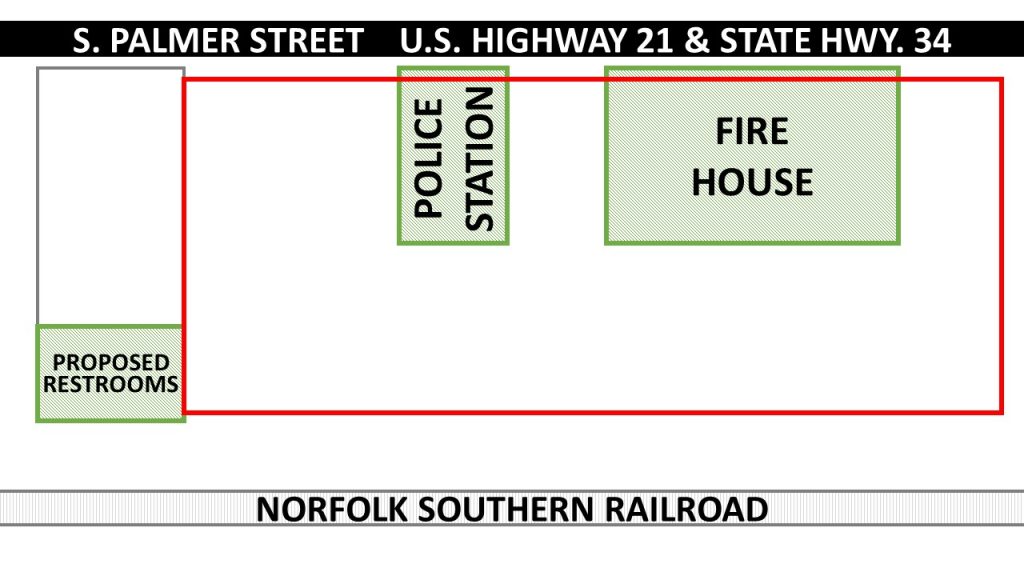
    The property inside the red line is the .65 acres the Ridgeway Town Council is purchasing from Norfolk Southern Railroad.
  • Surprise! Grace Coffee complies with zoning

    BLYTHEWOOD – While it may come as a surprise to the owners of brick and mortar commercial buildings in downtown Blythewood, Grace Coffee, a small turquoise and white mobile home housed on a parking lot in downtown Blythewood, is now a business in good standing and is in compliance with the necessary zoning approvals from the Town of Blythewood, according to an interpretation of the Town’s Zoning Administrator Brian Cook.

    How that came about is confusing to many and being questioned by some who run businesses out of brick and mortar buildings and have spent years adhering to the Town’s zoning and architectural review standards or face stiff daily fines.

    But Grace Coffee is apparently not required to meet the Town’s standards for materials, landscape, paint color, sign and other things, yet is not fined for not doing so.

    As the Town’s Planning Consultant Michael Criss, explained to the BAR Board Monday evening, Grace Coffee’s owner was initially removing the trailer every night as it had agreed to do when it was allowed to set up shop. But as the business became successful, the owner, Matt Beyer, balked at removing the trailer at night, Criss said.

    Next, Grace Coffee wanted a Certificate of Appropriateness (COA).

    The BAR met on April 17, 2017 to consider Grace Coffee’s request for a COA for its location in the parking lot of 208 Main Street.

    Under what one board member described to The Voice as ‘pressure’ from Town Hall, the BAR reluctantly granted Grace Coffee a temporary COA for a period of one year. According to the Town’s former administrator, Gary Parker, the Town had no ordinance in place to address the vending stand, but Criss interpreted it to be a structure.

    The temporary COA was supposed to allow the Town time to review and create regulations to address vending stands.

    Adding another layer of confusion, Council was then presented Ordinance 2017.002 for consideration. The passage of that ordinance on April 24, superseded the temporary COA issued by the BAR a week earlier, and made Grace Coffee a non-conforming use, Cook wrote in a memo to the BAR. This also gave Grace Coffee the same zoning protections of other brick and mortar buildings. However there was no announcement at the time to that effect and former Councilman Tom Utroska, who voted for the ordinance, told The Voice that he had not been aware that, when passed, the ordinance would supersede the temporary COA.

    Section 155.276 of the ordinance offers definitions of itinerant merchants and vending stands. Item B of the ordinance says that vending stands are to be removed daily and cannot be stored on property within the TC District – but that does not apply to Grace Coffee. Item C addresses nonconforming uses.

    “Any vending stand in lawful operation upon the date of first reading of this section may continue to operate without regard to the daily removal requirement…” That, according to Town Hall, is Grace Coffee. It can now operate as a nonconforming vending stand in the Town Center District, according to the interpretation of the Town’s zoning administrator. And while Grace Coffee’s one-year COA has expired, the issue is moot if, indeed, Ordinance 2017.002 superseded it.

    Cook drafted a version of the City of Columbia’s Temporary Vending Ordinance that has the Blythewood Chamber’s backing and presented it to the BAR Monday night for information. It will next go to the Planning Commission’s June 4 meeting for a vote.

    Jim McLean, Co-Chair of the Board of Architectural Review, expressed his concern that the proposed ordinance will allow a temporary food truck vendor the potential to set up 365 days a year in Blythewood.  As long as they meet the zoning district requirement, locate at least 100 feet from the door of a lawfully established eating place, maintain within the food truck proof of written permission from the private property owner, receives annually a zoning permit to operate a food truck, move the food truck off the property each evening and operates for no more than 10 consecutive hours within a calendar day, does not operate between 9 pm and 9 am and the parcel on which the vendor operates is more than 400 feet from a parcel zoned residential., they would be eligible.

    “I really have a struggle with the fairness of this,” McLean said.  “Are the brick and mortar stores being undercut?  They have made a hard investment in the town and are abiding by the regulations and restrictions.  The caveat of unfair competition needs to be addressed.”

    There was general consensus that food trucks and temporary vendors associated with events would continue to be acceptable.  And there appears to be no problem with concessionaires and persons selling only seasonal merchandise, such as fireworks, pumpkin stands and Christmas trees are also permitted under the ordinance.

    BAR member Alan George brought a “what if” to the discussion regarding the possibility of a tattoo truck setting up shop.  Cook said that if the vendor met all other criteria he would be eligible.  The question was raised regarding sexually oriented businesses (SOBs) being eligible under this ordinance.  Criss confirmed that the TC (Town Center) zoning would not have to accommodate the SOB use.

    The BAR committee asked that there be some criteria addressed for mobile vending and standards dealing with the appropriateness of the vendors.

    Criss said there are several options including adopting an ordinance to accommodate vendors, go back to only allowing them for special events or seasonal sales or something in between.
  • FMH CEO takes unpaid leave

    Smith: Council Close to Making Offer on FMH Campus

    WINNSBORO – After a relatively short, uneventful meeting Tuesday evening, the Fairfield Memorial Hospital board came out of executive session and voted unanimously to give an unpaid, one month leave of absence, beginning in June, to the hospital’s CEO Susie Doscher. There was no other explanation concerning the leave.

    County Council Chairman Billy Smith told The Voice in an interview on Tuesday that Council is moving closer to making an offer on a portion of the hospital campus. He said the offer could come as early as the next council meeting.

    “We’re interested in the two medical office buildings – the one housing Fairfield Medical Associates and the John Martin Primary Care facility,” Smith said. “The appraisal for those two is right at $1.6 million. If we add the rehab facility, that appraisal jumps up to about $1.9 million.”

    Smith said the offer depends on removal of the liens from the property.

    “They need to remove the liens if we’re going to purchase the property,” Smith said. “We’re not going to make an offer so long as it has liens.”

    Smith said there are no other obstacles to the making an offer that he is aware of.

    The next council meeting is May 29 at 6:30 in the County building.

  • Citizens open up to Winnsboro Town Council

    WINNSBORO – Winnsboro’s Town Council’s meeting agenda was light last week, but all the chairs in the room were filled, and many of those sitting in the chairs had something to say to Council.

    Winnsboro resident Jenyfer Conaway kicked things off by introducing herself as a “damn yankee” who works in Charlotte. She said she loves Winnsboro and purchased a house here 10 years ago for $78,000 which, she said, is now worth only $35,000.

    “Our town is dying,” Conaway stated, initiating a dialogue with council members, asking if they knew their oath of office.

    Mayor Gaddy intercepted the exchange and instructed Conaway that dialogue was not part of the program.

    “I just want someone to listen to us,” she added, before sitting down.

    Vanessa Reynolds said her position as a national sales manager gives her access to businesses in all areas of the country.

    “Small towns are not trending down overall,” she said.  She said they are trending up and cited the need for Winnsboro to enforce their code 96.5 Section B ordinances. These ordinances address decaying exterior exposures of buildings including peeling or cracked exteriors, broken doors and windows, etc.

    Reynolds said the Town’s lack of enforcement is extending the problem and called for cooperation among residents.

    “We need to roll up our sleeves,” she said.

    Mayor Gaddy responded, thanking her for giving Council solutions and not just complaints.

    Attorney and Ridgeway Municipal Judge, Adrian Wilkes, requested that Council record their meetings.  He said it would be a big benefit to have something to look back to when issues arise.

    “I was taken aback that merchants don’t know that grant money is available for downtown revitalization,” Mitford resident Wanda Carnes said. Carnes said she owns four buildings and would like to have been able to use the unspent money for revitalizing the look of her storefronts.

    “A line was added to the application saying that only one revitalization grant is available per owner,” Carnes said. “When was that line added and who voted to add it?”

    Gaddy said he would get that information to her.

    Keryn Isenhoward asked Council’s for the use of Mt Zion Green trail for a four-hour breast cancer walk on Oct. 20.  Keep Going Fairfield County will be the event title.  Council agreed to support the event by providing use of Mt Zion, electricity and maintaining the trash bins for the day.  Councilman McMeekin championed the event, making the motion to allow the walk.  The motion passed 5-0.

    Fairfield Central Band Director, Sir Davis, asked Council to allow gratis use of the Old Armory Building on June 1, for the band’s banquet.  Council voted 5-0 in favor.

    Also on the agenda was the Chamber of Commerce relocation discussion, but Terry Vickers asked that it be deferred.

    Councilman Danny Miller said he had held a council position for 23 years and expressed his love for concerned people.

    “We are all in it together,” Miller said, “and we are going to get there through love and working together.”

  • Rules for behavior on Ridgeway agenda

    RIDGEWAY – In an effort to return what he termed respect and order to Ridgeway Town Council meetings, newly elected Mayor Heath Cookendorfer rolled out new rules for behavior for council members at the last meeting.

    “When someone has the floor and someone else has something to add, if that person will raise their hand, they will be called upon and be given the floor next,” Cookendorfer said. “That way, we won’t have interruptions in the meetings or be talking over each other. This will allow respect for each other and an orderly meeting.”

    And that’s what happened. There were no interruptions and the meeting was orderly.

    In one of the first items of business, Cookendorfer sought to clear the air in public session about the status of the Town’s contract with Norfolk about the status of the Town’s contract with Norfolk Southern Railroad to purchase the cotton yard. He called on attorney Kathleen McDaniels, who was hired by former Mayor Charlene Herring’s administration to negotiate the purchase of .6 acres of property (cotton yard) for which the Town agreed to pay Norfolk Southern $73,000 plus about $20,000 in additional expenses to include surveying, legal fees, an environmental soil study, etc.

    Although the contract was signed by the previous council on March 22, 2018, and can now be discussed in public session, McDaniels suggested she update council behind closed doors regarding the contract.

    Cookendorfer, however, repeated that he would like to have the update in open (public) session, and McDaniels proceeded to the podium.

    “The Norfolk Southern closing on the property is set for June 20, 2018,” McDaniels said. “During that period of due diligence, lots of things have to happen – an environmental study of the soil, a survey, a legal description, title commitment, etc.,” McDaniels said.

    “Can the Town still get out of the contract?” Cookendorfer asked. “Do we have the option of renegotiating the contract?

    “There is certainly the possibility to do that,” McDaniels said. “But the likelihood that Norfolk Southern is going to renegotiate the contract is pretty slim. The earnest money of $5,000 has been paid to Norfolk Southern, so if you terminate the contract, you’ll lose the earnest money and the costs that you have already incurred for surveying, the environmental study, legal and other costs,” McDaniels said.

    Cookendorfer thanked McDaniels for her presentation.

    Other Business

    Luke Law was unanimously appointed as the Town’s new zoning administrator to replace Rick Johnson who resigned April 6.

    Council passed, 4-1, first reading of the fiscal year 2018-19 budget in the amount of $774,840. Councilwoman Harrison voted against first reading, saying she did not have enough information to vote. Council will hold a public hearing and second reading on June 14.

    Council voted unanimously to select the paint color ‘aqua sky’ for the new water tower.

    A discussion of water rate increases proposed by the Town of Winnsboro was tabled until next meeting.

    Council voted 5-0 to terminate Southern Resource Advisors previous arrangement to find overlooked income for the town government. The company said it has found approximately $900 of annual income for the town, 50 percent of which will go to the Town of Ridgeway and 50 percent to Southern Resource Advisors for their efforts. Cookendorfer said the company advised, however, that there is little more they can do for the town in that regard and suggested not going forward with the agreement.

    FOIA Reminder

    Cookendorfer said he had sent out a letter to all town government committee heads reminding them that they are subject to the provisions of the S.C. Freedom of Information Act (FOIA) for public bodies.

    “Meetings must be open to the general public,” Cookendorfer said, “and must be properly posted 24 hours in advance.” Cookendorfer said that anyone wishing to be notified of these meetings can have their name placed on a list at Town Hall to receive emails of the agendas.

    Executive Session

    Two agenda items were discussed in executive session – an employee matter related to the police department and another related to the town’s municipal court. Following executive session, Rufus Jones made a motion to consider former municipal judge Gen Palmer as a backup for the town’s current municipal Judge, Adrian Wilkes. The motion passed 5-0. No motion was made concerning the police department item.

    The next regularly scheduled meeting of Council will be Thursday, June 14.