Category: Government

  • Documents detail complaints vs RW chief

    RIDGEWAY—Police Chief Christopher Culp has been the subject of at least 15 formal complaints from Ridgeway residents and businesses in the past 12 months, according to documents obtained by The Voice.

    Dating back to July 2017, the complaints that nearly cost Culp his job provide a more detailed look into what drove Ridgeway Town Council to consider terminating him.

    A motion to immediately terminate Culp failed at the June 14 council meeting when a motion to fire him never received a second.

    Instead, the council opted to work with Culp in addressing the complaints following a 90-minute discussion about them in executive session June 14.

    “We do have some underlying issues with the police department, and we’re going to correct those issues,” Ridgeway Mayor Heath Cookendorfer said following the vote.

    Obtained through the S.C. Freedom of Information Act, the documents paint a picture of absenteeism, indifference and other breaches of protocol by the chief.

    Documents dispute SRO claim

    At a packed council meeting June 14, some residents claimed council members targeted the chief because they thought he spent too much time at Geiger Elementary School, which doesn’t have a school resource officer.

    Council documents included with the June 14 meeting agenda stated that during the month of May, Culp performed 22 security checks at Geiger Elementary, or about once every 1.4 days.

    Culp’s supporters said they didn’t mind the chief doubling as a de facto SRO, even though he’s not technically certified to act as one, according to the S.C. Criminal Justice Academy.

    “You’ve done everything except for what you are elected to do,” said Tiffany Allison, chairwoman of the Geiger Elementary School Improvement Council, to Council. “You have put children in danger because of your actions. You should restore the trust that has been broken.”

    Betty Branham, however, told The Voice that Culp spends too much time at the school.

    “If he wants to help school children, he needs to get busy on Coleman St. A child is going to get hurt the way the traffic races up and down this road. I live on the corner of Coleman and Third, and it’s amazing what’s being ignored out here. I only see the police car parked down at the station down from the school. Mr. Culp is never in it. Where does he go all day long, do tell?”

    Complaints obtained by The Voice, however, list a litany of other complaints unrelated to the SRO issue.

    One complaint filed Jan. 8 said a traffic ticket was unlawfully issued long after the offense occurred.

    “Culp came to residence, honking horn, to issue ticket of parking wrong side,” the document states.

    A similar report stated that Culp showed up in an unmarked car in an attempt to issue a parking ticket.

    “He came to my house to issue a ticket and beat excessively on the door to the extent of scaring my mother in law,” the report said.

    Another complaint filed Jan. 11 asked why a theft that occurred Nov. 27, 2017 hadn’t been investigated. The complaint noted that security cameras in the area no longer showed the date of the incident.

    An undated complaint included in town documents said Culp never issued any tickets when a resident reported dogs running loose in the street.

    “He asked if I was afraid of the dog at town hall? Then I shouldn’t worry about my neighbor,” the form states. “I tried to explain that the dog at town hall was well behaved and behind a locked door and my neighbors [sic] dogs were running loose.”

    Suspicious person overlooked

    “I find his attitude lackadaisical, unprofessional, and not very caring about protecting the town,” one complaint stated.

    Those remarks appeared in a July 2017 letter signed by Carol Allen, owner of Laura’s Tea Room.

    In her complaint, Allen said Culp failed to investigate a suspicious person who “camped out” in front of her business, using an electrical outlet to charge his cellphone.

    According to the complaint, Culp stated he was too busy to investigate the man.

    Allen eventually asked the Fairfield County Sheriff’s Office about the suspicious person. Deputies were familiar with the man and when they tried to speak with him, he took off running, the complaint stated.

    Deputies caught the man and took him into custody. He had multiple outstanding warrants for breaking and entering, and also had several pill bottles in other people’s names on his person, according to the complaint.

    “I feel we pay Officer Culp to serve and protect, and I understand he is just one officer, but I really feel he did not handle this correctly,” Allen stated in the complaint.

    Hard to find

    A complaint filed May 1 stated Fairfield County investigators were unable to contact Culp to review tapes at the police department.

    One week later, a complaint was filed that said Culp canceled a Feb. 7 meeting due to a family emergency, and couldn’t reschedule for two days later. Culp, however, clocked in from 9 a.m. to 6 p.m. Feb. 8-10, the complaint states.

    “Tried numerous times and when did reach Culp [he] said he didn’t have time and would call when convenient for him,” the complaint said. “It’s been 3 months and monitoring visit must be done.”

    Other complaints the town received were critical of Culp’s apparent lack of responsiveness.

    A complaint filed Jan. 28 states a person ticketed for an unknown violation appeared for court on Oct. 2, 2017, but Culp was absent. The document states Culp didn’t turn in the ticket until Oct. 11.

    According to the complaint, the person stopped by court on Nov. 29, 2017 so Culp could rewrite the ticket, but the chief wasn’t working. The person also tried unsuccessfully to call Culp on Jan. 28, 2018, the document stated.

    “[Three] visits no results,” the form said. “Requested jury trial.”

    The court complaint is in addition to one that Municipal Judge Adrian Wilkes filed June 14, the day before Ridgeway Town Council considered a motion to fire the chief.

    Wilkes stated in his complaint that Culp frequently and openly questions the judge in open court.

    “Chief Culp has shown a lack of manners, professionalism, and respect for the Court,” Wilkes wrote. “He has consistently attempted to speak over and interrupt myself and others within the court room.”

    Culp also called in sick for court with only 10 minutes of notice, resulting in a slew of not guilty pleas, the complaint stated.


    RelatedJudge, others issue complaints against chiefChief survives move to fire him

  • County inches closer to hospital property purchase

    WINNSBORO—As Fairfield Memorial Hospital prepares to close its doors, Fairfield County is moving forward with plans to acquire some of the hospital property.

    On Monday night, council members voted unanimously to present a memorandum of understanding to Fairfield Memorial to purchase “some or all” of the property.

    No dollar amounts were mentioned, though the motion said a price would be determined at a later date based on the fair market value.

    The property must also be unencumbered by liens or other attachments to the title, according to the motion.

    Council Chairman Billy Smith previously has said the properties of interest to the county were appraised at about $1.9 million including the rehab center, and $1.6 million without the center.

    Smith has also said the hospital has a lien of about $400,000 against it from the S.C. Department of Revenue. The lien would have to be cleared up according to the terms of the county’s memorandum of understanding.

    Applauding the vote was Laura Willingham, director of the hospital’s rehabilitation center.

    “We’re very thankful that the county has stepped in,” she said. “I think that was pretty much going to happen. The county was behind us, and we’re thankful for that.”

    At the May council meeting, Willingham spoke openly about issues concerning hospital finances and the treatment of employees.

    Willingham said she ran into no repercussions for speaking her mind.

    “I feel like the residents of Fairfield County deserve to have rehab here. They need it,” she said. “It needs to stay here in the county.

    Fairfield Memorial’s board of trustees discussed the county’s memorandum in executive session at its meeting Tuesday.

    No decisions were made and while trustees said they couldn’t discuss specifics, they said the discussions with Fairfield County have been highly positive.

    “It was an important board meeting for us,” said Catherine Fantry, chairwoman of the hospital board. “We received information from the board in a positive manner.”

    Earlier in Tuesday’s meeting, there was extensive discussion about hospital finances and plans for disposing of assets. An executive from Providence Health also gave a presentation about the healthcare provider’s plans for Fairfield County.

    Trustee Randy Bright asked several questions concerning Fairfield Memorial’s transition action plan, specifically staffing as well as how the hospital’s assets would be disposed.

    Darlene Hines, the hospital’s chief operating officer, said some employees may leave before the hospital closes later this year. Others may be offered positions with Providence Health, she said.

    “We’re keeping track of every employee that we have here,” Hines said, adding that the hospital was also tracking its leadership structure as well.

    Bright asked about patient rooms. Hines said the hospital still has to keep the facility’s 25 beds to comply with licensing requirements.

    Later in the meeting, Joseph Bernard with Providence Health provided a general timetable for construction of its Fairfield County facility at the bypass across from Bi-Lo.

    Bernard said Providence anticipates advertising for positions in the coming days, possibly into early July.

    Construction, he said, should be completed in November with a grand opening of the emergency room possible by mid-December.

    “Everything remains on track as far as we’re concerned,” Bernard said.


    Related:  Council makes offer to FMH,  Board to list hospital for sale,  Council wraps up budget requests, Providence, County break ground for ER


  • Fairfield settling Pauley lawsuit

    WINNSBORO—Fairfield County plans to settle a lawsuit its former recreation director filed earlier this year.

    Lori Schaeffer, the county’s former recreation director, filed suit against the county and Councilman Douglas Pauley in February 2018, saying in court documents that Pauley improperly inserted himself into recreation operations.

    Schaeffer was later terminated.

    Fairfield County initially sought to dismiss the suit. At Monday night’s meeting, however, the county voted to settle.

    In a 4-1 vote, the council approved a motion authorizing “the payment of an amount equal to, but not to exceed, the amount currently authorized by its insurer for final resolution of the Schaeffer lawsuit against the County and Councilman Pauley,” the motion states.

    Councilman Mike Trapp cast the lone dissenting vote while Pauley recused himself. Council Chairman Billy Smith was absent.

    The council didn’t state a dollar figure in its motion, and only the motion itself was available after the meeting.

    In Fairfield County court documents, Schaeffer said Pauley frequently interjected himself into recreation department affairs, even after being advised by County Administrator Jason Taylor to not do so.

    “Taylor said he had specifically informed Defendant Pauley that he should not be getting involved in the day-to-day operations and that he does not understand why Defendant Pauley does so despite his instruction,” the suit states.

    Schaeffer’s suit goes on to say that she and the entire recreation department were placed on a Performance Improvement Plan by the county, or PIP, in June 2017. She was dismissed in October 2017.

    In its response to the suit, attorneys for the county and Pauley asked for the case to be dismissed.

    The county’s response denies Schaeffer’s characterization of her conversation with Taylor. It also states “the disciplinary notices contained in Plaintiff’s personnel file speak for themselves.” The response also notes that South Carolina is a right to work state.

    In a separate motion for judgment that Pauley filed, the councilman said he was entitled to a favorable judgment because his inquiries into the recreation department were part of his legislative duties.

    “As a member of Fairfield County Council, Defendant Pauley therefore, as a matter of law, was not a third party capable of interfering with any alleged contract Plaintiff claims to have had with Fairfield County,” the motion states.


    RelatedLawsuit filed against Councilman and CountyPauley, County answer lawsuit

  • Jenkinsville will not appeal annexation vote

    JENKINSVILLE – Jenkinsville will remain the same size for now.

    The Fairfield County town had until noon Monday to appeal results from the June 5 referendum to the state, but an appeal was never filed, said Chris Whitmire, spokesman for the S.C. Election Commission.

    “The SEC has not received any appeals related to Fairfield/Jenkinsville annexation election,” Whitmire said via email, three hours after the deadline.

    If Jenkinsville attempts another annexation vote, state law mandates the town will have to wait another two years, said Debby Stidham, the county’s director of voter registration and election.

    “When an annexation election is defeated either by the voters inside the municipality concerned or within the territory proposed to be annexed, or both, another annexation election within the territory proposed to be annexed shall not be initiated within a period of twenty-four months from the date upon which the voting took place,” the law reads.

    The Jenkinsville annexation effort sought to absorb 143 properties into the town limits. Had the vote succeeded and accepted by town leaders, it would’ve quadrupled the town’s geographic boundaries.

    A prior review by The Voice of impacted properties found that the Jenkinsville tax base would’ve mushroomed by a factor of five.

    Jenkinsville Mayor Gregrey Ginyard previously has said annexation wasn’t a money grab. He said annexation was necessary to attract businesses and spur economic development.

    Speaking during public input at the Fairfield County Council meeting on Monday, Fairfield County resident Jeff Schafer credited Councilwoman Bertha Goins with helping to defeat annexation.

    “You saved the county and town grief with annexing of Jenkinsville,” Schafer said.

    Goins spoke openly against the annexation vote at a council meeting in May, and urged voters to defeat it.

    In the end, that’s what happened. Voters rejected the annexation measure by a 19-15 vote. One ballot against annexation was thrown out because a voter who lived outside the proposed annexation area voted when she shouldn’t have.

    Jenkinsville filed a protest of the election results, triggering a county election commission hearing on June 18. Commissioners, however, upheld the referendum results.

    Lawyers for the town argued several additional properties should’ve been excluded because contiguity was broken when one voter decided to opt out of annexation.

    But commissioners noted that an “opt out” letter from the voter was never sent to the Jenkinsville town clerk.

  • Judge, others issue complaints against chief

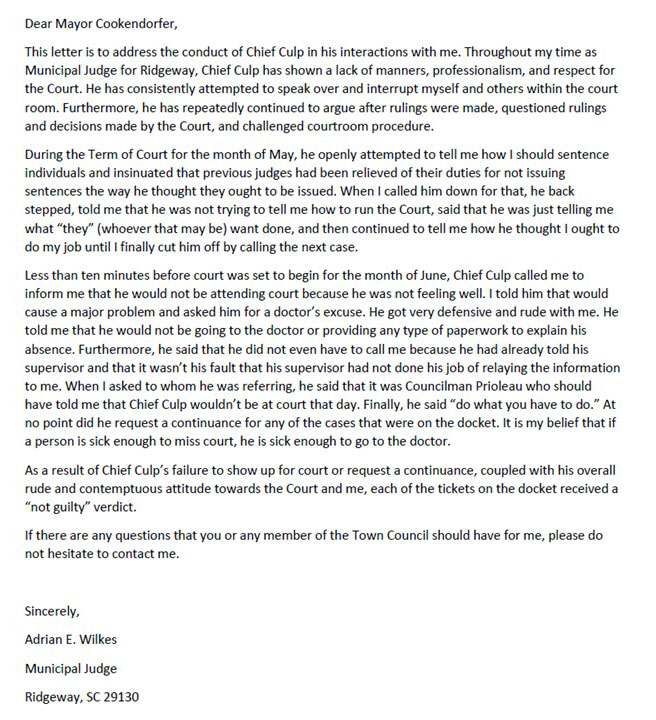
    RIDGEWAY – Ridgeway Police Chief Christopher Culp has repeatedly shown “a lack of manners, professionalism, and respect” for the town’s traffic court and Municipal Judge Adrian Wilkes, according to public records obtained by The Voice through a Freedom of Information request.

    Wilkes recently penned a scathing letter directed at the chief, who according to Wilkes, at one point made a veiled threat against him and disputed the judge’s sentencing.

    “He openly attempted to tell me how I should sentence individuals and insinuated that previous judges had been relieved of their duties for not issuing sentences the way he thought they ought to be issued,” the letter states.

    Culp couldn’t be reached for comment Tuesday.

    Mayor Heath Cookendorfer said the letter was one of a number of complaints the Town Council addressed in executive session Thursday.

    “It didn’t paint a good picture of our police chief,” Cookendorfer said on Tuesday. “All in all I’m not happy with any of it.”

    A motion to immediately terminate Culp failed due to a lack of a second. Instead, Cookendorfer said after Thursday’s meeting that the town plans to address performance issues with Culp.

    “We do have some underlying issues with the police department, some complaints, and we’re going to correct those issues,” the mayor said. “Addressed to Cookendorfer, Wilkes’ letter was dated June 13, the day before Ridgeway Town Council considered firing Culp.

    Wilkes’ letter says the chief consistently speaks over the judge and others in the courtroom.

    Culp also “repeatedly continues to argue” after rulings, questions court rulings and decisions, and challenges courtroom procedures, the letter continues.

    Of direct impact to town operations, Culp called in sick 10 minutes before a June court session was supposed to begin, the letter continued.

    “I told him that would cause a major problem and asked him for a doctor’s excuse,” the judge wrote. “He got very defensive and rude with me. He told me he would not be going to the doctor or providing any type of paperwork to explain his absence.”

    As a result of the chief missing court, everyone on the docket that day received “not guilty” verdicts, the letter states.

    “It is my belief that if a person is sick enough to miss court, he is sick enough to go to the doctor,” Wilkes wrote.

    Wilkes added that Culp told him that he informed his “supervisor” of his plans to call in sick, according to the letter.

    When Wilkes asked to whom Culp was referring, the chief replied that it was Ridgeway Councilman Donald Prioleau.

    Prioleau and Cookendorfer confirmed that Prioleau is considered Culp’s supervisor. They said a hierarchy was established in recent weeks to increase communication and to keep closer tabs on Culp’s whereabouts.

    Prioleau said the procedure calls for the chief to notify Prioleau if he expects to miss court, and for Prioleau to relay the message to the clerk of court.

    “That’s the instructions from the mayor,” the councilman said.

    Prioleau contends that personality conflicts are to blame for issues between Wilkes and Culp. Prioleau said he hoped to address them in a meeting that was scheduled for Wednesday with the Fairfield County chief magistrate.

    “The chief has 18 years of experience,” Prioleau said, defending Culp. “With a judge with no experience and a chief with lots of experience, I have recommended we bring in the chief magistrate of Fairfield County to develop proper procedures.”

    Cookendorfer said he has a meeting scheduled with Prioleau on Wednesday to discuss the town’s police department, but that he is not aware that the Fairfield County chief magistrate had been contacted in regard to issues with the police chief.

    Judge Adrian Wilkes’s letter of complaint to Mayor Heath Cookendorfer concerning Ridgeway Police Chief Christopher Culp.

    RelatedChief survives move to fire him

  • Chief survives move to fire him

    NAACP, School officials called to defend Culp

    RIDGEWAY – Christopher Culp still has his job.

    Ridgeway’s police chief was not present when town council members killed an effort to fire him immediately.

    Councilman Rufus Jones made a motion to immediately fire Culp, but the motion died when nobody seconded it.

    Culp’s brush with potential termination comes amid a number of complaints, including doubling as a school resource officer at the expense of policing the town and openly disrespecting the town judge, according to public records obtained by The Voice. (See ‘Judge, others issue complaints against chief’.)

    Mayor Heath Cookendorfer said Monday that Culp isn’t certified to serve as an SRO, nor has the town appointed him to that role.

    “His primary job/responsibility is to perform the duties of a police officer,” the mayor said.

    In a letter obtained by The Voice, Municipal Judge Adrian Wilkes said Culp frequently challenges his authority in and out of the courtroom.

    “Chief Culp has shown a lack of manners, professionalism, and respect for the Court,” the letter states. “He has consistently attempted to speak over and interrupt myself and others within the courtroom.”

    In spite of these complaints and others, council members adjourned Thursday’s three-hour meeting without further discussion.

    Jones declined to comment after the meeting.

    In making his motion, Jones alluded to complaints about the chief doubling as a de facto school resource officer at Geiger Elementary School. But he said other complaints drove his desire to fire Culp.

    “I want to make a motion – this has nothing to do with the school – this motion is for the complaints we’ve had about Mr. Culp,” Jones said. “I would like to terminate him at once.”

    Cookendorfer told The Voice that Culp’s time spent at Geiger Elementary wasn’t an underlying issue, but acknowledged there have been discussions about the chief’s school visits.

    Additional complaints drove the discussion, but Cookendorfer declined to specify the nature of those complaints.

    “We had some complaints, and we addressed those complaints tonight,” the mayor said Thursday. “We talked about the times that he has been going there (the school), but we have to find a happy medium there. He’s not a school resource officer. He’s the chief of police.”

    State Law and SROs

    In his monthly report, Culp said he performed 22 security checks in May at Geiger Elementary. He also responded to five accidents there, council documents state.

    Culp further stated that 20 citations and 11 warnings were issued in the town. There were no arrests.

    State law defines school resource officers, or SROs, as sworn law enforcement officers who have “completed the basic course of instruction for School Resource Officers.”

    The course must be provided or recognized by the National Association of School Resource Officers or the S.C. Criminal Justice Academy, the law states.

    State law further states SROs “have as a primary duty the responsibility to act as a law enforcement officer, advisor, and teacher for that school district.”

    Maj. Florence McCants, spokeswoman for the S.C. Criminal Justice Academy, said Culp meets the primary qualification of being a Class 1 officer, which basically means he has full arrest powers and has completed the academy’s 12-week Basic Law Enforcement Training Program.

    But the chief has not completed any SRO certification courses recognized by the Justice Academy.

    McCants couldn’t say whether Culp met the second requirement, which says an SRO’s primary duty is to work as a law enforcement officer for the school district.

    William Frick, chairman of the Fairfield County School Board, said all SROs are currently contracted through the Fairfield County Sheriff’s Office. The arrangement applies to schools both within and outside municipal limits, he said.

    Asked if there have been any communications between the Town of Ridgeway and school district about SROs at Geiger Elementary, Frick said he didn’t think so and deferred further comment to Superintendent Dr. J.R. Green.

    “Any contract negotiations would initiate with the district office,” Frick said.

    Green couldn’t be reached as of press time.

    In the meantime, Cookendorfer said the town plans to address performance issues with Culp.

    “It’s a heated situation, none of us run [for public office] to be popular. We have hard decisions to make,” he said. “We do have some underlying issues with the police department, and we’re going to correct those issues.”

    Supporters back Culp

    During both public input sessions, residents overwhelmingly spoke in favor of Culp. Among them were representatives of the National Association for the Advancement of Colored People.

    Brenda Murphy, president of the state NAACP and Ridgeway native, called Culp a role model.

    “You have a policeman who’s on the cutting edge,” Murphy said. “He’s there with our young people. He’s teaching them to not be afraid of the police. You are on the cutting edge because of this policeman.”

    Tiffany Allison said that as a relatively new resident and expecting mom that she believes in Culp’s ability to protect the town. She raised concerns about the town prohibiting Culp from performing well checks at Geiger Elementary School.

    “I was advised that you had banned Officer Culp from visiting the school for any reason other than to issue a citation,” Allison said.

    “You have removed the only protection our children have at this time during their school day for reasons that have yet to be justified,” she continued.

    Myra Bramlett, principal at Geiger Elementary, pleaded with council members to allow Culp to continue visiting the school.

    “If you are indeed thinking of taking away the local officer, I want you to think about how the kids have built a relationship [with Culp]. They know him and they support him,” Bramlett said. “The officers in law enforcement are our friends.”


    RelatedJudge, others issue complaints against chief

  • Councilwoman storms out of executive session…again

    RIDGEWAY – About 20 minutes into the executive session, of the Thursday night Ridgeway Town Council meeting called to discuss the police department, Councilwoman Angela Harrison emerged alone, visibly distraught. Harrison said she left executive session because she was bothered by what council members were saying about the chief. It was the second time she has burst out of an executive session since the new government was seated in April.

    “I’m not going to let them talk about our chief that way. I cannot defeat the lies,” Harrison said. “They’re just trying to fry him. This is evil.”

    She spent about five minutes criticizing council and receiving hugs from supporters of the town’s police chief, Christopher Culp, before returning to the session.


    RelatedChief survives move to fire him,  Judge, others issue complaints against chief

  • Election commission blocks JV annexation protest

    JENKINSVILLE – Fairfield County election officials upheld the result of the Jenkinsville annexation vote by a more decisive margin than the original referendum itself.

    In a unanimous vote Monday, the Fairfield County Election Commission voted to uphold the results of the June 5 special election that saw the annexation measure fail 19-15.

    Commissioners agreed one vote shouldn’t have been counted, but it wasn’t enough to sway the final result.

    Their decision to uphold the election was largely influenced by a miscommunication regarding a property owner who opted out, according to testimony. His property bordered other contiguous properties, which could have swayed the vote, town attorneys argued.

    Commissioners disagreed.

    One official noted a letter from the property owner was sent to the town’s lawyer, and not the Jenkinsville town clerk.

    “The letter should’ve been sent to the town clerk, and it was not sent to the town clerk,” election commissioner Alice Rice said. “It was sent to the lawyer instead.”

    Betty Trapp, chairwoman of the election commission, said a written order of the board’s findings would be issued as soon as possible.

    Trapp said the town could file an appeal in accordance with state law.

    Section 7-17-60 says appeals must be filed no later than noon Monday following the date of the county board’s decision, pegging the deadline as June 25.

    Had the annexation vote passed and been subsequently adopted by Jenkinsville Town Council, the town would have added 143 properties to its tax rolls, quadrupling the town’s geographical boundaries, according to Fairfield County property records.

    Two witnesses were called during Monday’s protest hearing: Jenkinsville Mayor Gregrey Ginyard and Debby Stidham, director of voter registration and election for Fairfield County.

    Jenkinsville’s protest cited three main arguments:

    The list of eligible voters provided to the polling location included voters outside of the proposed annexation area.

    A blind woman’s vote was incorrectly counted.

    One property owner exercised his right to opt out, which broke continuity with several other properties.

    “At minimum, the above irregularities make the actual outcome of the election uncertain and require a new election,” the protest states.

    Jeff Goodwyn, a Columbia attorney representing Jenkinsville, focused primarily on the contiguity issue in his opening statement.

    Goodwyn said if the property owner who opted out was excluded, it would’ve dramatically impacted the outcome because other properties would have been excluded as well.

    “Without this property, the part of the annexation, it breaks the contiguous nature in the city,” he said. “Their votes were meaningless because they couldn’t possibly be in the town.”

    Ginyard affirmed that position during testimony at Monday’s hearing.

    “There were quite a few votes that shouldn’t have been counted,” he said. “With the vote count being 19-15, with there being eight to 10 votes in that area, that could’ve swung the election either way.”

    Ginyard also testified that a blind woman who voted on a paper ballot intended to vote “Yes.” Her vote was excluded because the “X” didn’t appear in either the “Yes” or “No” boxes, Ginyard said.

    Election officials, however, said there’s evidence countering that statement.

    Commissioners noted the woman cast her ballot at the county election office using an electronic machine, meaning she couldn’t possibly have voted on a paper ballot.

    Stidham did confirm that another voter living outside the annexation area cast a ballot, but noted that wasn’t enough to order a new election.

    Stidham added that before the election, she sent a list of eligible voters to Ginyard for verification, but never received a response.

    “Going by the map I received with tax map numbers, I never got any feedback,” she said. “I assumed we had those registered voters correct.”

    Stidham also said the town never mentioned the voter who opted out.

    “The ‘opt out’ you keep mentioning, we had no knowledge of an ‘opt out,’” she testified. “We received nothing in my office to know there was an ‘opt out’ to even remove those voters.”

    Not mentioned during the hearing were reports that Ginyard was observed inside the polling location, beckoning voters to speak to him before they could register with poll workers and cast ballots.

    Stidham and Fairfield County Councilwoman Bertha Goins told The Voice they witnessed Ginyard calling out to voters. Stidham said she eventually asked Ginyard to allow voters to register.

    A state election commission spokesman previously said when public officials speak to voters before they register, it could be viewed as campaigning inside a polling location, a violation of state law.

    “That certainly would not look good and could be construed as campaigning, interfering, or intimidating voters,” said Chris Whitmire, spokesman with the S.C. Election Commission.

  • Jenkinsville subpoenas Voice reporter

    JENKINSVILLE – Jenkinsville’s effort to challenge the results of a recent annexation vote (see related story on page 6) included subpoenaing a journalist with The Voice.

    An attorney for the Town of Jenkinsville issued the subpoena, which sought to compel testimony from reporter Michael Smith at an election protest hearing Monday in Winnsboro.

    The subpoena never specified what sort of testimony the town was seeking.

    Smith, though, was never called to testify Monday, and the Fairfield County Election Commission voted 5-0 to toss the election protest.

    The Voice stood ready to challenge the subpoena, however.

    Jay Bender, an attorney representing the newspaper, was present for Monday’s hearing and had planned to file a motion to quash the subpoena. That step became unnecessary when Smith wasn’t called to testify.

    Smith was the author of several stories in The Voice about Jenkinsville’s failed effort to annex 143 properties.

    If successful, the annexation would have virtually quadrupled the town’s geographical boundaries and increase its tax base by a factor of five.

  • McEachern, Garvin in runoff

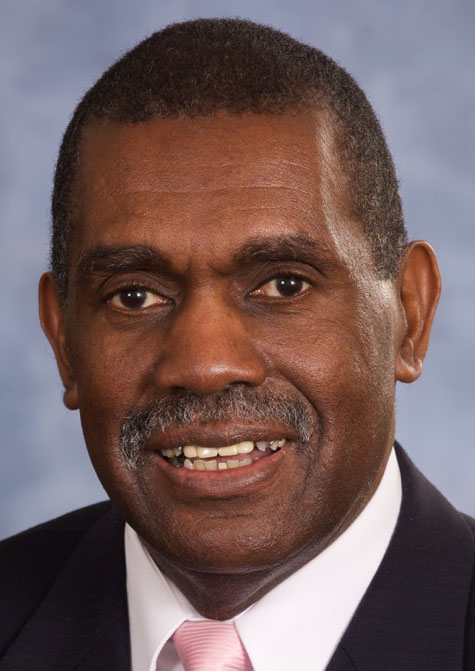
    McEachern

    BLYTHEWOOD – It was a tight House District 77 race Tuesday night for incumbent Joe McEachern, who, with 2019 votes (36.51%), squeaked past newcomer Kambrell Garvin with 2012 votes (36.38%) for a 7-vote majority. But with that slim majority and neither candidate garnering the 50 percent plus 1 votes for a win, the two candidates are now headed for a runoff set for June 26.

    Deyaska Spencer finished behind Garvin with 1,302 votes (23.54%), and John McCleric took 197 votes (3.56%).

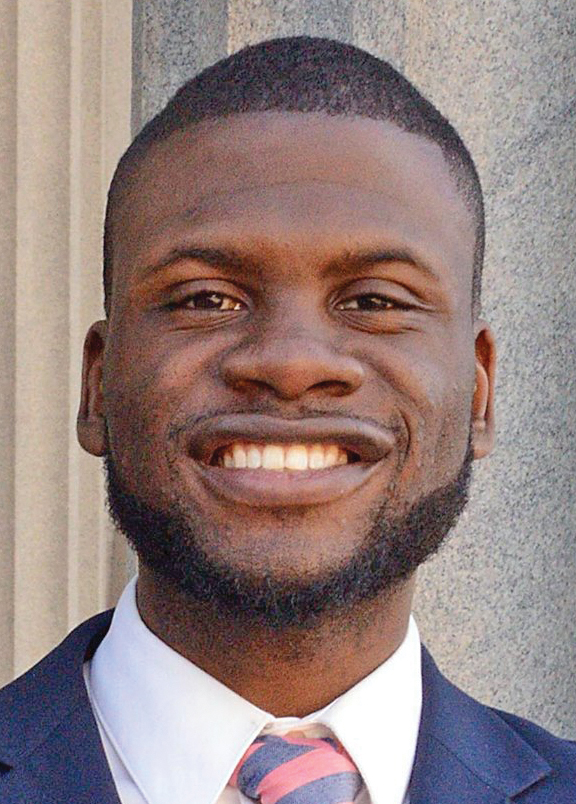
    Garvin

    Garvin easily took Blythewood precincts 2, 3 and LongCreek where he shook hands all morning on Tuesday. Deyaska Spencer, an attorney and resident of LongCreek Plantation and also a political newcomer, took the Sandlapper precinct, and McEachern handily took the rest of the precincts in his District including Blythewood 1 and Roundtop where his numbers were strong.

    “We’re ready,” McEachern said of the upcoming runoff. “I’m looking forward to visiting with the folks out there in Blythewood and Fairlawn. I appreciate all those who supported and voted for me. And I hope those who missed voting in the primary know they can still come out and vote in the runoff. Working together, I’m confident we’ll get there.” Garvin could not be reached for comment.