Category: Government

  • Governor to attend airport unveiling

    WINNSBORO – It was so dark, a state plane carrying S.C. Department of Commerce Director Bobby Hitt couldn’t land at the Fairfield County Airport.

    Not exactly the impression Fairfield County, a county hungry to land new industry, wanted to leave.

    Now when Hitt and his boss, Gov. Henry McMaster, potentially return in a few weeks for a ribbon cutting on the refurbished airport, the sky and runway beneath it will be much friendlier.

    The Fairfield County Airport will unveil its new look during a ribbon cutting ceremony scheduled for Aug. 20. Airport Director Denise Bryan made the announcement at Monday night’s County Council meeting.

    “Everybody had a part in this project,” Bryan told council members. “For your investment and support of this community, I applaud you.”

    Work began in October 2017 and reached substantial completion in late June.

    The Federal Aviation Administration, or FAA, picked up 90 percent of the tab of the $780,000 total cost, spending $702,000.

    Fairfield County and the state each pitched in with 5 percent, leaving their portions at $39,000 each, Bryan said.

    “We got a $780,000 project done at our county airport for $39,000,” she said. “That’s a spectacular investment and I can’t wait to show you what we’ve got.”

    Bryan invited all council members to attend the Aug. 20 event, which starts at 7 p.m. She said she plans to invite state lawmakers and the governor as well.

    The airport upgrades have been a long time coming. Although signage and pads were refurbished, the absence of adequate lighting was the most pressing problem.

    All lights have been replaced with LED lights, which are more energy efficient. They will also be protected by a series of conduits, which Bryan said would greatly increase their life expectancy.

    During her presentation, Bryan noted poor lighting caused a state plane to be diverted.

    “We had a state plane come in one night, and the [runway] lights wouldn’t even come on,” she said.

    County Administrator Jason Taylor later noted that Hitt was among the passengers on board.

    “I had to hear quite a bit about it [the lights] from him, so I’m glad they’re working now,” Taylor said. “It was not good.”

    Council members were ecstatic to learn of the airport news, especially since the report followed a series of votes and presentations focusing on economic development.

    “When I first came on [council], I went to the airport and saw the conditions,” Goins said. “So I’m excited about what I’m about to see very soon. Very excited about it.”

    “I think it’s fantastic for our county to pay $39,000 and get almost $800,000 in value,” Councilman Dan Ruff added. “As an economic development deal, it’s outstanding. I compliment you on that.”

  • RW lifts ban on overnight parking

    RIDGEWAY – Overnight parking is legal once again in Ridgeway, but only for brief durations and under certain circumstances.

    By a 3-0 vote at its July meeting, the Ridgeway Town Council amended its overnight parking ordinance to allow for overnight parking for up to 48 hours. Town permission is needed for longer periods.

    In October 2017, the council under different leadership enacted the ban, largely due to a sod truck that sometimes parked overnight in the Cotton Yard.

    The town, however, backed up on the ban, opting instead to allow a 48-hour grace period.

    “Additional parking needs to be approved by the police department or town council,” Prioleau said. “In the past we’ve had people go on cruises or family reunions, so sometimes we park a few cars longer than 48 hours, and this [ordinance] would restrict that.”

    Mayor Heath Cookendorfer, who in the past has supported limited overnight parking, said the process Prioleau requested was being built into the amended ordinance. He said anyone wishing to park longer than 48 hours should fill out a form.

    “If after that time frame is up and your car is still there, we’d notify you and say we need you to move your vehicle,” Cookendorfer said.

    In addition, parking longer than 48 hours would be allowed with permission for special events.

    Cookendorfer did say he wanted to restrict how long cars for sale can be parked overnight.

    “In the past, we’ve had cars set up out there [with ‘for sale’ signs] for months on end,” he said.

    Priolieau wanted to allow cars for sale for up to 10 days, which the council approved.

    The July parking debate was substantially more civil than previous parking talks.

    At the October 2017 meeting, discussion grew heated over trailers parked at the Cotton Yard, near where Ridgeway’s former mayor lived.

    And at the June 2018 council meeting, tempers flared between Councilwoman Angela Harrison and Rufus Jones.

    Harrison insisted that Jones abstain from voting on first reading of the ordinance because she said Jones sometimes parks vehicles overnight.

    “I have a picture of it if you would like to see it,” Harrison said.

    Jones declined to recuse himself.

    Other council members expressed concern that residents of Winnsboro and other communities might take advantage of overnight parking in Ridgeway.

    At the June meeting, Cookendorfer said while overnight parking does invite abuse, disallowing it altogether was too restrictive.

    “You do get some people up there putting their car up for sale and abusing it,” Corkendorfer said.

    In other business at the July meeting, the council approved final reading to an ordinance that increases water and sewer rates by 2 percent.

    Originally the town considered 4 percent, but dropped it to 2 percent at the June meeting.

    “Ridgeway has one of the highest rates in the state,” Jones said at the June meeting. “I think we should give that to the community.”

    There was no discussion at the July meeting. The vote passed unanimously.

    In June, the vote passed 4-1, with Harrison opposing because she supported 4 percent. Harrison was absent from the July meeting, as was Jones.

    The Ridgeway ordinance increases resident water rates to $16.58 for the first 1,000 gallons and $5.68 for each additional 1,000 gallons. Residents pay $16.25 for the first 1,000 gallons and $5.57 for each additional 1,000 gallons, according to the town.

    Sewer rates will rise from $13.25 to $13.52 for the first 1,000 gallons and from $5.04 to $5.14 for each additional 1,000 gallons.

    Non-residents will pay $21.93 for the first 1,000 gallons of water and $7.03 for each additional 1,000 gallons.

    Non-resident sewer rates rise to $14.79 for the first 1,000 gallons and $6.22 for each 1,000 gallons, council documents state.

    Commercial water customers will pay higher rates as well.

  • Town Hall takes reins of Big Grab

    Switzer: Town Agrees To Partner With Chamber

    BLYTHEWOOD – Blythewood Mayor J. Michael Ross announced via email on Wednesday, July 25 that the 2018 Big Grab is on for Sept. 7 and 8, and that the Town would be organizing and funding the event this year since two vendors, the Greater Blythewood Chamber of Commerce and merchant Teresa McKenrick, had backed off their requests to manage the Blythewood section of the event after the council said it would only fund them for the actual costs of the event.

    “Phil Frye, as chair of the chamber’s Big Grab committee, called me around noon today [July 25] and informed me of the [chamber] board’s decision to decline the town’s offer of $5,000 to organize this year’s Big Grab. Our staff, under the direction of Events Coordinator, Steve Hasterok, looks forward to this challenge and being ready Sept 7 for the 2018 Big Grab!” Ross stated in his email.

    About 9 o’clock the next morning, however, Mike Switzer, Executive Director of the Chamber sent out an email he said was a ‘Big Grab Joint Press Release from the Town and Chamber,’ stating that he and the town (not council) had reached an agreement to jointly support the Blythewood section of the Big Grab. The email stated that the Chamber would continue to manage the Blythewood Big Grab web page and Facebook page, and continue to coordinate vendor sites as it did last year. For information about security, trash and portable restrooms, however, questions were directed to Steve Hasterok, Director of the town’s conference center and events, at 803-754-0501.

    The Voice had not received the ‘joint press release’ from the Town Hall at press time.

    The question of who would manage the 2018 Big Grab became an issue at the July 23 town council meeting. That ended without a decision being made as to who would be heading up this year’s Big Grab.  Two applicants asked for $10,000 in A-Tax funding, but both presented much larger budgets. Merchant Theresa McKenrick’s budget came to $15,000 and Greater Blythewood Chamber of Commerce Executive Director Mike Switzer’s budget came in at $14,500. Both wanted to use the park for vendor setup, sell sponsorships to raise extra money and pay salaries for staffing – McKenrick, up to $4,000 and Switzer, $5,000.

    Merchants had been vocal that they did not want vendors in the park, which they said hurt the sales in the town’s brick and mortar businesses; they did not want to have to pay sponsorship fees of $75 each and they objected to A-Tax funds going to pay thousands of dollars for salaries for the organizer’s staffs.

    After council listened to both parties and other merchants, Ross offered $5,000 to cover actual expenses, with no allocation from A-Tax funds for staff salaries. McKenrick turned the offer down at the meeting, saying she would not run it without paid staff. After taking the option to the chamber board for a vote, Frye notified Town Hall on July 25 that the chamber, too, was turning down the offer.

    “The Town of Blythewood is always sensitive to the needs of local merchants, businesses and individuals,” Ross stated in his email. “We recognize the desire to return The Big Grab to the way it was before, to have it ‘get back to its roots,’ to be a family friendly event that highlights small businesses and individuals selling items in a true ‘yard sale’ environment,” Ross wrote.

    Ross stated that Doko Park would not be open to vendors during The Big Grab event this year. Instead, vendors will be encouraged to find spaces around the town and in empty lots where they can set up shop as they did during the first years of The Big Grab. Some of the merchants, including Blythewood Consignment, Bits and Pieces and Sweet Pea’s Ice Cream Parler, have offered vendors the opportunity to set up on their lots at no charge by calling ahead to reserve the spot. Others may charge nominal fees.

    Ross assured merchants and vendors that town hall would pay the costs of whatever is needed to make the event safe, enjoyable and successful such as arranging for sheriff’s deputies for traffic control, trash receptacles and portable restroom facilities along Main Street and other areas where they are needed.

    “We want to highlight the wonderful community that we have here,” Ross wrote. He referred questions to Hasterok at 803-754-0501 or at hasteroks@townofblythewoodsc.gov.

  • Providence has FMH rehab in strategic plan

    WINNSBORO – As Providence Health prepares to open a new emergency room in Winnsboro, its parent company is being sold.

    Tennessee-based LifePoint Health is being acquired by Apollo Global Management, a large venture capital firm, said Stephen Selzer, interim market chief executive officer of LifePoint.

    Selzer made the announcement during the Fairfield Memorial Hospital’s monthly board of trustees meeting July 24. Apollo disclosed news of the sale in a July 23 news release.

    “They [Apollo] are coming in basically to buy all of the stock of LifePoint and acquiring the company,” Selzer said.

    With the move, LifePoint will essentially switch from a publicly held company to a private corporation.

    According to the Apollo news release, LifePoint is merging with RCCH HealthCare Partners, which is owned by Apollo. Selzer said LifePoint would retain its name.

    As of March 31, Apollo listed nearly $3.2 billion in total investments, according to a quarterly report filed May 8 with the Securities and Exchange Commission.

    “We are excited that LifePoint and RCCH are combining to create a national leader in community-based healthcare, and are looking forward to the next chapter of the combined company’s growth,” Matthew Nord, a senior partner at Apollo, said in a news release.

    Closer to home, hospital executives said the merger means only good things for Fairfield County health care.

    “The company will not have to make decisions on a quarter to quarter basis,” Selzer said. “That’s a trap sometimes that you can only make decisions that make you look best in terms of your next quarterly earnings report. It’s a little bit difficult to think bigger long-term.”

    Selzer added that Apollo has tremendous assets which he said would lead to greater investment in health care, though he didn’t say specifically how that would translate in Fairfield County.

    “Once it [the sale] does close, we’ll be able to look at capitalizing on opportunities of having fair market here,” he said. “What I think is going to come out of this is something that’s much better for everybody.”

    The one-level, 18,000-square-foot building, located off U.S. 321 bypass near across from Bi-Lo, will dedicate 12,000 square feet to emergency services and include 6,000 additional square feet of space for future expansion.

    Lindy White, chief executive officer for Providence Northeast in Columbia, said the 6,000-square-foot expansion is part of Providence’s strategic plan for 2019.

    Fairfield Memorial Hospital board members were pleased with the report.

    “It is so apparent that you guys as of late are a hospital on the move and are trying to be on the forefront in the latest and greatest in the health care field,” said trustee Randy Bright.

    “I’m encouraged to know that you are working on a strategic plan,” added trustee James McGraw. “You guys are working to get the word out. The test is going to be inform the people in the rural areas. It’s going to be a great benefit having you in this county.”

    White said the facility’s clinical director position has been posted for a few weeks. She said Providence hopes to fill it in September.

    “We’re charting down that path with hopes of having that person, the right person, who’s going to promote patient quality and experience,” White said. “We will begin interviewing once we find right candidate.

    Other positions should be posted soon, if not already, White said, adding that job fairs will be held in late August.

    Providence also recently toured the Fairfield rehab center, which is the subject of a pending real estate transaction between Fairfield County and Fairfield Memorial Hospital.

    FMH has accepted Fairfield County’s offer of $1.3 million to buy three parcels, with an option to acquire the rehab center for an additional $285,000.

    The county said it wants to see the rehab center remain where it is, but hopes a private buyer will operate it.

    White said she was impressed with the energy at the rehab center, but also said Providence is still evaluating the feasibility of potentially running it.

    “Hopefully with the size of our staff and the staff we have, we can operate the facility too at a little lower cost based on that scale,” White said. “We’re trying to incorporate those things and do that due diligence.

    “The facility shows well and the team is very engaged,” White continued. “I was excited by the engagement. The team takes ownership, which is evident in the patient comments you see.”

  • State donates $2M for megasite infrastructure

    WINNSBORO – Economic development discussions led a busy night at Monday’s Fairfield County Council meeting.

    Council members voted to accept a $2 million grant for infrastructure improvements to the county’s megasite at I-77 and S.C. 34, as well as a series of ordinances that expand the boundaries of a regional industrial park.

    Council members voted unanimously in favor of the measures.

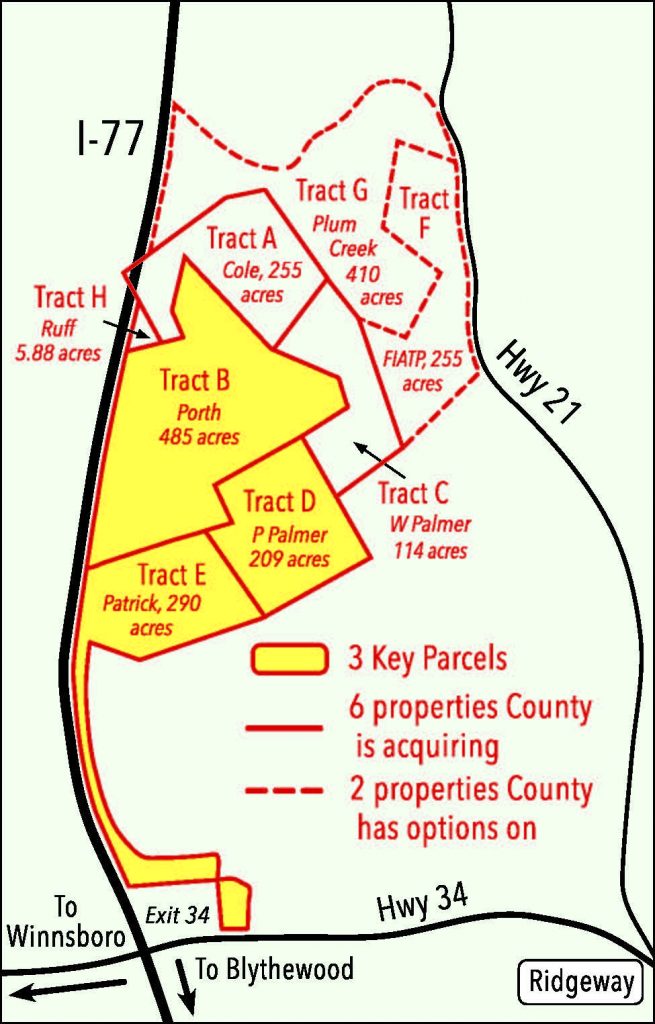
    Awarded by the S.C. Department of Commerce, funds from the $2 million grant will subsidize the installation of infrastructure at the megasite, an approximately 1,000-acre site the county purchased with help from the state in 2016.

    Megasite on Highway 34 and I-77

    The $2 million grant is through the Department of Commerce’s LocateSC program. LocateSC is on online tool that showcases prospective industrial sites, according to the commerce department’s website.

    County Administrator Jason Taylor said the county has been working closely with the Department of Commerce on the megasite. He noted the county pitched in with $3 million and the state spent about $6 million to buy the mega site property.

    Getting infrastructure in place is critical to drawing large industries, such as auto manufacturers, Taylor said.

    “Without infrastructure, we just have a piece of raw land,” Taylor said. “This is the first step to make this a true industrial site that would attract an industry to Fairfield County.”

    Ridge Fletcher with the South Carolina I-77 Alliance com mended the county for its commitment to the megasite.

    “That site, while owned by Fairfield County, has the potential to benefit the entire I-77 corridor when you land the right industry,” Fletcher said. “We’re really excited about that. We’re hopeful it’ll give a good portrait of the Fairfield County megasite. It is a regional asset.”

    Fletcher added that the alliance soon plans to unveil a promotional video and website that targets Fairfield County, and the megasite, in particular.

    “We’ve spent upwards of six figures on this on behalf of Fairfield County and the region,” he said.

    Council Chairman Billy Smith asked about the potential impact of a possible trade war triggered by newly imposed tariffs might have on luring economic development prospects.

    “Is there anything you’re doing to make sure the impact on companies along the [I-77] corridor is mitigated and backup plan on where to go to next?” Smith asked.

    Fletcher responded by saying it wouldn’t have much impact on domestic companies and international companies looking to establish a footprint in South Carolina. The main impact, he said, is on international companies looking to export to the U.S.

    “We don’t deal with the existing business side,” Fletcher said. “With us marketing toward the domestic side, it helps balance the fear sometimes. A lot of people are fearful about what the tariffs will do. In the international marketplace, fewer companies are thinking about coming to the U.S. to export.”

    Ridgeway resident Randy Bright, a frequent speaker at council meetings, said during the public comments section that he’s also impressed by the county’s commitment of infrastructure improvements.

    But he also noted the county needs a long-term plan to land permanent industry.

    “Residential builders won’t come here without water and sewer,” Bright said. “With industry it’s the same thing.”

    Another speaker, though, was critical of economic development efforts.

    Jackie Workman of Blair said she’s concerned about high unemployment and job losses associated with reactor projects shutting down at the VC Summer Nuclear Plant.

    Workman also questioned salaries paid in the county economic development office versus jobs created.
    In related business, council members approved third reading of an ordinance that expands the I-77 Corridor Regional Industrial Park by 10.31 acres. The properties are located in the 1000 and 1100 blocks of Shop Road, according to council documents.

    Council members also approved second reading of a second ordinance to add another 5.8 acres at 3800 West Ave. in Columbia, documents state.

    The companion ordinances were similar to measures already passed by Richland County Council.

    A third ordinance relating to the I-77 industrial corridor authorized the execution of the amended and restated master agreement, which involves the corridor.

  • A-Tax meeting turns into a near donnybrook

    Keith Loner of Blythewood and his daughter, Ashley York, take time out from shopping a previous Big Grab in downtown Blythewood to rest on a sale couch set along Highway 21. | Barbara Ball

    BLYTHEWOOD – When two separate applicants appeared before the Town government’s Accommodation Tax (A-Tax) committee last week to vie for $10,000 the town council has allocated for someone to manage this year’s Big Grab yard sale, the tense, hour-long meeting erupted into a shouting match between the two applicants and their supporters until frustrated committee member Ken Shettles called a halt to the ruckus with a motion to recommend that council reduce its allocation for the event to $5,000 and also make the decision as to which group will be awarded the money.

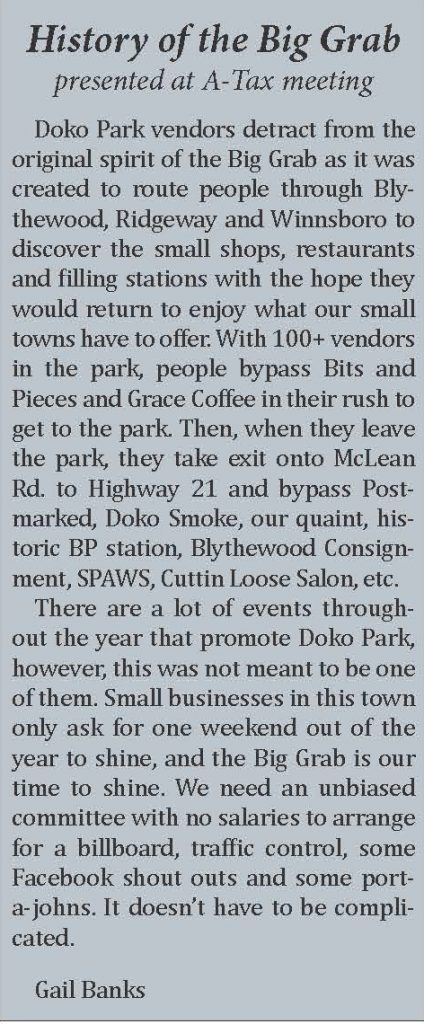
    History of the Big Grab, presented at A-Tax meeting

    The two applicants, Mike Switzer, Executive Director of the Greater Blythewood Chamber of Commerce and Theresa McKendrick, owner of Postmarked 29016, a gift shop on McNulty Road, each made a case as to why he/she should be awarded the $10,000.

    One committee member described the tug of war as a battle for the money.

    “Oh, no,” Switzer said. “It’s not a battle at all. We’re totally fine if this group of volunteers would like to take it over.”

    “So you’re withdrawing? Is that what you’re saying?” Shettles asked.

    “No, that’s up to the committee,” Switzer said, but reminded the committee that this would be the chamber’s third year to oversee the Big Grab if awarded the money.

    According to the chamber’s records, it made a profit from last year’s Big Grab, but how much is not clear. The Chamber did not turned over to the A-Tax committee a detailed listing of vendor fees and sponsorship sales for last year’s Big Grab, just a total number for each. One report showed a total Big Grab profit of $1,432.77, while other numbers indicated a possible profit of as much as $6,144.88.

    The A-tax applications submitted by Switzer and McKendrick were similar.

    Switzer’s application called for Big Grab to continue as a megasite in Doko Park as it did last year under the chamber’s direction. He listed project costs for the September, 2018 event at $10,000 but the revenue and expenses sections of the application each add up to $14,500, not $10,000.

    Total revenue sources include $10,000 (A-tax funds), $3000 (sponsorships) and $1,500 (food and vendor sales). A proposed total of $14,500 in expenditures includes $2,240 (park rental for 28 hours), $2,560 (Sheriff’s Deputies), $800 (portable restrooms and trash bins) $500 (misc. supplies), $400 (ROTC), $5,000 (payments to chamber and visitor center staff) and $3,000 (advertising/marketing).

    While McKendrick likened the Chamber’s Big Grab in the park to a flea market atmosphere, she, too, proposed locating vendors in the park but also in the town center.

    McKendrick’s revenue sources mirrored Switzer’s at $14,500, but her proposed expenditures of $15,000 included up to $3,000 (park rental), up to $4,000 (municipal and county resources), up to $4,000 (administrative/event planner) and $4000 (marketing/promotions).

    McKendrick justified payments of up to $4,000 for her staff as covering an event planner and “other support staff. If we have to hire day-of-event staff, then we would have that money available. We hope to hire a social media person and may have to pay to play if we hire social media influencers. We would pay them to post,” she explained.

    While McKendrick said she was speaking on behalf of the owners of the town’s consignment stores, Bits and Pieces and Blythewood Consignment, neither of the stores’ owners were happy with Switzer’s or McKendrick’s proposals.

    “Let’s start from the beginning,” Liz Humphries, owner of Blythewood Consignment said. “This is about a big yard sale, a glorified selling of junk. I don’t think we need to spend all this money. I think we all need to get together and volunteer for our community.”

    Joe Benini, co-owner of Bits and Pieces agreed.

    “The first Big Grab was awesome and easy,” Benini said. “Then the chamber took over and the next thing I know, it’s now a $15,000 budget, for what? My wife and I had to pay $50 just to be a sponsor. I paid for all my stuff, posters, etc. and posted the map that was in The Voice on our door,” he said.

    “Let the local people make the money,” Humphries said. “The Big Grab started as a way to get people in to our brick and mortar [stores]. The park has nothing to do with my store except that it’s a huge competition. My sales dropped in half last year because everyone was at the park. I’m just here to protect my business,” Humphries said. “I’m all about people selling their junk. But I don’t think people should get paid to do this. If you love Blythewood, you need to volunteer and not expect to get paid.”

    Susan DeMarco, who owns Sweet Pea’s Ice Cream Parlor, is a member of the Chamber and sits on the A-tax committee, agreed.

    “We can tag each other on Facebook and say, ‘We’re all merchants in Blythewood and we’re all excited about the Big Grab.’ It’s going to happen no matter what we decide today. It’s on. It’s on. What you put in to it is what you get out of it,” DeMarco said. “If we spend a bunch of money, we aren’t changing the Big Grab. All we’re doing is having a power struggle between two parties.”

    “We thought we were doing a good job,” Switzer said, defending the chamber’s management of the Big Grab. “We reached out to all the merchants. We thought we were working out solutions to try to help them because we’re all about businesses succeeding and thriving in this community. As for as being paid to run the event, we cover that cost with sponsorships and vendor fees.”

    “But you’re still holding it in the park,” said Gail Banks, a vendor at Blythewood Consignment. ”You’re not getting it.”

    “And last year the park looked like a disaster relief area,” committee member Kris White said.

    “No matter what we do today, we aren’t going to come to a conclusion,” Shettles said. “Our committee only makes recommendations to council, and these arguments need to be in front of council. We could go on here for hours.”

    With Shettle’s motion on the table, DeMarco offered a second motion recommending that no organizer would get any money for the event, but that the town would foot the bills for hard expenses like sheriff’s deputies, trash receptacles, portable restrooms, etc.

    “People have to stop asking the merchants for sponsorships,” DeMarco said. “I don’t want to give A-tax money to someone to run the event and who then comes to ask me for more money to sponsor it.”

    The committee voted 3-0, with DeMarco abstaining, to pass Shettle’s motion.

    The Big Grab 50-mile community yard sale is set for Friday and Saturday, September 7 and 8, and will include Blythewood, Ridgeway and Winnsboro.

  • Big Grab over A-Tax Funds

    Applicants offered $5K; Mayor: Take it or leave it

    BLYTHEWOOD – After the Accommodation Tax (A-Tax) committee passed last week on choosing one of two applicants (the Greater Blythewood Chamber and shop owner Theresa McKendrick) to receive $10,000 in A-Tax funds to run the Blythewood portion of this year’s Big Grab event, council was left to make the choice with the only recommendation from the A-Tax committee being that it limit funding for the event to $5,000.

    Rich McKendrick, who addressed council Monday night on behalf of his wife, Theresa, criticized merchants who, he said, supported her to apply for the A-tax funds to spearhead the Big Grab, but on the day of the A-tax committee meeting did not support her application. Those business connections, however, said that when they found out McKendrick’s application included $4,000 in staff pay, the assignment of vendors to the park and the sale of sponsorships – expenses they said they opposed from the get go – they could not support it.

    Those merchants said they were looking for an alternative to the chamber’s Big Grab megasite of vendors in the park last year that took much of their Big Grab business out of the town where it was originally designed to go. They also expressed their opposition to having to pay for sponsorships and for the A-tax money going to pay for thousands of dollars for staff pay.

    Kitty Kelly, office manager for the chamber, told council that the chamber did not receive any of its staff pay from A-Tax funds.

    “I don’t know where that’s coming from,” Kelly said.

    “Kitty, on the application you filled out for A-Tax funds, you designated ‘Blythewood chamber/visitor center staff, $5,000.’ That’s what your organization asked the A-Tax committee for to pay the chamber’s staff…$5,000 to administer the Big Grab,” Ross said, holding up the chamber’s application.

    “It’s $5,000 just to rent the park and pay Richland County (sheriff’s deputies),” Kelly said.

    As Switzer approached the podium, Ross told Kelly, “I think you need to let Mr. Switzer explain this.”

    “Yes, there are staff costs involved. Sponsorship and vendor fees have covered our staff costs,” Switzer said.

    However, the chamber’s application for A-Tax funds for this year and past years clearly listed staff salaries as coming out of A-Tax funds.  Further, while the chamber’s application listed its Big Grab budget at $10,000, the budget was actually $14,500. McKendrick’s budget was $15,000.

    Ross said council wanted to cover all the essential expenses for putting on the Big Grab – sheriff’s deputies, port-a-johns, marketing, etc. – with the caveat that council would receive receipts for those expenses. He said he felt the $5,000 would cover those expenses.

    “We’re not fools,” Ross said. “If we don’t give a dime to this, the Big Grab will happen and the vendors will set up in town and the businesses will do well.” He also suggested that the town could take over running the event but said he didn’t want to take an opportunity away from organizations that want to do it the right way.

    “We don’t want to bring people into our park to take them away from the businesses,” Ross said.

    Councilman Brian Franklin, however, ignoring merchant’s claims that the park vendors drastically reduce their business on Big Grab weekend, suggested still having as many as 50 vendors in the park.

    Mayor J. Michael Ross first offered the $5,000 for management of the event to McKendrick who declined, saying she would not run it without staff pay ($4,000) and allocations for other things such as rental for the park.

    Ross then offered the $5,000 to the chamber. Switzer said he was not turning the offer down but said the application was for $10,000 and that’s what he needed.

    The mayor countered that the option was take it or leave it. Switzer left the room and did not return.

    Council voted 4-1 to fund the chamber with the $5,000 if the chamber wanted to accept that amount and limit park vendors to 50. Councilman Eddie Baughman voted against. Otherwise, Ross said, the town would take over the Big Grab.

    The chamber was to notify town hall of its decision by 5 p.m., Wednesday, Aug. 25. That decision had not been made before The Voice went to press on Wednesday.

  • Auditor: Town’s books were a mess

    Council Advised To Hire Competent Accountant

    BLYTHEWOOD – Before presenting the audit for the town government during Monday night’s town council meeting, Gary Bailey, with Love, Bailey Auditors of Laurens, S.C., spoke plainly about the condition in which he found the town’s books when he was called to audit them last November.

    “The books were really in a mess,” Bailey said.

    During the May town council meeting, Mayor J. Michael Ross announced that the town’s books were not in order and hadn’t been for some time. He said the town “has not even commenced the annual audit process for the 2016-17 audit.”

    To that end, the town hired the CPA firm of Sheheen, Hancock and Godwin of Camden to bring the town’s books up to the level that they could be audited. That audit was presented just seven days before the July 30 deadline when, by state law, the state could begin to withhold state funds from the town.

    “It appears this situation has resulted from management’s failure to properly transition to the new accounting software system which was recommended to this council by professional public administrators who then failed to attain implementation,” Ross stated during the May council meeting.

    Ross credited the town’s newly hired administrator, Brian Cook, for detecting the deficiency very early in his service to Blythewood. Cook was hired last February to replace Gary Parker who retired. Assistant administrator Chris Keefer left her position in June.

    By Monday night, however, all appeared to be well.

    “[Sheheen] did an excellent job,” Bailey told council. “After they took hold of your books, we didn’t find any major issues. The town is in a very strong position.”

    Bailey gave the town a stern warning, however, going forward.

    “You can see the alternative of not having a qualified person in place [to do the town’s accounting.] Hiring someone without expertise cost you way more than just outsourcing for a fraction of the time that was needed [to get the books in order],” Bailey said.

    Hitting the highlights of the audit, Bailey said the town’s total general fund increased by $173,000 to $1.562 million and, of that, only $359,000 was restricted to debt service. The other $1.2 million was unassigned.

    “The general fund cash balances increased to $1.2 million in fy 2016, but dropped a bit to around $800,000 in fy 2017 because you have a lot of projects going on and transferred a good bit over to capital projects,” Bailey said.

    The unassigned fund balance of $1.2 million represented about 87 percent of the fy 2017 expenditures which, Bailey said, was very strong.

    “Most town’s push to have a 25 percent minimum fund balance. Yours is 87 percent, so that’s really strong,” Bailey said.

    Bailey reported that the town’s general fund expenses were $1.38 million for fy 2017 based on operating cash, not restricted cash, which gave the town almost 10-1/2 months of cash flow.

    “If you didn’t bring in a single dollar for 10-1/2 months, you’d have enough to continue funding the town. That’s very strong even at June 30, 2018,” Bailey told council.

    Bailey reported that while the overall general fund revenue did decrease by about $65,000 from fy 2016 to fy 2017, it was mostly isolated to building fees and permits.

    Expenditures, Bailey said, also went down about $10,000 in fy 2017 due primarily to payroll being up about $9,000.

    “You had about $14,000 in capital outlays within the general fund, but all other expenses decreased $33,000 from the previous year,” Bailey said.

    The good news, Bailey said, is that the town’s revenue was $64,000 more than was budgeted and expenses were $168,000 below what was budgeted.

    “You spent a lot of money in fy 2017 and wrapped it up in fy 2018,” Bailey said. “Overall capital outlay in fy 2017 was $865,000, mostly for two projects: the amphitheater for $416,000 and the Doko building for $408,000.

    The audit showed that Doko Meadows is becoming a bright spot instead of a blight on the town’s financial picture. Revenue increased from $135,000 in fy 2016 to $175,000 in fy 2017 The unadjusted fy 2018 numbers have the revenue at $212,000. Bailey also pointed out that the Doko Meadows losses decreased from $77,000 in fy 2017 to $35,000 in fy 2018.

    The outstanding balance on the bond that was used to construct Doko Meadows is $4.4 million.

    Going forward, Cook said the town is evaluating how it wants to reconfigure staffing to handle the town’s accounting. He said the 2016 transition from outsourcing the town’s accounting to an in-house system bogged down.

    “We’re thinking about hiring a qualified accountant and doing it ourselves, now, but with oversight from Sheheen. We have some controls in place and we’ll continue to have a CPA check up on us, maybe monthly at first and less frequently over time,” Cook said. “It’s going to take a little time to get set up.”

    Cook said he expects the town’s books to be ready for the fy 2018 audit to begin in October and Bailey said that audit is on track to be presented before Christmas.

  • County taps into water authority

    WINNSBORO – Fairfield County is looking to tap into the water and sewer business.

    The county, though, says it’s merely looking to work with other water providers, such as the Jenkinsville Water Company, and has no plans to force the JWC and other water companies into any agreements.

    At its regular meeting Monday, County Council voted unanimously on a resolution authorizing it to proceed with creating a joint water and sewer system.

    “It doesn’t immediately affect the water companies that are in the county,” County Administrator Jason Taylor said in response to a question from Councilman Mikel Trapp.

    “What it does is it sets up the framework that the county can provide water and sewer services,” Taylor continued. “We can work with these companies. Once we get into the creation of it, we’ll look at various engineering.”

    Taylor said toward that end, the resolution references a memorandum of understanding the county recently reached with the Town of Winnsboro, the county’s largest water provider.

    State law authorizes two or more cities or counties to develop a joint water and sewer system. In the case of Fairfield County and Winnsboro, it would be called the Fairfield Joint Water and Sewer System.

    According to the resolution, the commission would start with at least seven members. If additional partners join the commission, Fairfield County and Winnsboro would maintain equal membership and represent a majority of votes on the commission.

    The county and town would be empowered to appoint commissioners by resolution. In the event of a disagreement over an appointee, “the decision shall be resolved by the flip of a coin,” the resolution states.

    “There’s a lot of ability now with this new ordinance to reach out to the individual companies and offer to assist them or work with them in providing water services more comprehensively than in the past,” Taylor said. “It doesn’t force anything upon anybody. It gives us the ability to move forward and provide water and sewer services.”

    Monday ’s vote follows a discussion of the agreement the county’s public works committee held last Thursday. At that meeting, Taylor said the purpose of the agreement is to establish a foundation that would allow the county and town to solicit grant money to help subsidize startup costs.

    “This is just to set up the legal framework so we can have an authority that has the authority to execute these kinds of agreements and then accept money,” Taylor said.

    In related business, the council also approved a new sewage disposal agreement with the Town of Great Falls, replacing the previous one county officials say was never entirely fulfilled.

    Per the agreement, the county agrees to purchase 250,000 gallons of sewage capacity for $517,000. Plus the county pledged to spend $52,800 in engineering services for a new sewer line.

    Taylor said Great Falls and the county previously had an agreement to provide sewer services in the Mitford area in the vicinity of I-77 and S.C. 200.

    “It was anticipated there was going to be a lot of development in that area so we wanted to bring in sewer [services] to facilitate that development,” Taylor said. “Unfortunately the growth in that area never occurred. It never was fully realized. Great Falls took essentially a big hit on this thing because they only got like 11 customers.”

    The $517,000 spent on added sewer capacity covers about $234,000 in costs that Great Falls incurred in providing sewer services, and buys out $230,000 that Taylor said the county should have paid the town, but never did.

  • CPA: Visitor Center funds funneled to Chamber

    BLYTHEWOOD – After reviewing The Greater Blythewood Chamber of Commerce’s financial documents that were requested by council for fiscal year 2017-18, a certified public accountant concluded that the documents were “confusing, lacking in detail and sometimes impossible to follow and understand.”

    He also concluded that much of the $18,500 accommodation tax (A-tax) money council awarded to the chamber in June, 2017, to pay for a dedicated visitor center employee, was not spent on that employee. Instead, it was funneled directly to the chamber to pay one quarter of the chamber’s annual operating expenses, an unauthorized use of A-tax money, according to the CPA, and an arrangement the council never agreed to when it allowed the chamber to take over the management of the visitor center in June 2017 and awarded the chamber the funds for a visitor center employee.

    Those documents were acquired by The Voice from members of Town Council after the chamber’s executive director, Mike Switzer, turned them over to council on June 13, more than a month after council requested them. The documents included several untitled, undated budget reports along with others with partial dates. Many of the entries on budget ‘actuals’ do not match annual profit and loss statements for the same time period.

    Former Town Councilman Bob Massa, a CPA and former treasurer for the Blythewood Chamber, said the financials that were presented to council and passed on to The Voice do not meet professional accounting standards even though the chamber’s May 31, 2018 actuals reflect $2,730 for ‘professional account fees.’

    When council allowed the chamber to take over management of the visitor center in June 2017, it gave A-tax funding for a dedicated employee for the chamber, but did not approve that A-tax money for the chamber’s operating expenses as part of the arrangement.

    However, a report in the chamber’s financial documents, titled ‘Visitor’s Center Report: January 2018”, showed that during the first six months, after being awarded the $18,500 for a visitor center employee, the chamber charged one quarter of its operating expenses to the visitor center’s $18,500, producing an artificial deficit of $4,885 for the first half of the fiscal year and projecting an artificial deficit of $2,758 for the upcoming second half of the fiscal year.

    Switzer presented that report to council and, with no discussion as to why a quarter of the chamber’s operating expenses had been charged to the visitor center, which is, according to Massa, an unauthorized use of A-tax funds, voted to give the chamber another $7,643, the full amount of both artificial ‘deficits.’

    Massa also pointed out that at least some of the chamber’s operating expenses charged to the visitor center appeared to be inflated, thus artificially increasing the amount of the deficit. One example is a $626 charge for one-fourth of the chamber’s annual insurance cost which, multiplied by four, comes to $2,504 total for the year. But the chamber’s profit and loss statement and the actuals of a budget for that same time period listed the chamber’s annual insurance costs at $1,491.72, not $2,504. Council did not question the difference before voting to give the $7,643 to the chamber.

    “It’s difficult to tell what is going on with the chamber‘s and visitor center’s revenue and expenses from these documents. It’s a mess,” Massa said.

    While members of the audience at the June 25 council meeting questioned and criticized the chamber’s financials, council, without asking any questions about the requested financial documents, voted 4-0 to award another $9,250 to the chamber for the visitor center for the next six months, even though it also voted to discontinue all funding for the visitor center as of Dec. 31, 2018. Council did not outline any expectations for the visitor center operations or how the $9,250 is to be spent.

    “The A-tax money is intended to be used to promote tourism to the town, to bring visitors,” Massa said. He said it can also be used to pay an employee for a visitor center or to fund events, such as The Big Grab, that have the potential to bring visitors to Blythewood.

    “Council has a fiduciary responsibility to the residents. A-tax money is for specific things. It is not for funding the chamber’s operating expenses, but it would appear that it is being laundered through the visitor center to do just that.”

    $17,500 Grant

    A state official also had concerns about an economic development grant council awards each year to the Greater Blythewood Chamber, a practice that Massa said should be frowned upon by the residents since it does not appear to meet the criteria for a grant. This year, council’s grant to the chamber is $17,500, a $2,500 increase over last year’s award.

    “Who else is eligible to receive this grant? It’s not a grant if only one entity is eligible to apply and receive it,” the official, who asked not to be identified, said. “Grants must have criteria to which an entity has to adhere to and meet in order to apply and receive funds. Public funds must be spent for a public purpose. A service must be provided in exchange for these funds. The grant has to be open to anyone who meets the criteria. Businesses in the town could apply for this grant. There should be an expectation on the town’s part that there is a return on that investment. A contract is involved when a grant is awarded,” the official said.

    But the only ‘contract’ for the grant between the town and the chamber is a letter stating that the chamber must provide the town a $2,500 premier sponsorship and that Ed Parler, the town’s appointee to the Chamber board, must have a vote on the board.

    The state official said that is not a return on the town’s investment of $17,500.

    Other inconsistences in the chamber’s financial bookkeeping and reporting has to do with the A-tax funds awarded to the chamber by council for events organized by the chamber. For the last three years, council has funded the chamber with A-tax funds to organize The Big Grab in September, a glorified yard sale that includes Blythewood, Ridgeway and Winnsboro.  Last year, the Chamber also received A-tax funds to organize the community’s Solar Eclipse event.

    But Switzer’s reports on the chamber’s revenue and expenses for the two events came up short on transparency. Of the $8,750 A-tax award for The Big Grab, the chamber staff paid themselves $4,618 on top of their chamber salaries. Of the  $12,750 A-tax award for the Solar Eclipse event, the chamber staff paid themselves $7,475.25. This was compensation in addition to what the staff is regularly paid by the chamber for chamber activities.

    After each event, the chamber is required to submit a report to the A-tax committee on its revenue and expenses for the event.  Those reports, with few details, led to questions of how the money was actually spent.

    Solar Eclipse reports

    Switzer reported to the A-tax Committee that its total revenue for the Eclipse event (A-tax and other sources) came to $19,455.94. However, the annual profit and loss statement he presented to council for 2017-18 and the budget/actual for the year listed total revenue for the Eclipse at $24,625.98, a difference of $5,170.04.

    Switzer reported to the A-tax committee that the chamber’s total Eclipse expenses were $20,838.03.

    The chamber’s profit and loss statement for 2017-18 and the budget actual for 2017-18 showed expenses of $22,565.79, for a difference of $1,727.76.

    Big Grab reports

    While both the A-tax report and the profit and loss and budget/actual for 2017-18 Solar Eclipse revenue matched at $13.547.00, expenses for the event were off on the same reports. Switzer’s final report to the A-tax committee reported expenses of $12,114.23. His profit and loss for 2017-18 and the budget/actual for the year listed Big Grab expenses as $7,402.12; a difference of $4,712.11.

    In other reports for the events, there is little information about revenue and expenses for what Switzer said were lucrative t-shirt sales, vendor sales, sponsorships and other areas of revenue.

    “The chamber needs to explain these discrepancies,” Massa said. “They are playing fast and loose with numbers and the council is apparently going right along with them. When you’re making decisions to dole out town money, you’re accountable to know what the numbers really are.”

    Other financial reporting

    The reporting of the chamber’s total operating revenue and expenses also vary from one document to another for the same time period in documents presented to council. The last documents were presented on June 22, 2018 prior to the June 25 council meeting where council voted to extend funding to the chamber for the visitor center in the amount of $9,250 through Dec. 31, 2018.

    The total revenue listed under ‘actuals’ dated May 31, 2018 is $92,806.05. Total revenue listed on the chamber’s profit and lost statement for May 31, 2018 is $133,442.10, a difference of $40,636.05.

    The total operating expenses listed under ‘actuals’ dated May 31, 2018 is $114,639.52, Total operating expenses listed on the chamber’s profit and lost statement for May 31, 2018 is $86,907.35, a difference of $27,732.17.

    While the total revenue for the visitor center is reported on the May 31, 2018 actuals and on the May 31, 2018 profit and loss statement to be $40,616.05. It jumps to $67,342.76 on the June 22, 2018 profit and loss statement even though there appears to be no income activity for the visitor center in those 22 days.

    Total visitor center expenses are listed at $8,157.31 on the ‘actuals’  and the profit and loss statement for May 31, 2018, but they jump to $30,842.07 on the June 22, 2018 profit and loss statement, again, with no significant expenses documented for those 22 days.

    For his part, Switzer has maintained that the chamber is above board financially and that council has long approved of how the chamber has conducted its business and spent its money.

    “I just want to say thank you to the council for the vote of confidence with the increases that you’ve proposed for the upcoming budget,” Switzer said at a May 2018 budget workshop. “We appreciate your vote of confidence in the work that we’re doing and we’re looking forward to continuing to grow that work.”

    “Despite the very misleading and sometimes often outright false statements that were put out there, we are completely  of the upmost integrity at the chamber, and I think a good testament to that is that the town has had a representative on our board for many years,” Switzer said. He said the mayor, himself, had served as that representative for a year before Ed Parler, the town’s economic development consultant, took the role.

    “He (Parler) attended every single board meeting where our treasurer’s report is given out and all our financials are laid out,” Switzer said. “The $4,500 increase [$2,500 to the chamber and $2,000 to the visitor center] that you have in the budget for us will cover three-quarters of our rent increase of $6,000,” Switzer said.

    The chamber rents space for $24,000 a year in a building in McNulty Plaza that Mayor J. Michael Ross and a partner own. According to chamber documents acquired by The Voice, annual rent for the chamber was $600 in 2015/16, increased to $12,000 in 2016/17 and $18,000 in 2017/18. The increase of $6,000 will bring the annual rental fee for the chamber to $24,000. Ross said that increase went into effect July 1.

    On Wednesday, shortly after The Voice went to press, Switzer was to appear before the A-tax committee to request $10,000 in funding to organize and manage the next Big Grab event to be held in September.