RIDGEWAY – The Ridgeway Town Council hopes to conduct interviews with a potential new attorney next month who may represent the town in ongoing legal battles over an ill-handled land acquirement contract last year.
In November, the council learned that it was required to continue paying $320 annually for the right-of-way use attached to cotton yard property it purchased earlier in the year from Norfolk Southern Railroad for $80,000.
The lease requirement was not communicated to the council by attorney Kathleen McDaniels at any time during the purchase process, according to Mayor Heath Cookendorfer.
Last week, Cookendorfer told The Voice that the he had been speaking with multiple attorneys throughout the surrounding areas in an attempt to find representation for council. He said the town is at a disadvantage when it comes to finding adequate representation because it cannot afford to maintain an attorney by retainer, and instead must seek spot representation when needed.
“We are just too small to justify spending that kind of money on an attorney, but my hope is to narrow down our search by next month’s meeting,” Cookendorfer stated.
As he and other council members narrow their field of choices down to one, Cookendorfer said he hopes to have the prospect present at the Feb. 14 town council meeting for questioning from the full council and ultimately a vote on whether to proceed with an agreement for representation.
Cookendorfer said that meeting would include an executive session for the panel to question the attorney.
During public comments Thursday night, Ridgeway resident Randy Bright suggested the council consider posting budget reports online through the town’s website so that they are available to be viewed by the public.
“I think it would be helpful to everyone and would add an additional layer of transparency,” Randy stated.
Cookendorfer agreed with the suggestion and said the town could look into the process of posting financial and budget reports online in the near future.
Thursday’s council meeting also included a brief discussion on the construction of public restrooms downtown. A special called meeting is set for Thursday to review the architect’s rendering of the proposed project.
Cookendorfer said the council would hold further discussion before bids are let.
In other business, Cookendorfer requested the town contact SCE&G over what he called ‘concerning’ energy bills from the former police station building.
Despite having allegedly disconnected all services, financial reports reviewed Thursday night showed that the town was still being billed $440 in November for utilities at the unused building. Cookendorfer said it was council’s understanding that only security cameras were still being operated at the building, and that everything else had been turned off.
“Let’s reach out to them and make sure that everything has been disconnected as we were told,” Cookendorfer advised.
WINNSBORO – Former Geiger Elementary principal Joe Seibles has filed for the Fairfield County District 4 school board seat vacated by Annie McDaniels in November. McDaniels was elected to the SC House of Representatives (Dist. 4), replacing MaryGail Douglas.
The school board election is set for March 5, 2019. Filing closed Jan.
4, according to Debbie Stidham, Director of Fairfield County Voter Registration.
“Write-ins are still eligible to run for the seat,” Stidham said. “Even though only one person has signed up to run. We will still be holding a regular election.”
R2 parent Rhonda Meisner, left, addresses Board Chair Amelia McKie and calls for her resignation. | Michael Smith
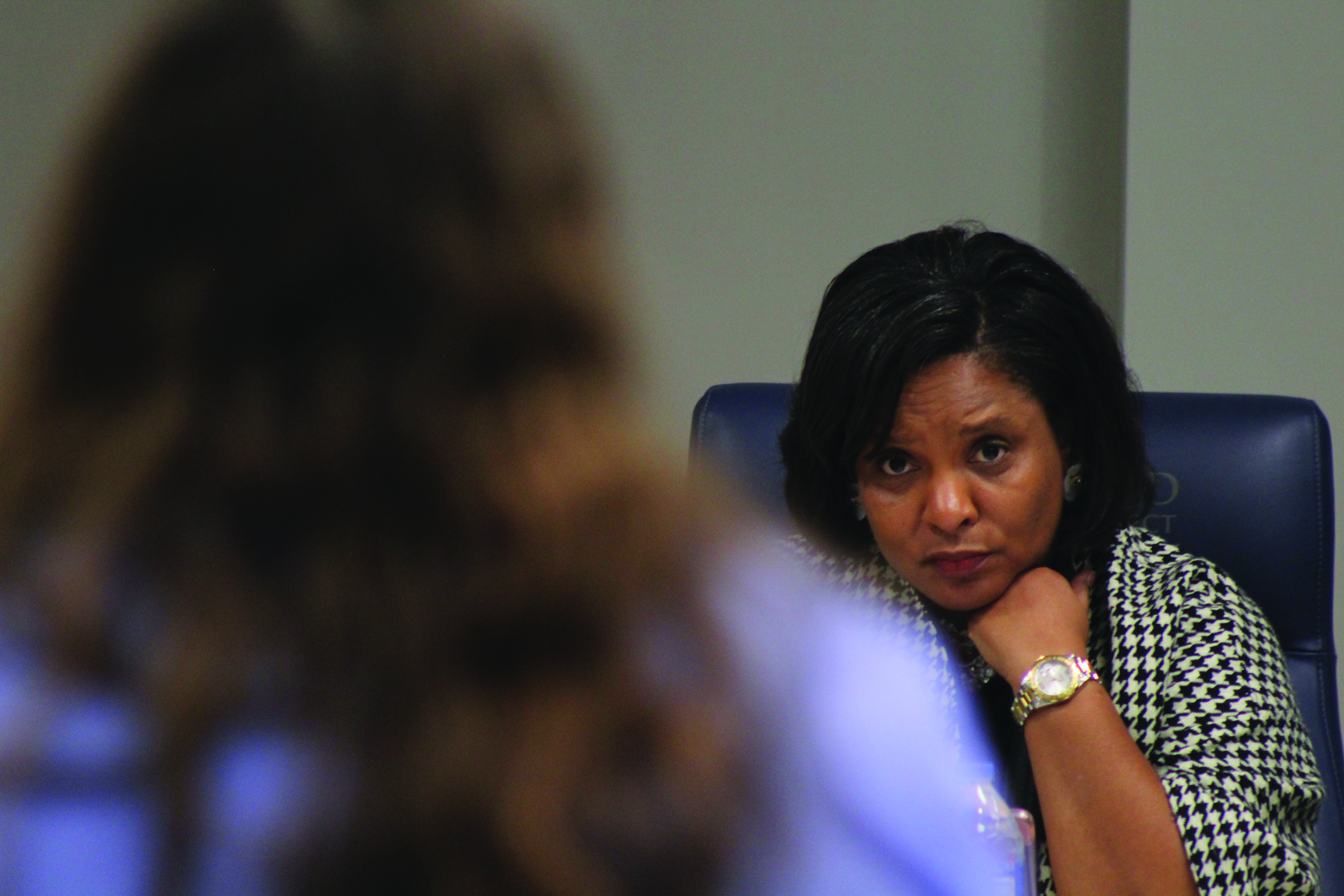
BLYTHEWOOD – Amelia McKie didn’t respond to a public call for her resignation Tuesday in the first Richland Two school board meeting of the year amid mounting ethics fines for the board chair.
After missing a recent payment deadline, McKie now owes nearly $52,000 to the South Carolina Ethics Commission, an agency spokesperson confirmed last week.
In July 2018, the commission fined McKie $41,000 as part of an eight-count complaint that said she failed to file quarterly campaign disclosure reports.
McKie was ordered to pay the first $20,000 by New Year’s Eve. She missed that deadline, meaning the total fine increases to $51,750, according to the complaint.
“No payments were made prior to Dec. 31, 2018 and the fine amount for that particular order reverts as outlined in the order,” an ethics commission representative said via email.
Richland Two parent Rhonda Meisner called for McKie’s resignation while speaking during the second public comment period at Tuesday night’s meeting.
“I would respectfully request that you resign from the school board,” Meisner said from the lectern. “I think that as a person you’re a very nice person, you’re very sweet, but unfortunately you put the community at risk in my opinion.”
Meisner pointed to state law, which says candidates who’ve not filed Statements of Economic Interest, or SEI, forms cannot be legally seated until they do.
Section 8-13-1110 of state law says no public official “may take the oath of office or enter upon his official responsibilities” unless an SEI form is filed.
State law also says SEI forms must be filed by March 30 each year.
Board members with previously unfiled SEI forms include James Shadd III, Teresa Holmes and McKie. All have since filed SEI reports following investigative reports by The Voice.
Holmes and McKie filed their missing SEI forms shortly after The Voice contacted them on Dec. 4, according to the ethics commission’s online database. Shadd III filed his 2017 and 2018 forms on Jan. 7, 2019.
Meisner said any recent past votes taken by those board members should be invalidated because SEI forms hadn’t been filed when they were sworn in.
“There are others of you on the board that are in the same situation,” she said. “I would ask that you look at your situation and resign.”
Board members respond
Board member Lindsay Agostini, during comments by board members, said, “My integrity and my character are very important to me.” She noted that The Voice’s investigation made it clear that she and James Manning were the only two sitting board members who had filed all their eithics forms on time. Agostini ended her comment saying, “A premier district deserves a premier board.”
Other Richland Two board members didn’t directly address Meisner’s comments or missing ethics filings listed in public records during the business portion of Tuesday’s meeting.
However, several made veiled comments from the dais amid the ethics filing fallout. At least two made references to “special interest” groups or attempts to “undermine the district.”
In a prepared statement, McKie thanked teachers and district staff, encouraging them to “stay the course regardless of the slings and arrows that come your way.”
“We don’t need to let side things distract us,” board member Teresa Holmes said. “We’re here for the business of educating children. That’s what I’m here for.”
After the meeting, Holmes declined to comment on McKie or Meisner’s call for board member resignations. She did, however, address what happened with her own 2018 SEI form.
“I’m brand new to this, I had no idea,” Holmes said. “I’m glad that you actually did the story. Nobody tells you these things when you’re running.”
Holmes’ 2019 SEI form has already been filed, according to the ethics commission website.
Others, including board members Monica Elkins-Johnson and Cheryl Caution-Parker, had previously missing quarterly campaign reports. Those reports were filed in December, ethics filings state.
McKie’s ethics record, though, has the most gaps.
As of Wednesday morning, McKie still hadn’t filed a campaign disclosure report since here last one in January 2015, according to the ethics commission database.
An investigation by The Voice also found inconsistencies in her SEI and lobbyist forms, which listed different amounts of income in 2015 and 2016.
McKie said she soon plans to issue a statement addressing the ethics filings.
“I’ve been working with the ethics commission to clear up some things that haven’t been accurate, and I’m going to issue a press release about that,” she said.
If McKie’s fines go unpaid and unresolved, the ethics commission has strategies it can employ to collect.
In 2015, the commission partnered with the S.C. Department of Revenue to increase ethics debt collection efforts through the DOR’s Setoff Debt Governmental Enterprise Accounts Receivable, or GEAR, collection programs.
Debtors who have reached “bad debt status” are referred to the Department of Revenue, according to the Ethics Commission website.
The Department of Revenue is authorized to garnish wages and tax refunds, or also impose liens to satisfy debts.
Richland 2 board members are responsible for a $273.9 million annual budget.
In 2017, school district millage accounted for more than two-thirds of a typical Richland 2 property tax bill, according to a report by the S.C. Association of Counties.
After missing a recent payment deadline, the Richland Two school board chair now owes nearly $52,000 in fines to the South Carolina Ethics Commission, an agency spokesperson confirmed.
McKie
In July 2018, the commission fined McKie $41,000 as part of an eight-count complaint that said she failed to file quarterly campaign disclosure reports.
McKie was ordered to pay the first $20,000 by New Year’s Eve. She missed that deadline, meaning the total fine increases to $51,750, according to the complaint.
“No payments were made prior to 12/31/18 and the fine amount for that particular order reverts as outlined in the order,” an ethics commission representative said via email.
Attempts to reach McKie have been unsuccessful.
In 2015, the ethics commission partnered with the S.C. Department of Revenue to increase ethics debt collection efforts through the DOR’s Setoff Debt Governmental Enterprise Accounts Receivable, or GEAR, collection programs.
Debtors who have reached “bad debt status” are referred to the Department of Revenue, according to the Ethics Commission website.
The Department of Revenue is authorized to garnish wages and tax refunds, or also impose liens to satisfy debts.
The Richland Two school board’s next meeting is scheduled for Tuesday, Jan. 8 at the Richland Two Institute of Innovation at 763 Fashion Drive, Columbia.
An agenda says the board will meet in executive session at 5:30, with the business meeting commencing at 6:30 p.m.
Lobbyist Income Report Doesn’t Match SEI Filing, Investigation Reels in 19 More Late Filings
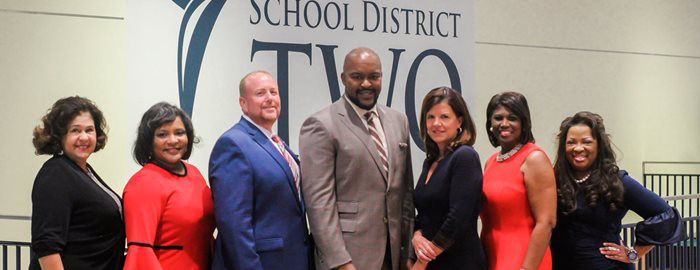
Richland Two School Board memberes include Cheryl Caution-Parker, left, Chairwoman Amelia McKie, Jim Manning, James Shadd III, Lindsay Agostini, Monica Elkins-Johnson and new member Teresa Holmes. | Richland Two Website
BLYTHEWOOD – As the deadline to pay a hefty ethics fine nears, more questions are arising over reports filed by Amelia McKie, chairwoman of the Richland Two Board of Trustees.
Meantime, more previously unfiled ethics forms have been submitted by another Richland Two board member following an investigation by The Voice of campaign finance violations, according to public records.
The latest issues involving McKie revolve around lobbying activity reported on her 2015 and 2016 Statements of Economic Interest, or SEI, forms.
McKie’s SEI form for 2016 doesn’t list any lobbying activity or income.
However, on her Individual Lobbyist report, McKie reported earning $13,562.50 as a lobbyist for the S.C. Association of Developing Colleges, or SCADC, between Jan. 1, 2016 and May 31, 2016,
Her 2015 forms don’t match either.
In 2015, McKie reported $15,000 in lobbying income from the SCADC on her economic interest form. But her lobbyist report lists a year-to-date number of $27,125.
In addition, $2,000 in lobbying income from the Coalition for Access to Healthcare appears on her individual lobbyist report, but not her SEI form.
McKie couldn’t be reached for comment.
In response to inquiries from The Voice, McKie filed previously missing SEI forms for 2015-2018 on Dec. 4, according to Ethics Commission records.
As of Friday, Dec. 28, she still hadn’t filed quarterly campaign disclosure reports since early 2015, ethics records show.
The commission has already fined McKie $41,000 as part of an eight-count complaint alleging unreported campaign contributions dating back to 2015.
She had until Dec. 31 to pay the first $20,000. If she misses that deadline, the fine increases to $51,700. That information was not available to The Voice at press time.
In related news, board member Monica Elkins-Johnson filed a slew of outstanding quarterly campaign finance reports and amendments on Thursday, Dec. 27, nearly two months after the Nov. 6 general election, according to the S.C. Ethics Commission online database.
Elkins-Johnson joins fellow board members Teresa Holmes, Cheryl Caution-Parker and McKie among those who filed missing ethics forms only after being contacted by The Voice.
The Richland Two school board plays a direct role in developing the district’s annual budget, which for the 2017-2018 fiscal year totaled $273.9 million, according to the school district website.
Because Richland Two board members are entrusted with spending millions of dollars in taxpayer money, greater scrutiny of their ethics filings is appropriate, said Jay Bender, a media law attorney representing the S.C. Press Association.
“You have all these people who take office who pay no attention what the requirements are, and that’s unfortunate,” Bender said.
Since The Voice’s investigation began in early December, Richland Two candidates have rushed to file at least 19 tardy ethics forms, detailing previously unreported campaign contributions, income sources and potential conflicts of interest.
Here’s a breakdown of each board member’s campaign contributions and statements of economic interest, when available, for recent election cycles.
Amelia McKie
On her 2018 SEI form, McKie reported $15,000 in income from lobbying activity for NextEra, a Florida-based energy company that recruited people to lobby the state to sell Santee Cooper, ethics forms state.
She performed additional consulting work for Infusion and LHI, though ethics forms don’t list income from those sources.
In addition to lobbying activity, McKie reported $9,600 in annual income from her position as school board chair.
McKie’s most recent quarterly campaign disclosure report was filed Jan. 10, 2015, ethic filings show.
She filed two amendments, one on Jan. 11, 2015 and the other Feb. 10, 2015.
Her Jan. 10, 2015 disclosure form, filed two months after the Nov. 4, 2014 general election, reported $10,861.95 in total contributions. She spent $9,524.41, leaving $1,337.54 cash on hand.
One contribution, a $1,000 donation from the Lou-Von Family Foundation in Sumter, was returned at the donor’s request, ethics forms state.
Though nearly four years old, an amendment McKie filed to her campaign disclosure reports in February 2015 raises additional questions.
In that filing, McKie lists 889.5 miles driven by various Columbia vendors for Get Out the Vote-related work, totaling $498.72 in mileage expenses at 56 cents a mile. The expenses were incurred on four dates in 2014: Nov. 3, Nov. 21, Dec. 11 and Dec. 22.
It is unclear from the forms what would require driving 890 miles in four days – roughly 222.5 miles per day – in the Columbia area.
James Shadd III
Board member James Shadd III has experienced issues with his ethics forms since 2014, when the ethics commission fined him $13,000 for failing to file several quarterly campaign disclosure reports, documents state.
The complaint has since been resolved, according to the ethics commission website. More recently, Shadd III hasn’t filed quarterly campaign disclosure or SEI reports since October 2016, according to ethics filings.
The absent filings only pertain to his school board seat. Quarterly reports for his 2014 solicitor’s office bid are available for public inspection.
Shadd III couldn’t be reached for comment.
In 2016, the last year Shadd III filed an SEI form, he only listed his school board trustee position, but not his income. He didn’t report any lobbying activity or any other potential conflicts of interest.
Shadd III filed three campaign disclosure reports in 2016, all on Oct. 31 of that year, which included his initial report, October quarterly report and his pre-election report.
He reported $10,375 in contributions for the election cycle, mostly from attorneys, physicians and other individual professionals. He spent $7,244.88.
Monica Elkins-Johnson
In all, Elkins-Johnson filed 14 previously missing quarterly campaign disclosure forms last week on Dec. 27, 2018, some of them dating back to 2016, according to ethics records.
One of the filings was a final campaign disclosure report for her 2016 campaign.
The report listed $12,860.52 in total contributions, most of which came from personal funds ($7,341). Most other contributions came from individual donors, filings show.
Elkins’ SEI forms have been filed on time most years. Her 2018 SEI report only listed $9,600 in income for her school board seat.
Teresa Holmes
Most of Holmes’ campaign contributions before the 2018 election come from personal funds.
For the 2018 election cycle, she reported $3,683.94 in contributions, of which $3,183 came from her personally, ethics records show.
The remaining $500 consisted of a donation from Sam Green, whose occupation is listed in ethics records as bishop of the 7th Episcopal District.
After the election, Holmes filed two amendments on Dec. 10 and Dec. 12, respectively amending her pre-election and initial reports to include additional contributions and expenditures.
As before, contributions mainly consisted of personal loans and small, individual donations.
Like McKie, Holmes filed her 2018 SEI forms after she was informed by The Voice that they had not been filed.
On her SEI form, Holmes reported $83,000 in personal income from the Fairfield County School District. She’s an assistant administrator and guidance counselor at the Fairfield Career and Technology Center, the Richland Two website states.
Cheryl Caution-Parker
Caution-Parker filed her four 2018 quarterly campaign disclosure reports on Dec. 17, shortly after The Voice contacted her that the forms hadn’t been filed prior to the Nov. 6 election.
Caution-Parker previously told The Voice that she had correctly entered the information, but didn’t complete the submission process because she failed to click the “File” button.
Her October 2018 pre-election report listed $5,150 in contributions and $5,129 in expenditures. She reported two contributions from developers: M.B. Kahn Construction Co., $1,000; and Stevens & Wilkinson, $250.
Caution-Parker spent the bulk of her funds on billboard advertising and campaign signs.
James Manning
Manning filed his quarterly campaign disclosure and SEI forms on time.
While it was previously reported that these fillings were late, most of his campaign disclosure reports are associated with the 2014 election cycle. Only a pre-election report filed Oct. 28, 2018 is associated with the 2018 election cycle, records state.
Manning said that’s because he announced his intentions to seek re-election late in the election cycle, which explains why his other quarterly reports are linked to 2014.
For the 2014 election cycle, Manning reported $9,198.76 in total contributions.
Manning reported an additional $7,775 in contributions for 2018. Notable donations for the most recent election cycle include: M.B. Kahn Construction, Co., $1,000; Brownstone Construction Group, LLC, $1,000; Darrell Campbell, construction, $500; and Grayson Thompson, architect, $300.
Manning reported $118,737 in personal income from working in state government. He works for the S.C. Public Employee Benefits Authority as a risk and compliance manager, according to the state’s online salary database.
Manning reported additional family income of $69,289, also from state government, and his $9,600 school board salary.
Lindsay Agostini
Besides Manning, Agostini was the only other current board member to file all her Campaign Disclosure and SEI forms on time. As reported previously in The Voice, Agostini hasn’t been required to file quarterly campaign disclosure reports since March 24, 2017, when according to ethics records, she submitted a final report.
Office holders may file final reports only after he or she closes their campaign account, which is what Agostini did, according to the Ethics Commission.
To qualify for this exemption, a candidate must have a zero balance and no outstanding campaign debts, according to the Ethics Commission websit, which Agostini met.
When her campaign accounts were open, Agostini was one of the school board’s top fundraisers. Her final report listed $22,947 in total contributions for the 2016 election cycle.
Contributions mainly came from attorneys, physicians and other business professionals. She spent the bulk of her funds on mailers and signage, records show.
On her 2018 SEI form, Agostini reported board member pay of $9,600 and various food and gas reimbursements totaling $1,146.89.
Under personal income, she listed Agostini and Associates as the source and event planner/swim lessons under the type. A dollar amount was not specified.
Agostini also listed 11 sources of family income, which include DaVinci Financial Designs, LPL, Midland Insurance, The Members Club, Washington & Lee University, Pomona College and other entities.
Craig Plank
Craig Plank, who did not win re-election to the board in November, but has filed all his forms on time during his time on the board, reported $13,090 in contributions this past election cycle, which included $2,100 from personal funds. He spent $9,483.85, mostly on advertising and direct mailing, records state.
Most of Plank’s donors consisted of individual business professionals, including several insurance agents.
Plank reported several contributions from developers: SC Builders PAC, $250; Stevens & Wilkinson SC, Inc., $250; Covert Homes, LLC, $250; LCK, LLC, $500; and M.B. Kahn Construction Co., $1,000.
On his 2018 SEI form, Plank reported a $12,000 stipend from the district.
Plank also reported receiving unspecified income from four sources: WIS TV, family income; State Farm Insurance Co., personal income; Millie Lewis of Columbia, personal income; and NFIP, personal income.
2019 Review: New Industries Brought Jobs, Investment to Fairfield County
WINNSBORO – A year
and a half ago, a Lowcountry newspaper lamented Fairfield County’s double digit
unemployment. What a difference a couple of years has made.
Today, the county’s unemployment rate has shrunk to 3.1
percent and, according to County Administrator Jason Taylor, industrial
prospects over the last couple of years have accounted for the creation of more
than 700 new jobs and a $70 million impact.
In fact, Fairfield County has completed one of its busiest
years on record, with county leaders tackling a flotilla of projects and inking
a number of important deals. The new year saw the opening of the Providence ER,
complete with additional outpatient services. The transformation saves the
county some $600,000 annually over the previous funding of the former Fairfield
Memorial Hospital.
Economic development, infrastructure improvements and
revitalization highlight a laundry list of accomplishments that followed in
2019, and county officials say they plan to continue growing that list in 2020.
County Council Chairman Neil Robinson said while much was
accomplished in 2019, he predicted that 2020 could be a breakout year. He
credited Taylor, who was hired a little over two years ago, for guiding the
council’s directives to fruition.
“His vision and knowledge of where we should be and how we
get there surprises me every day,” Robinson said. “If Fairfield’s 2019 could be
summed up in one word, it’s jobs.”
Taylor agreed.
“Between the various projects, it’s been a very good year
for us,” Taylor said. “One of our responsibilities in local government is to
improve the quality of people’s lives. A job is critical to someone having a
good quality of life.”
Taylor, council and county employees have taken that
responsibility seriously and the results are popping up in various ways, not
the least of which is a new, cooperative relationship between the county and
the Town of Winnsboro – a far cry from the rancor that had for years stymied
progress for the two governments.
Bringing employment to the county is a trend county leaders
hope to continue in 2020 as the result of groundwork laid the past couple of
years in revitalization, water and sewer infrastructure and the acquisition of
new industry.
To that end, the county is working to expand its newly
created Fairfield County Water Authority as well as construct a major
wastewater treatment facility to serve the I-77 corridor and megasite,
something Robinson says is vital in landing major industry on the order of
Boeing, BMW or Mazda.
Here’s a summary of the major projects Fairfield County
tackled in 2019, as well as the forecast for 2020.
Economic Development
Mattresses move along a conveyor belt where they are inserted into mattress covers, then rolled up by another piece of equipment and packaged for shipping.
MLILY, Pharmacy Lite Packaging and Sea Pro Boats are the
latest industries to have commenced or announced operations in Fairfield County
in 2019. More job announcements are anticipated in coming weeks, according to
Robinson.
“Landing MLILY was a major accomplishment,” Robinson said.
“You’re talking about a $48 million investment into the county. That’s a lot of
tax money coming to us.”
Ty Davenport, Director of Fairfield County Economic
Development, said Pharmacy Lite Packaging, which is launching operations in the
former Wal-Mart building, represents a $2.9 million investment, though he
thinks that figure will grow to $3.5 million in time.
“It’s expected to create 33 new jobs, which we think in
coming years will get up closer to around 100,” he said.
Just before Christmas, the county authorized an agreement
with Victory Boats, LLC, which is expanding to Fairfield County. Located in the
former Fazio building on Hwy 34 near the Highway 321 bypass, the company brings
with it a $3 million investment and 135 new jobs.
“We also did a lot of work to save and help expand both
Element and MEKRA Lang,” Taylor said.
“If we continue to target industrial growth opportunities,
commercial and residential growth should follow,” he said. “We were at 14
percent (unemployment) not too terribly long ago,” Taylor said. “The problem is
a lot of people are driving outside the county to work. We have to have
opportunities for people to work here at home. When people stay at home, they
invest and shop here.”
Water and Sewer Infrastructure
Heavily linked to economic development is the improvement of
the county’s infrastructure. Water and sewer are a top priority.
In March, the county formed the Fairfield County Joint Water
and Sewer Authority Commission. So far, the membership is made up of the county
and the Town of Winnsboro.
The authority is vital to the funding and construction of
the wastewater treatment plant, which is seen as needed infrastructure by
industry looking to relocate to Fairfield County.
In 2020, the county hopes to place a sales tax referendum on
the November ballot to help generate additional funds for the plant.
“We’ve been working hard in conjunction with the Town of
Winnsboro and the State of South Carolina to secure funds for the plant,”
Taylor said. “Water and sewer are critical to our future development.”
Over the past two years, the state has provided about $3.8
million to Fairfield County to cover costs associated with engineering and
studies for the new plant.
Robinson said council looked all across the county before
securing a site off Syrup Mill Road for the plant. Piping would funnel
wastewater from the megasite to the plant. It would then be discharged into Big
Cedar Creek.
Once we complete the wastewater treatment facility, that’s
when we’re going to land that big deal,” Robinson said. “Those (deals) could
mean hiring 1,500 to 2,000 employees.
Accommodations, hospitality taxes
The proposed local option sales tax referendum is separate
from the county accommodations and hospitality taxes enacted in 2019.
Expected annual revenue of about $250,000 from these taxes
will be paid primarily by tourists. The revenue can be spent in a number of
ways to benefit the town and county and their businesses. It can also be used
to construct public meeting facilities, other enhancements and tourism services
as well as entertainment events and capital projects that will attract tourist
dollars to the town and county.
The accommodation and hospitality tax revenue can also be
used to pay indebtedness issued by the County for public purposes.
In December, the Town of Winnsboro adopted a resolution
allowing the two taxes to be collected (by the county) from businesses in the
town as well.
“We’ve overcome the last obstacle to implementing the
accommodations and hospitality tax, and that will move forward shortly,” Taylor
added.
Airport upgrades
An especially valuable commodity in the county’s economic
development toolbox is the Fairfield County Airport, located off Hinnants Store
Road in Winnsboro. But it was not always so before Taylor hired pilot Denise
Bryant as director of the airport in 2017. Until then, the airport was
deficient in many areas. The previous fuel farm technically didn’t comply with
regulations set by the S.C. Department of Health and Environmental Control
(DHEC).
“We found that our fuel farm and our tanks were not what
they should be,” Taylor said. “They weren’t even licensed by DHEC. We have
taken measures to remediate all of that.”
During the last two years, Bryant has overseen the
construction of a new state-of-the-art fuel farm that was completed in
December.
“The fuel farm is very attractive, well-done. It’s something
to be proud of now,” Taylor said.
Two, 12,000-gallon fuel tanks were installed. With the extra
capacity, the airport can take in more fuel deliveries, which translates into
lower costs.
In addition, the pumps feature a card reader display and a
second screen display large enough for pilots to view, even when they’re
fueling their planes from the opposite side of their craft.
“You can actually go to the other side of your plane to fuel
and you can see the dollar amount of what’s going into your plane,” Bryant
said.
Bryant has also overseen other major upgrades including
lighting and signage. The facility boasts a 5,000-foot runway and parallel
taxiway, a modern terminal building with upgraded furnishings, a laser grade
testing center, a pilot’s shop, flight instruction and new T-Hangars.
In 2020, the county plans to resurface all of the airport’s
ramps, taxiways and runways. The work is expected to start sometime in March or
April, and take about a month to complete.
Bryant said the federal government is covering 90 percent,
or about $320,000 of the project. The county and state are each picking up 5
percent, or about $16,800 for their respective portions.
“Upgrang and modernizing the airport is important because
the facility is often the first impression CEOs of prospective industries have
when they fly into Fairfield County,” Bryant said.
“There’s a lot of general aviation traffic that comes into a
community first, especially in the corporate world,” she said. “The general
aviation airport in Fairfield is extremely important in putting down the
welcome carpet.”
Mt. Zion renovation
Fairfield County spent much of 2018 putting together a plan
to revitalize the former Mt. Zion Institute building to serve as a new
Fairfield County government center in downtown Winnsboro.
In 2019, the county devoted considerable efforts to working
with the developer, 1st and Main, a North Carolina firm, to secure the
financing for the renovation.
More than half of the funding of the $11.5 million project
would come from state and federal tax credits associated with the property.
Fairfield County plans to buy the building via interest free
annual lease payments of approximately $4.9 million over seven years. At the
end of those seven years, the county will make a final payment to purchase and
take ownership of the property from 1st and Main.
“We got all the
financing we were hoping we would get and a little more, actually. And all the design
work is done,” Taylor said.
The actual construction is slated to start in January 2020
and is expected to last 16 months, with a projected opening sometime in Spring,
2021.
Market Building
The launching of the Fairfield County Market building has helped
increase foot traffic in downtown Winnsboro, which county officials hope will
spill over to existing shops and restaurants.
Opened in May, the Market is located in a renovated former
county building located on East Washington behind the Town Clock. With a
kitchen, classroom, restrooms and a large, open market room, the building can
be used not only by the farmer’s market on Saturdays but for weddings,
receptions and other large community or family gatherings.
Zion Hill Revitalization
During 2019, the county and Town of Winnsboro cooperatively
undertook the revitalization of the Zion Hill and Fortune Springs Park
neighborhoods, with input from the residents of the area. It is a major step
forward in bringing this area back to its Glory days, county officials say.
In November, the county landed the first of several planned
grants to help pay for the project. The initial $488,000 Community Development
Block Grant (CDBG) will be augmented by a 10 percent ($48,900) local government
match, giving the county more than $536,000 at its disposal to begin Phase I of
the revitalization effort.
That work will include the demolition and clearance of
approximately 40 dilapidated and vacant structures, according to the Central
Midlands Council of Governments’ (CMCOG) planners who are working with the
county and town to guide and supervise the revitalization.
The demolition work made possible by the bond will begin
this spring and must be finished in two years. Both the town and the county are
eligible to apply for two $500,000 bonds each year.
At a community meeting in July, Gregory Sprouse, a planner
with the CMCOG, said he hopes the Zion Hill project represents the beginning of
more broad revitalization work in Winnsboro neighborhoods.
“We want this [Zion Hill] to be a starting point for how we
can move similar types of projects into other areas of the town that need the
same type of commitment,” Sprouse said. “CDBG funds must be spent to benefit
low to moderate income populations based on census data, and Zion Hill and the
Fortune Springs Park area fit that criteria.”
Broadband
County officials ended the year in new pursuit of broadband
expansion in the county – a pursuit that, in the past, has been futile.
“On broadband, I will just say we are exploring potential
opportunities that may be available that could assist us in working with our
existing local providers to expand the service,” Taylor said. “Like other
infrastructure that we are working on, we realize that for the county to grow,
improving our broadband service is critical. In today’s world, people expect
service to be widely available and fast.”
BLYTHEWOOD – The Blythewood Town Council is hoping to reprioritize some road improvement projects set for development in the near future under Richland County’s Penny Sales Tax program.
During the Dec. 18 council meeting, Mayor J. Michael Ross opened a discussion on the Penny Tax-funded road projects, which included a debated traffic circle proposed on Blythewood Road adjacent to the entrance of Cobblestone Park.
Specifically, council discussed reprioritizing the current first four of the Blythewood Penny Tax projects:
the traffic circle and widening of Blythewood Road on west side of I-77
Widening of Blythewood Road on east side of I-77
Improvements on McNulty Road
Extending Creech Road to Main Street (parallel to Blythewood Road)
Ross suggested moving McNulty Road (3) up to the second slot, moving the Creech Road extension (4) up to the third slot, and moving the widening of the east side of Blythewood Road (2) back to the fourth slot.
Council is expected to vote by resolution at the January meeting to confirm these changes.
The Creech Road Extension would begin at the cul de sac on the end of Creech Road near the Holiday Inn Express and run parallel to Blythewood Road, tying in to Main Street (Hwy. 21) somewhere yet to be determined between St. Mark’s Church and Blythewood High School.
“We (the council) believe that if we could get a Creech Road extension that would empty onto Hwy. 21, that would relieve a lot of the traffic stress and problems we are having in that area,” Ross stated.
Council member Malcolm Gordge said the prioritized list discussion had come up at the last council retreat, with the decision to table the item until council could meet with one of the engineers on the projects. That meeting, Gordge said, might happen as early as the Thursday after the Council meeting. Gordge said the meeting would allow the council to review traffic studies and have an updated discussion to see where SCDOT is and make them aware of the council’s proposed changes to the list.
BLYTHEWOOD – In addition to $15,000 that Blythewood Town Council appropriated earlier this year to Bravo Blythewood for a spring concert series, it voted unanimously last week to approve an additional $2,360 from Hospitality Taxes (H-Tax).
Four concerts will be held April 27, May 3, May 10 and May 17, 2019 at the Palmetto Citizens Federal Credit Union Amphitheater in Doko Meadows Park at a cost of $46,000.
Mayor J. Michael Ross said Bravo Blythewood will raise the remaining $28,640.
Revenue Sources
A budget sheet for the event presented to council by Martha Jones, president of Bravo Blythewood, listed those additional revenue sources as: sponsorships, $11,000; food vendors, $1,500; beer/wine sales, $14,560 and non-alcoholic beer sales, $1,634.
“You have made a real commitment in what you’re saying you’re going to spend, and how you’re going to raise it and how you’re going to get sponsorships,” Ross said, addressing Jones. “In looking through this, it looks really good, and I can’t wait for it,” Ross stated.
Expenses
The group will spend $9,000 on an event project manager, $9,500 on the headline band, $4,290 on beer and wine, $3,000 for the amphitheater, $1,200 to ‘volunteers,’ and Bravo Blythewood will keep $4,000.
Nineteen hundred and twenty dollars will go to Sheriff’s patrol, $1,700 will go to family entertainment and $1,200 to Freeway Music opening band.
Newspaper advertising will include $1,800 to The Country Chronicle, $400 to The Voice, $1,101.60 to Northeast News and $1,250 going to social media and web advertising, $500 for signs, $35 for posters and another $5,000 + for décor, rentals, graphics and other items.
Camp Discovery
Council also approved a one-time donation of $750 to Camp Discovery.
The donation came at the request of council member Malcolm Gordge, who sits on the camp’s board. Last month, Gordge invited the leaders of Camp Discovery to give a presentation to the council in consideration of the camp’s ongoing efforts and their funding needs in order to continue their operations.
The camp relies on donations from the public and various foundations to keep its gates open, which Gordge called “challenging” at times. Before the official decision, Gordge had asked the council if a donation in the range of $500 to $1,000 would be possible.
Ross recommended the donation be made out of the town’s promotions fund.
RIDGEWAY – The Ridgeway Town Council denied a request last week to approve $1,000 from the general fund to publish a book about the heritage and history of the town.
Former mayor Charlene Herring appeared before Council Dec. 13 to request they follow through on a 2017 vote to fund the book’s publishing costs.
Herring said the costs to publish the book had originally been estimated at $2,271, the lowest bid submitted by ByFarr out of Columbia. That amount, Herring told council, would publish 125 copies of a 100-page book that details the town’s history. The bid specified $1,200 for printing, $975 for designing pages and scanning photos and $95 tax. The bid price also included 24 color photos and an unknown number of posters at a cost of $3 each.
A note on the bid document stated that, “color pages may reduce the cost as we may not need (them).” Nothing was said by Herring or council about a reduction in pricing or the inclusion of the 24 color pages or the $3 posters.
Herring said if the Town sells all the books at $20 per copy, the total profit would be $229.
The book had originally been planned for publication in early 2017. Council voted unanimously at that time to pay for the project with the town’s hospitality tax (H-tax) revenue and then funnel the profits from the sale of the book into the general fund.
After being informed by the state’s Municipal Association that, according to state statute, any profits from a book funded with H-tax revenue would have to be returned to the H-tax fund and not to the general fund, Council rescinded its vote.
Council then narrowly passed, by a 3-2 vote, a new motion to withdraw money for the book’s publication from the town’s general fund and return any profits from the book’s sales back to the general fund as prescribed by state statute.
Council members Angela Harrison and Heath Cookendorfer voted against the new measure.
In October, Herring appeared before council to revisit the book’s funding, and at the December council meeting, Herring told she had secured over half the amount needed to cover the cost of publishing the book and asked council for a new amount of just $1,000 to make the book a reality. She said the profits from the sale of the book would be returned to the town.
“I believe the book is a great, unique story about Ridgeway and I hope to begin finalizing as soon as possible if approved,” Herring stated. She said the book would include interviews with citizens and historical photographs of the area, businesses and local events. However, she did not have any of the documents with her to show to council.
Herring faced strong opposition for her project from the Heritage/Culture Committee whose chairwoman, Jon P. Ward told council at the Dec. 13 meeting that the committee had pulled its support for the project at the end of 2017, and had provided a letter to the town’s administration stating that it no longer endorsed the project.
In the letter, Ward said she had initially helped Herring negotiate for the book a large collection of early photographs pertaining to the people and places in Ridgeway, but that many of the photographs were returned to the owner last March, eliminating their use in the book as initially planned.
“It is for this reason that I cannot support the publication of the book as originally planned,” Ward wrote.
Ward went on to tell council at the meeting that Herring had withheld half of the photos lent to her for the project – an allegation that Herring denied during the meeting.
“That’s like accusing me of theft; I don’t do that. People should know my reputation and what I stand for,” Herring told the council.
During council’s discussion, Angela Harrison and Donald Prioleau expressed their support for the project.
“I don’t like going back on something I already approved before,” Prioleau stated.
Mayor Heath Cookendorfer said he questioned the book’s merits considering the current lack of support from the Heritage/Culture Committee. Cookendorfer said he had initially given his support to Herring and the book, but that the change of heart by the committee had made him hesitant to move forward on the project.
“Yes it’s a thousand dollars, but this letter (of disapproval) is a little bit alarming to me. I want to know what the underlying issue is,” Cookendorfer stated.
Councilman Dan Martin said he believed the town would not stand to make much profit from the book’s sales based on current information provided to the town.
“It’s not about profit, it’s about the town,” Harrison countered.
Council member Rufus Jones requested an excerpt from the book for the council to review before proceeding.
Herring said she only had hand-written copies of transcribed interviews from local families, along with photos, and excerpts from other books that she would be using in the Ridgeway book. With nothing to show council, Herring asked them to accept her word about what the book would offer.
“I ask this question: when have I not ever delivered on anything I have promised for this town,” Herring answered to Cookendorfer’s request.
“I think it’s a great book and would be great PR for the town,” she stated.
In the end, the council chose not to proceed on the project, with only Harrison and Prioleau casting votes in favor of funding $1,000 to the project.
BLYTHEWOOD – The Blythewood Town Council unanimously approved a motion Tuesday night to rezone property in city limits to allow for a potential medical business development.
The property consists of nearly two acres, with the frontage of the area located within city limits at 204 Langford Road, across from the intersection of Langford and Sandfield Roads. It is currently zoned D-1 for a development district.
Applicants Dr. Sara Beaver, owner of Blythewood Eye Care, and Rob Lapin, a commercial realtor with NAI/Avant, requested the city rezone the property to Town Center District with architectural overlay. Upon approval, the property will also be subject to sign overlay standards and Board of Architectural review guidelines will also apply.
Beaver recently told The Voice that she has some considerations in mind for the property’s future use, but she remains uncertain about specific plans as of the Dec. 18 council meeting.
Much of the back portion of the property extends into Richland County. Town administrator Brian Cook said that part of the area would likely be subdivided off into a larger parcel at the rear of the property, and was not part of the consideration Tuesday night.
The Planning Commission approved the rezoning at its Dec. 3 meeting.
One building, a home, does still stand on the property, and Cook stated at the meeting that some plans he has viewed would allow for the remodeling of that building in addition to landscaping and parking development.