Category: Government

  • Chamber financials still in disarray

    BLYTHEWOOD – Almost a year after the Blythewood Chamber Commerce was not able to produce a credible set of books to Town Hall for the previous budget year, the Chamber’s Board Chairman Phil Fry told Council Monday evening that it still does not have a working budget, or even a draft budget, to present to Council.

    The occasion was an aborted attempt by the Chamber’s Executive Director Mike Switzer (as listed in the agenda) to request $20,500 from the Town’s FY 19/20 budget – $17,000 for an economic development work subsidy (previously called a grant by town officials) and $3,500 for an ‘elite partner’ annual membership for the Town at the Premier Level.

    Standing in for Switzer, the Chamber’s Chairman-elect Phil Frye asked council to withdraw a funding request that appeared on the agenda.

    “The chamber is making its internal budget cycle (inaudible)…we’re in the process of (inaudible),” Frye said. “We feel it is premature to make any further request of council at this time. Therefore, I respectfully request discussion be deferred to a later date, for the chamber to present any and all requests for discussion during the council’s budget workshops on May 9 and May 23.”

    Mayor J. Michael Ross, who is co-landlord of the McNulty Plaza offices rented by the Chamber, did not participate in the Chamber discussions. Mayor Pro Tem Eddie Baughman conducted the discussion.

    “Do you have a working budget at this time?” Baughman asked, then answered, “You said you do not. You do not have even a draft of your budget? We want to see a hard copy of your budget and how the funds requested by the chamber are spent,” Baughman said. ”We’ve asked for financials [in the past] and haven’t gotten them. We would like to see some monthly financials from the Chamber.”

    Baughman also asked about a business [The Guilded Iris] that the Chamber is now subletting a portion of its offices to.

    “Now that you have a business operating in your Chamber space, how is that going to affect your budget and your request as you’ll be receiving rental income from the business operating inside the Chamber,” Baughman asked. “And will you be expanding the business’ space and decreasing the space used by the Chamber?” Baughman asked.

    “You should be transparent,” Baughman continued. “I think the public has a right to know how public money is being spent. I don’t know how much rent you pay or the percent [of your rent] that the Guilded Iris pays you for rent. How will that affect your upcoming budget request and your year-to-year budget?”

    “When we come back for the budget [work sessions], these are some of the things I’d like to see,” Baughman told Frye. “The Town’s budget is transparent. We share our financials with the public monthly, and we expect to hear from you [Chamber] monthly.”

    In May 2018, after an investigation by The Voice of the Chamber’s financials, Council called for the chamber to turn over its complete financial records by June 12. Copies of those documents were subsequently provided to The Voice by two different town officials. After reviewing the documents, CPA and former Town Councilman Bob Massa concluded the submitted financials were “confusing, lacking in detail and sometimes impossible to follow and understand.”

    On June 25, 2018, with no further submission by the Chamber of credible financials, council voted to stop funding the visitor center after Dec. 31. However, that vote also continued full funding ($9,250 for six months) of the visitor center through Dec. 31.

    During that meeting there was no specific criticism of the chamber’s financial records by council and council did not set forth any clear expectations for how the chamber was to spend the $9,250.

    There was no mention of the chamber’s announcement that it would be increasing the amount it was charging the visitor center for the chamber’s operating costs. Even though the visitor center was fully funded for the first half of the budget year, Switzer announced in a letter to members in September that the visitor center hours were being cut back.

    In voting to continue to fund the Chamber through Dec. 31, Councilman Eddie Baughman said he “wanted to be fair to the chamber,” and not pull the rug out from under them. There was a suggestion, as in the past, that no more funding would be provided unless the Chamber provided council with complete financial records of how the funding was used.

    When the question of the Chamber’s finances came up during Council’s retreat last month, Councilman Bryan Franklin defended the Chamber saying its books were being audited by the same auditor the town uses – Love Bailey.

    “As soon as that audit is completed, they are going to present it to the board based on the conversation we had before when we found out there were some issues with their internal auditing,” Franklin told Council. “So they have agreed to do an audit with our town auditor.”

    When asked about the audit, Ed Parler, Council’s liaison with the Chamber, however, told Council there was no audit, but that Love Bailey had ‘reviewed’ the chamber’s books.

    Neither Parler nor Town Hall have been able to provide The Voice with any of the Chamber’s monthly financial statements since June 2018.

    At Monday night’s meeting, Frye told The Voice that while no financial statements have been produced by the Chamber since last June, the chamber is working with a CPA to prepare them.


  • E-Capital pulls rezoning request

    COLUMBIA – More than a hundred residents of Crickentree breathed a sigh of relief Tuesday night at a Richland County Council public hearing after the Texas investment firm, E-Capital, withdrew its application for the rezoning of the former Golf Course of South Carolina.

    The withdrawal was announced by County Councilwoman Joyce Dickerson at the beginning the hearing on the rezoning. Dickerson represents much of the Blythewood area, including Crickentree.

    E-Capital’s proposal to rezone the golf course from Traditional Recreational Open Spaces (TROS) to medium density residential (RS-MD) would allow  up to 600 homes to be developed on the 183-acre property. TROS is a zoning category designed to protect golf courses, ensuring that they remain open green space.

    Residents fear smaller lots and hundreds of additional homes will lower their large-lot home values and further congest already unmanageable traffic in the area.

    Robert Fuller, attorney for E-Capital, spoke with The Voice after the meeting. He was asked if E-Capital plans to come back to council and request a different zoning classification for the property.

    “I don’t know,” Fuller said. “I can’t say what they will do. Nothing has been decided.”

    In attendance at the meeting and signed in to speak in support of the residents, Mayor J. Michael Ross has been forthcoming in public meetings about his desire for the county to purchase the golf course property and turn it into recreational opportunities for the northern Richland County area.

    A story on the front page of The State Monday morning laid bare Dickerson’s irritation with Ross over that proposal.

    “If he wants a park, he can put it in there,” Dickerson was quoted in The State. According to the newspaper, Dickerson was miffed that Ross had “approached the Richland County Recreation Commission before the rezoning request was filed.”

    The story quoted Dickerson as saying that “caused some ill will when the mayor skirted County Council and pitched a plan for land not in the Blythewood city limits.”

    Later in the day on Monday, Ross emailed County Council members.

    “I wanted to reach out before tomorrow night’s meeting and express to you my concerns about the rezoning of the Crickentree property. Even though it was pointed out in The State newspaper today that the property being discussed is not in our town, it sure is close!!! If you don’t think another development of 200, 400 or 600 homes right down Langford Road doesn’t affect our town and its citizens, well I know you do! I encourage all of you to do what you and I were elected to do and hear the people’s wishes and vote in favor of preserving this wonderful green space in northern Richland County.  If this is rezoned and the TROS classification is lost, it will only be the first in this area to go.  The Windermere Golf club property will be right behind it.   I hope you, like me, would like to see a pause or hold on all the home development in northern Richland County especially when it devours ‘green space!’”

    The email ended with Ross’ trademark lightheartedness.

    “Thanks for all you do and, Mrs. Dickerson, I still know we are the best of friends no matter what!”

  • BAR OKs COA for optometrist office

    BLYTHEWOOD – The Blythewood Board of Architectural Review (BAR) unanimously voted (4-0) to approve a Certificate of Appropriateness (COA) last week for Blythewood Eye Care to convert the former Boney home at 204 Langford Road to an optometrist’s office. The BAR also approved four variances for the property.

    The two-acre property, owned currently by Great Southern Homes and located next to a much larger tract also owned by Great Southern Homes, was recently rezoned to the Town Center District (TCD).

    COA approval was given with the understanding that details such as landscaping, trees, signage and lighting would still have to be approved by staff and meet plan requirements.

    “If something is not according to plan and can’t be worked out, it will come back here,” Board Vice-Chair Jim McLean explained to the applicant.

    John Stephens of Crescent Engineering presented the plan. He said the potential owner, Blythewood Eye Care, plans few changes to the exterior of the building other than moving the steps from the front of the porch to the sides to allow for more buffering for the front yard area.

    Stephens also said Blythewood Eye Care preferred to have the parking lot in the front of the building.

    “The question this board has always looked at has been to try to reduce parking on the street side. Either move it to the side or the rear,” McLean said. “We’ve always taken a pretty strong stance to move parking from the front just to not create a parking lot coming down Langford Road. So that’s something we would talk to you about.”

    Stephens said that while the handicap ramp would be located in the rear of the building, “We don’t have any way to enter the rear of the building. I don’t want people to have to walk to the front [from a rear parking lot.] It’s only 8 parking spaces,” Stephens said. He also said that the company might later want to expand the building into the side yard to the south.

    The approval of the COA included granting the following five variances:

    • The protective front yard buffer was reduced from 15 feet to five feet.
    • The shared boundary line buffer on the north (residential) side of the property was reduced from 50 feet to 20 feet with the addition of an eight-foot privacy fence with appropriate landscaping.
    • The natural landscaping located along the boundary on the south side of the property would satisfy the 10-foot landscaping requirement until which time the property to the south becomes developed.
    • A crushed concrete, porous parking lot surface was allowed to be substituted for the required asphalt or concrete non-porous surface.
    • The parking lot was approved to be situated in the front yard instead of the back yard as required by ordinance.

    “It’s important to recognize that this street [Langford] is lined with homes converted into businesses. It’s important not to stand out from the others,” McLean said. “We want to keep the building as residential looking as possible.”

  • Ridgeway water tower comes in at $669,258

    RIDGEWAY – It came as a surprise to the Ridgeway Town Council earlier this year when they learned that the town’s new water tower would cost a total of $669,258.13 – about $45,000 more than they were expecting.

    Armed with a $500,000 Rural Infrastructure Authority grant in November 2016, the previous Town of Ridgeway administration contracted with Civil Engineering of Columbia (CEC), for $39,800, to prepare a drawing and bid package for construction of the tower. CEC estimated that cost at $510,000.

    Phoenix Construction won the construction contract with the low bid of $549,153.

    Earlier this year the current administration learned that several required items had not been included in CEC’s bid package – $16,400 for necessary piping, $11,610.13 for grounding, $7,985 for communication equipment and $7,500 for three power poles for a total additional cost of $43,495.13. This did not include the $39,800 for engineering and $10,000 for attorney fees, bringing total cost for the project to $669,258.13.The Town’s portion of the cost, $169,258.13, was paid for out of the capital expenditures fund.

    During the regular meeting last week, Council voted unanimously to approve the additional $7,500 for the poles from SCE&G, $7,985 to Hobgood Electric for grounding and $11,610.13 to Collins Pumps & Controls for communication equipment.

    The bid was also short on fencing costs. CEC’s bid estimate called for only 360 linear feet of fencing for the one-acre parcel. Phoenix agreed to credit the Town for the $8,640 included in the original bid for 360 linear feet of fencing and gate. At a special called meeting last Saturday, Council approved Gamecock Fencing to fence the entire one acre with that credit for the lower cost, $8,320.

    “This completes the May 7 deadline to close the project,” Mayor Heath Cookendorfer said.

    Funding was also approved for the lease of a folding and inserting machine for town hall to facilitate the monthly billling for the water service. Town Clerk Vivian Case asked that she be able to demo the equipment in operation before making the decision as to which lease to accept.  Both leases are under $4000 for 48 months.

    Volunteers from the Church of Latter Day Saints will be visiting Ridgeway to clear pine straw from around the Century House/Town Hall, plant flowers and pick up litter on April 27, 2019.

    Brad Hoffman and Valerie Clowney were on hand to solicit sponsorship participation by the Town of Ridgeway in the upcoming Fairfield County Ag & Art Farm and Art Tour on June 15 and 16, 2019.  No decision was made.

  • Element celebrates 5th anniversary

    The Fairfield Central cheerleaders and band welcome Governor McMaster and Congressman Norman to Element.
    Gov. McMaster, Congressman Norman Praise Company’s Success

    WINNSBORO – “Last summer we were wondering how we were going to stay open. This year we’re wondering how we’re going to produce all the orders that are coming in like a tsunami,” Michael O’Shaughnessy, CEO and owner of Element, said during a barbecue luncheon at the facility in Winnsboro on Friday.

    Gov. Henry McMaster addresses the lunch crowd at Element on Friday. Element owner and CEO Michael O’Shaughnessy and Congressman Ralph Norman, seated, also spoke, honoring Element’s fifth anniversary. | Barbara Ball

    The event, which featured Gov. Henry McMaster and U. S. Representative Ralph Norman as speakers, was a triple celebration of the company’s survival of last summer’s tariff crisis, it’s now booming business and the fifth anniversary of the opening of Element.

    In referring to what he called the trade war last year that threatened to raise the tariff on televisions assembled by Element, O’Shaughnessy said, “while it [trade war] is a good thing in the long term, Element found itself in a unique situation in which the tariffs could have materially hurt us or put us out of business.

    “But we all went to work to solve the crisis,” he said, crediting McMaster, Norman, county and company officials. “We have now solved the tariff issue that has been holding us back,” O’Shaughnessy said.

    Introducing McMaster and praising him for his support of the company in its darkest hour, O’Shaughnessy said there is not a better advocate for South Carolina than Gov. McMaster.

    “It was because of Gov. Haley that Element came to South Carolina,” O’Shaughnessy said. “But it’s because of Gov. McMaster that we stayed in South Carolina. He went to bat for us and he never stopped.”

    The luncheon was also an opportunity for Carl Kennedy, Vice President of Human Resources, to announce that the company has hired 100 new employees since the first of the year. He also acknowledged the 99 employees who have been with the company since it opened.

    Those employees were joined by McMaster and Norman as well as county, Town of Winnsboro and school officials under two large white tents in front of the building on Highway 321 Bypass.

    Speaking to Element’s success, McMaster said the people, “like the people here,” he said, gesturing to those sitting before him, have contributed to that success.

    “You’ve got to have the people, you’ve got to have the businesses and you’ve got to have the education – the three legs of the stool. If you have two of these and not the third, it won’t work,” McMaster said, addressing the state’s success in bringing in new companies.

    “New businesses are coming to South Carolina and we’re going straight to the top,” he said. “The best is yet to come.”

    Quoting Winston Churchill, Norman said, “’There’ll be a time when doing your best is not good enough, when we must do what’s required,’ You have done what’s required,” Norman said, praising the company, its employees, county and state officials for pulling Element through last summer’s crisis.

  • Improvements slated for Blythewood intersections

    BLYTHEWOOD – Blythewood area residents got a look last week at a new plan to improve traffic flow around and through the increasingly congested downtown streets as well as outlying busy intersections as far out as Blythewood Road and Hwy 321.

    The occasion was a public information and comment meeting hosted by the town government and the Central Midlands Council of Governments (CMCOG) at Doko Manor to review renderings of proposed traffic flow improvements.

    Those improvements are the result of a study done by AECOM, a firm contracted by Central Midlands COG, that began last August and included collecting traffic data and input from local businesspeople, developers and insurance companies.

    “The purpose of the study is to assess the current traffic volumes for the Blythewood area and predict future ones expected over the next 20 years or so,” Town Council member Malcolm Gordge said. “AECOM is examining the areas that are most congested and/or accident prone and recommending improvements such as additional turn lanes, traffic signals, junction realignment and traffic circles.”

    The dozen-plus projects are divided into short-term, mid-term and long-term recommendations. They range from adding turning lanes and signal lights at the U.S. 321-Blythewood Road and Langford Road-Trading Post Road intersections, to rerouting a portion of Langford Road to connect directly to Blythewood Road and creating a roundabout at McNulty Road and Blythewood Road, just beyond the I-77 signal light.

    Gordge said there is no plan of implementation yet. He said that will follow after the study is completed, comments are assessed and a funding program investigated and developed.

    The traffic study is a key element of the town’s comprehensive plan for future development.

    “Blythewood has experienced unprecedented growth in population since the early 2000s and this has brought about a considerable increase in traffic through the town, particularly during morning and evening rush-hour,” Gordge said. “The rate of growth is expected to continue for the foreseeable future.”

    Two of the biggest generators of traffic in Blythewood are Blythewood High School and the grocery stores, according to Roland Bart, Chief Transportation Planner with Central Midlands Council of Governments.

    Gordge said the full traffic plan has not yet been costed out, and discussion on funding sources has not yet taken place.

    While traffic problems increase by the day, Roland Bart, Chief Transportation Planner with Central Midlands Council of Governments, said the improvements are not just around the corner.

    “We went for 30 years with no increase in the gas tax and now we have an increase of two cents.  People will have to be patient as we use this increase to deal with the maintenance issues,” Bart said.

    While the AECOM worked closely with the Richland Penny sales tax committee in determining the necessary intersection improvements, the projects planned by the Penny Tax committee and AECOM are separate.

    “Projects that can be addressed through the Richland Penny Tax are the main priority for Blythewood,” Gordge said. “But each of these is important to the town to reduce congestion, improve safety and facilitate growth.

    “The input and feedback from area residents is welcomed, Transportation Director, Reginald Simmons said. “The things people tell us that are relevant to their needs we can share with the engineers and make the proper adjustments in the planning stage.”

    Send suggestions concerning planned improvements by April 23. 2019, to AECOM – Attn: Patrick Tyndall, 101 Research Drive, Columbia, SC 29203-9389.

  • Golf course zoning up for vote

    Council Meeting Set for April 23

    BLYTHEWOOD – Crickentree residents who oppose the proposed rezoning of the former Golf Course of South Carolina may have their toughest battle yet on April 23 when the issue goes before Richland County Council for first reading.

    Last month, the County’s Planning Commission voted 7-1 in the resident’s favor – to recommend that Council not change the zoning of the golf course, which shares a border with Crickentree, from its current Traditional Residential Open Spaces (TROS) to Medium Density Residential (RD-MS) use.

    But that win was only the first step in the residents’ effort to defeat the rezoning bid. The request for rezoning will now have three readings (votes) by County Council. The first, on April 23, will be the only opportunity that residents will have to address council about the issue. If Council votes is in favor of the rezoning at that meeting, it will hold two more readings without residents being allowed to speak. If council votes against the rezoning, the issue will be dead for another year or until a different zoning classification is requested.

    Crickentree residents have been reaching out to residents of other golf course communities to attend as well, since those golf courses could be affected next if the Golf Course of South Carolina is rezoned.

    The County planning staff has recommended approval of the rezoning, saying it complies with the county’s Comprehensive Land Use Plan which recommends for that area to be zoned RS-MD in the future. That zoning designation would allow up to 600 or so homes to be built on 8,500 square foot lots.

    But while the planning staff makes that recommendation, it also concludes that approval of the request may promote a density which is not consistent with that of the established and proposed developments of the adjacent and proximate subdivisions (Hunters Run, The Park at Crickentree, and Crickentree).

    Attorney for E-Capital, Robert Fuller, laid out a plan for the property to be developed under medium density zoning, but promised that no more than 237 homes would be built, not the 600 or so allowed under the requested zoning classification.

    Commissioner Heather Cairns interrupted Fuller’s presentation to point out that the Commission’s responsibility was not to consider the plan he was presenting, but to consider whether 186 acres should be rezoned to allow 8,500 square foot lots over its entire existence.

    Resident Russell St. Marie also challenged Fuller’s plan for development of the property.

    “E-Capital is on record that they have no intention of developing this property,” St. Louis said. “They merely want to get the zoning changed and sell the property to a developer.”

    Under questioning by the Planning Commission Chair, Stephen Gilchrist, Richland County Zoning Director Geonard Price said that, according to the purpose statement of the TROS ordinance, it was to insure preservation of conservation, recreation and open space.

    The public hearing is scheduled for 7 p.m., Tuesday, April 23 at the County Council Chambers, 2020 Hampton Building. Those wishing to sign up to speak for or against the rezoning will need to arrive early to sign up.

    For more information call the County Ombudsman at 939-6000 to direct your call to the planning staff or call Concerned Citizens of Crickentree at 803-719-1242 or visit SaveGolfCourses.com.

  • Looking Ahead

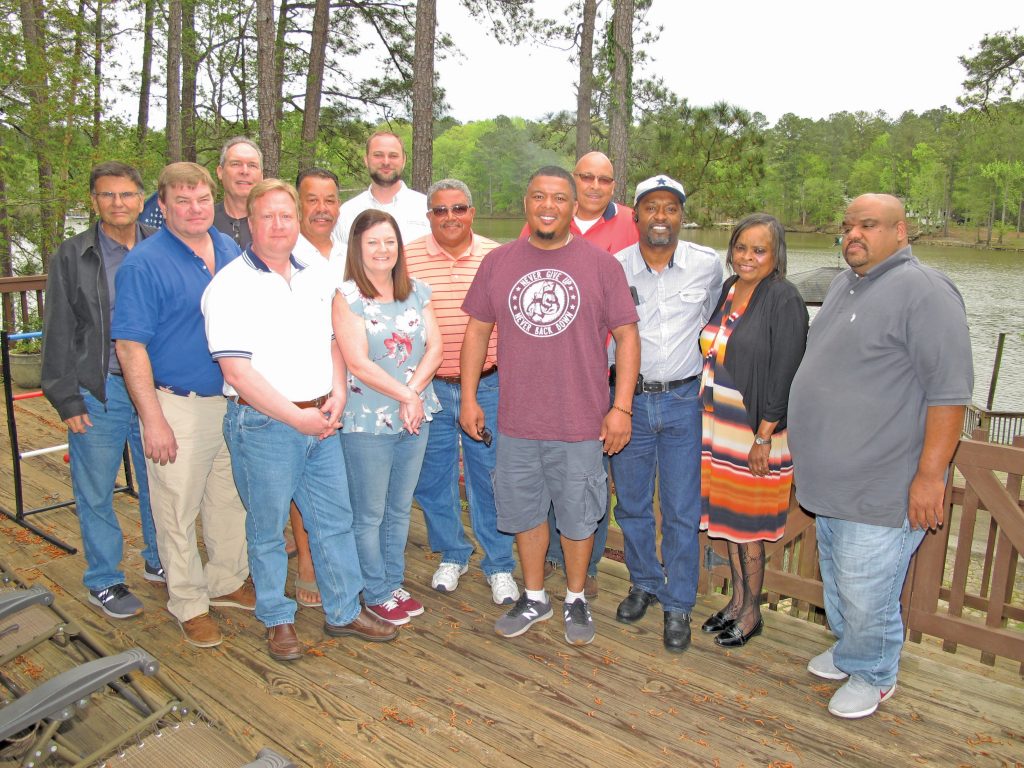
    WINNSBORO – County Administrator Jason Taylor and staff outlined for council members a list of plans and proposals for the county during a Council retreat last weekend at Lake Wateree. From left, front row: Economic Development Director Ty Davenport, Taylor, Clerk to Council Patti Davis, Council Chair Neil Robinson, attendees Rev. Quincy Pringle and Jackie Workman and Dep. County Administrator Davis Anderson. Back row: Attendees Randy Bright and Jeff Schaffer, Councilman Clarence Gilbert, County Planner Chris Clauson, Councilmen Moses Bell and Mikel Trapp. The Voice’s report on the meeting will appear in the April 28 edition.

  • Be sure you’re counted in 2020 census

    BLYTHEWOOD – Doris Green, a representative from the U.S. Census Bureau in Atlanta, addressed Blythewood Town Council members at their March 25 meeting, outlining why citizens need to be encouraged to participate in this year’s census.

    Green said that participating is critically important for several reasons.  The results determine Blythewood’s share of the $675 billion of federal funds available to states and communities. The data from census results are used to ensure public services and funding for schools, hospitals and fire departments, and census results determine how many seats each state is allocated in the House of Representatives.

    She also said that registering for the 2020 census will be easy, since online and phone options are available for the first time, in addition to mailing options.

    The U.S. Constitution requires the tallying of America’s population every 10 years. The census collects basic information about the people living in each household. When completing the census, everyone who is living in a household on April 1, 2020 should be counted.

    Green added that census workers will never ask for social security numbers, bank or credit card account numbers, money, donations or anything on behalf of a political party. She emphasized that all responses and personal information related to census questions are securely protected by strict federal law and robust cyber security practices.

    She said that over the next few months, the community will hear and see a lot of information about the upcoming census. April 1, 2020 is census day, and every person in every household should be included in order to have that most accurate count. Green said the census workers are in the process of building an accurate address list and automating field operations.

    Green said there are many temporary employment opportunities within the census program, as well. For more information or to apply, visit www.2020census.gov/jobs or call 1-855-JOB-2020. Additional information about the 2020 census can be found online at census.gov.

  • R2 board OKs stricter conduct for teachers

    COLUMBIA – Weeks after brushing aside adopting greater accountability measures for their own conduct, the Richland Two school board voted 6-0 for similar conduct rules for district staff.

    On March 26, board members combed through the five-page policy, which lists numerous behaviors classified as “misconduct.” Many behaviors focus on teacher-student interactions.

    Board vice-chair Monica Elkins-Johnson said she thought the staff conduct policy might discourage students from confiding with teachers who they trust.

    “Not all students have a relationship with school counselors,” Elkins-Johnson said. “This [policy] is stating that they can only have these conversations with a school counselor.”

    Superintendent Dr. Baron Davis said the district always encourages dialogue between students and staff. He said the policy is aimed at students in crisis situations, such as suicide.

    “Advice is absolutely not counseling,” Davis said. “We just want to encourage a student, [who] for example is having suicidal [thoughts] or harming themselves, we need to immediately get that student to a trained professional to de-escalate that situation.”

    Board member Teresa Holmes expressed another definition of misconduct, which includes “refusing to follow a supervisor’s instructions and directions.”

    “It’s too subjective that you have to follow instructions without them being clarified,” Holmes said. “You could tell me to go down the hall and if I don’t go, I didn’t follow your instructions. It’s too subjective.”

    Discussion of staff conduct comes on the heels of an ethics controversy involving a quorum of the board.

    At least three members have been fined by the S.C. Ethics Commission. Board chair Amelia McKie owes the most at $51,750.

    In February, board members voted 4-3 against the policy revision that would’ve authorized stripping board members of officer titles “for cause,” provided a supermajority approves.

    Board members found in violation would still retain their elected post.

    Those voting in the majority to reject the measure took issue with the phrase ‘for cause,’ calling it vague.

    Board member James Shadd III, who was fined $13,000 by the ethics commission in 2014, took issue with the proposed misconduct policy’s “for cause” terminology, voting against the proposed policy on Feb. 12.

    He suggested the policy proposal was reactionary, saying sanctions for legal troubles some board members face already exist in state law.

    “What does ‘just cause’ mean?” Shadd III asked.

    A search for the phrase “probable cause” in the state ethics statute generated 19 results. The phrase “just cause” appeared three times.

    Many of the board members voting down the policy were themselves in violations of various state ethics laws.

    “Because of recent events, I have made sure that I’m a stickler to policy now. I’ve become a policy guru,” McKie said in February.

    McKie would’ve been impacted by the policy change had it passed.

    “I would greatly shun having a nebulous policy,” she said. “If you want a policy that tightens things up a bit, I’ve got that.”

    Richland Two board members voted against the policy revisions following an investigation by The Voice that numerous board members violated state law by going months, and in some cases, years without filing campaign finance and/or conflict of interest forms.

    Also at the March 26 meeting, the board discussed language of the district’s profanity policy.

    Elkins-Johnson, the board’s vice-chair, asked if the policy applies to coaches. District staff said it does.

    Violations of the policy are “grounds for placing an employee on administrative leave, with pay, pending an investigation and possible recommendation for termination of employment,” the policy states.

    Ironically, Elkins-Johnson is facing a disorderly conduct charge following an obscenity-laden outburst after a recent school board meeting.

    At the Feb. 22 board meeting, while reading from a prepared statement, Elkins-Johnson apologized “for the language that I used” during an altercation at the Jan. 22 board meeting.

    A Richland County Sheriff’s Department incident report states that Elkins-Johnson cursed and made threatening comments during a dispute involving McKie’s husband and the sister of state Sen. Mia McLeod.

    Elkins-Johnson was charged with disorderly conduct. She’s tentatively scheduled to appear back in court later on April 29, according to Richland County court records.