Category: Government

  • Altered bond doc slips past R2 board

    COLUMBIA – When the Richland Two school board trustees’ former secretary declined to sign documents asserting that Board Chairwoman Amelia McKie is legally allowed to serve on the board, two trustees say the board was not notified the documents were modified to include phrasing dismissive of McKie’s ethics controversy.

    “I was not aware of the addition of the extra line in the bond documents,” trustee James Manning said. “I really don’t have a response to the legitimacy [issue]. I’m spending all my research looking into why that [the paragraph] is there and why we need it, so I’ll be looking at that.”

    Lindsay Agostini, the former board secretary, said her attorney advised her not to sign the documents. She thinks the document revisions should have been brought to the board’s attention.

    “We weren’t briefed as a board,” she said. “I do believe, with the modifications, I think it would’ve been important for the board to be briefed, either individually or as a group.”

    District Superintendent Dr. Baron Davis couldn’t be reached for comment.

    At issue are clauses added to documents relating to the district’s $468.4 million building program. Richland Two voters recently approved a bond referendum that raises taxes to finance construction.

    Added to the bond documents was the following statement:

    “The School District is aware that members of the public have called for the resignation of the current Board Chair because of fines owed by the Board Chair to the South Carolina State Ethics Commission because the Board Chair did not have on file a current Statement of Economic Interest prior to being sworn in to a second term as a member of the Board,” the document states.

    “The School District is not aware of any litigation, regulatory effort, or official proceeding challenging the Board Chair’s right and title to serve as a Board member of Board Chair,” the document continues.

    Agostini repeated her call for McKie to step down as chair, but hasn’t called for McKie’s outright resignation as some members of the public have.

    Manning said he doesn’t question McKie’s eligibility to serve.

    “Our legal counsel has told us based on the current law and previous attorney general opinions, the board really has no purview over whether Ms. McKie is a legitimate board member or not,” he said. “That is beyond board control.”

    Manning thinks state law should more clearly state whether public officials who fail to file ethics forms are legally allowed to serve.

    Section 8-13-1110 of state law says no public official “may take the oath of office or enter upon his official responsibilities” unless a Statement of Economics Interest form is filed.

    Section 8-13-1520 further states that ethics law violations are misdemeanors punishable by up to a year in prison, a $5,000 fine or both.


  • E-Capital files for new zoning request

    BLYTHEWOOD – Texas investment firm E-Capital has filed a second application for a zoning change of the Crickentree Golf Course. The request this time is to change the golf course’s current Traditional Residential Open Space (TROS) zoning to Low Density Residential (RS-LD) zoning.

    Low Density zoning allows for 3.63 homes per acre on the 183-acre property.

    Two weeks ago E-Capital withdrew a request before County Council to rezone the TROS to Medium Density Residential (RS-MD).

    The new rezoning request will first go before the Richland County Planning Commission on June 3 at 3 p.m. That body’s recommendation will then be sent to County Council on June 25, for a public hearing followed by the first vote on the issue.

    “That meeting will be the only time that citizens can voice their opinions in person to County Council,” Crickentree resident Michael Kosca said.  “If Council votes for RS-LD, we could end up with 600 homes in our back yard.”

    Both meetings are held at the Richland County Administration Building at 2020 Hampton Street.

    “Our primary concern right now is to reach out to the other golf courses who are also at risk of losing their TROS zoning and being developed – Woodcreek, Windermere and others,” resident Russell St. Marie said.

    The TROS ordinance was passed by Council in 2007 when golf courses in Richland County began to struggle financially, and developers began eying them for residential development. The purpose of TROS, according to the ordinance, was to ensure “the preservation of conservation, recreation, and/or open space; and to lessen the diminution of property values from the loss of open space commonly provided for in a community; and to provide opportunities for improved public and/or private recreation activities; and to provide for a community-wide network of open space, buffer zones and recreation spaces.”

    For those reasons, residents say they want Council to leave the TROS zoning in place.

    Planning Commissioner Heather Cairns also clarified that TROS pertains to golf courses with a neighborhood component, not to golf courses in general.

  • McKie fails to file ethics form… again

    COLUMBIA – In January, after racking up $51,750 in fines over unfiled ethics forms, Richland Two school board chair Amelia McKie vowed she would remedy the problem.

    “I am working with my legal counsel to address the fines and penalties imposed,” McKie said at a January board meeting. “I’ve learned a lot from my experience. It’s a problem that certainly will not happen again.”

    Apparently, it has happened again.

    As of Tuesday, McKie had not filed her quarterly campaign disclosure report with the S.C. Ethics Commission, according to the agency’s online database.

    The disclosure report was due April 10.

    Replying via email Tuesday evening, McKie disputed she had any missed ethics filings.

    “All my filings are compliant,” the email said.

    Disclosure reports not filed between 2016 and 2018 prompted the ethics commission to fine McKie $41,000 in July 2018. Another $10,750 was tacked on after she failed to pay a percentage by Dec. 31, 2018.

    At the Jan. 22 board meeting, while reading from a prepared statement, McKie publicly apologized for the ethics flap.

    “I made a number of mistakes and trying to address them simply got out of hand,” she said. “I am human. I’m not infallible. I am responsible and I am not running from those problems. I am taking action to fully resolve and address them.”

    News of the missed filing comes as several public citizens and a fellow board member have called upon McKie to step down as board chair or the board altogether. McKie has said she’s not stepping down.

  • Part 2: Retreat focused on changing image

    WINNSBORO – During Fairfield County Council’s retreat last month, County Administrator Jason Taylor and his staff – Community Planner Chris Clausen, Economic Development Director Ty Davenport and Deputy Administrator Davis Anderson – guided council members through what Taylor called “thoughts, ideas and discussions of where we want to take the county and how we want to work to improve it.”

    The focus leaned heavily on projects to change the county’s image.  The first seven of the 14 projects discussed were published in the April 25 issue of The Voice. The following is a review of the second seven projects discussed.

    Commerce Welcome Center

    “The economic development building is a nice building at the commerce center but it is not really set up for an [economic development] office,” Taylor said. “We’ve looked for a number of ways to add on to that facility. But to show the county off and to do something that’s nice and impressive and get people’s attention, I would suggest we look at something bigger and better out there that helps sell Fairfield County. Something that would let people know we’re forward looking and not just some small, unimpressive office.”

    Davenport said an addition to the current building is estimated to be $400,000. A new stand-alone building is estimated at $1.2 million on the high end.

    “We need to do something that is the face of the community,” Davenport said. “It’s the first thing that prospects see. We need to keep up with the Jones. It needs to be as nice as those in Orangeburg, Aiken, Richland, Chester and York. They all have great facilities. We need to be at this level,” he said.

    ‘I would love to build a new building up near the front of the park so that when you pull up to the park, it catches the eye, like, “Wow, this is Fairfield County?” Taylor added. He conceded, however, that a new build might not be financially feasible when council looks at the budget.

    “We’ll have to see what happens,” Taylor said, adding several possibilities to help fund it.

    “It could house the Water Authority which is a separate entity that generates its own revenue, so it would pay rent in the new building,” Taylor said. “We hope to bring Mitford in and are working with Winnsboro…we’d have 900 new customers almost immediately which would actually generate revenue to help support a new building. We have to have a place for the Water Authority and this would be an appropriate place for it.”

    Sewer Plant Property

    “We need to purchase property for a sewer plant and get it nailed down,” Taylor said. “That’s a top priority.”

    “We plan to design a two million gallon plant expandable to four-million gallons that will initially discharge up to 2 million gallons of effluent a day.” Davenport said.

    “We’ve been working with DHEC on this for a long time, Taylor said. “Commerce awarded us $2 million to survey and preform engineering studies on the megasite. A portion of those funds were also used for engineering studies necessary to design the wastewater treatment plant. We are working with Thomas and Hutton Engineering to get the permitting and design engineering approved by DHEC,” Taylor said.

    Then, when we have someone who wants to locate on the megasite, we drop the hammer and build the treatment plant. They’d be looking at only 15 months of construction instead of 3 – 4 years if they had to start from ground zero.”

    Farmer’s Market

    “Economic Development brings jobs. Community Development makes people who get those jobs want to say here and spend their paychecks here. And that’s what the Farmer’s Market and the Market parking lot are about” Taylor said.

    The County has restored the stable building on East Washington Street with $35,000 from the Chamber of Commerce. Taylor said that while it is being restored for use by the Farmer’s Market, it can also be used as an event center for weddings, reunions, parties and other events that will bring in revenue.

    The County also plans to repave and upgrade the parking lot behind the Market building for parking. Taylor said the idea is to bring people to the downtown area. The events would also bring in revenue for the County. He said it would be a draw for the downtown area.

    “Mom and pop stores and boutiques are what we want downtown. We need an anchor drawing card restaurant downtown. The buildings in downtown are cheap, but it takes a pile of money to get them up and going. We’re looking for more retail and restaurants downtown.”

    Upgrade Fire Stations

    All but about four of our firefighters are volunteers, so if we have a fire during working hours, we have a bad situation,” Anderson said. “To make sure we have round the clock service, we’re going to start improving our fire station living and sleeping areas and showers.”

    “We also need to move toward having more paid staff,” Taylor said. “If we have a huge plant located at the megasite, we can’t tell them we have a volunteer fire service. No, they’re going to want dedicated service. For economic development, we have to assure them that if they have a need, someone’s going to show up.

    Court House

    Taylor said the Court House must be restored because of moisture, mildew and mold and other problems. It is a bond project that was allocated about $2.1 million.

    “But that’s an old number and we’ll need to add about 10 percent more now,” Taylor said.

    Anderson said about $1.3 million is allocated for repairs of the HVAC, lighting and infrastructure for computer systems. To save money, the county asked engineers to estimate costs to work on the building without moving out the employees.

    “So they will be in there working on it at night and by 9 a.m., the employees can go back in to work during the day. The night and weekend work will cost another $300,000,” Anderson said, “plus an additional 10 percent. So we’re going to try to do that – working at nights and weekends and stay within budget.”

    Drawdy Parking Lot

    “When you go down to Drawdy Park in the afternoon, it’s chaos with 200 – 300 kids,” Anderson said. “So we’re going to try to put a parking lot there by the old Everett school, so people can actually park and walk down to the fields instead of cars parking on the graveyard and other places they shouldn’t be. This should make it a better municipal park for the citizens.”

    A-Tax & Penny Sales Tax

    “We recently passed the A-Tax ordinance with projections of revenue at about $250,000 a year,” Taylor said. “This revenue stream will do a lot to help community development. We won’t see immediate results because we’ll let it build up about a year.”

    “We’ve got our attorney working on a penny sales tax,” Taylor said. “That’s something that a lot of communities use to a great effect for growth,” Taylor said. “But before we pass it, we have to figure out exactly where we’re going to designate the revenues to go.”
  • Council adopts RC animal ordinance

    BLYTHEWOOD – Town Council voted last week to amend its animal care ordinance to be compliant with the Richland County animal care ordinance.

    In a memo to Council, Town Administrator Brian Cook commented that because the Town contracts by intergovernmental agreement (IGA) with Richland County for animal care, the town would have to operate under the County’s animal control agreement.

    “To secure the enforcement and uniformity of animal control regulations within the Town [and be] in compliance with the animal control ordinances of Richland County and in accordance with the laws of the state of South Carolina,” it would be necessary to adopt the County’s animal care ordinance into the Town’s.

  • House aims to bring internet to rural areas

    WINNSBORO – Every campaign year, a popular promise of candidates running for office in Fairfield County is to bring internet to the rural. But, as the year 2020 approaches, pockets of slow or dead internet zones still exist throughout the County.

    A bipartisan group of lawmakers hopes to change that.

    Introduced by 14 House Democrats and Republicans, House Bill 3780 proposes creating the “Growing Rural Economies with Access to Technology,” or GREAT, program to facilitate expanding broadband Internet service into rural areas of the state.

    House members passed the bill in a 112-0 vote on April 3. The Senate has passed first reading on the legislation, and it has been referred to the Senate Judiciary Committee, according to the General Assembly website.

    It was not immediately clear as of press time when the Senate might tackle second reading. Rep. Annie McDaniel, D-Winnsboro hopes it’s soon.

    “I know for Fairfield County it will make a huge difference,” McDaniel said. “I support it 100 percent.”

    McDaniel said she’s especially encouraged by the bipartisan support. She said expanding high-speed Internet access countywide carries a multitude of benefits, from students trying to complete schoolwork to conducting routine business transactions.

    “When you look at McCrorey Liston School of Technology, they definitely need to have Internet service,” she said. “I’ve talked to many people in that area who’ve said the Internet doesn’t serve them really well.

    “I’m excited that it’s something that we can work on together,” McDaniel continued. “I am exceptionally happy when I see that the Republicans and Democrats found a bill they can work together on.”

    The latest version of H.3780 proposes creating a special revenue fund in the S.C. Rural Infrastructure Authority.

    From this fund, grants can be awarded to applicants to subsidize qualifying broadband projects. Funding would be determined by the General Assembly, though the bill doesn’t specify how much would be funded, or from what funding source.

    H.3780 also proposes creating a points system to determine recipient eligibility.

    The scoring system would give weight to distressed counties, which according to FCC data have higher numbers of unserved residents when it comes to Internet service.

    Some aspects of H.3780 are similar to a farmer’s aid bill presently stalled in Congress, which also seeks to enhance Broadband service in remote rural areas.

    In July 2018, the U.S. House passed H.R. 4881, also known the Precision Agriculture Connectivity Act of 2018, which requires the FCC to establish at task force responsible for “identifying and measuring current gaps in the availability of broadband Internet access service on agricultural land.”

    The task force would also be charged with “achieving reliable capabilities” on 95 percent of agricultural land in the U.S. by 2025, according to the bill.

    No further action has been taken on the bill since the House passed it last summer, according to the U.S. Congress website.

    Boosting Internet service could generate important economic benefits as well.

    A provision within the bill gives the authority leeway to determine if broadband expansion “will benefit a potential economic development project relevant to the proposed area outlined in the eligible project.”

    While Fairfield County has placed great emphasis on enhancing water and sewer services, expanding broadband is also important to industries that desire ready-made infrastructure, said Fairfield County Administrator Jason Taylor.

    “Infrastructure, whether it’s water and sewer or soft infrastructure, like Internet, is critical,” he said. “It’s another tool to help market Fairfield County.”

    Better broadband service also improves public safety, Taylor added.

    “If you don’t have service, you can’t get 911 there or fire trucks there as quickly,” he said. “It’s wonderful from every angle.”

  • R2 board secretary resigns when asked to verify that McKie is legally seated

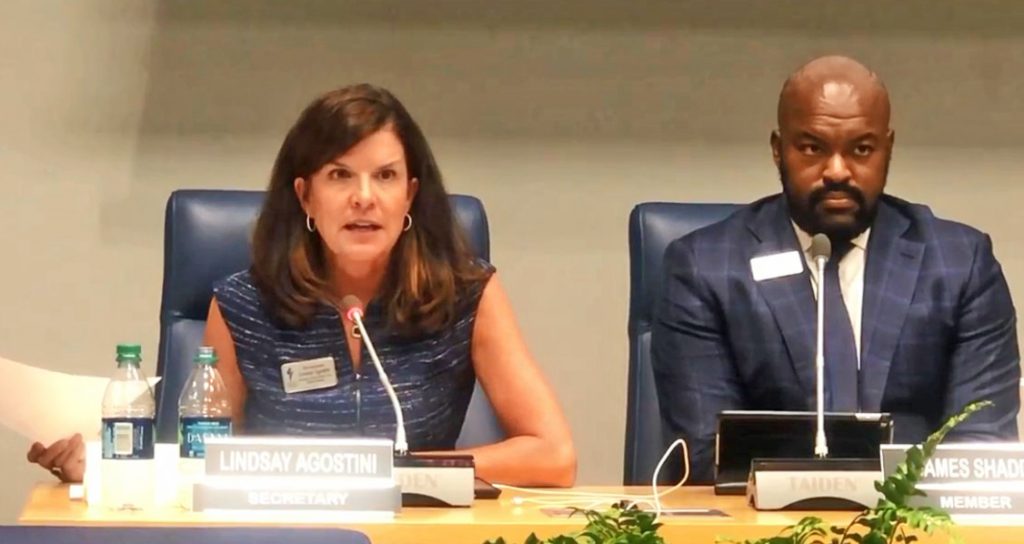
    R2 school board member Lindsay Agostini resigns as secretary. James Shadd, right, was elected to replace Agostini as board secretary. | Barbara Ball

    COLUMBIA – Chairwoman Amelia McKie’s ongoing ethics problems have prompted another member of the Richland 2 Board of Trustees to resign her officer position.

    Lindsay Agostini stepped down as secretary of the Richland Two board, but still remains on the board as a voting member. Agostini notified McKie and Superintendent Dr. Baron Davis of her decision via email Friday.

    In a prepared statement read at Tuesday’s meeting, Agostini said she consulted her personal attorney after raising concerns about two documents she says she was asked in her position as secretary to sign.

    Both documents alluded to lingering legal and ethics issues that have haunted McKie for months.

    “With these questions in mind and under advice of legal counsel, my principles would not allow me to sign these two documents,” Agostini said. “Therefore, I felt it was in the best interest of the district for me to resign as board secretary but continue in the capacity as a member of the Board of Trustees.”

    Neither McKie nor other trustees at Tuesday’s meeting responded to Agostini’s statement.

    One document, titled “Certificate of Incumbency,” asked Agostini to confirm McKie as the board chair. It also stated the dates of McKie’s chairmanship are July 1, 2018 to June 30, 2019, Agostini said.

    The “Signature and No Litigation Document,” which related to the recently passed $468.4 million bond referendum for school building upgrades, was modified to include verbiage inferring that McKie is legally allowed to serve on the board in spite of failing to follow state ethics law.

    “The School District is aware that members of the public have called for the resignation of the current Board Chair because of fines owed by the Board Chair to the South Carolina State Ethics Commission because the Board Chair did not have on file a current Statement of Economic Interest prior to being sworn in to a second term as a member of the Board,” the document stated.

    “The School District is not aware of any litigation, regulatory effort, or official proceeding challenging the Board Chair’s right and title to serve as a Board member or Board Chair,” the document continues.

    Agostini said she refused to sign both documents since she said she cannot, in fact, verify that McKie is legally allowed to serve.

    “This presented several questions to me. Is this normal wording? Why is an extra paragraph needed? Have we ever included wording like this in a Richland Two bond document?” Agostini asked. “We are asking our community for half of a billion dollar bond and we need to include this language?”

    McKie owes nearly $52,000 in ethics fines for failing to file various campaign disclosure reports.

    She also didn’t file statements of economic interest, or SEI, forms from 2015 to 2018 until December 2018, the S.C. Ethics Commission’s online database states.

    McKie did not file the forms until after The Voice sought comment from her about the missing forms. March 31 is the deadline to file SEI forms in a given year, according to the Ethics Commission.

    Section 8-13-1110 of state law says no public official “may take the oath of office or enter upon his official responsibilities” unless an SEI form is filed.

    McKie has been serving on the board since her re-election in November 2018. She didn’t file her SEI forms until Dec. 4, nearly a month later.

    McKie’s apparent ineligibility to serve has prompted several residents to call for her and other non-compliant trustees to step down.

    “The proper action is for Ms. McKie and [board trustee Teresa] Holmes to stand up now and step away from the board immediately,” Richland County resident Gus Philpott said at a Richland Two meeting in March. “Ms. McKie is not legally a board member and so cannot be chair of this board.”

    In January, when The Voice asked the state ethics and election commission spokespersons which agency is tasked with enforcing the eligibility statute, each agency punted the issue back to the other.

    “I would think compliance would be a question for that body [the ethics commission],” Chris Whitmire, spokesman for the S.C. Election Commission, told The Voice in January.

    Meghan Walker, the ethics commission’s director, said only the election commission has the power to remove a candidate from the ballot. She said the ethics commission only fines candidates for non-compliance.

    “We don’t file an injunction or anything,” Walker said.

    Section 8-13-1520 further says violations of the ethics chapter are misdemeanors punishable by up to a year in prison, a $5,000 fine or both, though there’s been no indication that charges will be filed.

  • Council to relook at H-Tax allocations

    BLYHEWOOD – Town Administrator Brian Cook gave an overview of the Town’s proposed FY 2019-20 budget last week and announced a workshop schedule for council to work out the details of the $1,621,696 budget, which is up from $1,565,114 last year.

    Looking at possible changes in budgeting for the coming year, Cook said council will be giving some attention to how it allocates hospitality funds in the future. He said there are several ways council might want to make changes.

    “In the past, we’ve allocated sporadically without knowing at any one time how many groups we are allocating money to for the entire year,” Cook said in an interview with The Voice. “I would like to see us look at the allocations for the whole year at one time so we don’t spend it all before we get to an event or project that we really want to do and then realize we don’t have any left for something that  we feel is important. Council is going to look at the best use of the money.”

    Cook said he would like to also look at specific projects that can be paid for with hospitality tax funds but that have been overlooked in the past. The new budget includes $10,000 for re-sodding and landscaping plantings and $500 for a new weed eater. About $7,000 was allocated from the current budget for a lawn mower, Cook said.

    “We are going to do the mowing of the park and town hall area in-house now and discontinue the contract we currently have for mowing the park. We’re going to be saving money right out of the gate,” he said. “We’ll pay for the lawnmower in the first year.”

    “There are a lot of things we can use hospitality funds for that are not event based,” Cook said.

    “This [hospitality] money can be used to beautify the town and landscaping,” Cook said. “The entrances to the town, maybe lay some new sod at the entrance to the park, places that are weedy and pretty much dying. When you go around to other places like Killian’s Crossings and look at the medians planted with color, we could be looking at doing some of that.”

    “Once we get to the May workshop, that’s when we will really get down to it,” Cook said.

    Cook said council will also be looking at other ways they allocate hospitality tax money – where it’s going and how it’s being used.

    At the April council meeting, Mayor J. Michael Ross told one event group that if they did not turn out better attendance numbers, the town might not continue to allocate hospitality funds for that event. He addressed the lack of local advertising by the event organizers.

    At the April meeting, council heard requests for event funding from Blythewood Bikes & Beers for $8,750; from The Red Barn for $12,051.20, and The Blythewood Chamber of Commerce withdrew a request for $20,500 that Chamber Chairman-elect Phil Frye said would be requested at the May 9 workshop.

  • Winnsboro restaurant suspension upheld

    WINNSBORO – A Winnsboro restaurant that was shut down last month over concerns it was doubling as a nightclub will remain closed until further notice.

    Meantime, a representative of Winnsboro Bar & Grill thinks the town’s decision to suspend her business license was overkill, saying her establishment is simply a restaurant that also serves drinks.

    Beverly Williams, owner of the business, thinks the town should have issued a warning instead of shutting her restaurant down completely.

    “If they had a problem, they could’ve come to us,” Williams said. “We’ve been locked out of our building. We haven’t been able to access any of our things. We’ve lost so much revenue.”

    On April 16, Winnsboro Town Council voted unanimously to uphold the suspension of Winnsboro Bar & Grill’s business license.

    Last Tuesday’s vote followed a public hearing in which Williams stated she never knowingly intended to violate any town rules.

    “We’re just a family business. We offer a full restaurant-bar, but we’re not a bar. We’ve never advertised as a bar. We’re just a family restaurant that has full bar service, that’s just who we are,” Williams said. “We’ve never had any problems in the community. We’ve always served the community, I’ve served many of the people who are in here now.”

    Town police, however, tell a different story.

    Police Chief John Seibles said officers were alerted to the business after discovering social media and radio ads promoting a large party. He said the town lacks resources to police a large party.

    “We have three officers on the street,” Seibles said. “We didn’t think that area of Winnsboro was conducive to this kind of bar, this kind of club.”

    Investigator Michael Carroll with the town’s police department said fliers began circulating that advertised a “new nightlife party spot for Winnsboro.”

    Carroll told council members that a relative of Williams subleased the property to James Randolph, the former owner of Kandyland, a Columbia area strip club the Richland County Sheriff’s Department recently shut down.

    Richland County deputies responded to a shooting death at Kandyland in December 2018, according to media reports. It remains one of four unsolved murders reported last year.

    “We can’t handle a nightlife party spot on Main Street,” Carroll said. “We just don’t have the officers or manpower to handle something Mr. James Randolph has done in the past.”

    Williams countered that Randolph was advertising a private party. She said her business is not a nightclub.

    “We’ve done everything according to what we thought was policy until we were otherwise informed it wasn’t,” she said. “We had no reason to think we were doing anything wrong.”

    In a telephone interview with The Voice, Williams said when she originally obtained her business license in July, the business wasn’t serving alcohol.

    Williams said the restaurant later obtained its liquor license from the S.C. Department of Revenue. She said the town’s decision to suspend her business license was over a mere technicality, one she’s happy to resolve.

    “If we reapply for a business license, it means we’ll have to reapply for all of our other licenses as well,” Williams said. “We can’t just open right back up. We’re trying to figure out how we’ll proceed from here.”

    According to a March 28 police report, Williams stated on her business license application that no alcohol would be sold, and that there wouldn’t be any coin-operated machines on the property.

    Officers, however, observed bottles of liquor inside, as well as a coin operated pool table, the report said.

    “Did you not think there was anything wrong if there was alcohol in the building, coin operated machines, and the business license said there wasn’t supposed to be anything like that in there?” Mayor Roger Gaddy asked during the hearing.

    Williams said the business has communicated with town officials via social media about the coin-operated machines since February, but didn’t address the alcohol bottles.

    “My main concern is the alcohol. Certainly it’s a clear violation of what your business is supposed to have,” Gaddy said. “I think the suspension is appropriate.”

    Gaddy said he’s not opposed to a business that sells alcohol or has a coin-operated machine in its business. He said Winnsboro Bar & Grill is welcome to reapply for a new business license.

    “This does not preclude you applying for other business licenses with the appropriate boxes checked,” Gaddy said. “Unfortunately in this situation, and I’m sorry you’re having to go through that, but clearly there’s a discrepancy.”

  • Retreat focused on changing image

    LAKE WATEREE – During Fairfield County Council’s first retreat in more than four years, County Administrator Jason Taylor led the meeting with a staff review of 39 or so projects the county initiated or mostly wrapped up over the last couple of years – Mt. Zion, Fairfield Memorial Hospital, Providence ER facility, the mega site, the animal ordinance, SCE&G lawsuit and website redesign, to name a few.

    Next, Taylor and his staff – Community Planner Chris Clausen, Economic Development Director Ty Davenport and Deputy Administrator Davis Anderson – guided council through what Taylor called “thoughts, ideas and discussion of where we want to take the county and how we want to work to improve it.”

    The focus leaned heavily on projects to change the county’s image.

    The following is a summary of the four hour meeting.

    Make a greater use of grants

    “We have a list of grants we want to throw out to you all, and we need projects to apply for those grants,” Taylor told council members. “We have not pursued grants in the past like we should have. We should always have a Community Development Block Grant (CDBG) going, whether it’s for a library or an infrastructure project. We’re going to restructure how we pursue grants now. There are $500,000 CDBG’s for community enrichment and $750,000 CDBG’s for infrastructure. We can also do blight removal with CDBG grants. The money’s out there but we have to have a project to qualify. We need you all to tell us what you want to see done, because we’re going to aggressively go after grants,” Taylor said.

    Build and improve on a grander scale

    “When we build new stuff, it can be a calling card. We don’t necessarily want the lowest cost and least impressive option,” Taylor said. “We might need to spend a little more money. When we build a permanent library in Ridgeway, we need to build something that makes a statement. Libraries are not just about books anymore. They are also about programs.”

    Water and Sewer Authority

    “The Water and sewer authority is one of the biggest projects on the list,” Taylor said. “For a long time, the county and town realized that neither of us could do it alone – to provide infrastructure throughout this county, maintain it or put it at the level it needs to be as far as distribution lines and capacity to support future growth. One of the first things we’re doing, now, is going out there and just finding out what’s in the ground. Once we know what’s out there we can strategically figure out where we need to fill in the gaps. I think we’ll first have to focus on the I-77 corridor since that’s where we’ll get the most return, initially, on our money. That area [especially the I-77 exits] is a gold mine for the county, and it’s never been developed because we have almost no lines out there. A developer is a lot more likely to come if we have a piece of property with infrastructure permitted and ready to go,” Taylor said.

    Community Development Director Chris Clausen added that there are some CDBG grants available for low-income rural residents who cannot afford to have water lines brought to their homes.

    Project Money from COG

    Taylor said the administration is bringing pressure on the COG to bring projects to Fairfield County.

    “The [COG’s] project grants all flow to Richland and Lexington counties,” Taylor said, “and none to the Fairfield community. The larger metropolitan communities get the money assigned to them for projects. We have to compete for it and put together a competitive grant package which is more difficult.”

    Taylor said he has broached the issue with COG leadership and the Council Chair now sits on the executive board which he thinks will help move money toward the county’s projects.

    “But to [get the grants], we also always need to have projects that fit the grant requirements,” Taylor said.

    Getting rid of blight

    “The biggest owner of blight in Fairfield County is Fairfield County,” Taylor said. “We have 120 – 150 properties in forfeited land trust – properties that land owners haven’t paid taxes on in years, so they come into the county’s ownership. We own about 25 houses in Winnsboro that are falling in.

    “The easiest way for us to start to clean up blight is to start with those properties,” Taylor said. “As we get the titles cleared up, we want to start knocking these houses down. And once they’re knocked down, the lots still have water, sewer and are ready to go for prospective home owners to build on. We might have a chance to bundle all the lots and sell them to a developer for basically nothing with the stipulation that they build x, y and z on the lots…and then we would have tax dollars coming in on those lots and have new housing stock in the middle of town which helps the town.”

    “CDBG does have a grant to help us with blight, but we have to have a neighborhood revitalization plan to pursue that grant,” Clausen said. “We’re looking at that for an area reaching from the former FMH hospital site to the library up to Fortune springs and over to First Baptist Church on Hwy 321. We’re going to have that whole area master planned to look at what can be done to help it be revitalized – everything from a demo plan to what businesses need to be enhanced and what buildings to be repurposed such as some of the school district properties in that area. Once that’s in place, we can pursue the funding through CDBG for blight removal.” Clausen said he has received a quote from the COG for the master plan, but has not had a chance to discuss it with administration.

    New Animal Control Facility

    “Our intake and adoption facilities are separate and we need to combine them,” Taylor said, “maybe where the existing intake facility is. We have more property there.”
    Anderson said it might be patterned after Aiken’s facility where there are inside and outside runs, a ventilation system and water is controlled by the animals.

    “Without asking County to budget it, we are going to try to work with Hoof and Paw and other animal associations within the county and raise money to build these,” Anderson said. “It’s going to be a community effort. Hoof and Paw has done a tremendous job helping us financially with spay and neuters, so we’re going to go to them to help us raise this money.”

    The current adoption center next to Midlands Tech could be turned in to a veterinary clinic for spay and neuter. To that end, Taylor said the county is floating the idea of working with Midlands to offer a vet tech program where students could gain experience at the clinic next door.

    DNR Trails

    Taylor also talked about ways to help the western side of the county grow.

    “We have a great asset along the Broad River – a rail trestle that runs over by Peak. It’s a hidden gem in the state. But it’s a small area. With a DNR grant, we could put something there where you could actually access the Broad River and put a canoe or kayak in, and it fits in with what DNR over all is trying to do. They have greenway paths and trails all the way to Richland. It would help us tie in to that. It will help the western side of the county grow to have an attraction over there. We could put $45,000 – $60,000 in to it and pull another $150,000 into it with a DNR grant and that will generate traffic out there,” Taylor said.

    “That’s for recreation,” Clausen said, “but if we could include fishing in the project as well, we might could pull in up to a $200,000 grant.”

    The remainder of the projects discussed at the retreat will appear in next week’s edition of The Voice.