Category: Government

  • Council reconsiders, passes budget

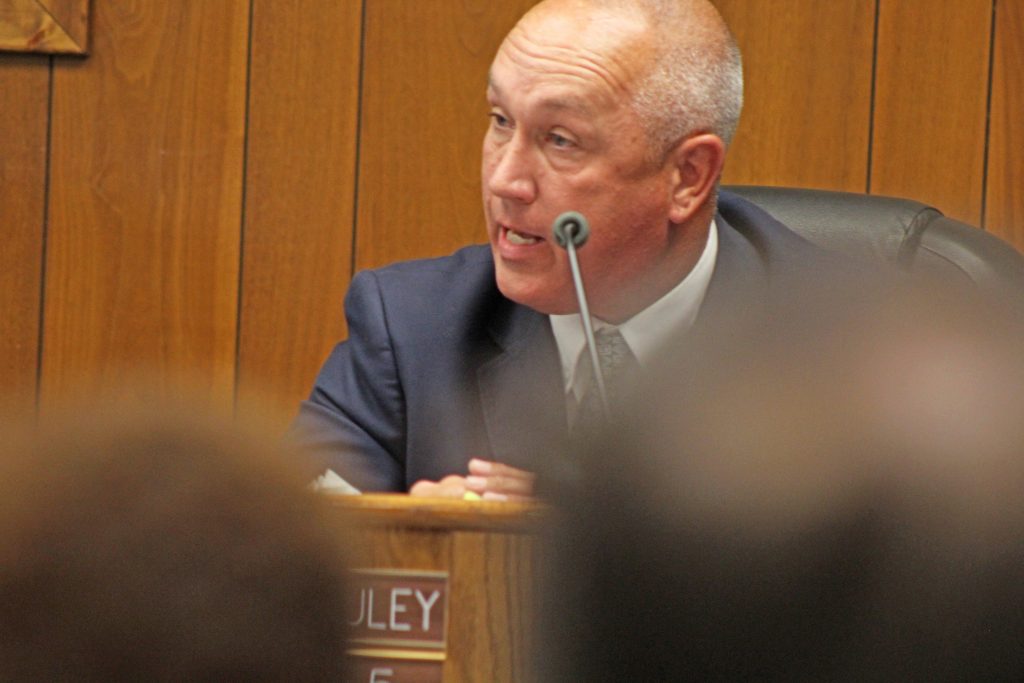
    WINNSBORO – It took a little longer than expected, but Fairfield County managed to pass its 2019-2020 operating budget Monday night.

    Separately, council members also approved a series of new taxes and fees largely aimed at boosting tourism related revenue.

    The council voted 5-0 to approve final reading of the $45.2 million budget. Council members Douglas Pauley and Mikel Trapp were absent.

    Pauley and Trapp voted against final reading at the May 28 meeting, but for vastly different reasons. The May 28 vote failed 3-3.

    Pauley thought overall spending skyrocketed to unacceptable levels while Trapp wanted more spending, specifically $100,000 for mini-parks in his district.

    Councilman Moses Bell, who previously sought $900,000 in additional spending for a recreation center in his district, also voted against the budget on May 28.

    Bell changed his vote Monday night so Fairfield County could move forward with an operating budget.

    “I felt that the recreation center in Ridgeway should’ve been part of the budget process. I felt very strongly about that,” Bell said. “But again, we need to pass this budget. We really do for the betterment of this county.

    “But as I said earlier, I am very disappointed that we couldn’t move forward with the recreation center,” Bell continued.

    Monday night’s budget vote was set up by a motion to reconsider the council’s 3-3 vote on May 28, allowing the council to avoid restarting the budget voting process from scratch, said county attorney Tommy Morgan.

    “A motion to reconsider is an opportunity for the body, such as county council, to bring back an item for reconsideration no later than the very next meeting,” Morgan said. “What happens is the prevailing party, the party that voted against the budget, is the person that could move to reconsider.”

    Later in the meeting, Council Chairman Neil Robinson said the budget represents a start in helping Fairfield County address infrastructure needs, some of which he said are 15-20 years behind.

    “We are on a good track. Sometimes we argue and fuss, but we get things done,” Robinson said. “No, it’s not what we wanted, but it [the budget] is OK with me. Things are going to happen.”

    In related fiscal matters, the council approved final reading on ordinances to establish a 3 percent tourism development fee and 2 percent hospitality tax.

    The council had previously considered the measures in March, but backed off after several residents voiced concerns about the tax, how it would be implemented and whether it would drive away tourism instead of enhancing it.

    Council members revisited the new fees after soliciting feedback from county residents.

    “We did take a lot of comments from the public and these changes are in response to comments from the public,” County Administrator Jason Taylor said.

    Most of those changes involved spelling out exactly how the taxes and fees would be collected and spent.

    The tourism development fee would be collected on the “rental of hotels, motels, and other lodging establishments” in the county. Money can be spent on tourism-related buildings (such as civic centers, coliseums and aquariums); tourism-related cultural, recreational, or historic facilities; beach access, renourishment, or other tourism-related lands and water access; highways, roads, streets, and bridges providing access to tourist destinations; advertisements and promotions related to tourism development, or water and sewer infrastructure to serve tourism related demand.

    The hospitality tax would be collected on prepared meals and beverages, and could be spent on various tourism-related capital projects, according to council documents.

    Morgan, the county attorney, said an exception would exist for the Town of Ridgeway, which has its own tourism and hospitality taxes. Those taxes would be divided evenly between the town and county.
  • PC OKs Red Gate for lower density PD

    BLYTHEWOOD – The Blythewood Planning Commission decided last month to hold further discussions this month on an intensely debated process that would allow the town to rezone three separate parcels located on Blythewood Road between Syrup Mill and Muller Roads. The properties, originally zoned Planned Development District (PDD) under the jurisdiction of Richland County, were later annexed into the town and have sat dormant since 2007.

    Those ‘further discussions’ on a forced rezoning by the Town were not necessary Monday evening as developer Harold Pickrel, III (HVP3 Development, LLC) of Elgin S.C., proposed developing the property under a Planned Development (PD) zoning designation, and with less than half the dwelling units previously proposed. After considerable discussion about projected growth and traffic congestion the area, the commissioners voted unanimously to recommend rezoning to PD.

    The three areas include two zones referred to as Red Gate Farms I and II and are owned by Arthur State Bank. A third area at the corner of Syrup Mill Road and Blythewood Road is owned by Sharpe Properties.

    The original plans under the PDD were to develop Red Gate I and II into housing communities. Plans for Red Gate I included 143 acres with a proposal to build 135 single family units and 23 acres of general commercial, while the Red Gate II plan proposed building 97 single family units and 300 multi-family units with 13 acres of general commercial.

    These numbers projected a total of 232 single family units, 300 multi-family apartment units and 36 acres of commercial.

    Pickrel proposed downsizing to 138 single family units and remove all 300 multi-family apartments.

    The new plan establishes the 138 single family units on 74 acres with 76 units constructed on a minimum lot size of 10,000 square feet and 62 units constructed on a minimum lot size of 20,000 square feet.  It also downsizes the area designated for commercial from 36 acres to 28 acres. Pickrel said he would also reserve approximately 40 acres of open space for a lake and walking trails.

    Both the Planning Commission and citizens voiced various concerns regarding the traffic issues that would worsen with another housing development.

    “I have sat there for 20 minutes or longer trying to make a left turn [off Syrup Mill onto Blythewood Road] at rush hour,” Commissioner Sloan Jarvis Griffin III said.

    Council Chairman Donald Brock expressed concern about Mueller Road Middle School being in the midst of the area affected. “The worst thing we could do is cause more problems,” he said.

    Pickrel promised to hire an SCDOT traffic engineer to do the traffic study.  They will do the study of both Muller and Syrup Mill Roads and do them during school and at all different hours,” he said.

    Larry Sharpe talked about his experiences with the SCDOT engineers.

    “They keep saying there is not enough traffic to install a light,” Sharpe said. “The Penny Tax was supposed to fund 5 lanes through there,” speaking of Blythewood Road.

    Doug Shay expressed his concern with more residential development in general.

    “It’s all over the place,” Shay said. “And it is not being controlled.  Schools are bulging at the seams.  This is an opportunity to do it right.  We need to police it properly,” Shay stressed.

    Pickrel promised to hire an SCDOT traffic engineer to do the traffic study.

    The Planning Commission voted unanimously to recommend that Council rezone of the 143-acre property with the downsized residential plan.

    The next evening, during a Town of Winnsboro council meeting, council voted to issue a Water Capacity Availability and Willingness to Serve Letter to HVP3 Development for 138 residential lots and a maximum daily demand not to exceed 41,400 gallons per day.

    Blythewood Town Council will take the first of two votes on the rezoning on June 30 at The Manor.

  • Crickentree residents take 5-2 PC vote

    Rezoning Request Now Heads for Richland County Council

    COLUMBIA – In horseracing terms, it’s pretty close to a hat trick.

    More than 50 residents of Crickentree and other Columbia area golf course communities pulled off a third upset in their quest to stop the rezoning of a former golf course property that borders their neighborhood from Traditional Recreational Open Space (TROS) to a residential zoning classification

    This time the win came at Monday afternoon’s Richland County Planning Commission where the panel voted against recommending Low Density Residential (RS-LD) zoning to council with a vote of 5-2.

    In April, the Commission voted against rezoning the property to Medium Density Residential (RS-MD) by a vote of 7-1. The third victory, of sorts, occurred last month when the applicant, E-Capital, withdrew its rezoning request for Richland County Council’s consideration just minutes before the matter was to be discussed and voted on.

    The county planning staff recommended approval before it went before the Planning Commission on Monday.

    Robert Fuller, a Columbia attorney representing E-Capital, reasoned that the RS-LD zoning, allowing 3.63 homes to the acre, is the same as the Crickentree property zoning.

    County zoning administrator Geo Price pointed out, however, that Crickentree lots are actually larger with 1.04 homes to the acre.

    Resident Russ St. Marie said chapter 26 of the county’s zoning ordinance directs that TROS zoned properties and their current uses are to be preserved and protected.

    “TROS zoning is just another zoning designation,” Commissioner David Tuttle, one of two commissioners voting for the rezoning, said. “It’s just another zoning classification.

    “In this zoning, lots would be restricted to no less than 1,200 square feet,” Fuller told the panel. “We would restrict the number of homes to 207 with a 150-foot buffer between the golf course property and the Crickentree neighborhood. This is the only way the owner can make anything of it.”

    The issue will go before County Council on Tuesday, June 25, for first reading and a public hearing. This is the only meeting that residents will be allowed to speak to the issue.

  • Council asks for 20% pay hike beginning next term

    BLYTHEWOOD – When council members are seated after the November elections, they will be receiving a pay increase if Mayor J. Michael Ross’ proposed pay increase for council members and mayor is voted into the budget for fiscal year 2019-20.

    Ross suggested at the May 23 budget meeting that the mayor’s annual salary be increased from the current $9,000 to $12,000 and council members’ salaries be increased from $6,000 to $9,000.

    “I will not get a dime of that money,” Ross joked. The town ordinance limits Blythewood elected officials to two terms, and Ross’ second term will end in November.

    “For eight years the salaries of the governing body has been the same,” Ross said. “When I was elected, the mayor’s salary was $18,000 and council’s was $12,000. Our council voted to reduce that by 50 percent,” he said.

    “When you think about everyone else making more money, no one does this job for money. I was going to kick around that we are in excellent financial condition and have money to spare,” Ross said.

    Former town councilman Tom Utruska reminded Ross from the audience that it is the staff who does most of the work.

    “They are the ones who should get the pay increase,” Utroska said, also reminding council of the insurance and retirement perks they also receive.

    And Ross conceded that the town does not have fire, water and other departments that council and the mayor have to supervise and maintain like other towns.

    When Ross brought the issue up again at the May 28 council meeting, Utroska suggested a 20 percent increase for both the mayor and council, increasing the mayor’s annual salary to $10,800 and council members’ to $7,200.

    “I think that’s fair and shows we’re moving forward,” Ross said. Second and final reading of the budget will be held June 24.

  • County, school district fund tuition ‘promise’

    WINNSBORO – Fairfield County’s school superintendent says a newly funded program will allow Fairfield County students to attend Midlands Technical College at no cost.

    Critics, however, say the money would be better spent elsewhere.

    Last month, the Fairfield County Board of Trustees voted 6-1 to approve second reading of the district’s $45.2 million budget for 2019-2020. Board trustee Paula Hartman cast the lone dissenting vote.

    The budget does not include a tax increase.

    Included in the budget is $75,000 for the Fairfield Promise Program. On Monday night, the Fairfield County Council approved a similar appropriation.

    It approved a budget amendment to match the $75,000, yielding $150,000 for Fairfield Promise.

    Council members Douglas Pauley and Jimmy Ray Douglas voted in opposition.

    Dr. J.R. Green, district superintendent, described the Promise Program as an initiative that would allow Fairfield County students to attend Midlands Technical College-Fairfield campus at no cost.

    After qualifying students receive any federal and state financial aid, “the Promise revenue would cover the balance,” Green said.

    To qualify, students would need to be a Fairfield County student – it wouldn’t be limited to the traditional public school system – and earn a GPA of 2.5. Green said the Fairfield Promise would resemble a similar program in Greenwood County.

    “It is for any student that is a resident of Fairfield County that graduates from high school,” Green said. “We’re extremely excited about this.”

    The Greenwood program, however, doesn’t fully fund college tuition for every student in the county. It uses a sliding scale that bases scholarship awards on length of residency, according to the Greenwood Promise website.

    For example, qualifying students attending county schools from grades 9 to 12 receive 65 percent funding, while students who began in Grade 5 receive 85 percent. Students starting in grades 10 or later get nothing.

    Only students attending school in the district since kindergarten receive a 100 percent award, the website states.

    Green said the $150,000 appropriation only leaves enough money for the 2019 school year.

    “Obviously with more funding we could go back to the class of 2016 or 2015,” he said.

    District officials said the $75,000 appropriation is not an additional budget item.

    Kevin Robinson, the district’s finance director, said funds were freed up by adjusting other budget expenditures.

    Fairfield County funding, however, is less certain.

    The county funded its share via budget amendment, essentially a one-off that’s not guaranteed year-to-year.

    Pauley said he didn’t oppose the program, but thought it should be funded from municipal grant funds.

    “I’m inclined to vote in favor of it, but we need to pull the money for it from somewhere else in the budget,” Pauley said. “I believe it is important and can be a big help to our youth.”

    Councilman Jimmy Ray Douglas saw the expenditure as taxpayer waste, questioning the value of Midland Technical College’s Fairfield campus.

    “That’s a waste of money. They’ve wasted money ever since they’ve been there. They’ve done nothing for the use of Fairfield County,” Douglas said. “They have tried to get nobody there to take classes and its called Midland Tech campus in Fairfield County, and they haven’t taught anything.”

    Paula Hartman, the Fairfield school board member who voted against the budget, said she didn’t oppose the Fairfield Promise expenditure per se, but did voice concerns about its viability.

    “If it’s something we don’t know we’re going to have, how are we going to budget for it?” she asked.

    Teacher Village update

    In other business, Dr. Green briefed trustees on the progress of the Teacher Village, a proposed housing project designed to lure and retain teachers by building a low-rent subdivision in Winnsboro.

    So far, the district has spent $12,500 in taxpayer money on the project, including $8,500 for surveying costs and $4,000 in legal expenses.

    Hartman questioned why the expenditures were necessary, noting that the Fairfield County School District Education Foundation created to head up the Teacher Village, had $9,100 in its own bank account.

    She also wanted to know why staff didn’t seek board approval for the expenditures.

    Green said a survey was needed to determine the boundaries of the 22 acres.

    “The district absorbed that cost,” Green said.

    As for the legal fees, Green said he previously said there would be legal fees associated with setting up the foundation. He said he provided an estimate, but not a final cost.

    “That was shared with the board,” he said.

    In November 2016, when the board voted to establish the foundation, Green told The Voice that the district would pay roughly $1,000 to register the foundation as a 501(c)(3) organization.

    It was not immediately clear why it cost $4,000 instead.

    The Teacher Village proposes building 30 homes on 22 acres the district owns off U.S. 321 Bypass, behind the district office. Teachers living there would receive taxpayer funded rent subsidies, cutting rent by about $300 a month.

    Gorelick Brothers Financial, a Charlotte, North Carolina firm that would build the development, is also seeking a $600,000 property tax waiver.

  • Frye: Chamber will be transparent

    Meggs: Town Bailout of Chamber is Unlawful

    BLYTHEWOOD – After it was revealed last week that the Greater Blythewood Chamber of Commerce is $22,000 in the red and is currently operating on a $20,000 line of credit, Interim Chamber Director Phil Frye raised eyebrows on Council when he announced the Chamber would no longer request the $17,500 grant from the Town’s general fund that it has requested and received annually for several years.

    “You are down $22,000! How can you not ask [for the grant]?” Mayor J. Michael Ross asked. “You’ve overspent, it looks like, and now you don’t need our money? I guess this is the fiscal responsibility we’ve been talking about over, over and over.”

    Town Attorney Jim Meggs made it clear where Council should be standing on the issue of funding for the Chamber.

    “You’re not a bank,” Meggs said to Ross. “Anything you do with public money has to go to a lawful public purpose. Being a bailout source is not an appropriate public purpose.”

    “But they aren’t asking for the $22,000,” Ross said. “That [grant] is the same thing they’ve been asking for every year.”

    Meggs shrugged, standing by his advice.

    Ed Parler, Council’s liaison with the chamber board, offered his explanation concerning the Chamber’s numbers.

    “The $22,000 is the profit and loss from July 1, 2018 to the projected end of the current fiscal year,” Parler said. “It is not the bank balance. [The Chamber] is anticipating taking a hit of $22,000 from the previous year. We are now operating on a line of credit until the membership dues begin coming in. With sound management, we are working toward a balanced budget.”

    “That’s a big hallelujah,” Ross said, drawing laughter from the audience.

    “The Chamber board voted unanimously against coming to Council for a bailout,” Parler said.

    “My hat’s off to you,” Ross said. “I think you’ll get the confidence of the community back that you have somewhat lost. It’s a great step forward.”

    Councilman Eddie Baughman thanked Frye for providing the Town with the financials.

    “Mike and I have talked. It is what it is and it showed what it showed,” Baughman said. “I appreciate you tightening the boot straps. It shows a lot of character.”

    “The good thing, Phil, is that if we don’t give you any money, you ain’t gotta tell us anything [about your finances],” Ross joked in an apparent reference to the requests The Voice has made for the Chamber’s financials over the past two years.

    Frye said the Chamber did, however, want to request that Council continue to purchase a $2,500 premiere membership with the Chamber, an amount that is in the Town’s proposed budget.

    Frye also asked for $14,000 for the Chamber for a fall fundraiser event. Frye said the Chamber hopes to net $10,000 from the event.

    Frye assured Council that the Chamber would be more transparent with its finances in the future.

    While praising the Chamber’s promise to be financial responsible in the future, no one on Council asked questions about the Chamber’s vague financials from this fiscal year or lack of financials from prior years. According to CPA Bob Massa, formerly both a Council member and member of the Chamber board, the financial documents submitted last week and last year by the Chamber are vague and do not show with any clarity as to where some of the money that came into the Chamber ended up.

    “Those financial records absolutely can’t be followed with any accuracy,” Massa said. “It’s anybody’s guess what was going on. They apparently kept no books on the chamber until someone started asking for them last year. And Mr. Switzer is apparently no longer available to comment on those financials. It’s hard to follow.”

  • County Council budget fails; Trapp claims racial bias

    Negotiations were intense as Councilman Bell sought support from Bertha Goins for the recreation center he wants in Ridgeway. | Photos: Michael Smith

    WINNSBORO – Fairfield County doesn’t have a budget.

    In a 3-3 vote Tuesday night, the proposed $45.2 million budget failed to garner enough support to pass third reading, with one council member claiming the budget was racially biased against African-Americans.

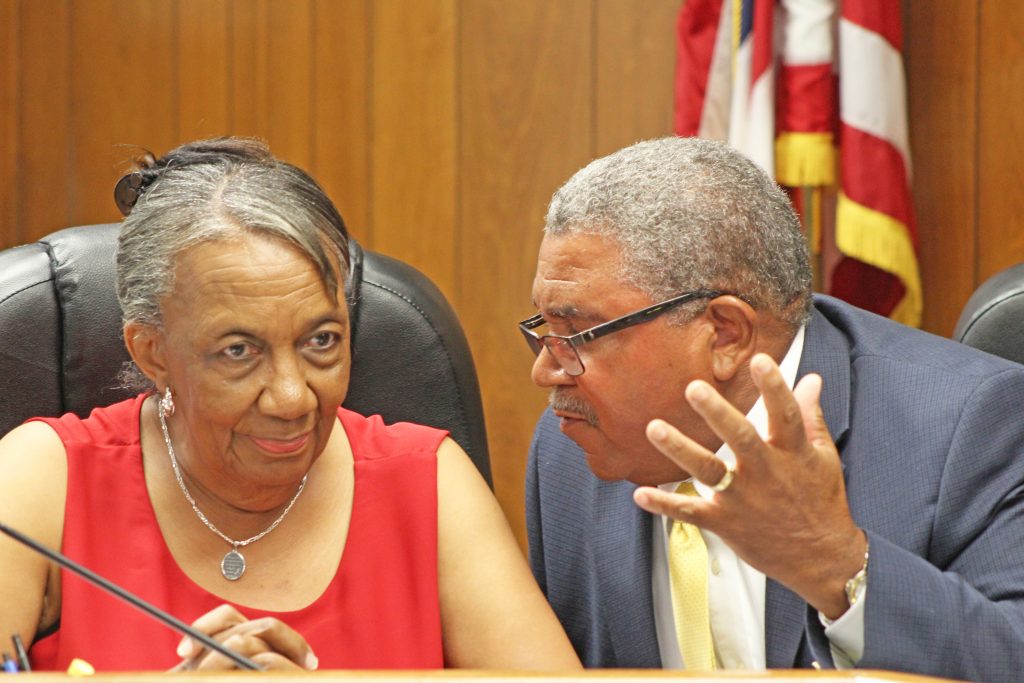
    Council members supporting the budget were Bertha Goins, Clarence Gilbert and Chairman Neil Robinson.

    Trapp

    Douglas Pauley, Moses Bell and Mikel Trapp opposed. Councilman Jimmy Ray Douglas was absent, setting up the tie vote.

    That vote followed a motion to amend the budget to include $900,000 in additional recreation spending – $800,000 for a recreation center in Bell’s district and $100,000 for two mini-parks in Trapp’s district.

    That motion failed 4-2, with Bell and Trapp the only council members supporting it.

    Moments later, Trapp walked out while the meeting was still in progress. He didn’t return.

    Council members took a 15-minute recess before voting, but ultimately weren’t able to muster enough votes to pass the budget.

    County Administrator Jason Taylor said another budget workshop would be scheduled to hash out differences before a re-vote is taken. The county has until June 30 to adopt the budget.

    Judging by comments from council members, reaching a consensus won’t be easy.

    Pauley opposed the budget over concerns about ballooning budget costs.

    “I cannot vote for this budget because it’s up 12 percent,” Pauley said. “There has been an average of 5.5 percent in annual increases for the past four years.

    Councilman Pauley voted against the budget, saying it was too expensive.

    “Another reason I oppose the budget is because it brings us back to across the board salary increases as opposed to the merit-based system that the last council worked for three years to have put in place,” Pauley continued.

    Bell and Trapp opposed the budget because they wanted to spend more.

    Bell offered to drop his request to $400,000, but the idea never gained traction.

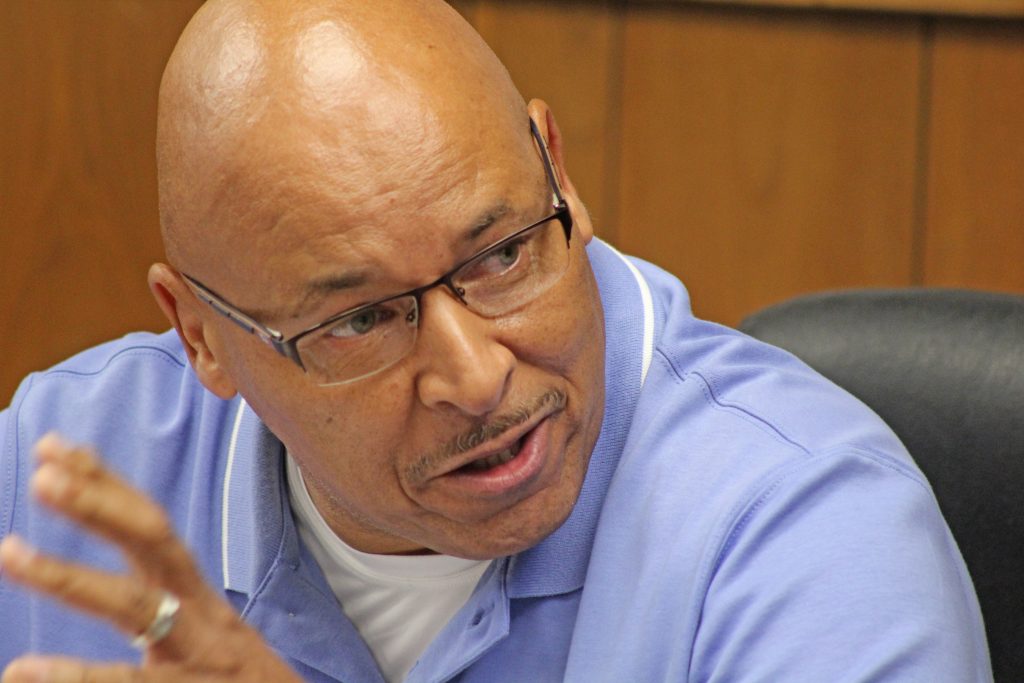
    “I support recreation in local communities,” he said. “Those who write and want to make me a villain, I will proudly wear that as a badge of honor.”

    Trapp claimed the county budget was racially driven. He said it excludes African-Americans while subsidizing a fire station and farmer’s market that he claimed benefit white people primarily.

    “In this budget we don’t have anything for the black community in the county,” Trapp said. “Every time someone asks for something for the black community, it’s always said that taxes are going up.”

    Goins pushed back on claims of racism.

    She said she plans to return a recent award because it recognizes her for being the first African-American elected to Fairfield County Council. She’s returning it because she said she doesn’t believe in labels.

    “When I hear the comments that are made and all the negativity, I have to do what my heart says and what my spirit says, and what I know is true,” Goins said.

    “We all came into this world with our breath, we all will leave this world with our breath,” Goins continued. “We talk about racism all the time, but many times those who talk about it are the racists. Those who talk about it are the dividers.”

    In trying to fund recreation centers, Bell suggested dipping into the fund balance. Although there’s technically about $24 million in reserve, roughly half is already dedicated to the old hospital, the airport and other projects, leaving about $12.7 million in unencumbered funds.

    The county also plans to spend about $8 million over the next several years repurposing the old Mt. Zion building into a new county administration building.

    Bell also proposed spending money left over from the 2013 $24M bond, which he said could help subsidze Ridgeway recreation. Of the $4M left from the bond, about $400,000 to $450,000 in funds are not encumbered, Taylor said.

    Pauley noted that the county budget has benefited Bell’s district greatly. In recent years, Ridgeway has received $150,000 for a park, $100,000 for an EMS station and a $1 million fire station, he said. He said the county has also helped with the water tower and sidewalks.

    “For it to be said that nothing was spent in Ridgeway is absolutely not true,” Pauley said. “A lot of things in Ridgeway might not have been done when Councilman Bell was on council, but a previous councilman got things done in his area.”

  • Fanning: ‘Good Ole Boys’ over

    Some Committee Members Closely Connected to Fairfield

    WINNSBORO – S.C. Senator Mike Fanning advertised last February for applicants to fill positions for four part-time Fairfield County magistrates and one full-time chief magistrate, all of whom would be up for reappointment in May. At the same time he advertised for applicants to fill positions for four part-time Chester County magistrates.

    To emphasize the fairness of his application process, Fanning posted the following on his Facebook page.

    “’The Good ‘Ole Boy System is Over!’ Now, an unbiased committee of out-of-county experts (who do not have established ‘connections’ to folks in our community) will review applications & interview finalists…making recommendations for appointment to this critically important judicial position(s).”

    In another notice, Fanning said the selection committee would be comprised of current and former magistrates from outside the county.

    Contrary to Fanning’s post, some of those committee members appear to have decidedly ‘established connections’ to Fairfield County and to Fanning, and not all of them were current or former magistrates, according to applicants interviewed by The Voice.

    Two applicants for the Fairfield positions said they met with different selection committees and that each committee consisted of three to four members.

    Applicant Mattie Stewart Smith, a retired attorney with 36 years of experience, told The Voice that she and at least two other applicants were interviewed on April 5 by four committee members: Chester County Chief Magistrate Angel Underwood, Underwood’s husband (then-Chester County Sheriff) Alex Underwood, a man with the last name of Gore and Fanning.

    Other members on selection committees were reported to include employees of the Chester County Sheriff’s office.

    Angel Underwood grew up in Fairfield County and graduated from Fairfield Central High School, records show.

    Underwood, who was suspended from her duties as Chief Magistrate in May 2015, handled more than 100 cases in which she should have told parties involved that she was married to the county’s sheriff, according to court records. After serving a year’s suspension, Underwood was issued a public reprimand by the S.C. Supreme Court but allowed to return to the bench.

    Underwood’s husband, Alex Underwood, another member of a selection committee for Fairfield magistrate applicants, served as Sheriff in Chester County from 2011 until he and two of his deputies were indicted in early May on charges ranging from conspiracy to falsifying evidence, records state.

    WBTV in Charlotte reported on Fanning’s appointment of the four new magistrates in Chester County after several viewers had brought up the issue of Fanning’s close ties to the Underwoods. Angel Underwood was the only Chester magistrate reappointed.

    On the day the FBI raided the Sheriff’s office in April, Fanning posted on Facebook, urging the community to stand by Alex Underwood. The station pointed out that Fanning posts photos of him and the Underwoods together socially, including at a dinner the weekend before the new magistrates in both Fairfield and Chester were named.

  • Ridgeway accepts bid for restroom

    RIDGEWAY – Before voting to raise water rates, accept a bid for new restrooms and clarify the cost of living increase for town employees at its May 9 meeting, the Ridgeway Town Council first voted to pass first reading of the Town’s FY 2019-20 budget of $751,959 with only Councilwoman Angela Harrison dissenting. Harrison said she wanted to see the audit for the previous fiscal year before voting on the budget.

    Council also clarified that the annual cost of living increase for Town employees will be set at three percent instead of the previously listed two-to-three percent.

    Water Bills Up

    The town’s water customers will see slightly higher water rates beginning with the July water bills if a second reading of the ordinance passes in June. The increase in wholesale water rates is a pass through from Winnsboro water service which supplies water to Ridgeway. Those rates will increase by $.18 per 1,000 gallons which amounts to a 3.5 percent increase for all customers.

    “We have no choice,” Councilman Rufus Jones said. “Council is not voting for any increase from the Town of Ridgeway by choice. Our water comes from Winnsboro and we are just having to pass along the same rate increase that we received from them.”

    Restrooms for Downtown

    Restrooms in downtown Ridgeway may finally become a reality. After a second sealed bid process was offered by the Town last month, a bid of $43,000 from W. T. Murphy’s Construction of West Columbia was the low and winning bid for two new public restrooms to be constructed in a building behind the Olde Town Hall Restaurant in downtown Ridgeway. The other bids opened at the council meeting were Taylor Made for $197,000 and Southern Renovations for $46,770.75.

    Council accepted Murphy’s Construction’s bid contingent on the outcome of a special called meeting at the construction site to discuss licensing, insurance and other details including a start and end date for construction. That meeting was held on Wednesday, May 29 at 6 p.m., just after The Voice went to press.

    The first set of bids submitted in March, ranging from $51,849 to $215,150, were rejected by Council.

    Farmers Market $ Request

    In other business, Council considered a request from Brad Hoffman of the Fairfield County Farmers Market for $1,500 to help fund the 2019 Ag + Art event.

    “What are they doing with the $1,500?” Councilwoman Angela Harrison asked. Councilmen Dan Martin and Rufus Jones also questioned how the money would be spent.

    “They had a booth at Arts on the Ridge and they sure weren’t full of customers,” Jones said. “So I think $1,500 is way out of line just for Ridgeway to be mentioned in the overall Fairfield County advertising. I suggest we give them $200 as we have in the past.”

    A motion by Harrison to reject the $1,500 offer failed for lack of a second. Council voted, instead, for Councilman Don Prioleau’s motion to meet with the Farmer’s Market people at the May 29 special called meeting to further discuss the matter.

    Council did approve a proposal for the Fairfield County Farmers Market to set up for two Thursdays each month in the Cotton Yard when available during the next six months at no cost.

    Historic RW Signs Tabled

    An agenda item put forth by Councilwoman Harrison to install “Historic Ridgeway” signage in partnership with funding grants was tabled for reconsideration in six months.

    Delivery Parking on Palmer

    Parking on Palmer Street, an agenda item regarding temporary blocking out of spaces on Palmer Street to allow access for 18-wheel tractor trailers to make the turn into the Ruff Hardware store for deliveries, was tabled until the next meeting to allow research from the DOT to be investigated.

    Family Night

    Council expressed strong support for the upcoming Family Night on the Ridge celebration on Saturday, June 8, from 4 to 8 p.m., at the Ridgeway Park. Proceeds from the event will go to support Ridgeway’s Barclay School.

  • Mayor questions how A-Tax and H-Tax awards are spent

    BLYTHEWOOD – The focus of Town Council’s third and final budget workshop on Thursday, May 23, centered on expenditures from the accommodations and hospitality tax funds.

    In recent months, Mayor J. Michael Ross has warned event organizers that he expects those who are awarded funds from the Town to spend those awards on advertising that will actually bring out crowds of people.

    “I feel like a broken record,” he said at Thursday night’s meeting. “We want these events to be successful.”

    He was addressing the organizers of the Bravo Blythewood Spring Market which organizer Sue Pence said brought in about 400 visitors over three days. The town awarded Bravo $4,000 for the event.

    Of that $4,000, Pence said, the group spent $1,250 on digital billboards in Columbia and $400 in The County Chronicle and none in The Voice.

    “Spending $1,200 of your advertising dollars on billboards in Columbia was a chance. If I see that on the next request for funding, I’m not going to approve it. I’m going to turn you down. If you had $1,250 to spend on billboards, you had money to advertise in the local papers,” Ross said.

    “We sit here and talk about we want to support our local businesses, want to shop local and that’s what we promote here in our town,” Councilman Eddie Baughman said. “To shop local, we need to advertise local. We see time and time again where the money is spent elsewhere. I think our event organizers should spend their money locally also.”

    Ross suggested advertising to the local community and then using Facebook to share outside the community.

    Ross said on Thursday evening that an arts immersion class that Bravo Blythewood is requesting funds for in the fall does not qualify for accommodation tax funds. However, on Monday, May 28, Council voted unanimously to fund the class for $1,500 of the $2,500 Bravo requested.

    Bravo organizers also sought $4,000 for their annual Holiday Market, but said it will no longer be held in the town of Blythewood but at the Columbia Country Club.

    “We’ve already contracted with Columbia Country Club and had to put down a $500 deposit,” a representative of Bravo said from the audience.

    Criticizing the town’s signage restrictions, the representative said the location outside of town would make advertising the location much easier.

    But Ross balked at funding an event outside the town limits, saying it would not bring business into the town, which is the intended use of the accommodation and hospitality tax revenues.

    “You take a tremendous risk doing that when you don’t already have the funds approved [from the Town],” Ross said. “It’s a hard sell when you take [the event] out of the town of Blythewood.”