Category: Government

  • Goats could soon be living in Ridgeway

    RIDGEWAY – At last week’s town council meeting, council proposed an amendment to Ordinance 6-1001 which prohibits [live]stock and cattle from running loose on the streets of Ridgeway.

    While the amendment is not aimed at reversing the ordinance to allow farm animals to run loose in town, it will, if passed, allow them to live there. Well, not all of them. Just some of them. Goats.

    Mayor Heath Cookendorfer said the amendment tweaks an earlier amendment (Sec. 2 of the livestock ordinance) that was passed in October 2013 which reads:  “It shall be unlawful for any person or persons or corporations or firms or associations to keep swine, hogs, pigs, goats and horses within town limits of Ridgeway.”

    The newly proposed amendment, if passed, will remove the word ‘goats’ from the list of animals prohibited from living in the town.

    “With a situation that came up, we had discussion about removing ‘goats’ from the ordinance,” Cookendorfer said. “A resident has a goat and is asking to keep that goat.”

    Councilman Rufus Jones asked if the ordinance says residents can’t have a goat or horse in their back yard.

    “What the amendment is saying,” Town Clerk Vivian Case said, “is that someone is allowed a goat under the amendment, but they [goats] are still not allowed to run free.”

    “Every residence in town is not compatible to having a goat,” Councilman Dan Martin said. “If you don’t have a third of an acre then you might not be allowed to have a goat. They are farm animals and need to be treated as farm animals. There will have to be some stipulations for how many goats you can have on a certain amount of property,” Martin said.

    Goat Mowers

    The issue arose when town resident Natalie Weathers recently brought two goats to live in the side yard of her residential property on Peach Street. When the Town gave Weathers notice that she was breaking the town laws by keeping the prohibited livestock within the town limits, she emailed town hall, asking council to reconsider the ordinance. In the email, she said she acquired the goats to mow her lawn.

    While one of Weathers’ neighbors has complained about the goats in a letter to town hall and another in a phone call, Council dismissed the complaints and weighed in on Weathers’ side with a proposed amendment to allow goats to live anywhere in the town, with some guidelines.

    “Do you want to put a limitation on the number of goats [a resident can keep]?” Cookendorfer asked his fellow council members during the meeting.

    Councilman Don Prioleau suggested that council find a goat expert to say how much land a goat needs to live on.

    “Yes,” Councilman Dan Martin said, “they are farm animals and need to be treated like farm animals. So if you have one in a 12’ x 12 kennel, I’ll be coming down the street to check on that.”

    “We’re opening a can of worms,” Jones groaned. “Goats are farm animals…what’s the point? Goats are as smelly as cows.”

    “We’re restricting everything except goats and chickens. We’re saying we’re going to limit how many goats you can have on the size of your land,” Councilwoman Angela Harrison said.

    Weathers has both goats and chickens. While neighbors say she allows her chickens to roam free, that’s okay in Ridgeway, Councilman Dan Martin said. The town’s ordinance does not specifically prohibit chickens from running loose in the streets of the town.

    Weathers’ goats are currently housed in a 15’-or-so x 15’-or-so chain link fence kennel with several tarps draped over parts of it. Martin told The Voice that Council is allowing Weathers to keep the goats under those conditions until the amendment is resolved – passed or voted down – which likely won’t occur until mid-September.

    “We need to talk about minimum acreage and fencing. We need input on this,” Cookendorfer said, looking to his fellow council members for wisdom on the subject.

    Council members generally agreed they need more information before voting and tabled the issue until Martin can research how much land is needed per goat.

    So far, Weathers has not appeared at a council meeting to state her case. Council has taken the lead. Neither have any of her neighbors showed up to publicly address the issue, for or against the goats.

    Town Clerk Vivian Case told The Voice that a public hearing is not required for a text amendment to an ordinance.

    During the public comment session that followed, Randy Bright, a resident of the rural area outside the town, suggested Council contact the local Hoof and Paw organization to discuss the ramifications and space needed to adequately keep goats at a residence inside the town limits.
  • Chatman sworn in as Town Councilman

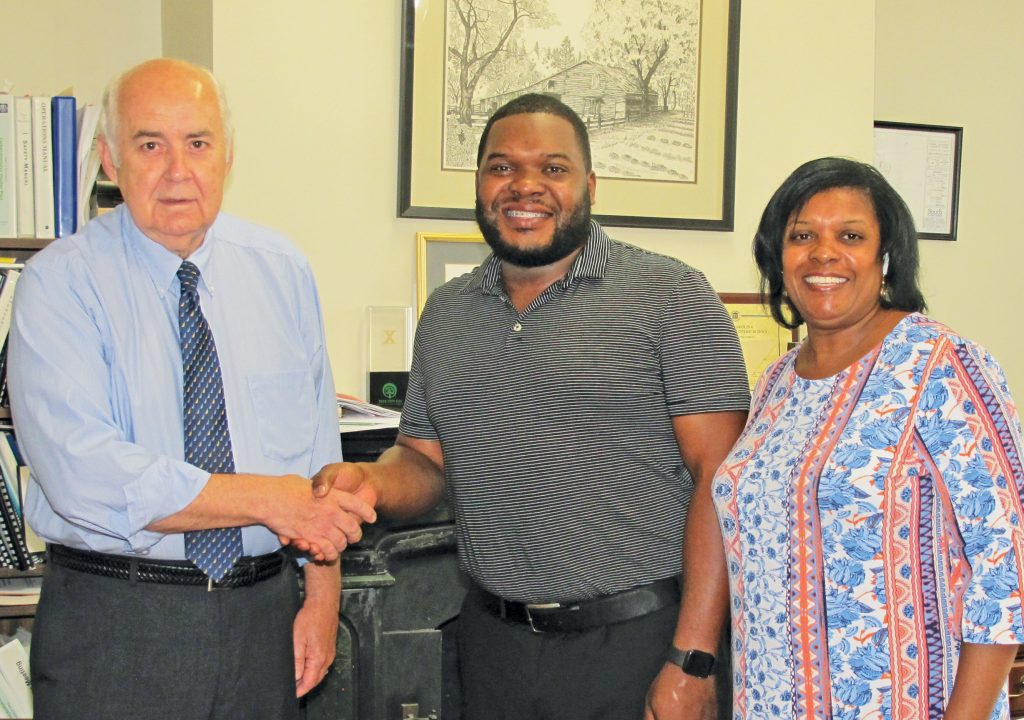
    Demetrius Chatman is congratulated by Winnsboro Town Manager Don Wood after being sworn into office. At right is his mom, Susan Chatman. | Barbara Ball

    WINNSBORO – Political newcomer Demetrius Chatman, 33, was sworn into the Winnsboro Town Council July 2 where he will take the seat for District 3.

    While it’s his first time to hold an elected office, Chatman said he is prepared.

    “I’ve been going to the meetings and talking to people in my district about things they would like to see brought forward,” Chatman said. “I think knowing what my constituents want is the key.”

    A native of Winnsboro, Chatman holds a Bachelor’s degree man holds a Bachelor’s degree in Business Management from South Carolina State University and an MBA from Webster University. He is also a graduate of Leadership Columbia.

    “I love Winnsboro, and that’s why I got into the race, to make things happen,” Chatman said.

    Chatman, a graduate of Fairfield Central High School, currently works at the University as a program manager for Title III, a federal grant program.

  • County Council casts second vote approving rezoning of golf course

    COLUMBIA – On Tuesday night, Richland County Council cast a second vote in as many weeks in favor of a rezoning that could turn a former golf course bordering Crickentree neighborhood into hundreds of homes. A third vote, to be taken Sept. 17, will be the final say on the issue.

    The 9-1-1 vote came after Councilwoman Joyce Dickerson, who represents the Crickentree area, presented a plan for developing the 183-acre golf course property that she said was a compromise reached during talks that occurred on July 2, between six Crickentree residents and E-Capital, a Texas investment firm that purchased the property out of bankruptcy last year.

    But Crickentree resident Dr. Traci Cooper, who, along with the majority of Crickentree residents, opposes the rezoning, said she was shocked when she heard the plan presented by Dickerson.

    “That was not a compromise reached at our meeting,” Cooper, one of the six negotiators, said following Tuesday night’s council meeting.

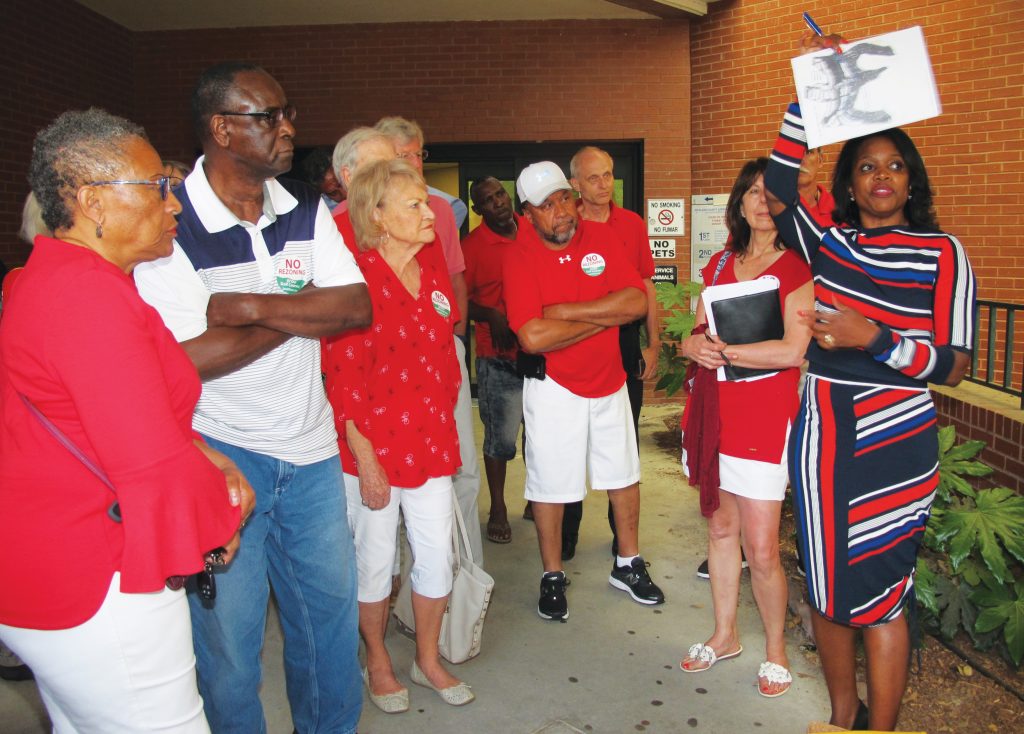
    Dr. Traci Cooper, right, rallies her Crickentree neighbors outside Council chambers Tuesday night following a second defeat by County Council. | Barbara Ball

    “That was an exploratory meeting that started out very healthy with both sides putting all their options on the table. But no conclusions were reached,” Cooper said.

    “We proposed a map with a 500-foot buffer and a maximum of 140 homes. The E-Capital representative, to his credit, listened to us and said he would take the options we presented back to his planner to see if they would work and that E-Capital would get back to us. We were to have another meeting that never materialized. That’s what Ms. Dickerson should have presented to council, because we had not yet heard back from E-Capital and no consensus had been reached.”

    In an email sent hours after the July 2 meeting to inform his fellow residents of the status of the evening’s negotiations, Crickentree resident Russ St. Marie wrote, “We offered a 500-foot buffer option that would have allowed E-Capital 138 homes. However, Mrs. Dickerson said she would not support a 500-foot buffer.”

    In that email, St. Marie wrote that Dickerson had agreed to doubling the 150-foot buffer to 300 feet.

    The next day, July 3, residents received an email from Dickerson indicating an agreement had been reached at the July 2 meeting for a 250-foot buffer and 205 homes.

    “We did not hear back from E-Capital, so we sent a letter to Ms. Dickerson on July 7 reiterating our proposal but heard nothing further from either Ms. Dickerson or E-Capital until she announced her plan to Council last night,” Cooper told The Voice on Wednesday.

    “The negotiations were cherry-picked and presented as an agreed-upon plan. How were the other council members to know her plan was not something we had agreed to?” Cooper said.

    “Our proposal is a win-win for everyone,” Cooper told The Voice. “They still get to build and make a profit of about $24 million, and we get something that we want. I hope they [council] will look at our plan.”

    Dickerson told The Voice on Wednesday that she left the July 2 meeting with the understanding that a consensus had been reached for 205 homes and a 250-foot buffer.

    “I wasn’t going to make E-Capital give up any more homes since they were giving another 100 feet of buffer,” Dickerson said.

    “While I don’t doubt what Ms. Dickerson is saying was actually discussed [with residents], I would like to see it in writing,” Councilman Calvin ‘Chip’ Jackson said after Dickerson made her proposal to council.

    Jackson moved to table the issue until specifics could be worked out and sent back in writing to council.

    “I don’t see why there is such a rush to do this, why can’t we defer it until the August meeting, until the details are worked out and if not, then it can be deferred again until the details are worked out and presented to this council,” Jackson said.

    Jackson’s motion to defer failed.

    Council voted 9-1-1 to approve the rezoning with Councilwoman Allison Terracio voting against and Jackson abstaining.

    On June 25, the council voted 7-3 in favor of the rezoning requested by E-Capital. While the county’s planning staff recommended the requested rezoning from Traditional Recreational Open Space (TROS) to Low Density Residential (RS-LD), the Planning Commission voted twice against recommending the rezoning to Council.

    The third and final vote is set for Sept. 17 at County Council Chambers.

  • Council OKs zoning for land for incinerator despite heated opposition

    WINNSBORO – A Fairfield County incinerator proposal remains a hot topic between Winnsboro area residents and county leaders.

    Over the objections of residence in attendance, Fairfield County Council voted 5-2 Monday night to rezone 11 acres off Old Airport Road as part of a plan to replace a wood chipper with an incinerator.

    Council members Moses Bell and Mikel Trapp voted against the rezoning.

    Those voting in the majority said the incinerator represented the cheapest and most environmentally viable option. They also said the rezoning vote doesn’t mean the incinerator is automatically a done deal.

    Others weren’t convinced.

    Shirley Seibles, an opponent of the incinerator, questioned whether it really falls outside a 500-foot buffer zone with residents’ homes. She said true distance is closer to 387 feet.

    “It is not 500 feet unless it goes into someone else’s property,” she said. “We think that’s a matter of environmental concern.”

    William Ott, an engineer with Davis and Floyd, Inc. of North Charleston, said measurements show the incinerator does lie at least 500 feet from the nearest home.

    Ott added that state and federal regulators would closely monitor the incinerator, especially in the early months, to ensure it complies with regulations. He said environmental impacts on residents would be minor to nonexistent.

    “These same pollutants are emitted out of your car,” Ott said. “These standards are set so that they will not be a hazard or health concern to the community.”

    Seibles and others pressed the council to consider acquiring property located behind the site and locating the incinerator there, further shielding residents from its impacts.

    “We are asking again you not put our property in jeopardy by voting for this air burner,” Seibles said. “Are you financially ready to accept the liability that will come from the citizens of Airport Road and the surrounding area for health concerns that may come, that will come, from being exposed to these kind of carcinogens?”

    County leaders, however, said acquiring the eight acres wouldn’t be economically feasible.

    “I really don’t want to be a part of something that’s going to add to their illness. Have we looked at a plan B?” Councilman Clarence Gilbert asked.

    “Your concerns are valid. We should have a plan B, we do not have at this point,” County Administrator Jason Taylor answered. “It’s expensive to do that.”

    Councilwoman Bertha Goins didn’t think purchasing the property was even possible since it’s owned by Dominion Energy, which acquired the eight-acre parcel after acquiring SCANA.

    “My understanding is the county does not own that property,” Goins said. “The previous contract has expired. What they allow to go into that particular area will not be up to us.”

    Council members were originally set to approve third reading on June 24, but deferred the matter so residents and elected officials could tour a similar, but substantially larger incinerator in Richland County.

    Residents and opposing council members said the Richland County incinerator emitted large amounts of smoke, affirming their opposition to the Fairfield County incinerator.

    “The one in Richland County was old and smoking from everywhere,” Bell said.

    Ott said the Fairfield County incinerator would limit smoke emissions.

    “The one in Richland County was overloaded. That’s going to cause smoke to release,” Ott replied, noting that with the rezoning, the county would still need to obtain air quality and solid waste permits, offering residents further opportunities for public comment.

    Ridgeway resident Randy Bright said just because a facility is permitted doesn’t mean it’s right for the community.

    “When it comes to the environment, even though you get a permit, you’ve got to be doubly sure that that’s correct,” Bright said. “How many EPA things have been approved in the past and turned out to not be so good?

    “Let’s not rush to a site, let’s pick a site that won’t bother anybody.”

  • Mayor’s seat, 2 council seats open for November election

    BLYTHEWOOD – Three seats on Blythewood Town Council will be on the town’s election ballot Nov. 5 – two council seats and the mayor’s seat.

    Because the mayor’s seat has term limits, Mayor J. Michael Ross will not seek re-election.

    Councilman Eddie Baughman told The Voice that he will be seeking re-election. Councilman Malcolm Gordge, whose term is also up, said he will campaign to become the town’s next mayor.

    Whether running for a seat or voting for one, the following is information residents need to know to participate in the Nov. 5 town election.

    Filings for seats open at noon on Aug. 22 at Town Hall. Because Blythewood is not districted, the town’s candidates are at-large. Candidates will file by Statement of Candidacy.

    Filings close at noon, Sept. 6. Candidates must file Statements of Economic Interests electronically with the State Ethics Commission and paper copies with the Blythewood Town Clerk by 5 p.m. that day. Candidates are certified by the Richland County Election Commission.

    For residents who plan to vote in the November election, Oct. 5 is the last day to register to vote in person (9 a.m. – 12 p.m.) Oct. 6 is the last day to register to vote by fax/online (until 11:59 p.m.) Oct. 7 is the last day for a by-mail registration to be postmarked.

    Oct. 7 is also the day absentee ballots are available at Richland County Voter Registration office.

    The general election is held on Nov. 5. Winners are determined by non-partisan plurality method.

    For information call Blythewood Town Hall at 803-754-0501 or the Richland County Election Commission/Voter Registration at 803-929-6000.

  • County, School District promise free MTC tuition

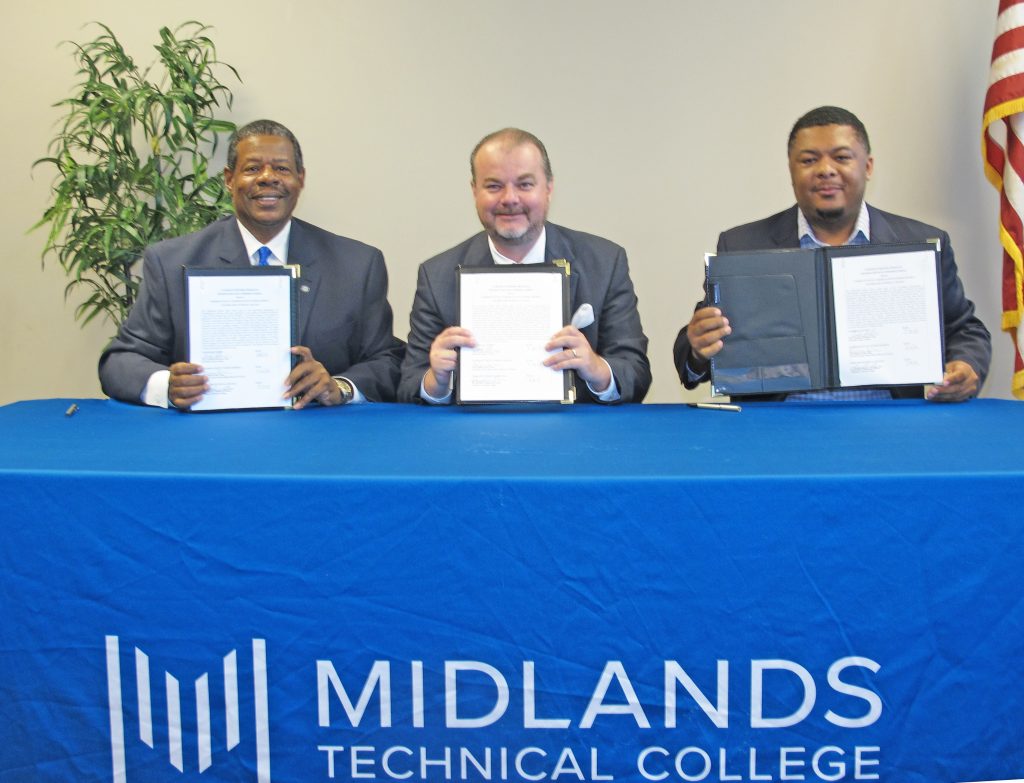
    A memorandum of understanding to create a Promise Program was signed Monday by Midlands Tech President Ron Rhames, Fairfield County School Board Chair William Frick and County Council Chair Cornelius Robinson. | Barbara Ball

    WINNSBORO – Providing free technical college tuition to financially struggling students is noble. Supporters say the Fairfield County taxpayer-funded Promise Program initiative will open college to more students and boost the local workforce.

    On Monday, representatives from Fairfield County, the Fairfield County School District and Midlands Technical College inked a Memorandum of Understanding (MOU), pledging their commitment to the Promise initiative.

    “This is a wonderful program and a way to move our county forward,” County Administrator Jason Taylor said to those gathered at the signing. “A good education is one of the surest ways to guarantee that our children will have access to good jobs and the opportunity for a better future.”

    Later that night, Fairfield County Council discussed in public, and also behind closed doors, its role in the Promise Program, recently pitched by Dr. J.R. Green, district superintendent.

    “Any kid in Fairfield County could go to Midlands Technical Institute at no cost,” Green said. “Students have to apply for financial aid. They’ll look at all the federal and state aid, and Promise revenue will cover the difference. But no one will be required to pay any tuition.”

    Similar programs exist in Kershaw, Sumter, Lee, Green wood, Clarendon and Williamsburg counties, according to the S.C. Technical College System, which governs the state’s technical schools.

    Most counties make free tuition available, but not unconditionally. The only conditions of note in the Fairfield MOU are that recipients must live in Fairfield County and graduate from a public or private school, approved homeschool or have a GED.

    Greenwood prorates tuition aid based on a student’s length of residency, according to the Greenwood Promise Program website.

    Sixty-five percent aid is offered to students attending grades 9-12, but students attending two years or less receive nothing. Full aid only goes to lifetime residents.

    In Sumter County, qualifying students can attend Central Carolina Technical College at no cost provided they maintain a 2.0 GPA and remain enrolled for six consecutive semesters, according to the CCTC website.

    Aid only covers tuition, however. Books, lab fees and other miscellaneous costs aren’t covered, the website states. What the funding covers is not made clear in the Fairfield Promise MOU.

    Promise creates confusion

    There’s some disparity between how some council members, the school district and MTC perceive the Promise Program arrangement.

    The MOU signed Monday describes the deal as a “nonbinding Memorandum of Understanding to announce their intent and purpose to work together to establish the Fairfield County Promise Program.”

    An MTC media advisory announcing the signing states that dignitaries “will sign an agreement that allows 2019 high school and GED graduates living in Fairfield County to attend MTC at no cost.”

    Both the school district and county have budgeted $75,000 for the Promise Program, but neither body has formally voted to authorize any expenditures for the program, though approval is likely.

    At Monday’s council meeting, Councilman Jimmy Ray Douglas repeated prior assertions that MTC doesn’t attract enough students to its Winnsboro campus to justify holding classes there.

    “I’m not against educating children, I’m all for it,” Douglas said. “I’ve been trying to get Midlands Tech to teach classes in the last five years, yet they’ve had no classes whatsoever. It’s a shame we have to pay them $75,000 to start a class.”

    Speaking to The Voice on Tuesday, Councilman Douglas Pauley identified several elements that concern him, namely cost and accountability.

    Pauley said MTC needs to more clearly state how many students plan to attend and what classes will be offered. He said county’s $75,000 share should be doled out in quarterly installments based on MTC’s ability to meet those standards.

    “To give a lump sum of money with no accountability to the taxpayers how that $75,000 is specifically going to be used, I’m not in favor of that,” he said.

    In addition, Pauley said students should be required to take more classes than the six-credit-hour minimum he said other council members support.

    Many traditional student loan programs require students to register for at least 12 credit hours to receive full financial aid.

    Pauley also said students should meet specific academic standards to qualify.

    “To me, with a C average, you’re just kind of coasting along,” he said. “If someone else is paying for your college tuition, you can do better than a C average.”

    Other council members embraced the Promise Program.

    “This is a huge deal to be able to allow our students to go to school tuition free,” Councilman Moses Bell said. “This is big, this is a good thing. This is something we ought to be jumping up and shouting about.”

    Council Chairman Neil Robinson also supports the Promise Program.

    “I just think investing in our future for the kids is definitely something that’s needed in this county so we can have a stronger workforce, a better quality of life,” he said. “We’d be bridging that gap for the workforce.”

    Robinson said the Promise Program would likely receive further discussion at the next meeting set for July 22.

    Transparency concerns

    Government secrecy is also throwing cold water on the initiative for some.

    On Monday night, council members retreated behind closed doors to further discuss the Promise Program. Ridgeway resident Randy Bright chided the council for doing so.

    “You’ve taken a slip back with this Promise Program. There’s lots of confusion, lots of secrecy,” Bright said during public comments. “Why are you talking about this in executive session? This is between governments. You shouldn’t need to talk about this in executive session. It should be open.”

    An agenda for the meeting stated the executive session was for a “contractual matter” to discuss and receive “legal advice regarding [an] agreement between Fairfield County, Fairfield County School District and Midlands Technical College as to the Promise Program.”

    Pauley said he didn’t agree with discussing the Promise Program behind closed doors.

    “I thought that matter pertaining to the Promise Program could’ve been done in an open forum,” he said. “I didn’t see a need for it to be in executive session.”

    Monday night’s executive session was improper because the county had already signed an MOU, said Jay Bender, an attorney with the S.C. Press Association, of which The Voice is a member.

    Bender also called the receipt of legal advice explanation “vaguely worded.”

    “The MOU sounds like a contract to me,” Bender said. “If there’s an MOU, which is a contract, you can’t go into executive session under the rubric of contractual matters.”

  • Page, Kesser appointed to commission

    BLYTHEWOOD – Two Cobblestone Park residents, both with banking backgrounds, were appointed to the town’s Planning Commission by Council at its June 24 meeting.

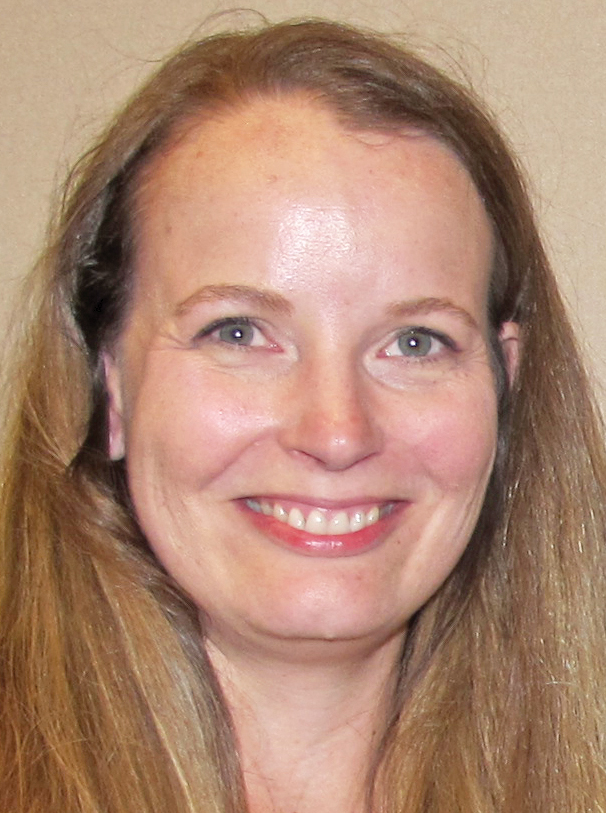
    Page

    A resident of Blythewood since 2015, Erica Page hails from Atlanta by way of Elgin. A graduate of the Darla Moore School of Business at the University of South Carolina, Page has been in mortgage banking for more than 20 years. She is one of only four women in South Carolina to hold a national designation as a Certified Mortgage Banker from the Mortgage Bankers Association out of Washington, DC.

    Page is married with two children who attend Bethel-Hanberry Elementary School.

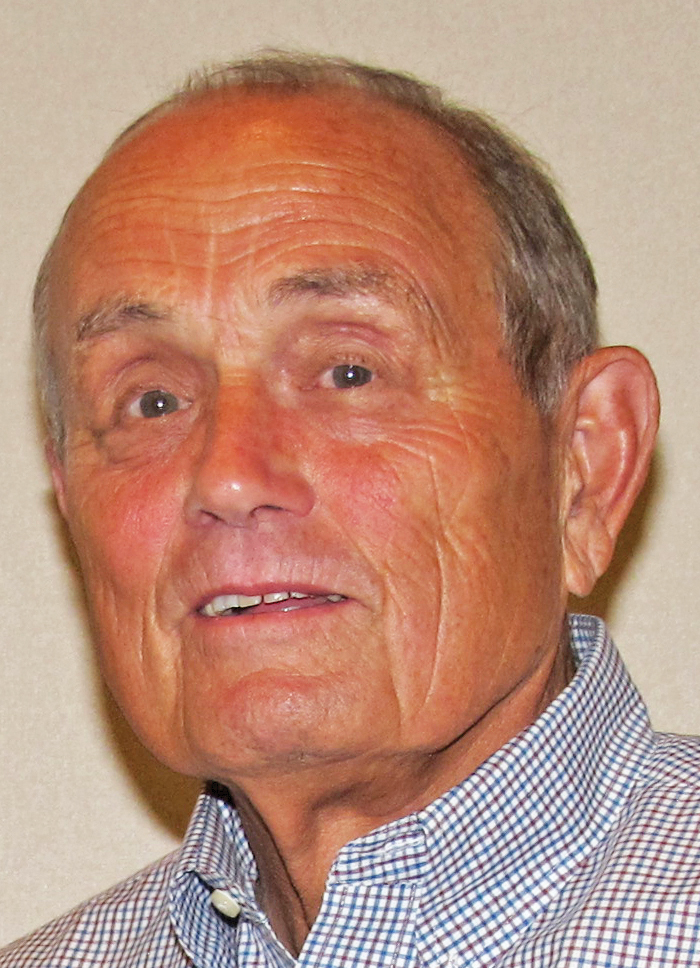
    Ed Kesser retired in 2014 from the banking industry. After graduating from The Citadel in 1969 with a degree in business administration, he served four years in the Air Force.

    Kesser

    Kesser began his banking career with Bankers Trust in 1973 and retired from Bank of America as a Regional Commercial Executive. He later joined BCI Lending, serving as Executive Vice President with responsibility for business development and commercial lending.

    Kesser also holds a Master of Science Degree in Management from the University of Arkansas.  He is a graduate of the University of Oklahoma National Commercial Lending College and the University of Virginia Darden School of Banking. Kesser is a Leadership Columbia alumnus and has served on numerous local boards.

    One additional seat remains open on the Planning Commission. To apply, contact town hall at 754-0501.

  • PC tables industrial zoning

    163 Acres of Manufacturing Proposed West of I-77

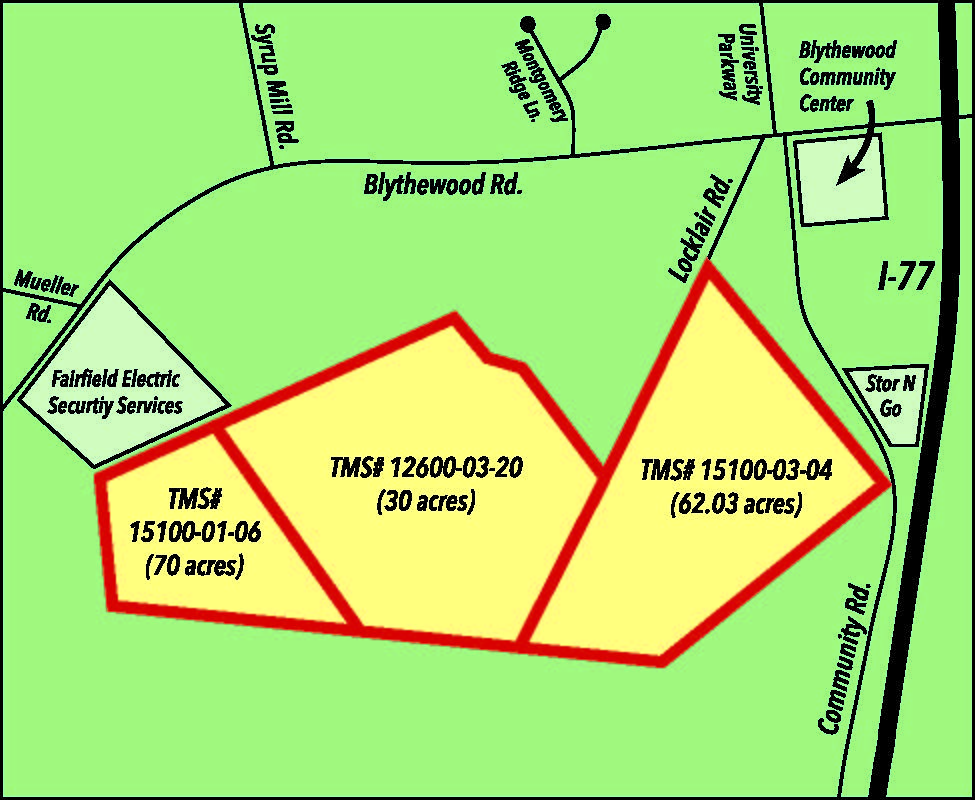
    BLYTHEWOOD – The Blythewood Planning Commission voted Monday night to table a request by Richland County to rezone three connected parcels west of I-77, totaling 163 acres, to Limited Industrial 2 District (LI-2) zoning. Tiffany Harrison represented Richland County’s Economic Development Office at the meeting.

    Richland County Economic Development Office is requesting to rezone 163 acres of property in the town to Limited Industrial 2 (LI-2) zoning. | Ashley Ghere

    The parcels, currently zoned Development (D-1) are bordered roughly by Blythewood Road to the north, Community Road to the east and Ashley Oaks neighborhood to the southwest.

    The three parcels are part of approximately 1,000 acres of potential industrial use. Two years ago, at Richland County’s request, council rezoned approximately 600 acres to the south of the 163 acres to Li-2.

    On March 25, town council voted to update the town’s Master Plan priorities listing Economic Development as a number one priority. From that list Council voted to define a possible technical village within the 1,000 acres.

    “The LI-2 zoning district allows a wider variety and greater intensity of manufacturing uses than the Limited Industrial (LI) district but not the most intense manufacturing uses of the Basic Industrial (BI) district,” Town Administrator Brian Cook explained to the commission.

    But the long and varied list of manufacturing businesses that are allowed to operate under the LI-2 zoning designation did not set well with many of the 20 or so residents who attended the meeting.

    Those uses include textile manufacturing, computer and electronics, pharmaceutical and medicine, aircraft, motor vehicle body and trailers, plastic and rubber products, certain steel and aluminum products, forging and stamping, machine shop, small arms ammunition and many other types of manufacturing as well as a number of kinds of services, warehousing and gas stations.

    A complete list of allowed and conditional uses is available at town hall and on The Voice’s website (blythewoodonline.com).

    Both Harrison and Blythewood’s Economic Development Director Ed Parler assured naysayers that the list does not include dirty manufacturing.

    “This is the highest and best use of this property,” Parler said, noting that it would provide jobs and revenue for the town.

    Asked by newly appointed commissioner Ed Kesser if the County has a master plan for the industrial acreage, Harrison said there would be covenants and restricts put in place, but that the priority is to get the properties rezoned. She said Richland County can’t move forward until the zoning is in place.

    “A lot of these kinds of manufacturing you’re not going to want in your neighborhood, Commission Chairman Donald Brock said, looking over the list. “And what if you get the zoning, but don’t get the cleaner manufacturers to come here, then will you take less desirable ones?” Brock asked.

    “We don’t want to limit uses too much,” Harrison said. “We want to keep it broad.”

    “I feel like we’ve been kept in the dark,” Tom Utroska said, echoing others in the audience. “I’m not opposed to LI-2, but you need a better explanation before you make a recommendation to Council,” Utroska said to the commissioners.

    Heeding that advice, the commission voted 4-2 to table the item until the August meeting.

    Planning Commission Packet

  • County delays action on library purchase

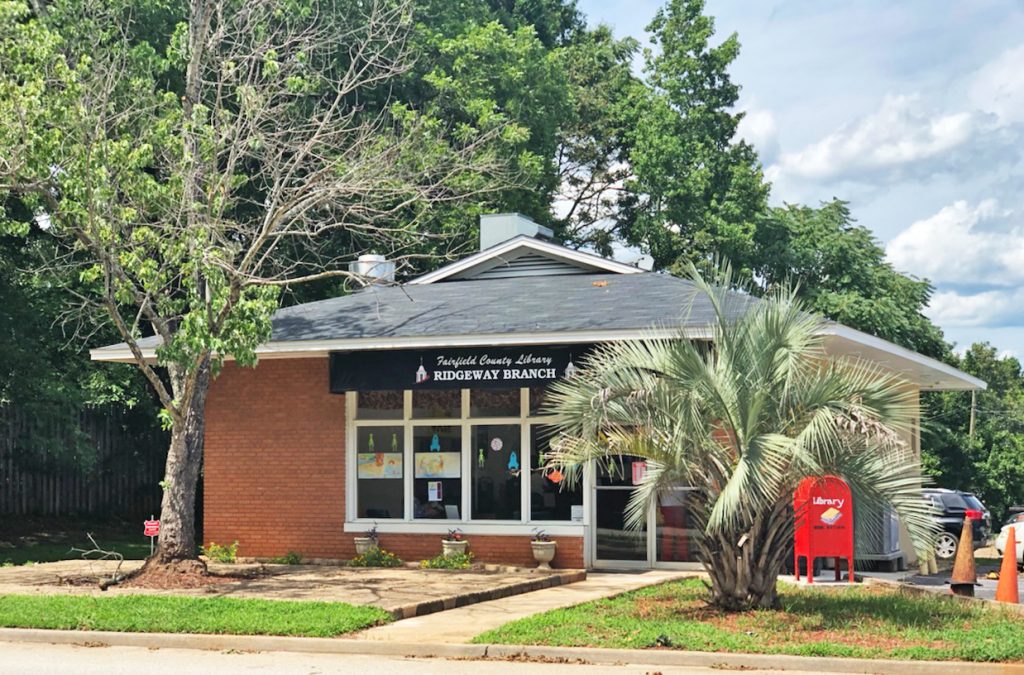
    The county recently renovated this building for the Ridgeway library, located on Palmer Street in downtown Ridgeway. The county is currently leasing it with an option to purchase.

    WINNSBORO – Plans to purchase a permanent home for the Fairfield County Library branch in Ridgeway are on hold for now.

    At a recent administrative committee meeting, council members voted unanimously to table a proposal to buy property the library is currently leasing on South Palmer Street.

    It was not immediately clear when the matter would return for a vote, though it will likely be later this year.

    That’s because the county wants to pursue federal grant opportunities that could potentially unlock more money to help cover costs of buying the property at 235 S. Palmer Street in Ridgeway.

    County Administrator Jason Taylor said up to $500,000 is available through the Community Development Block Grant, or CDBG, program.

    “It would be beneficial for us all if we try to secure the grant,” Council Chairman Neil Robinson said.

    Grant money would be especially helpful since the sale price is substantially higher than the property’s estimated value.

    Eric Robinson, the county’s library director, said at the June 24 committee meeting that the property owner is asking $169,900.

    Fairfield County property records, however, list the property’s fair market value at $66,700.

    The property last sold for $85,000 in June 2005 and was then deeded over to the current owner, Lok-Yan Yip Patterson for $1 in 2008, records state.

    “Has anyone tried to bargain with the lady?” Councilman Jimmy Ray Douglas asked.

    “Feel free to do so. She’s a shrewd business person,” Eric Robinson, the county library director, answered.

    “I know she is. She’s had the place remodeled and now is trying to sell it for three times what it’s worth,” Douglas replied.

    Robinson said he and the board prefer to remain in the existing building since the South Palmer Street is an ideal location. He said the library would incur additional costs if it had to move, citing the integration of technology in the current facility.

    “If you read the history on this, we’ve bounced around Ridgeway. We’re into our sixth different building,” Robinson said. “Because we’ve sunk so much money into it and the county has sunk so much money into it, we would like for this to be our permanent location.”

    At present, the library board has said it’s willing to offer about $90,000 to buy the facility, which is essentially half the current asking price plus any rent remaining on this year’s lease.

    Library officials, however, said the owner signaled she’s not interested in that amount because she would lose rent revenue in the long term.

    County attorney Tommy Morgan said there’s no harm in delaying action on buying the property. He said the lease agreement allows the county to renew for another two years, with rent only increasing from $850 to $892 a month to account for Consumer Price Index increases.

    In the meantime, negotiations over a final sale price can continue. The CDBG avenue also requires multiple appraisals, and would also work in the county’s favor.

    “The county is pretty much in the cat-bird seat when it comes to that,” Morgan said.

  • Council to raise franchise fees

    BLYTHEWOOD – Mayor J. Michael Ross announced Friday morning that council is planning to raise the franchise fees that town residents pay on their power and water bills from the current three percent ($3 per $100) to five percent ($5 per $100).

    The revelation came during the public hearing section of a special meeting called to grant new 30-year non-exclusive franchise agreements to both Fairfield Electric Coop and Dominion Energy.

    Lake Ashley resident Edith Norris came to the meeting with questions about the fee.

    “I understand that this fee is collected on our light bill on behalf of the town and that Dominion and Fairfield Electric give this fee back to the town. Is that standard for all the town residents? How much does the town collect and what is that money used for?”

    Ross explained that the three percent franchise fee is across the board for all residents in the town and that the town collects franchise fees not just from the power companies, but from insurance companies, Winnsboro water service and other companies that do business in Blythewood.

    “This current agreement with the power companies has been in effect since 2001 – 18 years. And it’s remained the same, three percent,” Ross said.

    He explained that Fairfield Electric returns about $140,000 in fee collections annually to the town and Dominion returns about $70,000.

    “Since there is no taxation in Blythewood, this is one of the few revenue streams we have to operate with,” Ross said. “So all these fees usually go back into the general fund for operating the park, paying employees and other things since there is no tax millage,” he said.

    “It’s been three percent for 18 years, so it’s time to go up on the fee, like all the other municipalities have done. Things have gone up more than three percent over 18 years and we don’t have another way to raise money for operating expenses other than building permits and business licenses,” Ross said.

    “I understand, but how does a franchise fee differ from a tax?” Norris asked.

    “I don’t know,” Ross said, looking to town attorney Jim Meggs for guidance. “It’s just a word,” he said, shrugging.

    “It looks like a tax to me,” Meggs said.

    “Only the residents who live in the town limits pay the fee,” Norris said. “Before we annexed into the town, we didn’t pay this fee. So, it is a tax, but it’s called a fee.”

    “The town requires the power company to collect this fee,” Morgan Harrell representing Dominion, added. ”The power company doesn’t require the town to pay it.”

    Meggs weighed in with some clarity on the issue.

    “Under our state constitution, municipalities have authority over streets and rights of way inside the town limits. We even have some say about the Department of Transportation’s rights of way,” Meggs said. “The constitution requires that if people use the town’s streets’ right of way, they have to have a consent or franchise agreement with the town. It’s a traditional municipal thing across the state. Counties don’t have franchise authority, so you don’t pay fees in the county.”

    “I realize it’s a way of collecting tax,” Norris said, pressing the issue, “but a franchise fee can’t be deducted on my income tax. So why isn’t it called a tax?”

    “I don’t know,” Ross finally said. “It is what it is. It gives the town the money it needs to run the town.”

    While Norris said that because the town has grown it is therefore collecting more money in franchise fees even though the fee has not increased.

    Ross countered that there is more work to do and pay for when there are more people in the town. He said it is not final that the fee will be raised to five percent. He said it may only go up one percent.

    Harrell pointed out that the town can also raise or lower the fee at any time during the 30-year contract. The fee, she said, is not bound by the contract.

    Ross said the new fee will be finalized at second reading and that any change in the fee would go into effect Jan. 1, 2020.