Category: Government

  • Town OK’s Installment Plan for Restaurant

    BLYTHEWOOD – Town Council voted on Monday night to authorize an installment purchase plan of finance to provide funds for the construction of a restaurant facility across from the front of Town Hall, next to the railroad tracks.

    The ordinance is required by Santee Cooper, who is loaning the Town $900,000 over 10 years at 2 percent interest through its revolving loan fund. Another $500,000 is being loaned to the Town though Fairfield Electric Cooperative. The combined $1.4 million will be paid directly to the Blythewood Facilities Corporation (BFC), which will pay the construction company as the work on the facility progresses. The Town plans to rent the restaurant facility and use the rental revenue to pay back the loan. The BFC was originally established to manage the Town’s repayment of the $5+ million bonds for the park. But, according to Mayor J. Michael Ross, the restaurant account and the park account are separate.

    The ordinance passed Monday night specifies requirements for a security agreement in favor of Santee Cooper for the $900,000 loan. According to the agreement, to finalize the loan the Town has agreed to pledge the following as a source of funds for the installment payments and loan:

    • the revenues generated from a lease of the restaurant;

    • a portion of the Town’s Hospitality and Accommodations Tax revenues (this pledge, however, is subordinate to the pledge of these revenues for the $5+ million debt service the town already owes to the BFC for the park construction);

    • installment purchase revenue bonds (for the restaurant); and

    • any other revenues available to the Town.

    In addition to these stipulations, the ordinance calls for the 1.4 acres designated for the restaurant to be separated from the original park property. Santee Cooper is also requiring, as a source of additional security, that the Town execute a first priority mortgage on the 1.4 acre restaurant property in favor of Santee Cooper.

    In order to acquire the loans for the restaurant facility, the Town has identified the facility as an economic development project for the town.

    In other business, the Council re-initiated the annexation and zoning for a 11.43 acre parcel shown on the Richland County tax map as TMS# 12500-01-02, 12500-01-12 and 12500-01-20 (1232 and 1224 Blythewood Road). The owner of the property is Milton Douglas Broom Jr. The parcel is zoned Community Commercial in Richland County and recommended interim zoning is Community Commercial. This property was annexed and given final zoning during the last couple of months, but is being re-annexed and re-zoned due to wording in the initial ordinances that Town Administrator John Perry said might not be entirely correct.

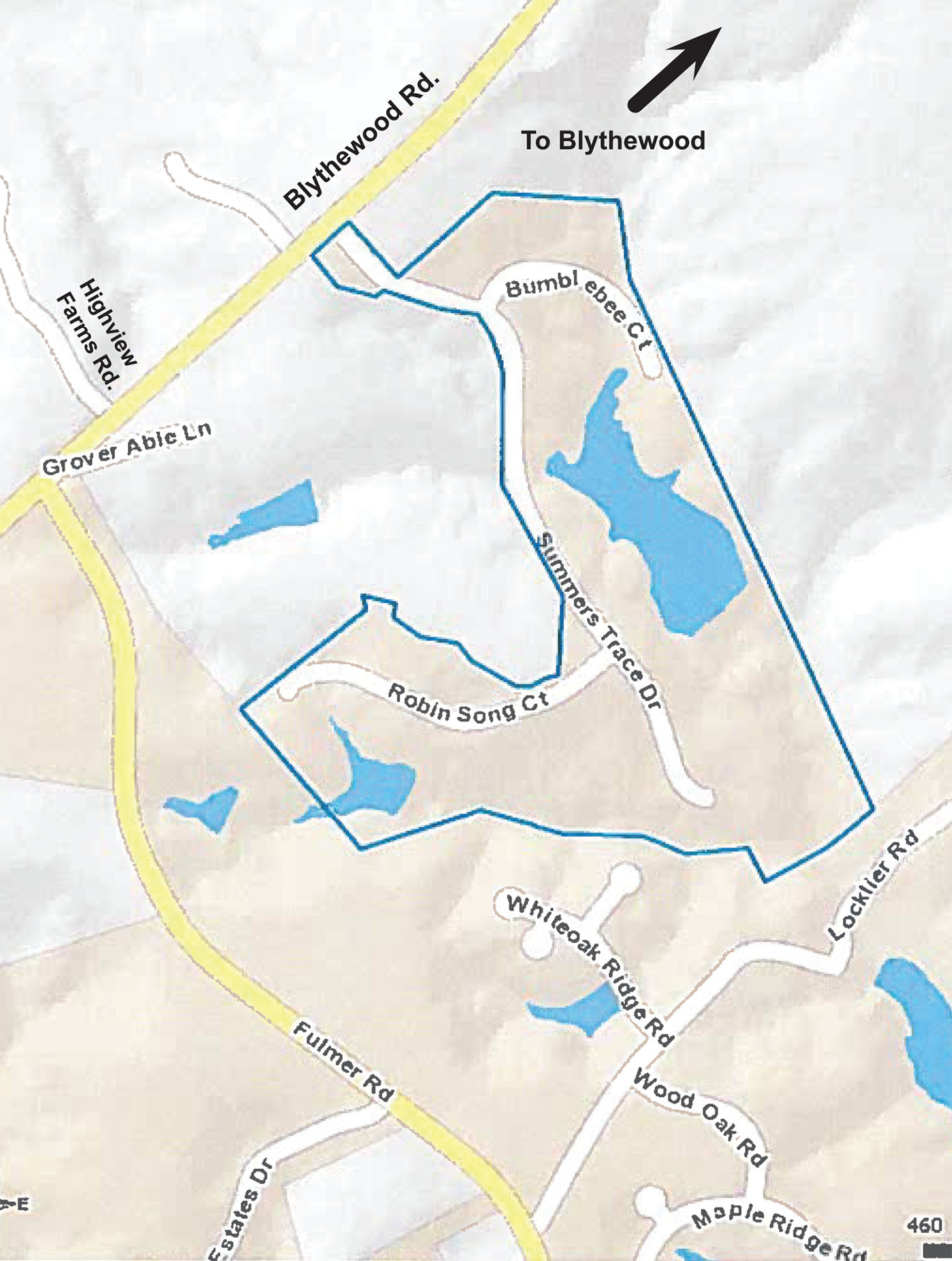
    A second and final reading was given to Ordinance 2013.012 to establish a final zoning designation of R-20 Low Density Residential for 88.16 acres located on the east side of Blythewood Road and between Fulmer Road and Annie Entzeminger Court. The property is known as Holly Bluff (formerly Summers Trace) and shown on the Richland County tax map as TMS #12500-02-05.

    Council also passed a resolution to authorize the Mayor to accept a bid from Gregory Electric Company, Inc. for the installation of five Electric Vehicle Charging Stations to be provided by the Town, at three business locations in the Town: one at Sharpe Shoppe 1 Exxon, 230 Blythewood Road; two at Comfort Inn, 436 McNulty Road Extension and two at the Holiday Inn Express & Suites, 120 Creech Road.

    The installations are to be completed within 90 days. The winning bid for the three charging stations came in at $21,468.

  • Evidence Points to Mishandled LOST Funds

    FAIRFIELD – At a County Council meeting on July 8, county taxpayer Maggie Holmes accused Fairfield County Council of mishandling millions of dollars of Local Option Sales Tax (LOST) revenue since it began collecting the tax in 2006. On July 29, the County brought in two consultants from Parker Poe Consultants with expertise in the field of LOST funds to address those accusations. Ray Stevens, a former head of the S.C. Department of Revenue, told citizens attending the Council meeting that the County had credited the LOST revenue to tax payers, but that it appeared the County was crediting it in two phases — when the millage was set in May or June and again on their tax bills in the fall. But he stopped short of saying the County had mishandled the LOST revenue or explaining whether the County had unlawfully accumulated much of the County’s  LOST revenue in the General Fund over the years.

    The evidence, however, is piling up that, since 2006, the County may, indeed, have mishandled its LOST funds in two ways — first, by grossly underestimating how much LOST funds it expected to receive each year, and second, by failing to return all of each year’s LOST revenue to the County’s property tax payers in the form of property tax credits.

    According to documentation provided to Maggie Holmes through a Freedom of Information Act request last March, former County Administrator Philip Hinely’s estimation of how much revenue he thought Fairfield County would receive each year from LOST revenue directly affected how much tax credit would be subtracted from tax payers’ annual property tax bills. The lower the estimate, the lower the tax credit that would be applied to each bill. The excess revenue that resulted from the low estimates accumulated from year to year in the General Fund. Such an accumulation, if it occurred, is a violation of state law.

    According to that documentation provided to Holmes by Hinely, a little more than $5.2 million of the LOST revenue accumulated in the General Fund between 2006 and 2012.

    About two weeks after Holmes made her accusations to Council, however, it was discovered by Holmes’ attorney and, perhaps by the County’s various hired consultants, that the $5.2 million amount might not be correct. The County, it appeared, was inadvertently, and apparently unknowingly, returning twice the amount of tax credit to tax payers that it had intended to return.

    It seems the equivilent of a LOST tax credit was first being given in May or June each year in a calculation error as millages for all County agencies were totaled in preparation for County Council to vote on the Resolution Establishing the total Millages for the County. The net County millages (the amount of millage needed after the tax credit was deducted from the gross millage) was added into the calculation of the total millage for all County agencies instead of the gross millage (the total millage needed to operate the County’s General Fund.) Then the LOST tax credit was deducted as it should have been–only on the property tax bill when it was prepared in October. The result was an unintended double deduction.

    According to Laura Johnson, the County’s Comptroller, the County’s Comptroller, the calculations for the Resolution were prepared by Hinely in conjunction with her Department in late May or early June. But Johnson said she was unsure how the final millage amount was calculated.

    “That’s one of the things the County Administrator [Interim Administrator Milton Pope] and the auditors are looking at now,” Johnson said. “As soon as their report is completed, then we’ll know what happened.”

    The double deduction presented two problems, according to Holmes — that the error had been made each year without detection since 2006, and that it was actually an indication that a large amount of LOST revenue was being accumulated in the General Fund each year.

    “The deduction was given twice and there was still a large overage of LOST funds going into the General Fund,” Holmes said. “It just wasn’t as much as we first thought.”

    Underestimated LOST revenue

    According to S.C. Statute 4-10-10, the law specifies guidelines for how to estimate the annual LOST tax revenue. It directs the estimate is to be based on how much LOST revenue was received the prior year. For example, the County received $1,812,814.73 in LOST revenue in 2010. So it should have based its estimate of LOST revenue for 2011 on that 2010 amount. Instead, the County estimated its 2011 LOST revenue at $908,495.51, approximately half the amount of LOST revenue it received in 2010.

    In correspondence to Holmes, Hinely listed a number of reasons why he estimated each year’s LOST revenue so low — fear of a weak economy, fear of certain provisions of Act 388 that “if the County overestimates the tax credit or if collections decline and lower the millage rate greater than it should, the County cannot make the appropriate adjustment to our millage,” fear of a fluctuation in tax revenue, etc.

    But several CPAs, auditors and a Director of Finance of a municipality, all of whom work with LOST revenue but asked not to be named, told The Voice that those fears are generally unfounded, pointing out that Fairfield County’s LOST revenue has continued in an upward trend even during the down economy years of 2008-2010.

    Furthermore, state law dictates that a county or town’s LOST tax revenue cannot be less than it was the previous year. One source told The Voice that this level of assurance is further provided by an equalization of LOST revenue among counties by the Department of Revenue after it collects the tax and before it sends the tax revenue to the County Treasurer.

    Failed to give taxpayers timely tax credits for LOST revenue

    It appears, according to the documentation Hinely provided to Holmes, that after greatly underestimating its LOST revenue, the County then siphoned off the overage and accumulated that overage from year to year in the County’s General Fund. As an example, after taking the 2011 estimate of $908,495.51 from $2,152,551.64 (the actual LOST revenue received in 2011), the County had an overage or ‘difference’ of $1,244,056.13. An accumulation of LOST funds from year to year is in violation of state law.

    “What’s most shocking about this, is that even with a double credit, there was still, apparently, a large amount of LOST revenue in excess of the County’s estimate that was held in the County’s General Fund,” said Jonathan Goode, Holmes’ attorney. “This shows how far off the County was in its estimates of how much of the LOST revenue to hold back.

    “If not for the double credit,” Goode said, “the County would have been giving taxpayers credit for less than half what it received in LOST funds. By estimating too low, a huge amount of excess is created. If that excess is not given back to the taxpayers in a timely manner in the form of property tax credits as required by law, this creates a gross influx of dollars to the General Fund.”

    While County taxpayers, and perhaps many in the County Administration, are waiting to learn from the auditors the final numbers of how much of Fairfield County’s LOST revenue was withheld and accumulated in the General Fund, Holmes said that, “just because the County was apparently giving tax payers a double credit of what they intended to give each year, that is not OK. Almost all of that tax credit should have been coming back to us each year. Something was wrong.”

    And, indeed, there may be no better proof that something was wrong than the fact that, since 2006, the LOST tax credit has hovered around 7 – 8 mills based on an $800,000 – $900,000 LOST estimate. After Holmes brought the subject up to Hinely and subsequently to Council, this year the LOST tax credit will jump to 21.37 mills for FY2014 based on a $2,400,000 credit from the General Fund.
  • ARB OK’s Region 6 HQ

    BLYTHEWOOD – The Architectural Review Board met Monday evening and voted to approve, with contingencies, a Certificate of Appropriateness (COA) for a building at 118 McNulty St. that will soon house the Region 6 Headquarters of the Richland County Sheriff’s Department as well as an office for the Blythewood Magistrate.

    Those contingencies placed by the ARB include final landscape approval by the Town’s architect and a change in the proposed signage on the front of the building from two separate signs for the Sheriff’s Department and the Magistrate’s Office to a single sign.

    The building was the former Ace Hardware store that was most recently occupied by the Rivers International Church. While considerable renovation will be done inside the building, the outside will see few changes. A column motif will be created along the front of the building and the color of the stucco and brick across the front will closely resemble Trinity United Methodist Church’s new youth center across the street.

    Town Administrator John Perry suggested that some full-grown crepe myrtles may be moved to the front of the property and he said the Town would most likely offer to share in that cost since it would benefit the town’s streetscape along McNulty Street.

    According to a spokesperson for the County, Richland County Council approved a total of $1,060,000 at their July 2 meeting for purchase of the building, the lot and the upfitting of both. According to Preston Young, the real estate agent for the sale, plans are to start the renovation process immediately.

    After the COA is approved, the permitting and oversight of the project will be turned back over to Richland County, according to Perry.

    The Headquarters will have four shifts with two-hour rotations and four squads, just as it is currently at Lake Carolina, and with the same command structure — Capt. Roxanne Meetze and Lt. Harry Polis.

    Capt. Chris Cowan of the Sheriff’s Department told The Voice earlier in the summer, “While the Town has 24/7 service from the Department now, there will definitely be more of a presence of the Sheriff’s Department in the Town with this move.”

  • District Sees Gains in State Scores

    FAIRFIELD – Fresh off last week’s Elementary & Secondary Education Act (ESEA) ratings that dropped the Fairfield County School District from a B to a D, Superintendent J.R. Green is much more pleased with results from this year’s HSAP and PASS tests. The number of high school students scoring at level 2 or higher (2=competence; 3=proficiency; 4=exceptional) on both the English Language Arts and Mathematics portions of the High School Assessment Program (HSAP) test grew over 2012 numbers. And although third- through eighth-grade students taking the Palmetto Assessment of State Standards (PASS) tests saw some declines in math and science, the District experienced overall gains in the percentage of students scoring Met or Exemplary.

    “There is still a concern with math, and science is where there is the most concern,” Green said of the PASS results.

    From 2012 to 2013, the percentage of students scoring at Met or Exemplary in math fell by a single point, from 62 percent in 2012 to 61 percent in 2013. That decline was greater in science, where scores fell from 61 percent to 56 percent over the same time period. But scores in other subjects have Green encouraged about the direction of instruction within the District.

    The percentage of students scoring Met or Exemplary in writing improved from 58 percent in 2012 to 65 percent in 2013. The percentages in English Language Arts edged up from 63 to 65 percent, while in social studies the number grew from 66 to 70 percent.

    The credit, Green said, goes to the teachers, as well as to the community.

    “We have teachers who are committed to providing engaged instruction,” Green said. “If students aren’t engaged, they are not going to be successful. We’ve been more successful getting everyone on board for the instructional process. We’ve had better involvement from parents and from the community.”

    Still, Green said, there is more work to be done.

    “I’m not saying we had an outstanding year,” he said, “but we are seeing some progress.”

    That progress can also be seen in the HSAP scores, which showed the percentage of students scoring at Level 2 or higher in English Language Arts reach 87 percent in 2013, up from 85.9 percent in 2012. More impressive, perhaps, were the gains in the percentage of students scoring at Level 4 (exceptional) between 2012 and 2013. In 2012, only 8.3 percent of students reached Level 4 status. In 2013, that figure was 16.6 percent.

    “We’ve got a good, strong body of teachers at the high school who have done a good job of engaging students,” Green said. “My goal is to hit 90 percent. I expect math (scores) to move into the 80s next year. That’s aggressive, but we can do it.”

    The percentage of students scoring at Level 2 or higher slipped in math between 2012 and 2013, from 67.6 to 66.8 percent, although the percentage of students hitting Level 4 went up from 10.8 to 13.5 percent. The percentage of students scoring at Level 1 (competency not met) also went up, however, from 32.4 to 33.2 percent. Green said the District has already made some personnel changes in the Math Department in response to those swings. Green said he has also done away with a long-standing tradition, one that is prevalent in many school districts, and one that allowed more experienced teachers to choose which classes of students to teach. Green said it has been common practice for more experienced teachers to push to teach juniors and seniors, leaving the freshmen to the rookies. But the freshmen, he said, may require instruction from a more experienced teacher in order to grasp the subject matter. A lack of experienced teachers for the underclassmen has been reflected in HSAP scores in the past, he said.

    “We’ve had to change that mindset,” Green said. “We have to have some of our most experienced teachers teaching our most needy students.”

  • No Water for Proposed Subdivision

    WINNSBORO – A proposed subdivision just over the county line in Blythewood will have to seek water elsewhere after Winnsboro Town Council passed on an informal request for service during Tuesday night’s Council meeting.

    The request was presented to Council by Creighton Coleman, one of the Town’s attorneys, who said he had been approached by developers seeking guidance on where to best obtain water. Coleman was unspecific about the exact location of the proposed subdivision, but indications are that the site comprises approximately 141.5 acres on Blythewood Road adjacent to Cobblestone.

    “A bank owns the piece of property. I think it’s a foreclosed piece of property,” Coleman told Council. “They had it sold on two different occasions to a developer, but the deal fell through because of lack of water.”

    Coleman said the development would take 273,000 gallons of water a day, “Which is a lot,” he said. There was also some question concerning the size of Winnsboro’s pipes in the area and whether or not they could handle the extra capacity.

    “I certainly understand the water situation here,” Coleman said. “And not to do anything that would compromise our water for the town. So I’m sort of looking at ya’ll for some direction to tell these people how to best go about looking into this.

    “I think it’s important to work with these people because I think that is a gateway to the development in our county,” Coleman added. “This is in Richland, but it’s right on the line. Before we get development in Fairfield, they’re going to have to fill up there and there’s going to be spillover. We’re getting spillover now, but this is a larger development with a lot of homes.”

    Jesse Douglas, Director of Water and Sewer for the Town, said the issue was not only the size of the Winnsboro’s pipes, but also the Town’s existing obligations in the Blythewood area. Winnsboro was committed to the University Club (Cobblestone), he said, as well as an obligation on Boney Road that the Town has not been able to fulfill.

    “They’re really requiring us to work more than we possibly can to keep up the system,” Douglas said. “Right now, my feeling is if we aren’t careful, and if we continue on, we won’t have enough (Columbia) water to send back to Winnsboro and we won’t have the pipeline capacity to bring it back to Winnsboro.”

    Douglas said there was also only one water tank in that area, and if it went down for maintenance the area could be left high and dry. Douglas recommended deferring service to the proposed development. Mayor Roger Gaddy suggested that Coleman steer water queries for that development directly to the City of Columbia, although Douglas noted that that would require Columbia to run approximately a mile of pipeline to tie into existing lines.

    “That’s going to be their quickest bet and their best bet,” Gaddy said. “We’ve still got work to do with our water situation; getting a stable, permanent water supply.”

  • Park Short on Funds

    BLYTHEWOOD – In discussing future construction plans for the town park before Tuesday’s special called Town Council meeting, Blythewood Mayor J. Michael Ross told The Voice that the town is going to need an infusion of money to continue building projects planned for the park.

    “Until Paul Moscati gives us a final accounting later this month of what we’ve spent and what we have, we won’t know exactly where we stand on the final numbers,” Ross said. “With those final numbers we can find some direction.”

    At a meeting last week of the Park Committee, Chairman Tom Utroska asked Perry what was left of the original $5.5 million park bond. Perry explained that some change orders in the original construction contracts for the grounds and the Doko Manor made some extra money available.

    Perry said that while the Town still owes a total of $600,000 to Monroe Construction (for Doko Manor and other vertical site work) and Conder Construction (for horizontal site work), he said the Town still has $300,000 left in the bank for project expenses from the original $5.5 million bond. In December, the town will receive a final payment of $450,000 from the sale of the Community Center (which sold for $1.5 million last year). Perry said those figures leave the Town with roughly $150,000 to pay for dumpster enclosures and site work at the planned restaurant and the construction of restrooms in the park. To have money to build the restrooms, the Park Committee delayed completion of the spray ground water feature.

    The bulk of the costs for constructing the restaurant will come from two low interest loans totaling approximately $900,000 from the Santee Cooper Revolving Loan Fund and funds secured through the Rural Economic Development Loan and Grant (REDLG) program of the U. S. Department of Agriculture.

    While the Park Committee suggested that the next feature to be completed in the park should be the amphitheater, there are no funds left to build it. According to Perry, the Town plans to create a tax-exempt, 501 C 3 Foundation to raise funds for future park construction. Former Town Councilman Jim McLean will solicit private contributions and seek sponsors for park projects. The Foundation committee will consist of five members.

    The next meeting of the Park Committee is set for 6 p.m., Tuesday, Sept. 17. Utroska has asked Moscati to provide a detailed spreadsheet of all moneys that have been spent on Phase I of the park.

    Contract Inked for Playground Equipment

    Council also gave Ross the OK Tuesday night to sign a lease/purchase contract for playground equipment for the town park.

    “While it’s called a lease,” Ross told The Voice, “we will own the equipment at the end of three years, and at that time we will have some options to trade up for more up-to-date equipment. That will be a benefit to us in terms of maintaining and evaluating the playground. The lease payments will come to about $30,000 per year.”

    That amount, he said, was actually a capital improvement that was already budgeted. The equipment, purchased from GameTime, a Playcore Company, is very progressive in its appeal and usefulness and will provide three different sections for three different age groups, Ross said.

    “One section will be for very young children,” Ross said. “There will even be equipment that will accommodate the needs and enjoyment of the geriatric set.”

    The equipment will meet federal handicap accessible requirements and will include a swing that will accommodate a wheelchair.

    Town Administrator John Perry said the site for the equipment is already being prepared and that the installation should be completed and the equipment in use by the end of the summer.

  • Town Plays Catch-Up with Zoning

    Blythewood Town Council passed first reading to establish R-20 zoning on this 88.16 acres called Holly Bluff (formerly Summers Trace), located east of Blythewood Road near Fulmer Road.

    BLYTHEWOOD – Town Council voted to pass first reading Tuesday to give final zoning to a property that was annexed into the Town in October 2008 but never received final zoning. The 88.16 acre property is located on the east side of Blythewood Road between Fulmer Road and Annie Entzeminger Court.

    In 2008 the owners of the property requested R-20 Low Density Residential zoning for the property, which is approximately a quarter acre per home, and the annexation ordinance referenced that zoning as well. The proposed development was called Summers Trace and was shown on the Richland County tax map as TMS # 12500-02-05.

    The property is now listed as Holly Bluff. The lack of permanent zoning came to light when the property owner sought information regarding development of the property which is in the town.

    Town Administrator John Perry told the Planning Commission on Monday night that he could not find a copy of the zoning ordinance. In order for Council to adopt zoning now, the matter had to go back before the Planning Commission for recommendation. The Commission recommended the zoning at its Monday meeting and Council approved it on Tuesday.

  • County Feeling Heat from Angry Public

    State Sen. Creighton Coleman (D-17) slammed Council for not following up on the Santee-Cooper economic development plan.

    FAIRFIELD – The Fairfield County Council came under fire again Monday as citizens packed the meeting room and sounded off about board expenditures, economic development problems, recreation needs and local option sales tax questions.

    Adding to the turmoil was a report from State Sen. Creighton Coleman (D-17) that the negative news reports on former County Administrator Phil Hinely may not be over.

    Coleman said the State Law Enforcement Division (SLED), “had additional information that was found on Mr. Hinely’s hard drive” and had it sent to Sixth Circuit Solicitor Doug Barfield for review.

    “I called to see if he could expedite it and he said he had a full plate in court, and will get to it as soon as he can,” Coleman said.

    Hinely resigned from his post June 28 after reports surfaced that he used his email account to forward pornographic images three years ago. SLED opened a file on the case but took no action after Barfield determined that none of the alleged images violated state obscenity laws.

    In his three-minute presentation to Council, Coleman slammed the Council for failing to follow up on a $40,000 economic development plan submitted by Santee Cooper years ago.

    “We sat on it, sat on it, sat on it” he said. “I talked to the Chair two or three times trying to get movement from him. Nothing ever happened.”

    Some of the harshest comments came from Fay Sandow, who said she was “appalled” to learn that SLED met with the Council Chairman David Ferguson (District 5) Feb. 21 on the issues with Hinely, but that Council took no action until June, when it voted unanimously to sanction Hinely.

    Sandow said it was even more shocking to hear of the decision of a Council member to accept county money for college tuition and insurance reimbursements.

    “If that’s the truth, and I believe it is, I would like to ask those Council members what were they thinking?”

    The State Attorney General recently issued an opinion that the County’s policy of tuition assistance and health insurance reimbursements for Council members was unlawful.

    Some Council members were receiving a direct, monthly payout instead of receiving the health insurance coverage provided by the County. The County was also paying for Councilman Mikel Trapp (District 3) to take business courses at Columbia College.

    Sandow said it is her opinion that anyone who accepts money from the county for personal use is “stealing.”

    She called on those Council members who have been drawing the money to pay it back with interest, apologize to the county and submit their resignations.

    Some members of the audience started clapping at the conclusion of her remarks, but Ferguson pounded his gavel and threatened to have deputies escort out of the meeting anyone who claps.

    State Rep. MaryGail Douglas (D-41) called on the Council members who received payment of insurance premiums, estimated at around $24,000 each, to pay it back. She also called for the return of the $26,000 in tuition money paid to Trapp.

    Trapp has agreed to return the tuition money, but he said it would take some time to repay. He said he thought the total amount was $22,000, but added that he could be mistaken.

    Resident Beth Jenkins told the Council that residents are due better than “a Council that teeters on the brink of what appears to be nothing but wrong-doing from a disgraced resigned Administrator to health insurance double dippers…”

    Tuesday Ferguson reiterated his position to The Voice that he had no intention of reimbursing the County for the health insurance premiums.

    “I don’t feel like I’ve gone anything wrong, even though they’ve hung me out to dry,” Ferguson said. “Mr. Hinely told us we didn’t have any choice on that.”

    In other action, the Council recognized the County’s new interim administrator, Milton Pope, who officially begins his duties this week. Pope, who served as Richland County Administrator before his retirement, said he hoped to help the County with economic development, having worked with Midlands development projects in the past.

    The Council also gave second reading approval to revisions of an ordinance regulating abandoned buildings, manufactured homes and junked cars. The Council also approved an ordinance revising sections of the road paving program.

    The Council also agreed to purchase property for a mini park in District 3 on Road 99.

    Council met in executive session to discuss an economic development plan, but no details were announced.

    Council will hold a special called meeting July 29 to discuss the outcome of an investigation into allegations that the County had mishandled more than $5 million in Local Option Sales Tax (LOST) funds. The meeting will be held at the Fairfield Magnet School at 6 p.m.

    Ferguson said the County’s research indicates that the funds were handled correctly and a full explanation will be offered Monday night by a former director of the S.C. Department of Revenue and County auditors. Ferguson said members of the audience will also be able to submit written questions to Pope following the meeting and that Pope would provide answers on an individual basis at a later date.

     James Denton contributed to this article.

  • County Taps Consultant for Interim Administrator’s Spot

    Milton Pope

    FAIRFIELD – County Council voted 5-0 during a special called meeting July 17 to hire Milton Pope as a consultant to serve as the County’s interim Administrator. Pope sat in on his first meeting with Council Monday night.

    “With the experience he’s had at a big county like Richland, I don’t think we’ll encounter anything he hasn’t already encountered,” County Council Chairman David Ferguson (District 5) said this week. “Milton has a lot of experience, he knows a lot of people and he knows how to get things done.”

    Pope is a principal with Parker Poe Consulting of Columbia and leads the firm’s local government division. Prior to joining Parker Poe, Pope served as the Richland County Administrator, managing 2,000 employees and a $700 million budget. Pope was also Richland’s Assistant County Administrator for more than seven years, managing multiple departments, including Emergency Services, the Register of Deeds and the Alvin S. Glenn Detention Center.

    Terms of Pope’s contract, released to The Voice this week, call for him to serve with the County for a period of up to 180 days, effective July 19. The County has agreed to pay Pope $10,833.33 per month as compensation. Pope will report to County Council, the contract states, and “perform the functions and duties as the County Council shall assign.”

    Ferguson said Pope will also assist with Council’s search and recruitment for a full-time Administrator, and added that Pope has made it clear that he was not interested in a permanent position with Fairfield County.

    “We’re not floundering in the water now,” Ferguson said. “We’re dealing with things we need to be dealing with. Hopefully, he’ll have a calming effect on us. We need to all pull together and do what we can, and we’ve been having some problems with that.”

  • R2 Board Reviews Charter School

    RICHLAND — The Richland 2 Charter School reported during the Richland 2 School Board’s regularly scheduled meeting Tuesday night at Longleaf Middle School that the school is open to junior and senior students who have good standing in discipline and academics. Thirty-four of the 40 seniors graduated this year with the same standards that all public high school students must meet. The on-line program offers academic classes, tutoring and counseling in a flexible schedule. Dr. Henry Lovett, principal of the Richland 2 Charter High School, has requested that the Board consider amending the school’s charter to include ninth- and 10th-graders. While stating that this program is not for everyone, former Superintendent Katie Brochu had sent letters to the District’s high school principals for their thoughts and it was thought the principals had been favorably inclined. Dr. Debbie Hamm, Interim Superintendent, will re-poll the principals, at the suggestion of the Board, and get the principals’ new feedback. The Charter School operates with the permission of the School Board/District but is funded with the local and state dollars that are attached to each student. The expansion of the program does not impact the budget of the District but the District does determine if the goals of the Charter School are a match for the objectives of Richland 2. A vote on the expansion of the lower high school grades will be a future item.

    The AVID (Advancement Via Individual Determination) program was modeled in Richland 2 a dozen years ago — flowing from the high schools to the middle schools and now to six of the elementary schools. High school students spoke of the merits of being in a program that supported them from sixth grade to graduation – giving them the skills to organize their work, prioritize their free time and practice public speaking. Their academic work improved and life skills were developed. Ridge View AVID teacher Tracy Skinner, herself an AVID graduate, spoke to the life-changing work of the program. Students selected are performing at a level below their potential. In some way in their life, they are underrepresented. Skinner had 18 seniors in her class. All of her students graduated and went on to college – earning more than $300,000 in scholarship money for their freshman years alone.

    Hamm had accepted the Interim Superintendent position effective July 1. District Staff and teachers report that her leadership of the District actually began the day Brochu resigned, June 13. The Board approved the employment conditions of her Interim position: a supplemental $5,000 a month salary and $800 per month for auto expenses.

    The Budget that was written in April in a special called meeting had awaited approval until local and state funding had been approved. With that known, the Board voted 6-1 to accept the $223 million general fund budget, with Barbara Specter casting the lone dissenting vote.

    During closing statements by Board members, it was mentioned by several that the joy in the District for the coming year was contagious. When Hamm spoke of experiencing the same joy with the teachers in professional development earlier in the day, the audience broke out in spontaneous applause. On that note the Board broke for a second executive session to attend to personnel, legal and contractual matters. No vote was to be taken. The next Board meeting is Aug. 13 at Longleaf Middle School.