Category: Government

  • County to Tackle Recreation Roadblocks

    WINNSBORO – After months of head-butting and debate, County Council announced Monday night that they will finally lay the groundwork for how they plan to proceed with recreation projects, the funding for which was earmarked in this year’s $24 million bond issue, at a work session on Sept. 18 in Council chambers at 6 p.m.

    The announcement of that agenda item raised question from Councilman Kamau Marcharia (District 4) on what criteria would be used to determine which projects moved forward, as well as a question about what became of money previously earmarked for recreation in his district.

    Council Chairman David Ferguson (District 5) said the Sept. 18 work session would determine “the manner in which we select recreation for each individual district; meaning, will it be left up to that Council member from that district, or will it be left up to the entire Council?”

    Efforts by Marcharia to move forward on construction of a recreation center on 8.12 acres off Ladds Road were voted down by Council in July. Marcharia moved to utilize the $500,000 earmarked for recreation in his district from the 2013 bond issue to begin construction, but was thwarted on a 3-2 vote. Marcharia also moved to use the remainder of a $500,000 allocation made by Council in 2005, but was also defeated, 5-2. In both cases, only Marcharia and Mikel Trapp (District 3) voted in favor.

    Since then, Marcharia has questioned the legality of transferring funds earmarked for a specific function back into the general fund without Council approval, which is exactly what happened, he says, with the 2005 recreation funds. Monday night, Marcharia again asked for a legal opinion.

    “I’d like a legal opinion on that,” Marcharia said, “whether or not Council is supposed to vote on that or can you just take that money and put it where you want and spend it, or does it come back to Council for appropriation?”

    Those funds, interim County Administrator Milton Pope explained Monday night, were part of the Recreation Commission’s budget. When the County took over the Commission in 2006, those funds, along with the Commission’s entire budget, were absorbed into the County’s general fund. And, Pope said, there is nothing in the County’s records that indicate the former Recreation Commission money absorbed by the County had to be used for recreation once it was in the County’s general fund.

    “We’ve gone back and looked at the minutes, and at this point there is no documentation that says that those dollars should have been only earmarked for that project at that time,” Pope said. “It’s in the County general fund bucket, unless when the County (took over the Recreation Commission) they had specific legislations or requirements or in the minutes that said all that was remaining (in the Recreation Commission budget) can only be used for that, and at this point when you go back and look at your minutes, at least my reading of it, it doesn’t say that.”

    Pope said he would have an answer for Marcharia during the Sept. 18 work session.
  • Town Finalizes Restaurant Payment Plan

    Stake Out –
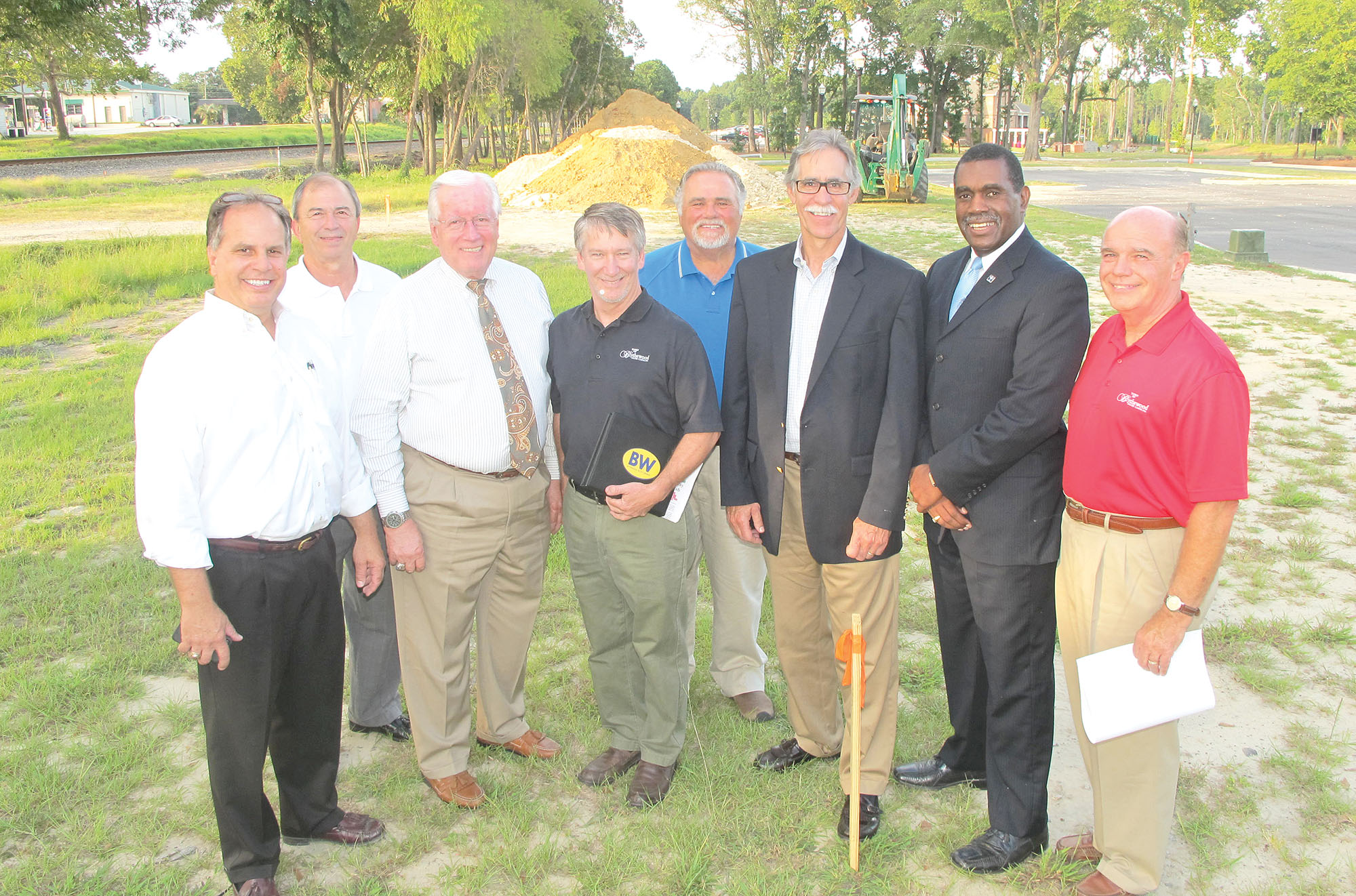
    Standing at the corner stake where the Doko Restaurant will soon be built are Town Councilman Paul Moscati; Ed Parler, the Town’s economic development consultant; Town Councilmen Ed Garrison and Roger Hovis; Mayor J. Michael Ross; Jonathan Bazinet, owner of Sam Kendall’s restaurant in Camden; State Sen. Joe McEachern, president of the Blythewood Facilities Corporation and Town Administrator John Perry.
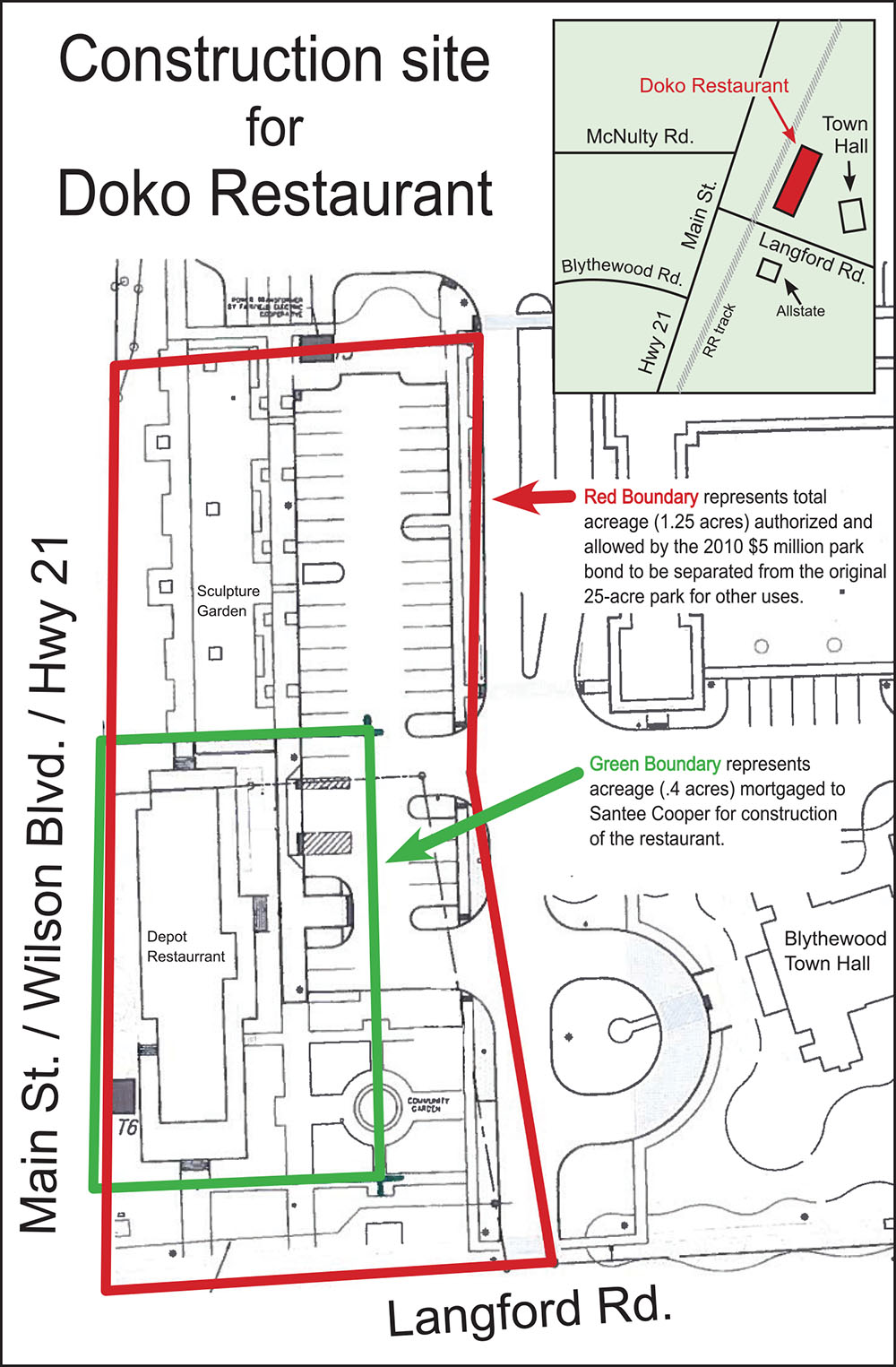
    The original park bond allowed for up to 5 percent of the park property to be separated out for other uses. The red line indicates a spatial area of 1.25 acres that the Town separated by ordinance from the original park property. The green line indicates the .4 acres that have been mortgaged by the Town for the construction of a restaurant. The portion of the red-lined area remaining (after the green-lined portion was taken out for the restaurant) can be reconfigured and used in other areas of the park for business activity and economic development.

    BLYTHEWOOD – Town Council passed final reading last week on an ordinance that authorizes an installment purchase plan for a restaurant the Town government plans to build adjacent to the Town Hall on a quarter acre of land that has been separated (by ordinance) from the park property.

    Financing of the $1.4 million project will come from two primary sources — a $900,000, one-year, 2 percent interest loan from Santee Cooper and another $500,000 from Fairfield Electric Cooperative, one of Santee Cooper’s family of companies.

    The loans will be contracted between the utility companies and the Blythewood Facilities Corporation (BFC) whose five members, appointed by Town Administrator John Perry, include Columbia Mayor Steve Benjamin and State Sen. Joe McEachern, President of the BFC. The BFC will be responsible for managing payments for the construction of the restaurant facility, which will be leased out to restaurateur Jonathan Bezinet, owner of Sam Kendall’s restaurant in Camden. The Town will pay off the construction loans, through the BFC, with revenue derived from leasing out the restaurant and with an undetermined portion of the Town’s Hospitality and Accommodations Tax revenues.

    The BFC will issue Installment Purchase Revenue Bonds for the restaurant project under the terms of the loan agreement between the BFC and Santee Cooper. The BFC was established in 2010 to manage payments for the construction of the park from the original $5+ million park bonds. The Town is paying back that money to the BFC with 75 percent of the payments coming from the Town’s Hospitality and Accommodations Tax revenues and 25 percent from other sources, including the General Fund.

    The ordinance that was finalized last week specifies requirements for a security agreement in favor of Santee Cooper. The Town is required to pledge:

    –Revenues generated from leasing the restaurant;

    –A portion of the Town’s Hospitality and Accommodations Tax revenues;

    –A first priority mortgage on the property where the restaurant will be built; and

    –Other revenues available to the town

    In its application for the loans, the Town designated the entire park as a 24-acre business park – Doko Meadow Municipal Business Park. The Town said it will use the restaurant exclusively for economic development purposes.

    A press release from Santee Cooper said the restaurant would “serve as an incubator for 325 acres of commercial property surrounding the park, helping to draw new commercial industry and jobs to the area.”

    The restaurant facility is being constructed by Northlake Construction, Inc. and should be finished by the end of the year, according to Perry. Monroe was awarded the bid for the park construction, but Perry said Monroe sub-contracted the project to Northlake who specializes in restaurant construction.

  • Planning Commission, Town Begin Work on Comprehensive Plan

    BLYTHEWOOD – Last week, Wayne Schuler with the Midlands Council of Governments presented the Planning Commission with a review of representative data that will be used to update the Town’s Comprehensive Plan. That Plan sets land use policy and guidance for the Town Council for the purpose of establishing zoning. The data collected by Schuler is designed to help the Town plan for future needs and consists of such basic information as average personal income, home prices, employment, housing (types and prices), growth, commuter data, etc.

    “With this data the Town government can more accurately look at goals and priorities for the Town,” Town Planner Michael Criss explained.

    For instance, some of the data Schuler presented pointed to a lack of affordable housing in Blythewood. A contributing factor is that Blythewood’s average personal income is second only to Arcadia Lakes in a four county area. With a median family income of $109,423 and low (3 percent) unemployment rate, there has been little demand for affordable housing.

    Commissioner Ernestine Middleton asked Schuler if the Town should take into account affordable housing needed with any industry coming to the area such as the 500 jobs coming to Fairfield County.

    “If there are housing needs for people that are low income,” Middleton asked, “should we provide low income housing for them in our area?”

    While Schuler said affordable housing is one area that the government will have to look at in the future, he said the Town has taken some initial steps toward a partial solution by creating higher density zoning in the new Town Center District. Schuler said this type of zoning would lend itself to a greater variety of housing that could include apartments. He said this could address the Town’s deficiency in low income housing.

    According to Schuler’s data, Blythewood is clearly on the wealthy side, with almost half the homes in the town ranging in price from $300,000 to $500,000 and another quarter of them in the $200,000 to $300,000 range. Based on the 2010 census data, 25 percent of the single family housing units fell within the range for low income families in the town. But only 8 percent fell within the range of low income families in the Columbia Metro Statistical Area (MSA.)

    Schuler said the priority investment areas of the town are in the Town Center District and include the I-77/Blythewood Road exchange, Blythewood Town Hall and the northwest corner of Main Street and McNulty Avenue.

    But Schuler said the Town’s goals in its Comprehensive Plan remain unchanged. He pointed out that the complimentary policies from the Master Plan have been added to matching goals to link the Master Plan with the Comprehensive Plan. He said to implement these goals the Town must pay close attention to its revenue stream.

    The Comprehensive Plan, Schuler explained, presents the broad picture for future planning. The Town’s Master Plan, he said, focuses on specifics — such as specific projects on specific parcels, where buildings are placed and how they should look, etc.

    “Now, in 2013,” Criss told The Voice, “we’re going to start fusing these two plans together, cross referencing between the two.”

    The state requires that if a government adopts planning and zoning, it must also adopt a Comprehensive Plan that is reviewed and updated every five years by the Town’s Planning Commission. Blythewood’s Town government last updated its Plan in 2008 and made significant tweaks to the Plan with the adoption of its Master Plan for the Town in 2010.

  • Seven File for November Council Elections

    Bryan Franklin
    Ed Garrison

    Paul Moscati
    Bob Massa
    Ernestine Middleton
    Tom Utroska

    BLYTHEWOOD – Seven residents have filed as candidates for three seats on Town Council as of noon on Friday, the deadline for filling according to Town Clerk Martha Weaver. Last to file was Bob Massa of Oakhurst subdivision, who is seeking a four-year term and Ernestine Middleton who lives in the Lake Stevens area and filed to run for a two-year term.

    Others filing for four-year terms are Tom Utroska of Cobblestone Park, Bryan Franklin of Ashley Oaks and incumbents Ed Garrison and Paul Moscati, both of Lake Ashley. Bob Mangone of Cobblestone filed for a two-year term. All candidates must be residents within the Town of Blythewood.

    Franklin has served as Mayor Pro Tempore in Whitakers, N.C. and currently serves as an Army Reserve Lt. Colonel in the Third US Army at Shaw Air Force Base in Sumter.

    Garrison, a realtor and developer is seeking a third term. He previously served on the Town’s Planning Commission.

    Mangone is a member of the Town’s Architectural Review Board and is Chairman of the Town’s Athletic Fields Committee. He is a retired sales manager of Pfizer Pharmaceuticals.

    Massa has served as Chairman of the Planning Commission and is currently a member of the Town’s Board of Zoning Appeals. He is a Certified Public Accountant and is employed as the Director of Finance for another municipality.

    Middleton is a member of the Planning Commission and was formerly employed for two years as vice president of administration of the Arkansas State Lottery before moving back to Blythewood two years ago.

    Moscati, a project manager for a construction firm, has largely overseen the construction of the town park. He is seeking a third term.

    Utroska has served as Chairman of the Planning Commission and is retired.

    The non-partisan election is for Tuesday, Nov. 5.

  • Town OK’s Water Taps for Blythewood Development

    WINNSBORO – Town Council approved eight new water taps Tuesday night for a residential development in Blythewood. The taps will go to a development currently known as Holly Bluffs, off Blythewood and Muller roads just over the Richland County line, and must be paid for in advance, Council said, to the tune of $1,350 each.

    Council also voted to change the billing information for Holly Bluffs to reflect the development’s new owner, S.C. Pillon Homes, Inc. John Fantry, special counsel to the Town of Winnsboro, said S.C. Pillon Homes is seeking approval from the Town of Blythewood for design changes to the development to increase the number of lots from the original 54 to include the eight additional lots. The sale of the development from Holly Bluffs to S.C. Pillon Homes has not yet closed, Fantry added. Winnsboro Mayor Roger Gaddy said the taps would provide an average of 450 gallons per day for each household.

    On other water-related fronts, Gaddy said no date has yet been set for the next meeting of the steering committee for the proposed Fairfield regional water authority, a matter Council discussed during Tuesday night’s executive session. If the process for forming the authority doesn’t move forward soon, Gaddy indicated it might be time to pull the plug.

    “The different members are being canvased to get some of their ideas of what kind of governing structure they’d like to have, plus the indication of their desire to see the project move forward,” Gaddy said. “If we don’t have clear evidence that people are on board and dedicated to it, we’re not going to try to pound a square peg in a round hole. We’ll table it until we have some further interest, if we can’t get enough support from all the members.”

    Gaddy has said in previous meetings, including the most recent intergovernmental meeting earlier this summer, that failure to form the water authority would mean the costs for maintaining and expanding the Winnsboro system would be passed along to distributors who purchase their water from the Town.

    Council approved an additional $12,650.65 Tuesday night to cover just such system upgrades. The request came from Jesse Douglas, Director of the Town’s Gas, Water and Sewer Department, and covers a portion of the Town’s transition from Chlorine to Chloramine to treat potable water. The Town had originally budgeted $22,000 to purchase equipment at the water plant necessary to monitor the chemicals involved in water treatment, as well as equipment to be used in field testing water. The cost of that equipment has gone up, Douglas said, to $34,650. 65.

    Town Manager Don Wood said that brings the Town’s investment in the Chloramine transition to approximately $200,000.

    In other business, Council approved a request from Carl McIntosh for a one-time cleaning of the cemetery located at the end of Cemetery Street in Winnsboro. Wood was unclear on what it will cost the Town to mow and clear the lot, but said it would only involve the cost of hourly labor and should take no more than a few hours to complete.

    Council also held first reading on an ordinance to revise the Town’s zoning code to include farmers markets under C-1 and C-2 of the Town’s existing zoning districts. Second reading and a public hearing on the ordinance will be held at Council’s next meeting, Sept. 17.

  • Industrial Buffer Could Shrink

    BLYTHEWOOD – Town Planner Michael Criss suggested to the Planning Commission on Tuesday evening a number of changes to the Town’s Landscape & Tree Preservation ordinance. While most of Criss’s suggestions were for technical clarifications or modifications to help the ordinance comply with the new Town Center District, others were more substantive, such as reducing the buffer between the Light Industrial Research Park (LIRP) zoning district and Rural or Residential zoning districts from 200 feet to perhaps as little as 20 feet, which is the buffer requirement between most of the Town’s Industrial and Commercial districts.

    As it is written, the ordinance governing buffer space between an LIRP zoning district and Rural and Residential zoning districts also calls for the first 20 feet from the residential zoning district line to be densely planted with evergreens, which will reach a height of not less than 20 feet at maturity to create an opaque screen. The current planting requirement for the remaining 180 feet consist of intermittent plantings of deciduous and evergreen trees, which would reach a height of no less than 40 feet at maturity. Town Administrator John Perry nodded, agreeing that he thought these current buffering requirements on LIRP zoned districts were excessive and called on the Planning Commissioners to consider reducing them.

    These buffer requirements were established several years ago as a result of neighborhoods in the town objecting to an LIRP district being zoned in proximity to their homes. In 2003, the Ballow Administration had established LIRP zoning on almost 900 acres adjacent to Ashley Oaks. As a result of input from homeowners in the Ashley Oaks neighborhood and others in the town, the next administration under Mayor Pete Amoth changed the zoning of the 900 acres from LIRP to D-1 (Development.)

    Perry told the Commissioners that, currently, the only property zoned LIRP is the Google property on Highway 21 near the intersection of Rimer Pond Road. However, Perry recently presented information for consideration by the Commission regarding the possibility of rezoning the 900 acres formerly zoned LIRP to a zoning designation that would accommodate Advanced Manufacturing, which consist primarily of high tech manufacturing.

    The next Planning Commission meeting is scheduled for Oct. 7.

  • Council Moves Meeting to Magnet School; No Discussion on LOST

    FAIRFIELD – County Council announced this week that they will hold their regularly scheduled Sept. 9 meeting at the Fairfield Magnet School, 1647 Highway 321 Bypass N., at 6 p.m. According to the agenda, released Sept. 6, Sen. Creighton Coleman (D-17) will give a 30-minute presentation on a solid waste flow control bill pending in the Senate, and interim County Administrator Milton Pope will update Council on the proposed purchase of 1 acre of land off Road 99 in Blair to serve as a mini park.

    There is no discussion slated for the Local Options Sales Tax (LOST) funds.

    Council has consistently struggled in recent months to accommodate overflowing crowds during their meetings, with Council chambers and an adjacent anteroom both packed to capacity. While a motion to move all of Council’s meetings to a larger venue on a three-month trial basis was defeated at their Aug. 26 meeting, Council did approve relocating meetings on an as-needed basis. Council also voted Aug. 26 to hold their review of the LOST funds at a larger venue.

  • Three More File for Council Races

    BLYTHEWOOD – Three more residents have filed to run for three open seats on the Town Council. Tom Utroska of Cobblestone Park has filed for one of the four-year seats and Bob Mangone, also of Cobblestone Park, has filed for the two-year term vacated in June by Jeff Branham. Another resident from Cobblestone Park has also filed but his application was not completed at press time, according to Town Clerk Martha Weaver. She said she could not release the name until the application was completed.

    Three other candidates had already filed: current Councilmen Paul Moscati and Ed Garrison, both of Lake Ashley, and Bryan Franklin of Ashley Oaks. The last day to file is Friday, Sept. 6 at noon. Candidates must file at the Town Hall, 171 Langford Road in downtown Blythewood. The Town’s general election will be held Tuesday, Nov. 5.

    Citizens who want to run for one of the vacant Council seats must be registered voters within the town limits of Blythewood. The filing fee is $5. For filing information, contact Weaver at 754-0501.

    Anyone wishing to vote in the election must be a registered voter in the Town by Oct. 5.

  • Council Nixes Move to Larger Venue

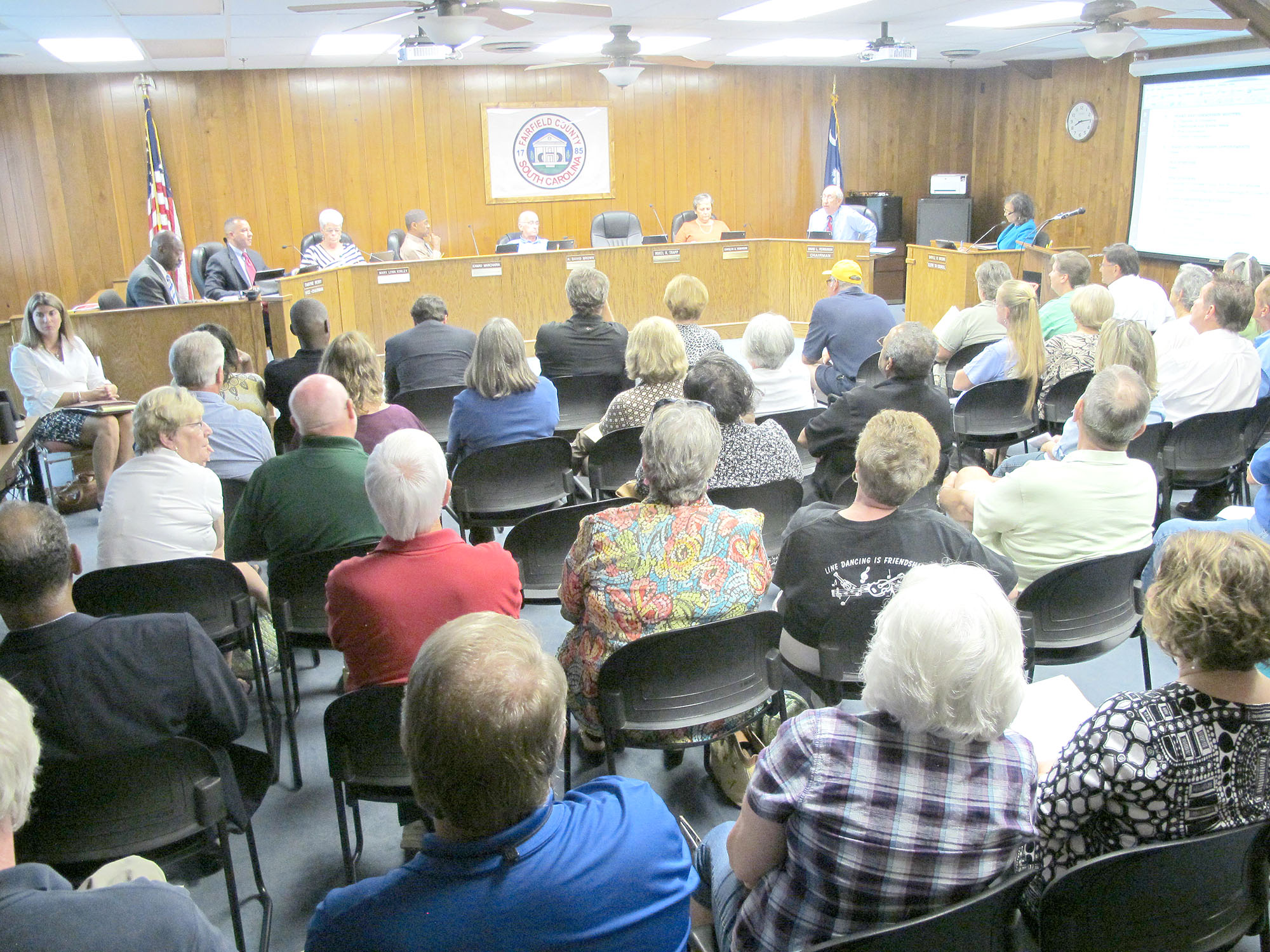
    County Council faced another full house Monday night.

    FAIRFIELD – Although County Council easily voted Monday night to move an upcoming special meeting on the Local Option Sales Tax (LOST) funds to Fairfield Central High School, two motions to relocate regular meetings to a larger venue touched off a rigorous debate, eliciting unhappy grumbles from the overflow audience before being swept away in defeat.

    Councilman David Brown (District 7), who placed the first motion on the floor to move Council’s regular meetings to a larger venue for a three-month period, said he has been hearing from voters in his district who want better access to County business.

    “We’ve got a group here that’s going to follow us wherever we go,” Brown said, indicating the capacity crowd. “I think the best thing to do is to put us in a large enough venue where everybody can have a seat. We’ve got people in the other room down there (a conference room down the hall, which was also filled). We’ve got people standing in the hall. It’s a fire hazard. If we can go to one of the schools where there’s more room, more air space, actually the Council and the people in the audience shouldn’t feel quite as heated.”

    While Councilman Kamau Marcharia (District 4) said he had also heard from voters in his district on the matter, he had bad memories of previous efforts by Council to bring the meetings to the public.

    “One of the members in my district did write me and ask me to vote yes for moving (the meetings), but that member also told me I needed to resign, so if we move the meetings I don’t know what we’d be talking about,” Marcharia said. “Eight or nine years ago we used to move Council around to fire stations and to McCrorey-Liston school and other places, and we had to call the police. We went to those meetings and folks would come there totally out of control. We had to call that off. Unless you want to wear a football helmet, I am leery about moving.”

    Councilwoman Mary Lynn Kinley (District 6) said she was opposed to the idea, although her reasoning drew grumbles from the onlookers in attendance Monday night.

    “This is our headquarters,” Kinley said. “The Town Hall is where the Town of Winnsboro meets. The School Board meets where they meet. The Senate meets where they meet. They don’t change the venue at the Senate just to accommodate the public when they want to come. It’s first come, first served. But the main reason is Miss Brown (Shryll Brown, Clerk to Council) has records in her office that we depend on greatly for things to be voted on and have correct information.”

    Chairman David Ferguson (District 5) said moving a meeting as highly anticipated as the upcoming LOST update was one thing, but to move meetings permanently was another.

    “To take Council away from chambers for three months, that’s a long time,” Ferguson said. “This is the County seat for meetings. That’s publicly known. Do we need to try one or two and see how that plays out? That might not be a bad idea. But I don’t think we need to spend a quarter of the year someplace else. I don’t think that’s feasible.”

    The motion failed, 4-2, with Brown and Councilwoman Carolyn Robinson (District 2) its only supporters.

    Brown then followed with a second motion, to move meetings on a trial basis for no longer than three months.

    “We can do it one month, if it doesn’t work, or we can give it two months or three months, but let’s give it a try,” Brown said. “If the larger venue is too large, or if this Council starts doing a great job and we lose about half these people out here, we can come back here.”

    That motion, too, failed to garner enough support to carry, dying in a 3-3 deadlock. Brown, Robinson and Marcharia voted in favor, with Ferguson, Perry and Kinley voting against. Perry then put forward the motion to move meetings, as needed, to a larger venue, causing some in the audience to cry out that it was needed now. That motion carried, 3-2, with Brown and Robinson voting against.

    “I hate to disenfranchise any constituent from any of the meetings we have,” Brown said.

  • Good News for Winnsboro Landmark

    WINNSBORO – Town Council got some encouraging news Tuesday night regarding the fate and future of a beloved Winnsboro landmark.

    Winnsboro attorney Mike Kelly gave Council an update on the renovation of Thespian Hall, former home of The News and Herald Tavern that was destroyed by fire nearly three years ago. Kelly, who now owns the building at 114 E. Washington St., said that he had taken on the purchase and renovation of the Hall with his heart, not his head.

    “I love Winnsboro,” Kelly said, “and I want to try to give back to the community by renovating the Hall.”

    Kelly said that in the last three years he’s spent more than $65,000 on cleanup and repairs and is close to being awarded a Certificate of Occupancy for the Tavern. He said his next step is to renovate the apartment to bring in some revenue. He is also looking into grants through the recently passed Abandoned Buildings Revitalization Act so that he will be able to receive a tax credit for restoring the property.

    Kelly said restoration of the Tavern to its previous elegance should be completed this year. He said as part of the renovation, he would like to turn the Charleston Room into a meeting place for the residents of the community.

    “Other than the clock,” Kelly said, “the Tavern is about the most treasured property in the town.”

    Farmer’s Market

    The Fairfield County Farmer’s Market got a double boost at Tuesday’s Council meeting. First, Council passed final reading on an ordinance to reduce the cost of the annual business license for the market’s vendors from $50 to $15. Second, Mike Mills, representing the Fairfield County Farm Bureau, offered to pay that annual business license fee for up to 35 vendors. Mills said that if the number of vendors increases to more than 35, the Bureau would cover their costs as well. In addition, Mills asked that the Council allow the Bureau:

    • to post a sign at the Market advertising the Bureau a sponsor;

    • place a notice in the newspaper that would advertise the Bureau as a Market sponsor and let potential vendors know the Bureau would pay for their vendor permits; and

    • allow the Bureau to provide informational literature about the Bureau to be given to vendors when they obtain their vendor permits.

    Mills explained that the Farm Bureau’s interest in supporting the market is to serve the agricultural community, both the farmers who sell the produce and those who purchase it. He said the Bureau represents all South Carolina farmers and farm land owners and that the Bureau’s mission is to promote agricultural interests in South Carolina. At the end of the meeting, Council voted to accept the Bureau’s offer.

    Council proposes to amend zoning

    Council also voted to go forward with a zoning amendment that would provide for zoning for the Farmer’s Market within the Town. There is currently no zoning designation for a farmers’ market in the Town limits. The market currently operates on a vacant lot next to the NAPA store, which is not zoned for market use. Town Manager Don Wood explained that the current location is temporary until zoning can be designated for a permanent location for the market.