Category: Government

  • Former County Offices to Anchor Farmers Market

    WINNSBORO – County Council Monday night took the first steps toward putting the fate of their former Voter Registration building into someone else’s hands, but the building at 117 E. Washington St. will not go to Christ Central Ministries, as initially suggested when the structure faced the prospects of the wrecking ball last April. Instead, Council passed first reading Monday night on an ordinance to sell the building to the Fairfield Community Development Corporation (FCDC), a local 501(c)3 dedicated to revitalizing the community.

    Terry Vickers, President of the Fairfield Chamber of Commerce, presented a proposal to Council on behalf of the FCDC during Council’s Sept. 18 work session. Vickers said the FCDC would purchase the building for $100 “and considerations,” during the work session, and the building would be remodeled to serve as the cornerstone of the next phase of the Winnsboro Farmers Market. Christ Central pulled their proposal before it ever came to full Council, Chairman David Ferguson (District 5) said Sept. 18, once they learned the FCDC was interested in the property.

    The 6,200-square-foot building, Vickers said, would be known as the Fairfield County Farmers Market Artisan Center Community Kitchen, and would be divided into three spaces:

    • 3,000-square-feet – Open area to house the farmers market and an artisans market, on a weekly basis. Fairfield County Arts Council would hold workshops here and students from the Blair College of Art would use the space to develop student-driven classes for adults and children, assisting local residents in developing personal growth and marketable skills;

    • 1,500-square-feet – Class space for 12-week courses by Farmers Entrepreneurial University, focusing on nutrition, labeling, expanded marketing for new markets and creation of demand for new jobs; and

    • 1,700 square-feet – Shared use community/commercial DHEC licensed kitchen facility, for local farmers to produce food products for market place. This space will serve as an incubator for food entrepreneurs by providing business support, and will serve the community by providing training on proper food preparation, including cooking and canning and other food related classes to increase sale and consumption of locally grown food.

    Vickers said the FCDC has received a pledge of $125,000 from three donors wishing to remain anonymous to begin refurbishing the building. The FCDC will also write a Rural Business Enterprise Grant proposal for an additional $200,000, she said. In early 2014, she said, a third phase grant through Eat Smart Move More South Carolina will be written for equipment, technical assistance, professional services, start-up operating costs and working capital. Vickers said the FCDC will insure the building at the time of purchase from the County and will have the facility fully operational by the fall of 2014.

    The farmers market is designed to be a year-round market, Vickers said, and the addition of the old Voter Registration building is key to making that happen. So is the ability of merchants in the market to accept SNAP, WIC and Senior Vouchers for the purchase of fresh foods. As of last March, Vickers said, $862,000 went to those food voucher programs in Fairfield County, and none of that money was able to be spent in the farmers market. Vickers said this week that the Winnsboro market has applied with the federal government to be eligible to accept SNAP, WIC and Senior Vouchers, and she said she expects that application to be approved within the next few weeks.

  • Board Paves the Way for Bank

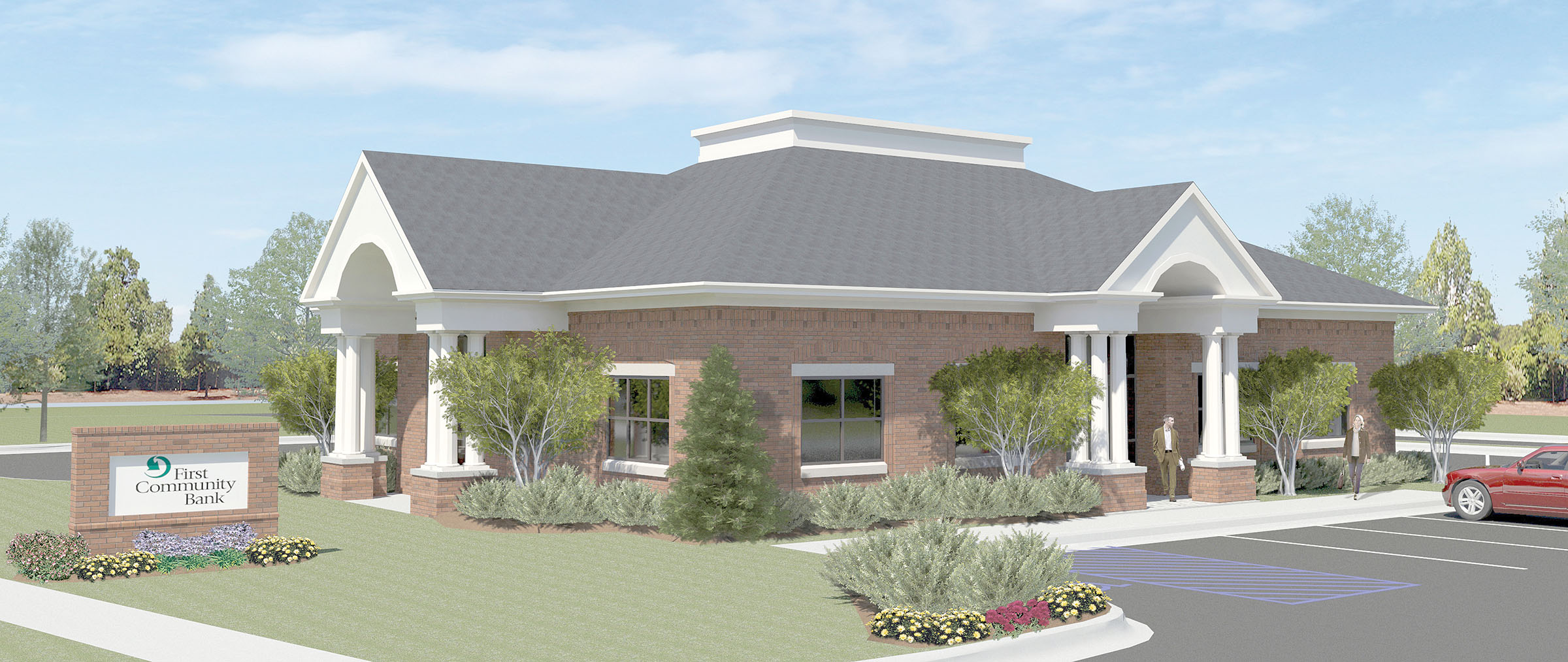
    A rendering of the First Community Bank building that is proposed for construction in downtown Blythewood.

    BLYTHEWOOD – The Town’s Architectural Review Board voted on Monday evening for conditional approval for a Certificate of Appropriateness (COA) for a building the First Community Bank plans to construct at the corner of Blythewood Road and Main Street (Highway 21) in downtown Blythewood. B & D Auto Sales currently operates on the property. The final COA is subject to approval of a landscape plan by the Town’s landscape consultant, Rick McMackin.

    Michael Crapps, President and CEO of the bank said construction on the bank should begin in about a year and should be completed around the first of 2015. Crapps told members of the BAR that Community Bank started in 1995 with two offices in Lexington and Forest Acres and is the largest community bank in the Midlands. Community Bank currently has 11 branches in a four-county area.

    “We expand into the type of communities that value local businesses and that value input and participation by citizens,” Crapps told the Board. “Our goal is to enhance the prosperity of the communities that we’re involved in. We look forward to serving the businesses and individuals in Blythewood.”

    The Board members had only positive comments to make regarding the architecture of the building as presented by Architect Cling Burdette representing Jenkins, Hancock and Sides Architects who designed the building.

    The 3,000-square-foot building will sit close to the street with parking in the rear and side according to requirements of the Town’s Master Plan. However, the building will not have to meet the height requirements of a recently passed ordinance that would require all new buildings on specific corner lots in the Town to include a simulated second story. Perry said the bank building would be 3-feet short of that requirement.

    Perry explained the exception as an improvement but not the quantum leap forward that the Town’s ordinance called for. While he stood by the Town’s aggressive plan for new construction in certain areas of the downtown, Perry blamed the economy, saying it made this a difficult time to move forward with the plan.

    “It’s better to take a half step forward and achieve an acceptable compromise,” Perry said. It [the requirement] might not be worth it for the development not to happen at all.”

  • Town Vows to Reign in ‘Renegade’ Signs

    BLYTHEWOOD – During the discussion segment of Monday night’s Architectural Review Board meeting, Town Administrator John Perry told members that he would soon suggest changes to the Town’s sign ordinance to strengthen it against what he called ‘renegade’ temporary signs.

    Perry said a couple of temporary signs had popped up at businesses in the downtown area recently that he was not proud of and that had slipped through the cracks of the Town’s sign ordinance.

    “There were no grounds [in the Code] not to approve them,” Perry told the Board, referring to two temporary black metal signs with large pink, yellow and red fluorescent letters that recently appeared on McNulty Road and Blythewood Road. Perry said the problem is that when one or two of these pop up, then others will follow.

    Town Planning Consultant Michael Criss told The Voice that the Town’s sign ordinance does not spell out the restrictions very well on temporary signs.

    “Many jurisdictions prohibit that style of a temporary sign, specifically, defining its portability with wheels and metal legs,” Criss said. “Our ordinance does not have that at this time. I think we need to look at temporary signs comprehensively because there are so many types.”

    Criss said Perry has the authority to address location, duration and to some extent the appearance of a temporary sign, “But the current Code doesn’t give him much guidance in making decisions on appearance,” Criss said. “In regard to temporary signs, Council may want to provide the Administrator with more guidance for approving these signs, and it may want to strengthen the Code itself.”

    For changes to be made to the Code, Criss explained, Council would have to ask the Planning Commission to look into the suggested Code changes. Some of those changes would also be looked at by the ARB, then the Commission would need to make a recommendation to Council which would have to give two readings to the amended Ordinance.

    “That’s going to take a little time,” Chris said. “It might be the end of the year before we could actually affect those changes.”

  • Council Defers Rent Payments on Restaurant

    RIDGEWAY – After a marathon executive session, Town Council capped off a 3-hour meeting on Sept. 12 by voting 3-1 to defer the first rent payments from Vesha Sanders, owner of the new Town Hall Restaurant, until Nov. 1. Councilman Russ Brown cast the lone dissenting vote.

    “I just think that’s a long time,” Brown said.

    Sanders opened the restaurant last week.

    Prior to executive session, Council passed first reading on three updated ordinances. An ordinance banning stock and cattle from roaming at large in the town limits was updated to include a prohibition against the ownership of goats and horses within town limits and increases the fine to a $100 minimum, a $500 maximum or 10-30 days in jail.

    An ordinance prohibiting prostitution was updated on first reading to increase fines to a maximum of $500 or not more than 30 days in jail. Fines for disorderly conduct were also increased to $500 maximum or not more than 30 days in jail.

    As Council continues to revise the Town’s ordinances, Mayor Charlene Herring said she had researched state law regarding the operation of golf carts and has found that drivers of such vehicles must be at least 16 years old, possess a driver’s license and have insurance. That information has been passed along to the Town’s Police Department, Herring said. Last month, Herring suggested Council consider enacting an ordinance governing the operation of golf carts within the town limits, but the idea was tabled until it could be determined what superseding laws might already be in place.

  • Grievances, Strategies Come Out at Meeting

    WINNSBORO – Approximately 86 people gathered in the Fairfield Central High School auditorium Monday night for a town hall meeting, hosted by State Sen. Creighton Coleman (D-17) and State Rep. MaryGail Douglas (D-41). The meeting served as a forum for residents who have been taking their concerns to Fairfield County Council in recent months and covered the hot-button issues of Local Option Sales Tax (LOST) funds, recreation funding, monthly allowances for County Council members and a push for reimbursement of payments made to Council members in lieu of supplemental health insurance. The meeting also touched briefly on efforts to open details of County spending practices to the public via a page on the County’s Web site.

    LOST

    Updating the group on where the County stood on accounting for seven years’ of LOST funds, Douglas said Winnsboro attorney Jonathan Goode and Fairfield County resident Maggie Holmes – who began questioning the County’s handling of the funds last March – told her they were expecting to have detailed information from the County next week.

    “Pending the correspondence they get back, they are positioning themselves for further legal action,” Douglas said.

    Milton Pope, the County’s interim Administrator, was in attendance Monday night and said Council has scheduled a meeting on the LOST funds for Sept. 30 at 6:30 p.m. The meeting is tentatively slated to be held in the high school auditorium. The meeting will include a dialogue, Pope said, between Council and the public.

    Questions raised by Goode and Holmes over the LOST funds triggered a massive internal examination over whether or not appropriate credit has been applied to property tax bills since 2007. A local citizens action group, Saving Fairfield, has since hired The Hobbs Group, a Columbia CPA firm, to conduct their own investigation. Evidence has mounted indicating a mishandling of those funds, and Monday night some in the audience questioned why none of the County’s internal financial mechanisms caught the error. Douglas placed the blame squarely on former County Administrator Phil Hinely.

    “Mr. Hinely’s comments to folks whenever they questioned anything was ‘You’re either on the team or you aren’t’,” Douglas said. “So jobs were on the line. That was said to me more than one time. That’s why we are where we are.”

    Douglas added that Council should also be held responsible for how the LOST money was handled.

    “We do not need to let our Council members go without some of the blame,” she said. “They are the stewards of our money, ultimately.”

    “We all know what happened,” Coleman agreed. “There were a certain three or four of them that were controlling everything and the other ones didn’t know exactly what was going on.”

    Recreation

    Earlier this year, County Council passed a $24 million bond issue, with $3.5 million of that money devoted to recreation. From nearly the moment the bond issue passed, Council has been mired in gridlock over how to spend those recreation funds, which Council divvied up into $500,000 allotments for each of the seven districts.

    “I just have a lot of heartburn over that $3.5 million, and I don’t mind standing up here and telling you that I can just envision all kinds of things, if we’re going to spend recreation money in this county, how it could best be used,” Douglas said. “I cannot believe that we’re going to sit by and for $3.5 million watch mini-parks go up, mini-parks that have no lasting value, that sit idle oftentimes.”

    Douglas has previously suggested the County reach out to the YMCA for a facility, but has gotten no positive feedback from County Council. Coleman, meanwhile, pointed out that Council has not even adopted a recreation plan, nor has there been any coordination between Council members to determine how to best serve the most people.

    “To me, that’s just preposterous,” Coleman said.

    One suggestion to come from the public Monday night was that, while the bond money that has been earmarked for recreation must be spent on recreation, how it is to be spent — $500,000 per district – might be able to be revised by a vote of Council.

    Reimbursement

    Douglas said the County has until Sept. 25 to answer a letter sent by Coleman requesting that Council members David Ferguson (District 5), Mary Lynn Kinley (District 6) and Mikel Trapp (District 3) repay the approximately $22,800 each they had received since 2009 in lieu of supplemental health insurance. Last week, both Trapp and Kinley said discussions were under way with attorneys on whether or not those funds would be repaid. Ferguson denied any such discussions. Trapp also received an additional $26,806 for tuition assistance. While he said last week that he has begun paying that money back, his reimbursement rate of $100 a month drew some harsh comments at Monday’s meeting.

    “If my math is right, it will take him 27 years to pay that money back,” Clyde Wade said. “A hundred dollars a month is a slap in the face to the taxpayers of this county.”

    Transparency

    Betty Scott Frazier asked Council at their Sept. 9 meeting if they would consider posting their expenditures to the County Web site. Monday night, Frazier said the postings would be not only on the County’s site, but on the State Comptroller’s Web site as well. Frazier said she had received a positive response from Deputy County Administrator Davis Anderson, and plans are to have the information posted within the next 30 to 60 days.

    Monthly Allowances

    In addition to their base salary of $15,000 a year (plus an additional $4,800 a year for the Chairmanship and $3,000 a year for the Vice Chairmanship), County Council members receive $795 a month for mileage, office supplies and Blackberry expenses, without turning in receipts. Douglas said Monday night she hoped Council would do away with that practice. Douglas also questioned if Council members had paid taxes on those allowances. Coleman said the accountant with the Hobbs Group was checking with the Department of Revenue to see if taxes had been paid on that income.

    Now What?

    Several members of the public Monday night took a reflective view of the group in attendance, noting that the audience represented only a small percentage of Fairfield County voters. How to energize and educate the remaining 98 percent, and how to truly effect change in Fairfield County, was a lingering question.

    Tell eight people, Douglas said, and make sure they tell eight more. And Coleman encouraged the group to remain active.

    “Exactly what County Council wants to happen is that the taxpayers peter out and not continue to stay on them,” Coleman said. “They’re waiting on that. If that happens, you only have one person to blame. You can look in the mirror and that’s who’s to blame. Me included. I think it’s absolutely incumbent that we all stay involved, go to these meetings and make our positions known. This is our one chance, our chance to do something about it, and that’s going to be at the ballot box next November.”

  • Final Park Budget Revealed

    BLYTHEWOOD – After numerous delays over the past year, Town Councilman Paul Moscati delivered to the Town Park Committee on Tuesday evening the long-awaited final accounting of how the Town’s $5.5 million park bond has been spent on Doko Meadows. The various park projects, costs and credits were projected on a screen for the committee to follow, but no copies of the presentation were available for the committee or the press. Moscati said he would email those to the committee at a later time.

    Before the meeting began, Tom Utroska resigned his position as Chairman of the Park Committee until after the November Town election citing his candidacy for a Town Council seat. Utroska nominated committee member Jim McLean for Chairman, and he was elected unanimously. Four of the six board members are candidates for Council.

    In Phase I of the park expenditures, Moscati reviewed both Condor Construction Co.’s and Monroe Construction Co.’s change orders, contract status and an overall budget recap.

    Moscati said the largest cost override of between $300,000 and $400,000 came from bad soil and sludge that had to be dug out and replaced with good soil. He said that was balanced with a number of credits for replacing some costly construction items with less costly ones and the addition of the proceeds from the sale of the Community Center.

    Some work still needs to be completed under the original contracts, such as mulching, additional landscaping, installation of fencing and completion of the punch list. That work, which Moscati said should be finished by the end of the year, is included in the cost of the original contracts.

    Moscati said that, going forward, there is also a wish list for the park that is not funded. A Park Endowment Foundation has been appointed to help raise money for those additional projects to complete the park. Committee members include: Buddy Price, Ken Baldwin, David Thames, Beverly Frost and Neal McLean.

    Overall Budget Recap

    Original Bond Revenue $5,500,000

    Proceeds from sale of Community Center   +1,500,000

    Condor final contract amount for horizontal work (grading, curbing, pond, underground infrastructure, etc.) -2,941,514.04

    Monroe final contract amount for vertical work (the Manor) -2,270,231

    Professional Fees -525,000

    Bond Service Fees -500,000

    Wetlands mitigation costs for walking trail -375,000

    Remaining Funds Available $388,254.96

    Option A for the remaining funds available (estimates)

    Restrooms (priority) $-240,000

    Clock Tower Base (priority) -40,000

    Sod Athletic Fields -28,117

    Irrigation revisions to Athletic Field -2,550

    2 Dumpster Enclosures  -26,250

    3 Driveway Gates w/Columns  -48,000

    Remaining Funds Available   $3,337.96

     (Moscati said he will provide Option B at a later date)

    The Wish List

    Playground Equipment:     CIP Project

    Grass Amphitheater $19,732

    Open-Air Pavilion      810,000

    Amphitheater 1,500,000

    Adventure Lodge 1,107,000

    Skate Park 702,000

    Total Funds Needed for Wish List: $4,138,732

  • Franklin Quits Race

    Bryan Franklin

    BLYTHEWOOD – Ten days after filing to run for a seat on Blythewood Town Council, Ashley Oaks resident Bryan Franklin has withdrawn from the race. Franklin, who is an Army Reserve Officer, sent an email to Town Clerk Martha Weaver last Thursday announcing that he was withdrawing because of his active duty military status.

    “After reviewing the Department of Defense Directive [1344.1 Uniformed Personnel and Holding Civil Office] provided to me, it appears it would be better for me to withdraw as a candidate for Blythewood Town Council this election cycle,” Franklin wrote. “I am an Army Reserve Officer, but I am serving in an active status for more than 270 days.” Franklin said that while he will retire on the last day of his order which is Sept. 30, 2014, he is in an ‘active status’ as defined in the Directive, and, in order to run for elective office, would require a waiver issued by the Secretary of the Army.

    In an interview with The Voice, Franklin said that even if he were granted a waiver, the Directive prohibited him from participating in his own campaign in any way.

    “So why would I run if I couldn’t campaign and get my message out? That wouldn’t be beneficial.” Franklin said. In his email to Weaver, Franklin wrote, “It is clear that the Defense Department is trying to separate the branches of government completely, including for the local, nonpartisan civil offices.” Franklin said he would comply with and support the Directive fully while still in uniform.

    In an email back to Franklin, Weaver explained that ‘active duty does not deem you ineligible as far as the Town of Blythewood or the Richland County Election Commission are concerned. Eligibility requires that you are a citizen within the town limits of Blythewood and a registered voter in the Town of Blythewood.”

    Because Franklin’s candidacy had already been submitted by the Town to the Richland County Election Commission and the SC Ethics Commission, Weaver said he would be required to supply the Town with a signed letter officially withdrawing his candidacy.

  • Candidates to Square Off at Debate

    BLYTHEWOOD – The Blythewood Chamber of Commerce has announced on its Web site that it will host a debate for the candidates for Town Council in the upcoming Nov. 5 election. In an email dated Sept. 16 and addressed to the six candidates, The Country Chronicle and two teachers from Blythewood and Westwood high schools, Chamber Chairman Mike Switzer said the debate will be held at the Manor in the town park on Oct. 19, at 6 p.m. and will be co-hosted by Blythewood and Westwood high schools. Switzer said two Blythewood high school government/civics students will moderate the debate. The Chamber Web site said the candidates — Bob Massa, Bob Mangone, Tom Utroska, Ernestine Middleton, Paul Moscati and Ed Garrison – will answer questions selected by the Chamber Board from among those submitted by the public at the Chamber’s online Blythewood Debate Question Form at blythewoodchamber.com.

    Switzer asked in his email that the candidates “‘reply to all’ so that the Country Chronicle and the teachers will also know your responses.” Switzer did not send any notification concerning the debate to The Voice.

  • Ministry May Save Former County Offices

    WINNSBORO – An historic Fairfield County building, the former headquarters for the County’s Voter Registration, Coroner and Fire Marshal’s offices, may be saved from the wrecking ball. County Council announced during their regular meeting Monday night at the Fairfield Magnet School that they will hold a work session in Council chambers on Sept. 18 at 6 p.m. to discuss a proposal from Christ Central Ministries to take ownership of the empty building, located at 117 E. Washington St. in Winnsboro.

    Under the proposal, “The County would give Christ Central the building outright,” Council Chairman David Ferguson (District 5) said, “the only stipulations being that the County doesn’t have to invest anything in it and Christ Central provides a suitable policy outlining the number of years it will take for them to build it out like they want it and if they have problems and can’t do so, to tear it down like we were going to do.”

    Ferguson said Councilman David Brown (District 7), who sits on the Christ Central Ministries Board of Directors, brought the proposal to Council for their consideration.

    Last April, Council was a vote away from demolishing the structure, per the recommendation of then County Administrator Phil Hinely. County moved its offices out of the building in July of 2011, relocating to a remodeled facility at 315 S. Congress St.

    “Several years ago, we abandoned the Voter Registration building. It had fire code violations, electrical code violations, public code violations. It had about every kind of code violation you could think of,” Hinely said during Council’s April 22 meeting. “It’s a safety hazard, it’s a fire hazard. I’m really kind of surprised it made it through the winter. We didn’t have any snow, but a heavy snow could have crashed that roof down.”

    But Terry Vickers, President of the Fairfield County Chamber of Commerce, pleaded with Council during the April 22 meeting to give the building another chance. Vickers said the building was part of the Chamber’s long-term vision for the local farmers market, and Monday night Ferguson said the Christ Central proposal did include a commercial kitchen, which would also be part of the farmers market project.

    Council will formally vote on the Christ Central proposal during their next regular meeting on Sept. 23, a meeting that Council voted Monday night to also hold either at the Magnet School or a facility of equal capacity.

  • Council in Talks to Repay Funds

    Trapp Repaying Tuition Money

    WINNSBORO – During the public comments portion of County Council’s Aug. 26 meeting, Winnsboro resident Bob Carrison presented three Council members with a contract that would bind them to repaying to the County approximately $22,800 each that they had been paid in lieu of supplemental hospitalization insurance since 2009. Carrison’s proposal also included a pay-back plan for one Council member – Mikel Trapp (District 3), who was absent from Monday’s meeting – who had also received an additional $26,806 in tuition assistance. During Monday night’s meeting, held at the Fairfield Magnet School, Carrison followed up on his proposal, and said he had heard rumblings that a pay-back agreement had been struck.

    “Rumor has it that you have agreed to repay those funds,” Carrison said. “That’s the scuttlebutt on the street, but we have no confirmation of that fact. I would like for you to please take the opportunity tonight to say that you have reached an agreement, to give us the terms of those agreements, and if so then we can go way knowing you have done the right thing, you can go away happy knowing that you have done the right thing, and that the interests of Fairfield County will have been served by your actions. We expect no less. We really want to see the right thing done on behalf of this Council. It would be a good first step, and I highly recommend that you take it.”

    Council members are eligible for the County’s insurance policy, unless they are already, through their current or former employer, covered by a state plan, as is the case with Trapp, Chairman David Ferguson (District 5), and, until her retirement from Fairfield Memorial Hospital a two months ago, Mary Lynn Kinley (District 6). Because they were covered by a state plan, the County’s hospitalization supplement was not available to them. Prior to 2009, these Council members, along with all part-time employees, were covered for hospitalization by the Carolina Cares plan. For each of the Council members in question, it was costing the County approximately $877 a month – or $31,560 a year total – to include them on the Carolina Cares plan. As the County worked through attrition to wean part-time employees from the plan, then County Administrator Phil Hinely also asked the three Council members to drop Carolina Cares and take a direct payout of $475 a month each – or $17,100 a year total – to get their own hospitalization insurance. That practice was also under attrition, but ended in July after the Attorney General’s Office released an opinion critical of the payments.

    On July 8, the S.C. Attorney General’s Office characterized those payments as inconsistent with state law and stated that, if a court were to confirm that opinion, Council members could be personally liable.

    Although Carrison did not get an answer to his question Monday night, Ferguson said after the meeting that he had no plans to repay the premiums, nor was there any discussion or negotiation planned to set up such an arrangement.

    “We were told by our Administrator (Hinely) it would save the County money,” Ferguson said. “Our question was, can we legally do that, and he said yes. What about the four others who get full insurance at twice what we were getting?”

    Trapp, meanwhile, stopped accepting tuition assistance in June, he said, and shortly after the Attorney General released his opinion began reimbursing the County at $100 per pay period. Tuesday, Trapp said he may consider taking it up a notch.

    “I am leaning toward forgoing my entire (County Council) salary until it is paid back,” Trapp said, “but I will make a final decision on that in the next few weeks.”

    Contrary to Ferguson’s statement that no negotiations were pending, Trapp also said that a meeting with County attorneys was in the offing for discussions of repayment of insurance premiums.

    “I think we’re going to have a meeting on that in the next couple of weeks,” Trapp said.

    “We’re still doing some research on (a potential reimbursement plan),” Kinley said Tuesday. “Milton Pope (interim County Administrator) is checking with some attorneys, so we should have an answer soon.”

    Kinley said Council had recently received a letter from State Sen. Creighton Coleman (D-17), requesting an answer from Council on whether or not reimbursement was forthcoming. She said Coleman wanted an answer by Sept. 25.

    “Either pay it back or somebody’s going to sue them,” Coleman said, confirming the letter. Coleman said he personally would not be involved in any potential lawsuit against the Council, but that he has spoken with other attorneys who were considering such action.