Category: Government

  • Lawsuit Looms for Council Members

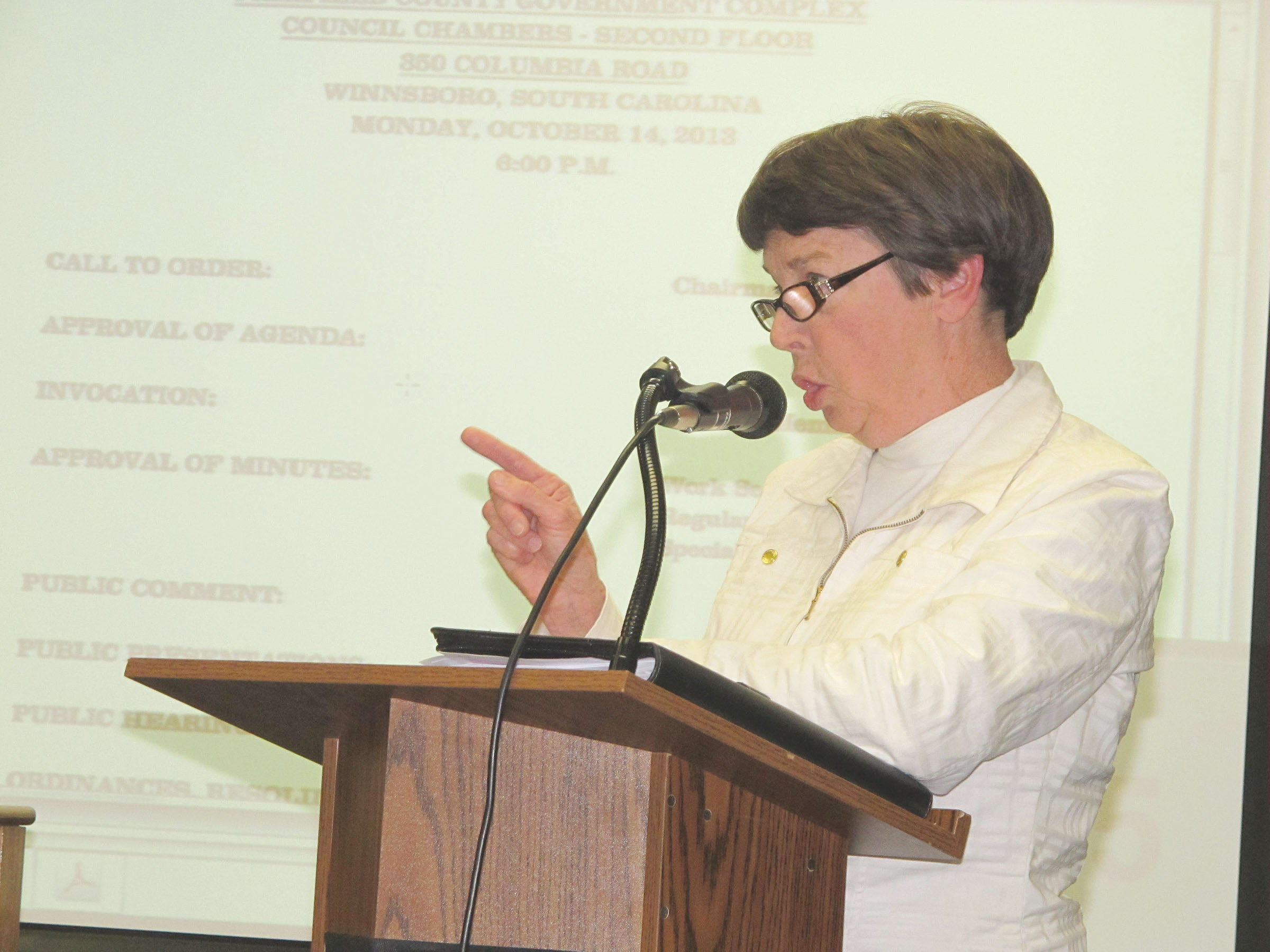
    State Rep. MaryGail Douglas (D-41) breaks the news to County Council. (Photo/Barbara Ball)

    WINNSBORO – Three members of County Council were formally put on notice Monday night – pay back money received since 2009 in lieu of supplemental health insurance premiums, or tell your story to a judge.

    State Rep. MaryGail Douglas (D-41) delivered the ultimatum during the closing of Monday night’s public comments portion of the meeting, and said that the citizens’ group calling itself Saving Fairfield was not going to let this issue die. Douglas said Council had failed to respond to a Sept. 25 deadline for action set forth in a letter sent by State Sen. Creighton Coleman (D-17) and herself in August and now there was only one recourse remaining.

    “Since Sept. 25, I cannot count the number of calls and the number of emails I have gotten asking ‘What did they say?’ ‘How are they going to pay the money back?’ Not one response has come,” Douglas said. “This, to me, smacks in the face of responsiveness to people who live in the walls of Fairfield County. Do you think this one’s going to go away, like the concerned citizens group did? Because that’s what you counted on then, and it happened. They threw their hands up in the air when the saw that nothing new was going to happen, that nothing different was going to happen. I’m going to tell you that you can count on the group that’s behind this movement now. It’s not going away. People in this county continue to be outraged, and I’m putting it mildly, at your belief and your behavior that you can do as you please, when you please and how you please.

    “Saying that, allow this third time at the podium to serve notice that further legal action is in process,” Douglas continued. “For you to simply ignore and not respond is not acceptable. This will be seen through to closure. The notice that we give tonight is that the court system will now deal with that. You can look for papers to be served.”

    Douglas said that more than 20 people had signed on as plaintiffs, and more, she added later, were pending. Coleman, she said, was handling the lawsuit.

    Phone calls to Coleman were not returned at press time.

    The practice of paying certain Council members for coverage of their hospitalization insurance dates back to 2009, according to county administrators. Council members are eligible for the County’s insurance policy, unless they are already, through their current or former employer, covered by a state plan, as is the case with Mikel Trapp (District 3), Chairman David Ferguson (District 5), and, until her retirement from Fairfield Memorial Hospital this summer, Mary Lynn Kinley (District 6). Because they were covered by a state plan, the County’s hospitalization supplement was not available to them.

    Prior to 2009, these Council members, along with all part-time employees, were covered for hospitalization by the Carolina Cares plan. For each of the Council members in question, it was costing the County approximately $877 a month – or $31,560 a year total – to include them on the Carolina Cares plan. As the County worked through attrition to wean part-time employees from the plan, the three Council members were also asked to drop the plan and take a direct payout of $475 a month each – or $17,100 a year total – to get their own hospitalization insurance. That practice ended following a July 8 opinion from the S.C. Attorney General’s Office that called the payouts “unauthorized” and “a departure from the law.”

    But a court of law, the Attorney General’s opinion said, would ultimately have to determine the legality of those payouts. It appears that now, the A.G.’s opinion will be tested.

    Ferguson has maintained that those payments were received in good faith, and as recently as last month he reiterated that position.

    “We were told by our (former) Administrator (Phil Hinely) it would save the County money,” Ferguson said in September. “Our question was, can we legally do that, and he said yes.”

    But Monday night, Douglas said that just wouldn’t wash.

    “You can beat it all you want that you did it in good faith, that you didn’t know it was wrong,” Douglas said. “In 2005, I stood at this same podium and told you that it was wrong then. It is still wrong now. The money that was paid to you needs to come back to this county.”

    After the meeting, Ferguson characterized Douglas’s comments as “hurtful” and “hard to take.”

    “And for what? What do you gain?” Ferguson said. “That seat (District 7) you ran for and lost (in 2008), you don’t get that. What do you gain from this?”

    Kinley, near the close of Monday night’s meeting, said that Council had responded to Coleman by the Sept. 25 deadline. She also said the State Ethics Commission was reviewing the former policy of the payouts in lieu of insurance premiums.

    “Once they conclude their investigation, then we’re going to make our decision,” Kinley said. “Once that is done, we will be responding to that.”

  • High Court to Hear Mitford Appeal

    WINNSBORO – The long and expensive battle between the Fairfield and Chester county school districts is finally nearing its conclusion, as the Fairfield County School District was notified last week that the S.C. Supreme Court will hear the appeal in the dispute over which district should pay to educate the approximately 200 students living in the Mitford community in Fairfield County but attending Chester County schools.

    Beth Reid (District 7), Chairwoman of the Fairfield County School Board, announced the high court’s decision to hear the appeal at Tuesday night’s Board meeting at Fairfield Middle School. The State Supreme Court will hear the case on Nov. 7 at 9:30 a.m. in Columbia. The hearing is open to the public, Reid said. Armand Derfner, a Constitutional lawyer from Charleston, has represented Fairfield County Schools since the District originally filed suit in 2010 in an effort to overturn local legislation introduced by State Sen. Creighton Coleman (D-17) mandating that the payment policy, which had stood since 1972, continue.

    In July 2012, Fifth Circuit Court Judge J. Ernest Kinard ruled in favor of Chester County and released nearly $2 million in back payments, which had been accruing with the Fairfield County Treasurer since the start of the 2009-2010 school year. A month later, the Fairfield School Board voted 5-2 to appeal the ruling. Board members Henry Miller (District 3), Andrea Harrison (District 1) and Annie McDaniel (District 4) voted for the appeal, as did then Board members Marchella Pauling and Danielle Miller. Reid and Board member Bobby Cunningham (District 5) voted against.

    Mitford students live within a 15-minute bus ride from the Chester schools in Great Falls, while a bus ride to Fairfield schools takes several hours each way. From 1972 to 2007, Fairfield paid Chester County $25,000 a year to cover the cost of educating the approximately 200 Mitford children in Chester schools. When those payments abruptly stopped under then Superintendent Samantha Ingram and then Chairwoman Catherine Kennedy, Coleman stepped in to negotiate a deal between the districts. In early 2010, an agreement had been struck to bring the payments up to date, but after sending $50,000 to Chester, Fairfield again ceased payments. Coleman then introduced local legislation to ensure the continuation of the payments. Coleman’s bill (S.1405) called for Fairfield to annually pay Chester 103 percent of Chester’s prior year per-pupil cost for each Mitford student enrolled in Chester schools.

    The District filed suit in July of 2010, claiming that the legislation was unconstitutional in that it conflicted with general law as set forth by Article III, Section 34 of the S.C. State Constitution, where local legislation is prohibited when a general law may apply, or when lawmakers have a “logical basis” for the legislation.

    In his ruling, Judge Kinard noted that Article III “generally prohibits special legislation where a general law can be made to apply,” but also said that “the prohibition of special legislation is not absolute, and special legislation is not unconstitutional where the General Assembly has a logical basis and sound reason for resorting to special legislation.”

    Kinard’s ruling stated that the Fairfield County School District “presented no evidence” that the General Assembly had abused its discretion in enacting this special legislation. The ruling also stated that the General Assembly did, in fact, have “a logical basis and sound reason” for enacting this special law.

    Kinard also said that, based on Fairfield County’s local per student funding level of $8,875 versus Chester County’s local per student funding level of $3,452, Chester County Schools are “not unduly profiting” from the arrangement and Fairfield County Schools are not being “unreasonably burdened.”

    “(The Fairfield County School District) is actually spending over $5,000 less per student than its per student revenue,” the ruling states.

    At the time the Board voted to appeal the ruling, Cunningham estimated that the District had spent more than $300,000 fighting the case. Current estimates on that cost were not available at press time.

  • Bond Funds Spent on Blair Park; Drawdy Project Grows

    WINNSBORO – County Council once again bumped up against the recreation spending issue Monday night when administration requested an additional $38,275 for the Drawdy Park improvement project that has already cost the County $280,000 out of this year’s capital improvements budget. The additional expense, interim County Administrator Milton Pope explained, was for fencing around the new football field at the park, and was deemed necessary by the S.C. Association of Counties who, Pope said, had identified the nearby retaining wall as a potential liability.

    Discussion of the expenditure revealed publicly for the first time that a portion of the County’s 2013 bond issue funds had been spent without Council having established any guidelines for approval of recreation projects.

    Pope explained to Council that the $38,275 for the fencing would come from the capital improvements budgets, as had all funds spent on refurbishing Drawdy Park. The only money spent thus far out of the $3.5 million set aside for recreation from this year’s $24.06 million industrial bond was, Pope said, the $15,000 Council voted to spend on Sept. 23 to purchase 1 acre of land at 118 99 Road in Blair.

    While news that some of the bond money had been spent without Council setting guidelines for how to do so raised no eyebrows, that Council was about to run the Drawdy Park price tag up to $319,828 – and do so from the capital improvements budget in the general fund – sent tremors through the District 4 representative.

    “That was not approved by the Council,” Councilman Kamau Marcharia said, “that was approved by the administrator (former County Administrator Phil Hinely). How did council allow an individual to put hundreds of thousands of dollars into an individual project, and we have a finance committee and everything, and nobody saw nothing? And I can’t get a dime. How did I miss that?”

    Chairman David Ferguson (District 5) assured Marcharia that the Drawdy Park project had been discussed and approved during Council’s budget meetings earlier this year.

    “I don’t remember reading that,” Marcharia answered. “If I heard $200,000 was going for a project, my ears would have stood up like a Doberman.”

    With the Drawdy Park project now knocking on the door of $320,000, Marcharia said, and with $500,000 allocated for each district in the bond issue, District 6 stood to make out with more than $819,000 in recreation funding this year. District 4, meanwhile, is locked in an endless debate, still looking for the erection of a recreation center, and the $500,000 to do so, promised them in 2005. Marcharia tried three times over the summer to carry a vote to release District 4’s portion of the recreation bond money to construct the center, but failed each time. Council was then faced with the question of how recreation money from the bond would be approved – either by individual Council members or by a majority vote of the entire Council.

    Ferguson, in a work session last month, put the issue before his colleagues, but five of the seven members told Ferguson they would rather wait until each district could produce plans and cost estimates.

    “Four weeks ago I asked Council to set a date for us to vote on how those projects were to be brought forward,” Ferguson said Monday night. “I got some feedback that we wanted to wait and talk about that. But before we start spending bond money for recreation, we’re supposed to have a policy of how we’re going to vote. And we have not done that.”

    The Blair park, Ferguson said, was unique, as it replaces a park Council closed last year in the neighborhood. The new park was something Council had committed to at that time, but well before Council passed this year’s bond issue. The decision to use bond money to pay for the new park, Ferguson said, was made by administration, not by Council.

    Councilman Dwayne Perry (District 1) suggested money for the Drawdy Park fence should also come from the bond, and said the Drawdy Park project is tantamount to “double dipping” for District 6.

    “In other words, they’re getting the money for that district (out of the bond) in addition to the money that’s being spent for the park,” Perry said.

    Pope said Council could either elect to take the $38,275 from the bond on the spot, or take it from the capital improvements fund and reimburse the fund at a later date, once Council has established guidelines for recreation spending. Council chose the latter by a vote of 5-1, with Marcharia voting against.

    Meanwhile, Ferguson said Council would vote at their next meeting, Oct. 28, to establish those guidelines. Councilwoman Carolyn Robinson (District 2) said the point was moot, since it was her understanding of state law that a majority vote was required before any council spent public funds.

  • CPA Previews Town Audit

    Moscati: $388,000 Left in Park Fund

    BLYTHEWOOD – The Town’s CPA, Kem Smith, reviewed the audit for fiscal year 2013 at last week’s Town Council meeting, highlighting some of the Town’s new accounting projects. She said the audit is under way and that she expects a clean report.

    “The Town has $2.1 million cash and a current liability of $200,000,” Smith reported. “We successfully paid down the principal and interest payments of the park bond and we’re winding down the Blythewood Financial Corporation (BFC) ‘Park’ as far as issuing the bonds and that part of the initial expenses.”

    Smith said the Town will continue to use the BFC for other things, like the current restaurant project across from Town Hall. Smith reported that the accounting work has been set up for an enterprise fund for the Manor.

    Councilman Paul Moscati recapped some of the final park budget that was presented at the last park committee meeting. He said the park committee will next decide how to spend the remaining $388,000 of the park money for phase one. Moscati said work has begun on the restrooms for the park and that they should be completed by the end of the year.

    Bob Mangone, chairman of the Ball fields committee, gave an update on the bond money he said Richland County had previously promised the Town for the construction of new baseball fields. Mangone said the Recreation Commission now says the money can only be used for the refurbishing of existing Blythewood ball fields, but that any money left over can go toward new ball fields. Mangone said he would pursue other options.

    It was announced that the art gallery in Doko Manor will now be called The Shives Gallery of Art after Randolph Shives and the Shives family made a donation for the completion of the gallery. The gallery currently features the art work of Harold Branham, Meg McLean and the late local artist Carl Bell.

    Council also approved finial reading to annex and rezone 11.43 acres on Blythewood Road at the intersection of Fulmer Road. The parcel is the location of Broom Heating and Air Conditioning and was rezoned to Community Commercial (CC.)

    Gunter Corley, who recently earned the rank of Eagle Scout, was honored by Council and presented a Certificate of Achievement by Mayor J. Michael Ross. Corley also received a painting of an eagle that was painted by Blythewood artist Harold Branham. Corley is the son of Chris and Sharon Corley.

  • LOST enigma untangling

    Accounting practices questionable, other answers still sought

    FAIRFIELD – The good news from Monday night’s County Council meeting is that, according to the accounting firm of Elliott Davis, LLC, hired by the County to review its accounting procedures in regard to its handling of Local Option Sales Tax (LOST) revenue, the Fairfield County government has not been accumulating millions of dollars of LOST revenue instead of giving it back as tax credits on property tax bills.
    The bad news is that, for eight years, the County government apparently didn’t exactly keep track of all those millions of dollars of LOST revenue.
    While accountants Tom McNeish and Brian D’Amico of Elliott Davis did not put it so plainly in explaining how the County handled the LOST funds, the pair concluded, before a packed house at the Fairfield High School auditorium, that the County had not used best practices in handling the funds, did not have ready records of how those funds were estimated and credited      and had no procedures in place to assure such. Going forward, the accountants suggested the County immediately establish and implement rules and procedures for how the LOST funds should be estimated, reported, credited and otherwise handled and accounted for.
    The issue bubbled up early last Spring when county tax payer Maggie Holmes and her attorney Jonathan Goode, of the Goode Law Firm in Winnsboro, questioned the County’s handling of the LOST revenue. Fairfield County voters passed the LOST referendum in 2005, earmarking 100 percent of those revenues for property tax relief. According to S.C. Statute 4-10-10, a 1-cent sales tax revenue is to be returned to property owners each year in the form of a credit on their property tax bills. These tax credits are given based on the County’s estimate of how much LOST revenue it expects to receive each year. Since the tax credit is applied prior to the County receiving the LOST revenue, to prevent a shortfall, any revenue in excess of the estimate is held back to be credited the following year and by law cannot be accumulated from year to year.
    A Freedom of Information Act (FOIA) request to then County Administrator Phil Hinely netted Holmes two pages of information last March, including one titled “Sales Revenue Received and Credit Billed 2006-2012” that detailed not only extremely low estimates of the LOST revenue from FY2007 through FY2013, but an accumulation of the excess revenue (resulting from the low estimates) from year to year in the amount of $5.4 million. It then listed an amount of $2.4 million budgeted as a credit for the 2013-14 fiscal year. That amount is also reflected as a millage reduction on the Council’s Resolution Establishing Millages for fiscal year 2013-14. The result would have amounted to a 21.37 sales tax credit next year.
    On Aug. 2, at a special called Council meeting, the County’s outside consultants explained that the County was indeed crediting the LOST revenue to the tax payers, albeit in an unorthodox two-phase method – first as a millage reduction each May when the County adopted its resolution establishing millages for Fairfield County and, second, as a traditional credit on the property tax bill in the fall. They also conceded that the estimates of revenue were low, but they had not determined to what extent the County might be accumulating the monies year to year.
    At Monday night’s meeting, McNeish and D’Amico said they had concluded their review of the County’s LOST revenue and distributed handouts that they said gave an accurate accounting of how the LOST revenue was remitted, estimated and credited each year. It bore little resemblance to the amounts in the document provided in Hinely’s FOIA response to Holmes last March. While Michael Kozlarek, an attorney with the Parker Poe consulting firm, had said at the Aug. 2 meeting that he was not aware that any of the LOST revenue remittances were less than the previous year during 2006 through 2013, the handout showed that, on two occasions, 2009 and 2010, the revenue remittances were lower than the previous year, and the County had to make up the difference which amounted to $76,312 in 2009 and $81,823 in 2010. The handout did not reflect the $2.4 million credit budgeted for 2013-14 in the Hinely FOIA document.
    McNeish said the Council would, in fact, revisit the resolution it passed in May to establish the millage rate for Fairfield County for FY2013-14. It will vote on a new millage resolution that will no longer reflect a sales tax credit. Interim County Administrator Milton Pope said that while changes will be made in millage amounts, the numbers won’t change in this year’s budget.
    The handout also reflected a carryover from 2013 in the amount of $805,660 that Pope said would be credited to the taxpayers next year.
    Goode and Holmes said after the meeting that some of the mystery surrounding the LOST estimates and tax credits have been cleared, but other pieces of the puzzle still seem to be missing and that some of the numbers still don’t add up.
    “I am frustrated by some of the numbers,” Goode said. “The sales tax credits listed in the handout don’t match the sales tax credits for the same years on the County’s Resolution Establishing the Millages. They should be the same numbers.”
    Council’s next meeting is Oct. 14 at 6 p.m. A location has not yet been determined.

  • Mt. Zion Gets Stay of Execution

    WINNSBORO – After hearing an impassioned plea for action by the Friends of Mt. Zion Institute (FOMZI) during a special work session last week, Town Council Tuesday night opted to table any final decision on the destruction or renovation of the Mt. Zion Institute building.

    Prior to reaching their decision, Council heard from FOMZI’s Brenda Miller, who asked Council to consider a more modest proposal from the citizens’ group.

    “While you’re considering discussion on the building,” Miller said, “please keep an open mind and focus on the auditorium and related structures. Those structures are very common and doable projects, and have been done successfully in Pelzer and Easley.”

    In those cases, Miller said, old high school auditoriums had been rescued, renovated and turned into arts centers and complexes for use by the towns. Miller said FOMZI had been working on a proposal and could have one before Council by their next meeting on Oct. 15. Following executive session, Council decided to do just that, deferring any final verdict on the fate of the property until they could see a written proposal from FOMZI.

    At the Sept. 24 work session, Vicki Dodds said FOMZI has raised approximately $60,000 to revitalize the building, with an additional $15-17,000 pledged. FOMZI was not, Dodds said, looking to the Town for additional funds, but for the green light to get started. With the Town holding the deed, Dodds said FOMZI is unable to put contractors to work, particularly on the roof, which she said had to be the first order of business. Dodds also indicated then that FOMZI would not be opposed to a scaled-down project that only saved the auditorium.

    In a contractual dispute with the Town of Ridgeway, Council voted to deny Ridgeway’s request for a $1,400 refund for water costs. Winnsboro Mayor Roger Gaddy said that, last August, a pump in the water tank on Highway 34 failed. The Town had to restart the pump manually, Gaddy said. Ridgeway had concerns over the quality of the water and purged approximately 87,000 gallons of water from their system, Gaddy said, and was seeking the refund to cover the cost of the water plus labor.

    “They did not call us or ask us about it (before purging their system),” Gaddy said.

    In other water matters, Council approved two more water taps for a Blythewood development, bringing the number of water taps dedicated to phase one of Langford Crossing to 28. The 13.1 acre development is located on Langford Road between Russ Brown Road and Monteith Pond Road.

  • LOST Enigma Untangled

    Accounting practices questionable, but County within the law

    WINNSBORO – The good news from Monday night’s County Council meeting is that, according to the accounting firm of Elliott Davis, LLC, hired by the County to review its accounting procedures in regard to its handling of Local Option Sales Tax (LOST) revenue, the Fairfield County government has not been unlawfully accumulating millions of dollars of LOST revenue instead of giving it back as tax credits on property tax bills as they have been accused by some Fairfield County citizens recently.

    The bad news is that, for eight years, the County government apparently didn’t exactly keep track of all those millions of dollars of LOST revenue.

    While accountants Tom McNeish and Brian D’Amico of Elliott Davis did not put it so plainly in explaining how the County handled the LOST funds, the pair concluded, before a packed house at the Fairfield High School auditorium, that the County had not used best practices in handling the funds, did not have ready records of how those funds were estimated and credited and had no procedures in place to assure such. Going forward, the accountants suggested the County immediately establish and implement rules and procedures for how the LOST funds should be estimated, reported, credited and otherwise handled and accounted for.

    The issue bubbled up early last Spring when county tax payer Maggie Holmes and her attorney Jonathan Goode, of the Goode Law Firm in Winnsboro, questioned the County’s handling of the LOST revenue. Fairfield County voters passed the LOST referendum in 2005, earmarking 100 percent of those revenues for property tax relief. According to S.C. Statute 4-10-10, a 1-cent sales tax revenue is to be returned to property owners each year in the form of a credit on their property tax bills. These tax credits are given based on the County’s estimate of how much LOST revenue it expects to receive each year. Since the tax credit is applied prior to the County receiving the LOST revenue, to prevent a shortfall, any revenue in excess of the estimate is held back to be credited the following year and by law cannot be accumulated from year to year.

    A Freedom of Information Act (FOIA) request to then County Administrator Phil Hinely netted Holmes two pages of information last March, including one titled “Sales Revenue Received and Credit Billed 2006-2012” that detailed not only extremely low estimates of the LOST revenue from FY2007 through FY2013, but an accumulation of the excess revenue (resulting from the low estimates) from year to year in the amount of $5.4 million. It then listed an amount of $2.4 million budgeted as a credit for the 2013-14 fiscal year. That amount is also reflected as a millage reduction on the Council’s Resolution Establishing Millages for fiscal year 2013-14. The result would have amounted to a 21.37 sales tax credit next year.

    On Aug. 2, at a special called Council meeting, the County’s outside consultants explained that the County was indeed crediting the LOST revenue to the tax payers, albeit in an unorthodox two-phase method – first as a millage reduction each May when the County adopted its resolution establishing millages for Fairfield County and, second, as a traditional credit on the property tax bill in the fall. They also conceded that the estimates of revenue were low, but they had not determined to what extent the County might be accumulating the monies year to year.

    At Monday night’s meeting, McNeish and D’Amico said they had concluded their review of the County’s LOST revenue and distributed handouts that they said gave an accurate accounting of how the LOST revenue was remitted, estimated and credited each year. It bore little resemblance to the amounts in the document provided in Hinely’s FOIA response to Holmes last March. While Michael Kozlarek, an attorney with the Parker Poe consulting firm, had said at the Aug. 2 meeting that he was not aware that any of the LOST revenue remittances were less than the previous year during 2006 through 2013, the handout showed that, on two occasions, 2009 and 2010, the revenue remittances were lower than the previous year, and the County had to make up the difference which amounted to $76,312 in 2009 and $81,823 in 2010. The handout did not reflect the $2.4 million credit budgeted for 2013-14 in the Hinely FOIA document.

    McNeish said the Council would, in fact, revisit the resolution it passed in May to establish the millage rate for Fairfield County for FY2013-14. It will vote on a new millage resolution that will no longer reflect a sales tax credit. Interim County Administrator Milton Pope said that while changes will be made in millage amounts, the numbers won’t change in this year’s budget.

    The handout also reflected a carryover from 2013 in the amount of $805,660 that Pope said would be credited to the taxpayers next year.

    Goode and Holmes said after the meeting that some of the mystery surrounding the LOST estimates and tax credits have been cleared, but other pieces of the puzzle still seem to be missing and that some of the numbers still don’t add up.

    “I am frustrated by some of the numbers,” Goode said. “The sales tax credits listed in the handout don’t match the sales tax credits for the same years on the County’s Resolution Establishing the Millages. They should be the same numbers.”

    Council’s next meeting is Oct. 14 at 6 p.m. A location has not yet been determined.

  • A-Tax Gives Band a Boost

    BLYTHEWOOD – The Town’s Accommodations Tax Committee met on Sept. 26 to vote on funding for the annual Blythewood High School Band Tournament. Each year, for the last several years, the Committee has voted to give the Tournament $10,000 and did so again last week. BHS Band Director Chris Rugila submitted a proposed budget for the tournament, which he said was based on the revenue and expenses from last year’s tournament. The proposed revenue, including the $10,000 donated by the Town, is $49,727. He said expenditures are expected to be $25,471, leaving a profit of a little over $24,000.

    The tournament is scheduled for Oct. 12 from about 11 a.m. until 10 p.m. Rugila said 30 bands will participate and that local businesses can advertise free in the tournament program.

    In other business, the Committee received final event reports on the Blythewood Rodeo and the Blythewood Labor Day Run. The Committee made a donation of Accommodation Tax funds last year for the Blythewood Rodeo and a donation of Accommodation Tax funds for the Run. No report was made available to the Committee on the actual expenses and revenue for the Rodeo or the Run.

    The Accommodations Tax committee is made up of representatives of the Town’s hotels and restaurants and does not meet regularly, but only when there is a request for funding.

  • Fate of Mt. Zion Hangs on FOMZI Proposal

    WINNSBORO – With the Mt. Zion Institute building teetering once again on the edge of demolition, Town Council met with Vickie Dodds and the Friends of the Mt. Zion Institute (FOMZI) in a public work session Tuesday night to discuss the future of the ailing landmark.

    Dodds, who said FOMZI made their first proposal to Council in 2009, said that proposal still stands, but only Council was holding it back.

    “Either you buy into it or you don’t,” Dodds said. “We’ve been ready to go since May. The only thing that has held us back has been ya’ll.”

    Ownership of the property officially returned to the Town in April, when Red Clay Development failed to live up to any of its commitments since taking control of the site in November of 2009.

    Dodds said FOMZI has raised approximately $60,000 to revitalize the building, with an additional $15-17,000 pledged. FOMZI as not, Dodds said, looking to the Town for additional funds, but for the green light to get started. With the Town holding the deed, Dodds said FOMZI is unable to put contractors to work, particularly on the roof, which she said had to be the first order of business.

    Dodds said to stabilize the roof over the classrooms and the connector to the auditorium would cost between $30-35,000. The roofing fix would be temporary, lasting 4-6 years. The roof over the gym, she said, was too far gone to patch. Once the roof was patched, and the deterioration of the building stabilized, an updated asbestos study would have to be submitted to the Department of Health and Environmental Control (DHEC). The next step would be restoring the windows, then working to remove lead paint chips from the interior.

    “This isn’t something we’re trying to do and say, ‘OK, in a year we plan to have one floor clean and the roofing done and the windows done’. We can’t do that,” Dodds said. “But we can’t not start. And it might be surprising how far we get once we get started.”

    Councilman Clyde Sanders said while FOMZI was Mt. Zion’s “last chance,” the Town couldn’t wait another five years for it to be renovated – something that would cost between $7-8 million, he said.

    “What are you risking,” Dodds asked, “if it takes five years, and we’re raising the funds and doing the work and not coming to ya’ll all the time (for money)? Three years or five years is not realistic for a project this size. I cannot figure out, for the life of me, what ya’ll have to lose by giving us a shot. We know the risks.”

    Mayor Roger Gaddy suggested a scaled-down version might be more reasonable, saving the auditorium only, an idea to which Dodds said she was not necessarily opposed.

    “No matter what decision we make, we’re going to alienate somebody,” Gaddy said. “This project is very ambitious and I think it would have more success if it were smaller.”

    Gaddy and Council asked for a lease proposal that would include some clear benchmarks for progress to be discussed at a future work session. A final decision by Council, he added – either to demolish the building or give FOMZI a shot at saving it – would be made in the coming weeks.

    “Red Clay had it for five years and nothing was done to it,” Gaddy said. “I guarantee you, we’re not going to wait another five years. We’re not going to wait another two years.”

    Dodds said benchmarks and a timetable could be included into any lease agreement; benchmarks that if not met could terminate the lease. But to not even try, she said, would be a missed opportunity for Winnsboro.

    “I won’t shed tears if it’s torn down because of the building,” Dodds said. “I will shed tears because it’s a missed opportunity.”

  • Council Ends Payout Policy

    No More Payments Without Receipts

    WINNSBORO – A long-standing and controversial policy was laid to rest Monday night as Fairfield County Council voted unanimously at their regularly scheduled meeting, held in the Fairfield Central High School auditorium, to change the way they receive monthly payments for mileage and other expenses.

    In addition to their base salary of $15,000 a year (plus an additional $4,800 for the chairmanship and an additional $3,000 for the vice chairmanship), Council has, since July of 2010, been receiving a monthly allocation of $795 for expenses. Those expenses included $195 a month for their “computer fund,” $210 a month for mileage, $125 a month for office expenses and $265 a month for a “Blackberry allowance.” Council has been under increasing public pressure in recent months to reduce what some have labeled “frivolous” and “irresponsible” spending, as well as to adopt a policy that requires Council members to produce receipts for expenses covered under the monthly allocations – something they had not been required to do under the now former policy.

    That pressure continued during the early going of Monday’s meeting as the public once again weighed in on recreation spending and urged Council members Mary Lynn Kinley (District 6), Mikel Trapp (District 3) and Chairman David Ferguson (District 5) to repay the more than $26,000 each they had received over the years in lieu of supplemental health insurance. And Beth Jenkins pressed Council to end their policy of taking $795 a month in expense allocations without having to produce a receipt.

    Monday night, it appeared as though Jenkins and others had gotten at least one of their wishes, and a roar of jubilant applause erupted in the auditorium as Milton Pope, interim County Administrator, read his recommendation to Council.

    “One of the things Council had asked me, in my capacity, to look at, was the process of our allocation process,” Pope said. “And after several weeks of looking at this, among other things in the County, I would forward you this recommendation:

    “Pursuant to the existing administration’s policy regarding expense allocations, based on several weeks of research,” Pope read, “I recommend the Council end the expense allocation policy as implemented by the former administration.”

    Pope said his staff would present a new allocation policy to Council at their next regular meeting on Oct. 14.

    “In essence, Mr. Chairman, what this would do is, those allocation expenses that were previously implemented, it is our recommendation that we should terminate that policy and implement a new policy which is strictly based upon actual reimbursement,” Pope explained.