Category: Government

  • ‘Ad’ for Appointments Fails to Clear Confusion

    BLYTHEWOOD – After considerable controversy during the last two years including a phantom ‘ad’ brought up at the Nov. 25 Town Council meeting regarding how applicants are recruited for the Town’s boards and commissions, the Town Hall has placed another ad in the classified section of the Dec. 19 issue of another media outlet to notify town residents of openings on both the Board of Architectural Review and the Board of Zoning Appeals. However, the new ad still does not specify a time frame for applications to be submitted or when the appointments will be voted on.

    Placement of this ad follows a contentious meeting on Nov. 25 in which former Town Administrator John Perry and Mayor J. Michael Ross placed an item on Council’s agenda calling for the appointment of three residents – Jim McLean, Raymond Fantone and Joseph Richardson – to Town boards and commissions without giving a 30-day notice to the public that these seats were open for appointment as required by Town law. It was the fourth time during the Ross administration that Council has ignored the town law that stipulates how vacancies on the Town’s boards and commissions are to be advertised to the public and filled.

    When newly elected councilmen Bob Massa, Bob Mangone and Tom Utroska objected to the unlawful appointment procedures at the Nov. 25 meeting, Perry argued for the appointments of the three individuals, saying the Town Hall advertises on an annual basis to get a build-up of potential appointees.

    “We did that,” Perry said, “and we will do that again.”

    Perry said the Town had run an ad in a newspaper last April or May (2013) calling for applicants for Town board and commission vacancies, even though there were no vacancies at the time. Perry said the three proposed appointees on the Nov. 25 agenda were the people who responded to that ad and had been patiently waiting to serve. Later in the meeting, however, Ross contradicted Perry, stating that no one had answered the ad which he said was published in April or May 2013.

    A search of all issues of both The Voice and The Country Chronicle published during April and May of 2013 failed to turn up any such ad placed by the Town Hall announcing vacancies or calling for applicants for the Town boards and commissions. When asked by The Voice whether the ad had actually been published, a spokesperson for Town Hall said it was published in the classified section of the June 27 issue of The Country Chronicle, not in April or May. That ad turned out to be a ‘Message from the Mayor.’ There was no headline heralding the purpose of the ad, though in small font below, it called for applicants for “seats 3 and 4 of the Planning Commission, Board of Architectural Review and Board of Zoning Appeals … to expire on September 30, 2011.” However, there were no agenda items listed for Council meetings in September for appointments to boards and commissions and no appointments were made to the seats in September. The ad made no mention of a time frame for applying for the seats or that it was the annual call for appointees for the Town’s boards and commissions.

    The Town’s statutes 155.465 (G) and 155.495 (E), state that, “If a vacancy occurs, the Town will advertise for candidates to fill the vacant seat in the manner in division (D) of this section. Town Council may make an appointment to a vacant seat at any Council meeting held not sooner than 30 days after the advertisement appears in the local newspaper.”

    Massa noted at the Nov. 25 meeting that the Town’s statutes governing such appointments was predicated on an existing vacancy, of which, he said, there were none in April or May of 2013.

    While the item was tabled at the Nov. 25 meeting, all members of Council have since decided to go along with something similar to the Mayor and Perry’s suggestion for an arbitrary call for applications for seats on the boards and commissions, and not give notice of vacancies. Council passed first reading on Dec. 16 to replace the current statue (that calls for a 30-day notice for applicants) with a new ordinance that would allow for the Town to advertise for applicants semi-annually, sometime in July and sometime in January, even though that would not necessarily be when vacancies would occur. The new ordinance, which does not specify any particular time during those two months for the ad to run, must pass a second reading to become law. That vote is expected to be held at the Jan. 6 special called meeting, although the agenda for that meeting will not be posted until Friday, Jan. 3.

    Adding further to the confusion of the Town’s appointment law/policy, the Town’s attorney Jim Meggs said at the Dec. 16 meeting that he had failed to include the Planning Commission appointments in the new ordinance and would bring a new ordinance before Council dealing with how appointments would be handled for the Planning Commission at the next meeting.

    A special called Town Council meeting is scheduled for Monday, Jan. 6, at Doko Manor at 7 p.m.
  • Monday Meeting May Reveal Interim

    BLYTHEWOOD – During a special called meeting on Monday, Jan. 6, at 7 p.m. at the Doko Manor, Town Council is expected to name an interim administrator to fill the position of former Administrator John Perry who resigned effective Wednesday, Dec. 29. In an interview last month with The Voice, Mayor J. Michael Ross confirmed that the Town Attorney Jim Meggs is, indeed, a candidate for the position.

    Meggs, who has a Master’s Degree in Public Administration, is reported to have expressed an interest in working in public administration for the Town. Meggs is a member of the Callison, Tighe and Robinson law firm in Columbia. He was hired by the Town in September 2010 during the administration of Mayor Keith Bailey. As the Town Attorney, Meggs receives a retainer of about $5,000 per month to attend to the Town’s government meetings and associated work. Perry earned approximately $115,000 per year as Town Administrator.

    Ross said a seven- to eight-member search committee will be appointed at the Jan. 27 Council meeting to find a permanent replacement for Perry. Asked if Meggs might later be considered as a permanent replacement for Perry, Ross, who is said to work well with Meggs, said that would be up to the search committee as to whether Meggs is a candidate for that position. He said the permanent position might not be filled until about June.

    No official reason has been given by the Town government as to why Perry left or was asked to leave the Town’s employment, and his separation agreement with the Town binds Perry not to make any comments whatsoever about his separation from the Town. Perry’s separation agreement was prepared by an attorney in Meggs’ law firm who specializes in labor and employment matters. That attorney was also present in the executive sessions in which Perry’s separation from the Town was finalized.

  • FOMZI Faces Choices, Timeline

    WINNSBORO – The Town of Winnsboro made public last week the official agreement between the Town and the Friends of Mt. Zion Institute (FOMZI), an agreement that places the long-debated property at Mt. Zion and the future of the buildings there squarely in the hands of the citizens’ group. The agreement puts some time constraints on FOMZI, with several benchmarks to be met to stave off the wrecking ball.

    “We felt (the Town) was generous with their time frame,” Vicki Dodds, FOMZI Chairwoman, said. “We’re good with the agreement.”

    According to the agreement, which was signed on Nov. 27, Town Council still has to pass an ordinance authorizing the sale of the property (for a sum of $5). Within 30 days of the transfer of the property, FOMZI’s first benchmark – insuring the property – comes due.

    “We’re on top of that,” Dodds said. “It is expensive, but not as expensive as I had feared.”

    FOMZI will have 18 months from the time of the transfer to stabilize the buildings on the property in order to meet the Town’s Dangerous Building Code (Section 151.01). Dodds said the task was “doable,” as the Code pertains mainly to safety and appearance. It will mean, however, choosing which of the four buildings on the property – the Mt. Zion School, the auditorium and gymnasium, the cafeteria and the Teacherage – to focus their effort on.

    “We’re just focusing on the Mt. Zion School – the classroom building – and the auditorium and gymnasium,” Dodds said. “We will talk to others about the Teacherage down the road.”

    The cafeteria, Dodds said, presents the biggest challenge because of the amount of asbestos inside.

    “That’s where most of the asbestos (out of all the buildings) is,” she said. “It’s in the floor tiles, the ceiling tiles. It’s the disposal that’s costly. If we could clean it up and use it, that’s up in the air.”

    FOMZI’s final benchmark is 30 months off from the date of purchase, when they must hire a contractor for historic rehabilitation or begin demolishing buildings.

    “Just because we’ve got it does not mean it’s a done deal,” Dodds said. “There’s still a lot of work ahead, but we’ll keep chipping away at it over the 30-month period.”

  • Councilmen Address Absences

    WINNSBORO – When County Council enacted amendments to their bylaws last month, their failure to install any meaningful attendance policy sent ripples of anger through the audience at the Nov. 18 special called meeting and again cast the spotlight on the recent attendance record of Councilman Mikel Trapp (District 3). All summer, citizens have questioned Trapp’s attendance record during Council’s public comments segment of regular meetings, and on Nov. 18 as Council was poised to vote on the amended bylaws, one member of the public, Beth Jenkins, vehemently expressed her disapproval of the weak attendance policy. So enthusiastic was her expression, Jenkins was, in fact, asked to withdraw from chambers, but not before she suggested that Council could enact a pay-by-attendance policy.

    After Jenkins had vacated Council chambers on Nov. 18, interim County Administrator Milton Pope addressed her suggestion, telling those who remained that such a policy was “not enforceable by law.” However, Scott Slaton, Legislative and Public Policy Advocate with the S.C. Municipal Association, later told The Voice that Council could, in fact, enact a ‘paid for attendance’ ordinance if they so wished.

    “There’s nothing in state law that prohibits a city council from using a pay for attendance system,” Slaton said.

    At least two S.C. towns – Heath Springs (in Lancaster County) and Furman (in Hampton County) – have done just that. While The Voice has been unable to reach the Town of Furman for details of how their policy was enacted and whether or not it has been challenged, a spokesperson with Heath Springs said their policy has been in place for nearly a year, has been well received by the public and has met with no legal challenges. Heath Springs Council members were, prior to the revised policy, paid an annual sum of $1,300, whether they attended meetings or not. Under the current policy, that $1,300 was divided by their 12 yearly meetings and Council members are paid $108.33 per meeting only if they attend.

    While Fairfield County Council’s new bylaws only encourage attendance and ask that members unable to attend a meeting notify the clerk to council in advance, the criticism of Trapp’s attendance only continues.

    At press time, County Council had convened for 48 total meetings, including regular meetings, work sessions, special called meetings and budget sessions. Of those, Trapp has missed a total of 24 meetings. He has missed nine regular meetings, eight special meetings, four work sessions and all three of Council’s budget sessions. Ten of Trapp’s absences came between Jan. 14 and July 24. The rest have accumulated since Aug. 14, when Trapp said he began taking an evening course as part of his business classes at Columbia College. On Dec. 13, that class ended, Trapp said this week, and he expects to be back on a regular schedule with Monday night’s meeting. In 2012, Trapp missed only 12 of Council’s 35 meetings.

    A 49th meeting was scheduled for Monday night, after The Voice went to press. Trapp said he would be attending that meeting.

    Trapp also said criticism of his attendance is coming largely from outside his district and that he has received “overwhelming support” from those living within District 3.

    “The People who are complaining are not from District 3,” Trapp said, “except for one person, so I don’t pay any attention to it. I am employed by District 3 residents, so what District 2 or District 4 residents say about me doesn’t matter.”

    Winnsboro Town Council, meanwhile, has often met in 2013 without its full complement of members. Council has held 24 regular meetings this year, as well as 11 finance meetings and three work sessions, for a total of 38 meetings. Of those, Councilman Danny Miller (District 1) has missed 24. Miller, who has served on Council for 18 years and has two years left on his current term, said that over his entire tenure his attendance has been quite good. In recent years, however, his job as Director of Transportation for the Fairfield County School District has impeded his ability to attend every meeting, he said.

    “If you look at all 18 years, you’ll see I probably have about a 90 percent attendance rate,” Miller said. “One year I had perfect attendance. My first priority is my primary job, getting kids to school safely and getting them home safely. I have an obligation to the District that requires me to work late at night sometimes. I’m not just playing hooky.”

    Miller said that when he does miss meetings, he is still kept in the loop on Town business by Town Manager Don Wood. And, Miller said, Winnsboro is in good hands.

    “We have a good mayor and a good council,” Miller said. “I know if we have a problem and if I’m not there, I’m confident business is being run properly.”

  • Discount Available for Early Business License Renewal

    BLYTHEWOOD – Business licenses renewals for 2014 are due by April 15. Businesses that renew during the month of January will receive a 10 percent discount. Those who renew during February will receive a 5 percent discount. Those licenses that are not paid until after April 15 will receive a 5 percent penalty of the calculated fee and an additional 5 percent for each month thereafter until the fee is paid.

    For questions , call Martie Weaver at Town Hall, 754-0501.

  • Filing Opens for Special Election

    BLYTHEWOOD – The filing period for candidates for the Blythewood Town Council Special Election begins at noon on Thursday, Jan. 9 and closes at noon on Thursday, Jan. 23. The Special Election, called to fill the seat recently vacated by Roger Hovis who resigned, will be held Tuesday, March 11. The seat is for the remaining two years of Hovis’ four-year term. Candidates will file at the Blythewood Town Hall, 171 Langford Road in Blythewood. The filing fee is $5.

    Voting will be held at only one precinct, Blythewood Park (Richland County Recreation Center), 126 Boney Road in Blythewood, for this Special Election. The precinct will be open for voting from 7 a.m. until 7 p.m. Election Day.

    Candidates must be qualified, registered voters within the Blythewood town limits. According to an advertisement the Town Hall published with another media outlet, at 9 a.m. on Election Day, the absentee poll managers will begin examining the absentee ballot return envelopes at the Elections and Voter Registration office, 2020 Hampton St. in Columbia. Also at that office, on Thursday, March 13, at 10 a.m., the Richland County Board of Elections and Voter Registration will hold a hearing to determine the validity of ballots challenged in the election.

    Those residents of the Town of Blythewood who wish to register to vote in the Special Election must register by no later than Feb. 11.

    For questions about the Special Election, call Martie Weaver at Blythewood Town Hall, 754-0501.

  • Cameras, Cop Gear Tabled

    RIDGEWAY – Town Council tabled a decision on the purchase of security cameras for downtown during their Dec. 12 meeting after receiving four bids from three companies, ranging from $1,669 to $4,987. It was the second time in as many meetings that the purchase of cameras had been deferred.

    “I still think we should target that money toward the Police Department first,” Councilman Donald Prioleau said, “and get our Police Department up to standards, and then go do these cameras.”

    Mayor Charlene Herring said the money for the cameras would come out of the Town’s contingency fund, and not the police budget. The contingency money could not, she said, be used for recurring costs, such as the salary of more police officers, as Prioleau had suggested. And, she said, cameras provide another level of security when the Town’s part-time police officers are not on duty. The downtown merchants, Herring said, support the idea of cameras and sent a letter to Council stating as much.

    “Most merchants, anywhere else you go, are responsible for their own security,” Councilman Russ Brown said. “I’m a merchant on Main Street, and I have stuff that could be stolen out of my office, but I think some of the responsibility should fall back on the merchants. It’s easy to write a letter and just put your name on it and say you want something paid for by somebody else, but I think there needs to be some time of accountability from the merchants themselves.”

    Herring said that the merchants have done a great deal to put Ridgeway on the map, and that the cameras were about more than security for the merchants, they were about security for the town. The cameras, she said, would be set up to view Main Street and the back side of the buildings along the south side of Main Street.

    The lowest bid of $1,669.20 came from Cor Digital Technology of Columbia and included eight cameras, additional equipment and installation. Cor also turned in a bid of $3,672.77 for eight-camera HD package. Capture It Surveillance turned in a bid of $2,570 for a six-camera package, and Electronic Systems submitted a bid of $4,987.35 for eight cameras.

    “The surveillance cameras are going all the time,” Councilman Doug Porter pointed out, “and our police officers are part time.”

    Prioleau suggested looking into prices for wildlife cameras, which he said were less expensive. He said he could not vote for the purchase of the cameras as presented if a vote were called for Thursday night.

    “I don’t think we’re to the point where we’ve got to have cameras,” Prioleau said, “with just two people in the Police Department and there are question marks about one of them.”

    Council voted unanimously during their Nov. 14 meeting to offer a part-time police officer position to Malcolm Little. Little, who currently lives in Rock Hill, put in 12 years of service with the N.Y. City Police Department, from 1997 to 2009, before moving down South. He did a short stint with the Chester Sheriff’s Office, from May to August, 2011, before switching uniforms to the Chester Police Department, where he served from November 2011 to September 2012. Little is currently employed with G4S Special Police, a private security firm in Charlotte.

    But since his hire, Little has only worked the Ridgeway Christmas parade on Dec. 1. After last week’s meeting, Herring said Little was still working out his scheduling with G4S and Town Hall said they had not yet received Little’s paperwork indicating his certification as a police officer.

    Other needs for Ridgeway’s Police Department – a computer system and the accompanying software to enable police to tap into the national crime database – were also tabled.

    In non-police related business, Council accepted a bid of $410 from Dwayne Styles to repair the kitchen door at the Century House. Styles’ bid came in under a bid of $543.75 from SteelRose Construction.

    SteelRose’s bid of $258.50 was good enough to secure the job of repairing the door at Just Around the Corner, coming in under Styles’ bid of $360.

    Council also gave the OK to a $350 bonus for full-time employees and $150 for part-time employees.

  • Board OK’s Credit Cards

    WINNSBORO – The Fairfield County School Board gave approval Tuesday night to a new procurement program that eliminates the need for purchase orders for items under $2,500. The Bank of America Visa Purchasing Card program, which is sanctioned by the State Budget and Control Board, passed on a 4-3 vote, with Andrea Harrison (District 1), Paula Hartman (District 2) and Annie McDaniel (District 4) voting against.

    The Board had tabled the issue last month after debate over controls for the cards. Tuesday night, those controls were addressed, according to Kevin Robinson, Director of Finance, with a detailed policy. Nine cards will be issued in the initial rollout of the program, one to the principal at each of the District’s schools. A total of 20 cards will be in play when the program reaches full implementation early next year, with cards issued to heads of the District’s various departments. Cards are to be used for purchases of $2,500 or less and each card has a $3,000 limit at one time. While purchase orders will not be required for expenditures made with the cards, a form will be filled out by the principals for each purchase made.

    “If we anticipate or we run into problems with departments not following procedures, then we can decide that they will have to do purchase orders,” Robinson said. “But in order to optimize the efficiency of the card, we decided we won’t have purchase orders for purchases of $2,500 or less.”

    It is the “same purchasing power” principals and department heads have now, Board member William Frick (District 6) said, only with a different process.

    “It’s not extending a credit line any more than it already is,” Frick said. “It’s not giving them more money than they’ve already got.”

    Cardholders will, under the District’s guidelines, have to turn in daily receipts to the District and weekly reports of the card transactions will be reviewed by District staff. Receipts and monthly statements will be maintained by the District for five years.

    The card is not, according to the policy, to be used for personal purchases or the purchase of alcohol. A cardholder will face disciplinary action if they allow the card to be used by an unauthorized user or if they split purchases in an effort to circumvent the $2,500 limit.

    “My understanding is the receipts would have to be turned in or that individual (cardholder) would be responsible for that purchase,” Board Chairwoman Beth Reid said.

    But Hartman was wary of the program and asked if the District had not had issues with credit cards in the past. Using a credit card can sometimes be too easy, Hartman said, and good people often find themselves in a bind over credit card use.

    “I am optimistic that people will do the right thing and behave in a responsible fashion,” J.R. Green, Superintendent of Fairfield County Schools, said. “And when individuals don’t behave in a responsible fashion, then we will address it.”

  • After Repeated Violations, Council Aims to Change the Law

    BLYTHEWOOD – Town Council unanimously adopted an ordinance Monday night to amend provisions of the Town’s Code of Laws pertaining to how applicants are recruited for the Town’s boards and commissions. The issue arose last month when Mayor J. Michael Ross brought forward the nomination of three applicants for appointment to the Board of Architectural Review and the Board of Zoning Appeals without following the Town’s statute that requires the posting of notices of vacancies on the boards and commissions at least 30 days prior to appointment so that members of the public can have notice of the vacancies in case they want to apply. This was the fourth time the Ross administration, with no public objections from Town Attorney Jim Meggs, proposed these appointments without posting a notice and without providing the required 30-day time period for residents to apply.

    In pushing back against criticism for this, the Mayor has told The Voice in each instance that he felt in his heart he was doing the right thing and that he felt that was more important than following the law.

    When Council asked Meggs’ opinion on the matter at last week’s meeting, Meggs said he would have to look at the chronology of what had come before. Even though the item had been on the agenda at that meeting and was in direct conflict with the Town’s written statute, as pointed out by two of the Council members, Meggs said he was not prepared to address the issue. The issue was then deferred until Meggs could review the Town’s statute. But, before the Council to defer the matter, the Mayor and then Town Administrator John Perry argued that the Town had run an advertisement in the newspaper last April or May calling for applicants for board and commission vacancies, even though there were no vacancies at the time. Councilman Bob Massa noted that the statute was predicated on an existing vacancy, of which, he said, there were none when the advertisement was posted.

    The Mayor presented a scenario in which “we did that (advertised for applicants for boards and commission) on an annual basis to give a buildup of candidates and we will do that again.” However, such a policy has never been presented publicly or mentioned verbally or in writing by anyone from the Town Hall and does not comply with the Town’s statutes 155.465 (G) and 155.495 (E), which state that, “If a vacancy occurs, the Town will advertise for candidates to fill the vacant seat in the manner in division (D) of this section. Town Council may make an appointment to a vacant seat at any Council meeting held not sooner than 30 days after the advertisement appears in the local newspaper.”

    On Monday evening, Council unanimously passed a new statute that would allow the Town to forego those requirements and, instead, advertise semi-annually for board and commission vacancies instead of when the vacancies occur. If second reading of the new ordinance passes next month, the Town will advertise for applicants sometime in July and sometime in January, but Council would not specify any particular time during those two months.

    Meggs suggested that the intent was to simplify the process.

    In other business, Councilman Tom Utroska offered an agenda item calling for a two-year term limit for the Mayor and Town Council members. Councilman Bob Mangone offered an amendment to also restrict candidates from re-running until three and a half years after having reached their term limits. Mangone’s motion died for lack of a second. Mayor Ross said he felt funny about term limits.

    “Term limits say we aren’t trusting the people to vote on who they want to be in office,” Ross said.

    Utroska countered that “When people have been in office too long, they can sometimes use their bully pulpit so that it’s hard for people to run against them.”

    No one in Blythewood has served a third term as Mayor or on Town Council since the Ballow administration ended in 2004. The only two incumbents who have been reelected to a second term since 2004 ran unopposed.

    Utroska said that since the S.C. Attorney General had previously rendered an opinion that the state ordinance neither provided for nor prohibited for term limits, he would be happy to take the issue to the people at a special election.

    “Let the people speak,” Utroska said, “in an advisory referendum on the issue.”

    The Mayor said he would be meeting with Howard Jackson of the Richland County Election Commission about the possibility of an advisory referendum being held in conjunction with the special election next spring to replace Councilman Roger Hovis whose resignation was final Dec. 15. The Council voted 3-1, with Utroska dissenting, to defer the vote until after the Mayor meets with Jackson.

    In other business, Massa, in opening remarks, commented on his first three weeks in office being very unusual.

    “We had to deal with two or three issues that we hadn’t anticipated, but we’re all working together. One of those issues,” Massa said, “is the Doko Restaurant agreement. We’ve had a couple of meetings and executive sessions about the restaurant contract and one of the things that has become quite clear is that the Town has not performed any, or if they did it was very cursory, due diligence. As a Council, we have now assembled a list of questions that we will present to Mr. Bazinet after the first of the year.”

    The three new Council members delayed the vote on the second reading of the restaurant agreement to look into, among other things, whether they could get a performance bond to protect the Town from some unforeseen problem in the future.

  • Developer Seeks Winnsboro Water

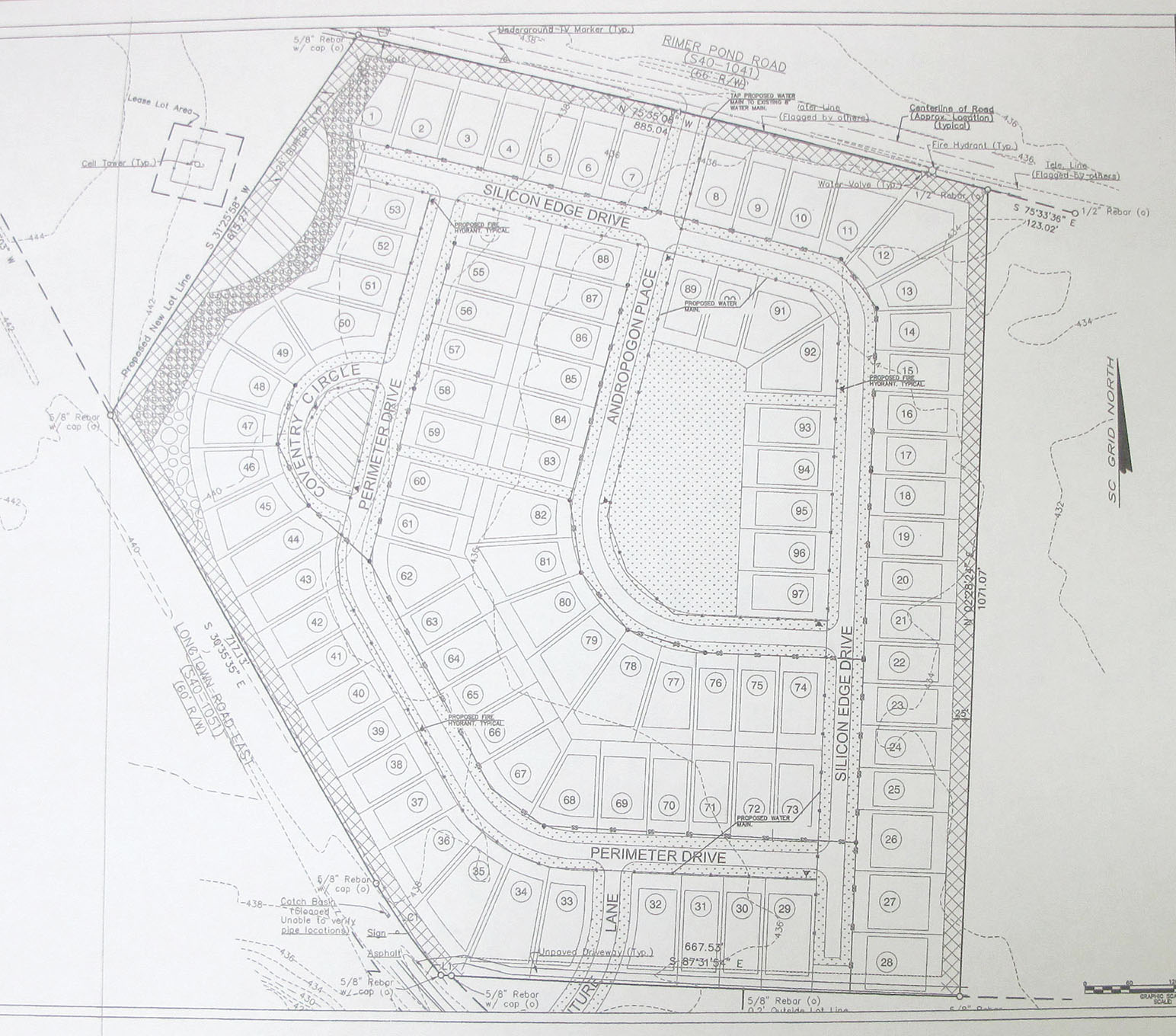
    95 homes planned near Blythewood Middle School

    WINNSBORO – Developers of a 95-unit neighborhood planned across from Blythewood Middle School on Longtown Road West at Rimer Pond Road are seeking water capacity of 38,000 gallons of water per day from Winnsboro Town Council. Representing LongCove Venture, John Thomas said at Tuesday night’s Town Council meeting that the development, named East Lake Village, is currently in the permitting process and will go before the Richland County Development Review Team Friday, Dec. 27.

    “Then, we’ll take about 90 days to do the engineering drawings and get everything submitted for permitting for the County and the Department of Health and Environmental Control,” Thomas said.

    Thomas said construction should start in the spring and that the homes would be primarily starter homes in the $180,000 – $225,000 range.

    Winnsboro Mayor Roger Gaddy said he expects the developers to be back asking Council for approval in four to six weeks.

    “At that time, we’ll have to decide if we will need another water tower to accommodate them. And if we, do we want to spend a million dollars on it? We’ll have to think about this,” Gaddy said.