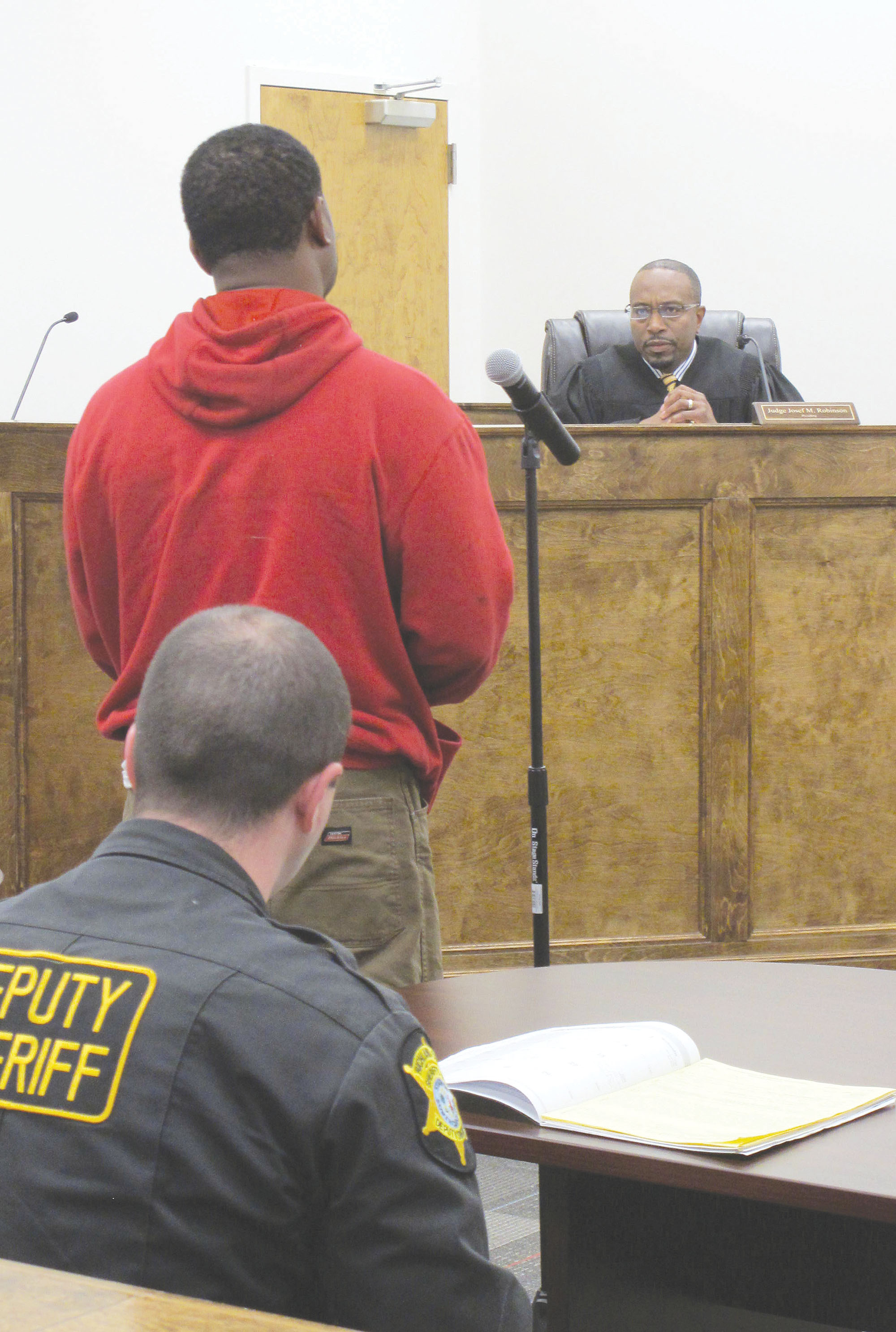
Richland County Magistrate’s Court Judge Josef Robinson hears his third case on opening day, an open container and driving under suspension violation that earned the offender a $250 fine.
BLYTHEWOOD – The new Blythewood branch of the Richland County Magistrate’s Court opened for business on McNulty Street last Friday, and already Judge Josef Robinson is doing a healthy trade. Court opened Jan. 17, taking many cases that were previously handled in the Pontiac Magistrate’s Court, and Robinson and his staff are plowing through traffic and civil cases at a rapid pace.
“I’m expecting it to be pretty busy,” Robinson said just days before court convened, “but I’ve got a very good, experienced staff. People can expect excellent customer service.”
Robinson currently holds court every Wednesday and Friday, both bench and jury trials. As the cases mount, he said, a Thursday session could soon be added.
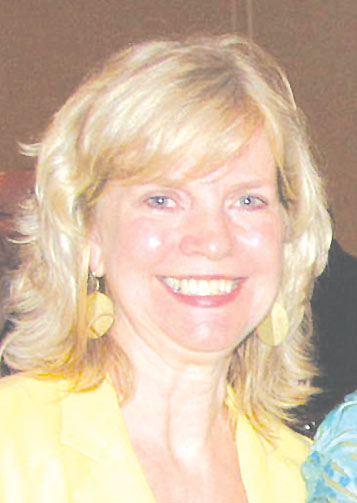
BLYTHEWOOD – The Town’s Events and Conference Center Director for the Manor, Martha Jones, has resigned that position after just a year to become the Director of Strategic Partnerships for Richland School District 2. Jones applied for the position with the District in October and the School Board voted on a consent agenda to hire her at their regular meeting on Jan. 14.
Jones, who was a teacher in the District for 15 years, was hired by Town Hall in January of 2013 to oversee special events planned by the Town and to manage rentals for The Manor. A press release from the District said she would assume her duties with Richland 2 in February and described her new job as “developing and sustaining positive community relations through strategic partnerships with civic organizations, faith-based organizations, parents and the Richland Two community.”
The District also announced the hiring of Elizabeth Roof as Executive Director of Communications to replace Ken Blackstone who left the District in October.
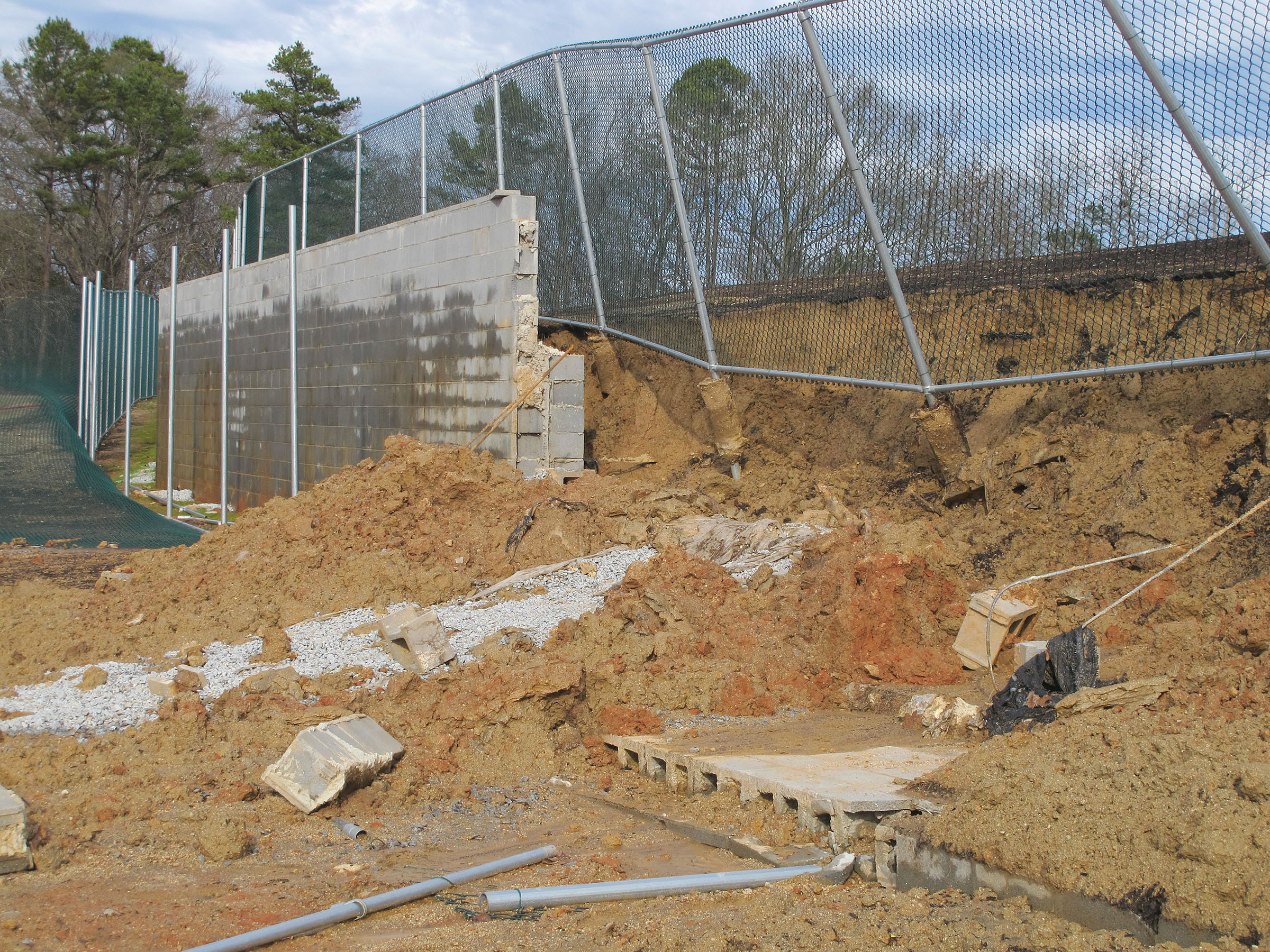
A 50-foot section of the retaining wall around the Drawdy Park football field collapsed Sunday night, spurring many County critics to say ‘I told you so.’
Contractor: Wall Poorly Constructed
WINNSBORO – In a massive stroke of dramatic irony Sunday night, the suspicions of County Council critics were confirmed when a portion of what is known in some circles as The Great Wall of Fairfield came crashing to the ground, leaving a 50-foot gap in the 525-foot long, 12-foot high retaining wall around the recently completed football field at Drawdy Park. The collapse prompted the appearance of the project’s chief engineer and sparked a public “We told you so” from one Council critic at Monday night’s County Council meeting.
While the collapse came one day after severe storms dumped more than 3 inches of rain on Winnsboro, both Sam Savage of S2 Engineering and Consulting, the firm that managed the project, and interim County Administrator Milton Pope said Monday night that it was too early to determine what caused the collapse.
“Obviously, we don’t know what happened that caused the failure,” Savage told Council. “We’re trying to look into that.”
Savage said he contacted the contractor on the project, Four Brothers Enterprise, LLC in Lexington, and brought them out to view the damage Monday morning. He said the contractor made it clear that he would honor the County’s warranty and repair the wall at no cost to the County.
Savage then left Council chambers without Council posing a single question. Pope, meanwhile, told Council that his staff would be following the progress of the repairs closely.
“There have been questions about the project ever since my arrival,” Pope noted. “Council had approved this and we want to make sure that the product we have is what the County paid for. The County will also make sure that we do our due diligence after they do a further assessment. I think it would be too premature for someone to suggest exactly what happened with the failure, because we want documentation from them to give us the confidence we need to make sure there are no additional problems with the construction there.”
But Bob Carrison, a County critic and member of Saving Fairfield, said the County should have been doing its due diligence all along, and he lambasted Council during the public comment portion of Monday night’s meeting.
“That the retaining wall was flawed is not news,” Carrison said. “No, the collapse was entirely predictable. Not a matter of if, but when. There are at least a dozen people or more in this audience that knew the project was flawed. People from this group have been trying for months to get your eyes on the project. Late summer last year we made attempts to raise red flags on this structure and we tried to sound the alarm. We saw and we heard ample evidence to convince us that the project was poorly conceived and poorly executed.”
Carrison said that when he learned in late September that no inspections had been done on the project, he went to the County’s Planning and Zoning Department to verify that.
“I was told then by Director Ron Stowers that no, there were no plans for the structure that we could view,” Carrison said. “No plans had been submitted, there had been no inspections and they didn’t need to inspect this structure.”
But Pope told The Voice Monday morning that the County did, in fact, have structural engineering drawings for the project. Furthermore, Pope added, after visiting the site of the collapse he could see that rebar and the supporting footings were in place.
A Blythewood general contractor, however, reviewed photographs of the wall for The Voice and expressed serious concerns with how the wall was constructed. The contractor, who wished to remain anonymous, has built similar structures. He said it appeared as if there had been no plan for constructing the wall, or if there had been, the plan had not been followed.
Among his concerns was the absence of adequate rebar in the construction. Photographs of the collapsed portion of the wall show rebar inserted into every eighth column of block. The Blythewood contractor said rebar should have been inserted into every column of block and should have been filled with concrete. Photographs of the collapsed section indicate that no concrete fill had been included with the rebar.
The Blythewood contractor also said the sections of the wall had not been interlocked, as they should have been, nor were the deadmen (horizontal support sections running from the wall into the earth behind the wall). Rebar had also not been properly installed into the deadmen. Soil behind the wall also should have been compacted with every 2 feet of fill, the contractor said. Photographs of the collapse indicate that it had not. Weep holes (drainage holes) also should have been drilled along the base of the wall, he said. Photographs reveal the presence of no such holes.
Carrison said Saving Fairfield did not bring their concerns directly to Council because they had “no concrete proof that the allegations of mismanagement of this project were in fact true,” and because they felt Council would not take their concerns seriously.
“We have come to the conclusion that this Council looks upon us as nothing more than troublemaking malcontents,” Carrison said.
Carrison said Saving Fairfield called in the Department of Health and Environmental Control (DHEC) to inspect the site in October in hopes they might condemn the property until testing and inspection could be done. However, all DHEC could do, Carrison said, was examine the site for proper runoff.
DHEC examined the site on Oct. 22 and gave it a “Satisfactory” rating, noting in their report that “A rough calculation of the disturbed area shows it to be less than 1 acre, which does not require an NPDES (National Pollutant Discharge Elimination System, which covers storm water drainage from construction sites) Construction General Permit to be issued.”
DHEC, County administrators clarified, was only concerned with an area at the lower end of the football field where significant amounts of earth had been displaced, and that area, they said they confirmed with DHEC, was less than 1 acre.
DHEC also noted in their report that “The area around the football field needs to be stabilized to ensure sediment does not leave the site.”
As Carrison’s allotted 3-minute time wound down, he showed no signs of letting up on Council.
“Done is done. Over a quarter of a million dollars is down the drain, literally,” Carrison said. “One question remains: How did the people of Saving Fairfield, how did we know these things and you did not? I don’t mean by that, how did Council or administration miss the red flags and the warnings. What I mean is that we knew and you did not. We were informed by people who knew what was going on.
“They did not come to you because they feared losing their jobs and their contracts,” Carrison said, raising his voice over calls from Chairman David Ferguson (District 5) for him to relent. “Please consider some strong whistleblowing protection for the employees and the contractors of this county (so they can) come talk to you and not fear reprisals and retribution. It has to be done,” Carrison shouted as a Fairfield County Sheriff’s Deputy escorted him from the microphone.
The cost for the entire project was originally capped at $280,000, according to an authorization signed by then County Administrator Phil Hinely on May 21, 2013. Late last summer, Council OK’d an additional $41,925 for fencing around the retaining wall. The County hauled away dirt from the site, at a cost of $5,737, bringing the grand total for the new Drawdy Park to $327,662.
RIDGEWAY – In a vote that hung precariously in the air for several strained moments, Town Council shot down a proposal to purchase a battery of security cameras for downtown Ridgeway during their regular meeting Jan. 9.
The motion, put on the floor by Councilman Doug Porter, nearly died for lack of a second, but was rescued by Mayor Charlene Herring who broke Council’s long silence and backed the motion herself. Porter and Herring quickly offered positive votes for the plan, but when Herring called for dissenting votes, the remaining Council members – Russ Brown, Belva Bush and Donald Prioleau – were again silent.
“You can’t ride the fence on it,” Porter urged his colleagues, and Herring, at last, polled each of the remaining Council members for their vote.
One at a time, then, Prioleau, Bush and Brown voted against the purchase of the cameras.
The vote came after an extensive debate on the issue, as well as an appeal by Ridgeway merchant Denise Jones, co-owner of the Cotton Yard Market.
“As a merchant, it is my utmost concern to operate a business in a safe and secure environment,” Jones read from a written statement at the outset of the meeting. “Just last night, as we left our Merchant’s meeting at the Cotton Yard Market, we were the only people on the street at 6:30 p.m. Often, it is just a few women who are there and leaving.
“We had requested that you provide security cameras outside to not only protect us but our customers as well,” Jones continued. “We have asked for very little and this would give us some comfort as we run our businesses.”
Council had tabled the matter during their December meeting as Prioleau said the Police Department had other more pressing needs that should be addressed before cameras are installed. Prioleau also suggested during December’s discussion that wildlife cameras may be a less expensive alternative to high-tech security cameras. But last week, Brown noted that wildlife cameras are far too easy to steal to be considered a viable alternative.
“I don’t want anybody to think I’m against cameras,” Prioleau said at last week’s meeting. “I’m not. But there are other parts of this police department that need to be brought up to standards, then do the cameras. If we had two or three officers hired, get the department computers, then it’s time for the cameras.”
But Herring, repeating a clarification she had made during the December discussion of cameras, reminded Prioleau that money to purchase cameras would have to come from the Town’s contingency fund. Funding for hiring police officers, as well as for computers – both of which have associated recurring costs – must come from the Town’s general fund budget. The contingency fund, she said, was money that could only be spent on one-time costs for capital improvements.
Bush said she was “baffled” that the Ridgeway Police Department lacked basic technology in the form of computers, and said the purchase of computers should come first. Herring countered by saying the Town had the money for both. And, Herring added, with the Dec. 27 resignation of recently hired officer Malcolm Little, cameras were a priority.
“I think we need (cameras) in order to assure safety,” Herring said, “because we’re still a ways from getting the help we need in the Police Department.”
But Brown said he had reviewed incident reports from the Ridgeway Police Department from the last three years and questioned the actual need for security cameras. Brown said the reports comprised 26 total incidents over the last three years. Nine of those, he said, occurred at businesses that have their own security camera systems. Eleven of the incidents occurred at residences that wouldn’t be covered by the proposed camera system. That leaves six incidents downtown in the last three years, Brown said.
Ridgeway received three bids in November for security camera systems – a $4,987.35 bid from Electronic Systems, a $2,570 bid from Capture It Surveillance and a $1,669.20 bid from Cor Digital Technology.
Council also put off the purchase of a computer for the Police Department, electing instead to attempt to utilize an existing computer that they said did not have the memory capacity to handle certain specific software used by law enforcement agencies. While the purchase of a computer would be a one-time cost, recurring costs for software licenses, virus protection and Internet service could run as high as $1,200 a year. If the existing computer proves inadequate, Porter stated in his motion, the Town would move forward with the purchase of a new desktop for approximately $900.
In other business, Council upped their contribution for the Big Grab cross-county yard sale to $61. This year’s event is slated for Sept. 5 and 6. Council also approved the purchase of a new chlorinator for the Water Department, estimated to cost between $1,200 and $1,400.
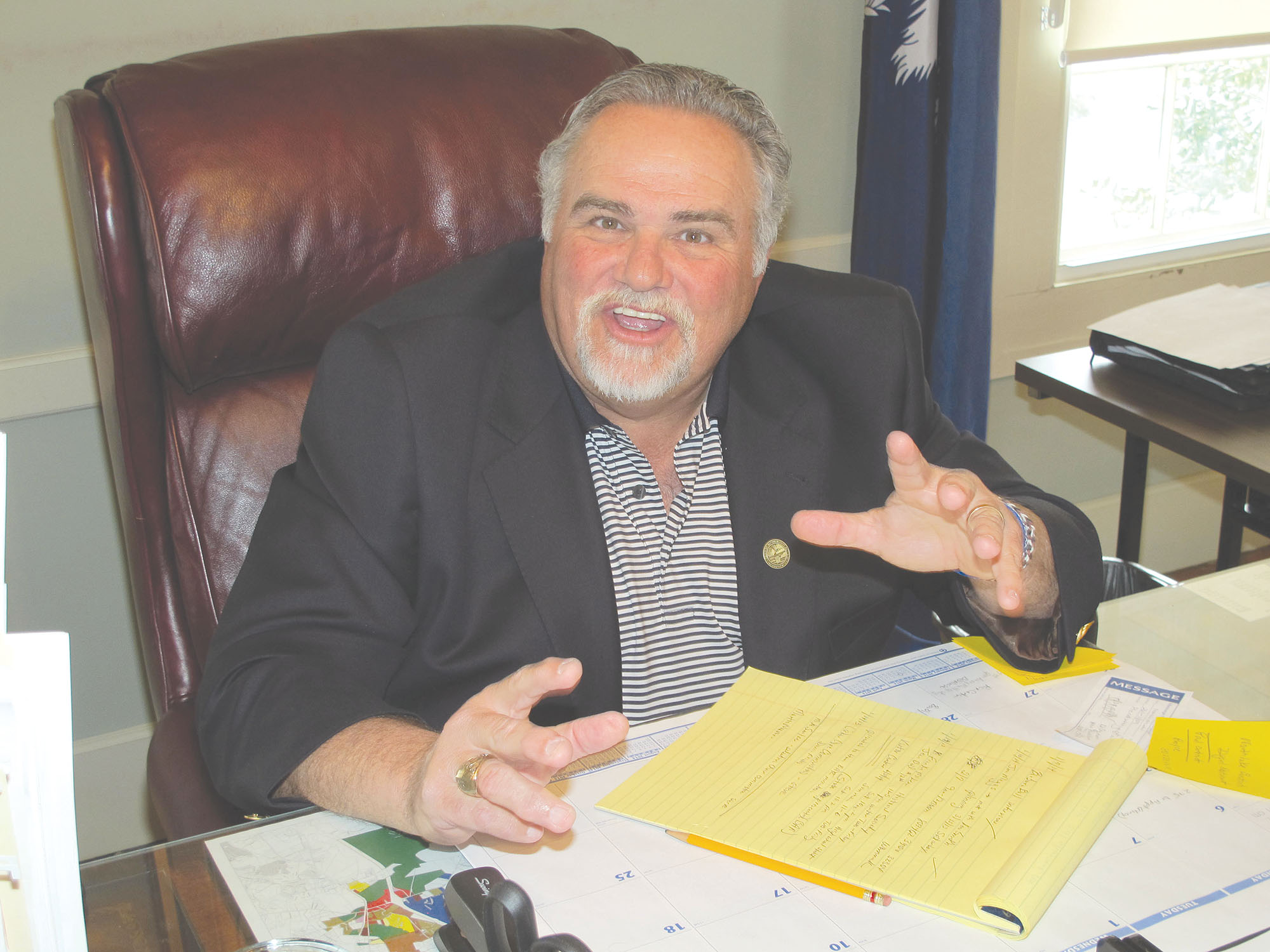
BLYTHEWOOD – Referring to himself as the CEO of the Town of Blythewood and discussing the new direction he sees for the Town, Mayor J. Michael Ross cast himself firmly in a new leadership role during an exclusive 45-minute interview with The Independent Voice last week. This is the first of several interviews planned about the town’s new direction.
The Voice: How much will the Town Attorney, Jim Meggs, be paid and how many hours will he work in his new position as the Town’s Interim Administrator?
Mayor: We have approved $75 an hour for Mr. Meggs for 20 hours a week*. He will work 8-1 Mondays, Wednesdays and Fridays. Of course with his work at his law firm, he might have to be in court some of that time. I look forward to a 20-hour-a-week Town Administrator. I think this is something Council and I need to evaluate. Does the Town of Blythewood need a 40-hour per week, $115,000 Administrator? Potentially, did we ever need that? The thing that’s exciting here is critical. After John (Perry) was no longer coming in to the office after Dec. 29, I am the CEO of the Town and the administrator works for me, but Martie, Chris, Martha, Booth, Kirk and me – we all did an admiral job running the office, basically, without a Town Administrator since Dec. 29.
(Editor’s Note: Meggs is being paid $20 more per hour than Perry was paid.)
V: Will the Town continue in the progressive direction that John Perry visioned for the Town or will there be a new direction?
Mayor: I don’t see what we have done as ‘John’s plan’. I see it as the Town’s plan. We may not be as flashy as John was, and Mr. Meggs probably won’t attend every Town meeting. He will let us, the elected officials, do that. Mr. Meggs will be more of a cut and dried administrator, doing administrative duties.
V: Was Mr. Perry not a cut and dried administrator?
Mayor: He was very progressive and an out of the box thinker. He did drive things for the Town every day, every minute, every second. There’s a lot to be said for that. But is that what people in Blythewood want? We have to be sure what the people’s vision is.
V: But after your election, you were vocal to many in the Town and to The Voice, that you had come to realize that what you read in the newspaper before your election was not true, that the community was happy with the direction the Town was going and that there were no problems in the town government, that everything was perfect. You said you found that the Town’s park and development plans were financially sound and that it was all run smoothly by Mr. Perry. What changed your mind?
Mayor: I think that when you get in there, it might take more than six months or a year or a year and a half to gain the knowledge. As I’ve gotten more hands on, I believe that for where the Town of Blythewood wants to go and the pace (the people) want to go, that John’s leaving might be a good thing. I now think it’s what the majority of the people have always said they wanted.
V: When John Perry brought many of these plans to the (town) boards, they were clearly his ideas and his to explain to the boards. Don’t you think more people, now, have come to appreciate Perry’s more progressive vision for Blythewood? You voted to carry out every one of those plans.
Mayor: This past election in November opened my eyes – the vote to remove incumbents who had been there for 8 years doing what they had done, to get voted out and a new group voted in with a more conservative view point. The people spoke and said we want these guys, not those guys. The (new members) ran on a platform that said we’re going to look at things more closely and, probably, as I saw that coming, it helped me not to worry that we could lose John Perry as our administrator. John was a brilliant guy and he loved being Town Administrator. He had a vision for the Town. The new people (on council) came in with a different approach for looking at things, to feel comfortable that the project is a safe, secure project. My mind has been changed. Now I realize that this is what the people want.
V: Where does the Town government stand with the depot/restaurant plans?
Mayor: We are gathering financial information from Mr. Bazinet and his LLC’s, from everywhere. We are continuing to work on that. But my eyes are open to re-look at it. I would not disrespect our previous council for our decisions. I guess our experience in business was enough to satisfy us, but another group has come in who might want to look at it closer. We will have a building we will have to pay $8,000 a month for. It’s like any other thing that people go in to business with, except it’s the Town going into business, and that does scare me, and it was a concern brought up by the new council members.
V: You don’t think Mr. Perry could have successfully managed the Town through to the vision?
Mayor: There was a total change in where this Town’s government and politics were headed, as was determined by the November election. The people were saying slow down and think about stuff. Maybe we don’t want all of this. John worked so closely with (former councilmen) Ed (Garrison) and Paul (Moscati) for so long and it was their vision, but the people now say they don’t want that vision any more.
BLYTHEWOOD – Several members of Blythewood’s St. Mark’s Lutheran Church attended the Planning Commission meeting Monday evening, and two of them addressed the Commission expressing concern about a road that has been proposed by Doko Village developers behind the IGA. Mike Gibson, the first speaker for the group, told the Commission that the road, as drawn on a site map that was published in The Voice on Dec. 20, would cut through the church property and the church’s cemetery. Gibson said the developers had approached the church some time ago asking for construction of a new road to be allowed across the church’s property to serve the proposed Doko Village.
“We considered that request,” said Gibson, “and we rejected it. Now we see in The Voice a map with the proposal for the development with the road on the north side of St. Mark’s. My point tonight is to let the Town of Blythewood know that the new road cannot be constructed on the church’s property.”
Dan Jorgansen, one of the church’s pastors, told the Commission that the church was blindsided by the story.
“I had spoken with the developer more than nine months ago,” he said. “I told him that the location of the road was not a good idea and that we would not support it.”
Jorgansen said that since the developer has requested water for the development (from Winnsboro), that he (the developer) appears to be prepared to go forward with it. Commission Chairman Mike Switzer told the group that, while the developer had requested water from Winnsboro for the development, the plan had not yet come before the Commission. Switzer told the group that Town Clerk Martie Weaver would notify them if and when the proposed development should be scheduled to come before the Commission.
Approval was given for the final plat as submitted for Abney Hill Estates, Phase 1. Representatives of Hurricane Construction made presentations to the Commission, saying 90 homes are planned for the 50 acres that make up Phase I. Town Planner Michael Criss told the Commission that Essex Homes is looking at building homes on Phase II of the plan, which would include 172 acres.
Final revisions to the Tree/Landscape ordinance were discussed and deferred. Criss and Interim Administrator Jim Meggs were directed to finalize it into ordinance form and bring it back to the Commission at the February meeting for final approval to forward to Council.
Meggs reported that his limited time on the job in his new position had not allowed him to prepare a report, but that he would have one prepared next month.
BLYTHEWOOD – Filing opened at noon on Thursday, Jan. 9, for candidates in the March 11 Blythewood special election, which is being held to fill the Town Council seat recently vacated by Roger Hovis who resigned. Two years remain of Hovis’ four-year term. Candidates interested in running for the seat can file at the Blythewood Town Hall, 171 Langford Road in Blythewood. The filing fee is $4. The filing period ends Jan. 23.
Those residents of the Town who wish to register to vote in the special election must register no later than Feb. 11. For questions about the special election, call Martie Weaver at Blythewood Town Hall, 754-0501.
BLYTHEWOOD – Town Council voted unanimously after a very short executive meeting at a special called meeting on Monday night to hire the Town’s attorney, Jim Meggs, to replace former Town Administrator John Perry on an interim basis. Meggs will now serve the Town as both the Town Attorney and as a part-time Interim Town Administrator until a permanent replacement is hired, which Mayor J. Michael Ross said could take up to six months.
Meggs will earn almost $11,000 per month for the two part time positions. He currently earns approximately $4,500 per month or $54,000 annually as a part-time attorney for the Town. He will earn an additional $6,450 per month for 20 hours per week in his new capacity as Interim Town Administrator. Perry was paid $115,000 annually as Town Administrator. Ross said Meggs, in his Interim Administrator position, will keep morning office hours Monday, Wednesday and Friday at the Town Hall unless he has a conflict with his work at Callison Tighe, the law firm in Columbia where he practices law.
Although The Voice reported in December that Meggs would likely be hired by Council as the interim replacement for Perry, no one on Council nor the Mayor has spoken publicly regarding Meggs’ hiring nor has there been any explanation to the public as to Meggs’ qualifications or how (and whether) he plans to move forward with Perry’s agenda for the Town. A town government official told The Voice prior to Monday night’s meeting that Council had not seriously sought other candidates for the position. The mayor confirmed this on Tuesday morning following the Council meeting.
After Council hired Meggs as the Interim Administrator, Councilman Bob Mangone asked Meggs, “In the chance there might be a legal opinion required to clarify a point that you make while Interim Town Administrator, how would that be handled?”
Without answering that question directly, Meggs said, “If there were some indication that legal advice that I had rendered in some way conflicted with or invoked some conflict with the administration’s function or goal, keep in mind that in Blythewood, the chief executive officer is the mayor and in this temporary arrangement, with the two hats I’m wearing, I would be the mayor’s helper in his executive capacity. But if there were any semblance of conflict then we would send that question out to another attorney, not in my law firm, but a seasoned municipal attorney that would give the council a second opinion.”
Meggs, who has a Master’s Degree in Public Administration, was reported to have expressed an interest in working as a public administrator prior to the departure of Perry. Meggs has been a member of Callison Tighe law firm since 2007. According to the firm’s website, Meggs previously practiced municipal law in the public sector, including 17 years as the city attorney for the City of Columbia.
Following the Dec. 16 Town Council meeting, when the Mayor and Town Council voted unanimously to accept John Perry’s resignation, Ross was asked by The Voice if Meggs was being considered for the Interim Administrator’s position, and Ross confirmed that he was. While the Town government has not offered any public explanation as to why Perry resigned or was asked to resign, sources in the government told The Voice that Perry’s resignation was forced, stemming from an ongoing employment related conflict between Perry and a Town Hall employee. Perry’s separation agreement with the Town, prepared by an attorney in Meggs’ law firm who specializes in labor and employment, restricts Perry from making any comment as to why he left the Town’s employ. Perry, who was hired in January 2008 by former Mayor Keith Bailey, did not have an employment contract with the Town.
Ross told The Voice in an earlier interview that Council will appoint a seven- to eight-member search committee at the Jan. 27 Council meeting to find a permanent replacement for Perry. Asked if Meggs will become the permanent replacement for Perry, Ross said that would be up to the search committee.
WINNSBORO – In their final regular meeting of 2013, Fairfield County Council voted unanimously on Dec. 23 to pony up $50,000 to help bolster efforts by the Eau Claire Cooperative Health Center to bring a new facility to Western Fairfield County.
Interim administrator Milton Pope told Council that the facility had encountered overrun costs at the new site off Highway 215 in Jenkinsville and said that, according to Dr. Stuart Hamilton, the Cooperative’s Director, the $50,000 contribution “would be a major component in stabilizing outstanding construction overrun debt on the facility.”
Councilman Kamau Marcharia (District 4) moved that Council allocate $25,000 for the facility in February 2014 with the other half of the funds to be allocated in February 2015. Councilman Mikel Trapp (District 3) offered the second. Chairman David Ferguson (District 5) later told The Voice that the $50,000 was to cover the cost and preparation of the land on which the new facility would sit.
Council rezoned the property, located at 8991 Highway 215, from RD-1 (Rural Residential) to B-1 (Limited Business) at a special called meeting on Feb. 25, 2013. Hamilton’s group had purchased the 3.76 acres from the Trustees for the Praise and Deliverance Temple. The rezoning process and relocation of the clinic from an existing site on Meadowlake Road sparked some controversy and debate at the time as citizens from the Blair and Dawkins communities spoke against the move.
“We were granted 8.12 acres on Meadowlake Drive to have a doctor’s office put there,” Bruce Wadsworth of the Dawkins Community Association said during Council’s second reading of the rezoning ordinance, back on Feb. 18. “The land is already cleaned off, it’s already paid for. Jenkinsville is a very small area. The Blair community is very large, and that facility is greatly needed there (in Blair).”
Jeff Schaffer, also of Dawkins, said during the same meeting that Jenkinsville was indeed too small to warrant such a facility.
“Thirty-eight people in Jenkinsville – 30 adults, eight children – don’t require a healthcare facility,” Schaffer said. “There’s no need for this to be moved and built there.”
Ferguson said last week that Eau Claire is funded by a $400,000 federal grant, which covers the cost of the facility. Equipping the facility will be funded by a second grant, Hamilton said on Feb. 18. The original plan, Ferguson said, when Eau Claire won the federal contract, was to put a new facility on the site of the previous clinic. However, he said, after Eau Claire took over they discovered the previous operation had left behind a trail of debt, including a $100,000 lien against the property itself. That left Eau Claire without a home in Western Fairfield.
With the grant money only targeted for an actual physical building, and not for property, Ferguson said Council knew last spring something would have to be done to help Eau Claire acquire and prep the new site.
“We knew up front, once the federal government said they weren’t going to pay for that same land twice,” Ferguson said.
Hamilton told Council back on Feb. 18 that Eau Claire Cooperative Health Center “is a federally qualified health center dealing with primary health care for all incomes. We have a sliding fee scale for people who can’t afford services, and no one is turned away because of inability to pay for services.”
“This is a completely amazing gift to the community in Western Fairfield County, to have no mortgage and no payments of any kind and will be run as a not-for-profit for all the residents in the service area,” Hamilton said during the Feb. 18 meeting. “I think it’s the greatest thing since sliced bread. You may or may not agree, but it will help many people who now have some difficulty accessing the facility on Meadowlake.”
WINNSBORO – County Council voted unanimously during their Dec. 23 meeting to immediately advance to Fairfield Memorial Hospital their second quarterly contribution for 2014. The $245,000 contribution had already been appropriated in the 2013-2014 budget, Councilman Kamau Marcharia (District 4) noted as he and his six colleagues supported the motion by Carolyn Robinson (District 2) and the second by Vice Chairman Dwayne Perry (District 1).
Council Chairman David Ferguson (District 5) said the payment brings the County’s commitment to the hospital current until June. The County’s annual contribution of $980,000, Ferguson said, goes entirely to keep the hospital’s emergency room open and operating. The six months’ advance of payments, however, gave him some concern, he said.
“It does (concern me), but having been on that (hospital) Board for 10 years and keeping up with the Fairfield Memorial trends as I have, it’s certainly not a surprise,” Ferguson said. “Unless they join up with a larger hospital with larger finances – you just can’t do it. And you can’t get industry into your county if you don’t have a hospital.”
During the Dec. 23 meeting, interim Administrator Milton Pope told Council that the hospital was indeed in negotiations with a larger facility – Palmetto Richland – for a long-term partnership. Pope said that in order to establish such an agreement, Palmetto Richland would “require various data,” from Fairfield Memorial and acquiring that data would require the services of a consultant. There was no word during the Dec. 23 meeting on costs associated with such a potential consultant.
Councilman David Brown (District 7) said the new Eau Claire Cooperative Health Center, to be located at 8991 Highway 215 in Jenkinsville and for which Council had earlier in the evening appropriated $50,000 for land and site preparation, would go a long way toward alleviating some of the pressures felt by the Fairfield Memorial emergency room.
Council also voted 7-0 to approve the purchase of a 2014 Ford F-250 crew cab truck for the County’s Emergency Management Department. While the sticker price for the truck, Pope said, was $28,791, the entire cost was being funded by grant funds. Davis Anderson, Deputy Administrator, said the truck would be used to tow the County’s decontamination trailer in the event of an emergency at the V.C. Summer Nuclear Station in Jenkinsville.
Council voted 7-0 to OK the temporary closure of a portion of Debutary Road near Lake Wateree. Pope said that since the washout of the Crooked Creek Bridge earlier this year, illegal dumping has increased along a portion of the road accessible by Wateree Road. Jack James, the County’s attorney, said the County approved a similar closure on Cook Road many years ago. The County will not be maintaining the road, James said, and the property owners on that stretch of the road would be responsible for putting up the barriers.
Finally, following executive session, Council voted to extend Pope’s interim Administrator agreement for an additional six months, Ferguson said. Pope was voted into his interim position during a special called meeting on July 17, with a contract period of up to 180 days. Ferguson said the extension maintains Pope’s original pay rate of $10,833.33 per month and includes “no fringes,” Ferguson said, such as a County car or health benefits.