
Category: Government

  • Former Mayor Dead at 80

    Pete Amoth

    BLYTHEWOOD – Former Blythewood mayor Pete Amoth, 80, died Monday following a short illness. Elected mayor in January 2004, Amoth served only one term. While he won a landslide victory with a 67 percent turnout after a politically tumultuous campaign, his tenure as mayor was largely unexceptional. He is not remembered so much for his accomplishments as mayor, as for his run for office and for his role in changing the balance of power in a government bent on industrializing more than half the town against many of the residents’ wishes. His campaign was remarkable in that it fully engaged the town’s residents in the political process.

    As a member of the Town’s Planning Commission in 2003, Amoth began speaking out against proposed industrial zoning that he feared would turn out to accommodate nothing more than common manufacturing. He also campaigned successfully against the previous government’s plans to sell the Blythewood Community Center property as a way to raise funds to build a large park and meeting place next to the Town Hall. He not only spoke out in public meetings, but regularly published editorials and letters in the town’s newspaper. Amoth’s political momentum was boosted further when the Town Council attempted to reprimand him for his writings and public speeches, and called for him to meet with them in a closed executive session. Amoth rallied public support and refused to meet privately with Council.

    Amoth was also in the forefront when 60 residents filed three initiative petitions with circuit court, one of which called for Town Council to discontinue their practice of appointing non-residents to the Town’s Planning Commission and appoint only electors (voting residents of the Town.) In response to the three petitions, Town Council filed three civil actions against the 60 residents asking the court to make the residents pay court costs and more if Council prevailed in the case. Again, Amoth and his supporters rallied the public and the Council backed down from the lawsuit. Four months later, a circuit court judge ruled against the 60 on two of the petitions, but ruled that the Council had to either pass an ordinance in compliance with the petition to appoint only electors or hold a referendum and let the people decide the issue. Four days after the ruling, Amoth was elected mayor and his administration passed the ordinance allowing only residents on town boards.

    While Amoth’s administration was fraught with questionable hirings and firings at Town Hall, he broke new ground in several areas, including hiring a high end legal firm in Columbia to represent the town, a practice that continues today. After leaving office, Amoth continued to be active in community issues and ran, unsuccessfully, for mayor again in 2012. Although he was criticized by many of his supporters for doing little to move the town forward during his administration and for failing to carry out his campaign promise to build a new community center on the 5-acre Blythewood Community Association property, he left the town unleveraged with no debt, no millage and millions in its coffers. See obituary on page 8.
  • County Budget Gets Final Nod

    WINNSBORO – Council gave the final OK to the County’s 2014-2015 budget Monday night with only minor adjustments, none of which affected the bottom line from preliminary figures hashed out in Council’s work sessions. With a general fund of $25,665,917 and a special revenue fund of $7,629,997, the total 2014-2015 County budget weighs in at $33,295,894, down 1.06 percent from $33,598,604 last year, and includes no tax increases.

    The budget also includes $2,500 per district in discretionary funds, an item that attracted several comments from the public prior to Council’s final vote. During a work session on May 5, Interim Administrator Milton Pope said his staff was crafting a new policy governing the expenditure of those funds, but as of Monday night that policy was still in the works.

    “I’m not opposed to helping school kids, or anything like that, which is the way some of this has been spun, but there are ways to do those sorts of things without making it look like the money comes from an individual Council member,” District 7 resident Billy Smith said during the first public comments portion of the meeting. “There’s also ways to do those things without going through religious organizations.”

    Pat Williams of District 2 said the expenditure of discretionary funds should come before the full Council for a vote before the funds are dispersed, while Selwyn Turner, also of District 2, said the fund should be eliminated entirely.

    “If you would stop this $2,500 per district, you could save $17,500 in fiscal year 2014 and you would remove suspicions that are cast upon your group with red flags all over the place,” Turner said.

    Council members have exceeded their allotted $2,500 in the past, Turner said, while some money has been passed through churches and “questionable organizations for questionable use.” According to the S.C. State Ethics Commission, Councilman Mikel Trapp (District 3) doled out $2,500 on July 1, 2011 and an additional $1,234 six days later to CIC, Inc., a nonprofit for which his sister-in-law works. When that report became public last February, Pope said Council members had $3,500 in their discretionary funds in 2011; however, Trapp’s contributions exceeded that by $234.

    “What is going on here?” Turner asked rhetorically. “Isn’t it time we said goodbye to such deceitful and suspicious practices as slush fund, doubletalk, discrimination? Eliminate the discretionary fund.”

    Prior to Monday’s final vote on the budget, Pope said no discretionary funds will be dispersed until Council has approved a new policy.

    “There will be no distribution of funds until we actually approve the new policy for this, which actually has to go to committee, through our committee process,” Pope said. “That’s what everyone agreed to, so that’s what that process is.

    “Fairfield County is not the only local government in the state of South Carolina that has funding or special funding that’s not earmarked for special normal general fund operations,” Pope added, “but I do believe we need additional criteria on the policy to make the policy clearer so that we can answer some of the questions that have been asked about the policy itself.”

    Councilman Kamau Marcharia (District 4) said he had some concerns about the new policy, indicating that only individual Council members truly understood the needs of the respective districts. Marcharia’s district includes McCrorey-Liston Elementary School, he said, which has a large number of students on the free or reduced lunch program.

    “When school is out during the summer, those kids are hungry, they don’t have food,” Marcharia said. “Their mothers and fathers work two minimum wage jobs and they don’t have enough to provide for the kids. There’s information that comes to you in your community that normally you won’t hear about. Who else on Council is going to go with me to all these different sites and set up the meetings and talk to people over a period of time? I don’t see it’s such a simplistic thing that if I can’t make a decision about what I know to be factually wrong in my community to help someone, if I can’t make that decision, how do you gather that information to make that decision?”

    At press time, no date had been established for a vote on the new discretionary fund policy.

  • Council Considers PR Post, Newsletter

    Brown: Media Neglecting ‘Good’ News

    WINNSBORO – ‘No new taxes’ wasn’t the only news to come out of County Council’s budget workshop on April 5. Councilman Mikel Trapp proposed that the Council hire a public information officer and publish its own countywide newsletter to enlighten the people of the County. Council Chairman David Ferguson agreed.

    “We talked about a newsletter the other day, and I think if I read you right, that’s something that most of the Council thinks would be advisable,” Ferguson said. “But a County Information Officer would be an additional salary to pay.”

    Councilwoman Mary Lynn Kinley also revealed that Council had been discussing “hiring a public relations person to help us get started. I honestly think we need a good PR person,” Kinley said.

    When Councilwoman Carolyn Robinson questioned how they would mail the newsletter out so that everyone in the county received it, Kinley suggested, “We could purchase lists of addresses for mailing.”

    Councilman David Brown also thought the newsletter was a bright idea for Council.

    “One of the biggest drawbacks of County Council is that what we are doing isn’t being broadcast to the people,” Brown said. “The good news about the County is not getting out there.”

    Brown said he didn’t think the county’s two newspapers and TV station were doing enough to get good news about the Council to the people.

    “You have people in the County who have no idea why they are paying taxes or what we’re doing as far as making decisions for Fairfield County,” Brown said. “We’re in the process of doing something monumental as far as this I-77 Alliance is concerned. How many people know this?” he asked. “It will make a difference for this county, Chester and others.”

    As an example, Brown brought up the $24 million bond that Council passed last year.

    “We have a plan for that bond and we shared that plan here a couple of times and at Rotary. We have a good staff and they do a good job, but no one knows what we’re doing. It’s creating a life of distrust because people are not aware of this stuff,” he said. “When we did the $24 million bond, we had in there what we were spending money on. . . . No one knew this. And it was presented to the public properly.”

    Brown said, “We need to plan ahead and we need to toot our own horn and communicate that to the public. We need to all be working together.”

    Information outlining how the $24 million bond is to be spent was published in a quarter page chart in an article about the bond in the April 4, 2014 issue of The Voice.

  • County Discussion Skirts Law

    WINNSBORO – Showing little regard for state open government laws, County Council veered completely off agenda Monday night to discuss and then vote on a letter of support for Fairfield Memorial Hospital in its endeavors to partner with a larger facility. The item was nowhere listed on Monday night’s agenda for the regular Council meeting.

    Questioned about the abandonment of the agenda, Interim County Administrator Milton Pope said the letter was considered an “emergency item,” as the hospital’s consultants required the letter in order to present a proposal package this week to the Richland County healthcare facility considering the partnership. Questioned further, however, Pope admitted that he had been aware of the need for the letter as long ago as last Wednesday (May 7), when Council’s Hospital Committee met with the Fairfield Memorial Board of Directors to discuss the partnership process.

    “The public is short-changed when Council discusses matters not on an agenda,” said Bill Rogers, executive director of the S.C. Press Association, and advocate for open government. “They can’t hear the debate or make comments without knowing an item is up for discussion.”

    Rogers also noted that the S.C. Attorney General has said “emergency” exemptions to notice required in the Freedom of Information Act must relate to a time sensitive issue.

    “If they knew of the letter in advance, it isn’t an emergency under the law,” Rogers said.

    Read before Council by Pope, and signed by Chairman David Ferguson (District 5), the letter states, in part: “. . . I would like to offer support of the endeavors of Fairfield Memorial Hospital to affiliate with a larger facility in order to sustain its position in the county. We all know how important a hospital is to our community, not only for our residents but for the future development of our economy. Without a hospital, the county would not be able to recruit industries that provide jobs to our residents.. . .”

    The letter also said the County’ long-range plan included the construction of a new hospital “within the next five to six years,” and stated that the County “would be willing to work with the new partner in fulfilling this goal for the county . . .” That detail raised questions from some Council members and sent Pope back to his office for a 15 minute recess to amend the letter.

    “I agree we need to support the hospital, but I don’t think we need to put a time frame in there on building a new hospital,” Councilwoman Carolyn Robinson (District 2) said. “We don’t even start supposedly getting our first funds in from (the V.C. Summer Nuclear Station) reactor 2 until 2019. That would be pushing the next elected officials up against the wall in order to accomplish something in five or six years. I respectfully request we remove the number of years.”

    Although the letter clearly stated that the County would only agree to “work with” any new partner in building a new facility, and did not commit the County to building a new facility entirely on its own, Councilman David Brown (District 7) said he was concerned that the County might get stuck with a huge construction bill, as well as a new facility that did more to help Richland County and less to help Fairfield County.

    “What if this new partner wants us to build a $100 million hospital?” Brown asked. “If someone comes in here and wants us to build a showplace down on I-77, that would help northeast Richland County more so than Fairfield County at an unbelievable cost. Are we obligating ourselves to that?”

    Pope said the intent of the letter was merely to show the County’s continuing support for the hospital, and not to lock the County into any construction agreements. Nevertheless, Ferguson asked Pope to remove the language. Following the brief recess, Council reconvened and voted unanimously to approve the letter.

  • Proposal to Open Quarry Sets Community on Edge

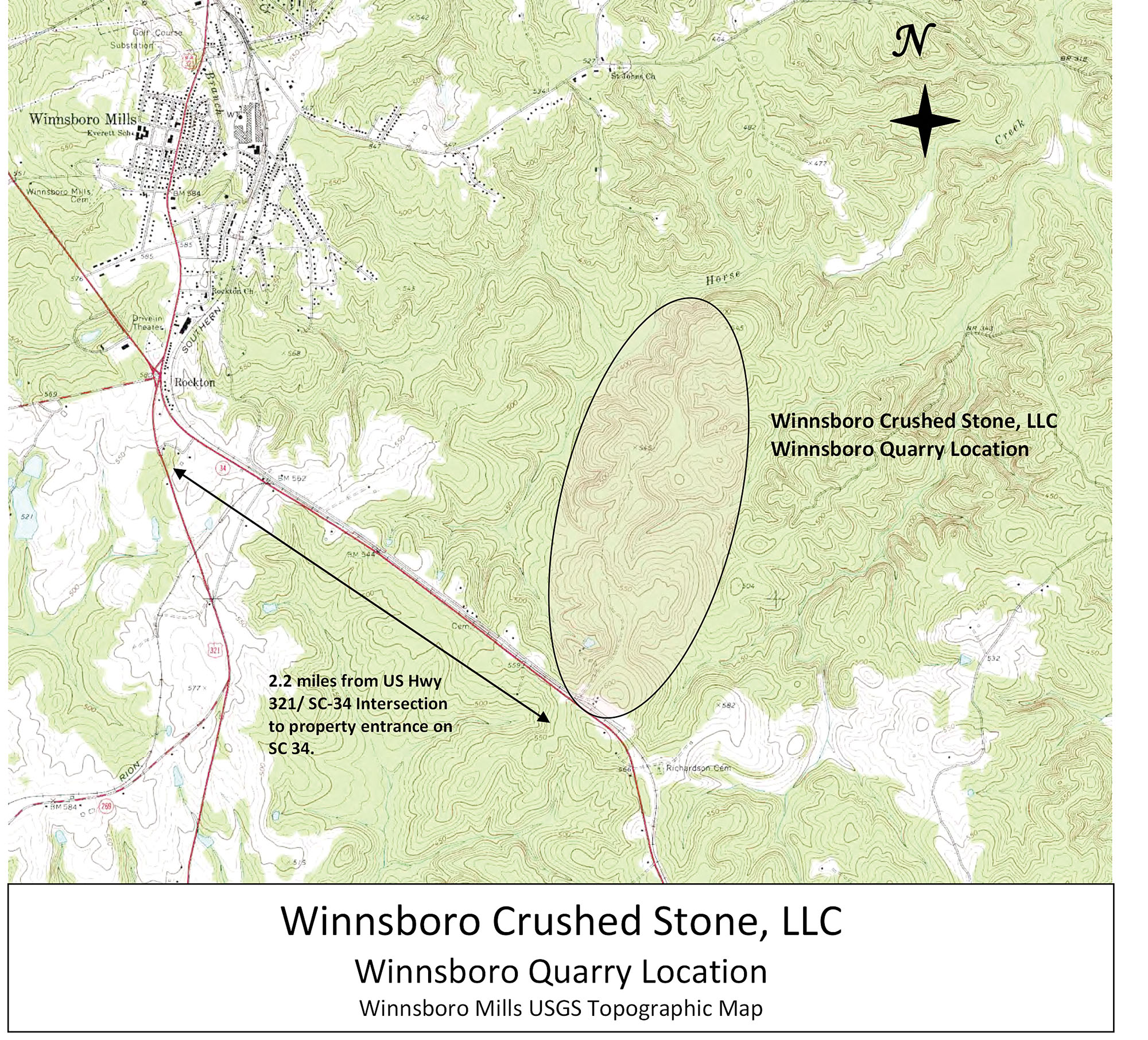
    The location of the proposed Winnsboro Crushed Stone Quarry.

    WINNSBORO – A proposal to mine granite from a portion of a more than 900-acre tract near the Rockton Thruway and process the stone into gravel has local residents up in arms. While the permit, submitted by Winnsboro Crushed Stone, LLC, is still pending before the S.C. Department of Health and Environmental Control (DHEC), residents of the surrounding area came before County Council Monday night to express their opposition to the quarry and ask Council to do the one thing it can do to kill the project.

    “The proposed quarry is in an area zoned as residential,” Dorothy L. Brandenburg, a Rockton Thruway resident said, “and the residents who live in the surrounding areas wish for that property to not be rezoned.”

    Winnsboro Crushed Stone, whose home office is listed as Monroe, N.C., according to documents available on DHEC’s website, submitted their application on March 13, but inspection of the land began more than a year ago. Archeologists with Brockington and Associates, Inc. of Charleston visited the site between April 15 and April 19 of 2013 at the request of Kennedy Consulting Services, LLC of Lexington, a group working for the Boggs Group, Inc., also of Monroe, N.C. According to their report, also available on DHEC’s website (www.dhec.sc.gov/environment/lwm/publicNotice.htm), the purpose of their visit was to help the Boggs Group obtain necessary permits to open and operate a granite quarry within a 569-acre tract.

    While the survey team stated that 10 archeological sites and six isolated finds were located on the property, the sites and finds were “small, low density prehistoric lithic or historic artifact scatters,” and were ineligible for the National Register of Historic Places.

    Between March 22 and April 16, 2013, Palmetto Environmental Consulting, Inc., of Lexington, visited the site to conduct an assessment of federally listed threatened and endangered species, as well as state listed rare, threatened and endangered species. Their report concluded that a “potential habitat for 10 of the 17” state and federal protected species known to occur in Fairfield County “appears to be located on the site,” none of the listed species “were readily observed” during their field investigations.

    But endangered species, as well as the method by which granite would be extracted from the site, were among the concerns expressed by Brandenburg’s mother, Lisa, during the first public comment portion of Monday’s meeting.

    “We have endangered species on our properties,” Lisa Brandenburg said. “The use of dynamite, the railroad spur that will be put in, the extra traffic on 34 is going to make it hazardous and a death trap for anybody trying to drive in and out on 34.”

    The mining application of Winnsboro Crushed Stone indeed notes the use of “blasting” as part of the mining process, but states that “all structures near the Winnsboro Quarry site that are not owned by Winnsboro Crushed Stone are located beyond ½ mile from the nearest point of blasting.”

    Interim County Administrator Milton Pope said that the County was not notified of the mining proposal until May 7, and since then, “there have been absolutely no other communications with the County about this mining application.”

    Chairman David Ferguson (District 5) instructed Pope to send a letter to DHEC requesting a public hearing on the mining proposal. The application expires on June 2.

    The property in question is located approximately 4 miles southeast of Winnsboro, 2.2 miles from the intersection of Highway 321 and Highway 34 and is accessible by the Rockton Thruway. The property owners are listed in the application documents as: Coleman Land & Timber, LLC (Hartsville, S.C. – 485.5 acres); Amos Davis Coleman, et. al. (Winnsboro – 349 acres); Jenkins & McLeod, LLC (Winnsboro – 35 acres); Quay W. McMaster (Winnsboro – one 43-acre tract and one 7-acre tract); and S.C. Electric & Gas (Columbia – 3.7 acres).

    The application states that 184.6 acres will be affected by mining and bonded; 185.6 acres will be affected by mining with bonding deferred; 147.4 acres for future reserves or future impact; and 405.6 acres for undisturbed buffer.

  • Pressure on to Find Use for Restaurant Money

    BLYTHEWOOD – The restaurant that just last year seemed destined for Doko Meadows in Blythewood’s Town Center is fading fast, leaving in its wake not only a huge pile of sand but a conundrum of ‘what-to-do’s’ regarding the money from grants and loans the Town acquired to build it. While discussing their options at Tuesday’s budget work session at The Manor, the Town’s economic development consultant, Ed Parler, explained that if they failed to use the money ($1,350,000) as planned and returned it to Santee Cooper, the Town would have to pay a penalty to the lender/grantor.

    Parler suggested that, instead of aborting the Town’s restaurant project and returning the money, he would like to see Council hang on to the money for now and pay the $18,000 annual interest payment due next October to Santee Cooper. He asked that Council consider appropriating that payment in the budget. Parler said, ideally, he would like to see the Town try to find a restaurateur who would want to build a restaurant similar to the upscale restaurant Mayor J. Michael Ross, former Town Administrator John Perry and the former Town Council had attempted to contract for last year with Jonathan Bazinet.

    “We have the money and the design for a restaurant that we would like to see built, and we can look for proposals from anyone interested in doing business in a similar type service,” Parler told Council.

    He suggested that, over the next six months, the Town use the local media to get the word out that the Town is looking for prospects.

    “After 45-60 days, if we don’t find what we’re looking for,” he said, “we might look at a family-style operation with the appeal of taking advantage of the park. If we still don’t get anyone, then we can send out RFQ’s (requests for proposals) for developers. My idea is to create job opportunities, a place that would employ people.”

    Parler said that if a restaurant doesn’t work out, maybe an office complex could be located where the restaurant was planned.

    Councilman Bob Mangone took the plan a step further, suggesting that the Town put the loaned/granted money into the Manor and turn it into a high-end restaurant, a move that he said might prove profitable for the facility.

  • Water Rates Up in Budget

    RIDGEWAY – Town Council gave the OK to first reading of the 2014-2015 budget during their May 8 meeting, and with that came an OK for a water and sewer rate increase that encompasses slightly more than the increase being foisted upon them by the Town of Winnsboro.

    “We pay for all the water we buy wholesale from Winnsboro and they go up on their rates,” Ridgeway Mayor Charlene Herring said. “In order to make some profit and provide the services, such as a person who needs help with their water and the testing and all that, we have to go up on ours, too.”

    But instead of just passing along Winnsboro’s 78-cent increase on rates across the board, Councilman Doug Porter recommended adding a few more cents to the base rate for the first 1,000 gallons for both water and sewer.

    “We’ve always passed on any rate increases from Winnsboro. This year, they’re going to increase their rates per 1,000 gallons 78 cents,” Porter said. “This is our major source of revenue, so if we have a lot of repairs that need to be done – re-waxing the Town water tank (two weeks ago) cost anywhere in the neighborhood of $10,000.”

    Councilman Donald Prioleau moved to accept Porter’s recommendation and Councilman Russ Brown offered a second. The motion passed without descent.

    The amended water and sewer rates for the first 1,000 gallons, effective July 1, are:

    Resident (in town): Water — $15; Sewer – $12

    Resident (outside town): Water – $20; Sewer – $13

    Commercial (in town): Water – $18; Sewer – $16

    Commercial (outside town): Water – $23; Sewer – $19.

    Overage rates for each additional 1,000 gallons will only carry the 78-cent increase passed along from the Town of Winnsboro. Those rates, also effective July 1, are:

    Resident (in town): Water — $5.07; Sewer – $4.42

    Resident (outside town): Water – $6.32; Sewer – $5.57

    Commercial (in town): Water – $5.07; Sewer – $4.57

    Commercial (outside town): Water – $6.32; Sewer – $5.57.

    Council did not propose any changes to water tap fees, which will remain at $500 for customers within the town limits and $800 for customers outside the town limits for a three-quarter-inch tap, non-bore. A 1-inch non-bore tap is also available for $900 for customers outside the town limits. Boring ads 10 percent to each fee. Sewer taps, both non-bore and bore, are provided at cost.

    Ridgeway’s proposed general fund budget comes in at $217,550, while their water and sewer fund is expected to be $359,355.

  • Council Trims Budget

    BLYTHEWOOD – Town Council (minus Mayor J. Michael Ross, who is golfing this week in Scotland) and Town Administrator Jim Meggs spent the better part of a four-hour budget workshop on Tuesday morning trying to stretch the Town’s actual revenue to cover its proposed expenses.

    Councilman Bob Massa, who chaired the meeting in the Mayor’s absence, said the preliminary look at the FY2014-15 budget shows total revenue at $1,208,000, down from $1,210,000 last year and total expenditures at $1,416,288, up from $1,210,000 last year. Massa said the proposed revenue will catch up somewhat before the next workshop in June as the franchise fees come in.

    The biggest cuts are suggested in proposed special initiative expenses in the general fund as well as the hospitality tax revenue fund. It was generally agreed at the meeting to cut about $300,000 from the $468,000 proposed for 10 or so special initiatives in the general fund. These items include many of former Town Administrator John Perry’s pet initiatives, including plug-in stations for eCars, additional eCar work vehicles for the Town, right-of-way purchases on McNulty Road to accommodate road widening and streetscaping, as well as the complete street plans. Cutbacks are also expected to several special initiatives currently paid for with hospitality tax revenues, such as the rental and other costs for The Visitor Center and Blythewood Artists’ Guild, certain events and the baseball tournament. At the same time, Massa and Councilman Bob Mangone suggested spending money on a billboard on I-77 to promote the Blythewood Artists Guild’s individual businesses and $8,000 for a part-time secretary for the Blythewood Chamber of Commerce. While the Town spent $34,258.22 last year on Perry’s “Special Initiative 3B,” no one on Council has so far determined exactly what that and several other similarly named special initiatives are. Massa said the Council should take a closer look at all these items before the next budget workshop on June 13.

    While the Town spent about $85,000 on mowing for the park and the new interstate landscaping last year, it plans to spend $95,000 this year; but that figure will also include the proposed $20,000 for new Christmas lights. Mangone criticized the lack of mowing and maintenance being provided for the new landscaping at the I-77 interchange and the median plantings at the Fairfield County line. Councilman Tom Utroska had mentioned prior to the meeting that the previous Council apparently did not provide for the costs of maintaining the considerable landscaping that was planted.

    A large chunk of the morning’s discussion focused on the Town’s hospitality and accommodation tax revenues and expenses. Massa pointed out that while the revenue is healthy, it is being stretched thin to pay for the park.

    “Almost 90 percent ($353,276) of the Town’s almost $400,000 annual hospitality tax revenue goes to make annual payments to the Blythewood Facilities Park for the $5.5 million park bond,” Massa told The Voice after the meeting. “That means that we are going to have to cut back on some of our traditional requests from community organizations for hospitality funds.”

    The hospitality revenue for the coming year (proposed at $270,000) is expected to be considerably less than the $287,000 budgeted for last year. That reduction is largely due, Massa said, to the decreased of tax revenue resulting from the renovation of the Bojangle’s Restaurant.

    “Anything over $270,000 this year will be a godsend,” Massa said.

    The state and local accommodations tax revenue is expected to be about $128,000 next fiscal year, down from the $157,000 expected in the current year’s budget, but up from this year’s actual intake of $95,000. The total hospitality and accommodations tax revenues are expected to be a little less than $400,000.

    Total proposed salary and benefits/expenses for Mayor Ross is $23,876, up from the $16,666.59 actually spent in FY2013-14. Total proposed (combined) salaries and benefits/expenses for Council is $22,177, up from $17,785.27 actually spent last fiscal year. Total staff salaries and benefits/expenses for FY2014-15 is $293,523, down from $379,549 actually spent last fiscal year.

    Council is expected to hold first reading on the budget at the May 27 meeting. It will continue to work on the budget at a second workshop to be held on June 13.

  • R2 Board OK’s Budget

    The April 29 Richland 2 School Board meeting began 30 minutes late before a packed house at Lake Carolina Elementary School. Executive session items were lengthy, said Chairmen Chip Jackson. While the specifics of those items were not disclosed, executive sessions items usually involve student discipline (there were 13 students appealing expulsions), personnel/ staff decisions and legal/contractual matters.

    The general fund operating budget was given the most time in the meeting. The Board had initially considered a budget that included an additional $13 million in property tax revenues over last year’s budget, but when word came from the Richland County Auditor’s Office that property tax collections would only generate $11 million more than last year, the budget was reduced by $2.1 million and the specifics of which line items to eliminate from the proposed budget were left to the discretion of the Finance department. In a 5-1 vote, the Board approved a total budget of $235 million.

    James Manning voted against the approval because it was lacking in the Board having the decision of what items were to be removed.

    Recognitions were made for many high school students: Westwood sophomore Andrew Plante won the 2014 State Strength Championship in the 190-pound weight class by pressing 280 pounds, squatting 495 pounds and extending himself 114 inches in a standing broad jump. Future Business Leaders of America students at Westwood High School (Jacob Schneider and Alani Thompson) and Blythewood High School (Ian Finch, Lorenzo Dyckes and Amy Johnson) won first-place honors at the FBLA state leadership conference. Blythewood High student Alex Vibber was honored for his first-place award at the recent Health Occupation Students of America (HOSA) state conference.

    Also in attendance were the Teacher Cadets from Westwood with Westwood teacher Jennifer Tinnery. They came to observe the Board meeting from the vantage point of a future teacher presenting to the District leaders and Board members. One student said that it was “interesting to see the role teachers can play outside the classroom in influencing education standard.” Early on in the meeting, a Lake Carolina science teacher lead her students in a presentation about nuthatch birds complete with singing by kindergartener Laura Eargle and a team of third-graders introduced the audience to the wonders of Canadian furry animals. The Teacher Cadets said they found the discussions about the District budget similar to talks from the economic classes.

    Fred McDaniels of the Planning Department reported on the recently launched on-line student registration process that has caught the interest of pre-school and kindergarten parents. While the initial workload was very heaving for the district’s IT Department, the streamlined approach has cut the registrar’s paperwork time in half, giving them more time to hear families about specific need their students might have. Families with multiple children would not have to repeat common data and the district can more accurately identify those that qualify for free or reduced meals. The District would like to encourage returning families to try the on-line registration and avoid standing in lines for the fall registration.

    The meeting ended a couple of hours later, around 9:30, with the Superintendent’s announcement of the District’s new Teacher Of The Year – first grade teacher Kim Kuhn of Bookman Elementary – and the national recognition for the third time to Blythewood Middle as ‘A School To Watch.’

  • Water Source May Be Closer Than Expected

    WINNSBORO – After meeting with staff members from U.S. Rep. Mick Mulvaney’s office two weeks ago in search of federal assistance in tapping into Lake Monticello for additional future water, Town Council learned Tuesday night that the solution to their problems might be right under their collective feet – and for a considerably lower cost than the proposed $8-$12 million to lay infrastructure out to Western Fairfield.

    Jim Landmeyer, a hydrologists with the U.S. Geological Survey (USGS) and a Blythewood resident, told Council Tuesday night that he had been following the trials and tribulations of the Winnsboro water system in The Voice newspaper “with great interest.” The problem is not unique to Fairfield County, Landmeyer said, and the USGS only recently wrapped up a study in Chesterfield County.

    “You’re not going to get (1,000 gallons a minute) in Fairfield County,” Landmeyer said. “You might get 200-300 gallons a minute. So if you had four production wells in a rock aquifer, pumping 200 gallons a minute, that’s a million gallons a day.

    “Have you ever thought about where that water (in the quarry) comes from? If you remember anything from tonight, remember that even though you’re sitting in fractured rock, you’re not sitting in sand (like Chesterfield), you do have an ample but unassessed source of water,” Landmeyer said.

    Landmeyer said a groundwater assessment survey would take two to three years to complete, with the entire project costing “a couple hundred thousand dollars.” A 30 percent match would be available from the federal government, he said.

    A groundwater survey has never been conducted in Fairfield County, Landmeyer said, at least not since 1879 when the USGS was founded. A mineralogical map was completed in 1970, he said, but there is no clear picture of how much water is available underneath Fairfield County, or how difficult it would be to bring enough of it to the surface for processing. The treatment of the groundwater would be minimal, he said, requiring only a dose of chlorine before it could be piped out to customers. Already there are many private wells in use in the county, he said, indicating that there is more water to be found.

    “There is groundwater out there,” Landmeyer said. “The question is, could we find the areas that are thick enough and open enough that you could depend on?”

    In other business Tuesday night, Council OK’d $26,000 in capital expenditures for the water plant for the purchase of a flow pump and its accessories. Council also reaffirmed an agreement voted on last November to provide 58 water taps to Landtech, a development in the Blythewood area.

    Blythewood’s efforts to bow out of their franchise fee agreement with Winnsboro for the use of right-of-ways in Blythewood for access to water infrastructure has not reached a final conclusion, Mayor Roger Gaddy said Tuesday.

    “I have talked with (Blythewood) Mayor (J. Michael) Ross on the phone,” Gaddy said. “I have not met with him personally, but I am sure there will be continued conversations to the negotiations.”