WINNSBORO – An era in law enforcement that has straddled two centuries came to an end this week as Fairfield County Sheriff Herman Young announced his resignation from office. The announcement came Tuesday morning and puts the future of the Sheriff’s Office, temporarily at least, in the hands of S.C. Gov. Nikki Haley, who will appoint an interim Sheriff.
Young, 72, was in the middle of what he said was to be his final four-year term. Filing will open next month, with a primary and runoff, if necessary, to follow. A special election to fill out the remainder of Young’s term will be held after the Nov. 4 general election.
Young said he has been struggling with non-specific health-related issues in recent months, which influenced his decision to retire.
“I’m going to miss being there,” Young told The Voice Tuesday. “I had every intention of completing my term, but as things got worse I felt I should hang it up.”
Young was sworn in as Fairfield County’s first African-American Sheriff in 1992. Prior to that, he had served as Administrator for the Fairfield County Detention Center since 1973. Born and raised in Blair, he began his career in law enforcement in 1962 as a New York City Police Officer. Young returned to Fairfield County in 1965 and became the first black police officer with the Winnsboro Police Department. In 1972, he became the first African-American EMT with Fairfield Memorial Hospital.
Young had only been Sheriff a short time when his office made national news, reopening a 20-year-old case that had been originally filed away as a suicide.
In 1967, Frances Beasley told police that her bed-ridden husband, Ronald “Little Red” Beasley had taken a .22 caliber rifle, fired it once at her and then put the barrel of the gun in his mouth and shot himself to death. Although then Coroner Earl Bower ruled the death a suicide, neither Little Red’s family nor Young believed it. Little Red had suffered a stroke a few months before his death. He could neither walk nor feed himself and required around the clock care.
In 1992, Frances Beasley – by then Frances Beasley Truesdale – was convicted of murdering her second husband, Jerry Truesdale, in Virginia. Although Virginia State Police handed their files over to the Fairfield County Sheriff’s Office in 1989, it wasn’t until Young took office that Little Red’s death was reopened. A Fairfield County grand jury indicted Frances Truesdale in January of 1996, and that November, while still serving her 20-year term for the murder of Jerry Truesdale, she was convicted for the murder of Little Red. Frances Beasley Truesdale died two weeks ago in a Virginia state penitentiary.
Young was recognized by his colleagues as Sheriff of the Year in 1996 and served as President of the S.C. Sheriff’s Association from 2011 to 2012. Young implemented the Summer Kids Camp and the Home Alone Program, a nationally recognized program that provides assistance to the elderly.
Gov. Haley’s office said the governor was “doing her due diligence” leading up to the announcement of a temporary successor, but added that an announcement would come quickly.
“Not only has Sheriff Young been an amazing public servant for 22 years but he is also a dear friend,” Haley said in a statement released Tuesday. “We are proud to celebrate his wonderful years of service. He is moving on from this post the same way he led the community of Fairfield County, with strength and grace. Michael and I, along with everyone in South Carolina, owe him a debt of gratitude.”
Young’s resignation was effective July 21. Filing for the election to fill the remainder of Young’s term will open Aug. 8 at noon and will close on Aug. 18 at noon. A primary will be held on Sept. 30 and any necessary runoff will be held on Oct. 14.
The special election for Sheriff will be held Nov. 18.
WINNSBORO – Extracting discretionary funds from County Council members is about to become more difficult and a lot more competitive, if the full Council accepts the recommendation made Monday evening by the Administration and Finance Committee.
While discretionary spending by Council members under former County Administrator Phil Hinely sometimes strayed from its $2,500 limit, included a rather informal paper trail and required the approval only of the Administrator, the new policy drafted by Interim Administrator Milton Pope and his staff outlines specific restrictions on the funds and requires a majority vote by the entire Council.
“What we tried to do from a staff perspective is to make sure the process we have is a transparent process, is an accountable process and is an open process for individuals to be able to submit things,” Pope told the Committee, which comprised Council Vice Chairman Dwayne Perry (serving as Committee Chairman), Council Chairman David Ferguson (substituting for Mikel Trapp) and Councilman David Brown (substituting for Carolyn Robinson).
For starters, the funds will no long fly under the flag of “Discretionary Spending,” but instead will be labeled “Community Enhancement Grants.” The funds are still limited to $2,500 per district and require the completion of a four-page application, accompanied by an IRS Form W-9. Charitable organizations will be required to provide the County with a copy of their 501 (c) or 501 (c) 3 designation form or a copy of their registration form from the S.C. Secretary of State’s Office.
According to the new policy, the County will award grants to fund the following types of projects:
Back to school supplies for K-12 students;
Community Enhancement programs/initiatives for churches, non-profit or other eleemosynary (charitable) groups that serve individuals or families in need;
Community Improvement Grants – programs/initiatives that improve the quality of life for neighborhoods, identification signs, beautification, etc.; and
Youth, Adult and/or Elderly programs/initiatives that support wellness, health fairs and related services to improve the overall quality of health in the community.
Applicants will have to describe in detail for the County how they intend to spend the funds, and a review panel will evaluate and score the applications based on the community and/or district benefit, the number of citizens served, the organization’s ability to deliver services and the county wide impact of the grant award. Special consideration will be given, Pope said, to organizations that are collaborating with other groups to deliver services.
Once the application has made it through staff, it will then come to full Council for a final vote. Grant recipients will be required to provide the County with receipts for how the funds were used and organizations found to have made questionable or unauthorized purchases with the funds, Pope said, may be barred from receiving future grants.
Brown, who along with Robinson has traditionally expended his District 7 money on providing street lights for the community, asked Pope where such an expenditure would fit into the new policy’s criteria. Pope said such an expenditure could either be incorporated into the policy for as long as that Council member holds their individual seat, or Council members could work with community organizations and encourage them to request the funds.
“It’s a competition for the best programs the community wants to get involved with,” Pope said. “There’s nothing that precludes a Council member from working with their community about some kind of need that’s been identified and apply for this.”
The draft of the policy discussed Monday evening capped the individual grants at $500 each, with a maximum of $2,500 per district. Ferguson, however, pointed out that Council may want to write more checks for less money.
“Because of how many churches we’ve got that we deal with, we don’t ever give that much to one church,” Ferguson said. “If you’ve got more churches than that that you could give like $250 or $300 to, you could supply more children in need in different churches. I think that’s the way we need to think about it.”
The Committee voted to amend the policy to read “up to $500,” keeping the maximum at $2,500 per district, and voted to recommend the policy to the full Council.
WINNSBORO – At its Tuesday evening meeting, Town Council held first reading of the ‘Baggy Pants’ Ordinance No. 080514 with no comment or discussion. Mayor Roger Gaddy said second reading and a public hearing will be held at the next meeting scheduled for Tuesday, July 29.
In other business, Council approved capital expenditures of $140,000 for a new garbage truck for the Streets and Sanitation Department and up to $25,000 for a dump truck with a wood chipper. Council also approved an application for a $140,000 USDA Rural Development Communities Facilities grant for the purchase of the new garbage truck. The truck will be financed through two sources: 55 percent (or $77,000) of the $140,000 matching grant and the balance financed by the Town of Winnsboro’s General Fund Unappropriated Investment Account.
Council also awarded a $31,350 contract to Site Concepts, LLC of Lugoff, to run a waterline down McCorkle Road, and tabled a request from the Fairfield Memorial Hospital Foundation for a donation to its annual BBQ, Bluegrass & Blue Jeans fundraiser in October, agreeing to take it up closer to the event.
Council finished the meeting with an executive session to discuss a contractual matter concerning an electricity contract with Project USA and legal and contractual matters concerning its water contract with the Town of Blythewood. Council also discussed a potential legal battle over water that was promised in 2008 to Sycamore Development, LLC, when it proposed to develop property on Rimer Pond Road in Blythewood (see “Winnsboro seeks resolution with Blythewood developer” in the July 4 edition of The Voice). No action was taken by Council members on any of the discussions.
RIDGEWAY – A proposed amendment to an ordinance restricting long-term parking in downtown Ridgeway was tabled at Council’s July 10 meeting, but not before considerable debate over the necessity of such an ordinance.
Ordinance 5-1001 already limits to three hours parking on Main Street, but Mayor Charlene Herring suggested an amendment to the ordinance to include police department property as well as the Cotton Yard, which the Town is considering leasing from Norfolk Southern Railway. Herring said the goal was to prevent drivers from leaving cars parked in town overnight for extended periods of time. Councilman Donald Prioleau, however, said the amendment was unnecessary and the number of cars parked overnight was negligible.
“You’re talking about one or two cars that may be parked down there sometimes overnight,” Prioleau said. “If (you’re going to be out of town), you’re going to be gone for two days, where would you want that car parked? Where there’s police protection.
“Several years ago, they had a limit on parking downtown,” Prioleau said. “That didn’t work out. I would hate to have somebody at somebody’s business, they come out and they’ve got a ticket.”
Councilman Russ Brown suggested the Town designate an area for parking more than three hours, with parking for more than one or two nights requiring permission from the Town.
“We don’t want the police to start bullying people,” Brown said. “I don’t think we need to abuse the privilege of having the lease and keep people off of (the Cotton Yard property).
“I think it can be curtailed a little bit,” Brown said, “but I don’t think we need to stop people and tell them what they can and can’t do.”
Prioleau said that the Town was “putting the cart before the horse” by attempting to place restrictions on property it doesn’t even yet have any rights to, but Herring said that in order for the Town to obtain the lease on the property, a tighter parking ordinance was necessary.
Police & Security
Following an executive session of more than two hours, Council emerged to authorize the hiring of a security officer to supplement the Town’s police force during special events. Council could not provide a figure associated with the costs of the temporary, as-needed hires, nor which private security company would be used.
Council also OK’d an oil change and a new set of tires for the Police Department’s Dodge Charger, at a cost of approximately $568.
Prior to the executive session, Councilman Heath Cookendorfer reviewed a list of proposed upgrades to the Police Department, including a new printer and a dedicated internet connection. Cookendorfer said a new computer was recently donated to the Department, but the internet was currently being accessed by using the library’s Wi-Fi.
“Jumping onto someone else’s network, you run some risks,” Cookendorfer said. “You open yourself up. It’s a lot easier to hack.”
Council took no action on the upgrades.
Restaurant
Town Council will soon be looking for a new tenant for the Old Town Hall Restaurant property on Main Street, as the property’s most recent tenant, Vesha Sanders, closed up shop and began the process of moving out last week. As of Council’s July 10 meeting, that search had not yet begun.
“They still have a time frame where they can renew their lease,” Brown said, “but they probably won’t. We’re going to give them their time to move out.”
Movie Night
Ridgeway plans to hold its first free movie night on Aug. 1 and is looking for sponsors for future films. Cookendorfer said the rights to show a movie in public cost between $300 and $400. Council voted to foot the bill for the Aug. 1 movie, which will be shown on the side of the fire station.
BLYTHEWOOD – The Board of Zoning Appeals (BZA) met Monday evening to hear the appeal of an administrative denial for multiple signage on a commercial property on Blythewood Road. But because the Board lacked a quorum, it was not able to convene. Of the Board’s seven members, only Chairwoman Sabra Mazyck and members Pat Littlejohn and Deborah McLean attended.
The appeal was brought by Sandy Khan, owner of the State Farm Insurance office located in front of the IGA on Blythewood Road. Last month Khan asked former interim Town Administrator Jim Meggs to allow her to place two signs on her property, one for her insurance business and the second for the Chamber of Commerce and Visitor’s Center located in the same building at the back of Khan’s property. That building also houses the Blythewood Artists Guild, and all three offices rent space from Kahn.
There are currently three signs on the property – a large sign on Blythewood Road that displays signs for both State Farm Insurance and the Blythewood Artists Guild; a 3x 4-foot free-standing sign at the back of the property for the Blythewood Artists Guild and a smaller sign in the side window of the Guild. An additional sign for the Chamber and Visitor’s Center would bring to four the number of separate signs on the property.
Meggs denied the request. In a memorandum dated July 11, Meggs updated the BZA on the issue, explaining that “Only one sign is permitted.” Meggs wrote that he informed Khan that she could appeal his interpretation of the law to the BZA.
In her request for an appeal, Khan said she felt that because The Chamber and Visitor’s Center are civic organizations, they should be exempt from the requirements of the sign ordinance that other businesses in the town must follow. In his memorandum to the BZA, Meggs wrote that, “The exemption which (Khan) claims is not applicable because a sign advertising the Chamber and the Visitor’s Center is not a sign erected by or on behalf of the Town or some other government (which are exempt.) There is no exemption for signs erected by or on behalf of a civic organization. Only a flag, badge or insignia of a civic, etc., organization is excluded from the definition of the term ‘sign.’ Signs placed by civic, etc. organizations are subject to the same regulations as commercial signs.”
Mazyck told The Voice that she expected the Board would be asked to call a special meeting soon to hear the issue. The BZA is a quasi-judicial board that meets only when there are appeals or requests for variances.
BLYTHEWOOD – A welcoming reception will be held for Blythewood’s new Town Administrator Gary Parker at The Manor on Thursday, July 24, from 5:30 to 7:30 p.m. The event will be sponsored by the Town of Blythewood in conjunction with the Blythewood Chamber of Commerce’s ‘After Five’ networking event held every third Thursday. Mayor J. Michael Ross will be on hand to introduce Parker to the Chamber’s members and their guests.
Parker, who retired as Town Manager of Sunset Beach, N. C. last December, was hired by the Town of Blythewood on June 17. He holds a master’s degree in public administration from N.C. State University in Raleigh and has more than 30 years’ experience in municipal government.
Chamber members are asked to register themselves and their guests for the event on the Chamber’s Eventbright page. The Manor is located at 171 Langford Road in Blythewood.
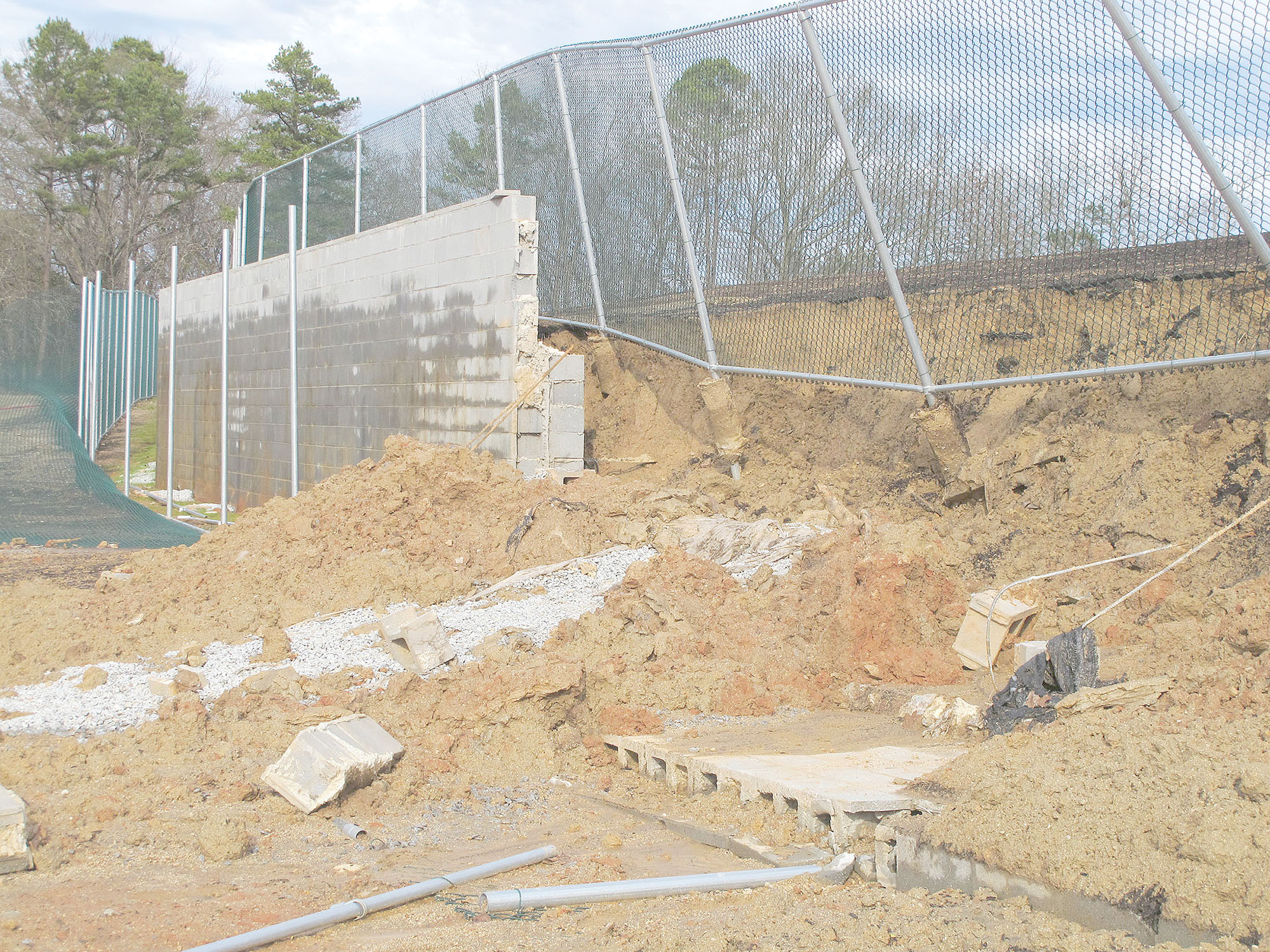
The aftermath of January’s collapse of a portion of the retaining wall around the new Drawdy Park football field. Construction has since picked up the pieces and is in the process of moving on.
WINNSBORO – Six months after nearly 60 feet of a 473-foot long retaining wall around the Drawdy Park football field collapsed into a heap of rubble, a detailed report from an independent engineering firm was obtained this week through an FOIA request by The Voice from Fairfield County Administrator Milton Pope. Although the wall collapsed following a day of heavy rain back on Jan. 12, the report places responsibility for the failure squarely at the feet of the project’s engineer, S2 Engineering and Consulting, their subcontractor, Four Brothers Enterprise, LLC and the unconfirmed individual whose name is on the plans.
“A lack of design detail and a disregard for the design intent during construction directly contributed to the failure,” the report, prepared by Goodwyn, Mills and Cawood, Inc. and dated March 31, states. “The design drawing does not include key elements on the spacing and geometry of the wall section, leaving construction personnel the latitude to deviate from the intent of the design professional. Additionally, the drawing does not include the signature of the design professional or the seal of the company that was responsible for the design as required by South Carolina law.”
Following the collapse, a Blythewood general contractor with experience in wall construction reviewed photographs of the wreckage for The Voice and expressed serious concerns with how the wall was constructed. The contractor, who wished to remain anonymous, said it appeared as if there had been no plan for constructing the wall, or if there had been, the plan had not been followed.
Among his concerns for a wall of that height (10 feet) was the absence of adequate rebar in the construction. Photographs of the collapsed portion of the wall show rebar inserted into about every eighth column of block. The Blythewood contractor said rebar should have been inserted into every column of block and should have been filled with concrete. Photographs of the collapsed section indicate that little or no concrete fill had been included with the rebar.
The Blythewood contractor also said the blocks had not been interlocked, as they should have been, nor were the deadmen (horizontal support sections running from the wall into the earth behind the wall). Rebar had also not been properly installed into the deadmen. Soil behind the wall also should have been compacted with every 2 feet of fill, the contractor said. Photographs of the collapse indicate that it had not. Weep holes (drainage holes) also should have been provided along the base of the wall, he said. No such holes are visible in the photographs.
That analysis was confirmed by the March 31 Goodwyn, Mills and Cawood report.
“The construction of the wall did not follow industry standards for the placement of the fill or the coursing of the reinforced masonry,” the report states. “The lack of adequate drainage behind the wall and the improper construction of the piers led to a failure . . .”
The Drawing Board
According to documents and invoices obtained earlier this year by The Voice, the County paid S2 $39,750 in March of 2012 for “architectural and engineering design layout and drawings.” Less than a month later, the County forked over another $11,275, since S2 discovered that the “total area for the Drawdy Park Survey and Engineering study is more than twice the size that was originally given,” according to the invoice. But as of last February, the County had no drawings for the project in its possession.
Drawings inspected by The Voice shortly after the wall’s collapse were revealed to be merely a set of “as-built” drawings pertaining strictly to the ill-fated retaining wall – drawings dated after construction of the wall had been completed. The drawings are not to scale and include little detailed information. Sources with the County told The Voice that the drawings were not plans, but were “as built” drawings and were protocol for changes that occur during a construction project. Those drawings were indeed unsigned and bore no official seal. The drawings were labeled as having been prepared by Sherman Sumter. A search of the S.C. Department of Labor, Licensing and Regulation database turned up no mention of Sumter.
Rising Costs
The retaining wall was only a few months old and still under warrantee when it toppled, and last month work began on reparations. S2 was still at the helm, but with Mims Contracting serving as subcontractor and Chao Associates as structural designer. The work is being done at no cost to the County.
Former County Administrator Phil Hinely green-lighted the construction of the new football field in May of 2013 with a cost limit of $280,000, but documents obtained earlier this year by The Voice indicate the project actually began much earlier than that, with the price tag quickly climbing to more than $380,000.
Last January, The Voice submitted a Freedom of Information Act (FOIA) request to the County for an itemized breakdown of all costs and expenses associated with the Drawdy Park project. The County answered that request, but instead of providing an itemized breakdown, only supplied The Voice with a copy of the County’s final authorization form and a “technical memorandum” from S2 to the County. Bids and invoices for chain link fencing around the field were also included, but an itemized breakdown of S2’s work was not. Those constituted all of the documentation in the County’s possession regarding costs for the project, Pope told The Voice.
The “Authorization to process on building maintenance projects assigned to S2,” signed for final approval on May 21, 2013 by Hinely, show that the Drawdy Park project was not to exceed $280,000. But the “technical memorandum” from Sam Savage of S2 Engineering & Consulting to Davis Anderson, Deputy County Administrator, dated May 15, 2013, gives a rough outline of “work to be performed and work that is near completion,” with an estimated cost of $321,200.
While the memorandum provides a laundry list of various aspects to the project – from engineering design and site clearing to the installation of an irrigation system and the construction of the retaining wall – it does not include any line-item costs or expenses associated with each aspect. A handful of invoices and other documentation obtained by The Voice through anonymous sources, meanwhile, indicate that the County has shelled out at least $339,750 to S2 for the project since March of 2012.
SLED
Last February, the S.C. State Law Enforcement Division (SLED) launched an investigation into Fairfield County’s procurement practices under Hinely. Of particular interest in the early stages of that investigation, according to a statement made by Council Chairman David Ferguson after Council’s Feb. 25 meeting, was the County’s relationship with S2 Engineering. Between December 2009 and September 2013, the County shelled out more than $8.76 million to S2 for various contracts. According to documents obtained by The Voice, projects over that time period range from improvements to the HON Building, construction of the new Voter Registration offices, work at the County Courthouse as well as the Drawdy Park project.
While records indicate that most, if not all, of these projects were not put out for bid, Pope said during Council’s Feb. 10 meeting that S2 was one of several firms on a list of firms approved for County work by Hinely. Since Pope’s arrival as Interim last summer, the County has returned to a more conventional procurement process, putting projects and purchases out for bid in accordance with County policy. Ferguson said on Feb. 25 that while the former procurement practices may have been unusual, they were not illegal.
“Was it best practices? It was the cheapest practice for us to get jobs accomplished,” Ferguson said. “Did we bid out every job? No. With Milton (Pope) we do. Does that cost you? Yeah, it does.”
A spokesperson for SLED told The Voice this week that their investigation remains open.
The Reconstruction
The March 31 report by Goodwyn, Mills and Cawood concluded that the failed section of retaining wall should be rebuilt by the contractor and that a drainage system, as well as waterproofing, should be installed on the back side of the wall to prevent another failure. Mims Contracting, under the direction of S2’s Sam Savage, has since had to overcome several challenges.
According to daily inspection reports provided to the County by Goodwyn, Mills and Cawood between June 3 and June 26, inspectors were able to prevent Mims Contracting from installing the incorrect rebar size on the new construction. Soil compaction testing, which held up the project for weeks, was finally completed and approved on June 23. Drainage appears to be an ongoing issue at the site, as three times the inspector has instructed the crew supervisor to open a temporary drainage trench at the wall footing. As of June 24, that had not been accomplished. Inspectors also noted safety concerns at the site and on June 19 recommended the installation of a safety fence beyond the top slope at the edge of the football field.
BLYTHEWOOD – At its regular monthly meeting on June 30, Town Council passed first reading on a recommendation from the Planning Commission to rezone a property on Syrup Mill Road from Rural Estate (RE) to Rural (RU). Property owner Jeremy Tesimale had appeared before the Planning Commission earlier in June to request the rezoning, which he said would allow him to subdivide the 4-acre property for sale.
RE zoning is similar to RU zoning except that RE requires a minimum acreage of 4 acres, while RU zoning requires a minimum of 1 acre.
Tesimale told the Commission that his rural neighborhood is a mixture of RE and RU zoning and that he had talked to his neighbors about the rezoning and that they did not object to it. The matter will have to pass one more reading at the next Council meeting before it becomes final. A public hearing on the rezoning and the final vote are scheduled for July 29 at 7 p.m., at The Manor.
BLYTHEWOOD – With no quorum at the Planning Commission meeting on Monday night, the meeting was not convened, but the two members in attendance, Chairman Malcolm Gordge and Buddy Price, informally discussed the only two items on the agenda: a pending federal mandate for the Town to manage its storm water and a pending new plat for Ashley Oaks’ Club House and Swimming Pool. Both were listed on the agenda as discussion-only items. Town Administrator Gary Parker and the Town’s Planning Consultant Michael Criss were also in attendance.
Town’s New Mandate
Gordge explained that existing federal legislation, titled Small Municipal Separate Storm Sewer System (SMS4), an offshoot of the 1970 Clean Water Act, will impose a storm-water management program on the Town, perhaps as early as this summer. The program is legislated federally, and administered at the State level by the S.C. Department of Health and Environmental Control (DHEC). It has already been imposed on larger towns and counties in the state, including Columbia and Richland County. The purpose of the program is to require the small towns in urban-designated areas to provide management, monitoring and reporting of all storm water (not including sewage) and other run off sources in the community with the intent of protecting streams, rivers and other water sources.
Gordge said he and Criss recently attended a workshop, conducted by DHEC, that gave the town government a heads up that it may be designated as one of those smaller towns that must embrace the SMS4 program.
“The designation is a result of the 2010 U.S. Census, which included Blythewood within the urban area of Columbia,” Gordge explained. He said the program is broad, comprehensive and designed to minimize the introduction of chemicals, pollution, bacteria, silt and other run off contaminants into the area’s surface and ground water.
While Criss explained that Blythewood adopted an extremely comprehensive low impact development (LID) ordinance a couple of years ago designed to work with nature to manage storm water as close to its source as possible, that ordinance primarily provides for management of runoff on new construction sites on private property, not on existing properties. He said the park and The Manor were built in compliance with that ordinance. But he said the SMS4 federal legislation addresses storm drainage and runoff from all sources in the community as they affect the whole community.
“This will be a major responsibility for the Town,” Criss said, “and we will have to complete or extend our existing LID storm water program in order to comply.”
Criss told The Voice that he expects Blythewood will receive an official letter from DHEC later this summer requiring the Town to enter the program. Criss said he and Gordge have asked DHEC to send a representative to Blythewood in late July or August to explain to the officials of the town, the media and the public what the Town’s responsibilities are regarding the program. Instead of the town government bearing the entire budget and staffing responsibilities for administering such a program, Criss said Blythewood officials might be able to negotiate an intergovernmental agreement with the County to administer the program.
“When Town Hall receives that letter from DHEC,” Criss said, “we’ll be under a timeline to comply. We will probably have six months to apply for permit coverage, then another year to develop a corresponding Storm Water Management Plan.”
Asked if existing private property land uses would be affected by the Town’s compliance with the program, Criss said they could be if, for example, the Town’s monitoring system discovers a septic system or other source is discharging contamination from private property.
“It would be the property owner’s responsibility to comply with the regulations,” Criss said.
Criss told The Voice that part of the Town’s responsibility in the program will be mapping the entire community’s storm water systems from catch basin to ponds and rivers. He said that while the Planning Commission would probably take the leadership role in fashioning recommendations for consideration by Town Council regarding the regulatory authority to implement and enforce the program on the local level, both he and Gordge said it might be beneficial to assign a task force or work group of citizens to research the implications of SMS4 more fully and help with making the recommendations to Council.
“As a small municipality,” Gordge said, “it is our job to submit a Notice of Intent (to comply with the State requirements) and be accepted by July 1, 2015. If we are approved then we get the benefit of State provided assistance, training, inspections, etc. If we are rejected we would have to prepare a case for independent control and monitoring of our storm water discharges. If we are late with our NOI, or are rejected we would be liable for any water pollution that can be traced back to the TOB.
“Another option to consider,” Gordge said, “is to combine resources with similar municipalities such as Arcadia Lakes and file a joint NOI ideally by November to allow six months for processing by DHEC.
Ashley Oaks Club House and Pool
Gordge, a resident of Ashley Oaks, explained that a new plat was carved out of the neighborhood’s common area that contains the clubhouse and swimming pool. The tract of land, he said, was owned by Mike Shelley the original developer of Ashley Oaks. When Shelley’s property was sold in lieu of foreclosure several years ago, the swimming pool passed to First Palmetto Bank, then to Crown Communities and then Essex Homes.
“To the mutual benefit and agreement of Essex Homes and Ashley Oaks HOA (Home Owners’ Association), the pool, clubhouse and the four acres on which it stands is to be deeded to the HOA since Essex has no use for it and the HOA maintains the property and amenities,” Gordge said.
The plat has already been approved by Jim Meggs, the former acting town administrator.
“The only reason it came before the Planning Commission,” Gordge said, “is to find out if anyone on the Commission had any problems with this arrangement.”
Even though the meeting was not an official meeting of the Commission, the two in attendance decided that it would not be necessary to bring the plat back for the full Commission to consider.
WINNSBORO – After sequestering themselves in executive session for more than 90 minutes, Town Council Tuesday night took no action on a potential legal battle over water that was promised in 2008 to a developer of property on Rimer Pond Road in Blythewood, instead accepting items from the closed-door session as information.
In 2008, Sycamore Development, LLC had planned to develop a 300-home subdivision on three parcels of land along Rimer Pond Road and obtained from Winnsboro a Capacity and Willingness to Serve letter for the development of 250 residential lots. The water taps were to be prepaid by Sycamore once the water line went in on Rimer Pond Road. That water line was completed and accepted by Winnsboro in July of 2009, but Sycamore never prepaid for any taps.
The subdivision never materialized, and two of the three parcels have since been sold off. Sycamore still holds a 31.23-acre parcel at 502 Rimer Pond Road that it also wants to unload but cannot, according to documents obtained by The Voice, because Winnsboro allegedly refuses to enter into a Capacity and Willingness to Serve agreement with prospective buyers.
Now Sycamore is considering legal action, documents indicate, unless Winnsboro makes good on its 2008 agreement. Sycamore is requesting 107 residential water taps, which is the equivalent of nearly 43,000 gallons a day, plus an additional 25,000 gallons a day for residential or commercial use. The extra 25,000 gallons per day would only come into play if the City of Columbia refuses to provide water to the property. Winnsboro would charge $1,350 for each tap.
“In 2008 we had promised them water and they never did anything with it,” Winnsboro Mayor Roger Gaddy said after Tuesday night’s meeting. “Now they want water and they wanted an answer rather quickly.”
Gaddy said he could not discuss pending or potential litigation, but said it was the Town’s intent to work out a deal. Documents state that Sycamore wanted a response in writing by July 15.
“We will meet with them (Sycamore), meet with Columbia and see what our options are,” Gaddy said.
Baggy Pants
Council also took no action on an ordinance to prohibit the wearing of baggy pants within the Town limits. Gaddy said a first reading on the ordinance would be taken up at Council’s next meeting on July 15.
Franchise Fee
A resolution to Winnsboro’s water franchise agreement with the Town of Blythewood, which was suddenly and unexpectedly terminated by Blythewood Town Council in April, remains in limbo. Although discussed in executive session, Council only accepted that discussion as information when they returned to open session.
Blythewood’s resolution to terminate the agreement came six years ahead of schedule, as the contract between the two towns is binding until 2020. Winnsboro has approximately 750 taps in the Blythewood area and has been paying the Town of Blythewood a franchise fee of around $13,000 a year for the use of Blythewood’s rights of way. Termination of the agreement, should it stand, would end those payments.
Personnel
Council voted 3-0 to lift the Town’s hiring freeze in order for the Gas, Water & Sewer Department to fill three vacancies.