COLUMBIA – In a 4-1 decision Monday afternoon, the State Election Commission denied an appeal by District 3 County Councilman Mikel Trapp, upholding the Nov. 17 ruling by the Fairfield County Election Commission that ordered a new election in District 3 between Trapp and challenger Walter Larry Stewart.
“It’s almost a new day in Fairfield County,” Stewart said after Monday’s ruling. “It’s time for the people to speak. We went through the process of law and that was step two. Step three is to have another election, and we’ll go from there.”
Trapp and his attorney, John C. Moylan III, have 10 days from the time a written order is produced by the State Commission in which to file an appeal, which would go directly to the S.C. Supreme Court. Debra Matthews, the Winnsboro attorney who represented Stewart in his protest and at Monday’s appeal hearings, said she was prepared for the possibility of an appeal to the High Court.
“We’re pretty confident,” Matthews said. “We’re prepared, because we’ve already done all the research and have all the Supreme Court cases to support the evidence, so we’re good to go.”
Trapp’s appeal hinged on his attorney’s ability to introduce as evidence sworn affidavits from a pair of voters in the Monticello precinct. Those voters were two of the five voters, Matthews successfully argued in Stewart’s Nov. 17 protest hearing, who had been given incorrect ballot styles in the Nov. 4 election, which Trapp won by only four votes. The affidavits, however, testified that both voters would have voted for Trapp, had they been given the correct ballot style on Nov. 4.
Kadena Woodard, who sat in for Trapp at the Nov. 17 hearing, tried to introduce similar documentation. Matthews objected, however, as the documents were not notarized. The County Commission agreed, accepting them only as “offers of proof,” to be judged by the State Commission.
Monday, Moylan urged the State Commission to hear the appeal “de novo,” or anew, considering the now sworn and notarized affidavits.
“It is beyond ironic that someone could use supporters of Mr. Trapp to overturn Mr. Trapp’s election,” Moylan argued. “That cannot stand. To turn a blind eye to direct evidence, we would submit, is not the appropriate thing to do.”
But Liz Crumb, an attorney from the McNair Law Firm representing the County Commission, argued otherwise.
“The rules of evidence of the Circuit Court must be followed as nearly as practicable (in election protest hearings),” Crumb told the State Commission. “You have a very thorough record before you, and the only reason the Board can determine to have a de novo hearing is when there is not a full and complete record and you determine that more evidence is needed.
“To allow affidavits after the fact,” Crumb said, “is not a proper proceeding.”
The best evidence of how a voter intended to vote, Crumb said, is, according to numerous court cases, the ballot.
“The problem is, in this case, they weren’t given the proper ballot styles,” Crumb said, “so you do not have a ballot. In this case, we believe it is improper to allow evidence after the fact when Mr. Trapp could have attended the (Nov. 17) hearing, did not ask that the hearing be delayed and provided documents that weren’t even notarized.”
Moylan reminded the State Commission that it only took two members of the Commission to move to a de novo hearing. Billy Way Jr., Chairman of the State Commission, opened the floor for such a motion to his fellow commissioners, but the Board was silent.
After returning from executive session and prior to calling for a vote on the matter, Way said that the Commission had not considered the new affidavits in their deliberation.
WINNSBORO – After more than an hour in executive session Monday night, a Fairfield County Council that was three-sevenths shy of a full load voted to lawyer-up and assist Rockton Thruway residents who have for nearly a year been fighting a mining company that is eyeballing more than 900 acres for a granite quarry in their back yards.
The late addition of the item to Monday night’s agenda captured the attention of Winnsboro Crushed Stone, LLC, which sent Charlotte attorney Jay McKeown to speak on its behalf during the meeting’s first public comment session.
“They were surprised to see that on the agenda tonight,” McKeown told Council. “The bottom line, and most simply, is there is a process in place. S.C. DHEC (the Department of Health and Environmental Control) has a process in place for mine applications. That process is in progress. There have been a number of public hearings and comment with regard to that process and I ask the Council to let that process go forward.”
McKeown told Council that the property in question, 405 acres of which will be left as undisturbed buffer, was zoned as Conditional Use in 2012.
“As I understand it, nothing has changed in the zoning laws or the ordinances that would affect this certificate that was issued by a County employee,” McKeown said. “The question I have to keep asking myself, and hopefully, Chairman, this Council may be asking this question, is why are you voting on it tonight?”
A similar venture, Fairview Mine in Blair, was issued a permit in 2009, McKeown pointed out, without the County becoming involved at all. A vote against Winnsboro Crushed Stone, McKeown added, was bad for business.
“If a business can’t rely on the County in upholding ordinances and zoning certificates, what type of affect will that have on businesses in the future?” McKeown asked. “A ‘No’ vote will have a negative impact on future investment and future industry in this county.
“This is a S.C. DHEC decision,” McKeown added. “And I think many of the members of Council understand that the County at this point, after giving permission, has nothing further to do with regards to this permit.”
While Council did not vote Monday night to ban the operation of the mine, they did vote to retain an attorney to help ensure that residents of Rockton Thruway had their concerns addressed. Many of those concerns were aired out at a Nov. 20 DHEC public hearing, held in the Fairfield Central High School auditorium. Those concerns included the impact of blasting at the mine on nearby homes, air quality, truck traffic and, predominantly, water usage.
“Because the Council has so many questions regarding the impact of the wells, the impact of truck safety, the hours of operation and meeting all of the standards and federal requirements,” Councilwoman Mary Lynn Kinley (District 6) said in her motion Monday night, “the Council does hereby direct the County Administrator to retain legal representation to defend the interests of Fairfield County in regards to the pending mining application of Winnsboro Crushed Stone.”
All four remaining Council members – Kinley, Carolyn Robinson (District 2), Chairman David Ferguson (District 5) and Vice Chairman Dwayne Perry (District 1), who also offered the second – voted in favor. Councilman Mikel Trapp (District 3) was present at the outset of the meeting, but did not return with Council after the executive session. Councilmen David Brown (District 7) and Kamau Marcharia (District 4) were not present Monday night.
After the meeting, Milton Pope, County Administrator, said the legal counsel will “look at all of these outstanding concerns that a lot of these citizens have raised, to look into those items along with the information at DHEC to provide public comment before the close of the public comment period on Dec. 4.”
Lisa Brandenburg, a Rockton Thruway resident that has helped lead the charge in opposition to the quarry, said after the meeting that her camp was “elated” at Council’s decision.
“But we are prepared to move forward with all initiatives,” she added.
WINNSBORO – Although Dr. J.R. Green, Superintendent of Fairfield County Schools, classified as “disappointing” results from this year’s district and school report cards, released this month by the S.C. Department of Education, what was more disappointing, he said, was one School Board member’s misinterpretation of those results and her Facebook post stating the results indicated a “dysfunctional school board.”
The District as a whole received, for the third consecutive year, an Absolute Rating of Average, while its Growth Rating slipped from Excellent in 2013 to At-Risk this year.
“I wanted to see us get to ‘Good’ by this year,” Green said. “We came up short. But there’s no doubt in my mind that we’re going to keep working hard and we’ll get there. Our goals remain high.”
Green said an on-time graduation rate that stalled out below 80 percent was primarily the stumbling block. The District’s on-time graduation rate was 76.3 percent, which is slightly above that of other districts with similar students (76.2 percent). The District also out-performed similar districts on HSAP passage rates (85.9 percent to 85.3 percent) and on End of Course exam passage rates (65.4 to 56.9 percent).
Green said the increased number of “self-contained students” (students identified as having cognitive disabilities) who are not seeking a four-year diploma, but are instead seeking certificates, counted against the district’s on-time graduation rate, and represents a flaw in the grading system.
Board member Andrea Harrison (District 1) posted a scathing indictment of the Board and the District on her Facebook account on Nov. 19 after the report cards were released.
“Want to know the results of how a dysfunctional school board [sic]?!! SC Annual Report Card: Fairfield County . . . drumroll please . . . DROPPED from EXCELLENT to At-Risk!!!!!” Harrison’s post began. “Now what’s wrong with that picture?!!”
In an email to the Board and to members of the administration, Green responded on Nov. 20, “Administrators, teachers, students and parents have worked extremely hard to achieve these results, and for someone who is a part of our governing body to attempt to discredit their success is extremely disappointing. As you will see, Ms. Harrison presents the ‘Growth’ rating in her post to support her position that the district is not experiencing academic success.”
The District’s Absolute rating of Average for three years running is, Green said, the “most significant, sustained, academic success the district has experienced” at least since 2006, which is as far back as the Department of Education’s report card data goes.
Growth ratings represent the movement between scores from year to year, and a school or district can maintain a Good Absolute rating, for example, but have a Growth rating of At-Risk. Scores at a school or district could, for example, drop from 84 to 81. That school or district is still Average, but since the scores dropped 3 points from one year to the next, its Growth rating is At-Risk according to the report card system. Conversely, a failing school may see a Growth rating of Excellent if its scores move from 51 to 59, but the Absolute rating remains At-Risk.
“It is unreasonable to expect that any district would be in a state of perpetual growth,” Green wrote in his email last week.
Harrison, in her post, encouraged community members to attend Board meetings so they can find out “WHAT IS REALLY GOING ON!!”, she wrote, “I know 2 of us will tell you the TRUTH!!”
Green said he is also encouraging the District’s stakeholders to attend and that he plans to present at next month’s meeting facts related to the report cards detailing the District’s run of sustained academic success. He said he will ask Ms. Harrison to also present any evidence she has to the contrary.
Responding by email Monday night, Harrison wrote: “Pursuant to the S.C. Annual District Report Card Summary, in the Growth Rating Category, Fairfield County School District went from a rating of ‘Excellent’ in 2013, to an ‘At-Risk’ rating in 2014. My Facebook post did not misrepresent this public fact. As a School Board member in Fairfield County, and a champion of education, it is my desire that every parent, community member, etc., be involved in our children’s education, this includes attending school board meetings, which is crucial in ensuring the continued academic success of our children and our school district.”
This marks the third straight year of an Absolute rating of Below Average for FES, while their Growth rating is down from last year’s Average. Green said FES houses the largest concentration of Exceptional Ed students in the District, whose scores are calculated along with those of traditional students.
Geiger Elementary – Absolute rating: Average (second straight year). Growth rating: Excellent (also second straight year).
Kelly Miller Elementary – Absolute rating: Average (third year). Growth rating: Average (down from Excellent).
McCrorey-Liston School of Technology – Absolute rating: Average (second year). Growth rating: Average (down from Good).
Magnet School for Math and Science – Absolute rating: Excellent. Growth rating: Good. Second straight year of Absolute rating of Excellent; Growth rating up from Average last year.
Fairfield Middle School – Absolute rating: Average. Growth rating: Average. (Third consecutive year of Absolute and Growth ratings of Average).
Fairfield Central High School – Absolute rating: Average (third year). Growth rating: Below Average (down from Average).
WINNSBORO – The battle for the District 3 County Council seat entered its next round Monday when the incumbent, Mikel Trapp, filed an appeal with the S.C. Election Commission of a Nov. 17 order for a new election by the County Election Commission.
Trapp edged out challenger Walter Larry Stewart by just 4 votes, 489-485, in the Nov. 4 general election, but during the Nov. 17 protest hearing, Stewart’s attorney, Debra Matthews, successfully argued that five voters – two in Mitford and three in Monticello – had been presented with the wrong ballot style on election day and therefore were unable to cast a vote in the District 3 race for County Council.
Trapp, who did not return phone calls seeking comment for this story, was not present at the Nov. 17 hearing, but sent in his stead Winnsboro resident Kadena Woodard. The County Commission did not allow Woodard to present an argument during the hearing, since she is not licensed to practice law.
In Trapp’s appeal, filed just before the noon deadline Monday, Trapp’s attorneys cited the S.C. Supreme Court’s Taylor v. Town of Atlantic Beach Election Commission case, which according to the appeal documents states that election results will not be “set aside . . . due to mere irregularities or illegalities unless the result is changed or rendered doubtful.”
“Not only did the County Board refuse to allow Councilman Mikel Trapp the opportunity to be heard on the protest, but it also employed a presumption against sustaining the election by ignoring that (1) two of the five challenged voters were registered in and had regularly voted in a different county council district without objection or challenge and without requesting a provisional ballot for this election, and (2) two of the other three disputed voters swore in written statements submitted to the County Board that they would have voted for Councilman Trapp if they had voted in District 3,” the appeal document also states.
Trapp’s appeal documents include a pair of sworn affidavits from the voters in Mitford, who averred that while they did not indeed cast ballots in the District 3 Council race, if they had they “definitely would have voted for Council Member Mikel Trapp,” each of their sworn statements say.
The affidavits are similar to documents Woodard attempted to have read into the record during the Nov. 17 hearing before she was barred by the Commission. The Commission’s attorney, Liz Crumb, said at the time that allowing Woodard to make a case for Trapp would be allowing her to practice law without a license. Matthews objected to the documents during the hearing, as they were not notarized, calling them “hearsay” statements.
The Commission sustained the objections, but eventually accepted the documents as an “offer of proof,” to be left to the State Commission to determine their value. However, Matthews said Monday after seeing the affidavits, which had now been signed by a notary and dated Nov. 23, 2014, that the affidavits amounted to “new evidence,” which cannot be entered in an appeal.
“I have received the appeal that was filed on behalf of Mr. Trapp,” Matthews said Monday, “which contains evidence and affidavits that were not presented in the first hearing, and in fact are dated Nov. 23.”
Regarding the S.C. Supreme Court case referenced in the appeal documents, Matthews said, “The Supreme Court has not had a case where electors were given the wrong ballot or where an elector was put in the wrong district.”
Trapp’s appeal documents also assert that the County Commission denied Trapp his “due process of law” because the Commission “rushed to a decision before Councilman Trapp could be present in person later that afternoon,” the documents state.
Woodard informed the Commission during the Nov. 17 hearing that Trapp was at work, but suggested he might be available later in the afternoon. The Commission then took a brief recess to allow Woodard to contact Trapp by phone to determine if he would indeed be arriving later in the day. When the Commission reconvened, however, Woodard told the Commission that Trapp was not, in fact, coming to the hearing.
The appeal will be heard by the State Election Commission Monday at 2 p.m. at 2221 Devine St., Columbia, in Suite 101. The appeal was filed on Trapp’s behalf by attorneys John C. Moylan III of Columbia and Wade S. Kolb III of Greenville.
BLYTHEWOOD – Last month it was announced that Town Council proposed to ‘rethink’ its restrictive, or what many in the town consider progressive, sign ordinance that was passed in 2009. So far, the only corresponding groundswell of criticism of the ordinance is that it is not administered fairly by Town Hall and that the high rise interstate signs should not have to come down in 2020.
On Monday evening, Mayor J. Michael Ross asked Council to reconsider possible revisions to the current Town Center District zoning regulations (Ord. 155.182) that support the Master Plan, which envisioned the future Town Center as a pedestrian destination for which a number of regulations were adopted.
Town Administrator Gary Parker read from the ordinance: “The Town Center District is established and intended to encourage the development of the town center as the principal focal point of the entire community with a vibrant mix of retail, service, office, restaurant, entertainment, cultural, civic, government and residential uses that create a strong sense of place. The Town Center District is also established and intended to provide a public realm and streetscape with aesthetically pleasing architecture, landscaping, signage, lighting, utilities and other features especially inviting to pedestrians. The design of buildings in the Town Center shall be based on the architectural traditions of the Midlands and contemporary interpretations thereof. Accordingly, the architectural and other design standards of this section are applicable to all new land uses, new construction and major improvements within the Town Center District.”
Parker said the Mayor would like to discuss in a work session those businesses that might come in the future who might not want this.
“We were looking at some of the sketches,” Ross said. “There was so much comparison with us (Blythewood) looking like Davidson, N.C. and Baster. Folks, that’s not what Blythewood is.”
Ross blamed the lack of economic development in the town on these stricter regulations.
“We need to revisit this, to (embrace) something more practical than dream,” he said. “If we want to see good economic development, but with restrictions that are fair to the people, then I ask you to consider this.”
BLYTHEWOOD – In a special called meeting last week, Town Council discussed its options regarding the Town’s recent designation by the S.C. Department of Health and Environmental Control (DHEC) as a Small Municipal Separate Storm Sewer System (SMS4).
“That designation,” Town Administrator Gary Parker told Council at an earlier workshop in October, “means that we will be required to manage a Storm Water Management Program for Blythewood. That is a very difficult thing for a town this size with limited staff and budget to be able to devote the necessary time to do the work required by such a program.”
At that time, Parker suggested the Town’s only feasible option was to take advantage of the opportunity to become a co-permitee with Richland County, which, Parker said, “does have the staff resources to conduct not only their county program but also the programs of municipalities within the county.”
Such a partnership could cost the Town as much as $50,000 up front through an Intergovernmental Agreement with the County.
More recently, however, Parker and Council members learned that they can apply for a waiver from DHEC to opt out of the program entirely. Councilman Tom Utroska questioned whether the SMS designation was too all-encompassing to include Blythewood at all.
Town planning consultant Michael Criss showed Council a map with a green boundary around an urbanized area that did not comprise all of the town’s limits. But Parker pointed out that the whole town might still come under the requirements of the SMS4 designation.
“It is possible that DHEC is considering the physically interconnected factor, which would require the inclusion of any small SMS4 located outside the urbanized area that contributes substantially to the pollutants loading into the physically connected SMS4,” Parker said. “That seems to be a hook DHEC can apply to the Town to bring all of the town into the area that is managed by the SMS4 water program, not just the urbanized area within the green boundary.”
Utroska called the plan a bureaucratic boondoggle, saying, “It may not apply to us, but they’re going to make us participate anyway. While we may fall into this designation down the road, we may not be there now.”
Mayor J. Michael Ross credited Parker’s research in determining that the creeks in and around the town mostly flow away from the town.
“The Town was built high on a ridge,” Parker said, “so we have small headwater streams radiating out from Blythewood like a wagon wheel.”
Parker said there is no doubt in his mind that, “we don’t want to take this on ourselves. It’s a comprehensive program that will cost much more than the $50,000 it will cost to join Richland County as a co-permitee.”
He suggested applying for a waiver and, at the same time, start the process of applying as a co-permitee with the County in case the waiver is denied.
The Town has until Dec. 1 to apply for a waiver. Once DHEC decides whether or not to give the waiver, the Town will have six months to submit a notice of its intent to DHEC.
Bonded Plat Approved
In other business, Council approved a bonded plat for the Holly Bluffs development near the intersection of Blythewood Road and Fulmer Road. The development was formerly called Summers Trace and the developer, Crowne Communities, was bought out by DR Horton last year. Approval of the bonded plat was recommended to Council for passage by the Planning Commission earlier this month.
“The bonded plat is a commitment by the developer and the Town to be sure all the requirements such as unfinished roads, storm drainage, sewer system, etc. will be completed on time to serve the residents who will move into the project,” Criss told Council.
Criss explained that if the projects are not completed by the developer in a set time, then the Town could use the bond money to finish the project. The time limit for completing the project is two years Criss said. The 61 single residential lots are being connected to Palmetto Utilities sewer system.
The submitted performance Bond was inflated 125 percent over the estimated costs of completing the development’s infrastructure, Criss said.
“That will take care of delays due to weather, inflation and other unexpected costs should, for any reason, the Town have to take over the project and finish it,” he said.
The developer was represented at the meeting by Jordan Hammond.
Pat Littlejohn, Vice Chairwoman and a 12-year member of the Blythewood Board of Zoning Appeals, argues that changes to the BZA’s rulings by Town Hall leads to inequality in the application of the Town’s sign ordinance. (Photo/Barbara Ball)
Planning Commission Pushes for Delay
BLYTHEWOOD – In a surprise announcement at the October Planning Commission meeting, Chairman Malcolm Gordge reported that Town Council was rethinking the sign ordinance that was passed in 2009 that calls for the majority of non-conforming signs in the town limits to be replaced with conforming signs by Jan. 26, 2016. The high-rise signs along I-77 would have to comply with the ordinance by January 2020.
He said the ordinance is “obviously going to cause some difficulties for local businesses. . . . What’s being proposed,” Gordge said, “is a work session with representatives of the Planning Commission, the Board of Architectural Review and the Chamber of Commerce to get some feedback to determine how the businesses perceive this requirement to comply with the ordinance . . . so that we have plenty of time to come to a compromise.”
Gordge said the issue came to light as Town Hall began preparing to send notices out to businesses with non-conforming signs at least a year before the deadline when all signs (except the high rise interstate signs) in the town limits must to comply with the ordinance.
That workshop was held Tuesday night with Gordge and his fellow panel members quickly laying the groundwork for postponing conformity for all signs in the town until 2020. Mayor J. Michael Ross was represented by J.B. Bishop who argued for an extension of the compliance, raising his voice that it was not fair to ask businesses to purchase new signs.
Before inviting the opinions of any business owners in the audience, Gordge got the ball rolling by suggesting three options to the current sign ordinance, two of which call for an extension of the sign ordinance for four more years:
Follow the ordinance as written with compliance required on Jan. 26, 2016 and, for high-rise interstate signs, January 2020.
Extend the compliance order until 2020 for all businesses, but require a formal statement from the business owners that they would comply with the ordinance at that time.
Consider some form of continuing license so that businesses could pay an annual fee to retain their grandfathered signs until Jan. 26, 2020.
While only one business owner, Larry Sharpe of Blythewood Oil, and representatives of Trinity Unity Methodist Church had questions about their particular signs, there was no groundswell from the audience for changing the ordinance. And both the chairman and vice-chairwoman of the Board of Zoning Appeals (BZA), who were not on the panel, gave the panel a tongue lashing for allowing some business owners and churches a bye while others either agree, or are forced, to abide by the sign ordinance.
Pat Littlejohn, vice-chairwoman of the BZA and a member of the board for more than 12 years, said “Ninety-five percent of our requests are for sign variances.”
Addressing her question to Bishop, she asked, “How will you compensate those businesses who have complied with the sign ordinance regulations, who came here anticipating the 2016 deadline? I would argue that they have not been allowed to have the same advertising capacity as the other businesses who have non-conforming signs.”
While Bishop, speaking for the mayor, talked about the drop-dead date of the ordinance and the recession, Littlejohn reminded him that he was not answering her question.
“There are a lot of businesses out there who have complied. The Hardee’s was not allowed to put up a sign equal to McDonald’s, so if I were Hardee’s I would say these folks have gotten a bye. The same is true for the Days Inn who was made to comply,” Littlejohn said.
She also pointed out that the town administration is “obviously changing the rules (for some businesses and churches) after they have been denied a variance from the BZA. I don’t know how Trinity (UMC) now has a sign that does not comply with the ordinance,” she said referring to a comment earlier in the meeting by BZA chairman Sabra Mazyck that the motion for a variance for Trinity’s sign was denied on Monday, May 5, 2008 according to the minutes from the meeting.
Littlejohn recalled that “at one point, there was an effort for us to not look like Two-Notch Road. There are plenty of communities that do not have non-conforming signs. And they have plenty of business, so that’s an invalid argument.”
Sharpe said he had no problems complying with the signs within the town, saying, “Everybody knew this date was coming (for compliance).”
But, he said if he was made to take down his interstate high-rise BP sign, he would consider that a government taking.
“If that sign has to come down, I think the Town will have to pay me for it,” he said.
He said he erected the sign in 1978 when the town was only loosely formed and he didn’t feel it should have a date set to come down. He said he felt the signs brought business to the town and that the town government benefited from the business taxes he paid.
“We bought that property because of the visibility on the interstate. Those issues will have to be decided in the courts,” Sharpe said.
He said it would cost $150,000 to replace his high-rise sign and $50,000 to replace the Bojangles sign.
“But I don’t have any problem conforming (my) other signs in the town,” he said. “That’s not an issue.”
Several members of the panel mentioned that the town’s businesses needed more time to comply with the ordinance. Bishop suggested that they needed time to save up some money for new signs.
But Littlejohn said she was surprised at the sudden amnesia.
“Since 2009, every person who has come before us, we have informed them of the 2016 decision,” she said. “It’s frustrating that we have been very diligent to enforce the ordinance while trying to be pragmatic. If the rules keep changing, we will continue to have problems.”
While one member of the panel seemingly dismissed her by thanking her for her service, Gordge stuck to his guns.
“We aren’t going to please everyone, but we must reach a conclusion that will be fair to the majority,” he said. “The only mitigating circumstance is that we weren’t anticipating a recession in 2006, 7 and 8.”
Town Councilman Bob Massa, a member of the panel, pointed out that the ordinance wasn’t passed until 2009 and that the committee that wrote the ordinance included many of the town’s business owners.
When a representative of Trinity said he didn’t feel the Town was giving enough notice to comply with the ordinance, Town Councilman Bob Mangone, who was sitting in the audience, said, “You have been notified seven years ago. I have not heard anything in this room to make me believe that four or five more years is going to cause the business owners to have an epiphany and decide to plan ahead. We had seven years to plan for this and the BZA has worked their butts off to make the best decision based on the ordinance. And now, one and a half years before the deadline, we’re saying, ‘Oh, my. I didn’t know this was going to happen’.”
Gordge sallied forth. “I’m hoping to get a consensus tonight that we make a recommendation to the Town Council to extend the deadline date from Jan. 26, 2016 to 2020. That seems to be the most popular response,” he said.
“If that’s what is going to happen, then please don’t ask for any more variances from the BZA, because we’ll be acting on what’s currently written in the ordinance,” Littlejohn declared.
Town Administrator Gary Parker spoke up from the back of the audience, cautioning Gordge, “I think it would be more appropriate to report information gathered at this meeting than to recommend to Council. Generally,” he said, “it’s only when a committee is appointed by Council and authorized to come back with a recommendation that that would be the case.”
Town Council’s next meeting will be Monday, Nov. 25.
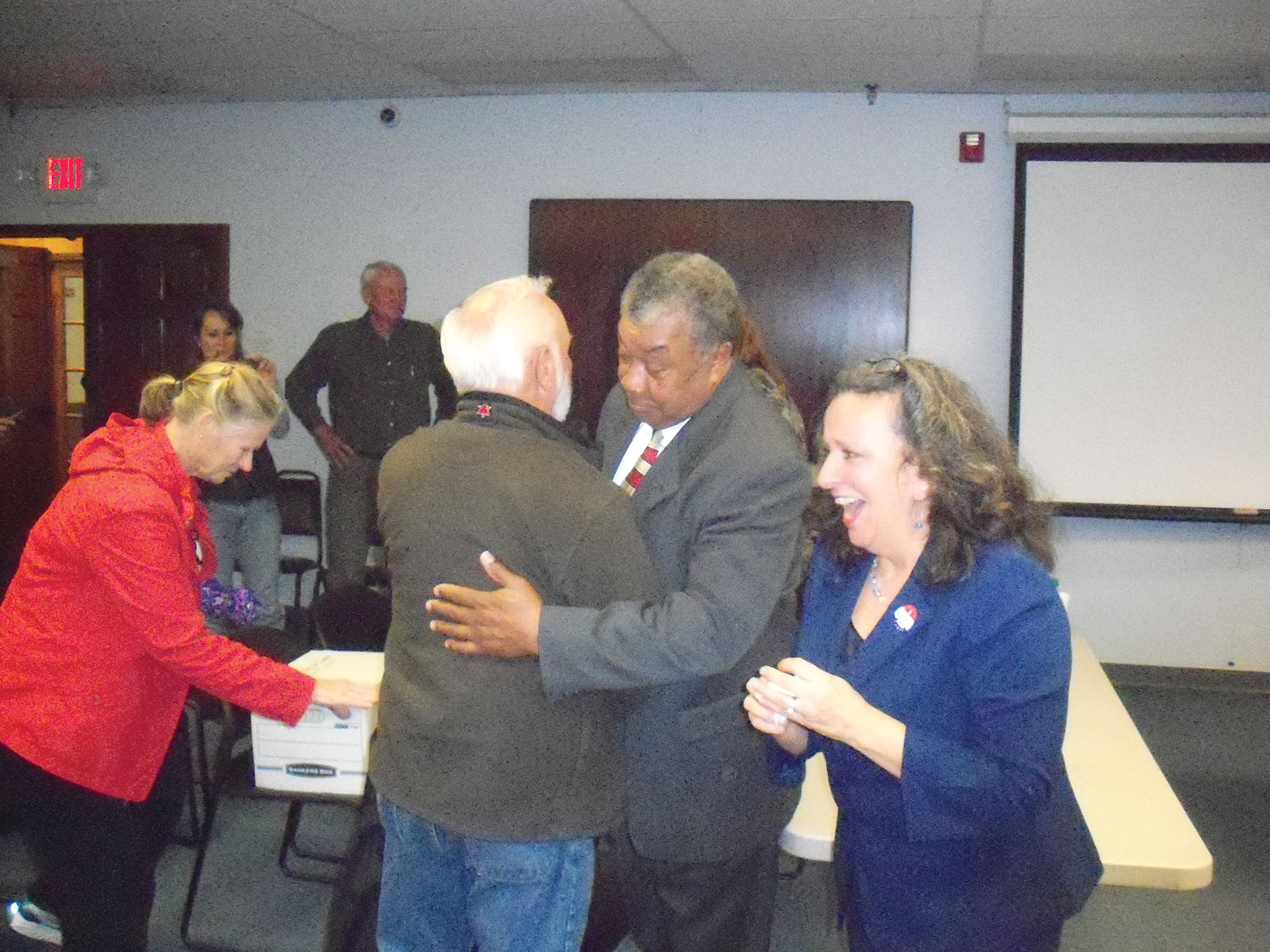
Winnsboro attorney Debra Matthews (right) celebrates as District 3 challenger Walter Larry Stewart (second from right) receives congratulations from Vernon Plyant following the Election Commission’s ruling Monday that a new election would be necessary between Stewart and incumbent Mikel Trapp for the District 3 County Council seat. (Photo/James Denton)
Battle for District 3 Seat Rages on
WINNSBORO – The proverbial Fat Lady who has been waiting in the wings since Nov. 4 to perform her closing aria for the District 3 County Council race will have to go back to her dressing room, at least for the time being. Monday afternoon, the Fairfield County Election Commission unanimously upheld two of the three grounds for protest presented last week by challenger Walter Larry Stewart and ordered a new election between Stewart and incumbent Mikel Trapp.
In results certified by the Election Commission following a recount on Nov. 7, Trapp edged out Stewart in the hotly contested race, 489-485. But irregularities found on absentee ballot envelopes by Stewart supporters, as well as reports of voters in District 3 receiving the incorrect ballot style at their polling places, prompted Stewart to file an official protest of the results last week.
While the Election Commission overruled Stewart’s protest on the absentee envelopes, it agreed with the Stewart camp that five voters – two in Mitford and three in Monticello – had been presented with the wrong ballot style on election day and therefore were unable to cast a vote in the District 3 race for County Council.
“This is democracy at its best,” Debra Matthews, a Winnsboro attorney representing Stewart at the hearing, said. “It’s a great day in South Carolina.”
Trapp did not make an appearance at Monday’s hearing, instead sending as his representative Winnsboro resident Kadena Woodard. Woodard’s participation in the proceedings, however, was limited.
As Woodard prepared to read a statement from Trapp to the Commission and offer two attached documents as evidence, Matthews objected.
“There is a notary spot at the bottom of this which is not filled in,” Matthews said. “This is a hearsay statement and I’m going to object.”
Liz Crumb, an attorney with the McNair Law Firm, retained by the Commission for the hearing, advised against Woodard making a case for Trapp at all.
“She’s not counsel and that would be practicing law without a license,” Crumb told Commission Vice Chairwoman Carolyn Y. Prioleau.
Prioleau chaired the hearing in place of Commission Chairwoman Betty M. Trapp, who recused herself from the proceedings and was not present Monday in the County Council chambers. She is related to Mikel Trapp by marriage to a Mikel Trapp cousin. Betty Trapp did chair the Nov. 7 recount and certification.
“I am not counsel, but I do have the right to read a statement that (Trapp) sent to the (commission),” Woodard said. “I would be treated so unfairly not to be able to read it.”
Woodard said she had in her possession a letter from Trapp apologizing for not being able to attend the hearing, but Matthews again objected.
“This is a hearsay statement and I’m going to object to the entry of this statement,” Matthews said. “I hadn’t seen it previously. It is directed to the board. I don’t know if the board has seen it previously.”
Both of Matthews’s objections were sustained. The Commission did eventually accept Woodard’s documents as an “offer of proof.” The documents were not reviewed by the Commission, but were instead sealed in an envelope and left to the State Election Commission to determine, in the event of an appeal, “whether or not the (commission) wrongfully kept you from making a statement,” Crumb explained to Woodard.
The Arguments
Matthews successfully argued that five voters had received the incorrect ballot style in the Nov. 4 elections, and therefore were prevented from casting a ballot for the District 3 Council race. Two of those voters were in the Mitford precinct and live at 202 Peay Ridge Road.
According to the 9-1-1 maps, which Debbie Stidham, Director of Fairfield County Voter Registration and Elections, testified were the means by which her office verifies voting districts, all even-numbered addresses on Peay Ridge Road lie on the south side of the road. That orientation places the even-numbered addresses in District 2. But through the testimony of Randy Roberts, of the Fairfield County Assessor’s Office, who on the witness stand reviewed the County’s aerial map of the road, 202 is an anomaly. It is the only even-numbered address among a host of odd-numbers lying on the north side of the road. And, according to Stidham’s testimony, addresses on the north side of Peay Ridge Road are in District 3.
Affidavits of the two voters living at 202 affirmed that they had both been given ballots for District 2 instead of District 3 on Nov. 4.
Three voters in the St. Peters Church precinct in Monticello were also given the incorrect ballot style on Nov. 4, Stidham’s testimony confirmed. Voters from both districts 3 and 4 vote at the church, and based on the records from the voting machines, the three District 3 voters who cast ballots there on Nov. 4 had their votes counted in District 4.
Trapp has until Nov. 24 to file an appeal, at which time the State Election Commission will make its ruling. A new election will not be scheduled until the State Commission sends their findings to the Governor’s Office and the election is ordered by Gov. Nikki Haley.
Efforts to reach Trapp by telephone for comment for this story were unsuccessful.
“We’re moving forward,” Stewart said after the hearing. “I’m going to need everybody’s support for this next step, in this next election. I need everybody’s support in this next election to make it a new day in Fairfield County, because we’re going to have to work hard to get there.”
WINNSBORO – Plans by County Council to place, as part of their new sweeping county wide recreation plan, a mini park at the intersection of Shoemaker and Center Creek roads hit their first speed bump Monday night and may very well have become derailed as one member of the community there appealed to Council to kill the project before it had even begun.
Don Quick presented Council Monday night with a petition of 33 signatures from 38 of the 61 households in the community that he said responded, all in opposition to the proposed park. Council passed first reading during their Oct. 27 meeting to purchase and develop 3.36 acres of property at the intersection for a new mini park.
“You have to understand, guys, I live out in the country,” Quick said. “And I mean the country. Everybody’s got at least three and a half or more acres. Most of us have 10 or more acres. And none of us have grandchildren at home, so there are no youngsters and we don’t want or need a park because we have all the land we need.”
The ordinance is scheduled for a public hearing during Council’s Nov. 24 meeting.
“I want to thank Chairman Ferguson for bringing this park to our attention,” Quick said. “It wasn’t his fault that the neighbors didn’t say anything in the beginning. All of a sudden at the last minute they didn’t want it.”
From Committee
Council also gave formal approval to a slate of items recommended from the Administration and Finance Committee’s Oct. 27 meeting. Council gave the OK to $184,000 for Mead & Hunt to begin retrofitting the HON Building for use as a temporary Courthouse.
“In order for us to renovate our Courthouse, we have to first renovate the HON Building in order to move those employees out of (the Courthouse) and into the HON Building,” County Administrator Milton Pope told Council Monday. “It also has to have a fully equipped courtroom for judicial purposes. This would be all of the design work to be able to get all of those things done.”
Funds for the project will come from last year’s $24.06 million bond issue, Pope said at the Oct. 27 Committee meeting.
Council also approved $87,844 for Davis & Floyd for additional repairs to the County Administration building. The repairs encompass the Fairfield County Sheriff’s Office’s evidence room in the basement of the building.
“In order to turn the evidence over to the new Sheriff, SLED will have to sign off on the evidence itself,” Pope said. “The evidence is currently being stored in a storage unit in the parking lot of the Sheriff’s Office and there are several significant renovations that need to be made in the basement of this building in order to bring that material back in to have it certified and signed off on.”
Funds for that project will also come from the bond money, Pope said on Oct. 27.
Council gave the nod to $40,000 for aerial photography of Fairfield properties in order to update the Assessor’s Office database. Pope said the funds were already earmarked in this year’s budget, but could, if Council desired, be extended over two budget years.
Council also approved the Committee’s recommendation to shell out $71,595.73 as a 5 percent match to more than $1.4 million in grant funds from the Federal Aviation Administration for runway safety improvements to the County airport. The State Aeronautics Commission is also chipping in a 5 percent match for the funds, Pope said. Council awarded the bid on the work to McLam & Associates.
The purchase of 2.3 acres of property on Overlook Drive in Blackstock from Carolyn Boulware Salters also received approval Monday night. The property, which lies in District 3, was requested by Councilman Mikel Trapp, Pope said, to be used for recreational needs. Pope said during the Oct. 27 Committee meeting that the Assessor’s Office valued the land at $5,000. Monday night, Council followed the Committee’s recommendation and OK’d $7,000 for the purchase.
Finally, Council approved a revised contract with Ken Simmons & Associates, the County’s recreation consultants, to combine the recreation projects with a new fire station in Ridgeway as well as a fire/EMS station in Jenkinsville.
“Instead of separating those two things, we recommend that while we were going out for this combine all of this into one particular project so it could all be bid out at the same time so we could receive the maximum amount of savings for the projects,” Pope told Council. “It will allow the consultants to go ahead with the architectural design of those projects already approved by County Council along with the architectural design for the two public safety projects as well.”
The bids for the actual construction of the projects, Pope said, would still have to come before Council for approval. Pope estimated that it may take as long as 30 days for the consultants to begin bringing bids back to Council.
WINNSBORO – Opponents of and citizens likely to be affected by a proposed rock quarry planned for 185 acres on a 923-acre tract of land off Rockton Thruway in Winnsboro will get another chance next week to air their concerns to the S.C. Department of Health and Environmental Control (DHEC) as the state agency’s Division of Mining and Solid Waste Management will meet with the public on Nov. 20.
The meeting will be held in the Fairfield Central High School auditorium, with a question-and-answer session slated to begin at 6 p.m., followed by the formal hearing at 7:30.
Leading up to next week’s meeting, residents of the Rockton Thruway community presented some of their concerns to County Council Monday night during the second public comment portion of Council’s regularly scheduled meeting.
While Council has, since news of the proposed mine became public last spring, made it clear that approval of the Winnsboro Crushed Stone, LLC operation was in the hands of the state and beyond the reach of the County, one resident Monday night suggested there may yet be action that the County could take. Lisa Brandenburg, who along with her daughter Dorothy has helped spearhead community resistance to the proposed quarry, told Council that according to documents available on DHEC’s website, the S.C. Mining Act does not supersede local land ordinances.
“Consequently, mining operations will need to conform to local zoning or land use conditions,” Brandenburg said. “We request that County Council send a letter to DHEC stating that County land ordinances are being violated by Winnsboro Crushed Stone, LLC and its application as submitted.”
Winnsboro Crushed Stone’s application includes additional impact areas and the company is seeking approval for both current operations and planned reserve operations. Brandenburg said the future impact areas should be removed from the application and should require a separate application process when and if the company decides to expand.
Brandenburg also said the County’s 1,500-foot blasting radius, as defined in the County’s land use ordinance, should be enforced. DHEC regulations, meanwhile, prohibit blasting within 1,000 feet of area homes. Representatives from Winnsboro Crushed Stone have said previously that the closest home to the proposed Winnsboro pit is 3,000 feet away. DHEC last summer estimated that distance at between 2,400 and 2,500 feet.
Access to the mine remains a sticking point as well, and Brandenburg told Council that, according to the County’s mining ordinance, access is to be restricted to major streets or roads. And, according to the County’s own definition, Rockton Thruway is a minor street.
Brandenburg also asked that public water access be brought to Rockton Thruway under the railroad prior to construction beginning on the quarry.
The public had an informal sit-down with DHEC back on June 26 at the County Administration Building. Brandenburg said Monday night that she asked DHEC then that the entrance and exit to the quarry to Highway 34 be clearly marked on the map and a list of the equipment and its location within the quarry be marked on a map.
“This information has not been provided in the application to DHEC,” Brandenburg reported to Council Monday.
Barbara Morris, another resident of the community, also voiced her opposition to the quarry Monday and asked for Council’s help.
“We do not need another sort of contamination in Fairfield County,” Morris said, and asked Council to consider the “expense of the increased insurance rates and lower property values, repairs to our homes, cars and hospital bills for long-term illnesses for now and future generations due to dust containing toxins in the air and water.”
William Rice, who also lives on Rockton Thruway, said the quarry and its truck traffic would have a negative impact on the day care center he operates out of his home. Rockton Thruway, a gravel road, is already dusty enough, he pointed out.
“When the rock quarry comes in, that’s not an investment,” Rice said. “The only people who are going to gain from this are people who have ties to the rock quarry. Would you want a rock quarry in your back yard? We do not want one.”
Milton Pope, Fairfield County Administrator, said Monday that anyone with specific questions that they feel need to be addressed by DHEC should forward those questions to his office. The Administrator’s office can be reached by calling 803-712-6501 or by e-mailing Milton.pope@fairfield.sc.gov.