Category: Government

  • Council Revisits Bylaws

    WINNSBORO – Technical changes to County Council’s bylaws, passed during Council’s March 16 meeting, got a second look Monday night after research by a freshman Council member brought the items back to the floor.

    The changes passed March 16 on 5-1 votes (then District 3 Councilman Mikel Trapp was absent) involved calling to order and chairing the first meeting of the new year following an election, and the election of officers during the first meeting of the new year. Previously, the bylaws left those duties exclusively in the hands of the chairperson, without regard to the end of his or her term. Chairwoman Carolyn Robinson (District 2) said on March 16 that the chairmanship officially ends each year at midnight on Dec. 31. Calling the first meeting of the year to order, she said, must then fall to the County Administrator. Council accepted Robinson’s changes, as well as a similar change calling for the Administrator to preside over the election of officers.

    Monday night, John E. James, Council’s attorney, said it was not “illegal or unlawful” for an unelected staff member to temporarily preside over those two meetings. However, Councilman Billy Smith (District 7), the lone dissenter in the March 16 vote, said he had conducted some additional research of his own.

    “With all respect to our County attorney, and I appreciate him looking into this for us, I also reached out to the attorney at the Association of Counties,” Smith said, “and that attorney said that he would advise us not to have a staff member preside over a meeting such as that and if we could indeed use an elected official for that.”

    Robinson placed the motion on the floor to call for the Council member with the most seniority to preside over those meetings. Smith offered the second and the motion carried, 7-0.

    Plantation Pointe Road

    The question over whether or not Plantation Pointe Road in the Lake Wateree community had been accepted by the County into its road system or if it was still a private road was sent to the Public Services and Development Committee for research.

    Walter Bierer, a resident of the area served by the road, told Council during the meeting’s first public comment segment that the developer who had built the homes in the area, as well as the realtor who had sold him the lot, both told him as long ago as 2007 that while the roads were definitely private at that time, the County was in the process of assuming responsibility for the maintenance and upkeep of Plantation Pointe and the surrounding roads.

    “It looks like this was almost a done deal almost 10 years ago,” Bierer said, “and somewhere it got lost in the process, whether it was the paperwork or the lack of paperwork or politics or whatever. I don’t know where it got lost. But the developer is gone, so he can no longer help us out, so this evening I’m just asking for your help in this matter.”

    In his report to Council, however, County Administrator Milton Pope said the road had not been accepted into the County system and was still private. He requested the item be sent to committee, “so we can do the full vetting and research on it,” he said.

    The road issue came full circle during County Council time when Councilman Kamau Marcharia (District 4) addressed recent criticism of Council’s decision to pony up $50,000 in matching funds for the completion of a sidewalk in Jenkinsville. Faye Sandow asked Council to consider revisiting the vote during Council’s March 16 meeting, and Monday night Randy Bright asked Council if the unbudgeted expenditure was truly a wise use of taxpayer dollars. Each referred to the project as the “sidewalk to nowhere.”

    “That sidewalk is there to provide a service for the community,” Marcharia said Monday night, adding that the sidewalk would provide safe access to the nearby park.

    Marcharia was interrupted during his comments, however, by District 3’s newly seated Councilman, Walter Larry Stewart.

    “Madame Chair, point of order,” Stewart interjected. “We are here to work together –”

    “This is county council time, Mr. Stewart, and I am speaking,” Marcharia cut in. “I am speaking. When you –”

    “The question (is) that you maintain law and order in here,” Stewart interrupted again. “We don’t want to incite folks.”

    Marcharia, addressing Robinson, said, “You need to put him in check.”

    When Robinson said Marcharia would be given another minute to speak, Marcharia said Council had made the right decision in supporting the Jenkinsville sidewalk. Similar consideration, he said, should be given to the Plantation Pointe Road issue.

    “Even though its private and they have their own money,” Marcharia said, “I would support them if it’s going to enhance the quality of life in their community.”

    Ridgeway Recreation

    Pope reported to Council the 3-2 decision by Ridgeway Town Council on March 12 to decline asking the County to consider relocating the future District 1 recreation site from Highway 21 near Smallwood Road into the Town limits at Church and Means streets. Pope said the County will be moving forward with plans to construct the facility at its Highway 21 location.

    Stewart later said he felt the entire recreation plan may need to be reviewed.

    “I am uneasy with our whole recreation plan for the County,” Stewart said. “I’m not sure where we stand on that, but it is my gut feeling that says we need some more citizen input on our recreation plan.”

    “We’ll get you an update on that,” Robinson answered.

    Capital Expenditures

    Council gave final approval to a laundry list of expenditures, recommended from the Administration and Finance Committee’s March 16 meeting.

    Council unanimously approved $153,799 for a motor grader and $149,992 for a pair of dump trucks for the Public Works Department; $35,000 for eight new roll-off containers and $16,050 for a pair of turn mowers for the Solid Waste Department; and $68,238 to replace three vehicles in the Planning, Building and Zoning Department.

    Council also approved $123,000 for a track hoe for the Solid Waste Department on a 6-1 vote, with Stewart voting against the buy. Stewart said he felt the track hoe was “overkill” for the department, adding that he wondered if the County’s existing equipment wouldn’t work just as well. Pope, however, said the track hoe was a more versatile piece of equipment that would free up the existing front-end loader for other work.

    Council unanimously awarded the new landscaping contract to Asbury Landscaping of Laurens for $34,500 a year. Asbury will take on landscaping duties at the County Government Complex, the Courthouse, the Midlands Technical College campus, both phases of the Walter Brown Industrial Park and at the spec building at the Fairfield Commerce Center.

    Finally, Council awarded Goodwyn, Mills and Cawood with the $35,000 contract to assess the roof of the Detention Center and provide engineering and oversight of a replacement roof, which will be tackled in next year’s budget.
     

  • Assault on Minutes Fails

    No Motion for Second Reading

    WINNSBORO – A move by the Fairfield County School Board to revise the way for-the-record statements are recorded in meeting minutes was stopped dead in its tracks when it failed to get the motion necessary to bring it to the floor for second and final reading during the Board’s March 17 meeting.

    While the effort to amend the Board’s policy on minutes, which some critics said was merely an attempt to silence the Board minority and that conflicted with the state’s open records’ laws, may have perished, efforts to simplify the way minutes are kept may be ongoing.

    The proposed changes to Policy BEDG, Minutes of Board Meetings, would have limited for-the-record comments by Board members to “written materials germane to the public agenda.” Those materials would have been limited to five pages, front and back, unless granted a special exception by the Board chairperson. The chairperson would also have had the power to rule such materials out of order and exclude them from the official minutes.

    “I think it’s dead,” Board Chairwoman Beth Reid (District 7) told The Voice this week. “What we’re looking at now is an interpretation of our current policy. I am checking around on some legal opinions on exactly what the FOIA (S.C. Freedom of Information Act) entails regarding word-for-word transcriptions of minutes.”

    The S.C. FOIA, under Section 30-4-90, requires that all public bodies keep minutes of public meetings. Minutes must include, but need not be limited to: 1) The date, time and place of the meeting; 2) The members of the public body recorded as either present or absent; 3) The substance of all matters proposed, discussed or decided and, at the request of any member, a record, by an individual member, of any votes taken; and 4) Any other information that any member of the public body requests be included or reflected in the minutes.

    It was the Board’s attempt to reword the fourth provision that raised eyebrows.

    “That is a problem,” Bill Rogers, Executive Director of the S.C. Press Association, said earlier this month, “when they can stifle Board members from putting things on the record that they (the majority) don’t agree with.”

    Board members Paula Hartman (District 2) and Annie McDaniel (District 4) both questioned the proposed changes during the Feb. 17 meeting. Early in the March 17 meeting, Hartman again raised her objections.

    “I wanted to say that I still think (the policy amendment) is against the FOIA,” Hartman said after the Board had approved the agenda. She was ruled out of order by Reid, who told Hartman the Board would address the policy when it came up under the superintendent’s report.

    McDaniel, during the first reading debate, said the policy change was nothing more than an attempt by the Board’s majority to muzzle its minority.

    “Disrespect for the minority on the Board, that’s what’s causing this,” McDaniel said on Feb. 17.

    But Reid said the attempted policy change was not an effort to silence the minority, but to make life easier for the Board clerk. Reid said after first reading that said so many for-the-record statements were slowing down the compilation of the minutes.

    “I understand the sentiment,” Board member William Frick (District 6), a Winnsboro attorney, told The Voice this week, “but legally, I don’t know what you can do.”

    Frick, who placed the motion on the floor to approve the policy change during its first reading on Feb. 17, said his view of the policy changed over the last 30 days.

    “I looked at it and realized my interpretation was not correct,” Frick said. “I thought it would allow you to say what you wanted to say at the meeting and submit written material. That’s not correct.”

    Frick said the provision giving the chairperson the authority to reject for-the-record statements created a problem that he could not overcome and support. Revisiting the policy, he said, may also be a waste of time.

    “As far as someone wanting to revise it and change it, I say good luck,” Frick said. “The way I look at it is we’ve got other things to worry about, so let’s move on.”


  • Group Seeks Funds for Doko

    BLYTHEWOOD – With no money left in the Town’s budget to complete the various features originally planned for the Doko Park, Jim McLean is heading up a foundation committee whose goal it is to raise funds for those features, including an amphitheater, farmers market, athletic fields and clock tower.

    In February, Town Council voted to give the Foundation $3,000 in seed money to apply for 501(c) 3 tax-exempt status so it can solicit corporate and individual contributions. During the meeting the board decided to add three more members to its six-member board, which includes, besides McLean, his nephew Neal McLean, Buddy Price, Beverly Frost, Bob Massa and Ken Baldwin. They also added Chris Keefer, a member of the Town Hall staff who also is the recording secretary for the board. The bylaws call for nine board members.

    At the suggestion of Town Attorney Jim Meggs, the board agreed to hire a member of Meggs’ law firm, Callison Tighe & Robinson, to assist them in the application process for tax exempt status. Since the committee can only add to the park those features already approved by Town Council, it was decided to create a prospectus, prioritizing items for which donations will be solicited.

    The only item thus far approved by Council for fund solicitations is the amphitheater band shell. While no firm bids have been sought for sound and lighting of the amphitheater, McLean told the board that the manufacturer of the amphitheater has given them a firm price for erecting the facility and that they estimate the lighting and sound will bring the total to $200,000.


  • Development Gets OK for Water

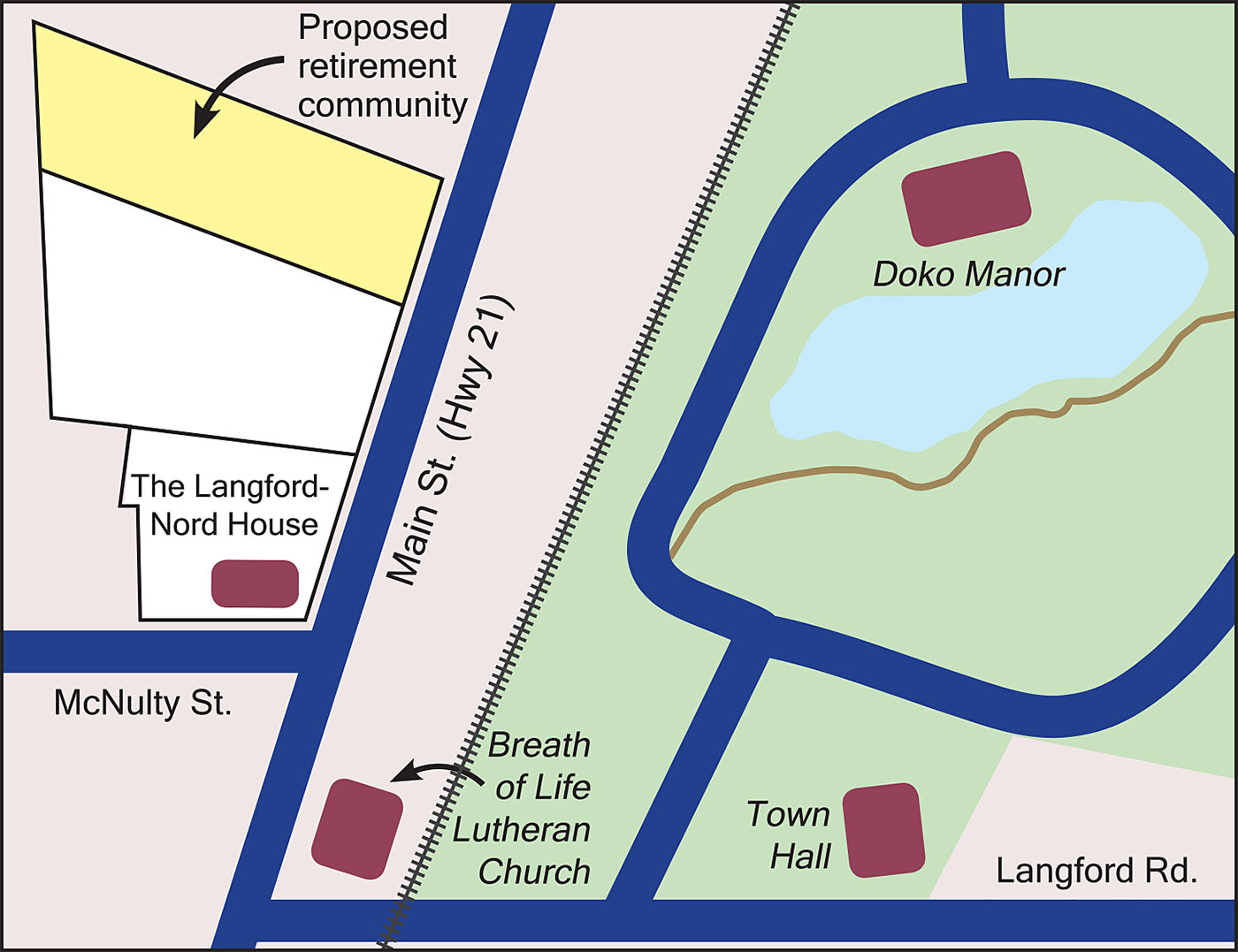
    Developers of a 64-unit retirement community, proposed for Main Street, got the green light for water last week from the Town of Winnsboro.
    Developers of a 64-unit retirement community, proposed for Main Street, got the green light for water last week from the Town of Winnsboro.

    BLYTHEWOOD – After being granted a willingness to serve letter from the Town of Winnsboro last January for up to 20,000 gallons of water per day for a proposed multi-family retirement community to be located on Creech Road in downtown Blythewood, Darren Rhodes of Fowler Realty and Land Services in Columbia asked Winnsboro’s Council last week to amend that arrangement.

    While the amount of water will remain at 20,000 gallons per day, Council said the developer has moved the location of the project and now plans to build the 64 two-bedroom, two-bath units on approximately 4 acres on Main Street across from Blythewood Consignment. Each unit is expected to require 300 gallons of water per day.

    Council agreed to the change. The agreement came with what is becoming a standard contingency, John Fantry, Winnsboro’s attorney for water and utilities, told The Voice last January.

    “It would be contingent upon the developer entering into a development agreement, as we’ve done in the past, then we would commit the water, in this particular project, in 2016,” Fantry told Council. At that time no developer had made a bid on the property, Fantry said. The property is owned by R & S Wilson Properties LLC of Mt. Pleasant, S.C.

    Blythewood Town Administrator Gary Parker told The Voice that he had had conversation with Rhodes about the proposed development but that, so far, no one has brought any plans for the project to the Town Hall.

    “It’s my understanding that the developer may still be looking at other areas,” Parker said. “I don’t know whether the site has actually been finalized.”

    While Rhodes could not be reached for comment before press time, he told the Winnsboro Town Council in January that construction is not planned to begin before January of 2016, but that it is expected to be completed in one phase.


  • Missing Data, Assumptions Mark Final S2 Report

    WINNSBORO – More than a year after County Council voted to commission a review of construction projects performed by S2 Engineering, the final report, obtained by The Voice through a Freedom of Information Act request, varies only slightly from the draft report, released last October.

    As in the draft report, the final document, dated Dec. 4, 2014 and prepared by Goodwyn, Mills and Cawood (GMC), inspectors were unable to determine framing adequacy for required code loadings because “building supplier information was not available,” the report states, for the County Coroner’s Building, the Probation Building and the Public Works Building, all of which were constructed from the ground up by S2 Engineering. The final report also notes that, for the same three buildings, “foundation information was not available . . . therefore, it was not possible to determine foundation adequacy.”

    Milton Pope, County Administrator, said the missing documentation simply does not exist under the method by which the County previously did business. Pope said he was unsure if that sort of information was required under contract because the various contracts for specific site work also do not exist. Instead, Pope said, the County operated under a general agreement with contractors like S2, assigning specific work as it came up.

    “Some of it you would think that (S2) would have, but a lot of it was not (available),” Pope said. “We don’t operate that way anymore. I could care less about the permit fees. But there needs to be a drawing someplace where you can go back to it.”

    The report also states that GMC engineers “requested design information on each of the following buildings from the original designer of record, but were not able to obtain any data concerning soil investigation, foundation design or pre-engineered metal building reactions.”

    The final report notes that “no footers are present” under the Coroner’s Building, nor could inspectors confirm slab thickness, reinforcement or depth of turn down at slab edge. Instead, the report bases its findings on assumptions.

    “Based on the construction photographs it is our assumption that the foundation for this (Coroner’s) building consists of a slab on grade with a perimeter turn down slab 1-foot deep x 1-foot 6-inches wide,” the report states. “We additionally assumed that the anchor bolts provided have been constructed in accordance with the pre-engineered metal building information and have adequate embedment depths. The building reactions can be resisted by our assumed perimeter turn-down size and are adequate, provided they have enough reinforcement to transfer these loads.

    “Based on our assumptions above, our opinion is that these foundations are structurally adequate to resist the loads applied.”

    The report made the same assumptions for the Probation Building after inspectors were also unable to confirm slab thickness and other details. Inspectors did run “calculations” based on those estimates, however, and determined it could stand up to vertical forces. Resistance to horizontal forces, on the other hand, “will require additional foundation modifications at the footings on grid lines,” the report states.

    “Our recommended modifications include constructing a pile cap connecting to footing locations . . . in order to resist outward forces,” inspectors noted.

    Inspectors also determined the Public Works Building was structurally adequate based on the same assumptions as the Coroner’s Building. Additionally, inspectors noted in the draft and in the final report that an “incorrect purlin rollover bracing is present in interior back room” at the location.

    The report noted that the Voter Registration Building was an existing structure modified by S2 and that “there are no anticipated structural issues with this structure.” Similarly, the HON Industries Building was not inspected at all.

    “Some of the stuff S2 did, they in essence did renovations on,” Pope said. “They can’t tell you about the footer on the building because they didn’t do that. But on the Public Work’s Building and the Coroner’s Building, those were total buildings that S2 totally built and they have to stand behind that.”

    Pope said it had not yet been determined if the County was going to ask S2 to complete the modifications to the Probation Building recommended by GMC.

    The centerpiece of the County’s new industrial park, the Fairfield Commerce Center was constructed in 2011 of a pre-engineered metal frame with slab on grade foundation. S2 was not involved in the design or original construction, but did perform modifications to the building. According to the draft document and final report, “visual inspection cannot confirm slab thickness, reinforcement, depth of turn down at slab edge or presence and sizes of footers.”

    “Based on construction photographs observed during inspection and exposure of free-formed concrete on exterior perimeter foundations, it appears that there are no spread footers present,” the report says of the Commerce Center. “Lack of foundations may render the structural stability inadequate per IBC (International Building Code) wind loading requirements. Further investigation is needed to confirm the presence of foundations.”

    Building supplier information was also not available for this building.

    The Dutchman Creek Fire Hall, constructed by ICE, PLLC of Columbia in 2010, was also inspected by GMC engineers. Unable to confirm slab thickness, reinforcement or depth of turn down at slab edge, the report also noted “lack of confirmation of post embedment depth,” and that “truss framing appears to be inadequate for wind loadings specified by the IBC code for this building location.”

    In spite of the missing information, Pope said he was satisfied with the inspections and with the safety of the buildings in question.

    “Were those safe buildings? That’s what it really boils down to,” Pope said. “The structural engineers did not report anything to us like that where there was any concern about any issue like that that S2 may have caused.”


  • Town OK’s Hospitality Tax Plan

    Cotton Yard Lease On Hold, Again

    RIDGEWAY – Although discussed and discarded by Town Council more than a year ago, the town “Where History Still Lives” may finally be ready to put a price on its hospitality.

    Council voted unanimously during its March 12 meeting to draft an ordinance instating a hospitality tax, placing first reading of the ordinance on their April 9 agenda. Councilman Russ Brown, who has long been a proponent of the tax but has seen his proposals for it rebuffed by Council on previous occasions, said the revenue could relieve some of the strain on the Town’s budget.

    “I don’t see it generating a ton of money,” Brown said, “but in a little town every little bit helps and it would go to a lot of different things.”

    Brown said the tax could not exceed 2 percent and could only be applied to prepared meals and beverages in an establishment or under an establishment’s license. The revenue could go toward tourism-related, cultural, recreational or historic facilities, as well as highways, roads, streets or bridges providing access to tourist destinations. The revenue could also go toward advertising and promotion of tourism development, and to water and sewer infrastructure serving tourism-related facilities. The funds could go toward preserving the arch on the old school property, and for promoting Pig on the Ridge, Arts on the Ridge and other Town events.

    However, Brown said the Town should exercise caution when committing revenue generated by a hospitality tax.

    “I think the town should be very careful on how it is spent and we may find it beneficial to build some of that up and have a kitty,” Brown said. “The thing that worries me is that if you use that money as a payment for a bond. Let’s say you get a bond and you’re using that money to help pay for that, and let’s say all those restaurants close down one day, then we’re hanging out to dry having to come up with that money.”

    Council voted 5-0 to have the ordinance prepared and on their April agenda.

    Railroad Lease

    For the second meeting in a row, Council delayed a vote on the second and final reading of an ordinance to approve a lease by the Town on the Norfolk Southern Railroad property, commonly known as the Cotton Yard, in the center of town.

    The $300 a year lease demanded by the railroad company would also require the Town to purchase liability insurance for the property at $1,000 a year. Mayor Charlene Herring told Council in December that the railroad company is reviewing leases and properties all across the state, forcing municipalities to either lease the lots and accept liability or see the lots fenced off. In Ridgeway’s case, at least two buildings stand on the property – the police station and the fire station – and the railroad would demand their removal unless the Town agreed to a lease.

    Last month’s delay hinged on a question of responsibility for a County owned building sitting on the property, as well as a suggestion by Councilman Heath Cookendorfer that Ridgeway press the railroad for a lower price.

    Last week, Council retreated into executive session to discuss the lease, emerging to vote 5-0 to table the final reading while declining to offer any specifics on the new delay.

    In his motion to table, Cookendorfer said the decision was “due to consideration of some information we have received and we will be contacting Norfolk Southern to have some questions answered.”

    “It’s a simple question, but we have to have an answer,” Brown said after the vote. “We can’t sign until we have an answer.”


  • Recreation Relocation D.O.A.

    Councilman’s Flip-Flop Dooms Proposal

    RIDGEWAY – Efforts to petition County Council to locate a new recreation facility inside the town limits died in a 2-3 vote during Town Council’s March 12 meeting, with one key supporter of the move, Councilman Heath Cookendorfer, changing course just before the vote.

    “From day one I have been an advocate of this. I personally think it’s a good thing,” Cookendorfer said after Councilman Donald Prioleau placed the motion on the floor. “As much as I am an advocate of it, I have to understand that the town came and spoke. They do not want it, and I have to actually follow that.”

    A clear majority of citizens, as well as people living outside the town limits, spoke out against the proposal during a public forum last month, with 13 weighing in against and seven speaking in favor. Council also received a petition of approximately 55 names that were opposed to asking the County to consider changing the location of the site from Highway 21 at Smallwood Road to the property at Church and Means street where the old Ridgeway School once stood.

    A petition of 78 names in favor of the move, presented by Prioleau before last week’s final vote, received little consideration from Council.

    “We had 55 (signatures) opposed (to bringing the recreation center into the Town),” Prioleau said. “We have 78 that approve of that being down there.”

    And all of the proponents on this petition, Prioleau said, live inside the town limits, unlike many of the opponents.

    “We still have to listen to our people,” Cookendorfer said, apparently ignoring Prioleau’s petition. “If I had people who came in here and said they were actually for it, I would weigh that as well.”

    Councilman Russ Brown, who first brought the matter to Council in December and who seconded Prioleau’s motion, said the location inside the town limits made the most sense.

    “You’ve got someone willing to invest in a nice facility that can be rendered the way we want it,” Brown said, “within our guidelines in the town where the population density is the highest and has ease of access, is visible and you have police protection from the Town and the County.”

    Brown also said the Town’s Comprehensive Land Use Plan and Strategic Plan, both of which have been cited by opponents to block the move, call for recreation facilities inside the town limits.

    “One thing that jumps out to me is the Comprehensive Land Use plan that was based on the 2000 census, and it says there are no public park facilities within the town limits, and a lack of park and recreation facilities is a concern,” Brown said. “Long-term goals the community wanted were recreation and a town park, community center and recreation facility. It says in 5 – 10 years there needs to be recreational facilities and a town park, and that was in 2000, so we’re past that.”

    Nevertheless, Cookendorfer’s flip-flop doomed the proposal, which failed 2-3. Only Brown and Prioleau voted in favor of the motion. Cookendorfer, Councilman Doug Porter and Mayor Charlene Herring voted against.

    “No one is going to win from this,” Cookendorfer said. “No one has won. I’ve seen the town turn on each other in the last couple of months. It’s very discouraging.”


  • Consultant Urges Town to Relax Master Plan

    Parler: Are We Going to Grow or Not Grow?

    BLYTHEWOOD – As the last presenter at Town Council’s annual retreat on March 7, Ed Parler, the Town’s economic development consultant, was charged with closing the deal on the town’s need for economic development. He pressed Council to answer the question, “Are we going to grow or not grow?”

    Parler addressed two areas of commerce in the town: 1) the need for more businesses in the downtown area, with more intense commerce along Blythewood Road all the way to Muller Road, and 2) a commercial industrial growth corridor between Community Road and Ashley Oaks.

    To bring more commerce into the downtown area, Parler had several suggestions, including relaxing the Master Plan standards for building height, creating a grid street system in the Town Center between the interstate and Wilson Boulevard (Main Street) and extending Creech Road (which runs from Hardee’s back to the Holiday Inn Express) to run parallel to I-77 behind Blythewood High School and connect with North Fire Tower Road. Extending the road, Parler said, would open up a large area for commerce. He also saw Blythewood Road (down to Muller Road) as having more intense commercial businesses in the future such as grocery stores.

    For what he called the long term health of the area, Parler asked Council to consider putting zoning in place that would accommodate industrial growth.

    “A $100 million plant,” he said, “could be paying as much as $1 million in taxes over a 30-year period. The average manufacturing job pays $38,000 a year.”

    Parler specifically spoke to a plan that Richland County has to bring manufacturing to a 600-acre property within the town limits between I-77 and Ashley Oaks. In 2003, that area was zoned for a Light Industrial Research Park (LIRP) by the Ballow administration, but due in large part to community resistance, the large wooded acreage was later down-zoned to Development (D-1), a zoning designation akin to Rural (RU). In response to a request from Nelson Lindsay, Richland County’s Director of Economic Development, the Blythewood Planning Commission recently approved a Light Industrial Zoning II (LI[2]) zoning classification for what it termed light industrial use and has recommended it to Council for passage.

    “If you create that zoning district (LI[2]), you will immediately have Richland County coming to ask for it to be applied to this property,” Parler said. “At that point, the County will option the property and do extensive work to make it a certified site.”

    Parler said the property has been on the County’s radar for some time.

    While Parler assured Council that the LI(2) did not include industries involved in such things as foundry work, petroleum products, rubber products or industries that produce noise and odor, he also said there would be no distribution centers. However, when the zoning amendment was presented to the Planning Commission on Jan. 5, it was tabled for further study after Commissioner Mike Switzer pointed out that some of the listed permitted industries, such as tire manufacturing and textile mills, might be considered heavy rather than limited manufacturing. The Commission did subsequently recommend the zoning to Council, which has not yet passed it.

    Parler said he would like to see the same zoning standards adopted for the 600 acres that were previously applied to the LIRP in 2003, but with some changes, including changing the height limitations for the industrial facilities. He would like to see them raised from the 40 feet permitted in the LIRP up to 100 feet in the LI(2) zoning district.

    “There is no residential in the area,” Parler said. “When you see a property of this magnitude, there is the opportunity for one or two very large investments. Prepare yourself. Are we going to accommodate these larger manufacturing facilities and are they welcome?”

    Parler said the Town should consider industrial zoning because of its potential to yield a higher revenue and better use than residential property.

    “We have some very positive things occurring,” Parler concluded.


  • Planning Commission Chairman Takes Aim at Green Space

    Gordge: The Manor Failed

    BLYTHEWOOD – With the unrelenting drain on the Town’s finances by the park and Manor, much of Town Council’s recent day-long annual retreat was spent looking at ways they might bring additional revenue to the town. Last week The Voice reported on Council members’ various proposals for and angst over levying a property tax in the not too distant future. They also looked at other revenue sources such as economic development.

    But before they got to that discussion, Planning Commission Chairman Malcolm Gordge made, at the request of Mayor J. Michael Ross, a presentation to Council outlining ways he felt the Town’s Comprehensive Plan (Comp Plan) and Master Plan stand in the way of economic development.

    “While the Master Plan is a grand overview of where the town is going,” Gordge told The Voice, “the Comp Plan is the more detailed document that the Town is legally obliged to provide and update every five years. It provides guidelines for planning and zoning.”

    While the Planning Commission has input into the Comp Plan, it has largely been updated over the last 10 to 15 years by Wayne Schuller with the Central Council of Governments (COG). Following the adoption of the Master Plan in 2009, the general plan going forward was to then update the Comp Plan to accommodate the Master Plan and make it happen.

    With the five-year update due this year, Gordge was critical of the proposed amendments suggested by the COG, saying the goals and focus, which are in keeping with the goals and focus of the Master Plan, are heavily biased toward residential growth and environmental amenities and provide almost nothing to encourage and accommodate commerce and industry within the town. With diagrams and charts, he illustrated what he saw as the Comp Plan’s shortcomings, showing in percentages (below) how the Plan’s priorities for planning and zoning were detriments to the Town being able to attract industry and commerce.

    • Environment – 35 percent

    • Transportation – 27 percent

    • Land Use – 13 percent

    • Architecture – 13 percent

    • Infrastructure – 7 percent

    • Economic Development – 7 percent

    “If you look at that, the environment is our most pressing need. Is that so?” Gordge asked, then answered, “I don’t think so.”

    Gordge told Council he was “as much for green space as anyone,” but said he was not sure how practical it was to focus so much on ordinances that protect the environment. He advised Council members that, “The Town is bureaucratic by nature. It’s very complex with ordinances and regulations that are difficult to change.”

    While Councilman Bob Massa agreed that economic development should be a top priority for the town, he also defended the importance of ordinances that protect the town’s environment.

    “Those ordinances that are there to protect the environment do make it very bureaucratic. But there’s a reason why they are there to protect the environment –” Massa managed to get out before being interrupted by Gordge.

    “But if we see that as an impediment to the progress we want to make,” Gordge said, “then we have to find a way to relax those ordinances to allow growth. Insufficient working capital is a reference to the fact that we don’t have any property tax millage, where we’re always struggling to find money for new projects.”

    In his power point presentation, Gordge criticized the Comp Plan’s current vision statement, which emphasizes sustainable development. He was also critical of the proposed amendments to the Plan that focused on such things as requiring a ‘community focus’ to development, pedestrian sheds in strategic locations, open spaces, public spaces available 24/7, protected green spaces, preservation of local nature, conservation of resources and efficient water management.

    Gordge proposed his own vision statement for both the Master Plan and Comp Plan, recommending “a modern infrastructure to accommodate visitors, commerce and a variety of industries with minimal impact upon the natural environment . . .”

    After an exercise in which Gordge asked each Councilman to list what they saw as the town’s strengths (people, location, good demographic groups, etc.), weaknesses (Manor, lack of recreation, lack of tax base, etc.), opportunities (improve town’s appearance, recruit health care, improve website, plan for commercial growth and development, etc.), and threats (running out of money, large 18-wheelers continue to use our exit, businesses moving out of the area, etc.), Gordge summed up his own visions of these categories, lamenting what he saw as currently the Town’s greatest weakness, what was to be the crown jewel of the Master Plan – The Doko Manor and Park.

    “We needed a success to stir commitment,” Gordge said. “Doko failed. That’s a strong statement.”

    At the end of the day, Gordge asked Council members to each give their own prioritization to the goals of the Comp Plan. Councilmen Eddie Baughman, Bob Mangone and Massa ranked economic development as the top priority. Councilman Tom Utroska and Mayor Ross ranked it as second in importance. Utroska ranked land use as the top priority and Mayor J. Michael Ross saw infrastructure as the top priority.


  • Committee OK’s Purchases

    WINNSBORO – County Council’s Administration and Finance Committee, chaired by Council Chairwoman Carolyn Robinson and filled out by Marion Robinson (District 5) and Mary Lynn Kinley (District 6), gave approval Monday evening to a laundry list of expenditures to be recommended to full Council at their March 23 meeting.

    The Committee gave the OK for the recommendation to purchase a new grader for $153,799, replacing a 12-year-old grader used in maintaining County roads, as well as two replacement dump trucks for the Public Works Department, at a cost of $149,992. A pair of zero-turn lawn mowers, at a cost of $16,050, eight new roll-off containers for $34,463 and a new track hoe for $121,189 were also recommended for purchase for the Solid Waste Department.

    The Planning, Building and Zoning Department, if approved by the full Council, will be replacing its 2001 Ford Crown Victoria, 2003 Chevrolet Blazer and 2008 Jeep Liberty with two new Chevrolet Colorado pickup trucks and a full-sized Chevrolet Silverado four-wheel drive. Total cost for the new vehicles, which are slated to be purchased from the state’s system, will run the County $69,238. However, County Administrator Milton Pope said Winnsboro’s local Chevrolet dealer will have the opportunity to match or beat the state’s price.

    The Committee also recommended a new contract for landscaping maintenance on several County properties, approving a bid that came in so low as to raise the eyebrows of one Committee member.

    “When I look at some of these bids, somebody must have been smoking dope,” Marion Robinson said. “It just blows my mind somebody comes in this far from everybody else.”

    The bid in question, which beat out other contenders, was submitted by Asbury Landscaping of Laurens and came in at $34,500 for the year, well under the County’s budgeted $56,136. Robinson confirmed that Pope and his staff had spoken with Asbury’s other clients to confirm their quality of work, yet still was taken aback.

    “We met with them, and I believe it was a father and son,” Pope said. “They don’t necessarily just manage (employees); they work. And they’re hungry. Other companies didn’t have any problems with them. Keep in mind, if they don’t perform we can always cancel the contract.”

    Asbury will take on landscaping duties at the County Government Complex, the Courthouse, the Midlands Technical College campus, both phases of the Walter Brown Industrial Park and at the spec building at the Fairfield Commerce Center. Pope said that while County employees handle much of the rest of the County’s landscaping tasks, it was more cost effective to privatize that portion of it.

    The County Detention Center is also in need of attention, Pope told the Committee, particularly to its 15-year-old roof that is beginning to fail. Pope said leaks have appeared in the building that are having an impact on the jail’s operations. While there are plans to replace the roof in the 2015-2016 budget, an assessment on the roof needs to be done in advance of that work. The project was put out for bid, Pope said, and he recommended (and the Committee approved) Goodwyn, Mills & Cawood, Inc. for the job.

    The company, which recently completed a review of projects performed for the County by S2 Engineering, was recommended over two other firms – Davis & Floyd and Mead & Hunt.

    “All of them were qualified,” Pope said. “We liked them a little bit better on how they had laid out what they would do, and their pricing on the assessment was less, or in the middle.

    “Some of the other companies, the County has done a considerable amount of work with,” Pope added, “and we’re looking to involve some new people.”