Category: Government

  • Winnsboro Clears DHEC Hurdle

    WINNSBORO – The Town of Winnsboro cleared its first hurdle on the way to the Broad River, receiving its permit from the S.C. Department of Health and Environmental Control (DHEC) to draw up to 10 million gallons a day from the river to feed into the Town’s reservoir.

    Mayor Roger Gaddy made the announcement at Tuesday night’s Town Council meeting. Gaddy said the Town was close to finalizing a deal to purchase land along the river from which to draw the water. State Sen. Creighton Coleman, also an attorney for the Town, said the Town and the land owners had agreed in principal to a deal, leaving just the final details to work out on paper.

    “We’re close to the end of the process of purchasing the property where we will have the withdrawal site,” Gaddy said, “and we soon will be working on the engineering portion of it.”

    Winnsboro has been working on the deal since last September, when it entered into an agreement with SWS Group; Utility Advisors Network, Inc. (UAN); and the Willoughby & Hoefer, PA Law Firm to assist with the project. Margaret Pope of the Pope Zeigler Law Firm has also been advising Council on the project, which is estimated to cost between $12 and $13 million. Gaddy said after Tuesday’s meeting that another meeting with Pope will be necessary to determine how to proceed next.

    Last September, Council said the preliminary engineering for the project would have to be completed next in order for the Town to determine how much they will be seeking in bond money. Last summer, Winnsboro freed up a considerable amount of debt with the final payment on a nearly $12 million bond that was issued for water treatment plant upgrades. Gaddy said the engineering could take up to six months to complete.

    Grants and Vehicles

    Council approved $70,000 for the purchase of a ladder truck for the Department of Public Safety Tuesday night, as well as $18,135 in matching funds for a U.S. Department of Agriculture (USDA) Rural Development grant for the purchase of a 2015 Chevrolet pickup truck for the Streets and Sanitation Department. Council also approved $39,540 in matching funds for another USDA grant for the purchase of a data software system.


  • Roofing Bids Open Old Wounds

    County Strays from Policies

    WINNSBORO – Of the many criticisms of County Council to emerge in the wake of last year’s collapse of a retaining wall around the Drawdy Park football field was the one that appeared at the time to have been addressed even before the concrete blocks toppled over – how the County bid out contracts for projects.

    Revealed in the aftermath of the collapse was the County’s practice under former Administrator Phil Hinely of cherry picking construction and engineering firms from a pre-approved list, without putting major projects out for competitive, sealed bids. That practice netted S2 Engineering more than $8.76 million in contracts between December 2009 and September 2013, including the contract for the work at Drawdy Park.

    Since Hinely’s resignation in July of 2013 and with the arrival of Milton Pope as Interim Administrator shortly thereafter, the County has consistently maintained that the no-bid days were over. As former Council Chairman David Ferguson told The Voice last July: “Did we bid out every job? No. With Milton (Pope) we do.”

    But a contract awarded unanimously by Council on March 23 indicates that the old days may not be in the rear-view mirror entirely.

    Detention Center

    The Fairfield County Detention Center, constructed in approximately 1998, is in need of a new roof. Leaks have developed, causing water intrusion into the facility and threatening sensitive equipment inside. During a March 9 meeting of Council’s Administration and Finance Committee, Pope recommended Goodwyn Mills & Cawood (GMC), one of three firms he said bid on assessing the damage to the roof. The actual replacement of the roof will not take place until the next fiscal year, Pope said during the meeting.

    Pope told the Committee that GMC will “provide for the analysis and construction administration of the Detention Center roof.” Only GMC’s winning bid was included in the information presented to Council members at the Committee meeting. Pope later said “staff should have included all three of the quotes in the A&F packet at the beginning.”

    The only question from the Committee came from Councilman Marion Robinson, who unseated Ferguson for the District 5 seat last November. Robinson asked Pope how many firms had bid on the project and why administration had decided on GMC.

    “All of (the three bidding firms) were qualified. We liked (GMC) a little bit better on how they had laid out what they would do, and their pricing on the assessment was less, or in the middle,” Pope responded. “Some of the other companies, the County has done a considerable amount of work with and we’re looking to involve and get some new people.”

    Pope also said the roof assessment was in the 2014-2015 budget for up to $35,000. The Committee unanimously approved the recommendation, which Pope presented to the full Council on March 23. During his presentation, however, Pope told the Council that the project was for $35,000, although Chairwoman Carolyn Robinson corrected him just before the vote to include the “up to” caveat.

    The Bids and the Manual

    Contrary to the assertions made by the former Chairman last summer and repeated by administration since then, the roof project was not put out for a competitive sealed bid. Instead, between Jan. 2 and Jan. 16, administration made contact via phone or email with three firms Pope said were on the County’s pre-approved list of bidders. Those included Davis & Floyd, Inc.; Mead & Hunt, Inc. and Goodwyn Mills & Cawood. And that much may in fact be in line with the County’s procurement manual, revised last July.

    According to page 28 of the manual, under the header “Bidders List,” the County may compile and maintain a list of “businesses that may be interested in competing for various types of County contracts. It is the responsibility of the supplier to ensure he is on a current bid list . . .”

    Awards of bids, according to page 34 of the manual, include 10 factors in addition to “lowest responsible and responsive bid,” none of which entail ‘involving and getting new people.’

    According to page 40 of the manual, under “Development of Request for Proposal (RFP),” the RFP “shall state the relative importance of price and other evaluation factors but shall not require numerical weighing of each factor.” The manual places no restrictions on the number or type of factors, “as long as they are stated in the request for proposal and relate to the purpose of the procurement.”

    The RFPs sent out by the County between Jan. 2 and 16 do not state any such factors.

    Responding to the RFP emailed them by the County on Jan. 2, Davis & Floyd submitted a bid on Jan. 5 for $17,375, while GMC, responding to the RFP emailed them on Jan. 16, submitted a bid on Jan. 19 for $20,000. On Jan. 19, Mead & Hunt submitted a bid for $37,225 in response to the RFP made over the phone on Jan. 15.

    The RFP, issued by the County, reads: “Fairfield County is seeking written proposals for the assessment of the Detention Center roof located at 10 Faith Lane. Please include in proposal an assessment and cost proposal for determining the possible cause and remedy for the Detention Center roof. County staff will be available for your review of the site.”

    Work proposed by Davis & Floyd included “field investigations to support architectural upgrades as a result of the reroofing;” “construction documents sealed by Registered Architect;” “specifications to define work;” and involvement in the bidding and award process for the actual construction, to include the pre-bid conference; providing the County with plans and specs; and bid opening and award/contract with owner and bidder. Their proposal did not include materials testing or roof coring, nor did it include construction period services.

    Mead & Hunt offered project management, to include preparation of the owner/architect agreement, oversight and quality control, document checking and project organization; as well as documentation and analysis, to include a visual investigation of the roof and documentation of existing conditions, an infrared study and core samples of the roof, and to refine architectural roof plans according to their investigation. The firm also offered a design development phase, which would have included roof demolition plans, re-roofing plans and detail, outline specifications, their opinion of probable construction costs and final design documents.

    Mead & Hunt also proposed to prepare construction documents and offered to be on hand for the bidding phase and provide extensive oversight and administration during the construction phase.

    Mead & Hunt also broke out their proposal in phases, bidding $3,725 for the assessment phase (infrared scan and core test; architectural report; project management); $9,300 for the design document phase, $9,300 for the bid document phase and $3,725 for the bidding phase (each of which included architecture and project management); $9,300 for the construction phase (architecture; project management, construction administrator); and $1,875 for the post-construction phase (record drawings).

    GMC’s proposal was offered in two phases. Phase one, for which the company offered the winning $20,000 bid, consists of obtaining a copy of the existing building construction documents for use in their study; investigating the existing conditions of the room systems inside the Detention Center; documentation of probable deficiencies and recommendations for the “replacement, repair and/or modification” of the roof; creating a project budget estimate; and presenting their findings to County staff.

    Not included in GMC’s $20,000 bid, but offered in a second phase of the project, are the creation of “construction documents suitable for competitive bidding, including demolition and new construction;” plans for permitting; assistance with bid solicitation; construction administration services; and a meeting between the design team and the County “to ensure the scope of work and contractual requirements are covered.”

    “Compensation for Phase II is TBD (to be determined) based upon the approved budget,” GMC’s bid concludes.

    Under the header “Bidder Information” on page 28 of the County’s procurement manual, “All procurements in excess of $10,000 shall be publicized in a newspaper of general circulation, or County website (www.fairfieldsc.com).”

    Although the lowest bid for the project came in at more than $7,000 over this amount, there is no evidence that the County adhered to this stipulation.

    “This request was not advertised,” Pope confirmed via email Tuesday. “Staff solicited quotes. The firms Mead & Hunt and Davis & Floyd are current firms solicited and contracted through the County’s IDC contract solicitation. Two firms were selected from the list and Goodwyn Mills & Cawood was also contacted. They recently performed work.”

    That work entailed coming in behind S2 and providing the County with a comprehensive report on the causes of the Drawdy Park wall failure, as well as supervising the reconstruction of the collapsed wall.

    According to page 29 of the manual, competitive sealed bids are “required when procurement is anticipated to exceed $25,000.” That County Council planned far enough ahead when preparing the 2014-2015 budget last year to set aside $35,000 for a roof assessment project may indicate that the project was indeed “anticipated to exceed $25,000.”

    Pope told The Voice Tuesday that GMC had in fact previously quoted a price of $35,000, although he did not say when or under what circumstances. Nothing in the documents provided by the County to The Voice indicate anything other than the $20,000 bid, which, Pope said, was only for the first phase of the work.

    “Goodwyn, Mills & Cawood would be responsible for assessing the building and reviewing previous building as-builts (drawings),” Pope said. “The construction services will be put out for bid.”

    While for a lower price Davis & Floyd offered a broader scope of work, to include construction documents and involvement in the bidding process for construction, and Mead & Hunt offered a range of work that spanned from the assessment to construction administration for a slightly higher price, administration recommended and Council approved GMC.

    “The proposals weren’t based solely on price,” Pope said. “Currently, Mead & Hunt and Davis & Floyd are assigned to several projects for the County. The decision was made to issue to Goodwyn Mills & Cawood. Any proposal can change pending on the findings, which may determine a broader scope of work. All findings would be brought to County Council to review and act upon.”

     

  • Manor Director Stepping Down

    Booth Chilcutt
    Booth Chilcutt

    BLYTHEWOOD – Booth Chilcutt, the Director of Events and Conference Center (The Manor) will be leaving his position the end of April for what he calls, ‘retirement’… real retirement this time.

    Chilcutt said he came to work for the Town as assistant to the Director in March 2013 freshly retired as Director of the Sumter County Cultural Commission and Director of the Performing Arts Center. The following January he was elevated to his present position.

    “I really never got a break from work,” Chilcutt told The Voice, with a laugh. “I just need a break and I need to leave all this hard work to someone who has the time and energy to run it. I’ll be in the audience enjoying and applauding.”

    While Chilcutt said he intends to spend time in the garden, and more time with his wife, Peggy, he still plans to stay involved with the Arts. While in Sumter, he was three times nominated for the Verner Award, the top award in the state for the Arts.

    “I was drawn to The Manor because of my love for the Arts,” Chilcutt said, “but now I want to be involved on a less committed basis. Sometimes I’m up here (at The Manor) booking events before 8 a.m. I really enjoy the work and the challenge, but at my age, it’s a little too much. I need some relaxing time with my family, and to read more. I love to read.”

    When Chilcutt came to work at The Manor the operational losses were at an all-time high. Projected losses were $12,000 to $44,000 for General Maintenance/Service Supplies and from $33,000 to $49,000 for Program and Oversight Salaries for the fiscal year. The weight of the Manor’s success was squarely on his shoulders. Since that time, working with Council, Chilcutt has made many changes in how The Manor does business. So it is with some degree of satisfaction that, last week, Chilcutt was able to report at the March Council meeting that the projected average loss for March through June is only $226.62.

    “We’ve learned a lot more about what we need to do to make it work and we have a conscientious, hardworking crew. The Manor has so much potential, but it’s a business, really, with contracts and other things that go along with a business,” Chilcutt said. “Probably more than anyone expected.”

    Chilcutt, who lives in Cobblestone, will still be in town. “I’ll probably see everyone just as much as I do now,” he said. “I’ll be at all the events.”

    Mayor J. Michael Ross told The Voice, “The town will miss Booth. He did a great job of bringing more arts and cultural events to our town! We wish him a happy retirement but may be calling on him to consult on future projects.”


  • Industry Getting a Lift

    Planning Commission OK’s Height Increase

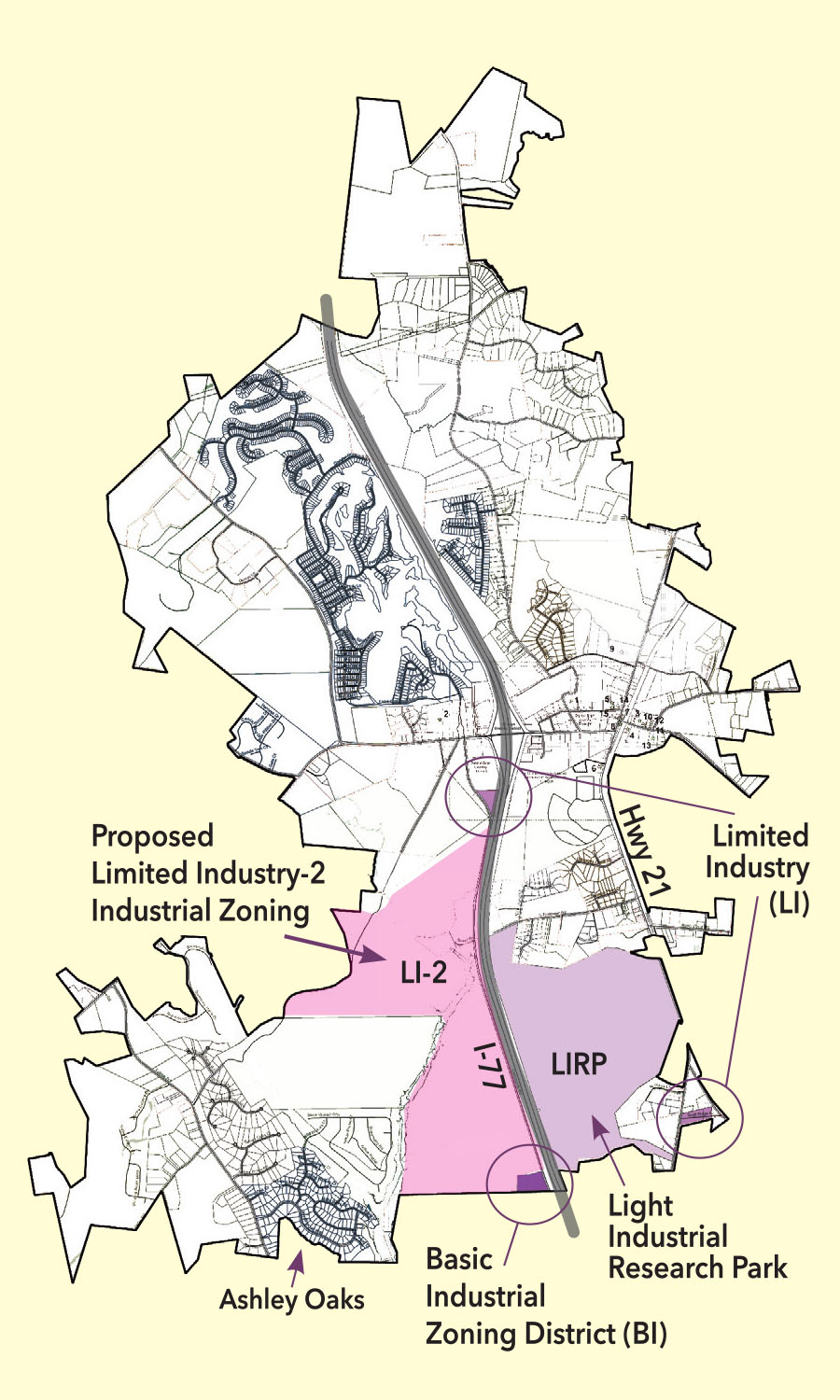
    This map of the Town of Blythewood depicts the areas that have been or are currently being zoned for industry. The Planning Commission has recommended that height requirements in these districts be allowed up to 100 feet.
    This map of the Town of Blythewood depicts the areas that have been or are currently being zoned for industry. The Planning Commission has recommended that height requirements in these districts be allowed up to 100 feet.

    BLYTHEWOOD – The Planning Commission voted to give Blythewood’s economic development consultant, Ed Parler, what he asked for and more on Monday evening – a recommendation to Town Council for an extension on the height of industrial facilities, from 35 feet to 100 feet, in the town’s newly proposed Limited Industrial (LI-2) zoning district. Another 10 feet can be tacked on by the Board of Zoning Appeals upon request.

    And while they were at it, the commissioners, at Chairman Malcolm Gordge’s suggestion, voted to make the 100-foot height extension applicable to all the town’s industrial zoning districts which, in addition to the proposed LI-2 district, include: Light Industrial Research Park (LIRP), Limited Industrial (LI) and Basic Industrial (BI).

    The height recommendation will now be tacked on to the second reading (vote) of the proposed LI-2 industrial zoning ordinance. Council passed first reading on that ordinance last week, but only approved Parler’s height request up to 50 feet, so Parler took his request back to the Planning Commission for recommendation. At their April 28 meeting Council members will decide whether to act on the Planning Commission’s recommendation for the additional height on the LI-2 zoning district only. Adding additional height to the ordinances governing the other three industrial zoning districts would have to be brought up separately.

    When Commissioner Marcus Taylor questioned how the 100 feet of height would impact neighboring residents, Parler said the nearest resident would be more than 3,000 feet from the industrial facility and that, when in proximity to residential areas, the lot line setback for the building would be 6 feet for every foot above 40 feet.

    The proposed LI-2 zoning ordinance is a text ordinance only. The zoning map will have to then be amended before such zoning can be applied to a particular parcel of land. Parler has told Council that a 600-acre parcel is the target of the LI-2 zoning proposal and will accommodate a specific industry that Richland County has recruited and wants to locate in Blythewood. The parcel is roughly bordered by I-77, Northpoint Industrial Park, the Ashley Oaks neighborhood and Locklear Road. The proposed parcel as well as the other three industrial parcels in the town can be seen on the zoning map.


  • Rimer Pond Road Gets Reprieve

    BLYTHEWOOD – A group of residents from Rimer Pond Road and three neighborhoods connecting to the Road – LongCreek Plantation, Cooper’s Pond and the Round Top Community – won their case Monday afternoon against a recommendation by the Richland County Planning staff for commercial zoning on Rimer Pond Road. But the victory does not end the residents’ fight to keep their road zoned Rural (RU).

    The issue will now go before County Council on April 28 for a public hearing and the first of three readings (votes) on the ordinance. That first meeting is the only one of the three meetings that members of the public will be allowed to address Council on the matter.

    After listening to most of the members of the group speak out against commercial zoning on the road, the County Planning Commission, which is only a recommending body, voted against the recommendation in a 4-1 vote.

    Commission member Christopher Anderson, a realtor in northeast Columbia, was the sole commissioner to argue for the rezoning of the 5.23-acre property located on Rimer Pond Road across from Blythewood Middle School.

    The property for which the zoning is sought is owned by developer Pat Palmer (Sycamore Development), who is also Chairman of the Planning Commission. Palmer recused himself before the agenda item was discussed, leaving only five members to vote.

    Commissioners Heather Carnes, Beverly Frierson, David Tuttle and Walter Brown Sr. sided with the residents, voting against the recommendation for commercial zoning on the road.

    A request at the same meeting by John Warren of Chapin for commercial zoning on a property he owns on the other end of Rimer Pond Road near Highway 21 was withdrawn from the agenda two days prior to the meeting.

    In a letter dated Feb. 17, Warren had sought the assistance of Blythewood Mayor J. Michael Ross to help him (Warren) obtain a commercial zoning designation. In a letter responding to Warren at the request of the Mayor, Blythewood Planning Commissioner Malcolm Gordge agreed to help Warren in his endeavor to obtain commercial zoning for the property and did not reveal that fact to a group of Rimer Pond Road residents when they came to a Blythewood Planning Commission meeting after learning about Warren’s Feb. 17 letter to the Mayor. Gordge’s letter was revealed only after The Voice asked Ross if he had responded to Warren’s letter.

    Because Warren withdrew his request, he must now wait 30 days before he can again take his request for commercial zoning before the County Planning Commission.


  • Intergovernmental Meeting Hones in on Wi-Fi

    WINNSBORO – Representatives from Fairfield County’s various governing bodies broke bread together at the School District Offices on March 25 in one of the more affable intergovernmental meetings in recent years. Half of the local legislative delegation, as well as representatives from the County, School District and the towns of Jenkinsville, Ridgeway and Winnsboro provided updates on recent activities and their plans for the future over a meal of chicken, rice, macaroni and cheese, salad and cheesecake.

    From the State House

    Rep. MaryGail Douglas (D-41), Fairfield County’s voice in the State House of Representatives, told those in attendance that state budget negotiations earlier this month “almost turned into a fiasco.”

    “I’m embarrassed about that,” Douglas said. “The legislature on the House side pretty much surrendered the budget authority to the governor. There were some that she held hostage.”

    Douglas said efforts to secure a raise for state employees failed, although funds were found to cover a portion of employees’ health insurance premiums. The major issue facing the Legislature, she said, is the maintenance and repair of roads and bridges.

    “Everybody seems to have a plan for roads and bridges, but nobody wants to release the dollars to do it,” Douglas said. “The budget on the House side provided an additional $50 million from the vehicle sales tax revenue that we could (use to) leverage another $500 million in federal dollars, and our governor is not happy with that proposal either.”

    From the County

    County Council Chairwoman Carolyn Robinson (District 2) said the County should see some movement within the next month on the updated strategic plan, which will include long-term goals for proposed future revenues from the two new reactors under construction at the V.C. Summer Nuclear Station in Jenkinsville. Robinson said SCANA, the primary shareholder in the plant, was committed to seeing both reactors completed, in spite of recent delays. Reactor 2 is expected to come online in 2019, she said, with Reactor 3 to follow a year later.

    Robinson said Council was currently reviewing its noise ordinance and may also consider discussion of a gun ordinance.

    Town of Jenkinsville

    Jenkinsville Mayor Gregrey Ginyard reported that the Western Fairfield town is, through a series of recent annexations, growing along Highway 215. While thanking County Council for contributing $50,000 in matching funds to complete a sidewalk to the Jenkinsville park, Ginyard said the town also had plans to illuminate the sidewalk with street lights once the project was completed. The Mayor also said the town was exploring the possibility of constructing a new government building, which he hoped would include a library, to serve as Town Hall.

    Town of Ridgeway

    Mayor Charlene Herring bragged on the opening of Royal Greens, a hydroponic vegetable growing operation in Ridgeway, and reported on the town’s recent Rural Infrastructure Authority grant to upgrade the wastewater plant. Herring also said she was concerned over the Legislature’s talks to trim local business license taxes.

    “That’s about 25 percent of our little budget of Ridgeway and that has a great impact,” Herring said. “We’ve had the local government fund reduced over the years and we don’t need another attack because any time we have to pay for something we have to bring back services from our people because we can’t afford that.”

    Douglas said she would keep an eye on any bills moving forward, but said she didn’t think it would get much traction.

    “It is being discussed heavily among our friends on the opposite side of the aisle,” Douglas said. “They can’t seem to come to any agreement and I don’t think that it’s going to fly on that side of the House.”

    Town of Winnsboro

    Mayor Roger Gaddy reported that as Winnsboro prepares for its upcoming budget discussions, Council will be looking once again at a possible increase in water rates, as well as a possible impact fee for new taps.

    Gaddy said the town had acquired a grant to develop a walking trail around the Mt. Zion Green, while the Friends of Mt. Zion Institute had begun putting plywood over the broken windows on the old school building, painting the plywood to look like windows.

    “That thing’s been an eyesore for a very long time,” Gaddy said. “I’ve been mayor 10 years and I said it would be torn down in nine months (after being elected). Sometimes you’ve got to be careful what you promise.”

    Gaddy also reported on Winnsboro’s plans to acquire a bond to extend a water line to the Broad River, withdraw water there and pump it back to the reservoir.

    “We’ve gone through the permitting process with DHEC (Department of Health and Environmental Control) to draw 8 million gallons a day,” Gaddy said. “The time period for public comment has passed, so we look forward to getting that permit from DHEC sometime in the near future.”

    Gaddy said the Town had an option on the property along the river where the lines will begin. Once Winnsboro secures the permit from DHEC, Gaddy said, the engineering process will take approximately six months, after which the Town will take out the bond and begin putting out bids for construction. Early estimates placed the cost of the project between $12 and $13 million.

    “We hope that 8 million gallons per day,” Gaddy said, “based on what our engineering consultants tell us, should hold us for 20 or 25 years for the future needs for commercial and residential development in Fairfield County and northeast Richland County.”

    Fairfield County School District

    Dr. J.R. Green, Superintendent of Fairfield County Schools, said the District would begin holding workshops on April 21 for their 2015-2016 budget. Green said he expected to see no operational millage increase this year.

    The new Career and Technology Center (CTC), under construction between Fairfield Central High School and Fairfield Middle School, had faced some delays because of winter weather, but is expected to be ready for the 2015-2016 school year. Green said four new programs – Barbering, Firefighting/EMT, Project Lead the Way Engineering and Biomedical Science (an extension of the Nursing program) – had been added to the CTC curriculum.

    Responding to a question from Mayor Gaddy, Green said the District plans to renovate the old Career Center site and use it as the new headquarters for the Transportation and Maintenance departments, as well as the new home for Gordon Odyssey Academy, which includes the District’s behavioral modification program and adult education.

    “Gordon Odyssey Academy is in very bad shape,” Green said, “and as excited as I am to see this new career center go up, I am probably equally as excited about the fact that we have the opportunity to move Gordon Odyssey Academy from where it is and put it in a facility that is in much much better shape.”

    Green also reported that all students in grades 3-12 now have their own personal learning devices in the form of new Google Chromebooks. That report sparked a discussion of the potential for county-wide internet access.

    Currently, Green said, the District is partnering with local churches, installing Wi-Fi internet in churches that agree to open their doors to students and allow them to access the internet there. This partnership has helped address the relatively small number of students who do not have internet access at home.

    “I think our partnership with local churches is a good short-term solution,” Green said, “but I think long-term we would love to see a partnership between County Council and Jenkinsville, all of the entities, to see if we can have broadband access throughout our entire county.”

    Green said he would like to see all of the governing bodies sit down with local internet providers and devise a plan. The new revenues projected from the V.C. Summer reactors, Green said, could make that plan a reality.

    “It doesn’t matter how much money we have,” Robinson said, “we’ve got to get past the Public Service Commission. We have so many providers in the county and they all are very territorial, so you’ve got to get past all that as well.”

    But County Councilman Kamau Marcharia (District 4) said countywide internet was exactly the kind of collective effort intergovernmental meetings were designed to tackle.

    “At intergovernmental meetings, we have come together and one of the things I’ve heard all these years is ‘what can we all do collectively to move this county forward?’” Marcharia said. “That’s it, right there. That’s something we all can work on and get our heads together to serve the public, if we agree to do it.”

    With the next intergovernmental meeting scheduled for June 15 and hosted by County Council, Marcharia suggested representatives of each local body get together in the interim to discuss an internet plan. Mayor Herring recommended Green to head up the informal subcommittee.

    As the meeting drew to a close, School Board member Henry Miller (District 3) offered a word of caution on working together, which, he said, “is what these meetings are all about.”

    “But I don’t know anything about Ridgeway,” Miller said. “I’m just a School Board member. If you ask me about schools, I can tell you something. But each one of us, we need to stay in our lanes. I’m not telling you to not ask questions. But if we all stay in our lanes and work collectively together, we can get something done. That’s the key. But you can’t run the schools and I can’t run County Council. I can’t run the town of Jenkinsville. We’ve got to work together.”


  • Blythewood Begins Zoning for Industry

    Ordinance Passes First Reading

    BLYTHEWOOD – Town Council took the first step Monday evening in a newly energized effort to bring industry to Blythewood. It passed first reading on a Limited Industrial Two (LI-2) zoning district that will allow a wider variety and greater intensity of manufacturing uses than the Town’s current Limited Industrial District (LI), Ed Parler, the Town’s Economic Development consultant told Council.

    The uses allowed in the ordinance run the gamut from tire manufacturing, machine shops, textile industries and testing laboratories to public relations agencies, cafeterias, full service restaurants and business support services. But Parler said LI-2 zoning would not allow the most intense manufacturing uses of the Basic Industrial (BI) district such as foundry and smelting operations. Distribution centers have also been eliminated. Conditional uses allowed include sale of manufactured homes and motor vehicle repair garages.

    While the ordinance, as written, calls for a building height limit of 35 feet, Parler asked Council to increase that to a 100-foot height limit (equivalent to 8-9 stories), adding that Richland County has no height limit for its industrial and manufacturing facilities. After some discussion, Councilman Tom Utroska made the motion to amend the ordinance to allow a height limit of 50 feet, to which Council unanimously agreed. Councilman Bob Mangone was absent.

    Parler said he planned to take the request for the 100-foot limit back to the Planning Commission at its April 6 meeting. If the Commission approves the additional height the request will be sent to Council as an amendment to the second and final reading of the ordinance at Council’s April 27 meeting, Parler said. In addition to any additional height Council might approve, the Town’s Board of Appeals can grant an additional 10 feet of height as a special exception. However, in an interview with The Voice, Parler said he and Richland County will look at additional changes to the height and other restrictions before the ordinance goes back to Council.

    “We want to know exactly what height we can get to in the end,” Parler said. “We need a very clear definition before the process starts.”

    While the ordinance before Council is a text amendment that only establishes the zoning district on paper and does not target a particular piece of property, Parler said the text ordinance is needed for the rezoning of a specific 600-acre tract in Blythewood that Richland County has its eye on for an industry it says is interested. The tract is bordered by Northpoint Industrial Park to the south, I-77 on the east, Lorick Road on the north and Ashley Oaks subdivision on the west. The property is known locally as the Barnett property and is owned by the Barnett family.

    “Be assured,” Parler told Council, “that if you establish this LI-2 zoning district, you will immediately receive a zoning request for LI-2 zoning for this 600-acre property and the applicant will be Richland County.”


  • Rimer Pond Road Issue Heads to County Planning Commission

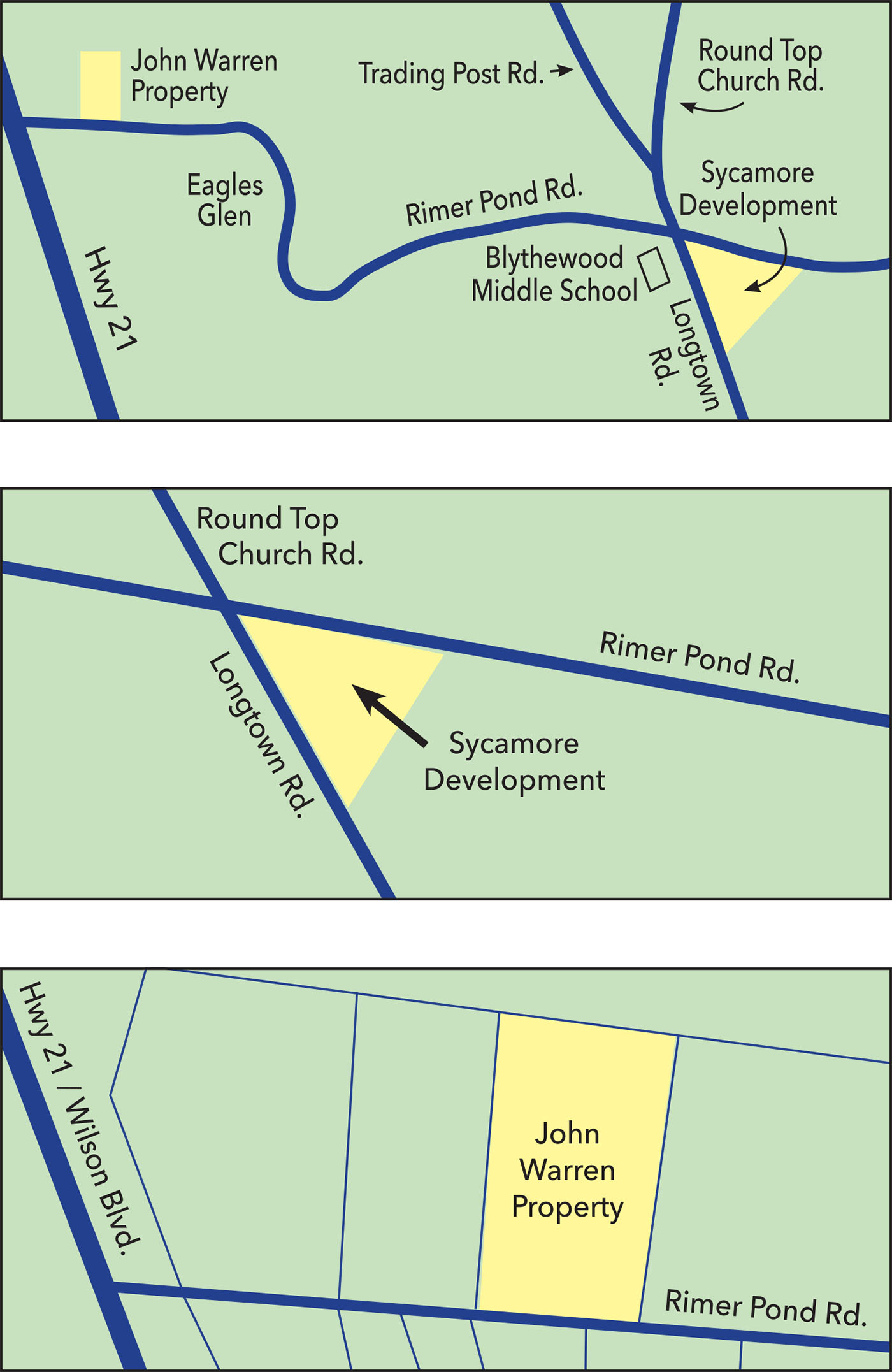
    The owners of properties on opposite ends of Rimer Pond Road are asking Richland County for commercial zoning that, if granted, would allow the first commercial zoning on the rural road.
    The owners of properties on opposite ends of Rimer Pond Road are asking Richland County for commercial zoning that, if granted, would allow the first commercial zoning on the rural road.

    Property Owners Seek Commercial Zoning

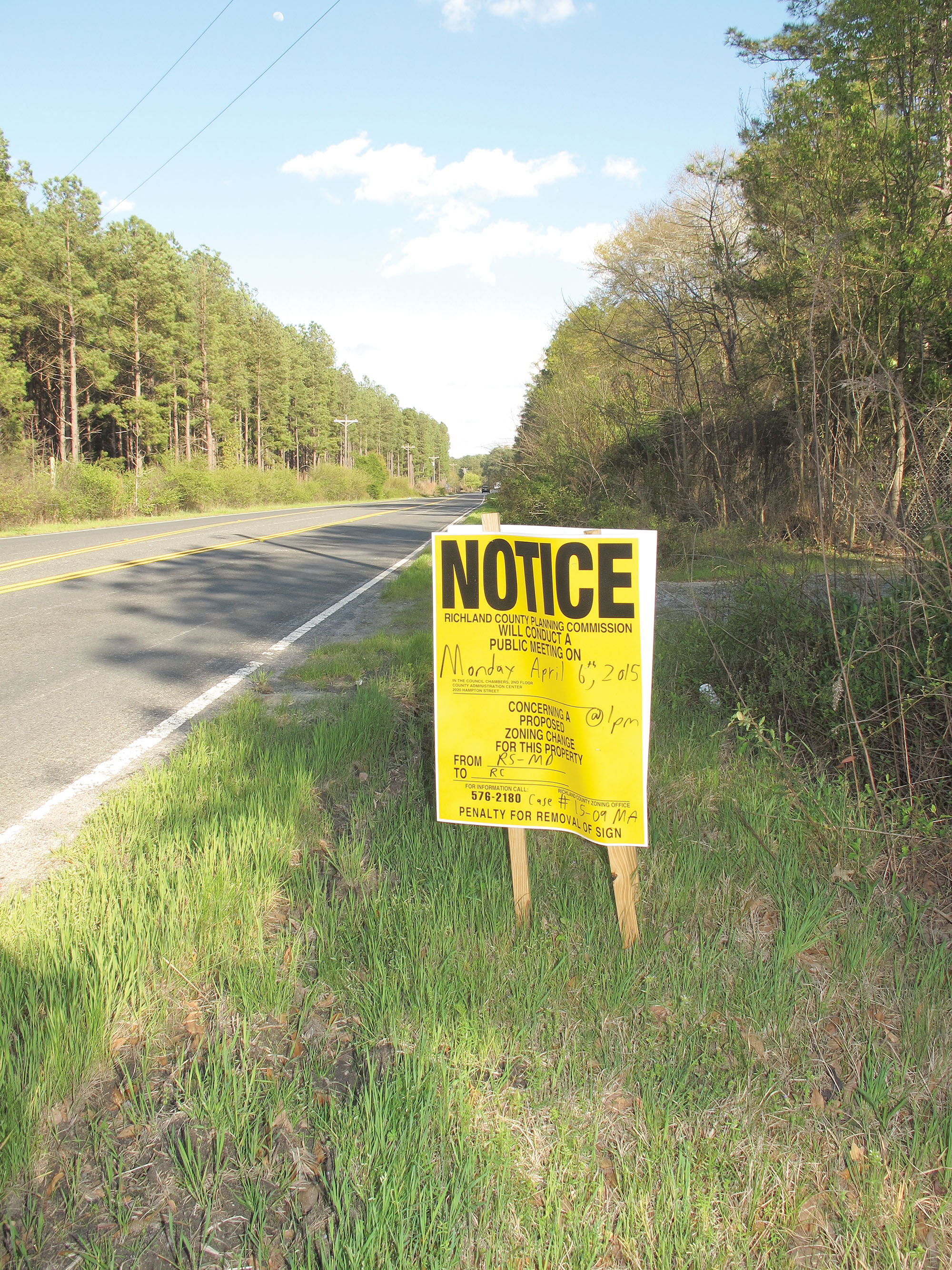
    Yellow signs posted to notify residents on Rimer Pond Road of proposed commercial zoning on the road.
    Yellow signs posted to notify residents on Rimer Pond Road of proposed commercial zoning on the road.

    BLYTHEWOOD – The owners of two separate properties on Rimer Pond Road will come before the Richland County Planning Commission Monday at 1 p.m. to request the zoning on their properties be changed from Rural (RU) to Rural Commercial (RC). One is a 2.76 acre parcel (tax map number R15100-06-26) owned by John Warren of Chapin and located about 700 feet from Highway 21. The other is a 5.23 acre tract that is part of a larger 31.23 acre parcel (tax map number R20500-04-27) owned by Pat Palmer of Sycamore Development LLC and located at the intersection of Rimer Pond Road and Longtown Road across from the Blythewood Middle School.

    The Richland County planning staff has recommended (to the Planning Commission) against commercial rezoning of the Warren parcel near Highway 21 but recommended in favor of Rural Commercial zoning of the 5.76 acre parcel located at Longtown Road and Rimer Pond Road.

    There is no other commercial zoning on the entire length of the road and the staff report acknowledges that the area is surrounded by wooded areas and large acre properties. According to Suzie Haynes, Boards & Committees Coordinator for Richland County, RC zoning allows many kinds of businesses including liquor stores, restaurants, grocery stores, convenience stores with gas pumps, pawn shops, motor vehicle sales and more.

    The Planning Commission is a recommending body to County Council and has no zoning authority. Council makes all final decisions regarding zoning. The Commission is also not obligated to adhere to staff recommendations.

    Historically, residents of the road have turned out in large numbers at hearings in the County to protest commercial zoning proposed along the road. But Trey Hair, a resident of the road who works in Columbia, said holding the hearing in the middle of a work day always prohibits many residents from attending.

    “These meetings should be held in the evenings so everyone who wants to can attend and speak out,” Hair said.

    Mary Lee, whose family has owned a farm on the road for almost 40 years, has spoken out against commercialization of the road at a number of Planning Commission and County Council meetings. And she plans to be there again on Monday.

    “We are a rural area with mostly farms, churches, schools, large-acre residential properties and some neighborhoods,” Lee said. “Once commercial starts, it will move down the road.”

    When contacted by The Voice about the 5.23 acre property further up the road, Palmer of Sycamore Development, LLC, who both owns the property and is Chairman of the Richland County Planning Commission that will be hearing and voting on the rezoning request, would not comment, saying he did not want to answer any questions regarding the rezoning.

    It was previously reported in The Voice that the owner of the other property, Warren, wrote a letter to Blythewood Mayor J. Michael Ross on Feb. 17 seeking the mayor’s support for the commercial zoning request. Warren wrote in the letter, “Though I would hate to do this to the community, if we can’t get it rezoned, we plan to divide the property and locate mobile homes on (it),” which Warren said he would rent out.

    The mayor told The Voice he asked the Town’s Planning Commission Chairman, Malcolm Gordge, who is appointed to the Commission and has no jurisdiction over the zoning, to reply to Warren. The Voice obtained from Gordge a copy of a letter dated Feb. 24, in which Gordge wrote to Warren, “The Mayor and I have discussed your desire to amend the zoning of the property in question . . . to Commercial and we would like to help you if at all possible.”

    Gordge went on to offer the assistance of the Town Hall staff to help Warren achieve his goal of commercial zoning for the property.

    When a number of Rimer Pond residents opposing the commercial zoning attended a Blythewood Planning Commission meeting on March 2 where the letter from Warren was on the agenda to be discussed, Gordge did not reveal that he had corresponded with Warren offering his help.

    During public comment time at the meeting, Hair, speaking for other residents in attendance, told the Commission, “While we are not residents of the Town, we are in the community. We shop here, attend Blythewood churches and schools and participate in the community’s activities. We would ask that you support us, the majority who do not want the commercialization of Rimer Pond Road rather than support (Warren) who has never lived here, will never live here and simply bought the piece of property to rezone it and sell for a profit. Once it (Warren’s property) becomes commercial, that commercial will domino right down the road.

    “We live here,” Hair said. “We don’t have a sign like Cobblestone, but it is our community and I just want to go on record against commercial zoning on Rimer Pond Road. I ask for your support in our objections to commercial zoning on our road.”

    Gordge told Hair, “We have some sympathy with your views, but that area has been earmarked (by the Master Plan) for some type of commercial zoning.”

    But Town Councilman Bob Massa, who was a member of the Town’s Planning Commission when the area was designated in the Master Plan for commercial zoning, told The Voice that the Town government (previously) agreed to the residents’ requests and did not further pursue commercial zoning on the road. However, the Master Plan still reflects the commercial ‘node.’

    Gordge told Hair that commercial zoning might not be as bad as the residents envision.

    “It’s easy for you to say it’s not going to be as bad as I feel it will be,” Hair said, “but once the commercialization begins, we won’t be able to stop it. It will domino.”

    The hearing for the rezoning of both properties will be held at the Richland County Building at the corner of Harden and Hampton streets in Columbia. Residents who would like to speak at the hearing must sign up to speak prior to the beginning of the meeting, which begins at 1 p.m. April 6.

    For information about the hearing or to receive an agenda and packet of information about the two properties, call Haynes at 576-2176. Residents can also contact Hair at thair@coastalscience.com.

  • Council OK’s Water, Lifts Annexation Ban

    WINNSBORO – Town Council gave the OK last week for water for a pair of Blythewood projects, one of which settles a dispute that has been brewing since 2008.

    Council unanimously approved up to 42,800 gallons a day for 107 residential lots on a 31.23-acre tract at 502 Rimer Pond Road in Blythewood, while also approving 25,000 gallons per day for 5 acres of commercial property adjoining the tract. The agreement puts to rest a beef by Sycamore Development, LLC, which had, in 2008, planned to develop three parcels there into a 300-home subdivision. The developer received a Capacity and Willingness to Serve letter from Winnsboro for 250 residential lots with the understanding that the water taps were to be prepaid by Sycamore once the water line went in on Rimer Pond Road.

    That water line was completed and accepted by Winnsboro in July of 2009, but Sycamore never prepaid for any taps.

    The subdivision never materialized, and two of the three parcels have since been sold off. Sycamore still holds a 31.23-acre parcel at 502 Rimer Pond Road that it also wants to unload but cannot, according to documents obtained by The Voice last summer, because Winnsboro allegedly refuses to enter into a Capacity and Willingness to Serve agreement with prospective buyers.

    During their March 17 meeting, Council amended the original resolution for water to include the commercial property. Council also agreed to amend a previous arrangement for a retirement community, initially planned for a 4-acre tract at the end of Creech Road in Blythewood, behind the Russell and Jeffcoat offices. While the amount of water will remain at the 20,000 gallons a day approved last January, the Town said the developer, Fowler Realty and Land Services in Columbia, now plans to build the 64 two-bedroom, two-bath units on the north end of Main Street in Blythewood, across from the BP Station.

    Annexation

    Council voted unanimously during their March 17 meeting to lift the moratorium on annexation into the Town limits, opening the door for properties to annex into the Town.

    Capital Expenditures

    Council gave the OK to three items for purchase during the meeting: a forklift for the Electric Department ($16,700), doors for the lab at the wastewater treatment plant ($3,645) and a steam cleaner for the Streets & Sanitation Department ($4,125).


  • Move to Police Comments Heads to Committee

    WINNSBORO – Although one citizen spoke out against the idea, and while three members of Council were lukewarm on the notion, County Council voted 7-0 Monday night to refer to committee a proposal to limit what members of the public may discuss during the two public comment segments of Council meetings.

    “You cannot argue against the truth that free speech is essential to democracy and is a bulwark to tyranny,” Ridgeway resident Randy Bright told Council during the meeting’s firsts public comment session. “Council has Roberts Rules of Order and reams of federal speech laws to enhance orderly and productive meetings. Why do we need more laws? Why do we need more restrictions?”

    Councilman Kamau Marcharia (District 4) brought the matter up during Council’s March 16 meeting, asking Council to consider closing the floor to public comment that strayed from the County’s turf, or that deviated into unsubstantiated and personal verbal attacks against elected officials serving on other public bodies. Marcharia told The Voice after the March 16 meeting that he was thinking specifically of the recent request made to Council by Gregrey Ginyard, Mayor of Jenkinsville, for $50,000 in matching grant funds for the completion of a sidewalk in the Western Fairfield town. Marcharia noted that public opposition to Ginyard’s request was accompanied by verbal attacks against Ginyard in his role as president of the Jenkinsville Water Company, with those attacks insinuating that Ginyard had mishandled or misappropriated water company funds.

    “I wanted it to go before the committee to take a look at that and see whether or not we’re responsible for other elected officials,” Marcharia said Monday night, “or what the public can say about other people that are not in our purview.”

    Councilman Dan Ruff (District 1) said he did not think the bylaws would have to change very much in order to address Marcharia’s concerns, provided Council abided by Roberts Rules of Order and provided the Chairwoman maintained order at the meetings.

    Councilman Billy Smith (District 7), while agreeing to send the item to committee, also agreed with Ruff.

    “I think that our bylaws and Roberts Rules of Order already preclude certain personal affronts or things of that nature,” Smith said. “I think our code of conduct in our bylaws takes care of that, so I don’t see a need for us to change anything.”

    “I would say to you, Mr. Smith, that over the last 18 months there have been some very derogatory things said to Council members,” Marcharia said. “Threats and intimidations and people had to be removed from Council, and it’s in our bylaws to stop that, to gavel that and apparently folks didn’t have any respect for us with that so I think we need something in place that when that happens we are able to legally with our authority put a stop to it.”

    Councilwoman Mary Lynn Kinley (District 6) said the topic, and not merely the content, of public comments needed to be addressed.

    “We have issues that are brought (to us) that we have absolutely no control over,” she said. “Water is a typical example. I don’t think we need to hear water issues and concerns when really have nothing to do with it. Things that we can do something about, yes; but things we have no control over, that’s one thing I wanted to have changed.”

    Councilman Walter Larry Stewart (District 3) said Council should be careful not to create “unmanageable legislation,” while Ruff added that Marcharia’s concerns apply to both the public and to Council members.

    “I understand what Mr. Marcharia is saying, but I know that it happens on both sides of the fence,” Ruff said. “People need to be respectful on both sides, and I think it’s really up to the Chairman to moderate and keep everything under control on both sides.”

    “And if I may, Madame Chairman,” Stewart said, “you already have that power. So let’s not go too far off the deep end.”

    With the 7-0 vote, Robinson said the matter would be referred to the Administration and Finance Committee, which consists of Robinson, Kinley and District 5 Councilman Marion Robinson.

    Later, during the County Council time portion of the meeting, Smith indicated that his decision on the matter had already been made.

    “I just have to add that I think the government is the citizens’ tool,” Smith said, “and so if the citizens can’t come and tell us what they want, then we can’t do what our job is, so I certainly won’t be supporting that.”

    “I’m glad to have everybody come and speak,” Ruff added. “Good, bad or whatever.”