Category: Government

  • Recreation Plan Under Fire

    Councilmen Push for Recreation ‘Revisit’

    WINNSBORO – Fairfield County has, since officially adopting the $3.5 million plan last September, been working toward a recreation makeover for the entire county. But with the housecleaning enacted by voters during the November general election and the March special election, in which four new Council members were swept into office, the plan as it exists today may be in jeopardy.

    District 3 Councilman Walter Larry Stewart, the last of the four newcomers seated to Council, brought the matter up during Council’s March 23 meeting.

    “I am uneasy with our whole recreation plan for the County,” Stewart, addressing Chairwoman Carolyn Robinson, said. “I’m not sure where we stand on that, but it is my gut feeling that says we need some more citizen input on our recreation plan.”

    Billy Smith, District 7’s new face on Council, echoed that sentiment during Council’s April 13 meeting.

    “I do want us to bring that (recreation plan) up at the next meeting to see if there’s anything Council members want to change,” Smith, also addressing the Chairwoman, said.

    Councilman Kamau Marcharia (District 4) questioned Smith’s suggestion of a review, asking if Smith was interested in having each Council member review their individual districts or take on the entire plan.

    “I think we need to start the discussion to see where that might go since we do have a new Council up here, but I’m talking about the plan as a whole,” Smith answered.

    Robinson said the plan was discussed at Council’s Feb. 21 retreat, but noted that Stewart, elected in a March 3 special election, was not in attendance.

    “I have no problem with us bringing back that same presentation and showing everyone as well as the public what is out there for recreation,” Robinson said.

    The presentation made to Council by David Brandes of Genesis Consulting just prior to their vote last September is available on the County’s website, and what it details is a project that is more than 100 percent over budget. But Brandes told Council then that “We’re not trying to get down to the exact budget. We want some ability for the marketplace to play a role. If prices come in better than we anticipated, we wanted to take advantage of that.”

    Only District 3, with a basketball court and a handful of playgrounds, came in under its $500,000 budget (at $499,337). The other districts range from as little as $9,600 over budget to more than $144,000 over budget, bringing the entire project over budget by $628,009.

    By bidding out the plan as one large project, instead of as individual smaller projects, the County hopes to get those numbers down, according to Milton Pope, Interim County Administrator. At present, the County has only advertised for pre-qualifications for bids.

    After the bids come in, Council will take another look at the numbers.

    “We haven’t looked at the final (bid) plans, yet,” Marcharia told The Voice this week. “After we get the bids, we will look at what can be trimmed, or even added.”

    Marcharia has long been an advocate for recreation in the county, particularly in rural District 4. After the adoption by the former Council of a comprehensive recreation plan, Marcharia is reluctant to see it tampered with.

    “I don’t feel good about it,” Marcharia said. “I feel very threatened. The whole community has worked on this, to have a community place to go. I feel bad they are contemplating looking at stopping it or starting all over again.”

    The plan for District 4, totaling $641,660 at present, includes a community center, walking trails and outdoor basketball court.

    “If it were up to me, I would like to revisit that and come up with a new plan,” Smith told The Voice. “That would be on the table.”

    With the bond money set to expire next year, however, any new plan would have to happen quickly.

    “The clock is ticking,” Marcharia said. “What will it cost taxpayers to put on the breaks? That’s inexcusable after all these years.”

    But Smith said the expense of starting over might be less than the expense of moving forward.

    “All that has been agreed to so far is the consulting services (Genesis and Ken Simmons Associates) and the architectural renderings,” Smith said. “If we changed the plan, we would lose that money, but that may be better than putting through a plan that wasted a lot of money.”

    The District 7 plan, created under Smith predecessor, David Brown, weighs in at $644,440 in pre-bid dollars, and calls for an outdoor basketball court, a baseball/softball field, picnic shelter, restrooms and improvements to the genealogy building. The latter, Smith said, pushes the boundaries of the definition of ‘recreation.’

    “I’m not so sure the County government using taxpayer money should be involved in the genealogy research business,” Smith said.

    And if individual Council members want to tweak the plans for their districts, Marcharia said, that is fine by him.

    “If they see something that needs to be fixed, they can do so without starting all over,” Marcharia said. “I hope they don’t plan on putting on the breaks and stopping this.

    “I am perplexed they think we would need to start all over,” Marcharia added. “And it wouldn’t just be for my district – everyone would have to start over at square one. Who knows how many more years that would take?”

    Smith said he hoped the item would be included on Council’s April 27 agenda. Robinson, however, said that as of Monday afternoon, it was not.

    “The budget is on everyone’s mind,” Robinson said. “Or it should be. I don’t know what is on their minds. I have my suspicions, but I don’t really know what it is they even want to talk about. Stewart was the only one not in our retreat. The other three (new Council members) got full disclosure on the recreation plan then. It’s to the point of being bid out. We are on a time table.”

    Robinson said the item would not likely appear on any agenda before Council gets at least one more budget work session in, the next one of which is scheduled for April 30, she said. Furthermore, she said, there were several “legal questions” that she needed answered before moving forward and placing the item on the agenda.

    “I have to know if we are following all the rules correctly,” Robinson said.
  • Final Zoning Vote on Tap

    BLYTHEWOOD – Town Council will take its final vote Monday evening on a zoning text amendment that will, if passed, provide for the Limited Industrial Two District (LI2) in the town and regulations relating to that district. According to the Town’s Economic Development Consultant Ed Parler, the new zoning district will allow a wider variety and greater intensity of manufacturing uses than the Town’s current Limited Industrial District (LI).

    Industrial uses allowed will include tire manufacturing, textile industries, testing laboratories, public relations agencies, cafeterias, restaurants and more. But Parler said LI2 would not allow such uses as foundry and smelting operations or distribution centers. He said distribution centers should be located elsewhere because of their heavy use of truck traffic.

    Council will also be considering whether to allow the height of the buildings in the district to extend to 100 feet as recommended last week by the planning commission. Should Council approve the height extension, the Board of Zoning Appeals would have to option to approve an additional 10 feet. The building height in the ordinance as it is now written is 35 feet. Parler appealed to the Commission to approve the height extension, saying the County has no height limit at all.

    Parler said the text amendment is needed for the rezoning of a specific 600-acre tract of land located between Ashley Oaks and I-77, known locally as the Barnett property. Parler said Richland County has its eye on the property for an industry it says is interested.

    “Be assured,” Parler told Council, “that if you establish this LI2 zoning district, you will immediately receive a zoning request for LI2 zoning for this 600-acre property and the applicant will be Richland County.”

    Other items on the agenda include possible action on a new structure for rates for business meetings at the Manor, presentation of the proposed FY 2016 budget, consideration to bring the Wall that Heals to Blythewood to honor the community’s war heroes and appointment of a new Town Clerk. The current Town Clerk, Beverly Colley, was recently married and will be relocating with her husband.

    The meeting is scheduled for Monday evening, April 27, at 7 p.m. at The Manor.


  • Rimer Pond Road’s Next Hurdle

    Rezoning Comes to Public Hearing

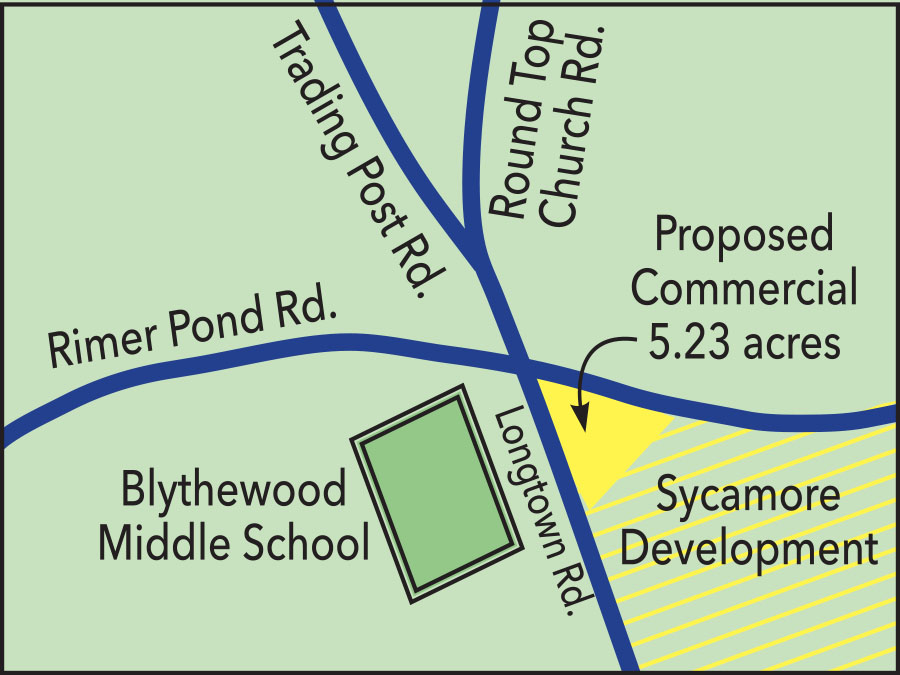
    Rimer Pond map April 24 copyBLYTHEWOOD – Rimer Pond Road residents are expected to show up at a Richland County Council public hearing on Tuesday evening a little before 7 p.m. to sign up to speak against the proposed rezoning of a 5.23-acre parcel of land at the intersection of Rimer Pond Road and Longtown Road/Trading Post Road. The owner of the property, Sycamore Development, is requesting a change in zoning from Medium Density Residential (RS-MD) to Rural Commercial (RC). The parcel is located across from Blythewood Middle School.

    While the County’s Planning Department staff is recommending that Council vote in favor of commercial zoning, the County’s Planning Commission, which is the recommending body to County Council, voted 4-1 on April 6 against the staff’s recommendation.

    The Chairman of the Planning Commission, Patrick Palmer, recused himself from voting on the rezoning request since he is handling the sale of the property. Palmer is the Director of Retail Services for NAI Avant Commercial Real Estate in Columbia. It was reported in the April 17 issue of The Voice that Palmer is also an owner of Sycamore Development, but he told The Voice on Tuesday that he is not. He would not say who the owners are. However, the Secretary of State’s office lists his father, Hugh A. Palmer, as the registered agent for Sycamore Development.

    Two Columbia area commercial realtors, who asked not to be named, provided The Voice earlier this week with a sales promotion flyer from Palmer’s office advertising the property to prospective buyers as having already been zoned for commercial use. Both sources said the flyer was distributed prior to the April 6 Planning Commission meeting. The document lists Palmer as the person to contact for more information. When reached by The Voice on Tuesday to verify the authenticity of the flyer, Palmer took responsibility for the flyer, but said he did not realize that it contained incorrect information claiming the property was already zoned commercial. He told The Voice that he would make that correction in the flyer.

    Among other information, the flyer states that the 5.23 acres identified as commercially zoned are priced at $350,000 per acre and an additional 31.23 acres of adjoining lots owned by Sycamore Development and zoned for medium density residential use are priced at $28,500 per acre.

    A notation at the bottom of the sales flyer states: “This document may not be reproduced in whole or in part without the express written consent of NAI Avant.”

    Twenty or so residents from Rimer Pond Road, LongCreek Plantation and Round Top Community attended the April 6 meeting to protest the rezoning and remind the Planning Commission that there is no commercial zoning anywhere on the road. They talked about their love of the rural, the increasing traffic congestion on the road and their fear of how commercial development would change their community.

    “For the last 25 years we have been down here helping the county make zoning decisions on our road,” longtime Rimer Pond Road resident Michael Watts told the Commission. “Every time commercial has come up on this road, we’ve been here to say thanks but no thanks. We like it the way it is. Commercial zoning has no place in this rural environment. We’re begging you to not put it on us. Let us continue to enjoy the rural out here.”

    Joanna Weitzel of LongCreek Plantation said, “Blythewood has managed to maintain the integrity of its rural. If you open up one store out here, you’ll open up a flood gate of commercial. You’ll change our rural community. I’m not against development. But I am for responsible development. This is not responsible development.”

    Palmer told The Voice on Tuesday that he thinks commercial zoning will not bring to fruition the residents’ worst fears.

    “It makes sense to me that Rural Commercial zoning would be appropriate (within) a rural zoned area,” Palmer said.

    The County zoning code for RC includes grocery stores, liquor stores and convenience stores with gas pumps as well as offices and restaurants. Palmer said he envisions this particular commercial zoning to “service the folks who live there.”

    He also said this zoning “is what the County, as a whole, has instructed the development community to do. Maybe it’s against what the residents out here want. But as a person who owns property in the county, all I have to go on is what the County says, so that’s what I’m going to do.”

    He said the County’s Comprehensive (Comp) Land Use Plan and zoning ordinances say “this is the direction we want to grow.”

    Palmer also said a cell tower on the property limited what he could do with the property, saying he couldn’t put homes there because, “people don’t want to live around cell towers.” Rimer Pond Road resident Ken Queen reminded the Planning Commission, though, that Palmer had originally asked for and was granted residential zoning for the entire property and now wants to change the point of the parcel to commercial zoning.

    According to the County staff’s zoning district summary, RC zoning is designed to bring commercial services to residents in the more isolated agricultural and rural districts who are located beyond the limits of commercial services. The summary also states that the RC district is designed to be located at or near intersections of major collector roads.

    “All the (zoning) guidance points to this intersection as a parcel needing rezoning. That’s what the guidance says,” Palmer continued. “The documents that the County has passed have put this area as an area for change per the comp plan.”

    Planning Commissioner Heather Cairns disagreed.

    “If all it takes is an intersection for there to be commercial development in what is an otherwise totally rural area, I’m sort of horrified,” Cairns said. “That means we won’t ever have integrity in our rural areas. It may be an intersection, but this area is already well served by commercial development a couple of miles away.”

    Cairns also addressed the suggestion that the school contributed favorably to commercial development.

    “To me,” Cairns said, “to see a school completely surrounded by residences, I say that’s a good thing. Just because a school is there does not mean it has to have commercial next door. This area is not underserved by commercial development.”

    Commissioner Beverly Frierson agreed, saying that the properties along Rimer Pond Road are not isolated from commercial services.

    “These residents,” she said, “would be adversely impacted. There are already stores and conveniences nearby.”

    The zoning request will be heard by the County Council at 7 p.m. on Tuesday, April 28, at the County Building, 2020 Hampton St. in Columbia (at the corner of Hampton and Harden streets) and is the first item on the docket.

  • Cotton Yard Lease Faces Third Delay

    H-Tax Passes First Reading

    RIDGEWAY –The third time was not the charm for a lease between the Town of Ridgeway and Norfolk Southern Railway as Town Council once again tabled a final vote on the agreement during their April 9 meeting.

    “We had a contractual question,” Councilman Russ Brown told The Voice this week, “and they responded, but not until 4 p.m., right before the meeting. One of the questions they did not make very clear, as far as terms and length of terms and conditions. And we have a new contact at the railroad and he is kind of playing catch-up. We’ve just got to get one or two things squared away.”

    The $300 a year lease demanded by the railroad company would also require the Town to purchase liability insurance for the property at $1,000 a year. Mayor Charlene Herring told Council in December that the railroad company is reviewing leases and properties all across the state, forcing municipalities to either lease the lots and accept liability or see the lots fenced off. In Ridgeway’s case, at least two buildings stand on the property – the police station and the fire station – and the railroad would demand their removal unless the Town agreed to a lease.

    Budget

    As Council begins preparations for its 2015-2016 budget, Council members presented items for consideration.

    Councilman Heath Cookendorfer said he would like to see an itemized breakdown of miscellaneous expenses in this year’s general fund, while Brown said it might be helpful to have someone overseeing the Town’s monthly bank statement and for Council to have that statement included in their meeting information packets.

    Focusing on the Police Department, Councilman Donald Prioleau said he would like to see Council come up with funding for body cameras for the Ridgeway’s officers, as well as money for police overtime pay and for a stable of reserve officers or constables to be used on an as-needed basis. Cookendorfer added that he would like the Town to find money for internet service at the police station.

    Councilman Doug Porter said Council should be prepared to raise water and sewer rates again this year, as the rates for water from Winnsboro, Ridgeway’s primary supplier, are also going up to 98 cents per 1,000 gallons. Herring also suggested a review of the Town’s business license fee, which she said had not been increased since 1987.

    Hospitality Tax

    Council also passed first reading on an ordinance authorizing a hospitality tax.

    The ordinance caps the tax at 2 percent and only applies to prepared meals and beverages in an establishment or under an establishment’s license.

    During Council’s March discussion of the tax, Brown said the revenue could go toward tourism-related, cultural, recreational or historic facilities, as well as highways, roads, streets or bridges providing access to tourist destinations. The revenue could also go toward advertising and promotion of tourism development, and to water and sewer infrastructure serving tourism-related facilities. The funds could go toward preserving the arch on the old school property, and for promoting Pig on the Ridge, Arts on the Ridge and other Town events.

    Council will hold second reading at their May 14 meeting.


  • Board Debates Legal Fees, Considers Pay Increase

    Hartman: Legal Budget a ‘Slush Fund’

    WINNSBORO – As the Fairfield County School Board, during their April 7 meeting, passed first reading of a more than $37 million budget for the 2015-2016 fiscal year, Board members took up the topic of travel expenses, Board compensation, legal fees and funding for Fairfield Behavioral Health Services.

    Weighing in at $37,401,195 (up from $35,548,351 in 2014-2015), the 2015-2016 budget includes no operational millage increase, Kevin Robinson, Director of Finance, told the Board April 7. The operational millage will remain at 203.1 mills, Robinson said, while the debt service millage will decrease slightly from 32 to 23.6 mills. Robinson said he expects an increase in local revenues from $22.5 million last year to $24.3 million this year, based on an expanding property tax base in Fairfield County. The budget passed first reading on a 4-1 vote, with Andrea Harrison (District 1) voting against and Annie McDaniel (District 4) and Paula Hartman (District 2) abstaining.

    Legal Fees

    Hartman questioned why, with actual legal spending on the decline in recent years, the District continued to budget a total of $307,707 for legal fees ($282,707 under the Board’s “Legal Fees,” and $25,000 for the District’s “Legal Services,” the latter of which Robinson said was for the expenses associated with recruitment and retention of foreign teachers).

    Hartman said money had been redirected from the Legal Fees budget to fund teacher Christmas bonuses, as well as a field trip in 2014-2015, and suggested the amount budgeted be lowered and shifted into the fund balance.

    “This looks like this (the Legal Fees line item) is being used as a slush fund, because it’s been used for bonuses, it’s been used to send the chorus class to Disney World, instead of for legal fees,” Hartman said. “I certainly think we’re budgeted way too much when a very little amount has been spent.”

    During the 2013-2014 fiscal year, the District spent $96,987 in legal fees, according to a draft of the upcoming budget provided to The Voice, while the 2014-2015 legal expenses are expected to top out at $39,765. Legal Services expenditures, meanwhile, are projected to hit just $13,782 by the end of this fiscal year.

    Dr. J.R. Green, Superintendent of Fairfield County Schools, told The Voice this week that referring to the legal budget as a “slush fund” was “absurd.”

    “We had two expenditures out of the legal fund this year,” Green said, “for the employee gift cards at Christmas and to pay part of the expense of sending the Middle School chorus to Disney World. Both were presented to the Board and they voted on them.”

    The gift cards, Green said, set the legal fund back approximately $35,000, while the portion of the trip to Disney World paid out of the fund was approximately $12,000.

    “I don’t know if a couple of years reflects enough of a trend to reduce the budgeting (for legal fees),” Green said. “I would hope that we continue down this road we’re going down.”

    Green told the Board during the April 7 meeting that he would “wait until this (reduction in legal spending) continues for multiple years before we determine we don’t necessarily need that amount to be budgeted.”

    Behavioral Health Services

    Green said Fairfield Behavioral Health Services (FBHS) was, like last year, requesting $60,000 from the District to provide services to students. The funding last year surprised some Board members, specifically Harrison, who questioned its inclusion in the 2014-2015 budget. During the April 7 meeting, Harrison asked for a financial breakdown of services provided by to the District by FBHS.

    “The issue is that funding is limited and we’re assisting them with providing funding so they don’t have to cut services,” Harrison said. “Then we need to know specifically what we’re paying for. We may have been advised previously that this was a budget shortfall on their part, which to me doesn’t necessarily constitute the School District being responsible. Behavioral Health is a County entity.”

    Green said he would provide the documentation before the second reading of the budget.

    Travel

    William Frick (District 6) said the Board may want to consider a discussion on the amount and expense of travel taken by Board members throughout the year, particularly when considering what he said was the public perception of extensive travel.

    “The public perception is that it is a paid vacation,” Frick said. “I assure you it is not. I certainly think folks should go to the state annual conference. I think there’s a benefit of the national conference. But I think it is something we should be aware of, as far as public perception.”

    Frick said some districts limit the number of trips board members can take in a year, as well as limit the number of board members who can attend any given trip.

    McDaniel said her concern over travel was a methodology to “ensure when Board members travel, we get the best value for our dollars.” The issue came up, she said, when she and Hartman traveled recently to Nashville for the National School Boards Association conference. McDaniel said she had found a cheaper flight and cheaper rooms, but ran into difficulty at the District level when attempting to rearrange her travel plans.

    “Last minute finding a flight and a hotel that’s cheaper, that’s a noble attempt,” Board Chairwoman Beth Reid (District 7) said, “but at some point it’s too late. If the Board clerk has been directed to make these hotel reservations or plane reservations, the wheels have started turning at that point and Board members shouldn’t be making their own travel arrangements.

    “If you want the cheapest rate, then find it, put it on your credit card and get reimbursed,” Reid added.

    Hartman asked Reid why she was “making an issue” of Hartman and McDaniel, who switched to less expensive hotel rooms in Nashville, saving $1,500 on the trip.

    “Right,” Reid said. “And how much did you spend?”

    Reid said the District did not have problems with every Board member who travels, to which McDaniel replied was only because some Board members do not travel.

    “If you would travel and go to some of these conferences you would learn a lot,” McDaniel said to Reid, “and not make some of the mistakes that you’re making up here.”

    Compensation

    Henry Miller (District 3) said it may be time for the Board to take a look at its compensation rate, which currently stands at $35 per meeting.

    “Other boards around the state, their compensation is higher per month,” Miller said. “I know we serve the same constituents as County Council. In my opinion, we do more work. I think we should be (paid) at least half of (what) County Council (makes).”

    County Council members receive a $15,000 a year base salary, with an additional $4,800 for the chairperson and $3,000 for the vice chairperson.

    “We didn’t get on the Board for the money,” Miller added, “but we didn’t get on the Board to lose, either.”

    Frick said he had researched board pay throughout the state, citing as an example Lancaster County, which pays its board members $400 a month. Harrison, however, noted the apparent paradox in the Board’s recent discussions.

    “So, in one breath we’re saying the perception of the public is we spend too much money on travel to become educated, yet we turn around and asked to be paid (more),” Harrison said. “I think we need to thoroughly talk this out and work through it more. We meet once a month. I don’t care if I’m compensated or not.

    But, she added, “I’m not recommending against it, if that’s what the Board wants to do.”

    Frick said it was just a discussion topic. The $400 example, he said, came to $4,800 per Board member per year. Travel, he said, averages between $1,500 and $3,000 per trip.

    “And there are some folks who have taken three or four trips a year,” Frick said. “If you’re taking that many trips, that gets pretty high.”

    Of the 81 school districts in the state, 31 offer no compensation. Of the 50 that do pay members, those range from as low as $25 per meeting (Florence 1) to $800 a month (Richland 2). For a complete list, see: http://scsba.org/general/aboutus_schoolboardfacts_boardmemberpay.pdf

    The Board took no action on either travel or compensation. The Board will hold a budget work session on Tuesday at 6 p.m.


  • Council Backs Bid Process

    In Face of Criticism, No Move to Re-Bid Detention Center Roof

    WINNSBORO – Responding Monday night to concerns voiced by the public, County Council briefly addressed procurement – for the assessment of the Detention Center roof as well as for the recent purchase of a piece of heavy equipment – but ultimately took no action on reconsidering the purchases.

    Beth Jenkins, addressing Council during the second public comment portion of the meeting, asked Council to reconsider the bid for the Detention Center roof.

    “I think that you were misled,” Jenkins said. “I don’t think you got the truth, the whole truth and nothing but the truth as far as the scope of work for the bids, the scope of work, the prices and what all it entailed. This procurement process was put in place for a process. It was not followed. I think we need to un-ring that bell and follow it.”

    Randy Bright, also speaking during the second public comment segment, agreed, adding that the County should be putting out bids for more of its purchased goods and services.

    “The process was not done right,” Bright said. “Our procurement process still seems to be wanting. I don’t see any bids on legal services, which are extremely expensive. I don’t see any bids on fuel, $80,000 last month. Fuel should be going way down. Consulting. I don’t see any bids on consulting. And I don’t see anything for auditing.”

    During County Council time, Walter Larry Stewart (District 3) asked Milton Pope, Interim County Administrator, if the procurement process had been followed to the letter. Stewart also asked Pope and Council if the County should re-bid the roof assessment. When he received no answer, Billy Smith (District 7) followed with the same question.

    “We do feel we were consistent with what is in the code to be able to do that,” Pope said after reviewing for Council how the process had transpired. “It was totally transparent from the committee process, the process that went to the physical council.”

    Pope said the assessment could be re-solicited, if Council desired, or could be folded into the entire project, to include the replacement of the roof, which would come in the 2015-2016 budget. That process, Pope said, would require sealed bids since it would exceed the $25,000 outlined in the procurement manual (see “Roofing bids open old wounds” in our April 10 edition).

    Marion Robinson (District 5), a member of the Administration and Finance Committee that recommended the assessment to Council, said questions about how the solicitations went out might be leading the County down an untenable road.

    “Are we saying we cannot do anything without going out for sealed bids?” Robinson asked. “I mean, that is not the way companies operate. They have vendors’ lists that are approved. They may be approved for a year or two years, but no company . . . or anybody can go out on sealed bids for everything they have done. I just wonder if that’s what we’re getting towards, because I’m thinking it’s the wrong thing to do.”

    One criticism of the roof assessment process was that it was not advertised either in a local newspaper or on the County’s website, as required by the manual for projects or purchases over $10,000. Although Pope and Chairwoman Carolyn Robinson (District 2) confirmed with The Voice last week that the project was not advertised, Councilman Dan Ruff (District 1) asked again Monday night if it had been.

    “No,” Carolyn Robinson said. “When you solicit, you go to that group of people (the approved vendors list) and solicit. But that’s only for small kinds of money. It’s not for big jobs like $100,000 and over, which to me always have to be sealed bids.”

    The procurement manual, however, puts the threshold for sealed bids at $25,000. The County budgeted $35,000 for the assessment, and on March 23 approved the assessment for “up to $35,000.” The winning bid, from Goodwyn Mills & Cawood, was for $20,000.

    “Since this was the engineering services, we knew – we didn’t even think it would be $25,000 in any way, shape or form,” Marion Robinson said Monday night. “In fact, it was $20,000 on one of them. So I’m real confused as to what we would do different going out to get engineering services to do the job.”

    Council also took some heat from Allen Gantt on their March 23 purchase of a $123,000 track hoe for the solid waste department.

    “Ya’ll missed a perfect opportunity last Council meeting to show some restraint,” Gantt said. “Mr. Stewart questioned the purchase of the excavator for the Airport Road landfill and recycling center (see “County revisits bylaws,” in our March 27 edition). It was right there on the table and teed up for you guys to at least show some restraint on spending our County money and it wasn’t done. Additional questions should have been asked. What are they going to use it for? Why do they need it? I know it’s a want, but is it a need?

    “If the answer is we don’t own an excavator, then the acquisition is reasonable; but to just blindly vote on it based on Mr. Pope’s recommendation based off somebody else’s recommendation doesn’t seem like it’s very good use of the County’s money,” Gantt said.

    Stewart voted against the purchase on March 23.

    Pope said Monday night that the track hoe had also gone through the committee process and that it was indeed a needed piece of equipment.

    “I didn’t want the citizens to feel as though the committee was just going on what I suggested,” Pope said. “There was some documentation and a request of action stating the needs of the piece of equipment.”


  • Residents Stall Rezoning

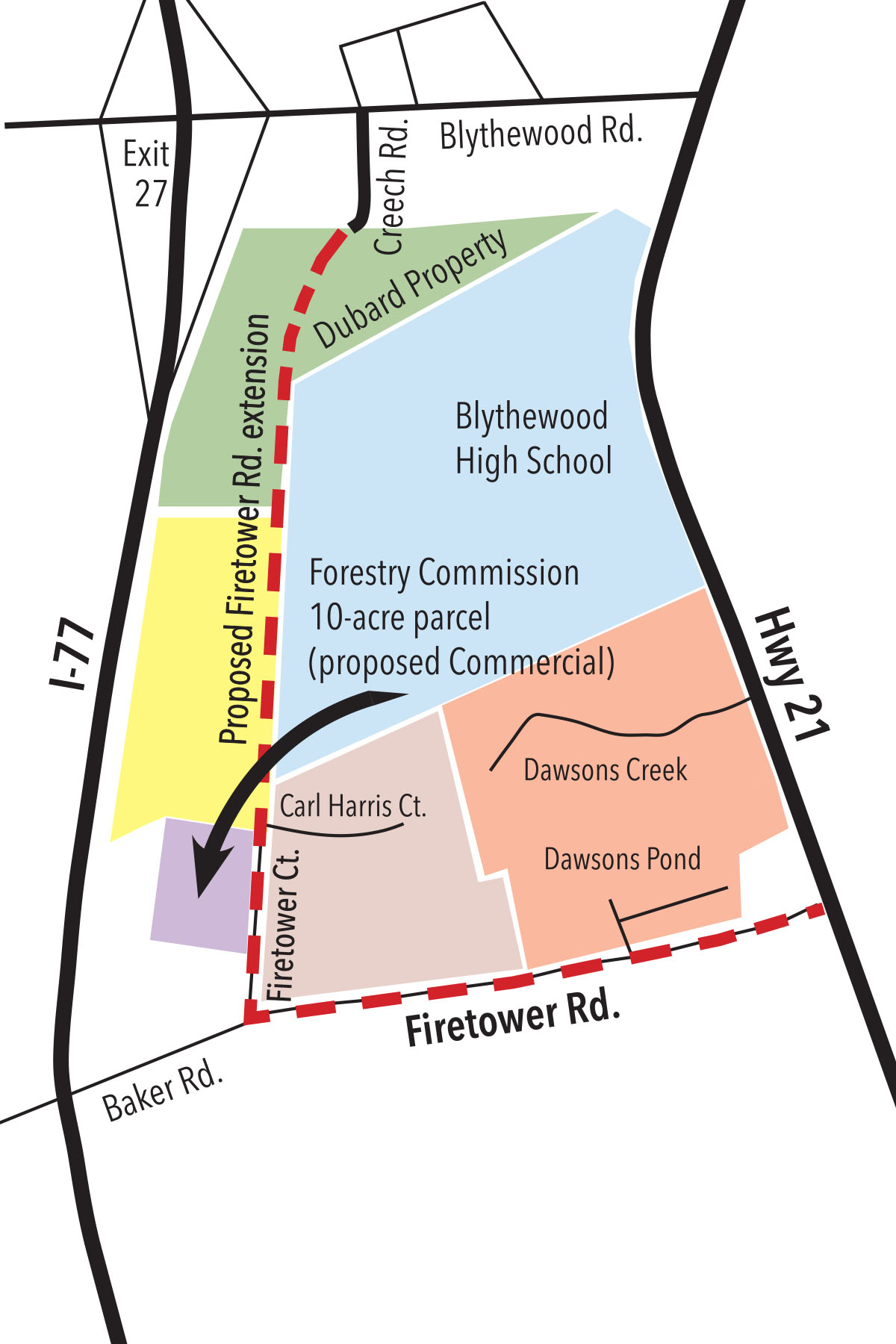
    Firetower map conv copyBLYTHEWOOD – In addition to two parcels of land on Rimer Pond Road being on the block for Rural Commercial (RC) zoning at the Richland County Planning Commission last week, a 10-acre parcel on Firetower Road was also on the agenda for General Commercial (GC) zoning but was withdrawn by the applicant just before the Commission started proceedings.

    Residents on Firetower Road signed a petition opposing the rezoning and Caleb Thomas and several others who live near the proposed rezoning were prepared to present the petition to the Commission had the matter been taken up. The applicant must now wait 90 days before bringing the rezoning request back before the Commission.

    The parcel in question, which adjoins the Carl Harris neighborhood and lies to the west of Dawson’s Creek and Dawson’s Pond neighborhoods, is owned by the S.C. Forestry Commission and was for years the site of a fire tower that served the Blythewood area. According to an employee with the S.C. Budget and Control Board who was not authorized to speak on the matter, the parcel is sold pending the rezoning of the property from Rural (RU) to GC. The source said it is the buyer who has initiated the rezoning. Because the parcel is state-owned land, the sale had to be approved by the General Services Department of the Budget and Control Board which issued an Invitation to Bid and initiated a sealed bid process for purchase.

    Residents say they are worried about the parcel being rezoned for General Commercial uses which include motorcycle and go-cart tracks, bus facilities, multi-family housing, restaurants, theaters, department and grocery stores, liquor stores and more.

    At last month’s Town Council workshop, Blythewood’s economic development consultant, Ed Parler, said he would like to see the area opened up for commerce by extending Creech Road (which runs off Blythewood Road in front of Hardee’s back to the Holiday Inn Express) down to Firetower Road which exits onto Highway 21 (Wilson Boulevard).

    For the extension to materialize and connect to Firetower Road, it would need access through three properties: a 36-acre parcel along I-77 owned by Margaret Dubard, et. al.; a 27-acre parcel of land owned by the Richland School District Two that runs between the high school and I-77 and the 10-acre parcel owned by the S.C. Forestry Commission. In the past, the school district has not warmed to the idea of the Creech Road extension. Parler told The Voice that he had not discussed the Creech Road extension possibilities with the district, that he did not know their stance on it and that he had no involvement with anyone purchasing or seeking to rezone the Forestry Commission property for commerce.

    Bruce Keen, a resident of Carl Harris Road, a quiet wooded neighborhood lined with tidy homes on large lots, told The Voice that he may be the only one in the neighborhood who would welcome commercial. He said owns a triangular lot on Firetower Road which he currently rents out for a cell tower.

    “The rental runs out in two years,” Keen said, “so that property would be in a good place to become commercial. It’s a gold mind for me.”

    But others along the road oppose the rezoning to commercial and say a connection between Creech Road and Firetower Road would turn the quite rural road into a thoroughfare.

    “If that extension becomes reality that will open Firetower Road up to a lot of traffic, including school traffic,” said Thomas. “Firetower Road would become a racetrack from Hardee’s through these neighborhoods to Highway 21. And that would ruin this nice quite area. We love it here.”

    Dawson’s Creek and Dawson’s Pond subdivisions are both in the Town of Blythewood as are some properties on Carl Harris Court and Firetower Road. Others, including the Forestry Commission parcel, are in the unincorporated area of Richland County.

    Because the agenda item was withdrawn, it cannot be brought back for consideration by the Planning Commission for 90 days.


  • Town May Shrink Boards, Commissions

    Council Urges Citizens to Take Traffic Survey

    BLYTHEWOOD – During its monthly marathon workshop Tuesday morning, Town Council discussed a number of topics, but took no votes. Councilman Tom Utroska managed to stir the pot even though he was absent due to travel. He left behind a letter to members of Council suggesting they consider cutting to five the number of appointees on each of the Town’s boards and commissions. All appointed boards now have seven members.

    “I feel the increase in the number of members has led to increased lack of resolutions due to management by committee,” Utroska wrote. “By requiring more members, we are restricting our ability to have a fresh pool of new talent.”

    He suggested the Council revert back to five members on each board and do so through attrition starting with the expiration of the next two incumbent terms.

    While Town Administrator Gary Parker said he had no strong feelings one way or the other, he pointed out that, “Sometimes the more members you have, the longer it takes to come to a decision. But that should be handled by a good chairperson.”

    Councilman Bob Mangone was concerned that fewer members might make it difficult to get a quorum. Mayor J. Michael Ross agreed. But Councilman Bob Massa countered, saying, “With seven, we have a better chance of having all areas of the town represented. That’s going to be a concern as our town grows. With only five members, it might be difficult to get good representation for the whole town.”

    It was for that reason that Councilman Eddie Baughman said he would like to keep the numbers as they are.

    “It looks like the consensus is to leave the numbers at seven,” Mangone said.

    “I lean toward five,” Ross said, “with the experience I’ve had in the last three years when these vacancies come up. We really don’t get that much interest. Let’s put it on the agenda and vote at the next meeting.”

    Citizen Survey

    During opening comments by Council members, Massa called attention to a study that might lead to alleviating Blythewood’s increasing traffic problems on Langford and Blythewood roads. He said the town’s citizens have an opportunity to answer a survey that is part of a study being conducted by the Central Midlands Council of Governments (CMCOG) to determine the transit needs of those living and/or working in the rural areas of Richland and Lexington counties outside existing metropolitan transit service. The study includes a one-page survey that is available at Town Hall and the Blythewood Branch Library.

    “The heavy morning traffic on Langford and Blythewood Roads,” Massa said, “and 600 new homes being built in Cobblestone alone will soon create even greater traffic problems. The folks in our community need to fill out this survey. It only takes a few minutes and can be dropped off at the library at 218 McNulty Road in Blythewood by May 1, and will be picked up.”

    Mangone agreed with Massa, emphasizing that, “There is no public transportation here in Blythewood. If someone needs to go into Columbia from Blythewood and has no transportation they’re out of luck. We need some kind of regular bus service.”

    In other business Council spent half the morning discussing changes to the Employee Handbook, some concerns about enforcing the current tree and landscape ordinance and adjustments to the rates for the manor.

    The next Town Council meeting will be Monday, April 27 at 7 p.m., at The Manor.


  • Community Speaks Out on Noise Ordinance

    WINNSBORO – The tranquil setting of Lake Wateree may get a lot quieter in the near future as Fairfield County Council’s Public Affairs and Policy Committee took public comment Monday night on proposed revisions to the County’s noise ordinance.

    The Committee is considering tacking on measurable decibel (dBA) levels to the existing ordinance, as well as extending the period of time covered under the ordinance to include 6 a.m. to 10 p.m. The current ordinance covers the 10 p.m. to 6 a.m. time period, but with no dBA levels, Sheriff Will Montgomery said the law was difficult to enforce and convictions were all but impossible.

    “The reason for the decibels is for mainly court purposes,” Montgomery told the Committee. “If we don’t have that, we don’t have anything to show the judge that the noise reached this level.”

    The ordinance won’t apply to Lake Wateree residents only, but the push to revise the current law began at a Lake Wateree community meeting, Montgomery said. But lake residents on hand Monday night said they were concerned how dBA levels would affect local businesses.

    “During the winter months on the lake, if you don’t make some money you’re going to starve to death,” Wateree resident Charles Stogner said. “The only way they make ends meet during that time is to bring in a band or some form of entertainment to attract more customers in.”

    The levels listed in the draft ordinance (available on the County’s website, www.fairfieldsc.com) limit decibels in residential areas to 70dBA from 6 a.m. to 10 p.m. and 65dBA from 10 p.m. to 6 p.m. In non-residential areas, the levels are limited to 75dBA from 6 a.m. to 10 p.m. and 70dBA from 10 p.m. to 6 a.m.

    Stogner told the Committee that everyday noises like a passing car or a running vacuum cleaner can generate around 76dBA, while things common to the lake area like outboard motors and motorcycle engines can crank out between 90 to 100dBA.

    “Not only would restaurants and establishments have a problem, I don’t know how we are going to be able to restrict the noise level of an outboard motor to 70 decibels during the daylight hours,” Stogner said.

    Clyde McFadden, another lake resident, said the noise ordinance was a waste of the County’s time.

    “I don’t know why the County is even working on a noise ordinance,” McFadden said. “Most of the people at Lake Wateree don’t want a noise ordinance. I think Sheriff Montgomery’s department has more important things to do chasing crack heads and stuff up here around Winnsboro than have a policeman leave Winnsboro and go out to the lake and tell somebody to turn their music down or you’re going to get a $100 ticket or 30 days in jail.”

    Councilwoman Mary Lynn Kinley (District 6), who chairs the Committee, said loud music was not the main thrust of the revisions. The impetus to strengthen the ordinance came, she said, after an incident in the lake area involving an individual racing a loud ATV and firing a high-powered rifle near a residence. But with the way the revised ordinance is written, McFadden said, music could easily become a target. The solution, McFadden said, was “common sense.”

    “On Jan. 1, I was deathly ill and they were shooting fireworks till 1:30 in the morning,” McFadden said. “What did I do? I put some earplugs in. I used common sense. I didn’t call Montgomery and say ‘Hey come arrest these people’.”

    But Lynn Bone said sometimes the loud, offensive noises go on non-stop for hours on end.

    “You don’t want to have to wear earplugs 12 or 15 hours a day, I don’t think,” she said.

    And neither does Robert Christenbery, the originator of the initial complaint.

    “I’m a retired jet engine mechanic,” he said. “I wore earplugs for 30 years. I know what’s loud.”

    Lake resident Jack Morris said the Sheriff’s need for definitive numbers in order to convict offenders was understandable, but said Council had its work cut out for it in order to strike the right balance.

    “I think people want a simple ordinance,” Morris said. “We don’t want a bunch of oversight and police showing up all the time, but at the same time people need some protection from the really unreasonable neighbor who just won’t come around. I challenge anybody to write that.”

    Councilman Billy Smith (District 7), who along with District 3 Councilman Walter Larry Stewart filled out the Committee, said it may be possible to include the decibel limits while also leaving some discretion to law enforcement. Smith said the idea came from reviewing Horry County’s ordinance, which gives deputies the discretion over volume intensity, the unusual nature of the noise, its proximity to residential sleeping quarters, the duration of the noise and other factors.

    A date for the next Committee meeting has not been set, but Kinley said at that meeting the members would discuss the issue further, taking into consideration the public input received Monday night. The initiating incident also brought to light the fact that the County has no gun control ordinance, which Kinley said may also be on the table in the near future.


  • Move to Curb Comments Dies in Committee

    WINNSBORO – An attempt to regulate what topics the public addressed during the second public comment portion of County Council meetings, also known as “public presentations,” failed to get out of the Administration and Finance Committee meeting Tuesday evening.

    Councilman Kamau Marcharia (District 4) brought the matter up during Council’s March 16 meeting, asking Council to consider closing the floor to public comment that strayed from the County’s turf, or that deviated into unsubstantiated and personal verbal attacks against elected officials serving on other public bodies. Marcharia told The Voice after the March 16 meeting that he was thinking specifically of the recent request made to Council by Gregrey Ginyard, Mayor of Jenkinsville, for $50,000 in matching grant funds for the completion of a sidewalk in the Western Fairfield town. Marcharia noted that public opposition to Ginyard’s request was accompanied by verbal attacks against Ginyard in his role as president of the Jenkinsville Water Company, with those attacks insinuating that Ginyard had mishandled or misappropriated water company funds.

    Council agreed on March 23 to send the matter to committee, where it failed to garner a motion from members Marion Robinson, Mary Lynn Kinley or Carolyn Robinson.

    “At the beginning, I agreed wholeheartedly with Mr. Marcharia,” Kinley said Tuesday, “and then I had a citizen write to me (to say) that we saw people and they do not. I kind of feel like maybe these folks do not get the voice that we have.”

    Marion Robinson said he would like to be assured by citizens bringing matters outside the County Council’s purview that they first took their concerns to the body with which they have the complaint before airing it out in Council chambers. Kinley agreed.

    “That would make me feel better if I knew that they did that,” she said. “If we do our part then they need to do theirs.”

    The Committee recommended some technical changes to the bylaws covering public comment, moving items 11 (All comments should be addressed to the Chairman and not individual members of Council), 12 (Council may not respond or engage in dialogue with the speaker) and 13 (Council members wishing to respond may do so during County Council Time) from the rules governing the first public comment segment and into the rules governing the second.

    The Committee also recommended adding to the rules for the second public comment segment “Subject matter shall be limited to that which relates to, is associated with or has some immediate, future or long-term effect on Fairfield County.”

    The recommendations will be taken up by the full Council during their April 27 meeting.