Category: Government

  • City Pushes Water Easements

    BLYTHEWOOD – In its latest letter to the residents of Rimer Pond Road, the City of Columbia appears to be tightening the screws on the residents to comply with its request for a 20-foot wide easement across their properties that would allow the City to install a 4-foot diameter water main the length of the road.

    Trey Sturkie and Hector Garcia, both Right-of-Way agents for the Real Estate Division of the City’s Utilities & Engineering Department, wrote in separate letters that the easement would run through “an area of your property which already has limitations as to what it can be used for.”

    Asked about those “limitations,” Sturkie told The Voice via email, “The water main project has been strategically designed to be located within the legal setback on the property where buildings and other improvements are prohibited.”

    The front setback for Rural zoned properties in the county is 40 feet. But a former Richland County Planner who asked not to be identified said that the interpretation in the City’s letter may be loose.

    “You cannot build a home or structure in that 40-foot setback,” the source said, “but a fence and trees are another matter.”

    “If the City were not able to acquire the easement from the residents along the road with its previous $1 offer,” another planning professional told The Voice, “it might decide to ‘take’ the properties, in which case it might be forced to pay the residents a fair market value for their property. The implication in the letter might be that since the area in the setback cannot be used for anything, its value is therefore reduced, thus reducing what the City would pay for the easement.”

    While the letter plied the residents with what it called the benefits of public water as opposed to well water, which is the water source for most of the homes along Rimer Pond Road, it concluded, “The City has spent public dollars planning this project and at this time you are requested to cooperate with this public project that will greatly benefit your property.”

    The letter informed recipients that they had 10 days from the date of the letter to address any concerns they might have regarding the details of the project. It did not say what the consequences were for not answering in the specified time limit.


  • Rezoning Request Withdrawn

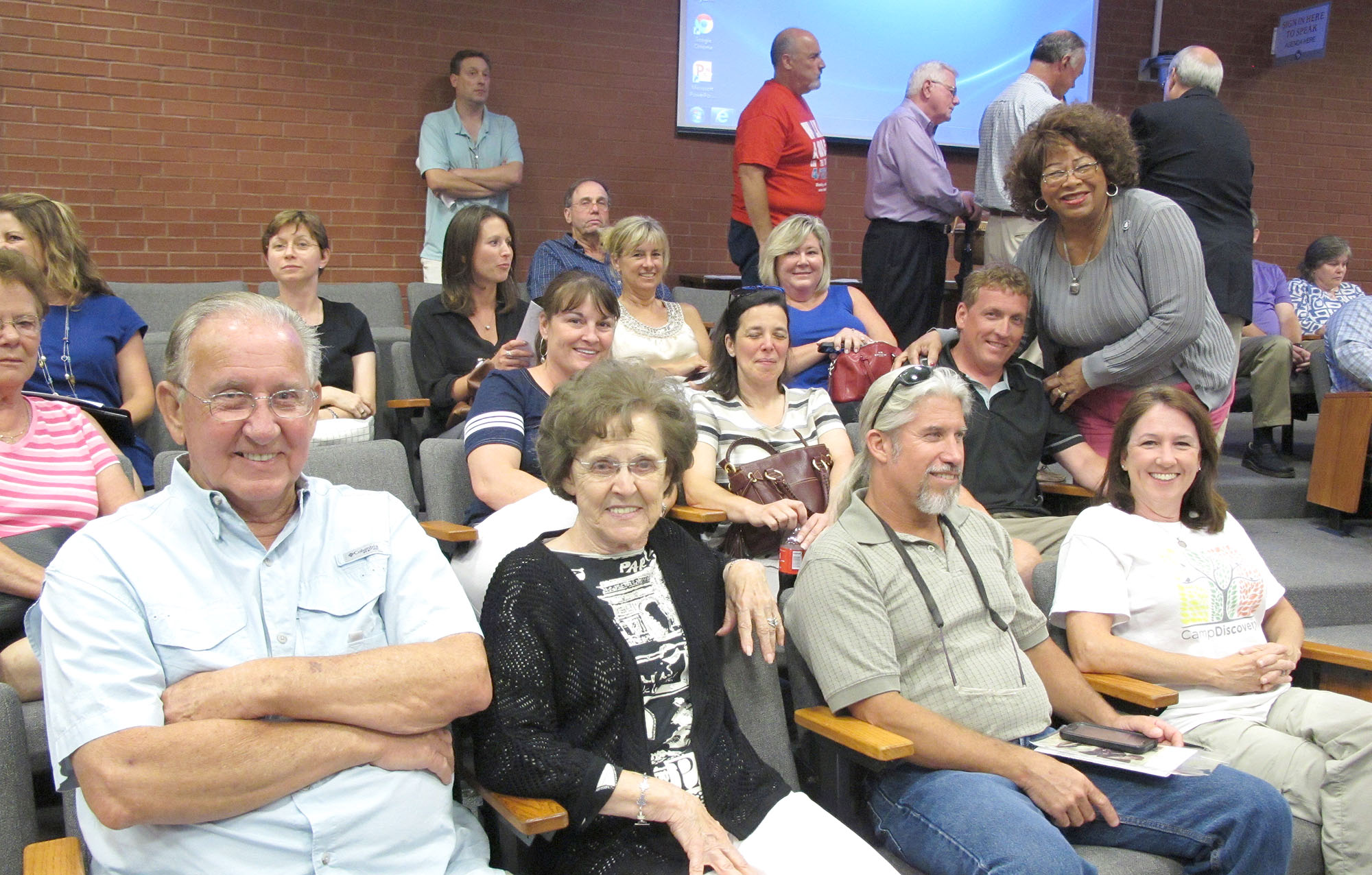
    Blythewood Mayor J. Michael Ross greets Blythewood residents and shakes hands with Michael Watts as he arrives at Richland County Council chambers on Tuesday evening to support opposition to commercial zoning proposed on Rimer Pond Road. Seated in the front row, from left: Mary Lee, Micahel Watts and Joanna Weitzel.
    Blythewood Mayor J. Michael Ross greets Blythewood residents and shakes hands with Michael Watts as he arrives at Richland County Council chambers on Tuesday evening to support opposition to commercial zoning proposed on Rimer Pond Road. Seated in the front row, from left: Mary Lee, Micahel Watts and Joanna Weitzel.

    COLUMBIA – After months of meetings and postponed meetings related to an effort by commercial real estate agent Patrick Palmer to rezone 5.23 acres on Rimer Pond Road for commercial use, many residents of Rimer Pond Road, LongCreek Plantation, Eagles Glen, Seton Ridge and Cooper’s Pond who opposed the rezoning breathed a sigh of relieve Tuesday night when Palmer officially withdrew his application.

    Some Richland County Council members told residents in private prior to the meeting that Palmer did not have the votes he needed on Council. Palmer did not return phone calls from The Voice before press time.

    The issue was scheduled for first vote by Council Tuesday night following a public hearing that was well attended by a crowd of residents opposing the rezoning. Among those who signed up to speak against it was Blythewood Mayor J. Michael Ross who had earlier in the day sent an email to all the County Council members asking them to “not compromise the residential areas around (Rimer Pond Road) and our middle school by allowing such uses as a gas station, pizza joint, etc. to locate there.”

    “I know this is not in the Town of Blythewood,” Ross continued, “but if you go to the end of Rimer Pond Road, it is Blythewood. You may remember in our Master Plan that was developed about five years ago, we included a small commercial hub at the end (of Rimer Pond Road). Well, that went over like a lead brick and brought people from out of the woods on Rimer Pond Road,” Ross wrote. “We have since focused on our Town Center District, letting that be the Town’s primary commercial district and Rimer Pond remain residential.”

    As the crowd of residents took their seats before the meeting started, several Council members, including Joyce Dickerson, who formerly represented the Blythewood area, stepped down from the Council platform and into the audience to shake hands and reminisce about previous trips the Rimer Pond Road group had made to Council chambers in recent years to oppose commercial zoning on the road.

    Richland County Councilwoman Joyce Dickerson who formerly represented Blythewood on County Council visits with Blythewood residents who attended Tuesday night’s Council meeting to protest proposed commercial zoning on Rimer Pond Road.
    Richland County Councilwoman Joyce Dickerson who formerly represented Blythewood on County Council visits with Blythewood residents who attended Tuesday night’s Council meeting to protest proposed commercial zoning on Rimer Pond Road.

    According to Council rules, if Palmer wishes to bring his rezoning request back to Council he must start the process over by first bringing it before the Richland County Planning Commission. A major obstacle for Palmer in trying to get the 5.23 acres rezoned to Rural Commercial (RC) is the wording of the RC ordinance, which states that RC zoning is suited for the more isolated agricultural and rural residential districts and residents located beyond the limits of service of the municipalities.

    The Planning Commission cited that wording as the reason they voted against recommending RC zoning for the 5.23 acres. Commissioner Beverly Frierson commented that the area in question was not isolated and not underserved.

    Palmer, who is Chairman of the Richland County Planning Commission, placed on the Commission’s June 1 agenda for discussion the possibility of rewording the ordinance. That rewording is expected to be considered and voted on at the July 6 Planning Commission meeting to be held at 1 p.m. in Council Chambers, 2020 Hampton St. in Columbia. The agenda and meeting packet for that meeting will be available at richlandonline.com.


  • Council Cools to Wi-Fi Bid

    Ridgeway Wants Upgrades to Existing Service

    RIDGEWAY – Town Council was lukewarm during June 11 follow-up discussions on last month’s proposal by TruVista Communications to turn downtown Ridgeway into a Wi-Fi hotspot, suggesting upgrades would be required by the internet service provider before the Town locked itself into a contract.

    “I’ve had complaints from several people downtown,” Councilman Russ Brown said, “(that) you can’t get work done because the internet is so inconsistent. I’ve been in the (Old Town Hall) restaurant when the TVs and computers are inconsistent over there. They can’t cash people out when it’s busy because it’s so up and down, it fluctuates so much.”

    During Council’s May 14 meeting, Brannon Hough, a TruVista Business Solutions Specialist, told Council her company would be willing to waive any installation costs for the 5-meg Ethernet service, “providing that we are able to put up a Council-approved sign somewhere in the town that says it’s provided by TruVista.”

    Hough said TruVista was proposing three access points within the town – one at the Century House and two on Main Street – that “will create a wireless network in downtown Ridgeway that can be used by anyone.”

    Creating a downtown hotspot was part of Ridgeway’s initial long-range strategic planning talks led by Scott Slayton of the S.C. Municipal Association last September. During a follow-up planning session last November, however, free Wi-Fi failed to make the final cut of priorities; although Mayor Charlene Herring did indicate that Council would explore the possibility of doing so.

    Randy Allen, a TruVista sales engineer, told Council during the May 14 presentation that the proposed wireless network could accommodate up to 15 network names with up to 100 users per network. The network also comes with a feature that would allow the Town and businesses to track the number of visitors to Ridgeway, whether they log onto a network or not.

    The service would potentially cost the Town a little more than $498 a month, but would provide a free internet connection to users in the downtown area.

    But last week, that proposal bumped into a Council concerned with the quality of service.

    “I really would like to see some upgrades to that before we agree to a five-year contract at $500 a month,” Brown said.

    Mayor Charlene Herring said she would present those concerns to TruVista for further discussion.

    Sidewalk Repair

    During her report to Council, Herring suggested exploring avenues of funding to repair a section of sidewalk on Highway 21 in front of the Post Office. The estimated cost to repair the sidewalk, she said, was $235,000. Herring said she would discuss the matter with State Sen. Creighton Coleman to determine if any funds were available through the County Transportation Committee.

    Expenditures

    Council OK’d $899 for the purchase of a bush hog to clear rights of way for the Water and Sewer Department. Council also discussed whether or not they may be able to recoup any of the $8,740 the Town recently spent repairing a fire hydrant on Dogwood Avenue. The hydrant was destroyed recently when a car crashed into it. Because the car was later reported stolen, Council said, the Town’s insurance company denied their claim.

    New Kids on the Block

    Council voted to extend a lease to Dr. Virginia Schaffer’s new venture, Health, Wellness and Education, at 128 Palmer St., the former home of Just Around the Corner. During her presentation to Council, Schaffer said the business will be devoted to the sale of nutritional products and health-related services.


  • Economic Development Director Steps Down

    Tiffany Harrison (left), Fairfield County Economic Development Director, with Gov. Nikki Haley at last year's BOMAG Americas, Inc. groundbreaking.
    Tiffany Harrison (left), Fairfield County Economic Development Director, with Gov. Nikki Haley at last year’s BOMAG Americas, Inc. groundbreaking.

    WINNSBORO – Tiffany Harrison, Fairfield County’s Director of Economic Development since 2006, announced her resignation last week, effective July 2. Harrison has accepted the Executive Director position with the Midlands Education Business Alliance in Columbia, an organization that fosters work-ready educational needs.

    “It’s a great opportunity to support economic development from the workforce side,” Harrison said. “And I will continue to support Fairfield County.”

    During Harrison’ tenure, Fairfield County broke ground on a new industrial park on Peach Road in 2011 and welcomed its first tenant in February of 2014, BOMAG Americas, whose assembly operation and showcase room for industrial machinery promises 121 new jobs. Prior to that, in August of 2013, Element Electronics announced 500 new jobs at its television manufacturing plant on the Highway 321 Bypass in downtown Winnsboro. In May of 2014, the Spanish manufacturer of elevators and lift systems, Hidral, announced a $1.5 million investment and 25 jobs for its new North American sales office in the Walter Brown Industrial Park. In August of 2014, toy and games manufacturer Enor Corp. announced 151 jobs at its new location on the Bypass.

    “The county is in great position for growth and success,” Harrison said. “We have the building blocks in place so the next person coming in will be able to continue that success.”

    County Council Chairwoman Carolyn Robinson (District 2) said the Administrator would initiate a search for Harrison’s replacement, but the County would miss Harrison’s easy demeanor.

    “It’s going to be hard to fill that void for a while,” Robinson said. “She’s been with us nine years. She has come to know our county, know our product and work well with the Department of Commerce and the alliances, and we have seen growth. She has been easy to work with as the liaison to the County. But she has a good opportunity and I wish her well.”

    Harrison said none of the county’s recent economic success would have been possible without the support of County Council. Now, Harrison said, she is looking forward to helping ensure Fairfield County and the Midlands have the workforce to meet future economic needs.

    “Sixty-five to 70 percent of jobs in this county and the state require something less than a four-year degree, but something more than a high school diploma,” Harrison said. “The Midlands Education Business Alliance will help grow the workforce businesses need.”


  • Public Resist Rezoning

    Rimer Pond Road Residents Put Developer on the Spot

    BLYTHEWOOD – No minds were changed after a June 8 neighborhood meeting at Round Top Elementary School between 50 or so residents opposing a request for the commercial zoning of 5.23 acres on Rimer Pond Road (across from Blythewood Middle School) and two Richland County government officials: Torrey Rush, County Council Chairman and representative of the district surrounding the 5.23 acres and Geonardo (Geo) Price, Richland County Zoning Administrator. Also present was the applicant for the commercial zoning request, Patrick Palmer who is the broker in charge of the sale of the property as well as Chairman of the Richland County Planning Commission that recommends zoning for the property. Palmer is also son of the owner of the property.

    Palmer has listed the property for $350,000 per acre, but that price is dependent on the County rezoning it for commercial use. Palmer said at the meeting and later told The Voice that a 9,000-square-foot building is planned for the property. Asked by The Voice to verify or deny a rumor circulating that a Dollar store is planned for the site, Palmer said he didn’t know. The 5.23 acres is part of a larger 31.23-acre parcel zoned Medium Density Residential (MS-RD).

    Price opened the June 8 meeting by saying he did not want to throw anyone under the bus, then proceeded to say members of the Richland County Planning Commission had not given a good enough reason at their April 6 meeting as to why they voted against staff’s recommendation that the 5.23 acres should be zoned commercial. But Suzie Haynes, Boards & Committees Coordinator for Richland County Planning & Development Services, told The Voice that the only reason the Commission is asked to give a reason for their decision when going against staff’s recommendation is so Council can better understand the Commission’s position on the issue.

    “There was really nothing substantial from the Planning Commission to make us (staff) go back and look at this area,” Price insisted, pressing on. “I was not comfortable (with their reasons). It was not clear as to why they should oppose staff’s recommendation (for commercial zoning).

    The Commissioners said they voted against the request because the Zoning District Summary in the zoning ordinance for Rural Commercial District (RC) was antiquated in that it stated, among other things, that the RC district was best suited for isolated agricultural and rural residential areas and so that residents located beyond the limits of service of the municipalities can receive convenience merchandising and services. Commissioners concluded that RC did not apply to the area around the 5.23 acres.

    When later asked whether the Commission’s reason for recommending denial of commercial zoning on the 5.23 acres was valid, the County’s Planning Director, Tracy Hegler, said the Commission’s point was, indeed, a valid reason for voting to deny staff’s recommendation for commercial zoning.

    The residents repeatedly told Rush and Price that the Rimer Pond Road area was neither isolated nor underserved and therefore the RC zoning district was not suitable for the area.

    “Nobody out here asked you to bring a Papa John’s or anything else to us,” Rimer Pond Road resident Ken Queen told Palmer. “We don’t want them here.” He then turned to Rush. “If the residents, your constituents, don’t want it, that’s what counts.”

    Other residents chimed in in agreement.

    One unidentified resident said, “What we’re saying is that we have enough conveniences. This zoning change does not fit our area. Services are very convenient to us now – the bank, grocery store, etc.”

    “But we look at how this area should grow,” Price countered.

    When one resident replied to Price, “But we don’t want it,” the audience applauded.

    Palmer told residents that he had been on the Planning Commission for 12 years and that he was part of the community and lived in the area. But he later recanted that statement, saying instead that he lived in the Northeast when pressed by a resident as to whether he actually lived in Blythewood.

    “This is not about community,” Queen said, “It’s about greed. With all due respect, Mr. Palmer, the rest of the property (besides the 5.23 acres) is zoned Medium Density Residential. There’s plenty of money in that.”

    Queen reminded Rush that Palmer had succeeded in getting the entire 31.23-acre parcel rezoned from Rural (RU) to Medium Density Residential (MS-RD) in 2011.

    “None of us wanted that,” Queen said. “You (Council) voted for it in spite of the residents’ objections. Now we have to live with that. Now Mr. Palmer has changed his mind and wants zoning (on the 5.23 acres) for commercial that creates even more traffic problems and is less palatable than what he asked for in 2011.”

    Price assured the group that the 5.23 acres of commercial would be limited to that intersection.

    “It’s not designed to spread down the road. It will stay at the intersection,” Price said.

    But Rimer Pond Road resident Michael Watts told Rush that, “If you zone one parcel commercial on this road, then the property owner beside it will want commercial too. You say you can stop it, but you can’t. The person owning the next property will go to court against you (to get commercial).”

    Palmer’s rezoning request is the first item on the agenda for the Tuesday, June 23 Public Hearing to be held at 7 p.m. in Council chambers located at the corner of Harden and Hampton streets. The public hearing is the only time residents will be allowed to speak to the issue. Those wishing to speak should arrive 10-15 minutes early to sign up. To request an email of the agenda packet, call Suzie Haynes at 576-2176 or email her at HAYNESSU@rcgov.us.

  • Water Rate Hike Goes Above and Beyond

    Winnsboro Up Less Than a Dime, Ridgeway OK’s $1

    RIDGEWAY – Town Council gave final reading May 14 to a $222,840 general fund budget and a $364,636 water and sewer fund budget for the 2015-2016 fiscal year, passing the budget without dissent. As a companion piece to the upcoming budget, Council also passed final reading of an ordinance raising water rates $1 per 1,000 gallons across the board.

    The rate increase roughly corresponds with what Councilman Doug Porter said was a 98 cent per 1,000 gallon increase being levied on Ridgeway from the Town of Winnsboro, their single supplier of potable water. However, as Winnsboro’s Assistant Town Manager Lorraine Abell pointed out to The Voice last month, Winnsboro’s rates did not go up quite so much.

    According to a March 31 letter to Ridgeway from Winnsboro Mayor Roger Gaddy and Town Manager Don Wood, Winnsboro’s rates, effective July 1, are going up only .098 cents – less than a dime – per 1,000 gallons.

    Ridgeway Mayor Charlene Herring said this week that she did not know if Council would pass a new ordinance to adjust the rates, or merely let stand the rates passed last week.

    According to the ordinance passed unanimously May 14, Residential water customers inside the Town limits will see their rate for the first 1,000 gallons go up to $16, and will pay $6.07 for each additional 1,000 gallons. Residential customers outside the Town limits will be paying $21 for the first 1,000 gallons and $7.32 for each additional 1,000 gallons.

    Commercial water rates inside the Town limits are going up to $19 for the first 1,000 gallons and $6.07 for each additional 1,000. Those rates outside the Town limits will be $24 for the first 1,000 gallons and $7.32 for each additional 1,000 gallons.

    Residential sewer rates for customers inside the Town limits will increase to $13 for the first 1,000 gallons and $5.42 for each additional 1,000 gallons. Outside the Town limits, those rates are going up to $14 for the first 1,000 gallons and $6.57 for each additional 1,000 gallons. The flat rate for residential sewer customers will now be $26.

    Commercial sewer rates inside the Town limits are increasing to $17 for the first 1,000 gallons and $5.57 for each additional 1,000 gallons. Outside the Town limits, those rates are going to $20 and $6.57, respectively.

    Winnsboro increased its wholesale water rate to $4.618 per 1,000 gallons, according to the March 31 letter from Winnsboro to Ridgeway.


  • B.A.R. Gives First OK to Office Building

    An architect’s rendition of a proposed new medical office at 121 Blythewood Road.
    An architect’s rendition of a proposed new medical office at 121 Blythewood Road.

    BLYTHEWOOD – The Town’s Architectural Consultant, Matt Davis, stepped out of that role on Monday evening during the Board of Architectural Review meeting to represent the applicants for a medical office to be located at 121 Blythewood Road, across from Companion Animal Hospital.

    Designed to be shared by two private medical practices, a pediatrician and an ophthalmologist, the 7,085-square-foot building is a combination of a two-story center section with one-story wings.

    Because the Town Center zoning ordinance requires all new commercial buildings to have multiple stories, the BAR voted to give the applicants a variance for the two one-story wings. And because the Department of Motor Vehicles requires that driveways (entrance/exits) must align with driveways across the street, the Board also voted to allow a shift of the building toward the east lot line to allow for that driveway match up.

    The BAR voted unanimously to give partial approval for the architecture and building location. Additional architectural details (materials, colors, etc.) and the final site plan with landscaping, lighting and signage will be submitted to the BAR at the July 20 meeting for the balance of the approval.


  • Public Resists Rezoning Efforts

    Rimer Pond Road Residents Put Developer on the Spot

    BLYTHEWOOD – No minds were changed after a June 8 neighborhood meeting at Round Top Elementary School between 50 or so residents opposing a request for the commercial zoning of 5.23 acres on Rimer Pond Road (across from Blythewood Middle School) and two Richland County government officials: Torrey Rush, County Council Chairman and representative of the district surrounding the 5.23 acres and Geonardo (Geo) Price, Richland County Zoning Administrator. Also present was the applicant for the commercial zoning request, Patrick Palmer who is the broker in charge of the sale of the property as well as Chairman of the Richland County Planning Commission that recommends zoning for the property. Palmer is also son of the owner of the property.

    Palmer has listed the property for $350,000 per acre, but that price is dependent on the County rezoning it for commercial use. Palmer said at the meeting and later told The Voice that a 9,000-square-foot building is planned for the property. Asked by The Voice to verify or deny a rumor circulating that a Dollar store is planned for the site, Palmer said he didn’t know. The 5.23 acres is part of a larger 31.23-acre parcel zoned Medium Density Residential (MS-RD).

    Price opened the June 8 meeting by saying he did not want to throw anyone under the bus, then proceeded to say members of the Richland County Planning Commission had not given a good enough reason at their April 6 meeting as to why they voted against staff’s recommendation that the 5.23 acres should be zoned commercial. But Suzie Haynes, Boards & Committees Coordinator for Richland County Planning & Development Services, told The Voice that the only reason the Commission is asked to give a reason for their decision when going against staff’s recommendation is so Council can better understand the Commission’s position on the issue.

    “There was really nothing substantial from the Planning Commission to make us (staff) go back and look at this area,” Price insisted, pressing on. “I was not comfortable (with their reasons). It was not clear as to why they should oppose staff’s recommendation (for commercial zoning).

    The Commissioners said they voted against the request because the Zoning District Summary in the zoning ordinance for Rural Commercial District (RC) was antiquated in that it stated, among other things, that the RC district was best suited for isolated agricultural and rural residential areas and so that residents located beyond the limits of service of the municipalities can receive convenience merchandising and services. Commissioners concluded that RC did not apply to the area around the 5.23 acres.

    When later asked whether the Commission’s reason for recommending denial of commercial zoning on the 5.23 acres was valid, the County’s Planning Director, Tracy Hegler, said the Commission’s point was, indeed, a valid reason for voting to deny staff’s recommendation for commercial zoning.

    The residents repeatedly told Rush and Price that the Rimer Pond Road area was neither isolated nor underserved and therefore the RC zoning district was not suitable for the area.

    “Nobody out here asked you to bring a Papa John’s or anything else to us,” Rimer Pond Road resident Ken Queen told Palmer. “We don’t want them here.” He then turned to Rush. “If the residents, your constituents, don’t want it, that’s what counts.”

    Other residents chimed in in agreement.

    One unidentified resident said, “What we’re saying is that we have enough conveniences. This zoning change does not fit our area. Services are very convenient to us now – the bank, grocery store, etc.”

    “But we look at how this area should grow,” Price countered.

    When one resident replied to Price, “But we don’t want it,” the audience applauded.

    Palmer told residents that he had been on the Planning Commission for 12 years and that he was part of the community and lived in the area. But he later recanted that statement, saying instead that he lived in the Northeast when pressed by a resident as to whether he actually lived in Blythewood.

    “This is not about community,” Queen said, “It’s about greed. With all due respect, Mr. Palmer, the rest of the property (besides the 5.23 acres) is zoned Medium Density Residential. There’s plenty of money in that.”

    Queen reminded Rush that Palmer had succeeded in getting the entire 31.23-acre parcel rezoned from Rural (RU) to Medium Density Residential (MS-RD) in 2011.

    “None of us wanted that,” Queen said. “You (Council) voted for it in spite of the residents’ objections. Now we have to live with that. Now Mr. Palmer has changed his mind and wants zoning (on the 5.23 acres) for commercial that creates even more traffic problems and is less palatable than what he asked for in 2011.”

    Price assured the group that the 5.23 acres of commercial would be limited to that intersection.

    “It’s not designed to spread down the road. It will stay at the intersection,” Price said.

    But Rimer Pond Road resident Michael Watts told Rush that, “If you zone one parcel commercial on this road, then the property owner beside it will want commercial too. You say you can stop it, but you can’t. The person owning the next property will go to court against you (to get commercial).”

    Palmer’s rezoning request is the first item on the agenda for the Tuesday, June 23 Public Hearing to be held at 7 p.m. in Council chambers located at the corner of Harden and Hampton streets. The public hearing is the only time residents will be allowed to speak to the issue. Those wishing to speak should arrive 10-15 minutes early to sign up. To request an email of the agenda packet, call Suzie Haynes at 576-2176 or email her at HAYNESSU@rcgov.us.

  • Board OK’s Salary Schedule, Budget

    WINNSBORO – The Fairfield County School Board Tuesday night adopted on a 4-2 vote a revised salary schedule for district employees. The schedule is more in line, according to Dr. J.R. Green, Superintendent, with what was originally recommended to the Board by MGT Consultants in 2011, and clears up inconsistencies within the version of the schedule adopted by the Board four years ago.

    “There was a study done in 2011 and we ended up adopting part of what was presented from that study,” Green said. “There were some issues in terms of the increments between steps. Whereas (MGT) recommended a 1.5 or 3 percent increase, we were doing kind of a hodgepodge of increments – 1.5 in some respects, .6, .8, 1.2 – it was kind of all over the map.”

    Green said the cost to implement the new schedule, including benefits, would be approximately $500,000, and would be part of the 2015-2016 budget.

    “We anticipate on what we have done the last three years we will have a fund balance similar to what we have had this year ($6.7 million), so our hope is that we will get some of that from savings that we are able to realize over the course of the year,” Green said. “What we don’t get from savings, we’ll pull it out of the fund balance from next year.”

    That the revised schedule would be implemented in the upcoming fiscal year sparked an outcry of protest from District 4 Board member Annie McDaniel.

    “We’re going to have third reading of the budget,” McDaniel said. “This was not presented to us up to third reading and now we’re being asked to approve something that wasn’t incorporated after we’ve had third reading, after we’ve had the public hearing, and that’s what we’re doing?”

    McDaniel said she questioned the legality of making changes to the budget after the public hearing, but the district’s legal counsel, Vernie Williams, of the Childs and Halligan Law Firm, said the Board was in the clear.

    “The discussion you’re having tonight is at a public meeting,” Williams said. “It’s not like you are trying to take some action without having public discussion about it.”

    Paula Hartman (District 2) questioned the timing of the matter and asked why the revised schedule had not been brought up earlier.

    “It was brought up last month,” Board Chairwoman Beth Reid (District 7) said.

    “A few things about it,” Hartman said. “Not any big changes like this. It was commented about checking into it; that was the comment that was stated.”

    Green presented the revised schedule to the Board during their May 19 meeting, including the variances between steps. The recommended salary range for middle school principals was also not adopted, Green said last month, while teacher salaries were not competitive in years zero through three. MGT had also recommended an additional $1,000 for non-instructional personnel with a Master’s degree + 30, and $2,000 for non-instructional personnel with a doctorate degree, neither of which was adopted in 2011.

    “We get this Friday and we’re supposed to understand all this?” Hartman said, “That’s awful soon as far as I’m concerned. To adopt something like that, this large of an increase and we don’t understand it does not make any sense, and get it Friday and then we’re expected to vote on it on Tuesday.”

    Green said he had sent the final revised salary schedule to Board members earlier in the week, not Friday. McDaniel, while asking several times to see the presentation again, said she was concerned about the effectiveness of the new schedule and its ultimate fairness.

    “I’m just asking to be able to verify the validity,” McDaniel said. “That’s all I’m asking.”

    Green said that with the exception of teachers and hourly employees, steps will be determined by year-end evaluations, something that also concerned McDaniel.

    “Now it sounds like we’re saying that if employees are not going to, for lack of a better word, kiss up to their supervisors, then their subject to (not) get a better evaluation and then they can’t get a step,” McDaniel said.

    McDaniel and Hartman ultimately voted against the revised schedule.

    Budget

    The Board also passed third and final reading of a $37,401,195 general fund budget. The operational budget includes no millage increase, holding at 203.1 mills, while the debt service millage will decrease slightly from 32 to 23.6 mills.

    McDaniel and Hartman voted against the measure.

    To hold the district over until tax bills go out and money begins to flow into the district, the Board unanimously passed a Tax Anticipation Notice (TAN), not to exceed $6,275,000.

    William Frick (District 6) asked if it were possible that this might be one of the last TANs he has to vote for.

    “No,” Hartman quipped, “you just gave it away in all this salary.”


  • Council Clips Allocations, Keeps Roads Fee in Place

    Good Sam, Others ‘Frozen’ at 14-15 Levels

    WINNSBORO – In a complete reversal of last week’s consensus following a final budget work session, County Council Monday night sliced into a laundry list of social program allocations before passing third and final reading of the 2015-2016 budget.

    Although the cuts were part of a recommendation by County Administrator Milton Pope as an alternative to levying a new roads maintenance fee, Council passed the budget with the fee intact.

    To Fee or Not to Fee

    Talk of the fee first surfaced during Council’s May 7 budget work session, and came at the suggestion of the County Transportation Committee (CTC), according to Pope. The proposed $5 a year on personal vehicles and $10 a year on commercial vehicles, which would be added to Fairfield County car tax bills, would raise an estimated $123,570 to provide maintenance on County improved roads and dirt roads.

    An effort to squash the fee and replace it with savings from within the budget came from Council members Walter Larry Stewart (District 3), Dan Ruff (District 1) and Billy Smith (District 7), prompting Pope to dig into the budget. At Council’s June 1 work session, Pope brought forward an option to cut into Council’s cell phone budget, meals for Council, meals and lodging for the Administrator and the County attorney, dues and membership fees for the Administrator, unemployment insurance and fuel for County vehicles. The option also included freezing allocations at 2014-2015 levels for the Good Samaritan House, the Board of Disabilities and Special Needs, Transitions, the American Red Cross and the Chameleon Inspirations Learning Center.

    After considerable discussion of the alternative (see the June 5 edition of The Voice), Council decided against the cuts by a 4-3 consensus, leaving the road maintenance fee as is. Chairwoman Carolyn Robinsons (District 2) was the deciding voice, siding with Kamau Marcharia (District 4), Mary Lynn Kinley (District 6) and Marion Robinson (District 5).

    By Monday night, however, both Robinsons had flipped.

    “It was a snap decision,” Chairwoman Robinson said after the meeting. “Go back and check. Carolyn’s always had problems with those gifts. This is not my first rodeo to say ‘no’.”

    A handful of citizens spoke out against the fee during the firsts public comment portion of the meeting, including District 2 resident Beth Jenkins, District 4 resident Jeff Schaffer and District 3 residents William Coleman, Wanda Carnes and Debra Matthews.

    “We have people living in this county paycheck to paycheck,” Matthews said. “They can’t pay their utility bills. Those are the folks who that $5 will affect. I cannot believe you cannot get $124,000 out of an over $30 million budget. I don’t buy it.”

    Night of the Long Knives

    Smith’s motion cut $1,250 each from the American Red Cross and the Chameleon Learning Center and $2,500 each from the Good Samaritan House and Transitions. His motion also included cuts of $5,000 each, not recommended by Pope, to the Eau Claire Health Cooperative, the Boys and Girls Club and the Harvest Hope Food Bank.

    Smith stressed that the reductions were not actual cuts, but a freezing of funds at last year’s levels. Thus, Good Samaritan’s allocation will stand at $25,000; Transitions at $2,500; the Red Cross at $3,750; Chameleon at $4,000; and Eau Claire at $55,000.

    The Boys and Girls Club and Harvest Hope were new allocations proposed in this year’s budget and will therefore receive zero dollars from the County in 2015-2016. No reductions were made to the Board of Disabilities and Special Needs, which will receive $43,000 (up from $32,000 last year).

    Pope reported to Council that the cuts represented a reduction of $29,100, and his calculations included a reduction of $1,350 from the recreation budget for promotional supplies – another motion by Smith; however, one that failed to carry on a 3-4 vote, with only Smith, Ruff and Stewart voting in favor.

    Pope told The Voice Tuesday via email that the vote on the $1,350 was not “officially recorded,” although The Voice’s recording of the proceedings indicate that it was.

    “As a means to clarify Council’s wishes, I specifically went through all of the proposed budget reductions in the Smith motion(s) to make sure members knew what they were voting on and voting for,” Pope wrote. “Council then ‘officially’ voted (raising of their hand) on the reductions, which included the $1,350.  This reduction is reflected in the final general fund budget total number.”

    The Chairwoman said the cuts, based on Pope’s original calculation of $29,100, would translate as a savings to taxpayers of approximately one half of one cent on their tax bills.

    Smith also pushed through a motion to reduce Council’s cell phone line item by $5,250, which passed on a 6-1 vote. Marcharia, while he said he was not on the County’s cell phone plan, voted against the measure.

    Smith also moved to reduce line items for County Council catered and prepared meals; County attorney meals and lodging; County Administrator dues and memberships; and County Administrator meals and lodging by $500 each for a total of $2,000.

    “I just find it absurd to attack this kind of petty little stuff,” Marcharia said before the vote.

    The catered meals, Chairwoman Robinson said, included County sponsored functions, like Industry Appreciation Night and next week’s intergovernmental meeting.

    “The other night we had a very nice event for industry appreciation that we had not had in two years to thank all the companies, so I guess that takes that out as well,” she said prior to the vote.

    After the motion failed to carry on a 3-4 vote, with only Smith, Ruff and Stewart voting in favor, Robinson addressed the freshmen Council members.

    “You’ve been here five months,” she said. “You have no idea how much we have to meet with other folks in order to build a relationship.”

    ‘Enough Talk’

    Once the pruning knives had been put away, Kinley moved to approve the slightly leaner budget with the fee still in place and a 2 percent cost of living increase for County employees, to include countywide elected officials. Marion Robinson offered a second just as Stewart tried to be recognized.

    “Before we do that I have an additional motion,” Stewart said.

    Marcharia noted that there was a motion on the floor, and Kinley asked the Chairwoman to call for the question.

    “You need to understand what I’m getting ready to do,” Stewart said.

    “But you can’t do that,” Marcharia said. “She’s called for the question.”

    “No, no, no, no, no,” Stewart said. “We are not – it appears that she is trying to approve something that I am not prepared to approve, and she’s trying to close out the discussion.”

    “We’ve had enough discussion,” Kinley said.

    Chairwoman Robinson called for a vote on the call for the question, which passed 4-3, with Stewart, Ruff and Smith voting against. Robinson then called for a final vote on the budget, which passed along the same lines, 4-3.

    “My motion as going to be to remove the $123,570 for the road maintenance fee,” Stewart said afterwards. “Just take it totally out of the budget.”

    Near the close of the meeting, during County Council time, Stewart questioned the final vote.

    “We had motions to amend,” Stewart, addressing the Chairwoman, said. “You recognized Mrs. Kinley before us and accepted her motion, which shut us out of the process. That was patently unfair and very irregular, and I question whether what we have done after that is illegal, because of the procedure that you used.

    “In a budget of $35 million, this ($123,570), that is less than two-tenths of 1 percent,” he continued. “I know in this budget somewhere there is some excess that we could have looked at, instead of putting an additional burden, an addition levy on the citizens.”

    Ruff said he was also disappointed Council did not eliminate the road fee. Smith agreed, but said Kinley’s move was a parliamentary one that was just “part of the process.”

    “We just lost on that one,” Smith said.

    Smith also said Council should take a harder look at how it handles allocations overall.

    “At some point I think this Council needs to have a discussion about not continuing to take money from citizens and then give it to something else,” Smith said. “We can take money away from folks just as well as we can give to them, or take away from them less as well as we can give them more. This is just taking money from folks and sending it somewhere else. At some point we have to think a little bit less about spending and spending and spending and we have to think about cutting.”