Category: Community

  • County delays action on library purchase

    The county recently renovated this building for the Ridgeway library, located on Palmer Street in downtown Ridgeway. The county is currently leasing it with an option to purchase.

    WINNSBORO – Plans to purchase a permanent home for the Fairfield County Library branch in Ridgeway are on hold for now.

    At a recent administrative committee meeting, council members voted unanimously to table a proposal to buy property the library is currently leasing on South Palmer Street.

    It was not immediately clear when the matter would return for a vote, though it will likely be later this year.

    That’s because the county wants to pursue federal grant opportunities that could potentially unlock more money to help cover costs of buying the property at 235 S. Palmer Street in Ridgeway.

    County Administrator Jason Taylor said up to $500,000 is available through the Community Development Block Grant, or CDBG, program.

    “It would be beneficial for us all if we try to secure the grant,” Council Chairman Neil Robinson said.

    Grant money would be especially helpful since the sale price is substantially higher than the property’s estimated value.

    Eric Robinson, the county’s library director, said at the June 24 committee meeting that the property owner is asking $169,900.

    Fairfield County property records, however, list the property’s fair market value at $66,700.

    The property last sold for $85,000 in June 2005 and was then deeded over to the current owner, Lok-Yan Yip Patterson for $1 in 2008, records state.

    “Has anyone tried to bargain with the lady?” Councilman Jimmy Ray Douglas asked.

    “Feel free to do so. She’s a shrewd business person,” Eric Robinson, the county library director, answered.

    “I know she is. She’s had the place remodeled and now is trying to sell it for three times what it’s worth,” Douglas replied.

    Robinson said he and the board prefer to remain in the existing building since the South Palmer Street is an ideal location. He said the library would incur additional costs if it had to move, citing the integration of technology in the current facility.

    “If you read the history on this, we’ve bounced around Ridgeway. We’re into our sixth different building,” Robinson said. “Because we’ve sunk so much money into it and the county has sunk so much money into it, we would like for this to be our permanent location.”

    At present, the library board has said it’s willing to offer about $90,000 to buy the facility, which is essentially half the current asking price plus any rent remaining on this year’s lease.

    Library officials, however, said the owner signaled she’s not interested in that amount because she would lose rent revenue in the long term.

    County attorney Tommy Morgan said there’s no harm in delaying action on buying the property. He said the lease agreement allows the county to renew for another two years, with rent only increasing from $850 to $892 a month to account for Consumer Price Index increases.

    In the meantime, negotiations over a final sale price can continue. The CDBG avenue also requires multiple appraisals, and would also work in the county’s favor.

    “The county is pretty much in the cat-bird seat when it comes to that,” Morgan said.
  • Blythewood cut-flower farm on AG + Art tour

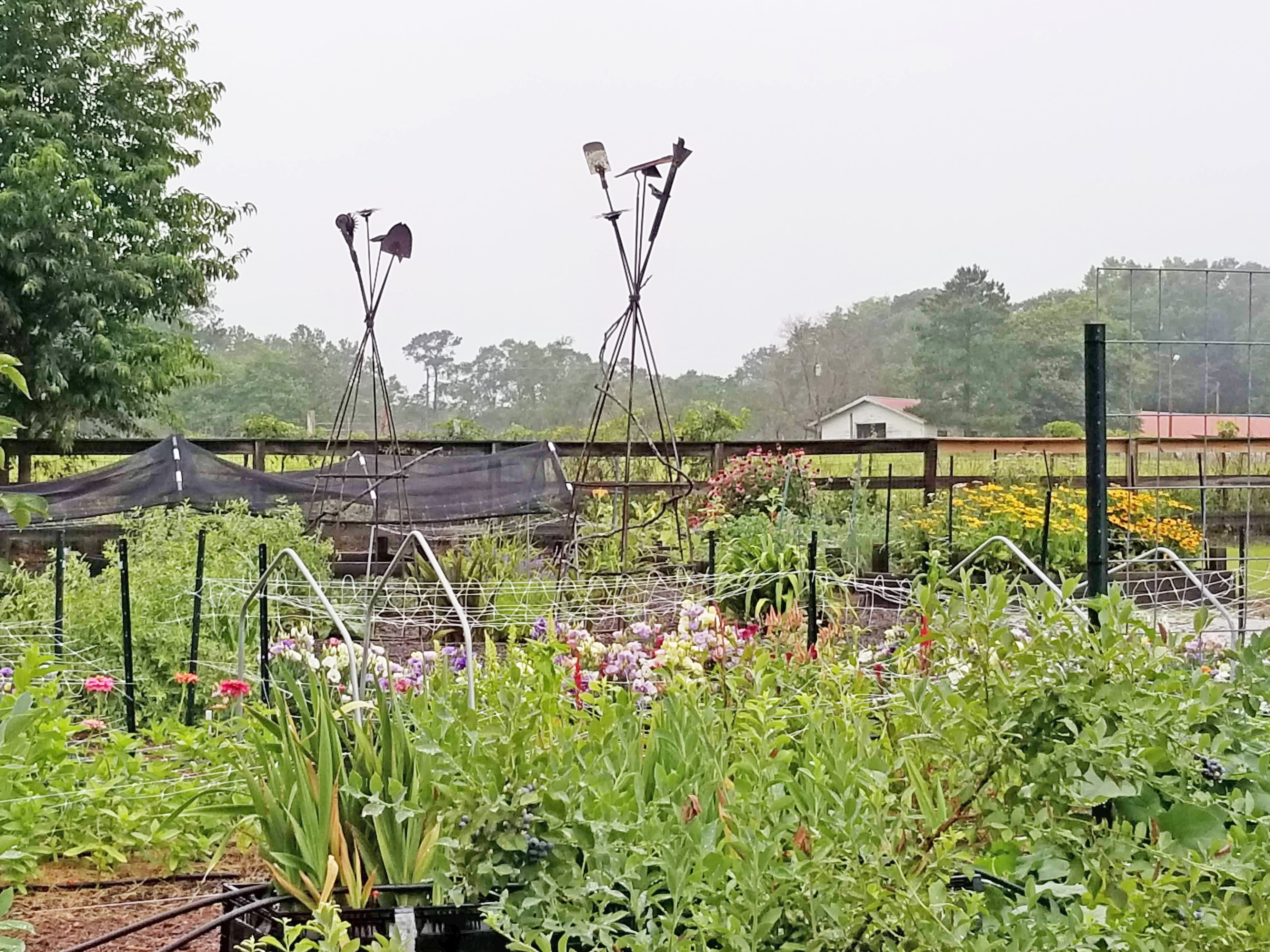
    Purple Tuteur farm is named for the unique trellises (tuteurs) in the garden.

    BLYTHEWOOD – Influenced by her grandmother, who grew roses, Linda Bradley has had a life-long love of flowers.

    “As I grew,” Bradley said, “so did my interest in growing flowers. I enjoyed working in our home garden with my father. In college, I studied botany and horticulture, among other things.”

    In the mid-2000s, Bradley began improving the soil in her backyard gardens and planting perennials.

    By 2016, after becoming credentialed as a Master Gardner and retiring from a lifetime of work in IT, Bradley said she continued to expand her knowledge and relished being part of a community of avid growers.

    “This was also the year when my mother passed away, and I began this journey in earnest,” Bradley said.

    So it was only natural that she would launch a new career in cut-flower farming. Bradley’s flower farm, Purple Tuteur, is located on Langford Road in Blythewood.

    This weekend, Bradley’s farm will be one of four Blythewood farms showcased in the inaugural Richland County Ag + Art Tour.

    “Honoring the memory of my family through this mission gives me great joy,” Bradley said. “I remain connected to them while making others smile through the beauty of fresh flowers,” Bradley said.

    Farm owner Linda Bradley gathers flowers.

    The farm’s name, Purple Tuteur, is derived from a sort of garden trellis, or tuteur. Two imposing tuteurs, stand about eight feet tall in Bradley’s front garden.

    Traditionally, tuteurs are used to elevate and support plants in the garden and are usually made of a few sticks and some twine tossed together to corral wayward tomato plants, or they can be permanent and ornamental structures.

    “The free standing trellises add structure and interest and are used to save room in the garden,” Bradley said. “By serving as a frame for plants to grow up instead of sprawling on the ground, more can be grown in the same space.”

    Bradley’s tuteurs, made of rebar, were created and installed by gardener Jenks Farmer, a popular gardening contributor to Southern Living Magazine and other publications.

    One of Bradley’s tuteurs is painted purple and the other one has been allowed to rust naturally like abandoned farm machinery in the field.

    While many cut-flowers available in the United States are imported by airplane from South American countries with dubious policies on chemicals and labor, flowers harvested and delivered to the customer without ever seeing the inside of an airplane or a tractor-trailer are fresher and last longer in the vase, according to Bradley.

    She has different markets for her flowers. She sells bouquets at the Lake Carolina Farmers Market every week and alternates between Blythewood Farmers Market and Sandhills Farmers Markets, attending two markets each week.  She also delivers fresh bouquets to her customers’ homes and businesses through a subscription bouquet service.  In addition, she sells flowers to local florists and event planners.

    “Local flowers are truly fresh, often cut the same day that you see them,” Bradley said. “Fresh flowers last longer, smell better and they contribute to our local economy.”

    Eventually, Bradley said she would like to host workshops on gardening topics at the farm.  For a complete list of flowers she grows and the seasons they are available, visit her website at www.purpletuteur.com.

    To visit Purple Tuteur Farm, on Langford Road, join the Richland County Ag and Art Tour this coming weekend, June 29 and 30.  It is a free event that allows you to tour local farms while also enjoying local artisans.

    At Purple Tuteur, wander the gardens while seeking solutions to your gardening woes from Master Gardeners there.  Several artisans will be painting, making jewelry and throwing pottery at the farm.

    While in Blythewood, visit Doko Farm on Cedar Creek Road and see their heritage pigs, turkeys, lambs, and goats and take home some pasture-raised meat.  Artisans, including a woodworker, painter and a bluegrass band will be performing.

    Head a little farther north from Doko Farm and visit Fabel Farms on Hinnants Store Road to get some vegetables, honey, and wool products and see more artisans.

    Finally, head south to visit Carolina Bay Farms in Hopkins and City Roots Farm in Columbia.  The farm tour will run on both Saturday, June 29, from 10 a.m. – 4 p.m. and Sunday, June 30, from 1-5 p.m.

    For more details, including the addresses of the farm, what each farm offers and times for guided tours, visit https://agandarttour.com/richland/

  • Council sends Red Gate back to PC

    BLYTHEWOOD – Approximately 60 residents filled the Blythewood Town Council chambers Monday night in Doko Manor to protest myriad aspects of a proposed rezoning of 143 acres, referred to as the Red Gate property, located along Blythewood Road between Syrup Mill and Muller Roads. The property lies across Syrup Mill Road from Cobblestone Park and in an area of horse farms and large acre residential properties.

    The rezoning was recommended to Town Council for approval by the Planning Commission on June 3.

    Originally zoned PDD (Planned Development District) in 2007 under the jurisdiction of Richland County, the property was subsequently annexed into the Town of Blythewood as a PD (Planned Development) zoning designation. That PD, which is still in place, allows for 232 single family units, 300 multi-family apartment units and 36 acres of general commercial.

    Before it was developed, the property went into foreclosure, and is currently owned by Arthur State Bank. Hoping to now develop the property, developer Harold Pickrel has requested an amendment to the property’s current zoning map that would actually reduce the density – from 232 to 138 single family homes, from 36 to 28 acres of commercial use and eliminate the 300 multi-family dwellings.

    But even that density seemed, Monday evening, to be a world away from what surrounding rural residents said they feel is appropriate for the area.

    Fifteen of those neighbors attending the meeting came to the microphone to ask council to send the rezoning request back to the planning commission for a re-do that would be more in character with rural properties in the area. In general, they called for ‘smart planning’ that would better transition the housing development to the rural area around it. Specifically, they asked for minimum 20,000 square foot lots, thus reducing the housing density further than 138 homes. They also asked for the addition of buffering around the development to protect the privacy of the surrounding properties.

    George Walker

    “We’ve been blessed with [large acre neighborhoods] like Surrey Woods, High View Farms, Camry Farms, Birch Springs and Center Creek that value trees and set the stage to create the kind of environment that makes people want to keep coming back,” Persimmon Fork Road farm owner George Walker said, addressing council.

    “We aren’t opposed to development and we appreciate that this developer has already made concessions in regard to multi-family units,” Walker said. “We aren’t trying to drive him [Pickrel] away, but we are trying to come up with a plan that is farsighted and works for everybody.”

    Walker reminded council that they had set a 20,000 square-foot minimum on lots in the town, and he urged them to honor that in the PD as well.

    “Backing homes on 10,000 square-foot lots up to a property that the town annexed under a Rural (RU) designation is overly aggressive,” Walker said.

    Another Persimmon Fork resident, Attorney Stuart Andrews, said he counted 15 areas of discretion in the project that are open to the developer.

    “He could make modifications on the plans that are presented with regard to boundaries and actually in changing the density of houses without any input from town council, the planner or the community,” Andrews said. “I suggest having a thorough study of this proposal before the plans are adopted, and then have the plan and the rezoning meet [requirements] that would be consistent with the rural character of the community.”

    John Moore, a resident of Cobblestone Park and a former planning commissioner, said the plan was one of the poorest he had seen.

    “There’s no mention of price points or the homes’ square footage,” Moore said. “Why are the 10,000 square foot lots even in this document?” Moore asked. “There should be a traffic study before the development is approved and it should be conducted during the school year when school is in session,” he said.

    Rue, who owns a horse farm in the area, asked council to protect her “little slice of heaven.”

    Mayor J. Michael Ross defended the planning commissioners’ decision to recommend approval of Pickrel’s rezoning request, noting that the current zoning allowing 232 homes, 36 acres of commercial and 300 apartment units could be built today without town council’s consent.

    “The commissioners probably thought they were doing a pretty doggone good thing to get the 300 apartments taken out and get some 20,000 square foot lots,” Ross said. He also said he empathized with the residents.

    “I thank all of you for coming, and I hear your passion,” Ross told the crowd, “and I understand it. I’m just like you. I used to live on Dennis Lane. So if I was there now and this [development] was coming in, I would be one of you sitting out there, too. But this land has been there since 2007, and it has been zoned so that if [a developer] came in, he could build on 5,000 and 8,000 square-foot lots. That’s what’s approved right now,” Ross said. “So there is a risk that if somebody else came in here and wanted to develop this property as it is now, then that is how it is zoned. This requested zoning is a new PD. The old PD that was established in 2007 is still on the books,” he added.

    “That being said, we don’t want that either, so we hear you. I do think a lot of the things you said are very important – a traffic study before action is taken, traffic and other safety issues,” Ross said.

    Council voted unanimously to send the rezoning request back to the planning commission for reconsideration.

  • RC Council to vote on golf course zoning

    BLYTHEWOOD – Tuesday night’s Richland County Council meeting could be a turning point for the residents of Crickentree concerning a rezoning request they oppose for the 183-acre golf course property that adjoins their neighborhood.

    The meeting will include a public hearing on the issue and the first of three votes to deny or approve a request from the property’s owner, E-Capital Management, to rezone the property from Traditional Recreational Open Space (TROS) zoning to Low Density Residential (RS-LD) zoning.

    While the council has three votes, the first vote – yay or nay – more often than not portends the final outcome. If council members vote against the rezoning on the first vote, that’s the final vote. If council votes to approve the rezoning, it will have two more votes. If the second is a vote for approval, the third vote will determine the outcome.

    If, like the last time it came before council, E-Capital pulls the request before it is considered, the request could return as another zoning classification, perhaps Rural (RU), and re-enter the rezoning cycle.

    The residents and the rezoning applicant will only be allowed to express their concerns prior to the first vote.

    Tuesday will be the second time around the block for a rezoning request. It was initially recommended earlier this year by the county staff for Medium Density Residential (RS-MD) zoning, but subsequently recommended for denial by the Planning Commission. On April 23, E-Capital’s attorney Robert Fuller pulled the item from council’s agenda before it came up. After a new zoning request for RS-LD was recommended by the county planning staff in the Spring, the Planning Commission balked again, recommending on June 3 in a 5-2 vote that Council deny the rezoning request.

    The ball is now back in council’s court. The issues are still myriad.

    Some residents say TROS is not subject to rezoning.

    Resident Russ St. Marie said chapter 26 of the county’s zoning ordinance directs that TROS zoned properties and their current uses are to be preserved and protected.

    Planning Commissioner David Tuttle, one of the two Commissioners who voted for the rezoning, disagreed. He explained that TROS is just like any other zoning classification that comes before council.

    “Prior to the creation of TROS zoning,” Tuttle said, “golf course properties within neighborhoods were subject to being reverted to their previous zoning without coming before council. The purpose of TROS was to insure that the property would go before council before it could be rezoned.” He said that process served as a protection for adjoining property owners, that it gave the neighbors a say in the rezoning process.

    Fuller reasoned that the RS-LD zoning, allowing 3.63 homes to the acre, is the same as the current Crickentree property zoning, Low Density Residential.

    County zoning administrator Geonard Price pointed out, however, that Crickentree lots are actually larger with 1.04 homes to the acre, possibly making Low Density zoning of the golf course property incompatible with surrounding properties.

    “In RS-LD zoning, lots would be restricted to no less than 1,200 square feet,” Fuller told the panel. “We would restrict the number of homes to 207 with a 150-foot buffer between the golf course property and the Crickentree neighborhood. This is the only way the owner can make anything of it.”

    The issue will go before County Council at 7 p.m., Tuesday, June 25 for first reading and a public hearing.

  • Agency of the Year

    WINNSBORO – Fairfield County Sheriff Will Montgomery accepts award for his department being named Agency of the Year by the D.A.R.E. Association of South Carolina.

  • Goins fearless of JWC threat

    WINNSBORO – Bertha Goins has until Friday to apologize.

    That’s the day Jenkinsville Water Company lawyers set for the Fairfield County Councilwoman to apologize and retract her criticisms of Jenkinsville water quality.

    Bertha Goins

    If she refuses, the bubbling controversy is threatening to spill into the courtroom.

    In a letter obtained by The Voice, attorneys for the JWC say Goins will face litigation if she doesn’t reverse course and keeps making “defamatory” statements about Jenksinville water.

    The letter also demands that Goins publicly acknowledge that she has no evidence the water or piping are substandard. Lawyers gave her 10 days from the June 4 letter to comply or they said they would sue.

    “The JWC has been very patient in refraining from taking legal action to stop her from telling lies, making unsubstantiated disparaging comments, and spreading misinformation about JWC and that patience has run out,” the letter states.

    Goins isn’t backing down.

    County attorney Tommy Morgan, who’s representing Goins in a private capacity, responded with a letter of his own that chides the JWC for threatening legal action.

    “The mischaracterization of statements are being made by JWC against Ms. Goins as shown by its repeated, meritless legal demands,” Morgan wrote. “Ms. Goins will not be silenced by JWC’s threats of legal action and will not respond to the demands made in the June 4, 2019 [letter].”

    Morgan said the JWC’s actions are fiscally irresponsible as well.

    “Ms. Goins is saddened and troubled by the thought that JWC continues to use funds collected by its customers to continue its legal vendetta against her,” the letter continues. “It is hoped that JWC would turn its attention away from harassing its customers to more pressing needs such as ensuring it complies with all testing and reporting requirements under state and federal laws.”

    In its June 4 letter, attorneys for the JWC suggest Goins has a chip on her shoulder because water company members voted her off the board, which lawyers state is why she criticizes the JWC.

    “Since that time, Ms. Goins has consistently criticized the board members that took the other side of this issue, and JWC as a whole, in her efforts to retaliate,” the letter states.

    The letter also calls Jenkinsville water “award winning.” Referencing a 2018 DHEC report, the letter says no water quality violations have been found again on JWC, and asserts that no contaminants above DHEC levels have been detected in seven years.

    Morgan’s response cites a report that stated a different viewpoint.

    “As JWC’s own 2018 Water Quality Report shows, ‘We failed to complete all the required testing of our drinking water for the contaminant and period indicated,’” Morgan’s letter states. “Devoting resources to such tasks would demonstrate JWC’s commitment to providing clean and safe drinking water to its customers.”

    Publicly and through her attorney, Tommy Morgan, Goins has said that threats from the JWC and its lawyers are attempts to silence and intimidate her.

    On April 10, in another letter, Morgan warned the JWC not to threaten his client for exercising her right to free speech.

    “Ms. Goins will not be silenced by Jenkinsville Water Company’s threats of legal action and damages to be sought against her for merely speaking out about the water she receives from Jenkinsville Water Company,” Morgan’s letter states.

    “Despite your meritless legal demand, Ms. Goins will continue to shed light on the matter that Jenkinsville Water Company seems so intent on keeping in the dark,” the letter continues.

  • Killian/I-77 Bridge repairs slow traffic

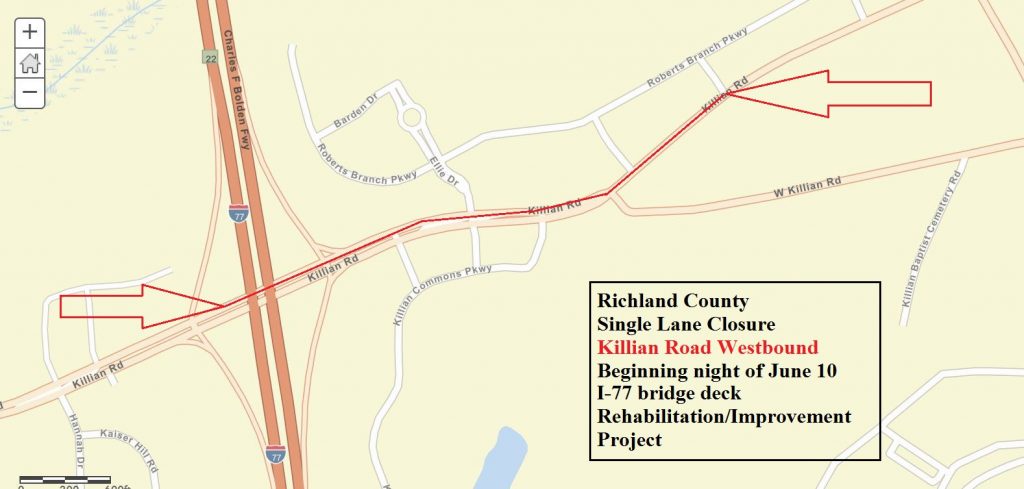
    COLUMBIA – Delays being experienced on Killian Road in the area of I-77 will last approximately six weeks according to SCDOT officials. SCDOT began a construction project to repair the bridge over I-77 on Monday evening.

    The project will be done in two phases, each lasting about three weeks, according to an announcement by SCDOT. The right lane of westbound Killian Road will be closed first, starting at Killian Crossing and ending beyond the overpass of I-77. Upon completion of the right lane of the bridge, traffic will be shifted onto the new lane and the left lane will then be closed to traffic to continue the final stage of the bridge deck repairs.

    The entire project is estimated to take approximately 6 weeks, barring delays due to weather or other circumstances. Work will be done around the clock to lessen the impact to motorists as much as possible, officials said.

    SCDOT warned that traffic in the area is very busy and could cause significant traffic and delays. Officials encouraged motorists to avoid the area by taking alternate routes if possible during construction.

    Officials say crews will work around the clock. SCDOT crews ask that motorists please drive with caution in the construction area.

    The project is part of SCDOT’s 10-year plan to improve what it calls structurally deficient bridges throughout South Carolina.

    All on-ramps and off-ramps to I-77 at this interchange will remain open during construction.

  • Chamber Welcomes Planet Fitness

    COLUMBIA- Greater Blythewood Chamber member Brian Bobenage, center, cuts the ribbon for the grand opening of his Planet Fitness facility at Hardscrabble and Clemson Roads on Tuesday.

    From left: Chamber Board Chair Mark Cunningham, board member Tom Gawinski, Byron Thomas (aid to Representative Joe Wilson), Town Councilman Eddie Baughman, Interim Chamber Director Phil Frye, Bobenage, Adam Bobenage, Chamber board member Trez Boulware, Town Councilman Larry Griffin, Chamber member Ron Perryman, board member Deborah McCutchen and Brad Lewis of Mid-Carolina Credit Union in Blythewood.

  • Lunch and Learn

    COLUMBIA – The new Watercrest senior living community, under construction on Clemson Road, hosted a Lunch and Learn for Blythewood area residents on Tuesday at the Columbia Country Club. For information about the apartment residences, contact Joy Peterson at  771-7500.

  • Green Energy BioFuel moves headquarters to Aiken

    WINNSBORO – After 10 years of operations, Green Energy Biofuel is relocating its headquarters from Winnsboro to its new Aiken facility, purchased in 2018. The business, founded by Joe Renwick of Winnsboro, collects used cooking oil from local restaurants, which is then recycled and used for biodiesel production, creating a cleaner burning alternative fuel.

    In its Winnsboro facility, the company processed 2 million gallons of grease annually. The new Aiken Plant has an industrial tank farm with custom machinery capable of processing 50 million gallons of grease annually and has been outfitted with automation systems that improve production efficiency, Renwick said.

    “While we love our Winnsboro roots and will remain active in the community, our Aiken plant has a much larger capacity that can handle our growing customer base and industrial volumes,” Renwick said. “We aren’t just closing a plant, we have built a new one that will truly fuel our future and help cultivate clean diesel fuel options for the U.S. and beyond.”