Category: Business

  • Deadlines tighten on vendor regulations

    BLYTHEWOOD – On Monday night, the Planning Commission once again tackled the question of what policies, procedures and guidelines the Town government should put in place for itinerant vendors who want to set up shop in the Town Center District.

    And, once again, the Commission punted.

    Commission Chair Donald Brock opened the issue by questioning whether the discussion should be put off until the Blythewood Chamber members could have a seat at the table.

    Commissioner Rich McKendrick, however, questioned whether it is appropriate that the Chamber be in the mix during a regular meeting of the Commission. He suggested a workshop might be the more appropriate place to include so-called stakeholders on the issue.

    “I’d say the Chamber position would be to get as many businesses into town as possible for more revenue,” Brock said. He also suggested earlier in the meeting that the Commission should question whether they, ultimately, even want itinerant merchants doing business in the town.

    “Once that question is answered, it will steer us in the direction of where we want to go,” Brock said.

    While Town Planning Consultant Michael Criss listed some of the pluses of street vendors (they add interest and pedestrian traffic to the TCD), he also said there are concerns about the aesthetics of unregulated vendors and referenced Grace Coffee.

    “However, the coffee vendor (Grace Coffee) was approved for a Certificate of Approval (COA) last year [April, 2017], by the Board of Architectural Review (BAR),” Criss said.

    A loophole in the Town’s code of ordinances paved the way for Grace Coffee, a vendor housed in a small turquoise and white mobile home on Main Street in downtown Blythewood, to do what no other business in town has been able to do – receive a COA without meeting the Town’s architectural review standards.

    It appears the Town’s ordinance regulating architectural review in the Town Center District (TCD) did not have well-defined regulations for mobile vendors.

    “We were asked to give a COA without guidelines,” BAR [then] Vice Chairman Jim McLean told The Voice. “We (the BAR) did not want to do that because a COA is permanent. We grappled with it, and we did all we could do, considering the Town has no architectural review standards in place for mobile vendors,” McLean said. “The Town was caught off guard.”

    Instead, the BAR agreed to grant a one-year conditional COA to the business to give the Town Council time to draw up standards and an ordinance for mobile vendors. That year will be up on or about April 17, 2018 and the Commission is no closer to forwarding a draft ordinance on the issue than it was a year ago.

    At issue, according to Criss, is the definition of ‘structure’ in the Town’s code of ordinances.

    “Structure’ is very broadly defined in the code, yet this mobile vendor is a ‘structure,’ and because it is in the TCD, it must have a COA from this Board for its exterior appearance,” The Town’s Planning Consultant Michael Criss told the Board in April, 2017.

    While brick and mortar buildings in the Town Center District must adhere to guidelines for paint color, lighting, whirly gigs and other exterior architectural features, Grace Coffee was not required to meet any of those standards, Criss said.

    However, McLean said the coffee vendor’s COA is based on how it currently stands and that it cannot make further (substantive) changes in its appearance going forward without coming back to the BAR.

    Newly installed Board Chairwoman Pam Dukes then asked how the sign allowances would be applied to Grace Coffee.

    That, too, turned out to favor the vendor over the town’s brick and mortar businesses.

    “It’s clear what the regulations are for permanent structures that are affixed to the ground,” Criss said. “The landlord gets one monument sign freestanding out in the front yard and one wall sign on the facade facing the street.”

    Those signs, according to the Town’s code must meet specific size and quantity guidelines.

    “But it’s not crystal clear what the sign limitations are on a mobile unit such as a trailer,” Criss said.

    Grace Coffee usually has four signs displayed – one at each entrance, one on the trailer and a menu sign in front of the trailer.

    “Suppose they were frying chicken in there,” McLean asked, referencing a discussion the Board had earlier in the meeting with Kentucky Fried Chicken officials who are looking to make major exterior renovations of the KFC in downtown Blythewood.

    “I’m trying to go back and grab the fairness. We just turned down Kentucky Fried Chicken about what they can and can’t do (with signage),” McLean said, pointing out that brick and mortar businesses in the Town are held to higher standards.

    The discussion has been ongoing ever since Grace Coffee pulled in to town in December, 2016 and set up shop in the parking lot of Bits and Pieces consignment store.

    “When we initially talked with them (Grace Coffee), they said they were going to take the trailer away each night. But now it sits there,” Mayor J. Michael Ross told Council in January of last year. “It’s another example of how a vending stand comes in and is just left there. It’s frustrating.”

    At the February, 2017 meeting, Grace Coffee’s owner Bret Beyer added another dimension to the mobility issue, telling Council members that the stand was no longer mobile, that it could not be moved.

    While a one-year temporary vender ordinance was passed in March, 2017 and Grace Coffee’s one-year COA is set to expire in April, and the Planning Commission is charged with coming up with draft standards [ordinance] for mobile vendors for recommendation to Town Council before those one year terms expire, expectations are growing slim that a new, permanent vending ordinance will be in place to meet those deadlines. The issue is not expected to be brought up for discussion again until Town Council’s annual retreat on March 10.

  • Friends of the Earth statement on Dominion takeover of SCANA

    A Bad Deal for Clean Energy in South Carolina and for SCE&G Ratepayers, who get Stuck Paying for the V.C. Summer Nuclear Reactor Debacle for 20 Years

    COLUMBIA, S.C. – On January 3, 2018, Dominion Energy and SCANA announced that Dominion has instigated a takeover of SCANA, a South Carolina-based utility. SCANA has been vulnerable to takeover as it’s facing financial and regulatory woes due to pursuit by its subsidiary South Carolina Electric & Gas (SCE&G) of two nuclear reactors that were canceled on July 31, 2017, after a waste of $9 billion.

    See Dominion presentation on the proposed merger: “Combination of Dominion Energy and SCANA,”
    January 3, 2018, http://investors.dominionenergy.com/static-files/358568a2-cd8e-4844-a15c-2f618e902fc7

    Photo Courtesy of High Flyer, October 2017

    The take-it-or-leave-it deal falls far short of protecting ratepayers from absorbing the costs of the nuclear fiasco, while replacing the unneeded nuclear plant with unnecessary natural gas capacity instead of cheaper and cleaner energy alternatives. The deal proposes an initial rebate to SCE&G electricity customers for a small amount of the money already paid for the V.C. Summer nuclear reactor construction debacle. The proposal would then require that a typical customer continue to pay 13% of their monthly bill for a period of 20 years, with full profits on the remaining abandoned nuclear project costs. About 18% of customers’ current bill now goes to the nuclear project, with SCE&G collecting about $37 million per month from ratepayers.

    SCE&G is still expected to file a formal abandoned nuclear project cost recovery petition with the South Carolina Public Service Commission on or about January 8, 2018, as the company announced last month. That petition will provide important details on Dominion’s proposed deal and draw engagement from public interest groups. Friends of the Earth and Sierra Club will respond aggressively to any proposal which fails to protect ratepayers and assure a clean energy future for South Carolina.

    Friends of the Earth and the Sierra Club currently have a complaint pending before the PSC which seeks repayment to customers of money wasted on the nuclear project and a future commitment to pursue cleaner, cheaper, alternative energy. In that on-going case Friends of the Earth and Sierra Club are actively seeking to compel discovery of documents from SCE&G that could hold evidence of fraud and imprudence on the part of the utility. While it is unclear how the merger proposal will proceed, the organizations will continue to fight at the PSC for a return of money spent on the nuclear fiasco.

    Related Articles:  SCE&G says it will pull license; Dominion Energy announces takeover of SCANA  ,  Citizens sue to stop SCE&G dividend payouts  ,  County files injunction against SCANA  ,  Fairfield residents sue SCE&G, SCANA


  • SCE&G says it will pull license; Dominion Energy announces takeover of SCANA

    VC Summer Nuclear Plant, May 2017 | Courtesy of High Flyer

    CAYCE, S.C. – Barely two weeks after Fairfield County Council took South Carolina Electric & Gas Company (SCE&G) to court to request an injunction to prevent SCE&G from relinquishing its nuclear license for VC Summer Units 2 and 3, and before a judge could rule on the request, SCE&G filed a formal request with the Nuclear Regulatory Commission (NRC) to withdraw the combined operating licenses (COLs) for  the two VC Summer Units.

    In addition, on Wednesday, Dominion Energy and SCANA announced that Dominion has instigated a takeover of SCANA which has been vulnerable to takeover as it’s facing financial and regulatory woes due to pursuit by SCE&G of two nuclear reactors that were canceled on July 31, 2017, after a waste of $9 billion. (For the complete breaking news on this announced takeover, go to blythewoodonline.com.)

    SCE&G is still expected to file a formal abandoned nuclear project cost recovery petition with the South Carolina Public Service Commission on or about Jan. 8, 2018, as the company announced Dec. 28. That petition will provide important details on Dominion’s proposed deal.

    “This notification (Dec. 28, 2017) is consistent with our plans for abandonment and helps to ensure we qualify for a tax deduction in 2017 so that we can capture approximately $2 billion for our customers to offset the costs of the new nuclear project,” said incoming SCANA CFO Iris Griffin.

    In its notification to the NRC, SCE&G stated that it has irrevocably abandoned its interests in the VCS Units 2 and 3, ceased all completion and preservation activities, and has limited work at the plant to only those actions required to place the site in a safe condition, terminate construction and close active permits.

    SCE&G has offered to cede its abandoned interest in the VCS Units 2 and 3 to Santee Cooper, for no consideration. If, prior to the NRC approval of this request to withdraw the COLs, Santee Cooper chooses to seek to become the sole licensee for the project, SCE&G officials said they will support an application to the NRC to transfer the licenses to Santee Cooper.

    “Fairfield County is aware of SCE&G’s desire to withdraw the licenses for VC Summer Units 2 and 3 so it can take a tax write-off for 2017,” said attorney John McKenzie, one of two law firms representing the County in its legal action against SCE&G.

    “The County is also aware that Santee Cooper, by letter of December 15, 2017, has yet to consent to the surrender of these licenses, and apparently cannot do so until its board meets in late January,” McKenzie said. “We also understand that there are interested parties who might purchase Santee Cooper. We would hope that SCE&G would not return the licenses in question until all options to restart this project have been explored.  Otherwise, SCE&G will have taken additional steps to show its bad faith toward both the citizens of Fairfield County and Santee Cooper, which also furnishes power to electric cooperatives serving the citizens of Fairfield County.”

    Related Articles:  Statement on Dominion Takeover of SCANA   ,  Citizens sue to stop SCE&G dividend payouts  , County files injunction against SCANA  ,  Fairfield residents sue SCE&G, SCANA

  • County Launches Economic Development Website

    WINNSBORO – The County’s new economic development website has launched. And no one could be prouder of it than Ty Davenport, the County’s Director of Economic Development.

    “We wanted our new site to elevate Fairfield County and be attractive to companies interested in investing in the area,” Davenport said. “And I think it does that.”

    To view the new website, go to https://www.fairfieldcountysc.com/

  • Durafiber closing hits town pocketbook; claims 220 jobs

        WINNSBORO – Durafiber Technologies announced last week that it would close its plant in Winnsboro’s mill village if it can’t find a buyer for the plant by Sept. 11.

    The company said a total of 220 employees who work at the Fairfield plant will be affected by the closing. Another 580 employees in plant closings in Salisbury and Shelby, N.C. will be effected.

    Looking at the financial effect the plant closing will have on the Town of Winnsboro utilities, Town Manager Don Wood said in the finance meeting Tuesday evening that, “the news is not good, but it’s not devastating. They’re still pursuing a buyer, but it’s highly unlikely,” Wood said.

    “We’re looking at anywhere from $400,000 to $441,000 in lost revenue per year,” Tripp Peak, Director of Gas, Water and Sewer Utilities for the Town said during the meeting. “The gas is going to be the hardest hit at around $256,247. They’re about half our summertime load, so at this time of the year, half our gas revenue comes from Durafiber,” Peak said.

    “They’re water consumption varies, but we’re looking at anywhere from $125,000 to $158,000 in lost revenue. They use very little sewer, around $26,000 a year,” he said.

    But Wood and Peak said there were some possible solutions to the revenue loss, including selling off some of Winnsboro’s gas capacity which would generate $96,000 to $102,000 savings per year. Peak said the Town is locked into a capacity contract until the year 2015, but can sell surplus gas on the market.

    The Town is also looking to expand its gas customer base by 300 customers which would generate about $360,000 in gas sales revenue and $58,000 in demand charge revenue. Peak said the Town has the gas rights to serve all of Fairfield County.

    “We talk about lost revenue…I assume that’s not synonomous with profit, and my question is, we might lose that much revenue, but we also lose the cost of the gas and the water and electricity, so what is the bottom line of what it’s really going to cost us?” Mayor Roger Gaddy asked.

    The Town’s Finance Director, Kathy Belton, said the loss would be about $250,000.

    Durafiber said in a press release that it is taking steps to close the plants following a series of “initiatives to lower production costs in response to increased competition in the textile industry, as well as a thorough review of strategic alternatives, including potential asset sales.”

    Headquartered in the Charlotte suburb of Huntersville, Durafiber has international operations in France, Germany, and Mexico which the company said would continue to operate as usual.

    “While today’s announcement is a difficult one to make, increased labor, energy, transportation and raw material costs — in addition to continued market pressures — have strained Durafiber’s finances to a point that is no longer sustainable,” Durafiber’s CEO Frank Papa said in the press release.

    “Our team will work diligently to ensure a smooth transition for our employees, customers and suppliers during the next 60 days, even as we continue to pursue strategic alternatives to keep these plants open.”

    The Winnsboro plant, located at 199 Maple St., was acquired from Invista in March 2008. The plant produces industrial polyester tire fabric.

    Built in 1898, the Winnsboro plant is located on 45 acres in the heart of the mill village, and has 473,000 square feet of manufacturing area.

    DuraFiber is a global supplier of high-tenacity polyester fibers and fabrics, Nylon-6, engineered fabrics, sewing thread fibers and advanced materials for consumer and industrial applications, according to the press release.

  • Storage Express to expand along I-77

    BLYTHEWOOD- A proposal has been made by Dewayne Bohannon, the owner of the existing Storage Express mini-warehouses that sit between Community Drive and I-77 and within the Town limits, to fully develop the five-acre site by adding 30,926 square feet of new mini-warehouse space.

    While that is an allowed land use in the Limited Industrial (LI) District, the size of the project requires Planning Commission approval of the site plan as a group development.

    Design issues for the commission to consider include internal and external vehicular and pedestrian traffic circulation, landscaping and screening, tree preservation and storm water management.

    Due to the very limited occupancy of the site, Town Administrator Gary Parker pointed out in a memo to the Commissioners that he recommended no traffic impact study was required.

    “I am also recommending the proposed alternative landscape design (submitted by Bohannon),” Parker wrote. “The extensive building and driveway impervious surfaces hinder the usual interior tree plantings and building foundation plantings.”

    Instead, he suggested intense landscaping, fencing and berm screening to hide the new expansion from traffic along the I-77 frontage road. He wrote that this would enhance this gateway to Blythewood.

    According to landscape drawings submitted by Bohannon, the tree preservation will occur at the southern end of the site, surrounding and screening the main detention pond.

  • Vendor OK’d, KFC Grilled

    BLYTHEWOOD – A loophole in the Town’s code of ordinances has paved the way for the owner of Grace Coffee, a vendor housed in a small turquoise and white mobile home on Main Street in downtown Blythewood, to do, on Monday evening, what no other business in town has been able to do – receive a certificate of occupancy (COA) without meeting the Town’s architectural review standards. The business owner, Matt Beyer, did not attend the Board of Architectural Review (BAR) meeting.

    It appears the Town’s ordinance regulating architectural review in the Town Center District does not have well-defined regulations for mobile vendors.

    “We were asked to give a COA without guidelines,” BAR Vice Chairman Jim McLean told The Voice. “We (the BAR) did not want to do that because a COA is permanent. We grappled with it, and we did all we could do, considering the Town has no architectural review standards in place for mobile vendors,” McLean said. “The Town was caught off guard.”

    Instead, the BAR agreed to grant a one-year conditional COA to the business to give the Town Council time to draw up standards for mobile vendors.

    At issue is the definition of ‘structure’ in the Town’s code of ordinances.

    “Structure’ is very broadly defined in the code, yet this mobile vendor is a ‘structure,’ and because it is in the Town Center District, it must have a COA from this Board for its exterior appearance,” The Town’s Planning Consultant Michael Criss told the Board.

    While brick and mortar buildings in the Town Center District must adhere to guildelines for paint color, lighting, whirlygigs and other exterior architectural features, Grace Coffee was not required to meet any of those standards, Criss said.

    However, McLean said the coffee vendor’s COA is based on how it currently stands and that it cannot make further (substantive) changes in its appearance going forward without coming back to the BAR.

    Newly installed Board Chairwoman Pam Dukes then asked how the sign allowances would be applied to Grace Coffee.

    That, too, turned out to favor the vendor over the town’s brick and mortar businesses.

    “It’s clear what the regulations are for permanent structures that are affixed to the ground,” Criss said. “The landlord gets one monument sign freestanding out in the front yard and one wall sign on the facade facing the street.”

    Those signs, according to the Town’s code must meet specific size and quantity guidelines.

    “But it’s not crystal clear what the sign limitations are on a mobile unit such as a trailer,” Criss said.

    Grace Coffee usually has four signs displayed – one at each entrance, one on the trailer and a menu sign in front of the trailer.

    “Suppose they were frying chicken in there,” McLean asked, referencing a discussion the Board had earlier in the meeting with Kentucky Fried Chicken officials who are looking to make major exterior renovations of the KFC in downtown Blythewood.

    “I’m trying to go back and grab the fairness. We just turned down Kentucky Fried Chicken about what they can and can’t do (with signage),” McLean said, pointing out that brick and mortar businesses in the Town are held to higher standards.

    The discussion has been ongoing ever since Grace Coffee pulled in to town last December and set up shop in the parking lot of Bits and Pieces consignment store.

    “When we initially talked with them (Grace Coffee), they said they were going to take the trailer away each night. But now it sits there,” Mayor J. Michael Ross told Council in January. “It’s another example of how a vending stand comes in and is just left there. It’s frustrating.”

    At the February meeting, Beyer added another dimension to the mobility issue, telling Council members that the stand was no longer mobile, that it could not be moved.

    During the coming year, prior to the expiration of Grace Coffee’s one-year COA, the issue of standards for mobile vendors is expected to come before the Planning Commission for recommendation to Town Council.

  • First Citizens in Ridgeway closes to keys and cookies

    Ridgeway major Charlene Herring presents Keys to the City to employees of Ridgeway’s First Citizens Bank. Manager Bret Whiting, left, Sheila Brown, Herring and Fannie Ford

    Shortly after the First Citizens Banks in South Carolina were merged with the North Carolina First Citizens Banks, the company announced it would be closing the doors on the bank in Ridgeway. That happened on Wednesday.

    The bank has been open under various names for the last 119 years. It is an institution the townspeople say they don’t know how they will get along without.

    At Monday night’s Fairfield County Council meeting, Councilman Dan Ruff, (District 1) who represents Ridgeway, said he is working closely with the County’s Economic Development Director Ty Davenport to fill the void left by the closed bank.

    In the meantime, the town’s merchants and many longtime customers of the bank threw a couple of farewell parties. Mayor Charlene Herring gave all the bank employees keys to the city. Carol Allen, proprietor of Laura’s Tea Room, served tea, crumpets and other culinary delights to customers on Friday afternoon as they bid farewell to Bank Manager Bret Whiting, who has 31 years of banking service; Fannie Ford, who is retiring after 41 years and Sheila Brown who is retiring after 34 years of service.


  • Residents Beat Back Rezoning Attempt

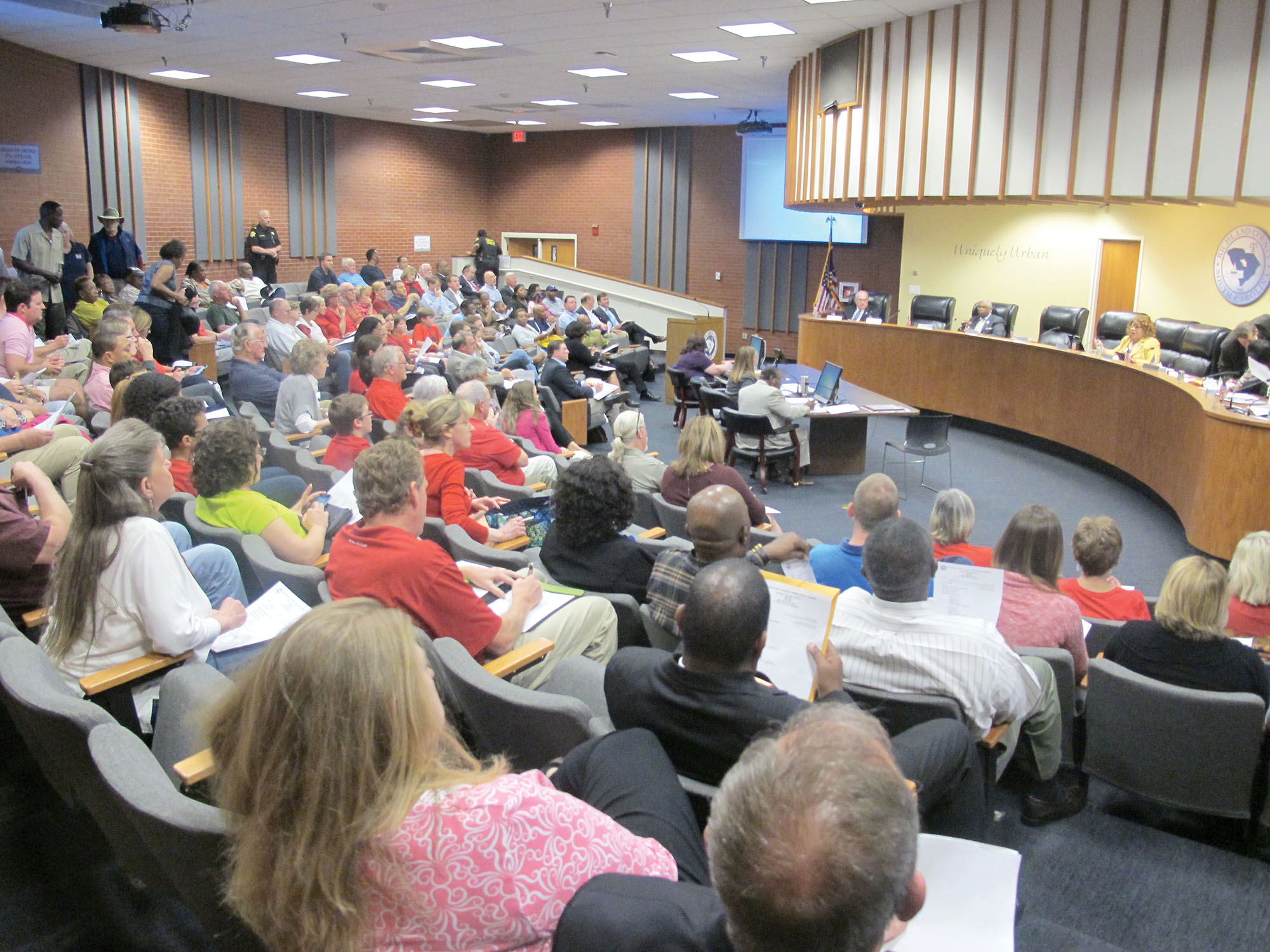
    Rimer Pond Road residents pack County Council chambers Tuesday evening. (Photo/Barbara Ball)

    COLUMBIA (March 2, 2017) – The third time was not the charm for developer Hugh Palmer Tuesday night when he again came before County Council requesting a Rural Commercial (RC) zoning designation for a 5.23-acre parcel he owns at the intersection of Rimer Pond Road and Longtown Road West in Blythewood.

    After almost an hour of passionate pleas from 30 or so residents in the Rimer Pond Road/LongCreek Plantation area asking Council to deny Palmer’s request to bring commercial zoning to their rural neighborhood, the road’s own County Council representative, Gwen Kennedy, made a motion to approve Palmer’s request. When Chairwoman Joyce Dickerson, who also represents a portion of Blythewood, called for a second, Council fell silent and the motion died for lack of a second.

    Dickerson then called for a second motion for denial and 10 of the 11 Council members raised their hands to deny Palmer’s request with Kennedy casting the lone vote against the motion for denial.

    Dickerson called for a break in the proceedings as the crowd of more than 100 residents, hugging and congratulating each other, left the chamber, leaving it almost empty.

    During the Hearing, Palmer sat with his son, Patrick Palmer, a member of the Richland County Planning Commission, and lobbyist Boyd Brown who told Council members he was there to help Hugh Palmer win their votes. Patrick Palmer recused himself earlier in February when the issue came before the Commission. The issue when before the Commission ended in a tie vote that resulted in no recommendation being sent to Council.

    Hugh Palmer has brought his rezoning request before Council twice previously, both times facing hundreds of residents in opposition, including Blythewood Mayor J. Michael Ross. In June of 2015 Palmer withdrew his request when it was apparent that he did not have the votes. Later that year, in November, Council denied the request with a 5-5 tie vote.

    Hugh Palmer was on fire Tuesday night as he warned Council members during his two minutes at the microphone that his request was the victim of misinformation being spread on Facebook.

    “I’m not proposing a landfill, a sewage treatment plant, a large grocery store or shopping center as some have claimed,” Palmer said.

    While those claims had not been made by anyone during public hearings at either the Planning Commission or County Council, he did not say who made them or where they were made.

    “I propose small retail development that would serve the needs of and be convenient to the surrounding area, to the people that already travel this area every day,” he said. “This area is changing, whether these folks in here like it or not.”

    Palmer told Council his request falls within the boundaries of the County’s land use plan, has County staff’s approval and meets Rural Commercial (RC) standards.

    “Those should be the questions that matter here tonight,” he said, dismissing the pleas of those present who live in the area.

    While Brown, speaking for Palmer’s rezoning request, held up a petition that he said was signed by 125 people in the community who supported the rezoning, some opponents of the rezoning frequently reminded Council that the 125 petitioners didn’t show up at the hearing. County Council does not accept petitions.

    Although Palmer told Council the goal of his request was to bring commercial conveniences to the neighborhood, speaker after speaker repeated, “We don’t want it. We don’t need it.”

    “We enjoy the rural setting,” Christopher Henchy of Eagles Glen said. “No one on Rimer Pond Road wants commercial development on our road.”

    Fifteen-year resident Kathy Johnson spoke against the rezoning and related an anecdote of how her car’s low fuel light came on at the intersection where Palmer is seeking rezoning.

    “I was close enough to Blythewood that I was able to drive three miles to get gas before I ran out. I think we’ll be OK,” Johnson assured Council.

    LongCreek Plantation resident Jay Thompson challenged County staff’s approval of the request and their conclusion that RC zoning was compatible with the Palmer property.

    “RC zoning is not compatible with the Rimer Pond Road land use plan,” Thompson said. “The nearest RC zoning is to the west of Blythewood on Winnsboro Road.”

    To make his point that commercial zoning would bring crime to the Rimer Pond Road area, Trey Hair handed out to Council members neighborhood crime maps off the internet that showed only a handful of crimes committed in a one-mile radius of Rimer Pond Road over a one-year period. A map of the same time frame and radius of a nearby commercial intersection was almost solid with symbols showing where crimes had been committed.

    “RC zoning is described by the County as serving areas that are isolated or underserved,” Rimer Pond Road resident Ken Queen said. “We are neither. We have everything we need within three miles. One person’s wants and desires should not take precedent over hundreds of people who live in this community and oppose (this zoning),” he said.

    The neighborhood’s representative in the State House, Joseph McEachern, spoke supporting the residents in their fight against the commercial rezoning.

    Because the request was denied, it is not eligible to come back to Council for a year.


  • Vendor Regulations Postponed Again

    Council Seeks to Add DHEC Permits, Insurance, Zoning Requirements

    BLYTHEWOOD (March 2, 2017) – Town Council Monday night made another abortive pass at an ordinance regulating itinerate merchants and vending stands within the Town Center District (TCD). Unlike last month’s attempt, however, when Council faced considerable public backlash for its efforts, Monday night a handful of citizens – including one merchant who would be directly impacted by the proposed rules – spoke out in favor of some form of regulation.

    “There really needs to be regulation so roadside services, roadside stands that come up, whether they’re selling food or products, that they’re fully compliant with all the town’s regulations,” Tom Duka told Council during the Citizens’ Testimony portion of the meeting. “When somebody builds an actual brick-and-mortar structure to have a store or restaurant or facility, they’re making a definite investment, but some of these vending stands that are coming through town are very temporary in nature. We want to make sure that people who make an investment in town by actually complying with the zoning, by complying with the building regulations, are the ones who are most protected, as long as they are following regulations as well.”

    Scott Opolyn, owner of Scotties Restaurant, told Council he was concerned that mobile food vendors may not have obtained their appropriate inspections from the Department of Health and Environmental Control (DHEC). Opolyn also said any new regulations should ensure that mobile vendors are properly insured and that they meet the town’s zoning regulations.

    “I personally think that having food trailers that would come here is great, but you don’t want to make Blythewood a Gypsy city, either,” Opolyn said. “Which means we have to set rules and regulations.”

    The key word in defining an itinerate merchant, Opolyn said, is “mobile,” and Council’s proposed ordinance would require such merchants to remove their vending stands from the TCD at the close of each business day. But a loophole could appear, Opolyn said, if Council failed to also regulate hours of operation.

    “If they’re open 24-hours a day, seven-days a week, well I guess there’s nothing to move,” he said. “But it still comes down to cleanliness. How are they going to clean their trailers? They’re mobile. They don’t carry a lot of water. Where do they use the bathrooms? What about the people who are eating there and drinking there if they’ve got to go? You don’t want them urinating in a jar and pouring it outside their trailer. It’s not a public toilet. This is where we live.”

    Matt Beyer, owner of Grace Coffee Company, said he was not opposed to Council regulating mobile vendors. The iconic coffee trailer at 208 Main Street, which has found itself at the center of the debate, would be directly impacted by any new laws governing itinerate merchants and vending stands.

    “I think there should be some regulations,” Beyer said. “You should regulate us, to a degree. I think we all in this room need to figure out how to work it out and create a win for all of us.”

    Although the company was indeed a mobile enterprise when they opened for business three months ago, Beyer said, they have since become fixed to their spot on Main Street.

    “We look mobile, but we’re not anymore,” Beyer said. “What we have inside, it’s not just a hassle to move, it’s not possible. So it’s either we’re here or we’re not.”

    Councilman Tom Utroska, who was absent from last month’s meeting when the initial first reading on the ordinance was postponed, said Monday night that he had “a real issue” with the proposed rules.

    “Let’s say we have somebody that comes in a purple and red and orange truck that wants to park in the Town Center District,” Utroska said. “We won’t let people build buildings that look like that, but we’re going to say it’s OK to park your truck there. It kind of seems like it’s a slap in the face to the business owners. I think there needs to be some standards.”

    Utroska also said he felt Council should ensure that mobile food vendors have any necessary DHEC permits, and that mobile vendors of any sort should have liability insurance.

    The proposed ordinance presented Monday night included one minor addition to the version presented last month – a grandfather clause that would allow any vending stand in lawful operation at the time of first reading to continue to operate without regard to the daily removal requirement. But Utroska said he thought existing vendors should be given 60 days to comply.

    “I don’t think we give them perpetuity,” he said. “I am not happy with this ordinance. It doesn’t say anything about them having to have a DHEC permit, it doesn’t say anything about insurance. It doesn’t say anything about the Town Administrator being able to decide whether or not you can park in a certain location, that the color may not fit in with the zoning. There’s a lot of things I don’t see in the ordinance.”

    Jim Meggs, the Town’s attorney, reminded Council that the original model ordinance he had presented to them included a veritable laundry list of detailed regulations, but Council had rejected that as too stringent. The version presented last month, he said, had been pared down to simply requiring vendors to pull up stakes are the end of each business day.

    “Somewhere there’s a happy medium,” Utroska said. “I think there has to be some modicum of restriction. I do think they have to move every day. And if their colors are so garish they wouldn’t be allowed, they shouldn’t be here.”

    Mayor J. Michael Ross asked Utroska to work with Meggs to develop a broader ordinance. A third version, Utroska agreed, should be ready for Council’s March 27 meeting. Council’s agenda for Saturday’s annual retreat also includes discussion of the ordinance. The retreat begins at 9 a.m. at The Manor.