Category: Business

  • COA for pediatric clinic delayed

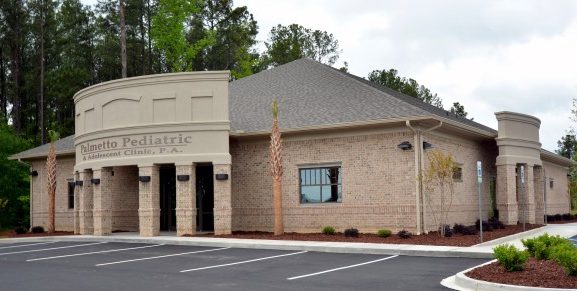
    Palmetto Pediatric has this semi-circular structure in front of some offices.

    BLYTHEWOOD – A 16-foot tall free-standing, semi-circular wall that is the feature of the front entrance to a medical building proposed on Blythewood Road did not get a warm welcome from the town’s Board of Architectural Review (BAR) Monday evening. One board member called it overpowering.

    Matt Davis, the architect representing the applicant, Palmetto Pediatric and Adolescent Center, defended the giant curved front entrance structure, explaining that it has become something of a symbol of the Center which has several locations.

    “It is used to break up the perception of a non-descript, rectangular hip roof,” Davis said.

    While the board generally agreed that the hip roof was ‘plain’ and ‘ugly,’ they had difficulty seeing the curved wall as a solution to the problem.

    “The board’s job is not to accommodate the doctors as to how it (the building) looks, but to determine how it looks in our community,” board member Cindy Nord said.

    Board members also expressed their dismay with the proposed facility’s landscaping plan that would require taking down all but one of the trees on the property.

    The plan, Davis said, is to leave a 24-inch heritage tree in the front and plant 10 canopy trees to include five live oaks and five willow oaks. Dwarf shrubs, crepe myrtle and nandina would round out the landscaping.

    Board member Jim McLean shared his concern regarding the proliferation of black asphalt proposed in a front parking lot.

    “We need to be careful not to throw away the look of the front to asphalt,” McLean said. “We don’t want to set a precedent we might regret down the road.” He cited other Town Center District (TCD) businesses that were able to design parking accommodations that were to the side or to the rear of their building locations.

    “Palmetto is a wonderful group,” McLean assured the applicant, “and we want to work with you.”

    Davis explained that the S.C. Department of Transportation (SCDOT) requirement for the position of the driveway entrance made parking in the front a necessity since they needed to maintain a 25-foot aisle to allow for cars to pull in and out of spaces. He said Palmetto Pediatric & Adolescent clinics are especially high users of parking due to the large number of staff members required to serve this niche of care.

    The board’s architectural advisor, Ralph Walden, made some suggestions for Palmetto Pediatric to consider for rear parking arrangements and for enhancements to the general appearance of the building. He suggested that they consider adding some articulation, additional elevation, dormers or perhaps a gable end to the roof.

    After further discussion, a motion was made and passed to remand the application consideration back to the Cohn design team for potential adjustments as a result of the board’s feedback. Board member Alan George, manager of Community Bank in Blythewood, recused himself since Community Bank is financing the project.

    This request will be on the agenda for the August 20 BAR meeting.


    Related: Pediatric clinic eyes Blythewood

  • Alltemp is open for business

    WINNSBORO – The Fairfield Chamber of Commerce welcomed Alltemp Comfort Services to town last Friday with a ribbon cutting. Winnsboro Mayor Roger Gaddy and Alltemp owner Chris Griffith, center, wielded while co-owner Amy Griffith, left of Gaddy, and other members of the chamber assisted. Holding the ribbon are Chamber Director Terry Vickers, left, and Chamber secretary Susan Yenner held the ribbon. Alltemp is located on Peays Ferry Road in Winnsboro.

  • Pediatric clinic eyes Blythewood

    BLYTHEWOOD – The Board of Architectural Review (BAR) is expected to hear a request Monday evening for a certificate of occupancy for a pediatric and adolescent clinic.

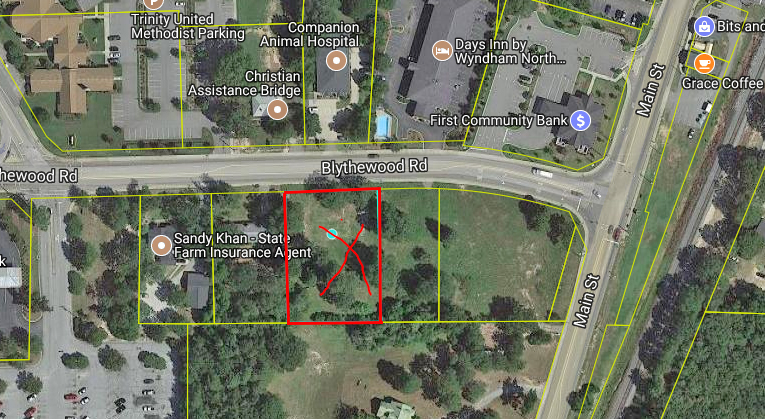
    The proposed 5,408 square foot building is to be constructed on a vacant parcel at 121 Blythewood Road, across from Companion Animal Hospital.

    Cohn construction has posted a sign on the property and The Voice has been told that HB Engineering of Lexington will do the engineering for the construction.

    In 2015, the BAR gave conditional approval for a COA to a pediatrician for a 6,500 square foot medical building on the same location. That approval was conditional on plans for lighting, landscape and signage being presented and approved. But that approval never materialized because the applicant never came back to the BAR.

    The BAR meeting will be held at 6 p.m., Monday, July 16 at The Manor.

    Location proposed for pediatric clinic on Blythewood Road.
  • Council opens door to vendors

    Vendor Johnny Dial runs a vegetable stand across from the Food Lion on Blythewood Road. | Barbara Ball

    BLYTHEWOOD – Town Council passed a temporary vending ordinance last week that opens the door for vendors to set up shop in the Town Center District (TCD).

    The ordinance, which took more than a year to pass, is a City of Columbia ordinance knockoff that basically allows street vendors to begin operating in the town if they are permitted by a property owner to locate on their property, leave the premises every evening and acquire the proper temporary vendor permitting from Town Hall. There are a few specific regulations for different types of vendors.

    Food trucks must locate more than 250 feet from the door of a lawfully established eating place unless the owner of that eating place provides a letter of consent.  Seasonal vendors and food trucks must obtain a zoning permit prior to operating in the town and must locate within a district that otherwise permits that type of business. Vendors located within 400 feet of a parcel zoned residential are not allowed to operate between 9 p.m. and 9 a.m., and vendors cannot operate more than a total of 10 hours within a calendar day.

    Vendors are generally allowed to operate at the same time the other businesses in town are open.

    Unlike brick and mortar businesses in the town, vendors are not required to adhere to architectural review standards. A business owner in the TCD who is prohibited from painting his building garish colors could come in with those same colors as a vendor without penalty. There are no architectural review requirements or restrictions for temporary vendors.

    Still, vendor Johnny Dial, who has manned a vegetable stand across from the Food Lion on Blythewood Road for most of the past three years, says the rules are too tough on vendors.

    “Having to move out every night, pull up stakes and come back the next day and set up is a lot of work.”

    But Dial also says it is too expensive to lease a building.

    “People don’t like to buy produce in a store. They like to buy vegetables in open air markets,” Dial said.

    Dial purchases most of his vegetables from producers in Lexington County – Moneta, Mr. Rawl’s and William’s Produce – who deliver the products to him.

    The ordinance defines ‘temporary vendors’ “as a person who sells merchandise, goods, services or forms of amusement from a tent, awning, canopy, umbrella, stand, booth, cart or trailer, from a vehicle, from his person or other temporary structure.”

    A food truck is defined as a licensed, motorized vehicle that includes a self-contained or attached trailer kitchen and the vehicle is used to sell and dispense food to the general public.

    Grace Coffee, although it looks like a vendor, does not have to pull up stakes and leave every evening like the other vendors. It is allowed to stay on premises 24/7/365 like brick and mortar businesses, but is not bound by architectural review restrictions and regulations that brick and mortar businesses are bound by. Grace Coffee has been declared by Town Hall to be a ‘business in good standing.

    Cook said the term ‘temporary vending’ has to do with venders who are only in town for the day, but leave after business hours.

    The temporary vending ordinance was recommended for approval by the Planning Commission on April 4. It was also shown to the Board of Architectural Review (BAR). While BAR members were not given any authority to make changes or vote on the ordinance, they asked that there be some criteria addressed for standards dealing with the architectural appropriateness of vendors.

    “I really have a struggle with the fairness of this,” Jim McLean, co-chair of the BAR said. “Are the brick and mortar stores being undercut? They have made a hard investment in the town and have to abide by the BAR regulations and restrictions. The caveat of unfair competition needs to be addressed.”

    Appearance of the vendors was not addressed by Council when it passed the ordinance last week.

  • Judge OKs amended suit vs JWC

    JENKINSVILLE – Broad River Campground can amend the lawsuit it filed against the Jenkinsville Water Company to include new allegations and statements from witnesses, a judge has ruled.

    Sixth Circuit Judge Grace Gilchrest Knie also ruled in a separate order that campground lawsuits against the JWC, as well as board chairman Gregrey Ginyard and vice-chairman Joseph McBride, can be combined.

    Both lawsuits allege violations of the S.C. Unfair Trade Practices Act, or SCUTPA, according to Fairfield County court records. Orders combining and amending the suits were signed in late June.

    “The factual allegations in the SCUTPA cause of action against JWC are identical to the factual allegations against Ginyard and McBride,” the order combining the lawsuits states.

    “I find that the factual allegations the Plaintiff has asserted against JWC, Ginyard and McBride arise out of the same transaction, occurrence or series of transactions or occurrences and that there are questions of law and fact common to all defendants that will arise in the action,” the order continues.

    At issue are claims that the JWC reneged on agreements to provide additional water service to the campground, which in recent years has seen an influx of workers at the V.C. Summer nuclear site.

    The campground’s suit claims the JWC wrongfully denied water service in 2014 despite a superfluous amount of water.

    Broad River Campground states in its suit that JWC is contractually obligated to provide additional water, citing a letter from the JWC as proof that a contract existed between the parties.

    According to the letter, the JWC stated it could commit to 8,050 gallons per day. The campground has said that even with the extra water, it falls below the 8,050-gallon threshold.

    “The water company will consider increasing our commitment, but only if that can be done without negatively impacting other customers of the water system,” the letter states.

    In legal documents, Ginyard individually and the JWC as a whole deny allegations in the suit. The JWC has also claimed in its filings that the letter doesn’t constitute a contract.

    “JWC denied and continues to deny that Exhibit 1 [the letter] is a valid and legally enforceable contract,” an affidavit previously filed by Ginyard states. “However, to the extent that Exhibit 1 is a valid and legally enforceable contract, JWC never breached it.”

    JWC’s answer to the litigation also states it lacks sufficient water capacity to meet the campground’s request.

    “Defendant pleads impossibility, impracticability, unconscionability, and an Act of God as Defendant does not have available water capacity to satisfy Plaintiff’s demand,” the answer states.

    The campground’s amended complaint inserted the word “willful” in numerous causes of action. It also included an affidavit from former JWC board member Lori Smith, who restates assertions made in the campground’s suit.

    Smith further stated in her affidavit that Ginyard pressured other board members to influence their votes.

    “If Mr. Ginyard wanted a vote to go a particular way he would call Board members and try to get them to vote his way,” the document states. “He intimidated members of the Board who were supporting the campground.”

    A Dec. 3 trial date is tentatively planned.

  • SPAWS pet grooming salon cuts the ribbon

    Teresa Santiago, center, owner of SPAWS Pet Grooming & Day Care was assisted by Ed Parler, Blythewood’s economic development consultant, during the shop’s grand opening on Saturday.

    BLYTHEWOOD – Just in time for lake swims, muddy paws and summer romping, SPAWS Pet Grooming & Day Care has opened at 424 Main St. in Blythewood, in the former Groomadog location. New owner Teresa Santiago, a certified groomer, employs three other certified groomers, with appointments available Monday through Saturday. Spots are already filling up, with clients who are following her from previous grooming locations and 20 new client bookings from the salon’s grand opening celebra bration on June 23. Santiago said she’s thrilled to be starting a new grooming business in Blythewood, and said her highest priorities are making sure the dogs are safe, happy and receive expert grooming.

    “In order to work here, you have to truly love dogs, and be compassionate. That’s my policy,” Santiago said. “We don’t have students, only certified groomers – myself, Emily Strange, Lyndsey Crouch and Casey Ororke. I feel that it’s important to do things like making sure your furbaby is with the same groomer every time. That helps to build a relationship – and since everybody cuts a little differently, you know it’s going to be the same haircut. And we always speak to the dogs by name, to help them feel comfortable, like ‘okay, she knows me.’”

    Santiago is making a number of changes in the salon, including a gradual process of painting and fixing things up.

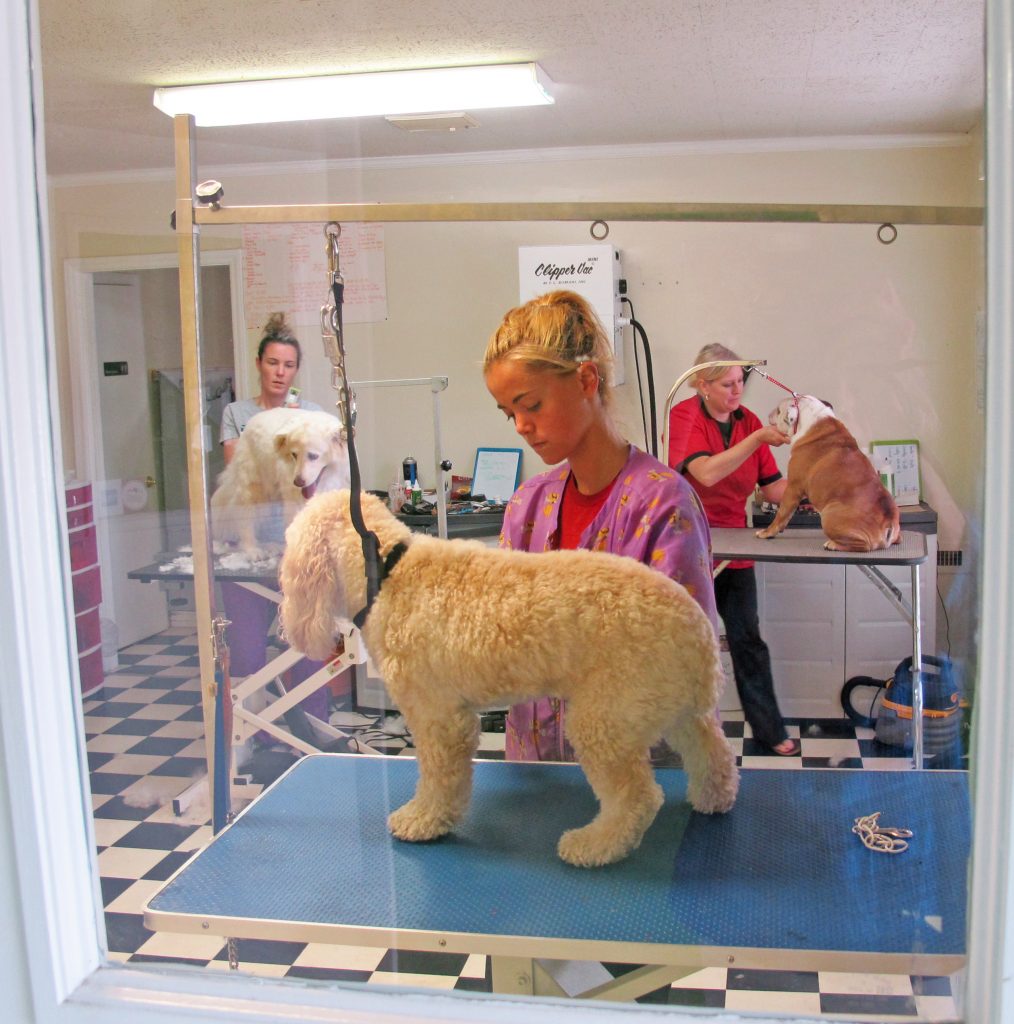
    “We’ve taken down the window blinds so that visitors and clients can see into the grooming area,” Santiago said. “Now when you come in, you can walk by and see your furbaby being pampered and groomed. Everything is open, you can always just pop in.”

    Santiago said she especially enjoys the morning drop-off time between seven and nine.

    “That allows me to spend a little time with the dogs and meet the parents,” she said. “We can go over the haircut and really find out what they want. Then at pick-up time, I check each dog out with the parent, and make sure they’re satisfied and happy with the haircut. We take notes about the cut, and if they want something a little bit different, we write that down. I believe in really making it personal, and taking good care of their furbaby.”

    She previously worked as a deli manager at Publix, and was with the company for 23 years and loved her job. But she said she wanted to do something different.

    “I’ve always loved dogs, so I went to school and became a certified groomer. Then right out of school, I was fortunate to get a position at Groomingdales, a five-star grooming salon in Shandon. I wanted to eventually open my own business, and here I am in Blythewood.”

    A viewing window allows visitors to observe the grooming room

    Over 30 clients came with her.

    The SPAWS grooming team works with a wide variety of breeds – including a 180-pound Alaskan Malemute – and Santiago said they really enjoy getting to know the dogs’ unique personalities.

    “Sometimes dogs are nervous when they come in, so we make them feel comfortable while they’re getting their new haircut. I love seeing how happy the dogs are after getting a haircut. They get so frisky!” Santiago said.

    In addition to grooming, SPAWS also offers a doggie day care service.

    “We have a big room with a couch for them to jump up on, and they can play or just hang out with us. It gets them out of the house, and we love having them around. We’re also planning to install a doggie door, so they can go outside to play, or if it’s hot outside they can stay cool in the playroom.”

    To find out more or to book an appointment, call SPAWS at 803-786-2009 or visit their website at spawspetgrooming.com.

    About 50 people/pets attended the grand opening, which featured Smooth Move smoothies and MAFIA Pet Rescue


  • County inches closer to hospital property purchase

    WINNSBORO—As Fairfield Memorial Hospital prepares to close its doors, Fairfield County is moving forward with plans to acquire some of the hospital property.

    On Monday night, council members voted unanimously to present a memorandum of understanding to Fairfield Memorial to purchase “some or all” of the property.

    No dollar amounts were mentioned, though the motion said a price would be determined at a later date based on the fair market value.

    The property must also be unencumbered by liens or other attachments to the title, according to the motion.

    Council Chairman Billy Smith previously has said the properties of interest to the county were appraised at about $1.9 million including the rehab center, and $1.6 million without the center.

    Smith has also said the hospital has a lien of about $400,000 against it from the S.C. Department of Revenue. The lien would have to be cleared up according to the terms of the county’s memorandum of understanding.

    Applauding the vote was Laura Willingham, director of the hospital’s rehabilitation center.

    “We’re very thankful that the county has stepped in,” she said. “I think that was pretty much going to happen. The county was behind us, and we’re thankful for that.”

    At the May council meeting, Willingham spoke openly about issues concerning hospital finances and the treatment of employees.

    Willingham said she ran into no repercussions for speaking her mind.

    “I feel like the residents of Fairfield County deserve to have rehab here. They need it,” she said. “It needs to stay here in the county.

    Fairfield Memorial’s board of trustees discussed the county’s memorandum in executive session at its meeting Tuesday.

    No decisions were made and while trustees said they couldn’t discuss specifics, they said the discussions with Fairfield County have been highly positive.

    “It was an important board meeting for us,” said Catherine Fantry, chairwoman of the hospital board. “We received information from the board in a positive manner.”

    Earlier in Tuesday’s meeting, there was extensive discussion about hospital finances and plans for disposing of assets. An executive from Providence Health also gave a presentation about the healthcare provider’s plans for Fairfield County.

    Trustee Randy Bright asked several questions concerning Fairfield Memorial’s transition action plan, specifically staffing as well as how the hospital’s assets would be disposed.

    Darlene Hines, the hospital’s chief operating officer, said some employees may leave before the hospital closes later this year. Others may be offered positions with Providence Health, she said.

    “We’re keeping track of every employee that we have here,” Hines said, adding that the hospital was also tracking its leadership structure as well.

    Bright asked about patient rooms. Hines said the hospital still has to keep the facility’s 25 beds to comply with licensing requirements.

    Later in the meeting, Joseph Bernard with Providence Health provided a general timetable for construction of its Fairfield County facility at the bypass across from Bi-Lo.

    Bernard said Providence anticipates advertising for positions in the coming days, possibly into early July.

    Construction, he said, should be completed in November with a grand opening of the emergency room possible by mid-December.

    “Everything remains on track as far as we’re concerned,” Bernard said.


    Related:  Council makes offer to FMH,  Board to list hospital for sale,  Council wraps up budget requests, Providence, County break ground for ER


  • Switzer to hand over financials

    BLYTHEWOOD – Town Council again addressed the growing issue of the Blythewood Chamber of Commerce and Visitor Center financials at the May 26 Town Council meeting. And, again, Council asked Mike Switzer, Executive Director of both the Chamber and Visitor Center, to produce the complete financial records for both organizations. The Town and The Voice have requested the financials several times over the past month without results.

    Switzer said the Chamber’s treasurer, Dennis Drozbak, would submit the information to the Town on or before June 12. At the meeting, Switzer explained again why the financials had not been presented to Council.

    “We’ve been creating all these sub-categories with much more magnification. We don’t have these categories filled in so we have to go back and reclassify every single thing,” Switzer said.

    “We need those before we can approve the numbers for the next budget year,” Mayor J. Michael Ross said.

    “I thought you only wanted the budget,” Switzer said. “We haven’t finished the budget.”

    “We want the financials, everything. Anything that’s been written in the paper or questioned,” Ross said. “We want you to present this Council with something we can look at and we are either going to say the paper wasn’t right or, if it is right, then we’ve got a problem.”

    While former Town Councilman Tom Utroska has on several occasions called for an audit of the Chamber’s funds, the Council as a whole has never asked for an audit and, until recently, rarely questioned how the Chamber spent money it receives from the general fund or how the Visitor Center spends the money Council awards it from the accommodation tax funds.  The Town has given Switzer more than a month to work on the Chamber and Visitor Center financials in order for them to be reviewed by Council.

    Switzer insisted, however, that he has been open about the Chamber’s finances with the Town.

    “We actually give monthly P & L statements to the town’s representative on the Chamber board,” Switzer said.

    “We’re not just talking about profit and loss,” Ross said. “We’re talking about financials that we can look at. More detail on salaries and everything. Let us look at everything so we can make a determination.”

    Ross notified The Voice last weekend that he, Councilman Brian Franklin and the Town’s representative on the Chamber board, Ed Parler, met with Drozbak on Wednesday, June 6 to discuss the Chamber and Visitor Center financials.

    “Mr. Drozbak brought no documents with him. We told him we want to look at all the Chamber and Visitor Center financials,” Ross said.

    Ross, town attorney Jim Meggs, another  Councilman and Town Administrator Brian Cook were to meet on Wednesday, June 13 with Switzer and Drozbak, who agreed to hand over the requested documents. That meeting was scheduled shortly after The Voice went to press.

    The Chamber has never responded with financial documentation requested by The Voice through a S.C. Freedom of Information request submitted on April 4. Detrimental to that request, the S.C. Supreme Court issued a ruling on May 23, in a case brought against the Hilton Head Chamber of Commerce that strips the media and citizens of their ability to use the S.C. Freedom of Information Act to find out how Chambers of Commerce in the state spend taxpayer money awarded them by governments. With the ruling, the government that awards the money is now the only entity that has recourse to find out how a chamber spends that money.

  • USA Today recommends Laura’s Tea Room for Mother’s Day

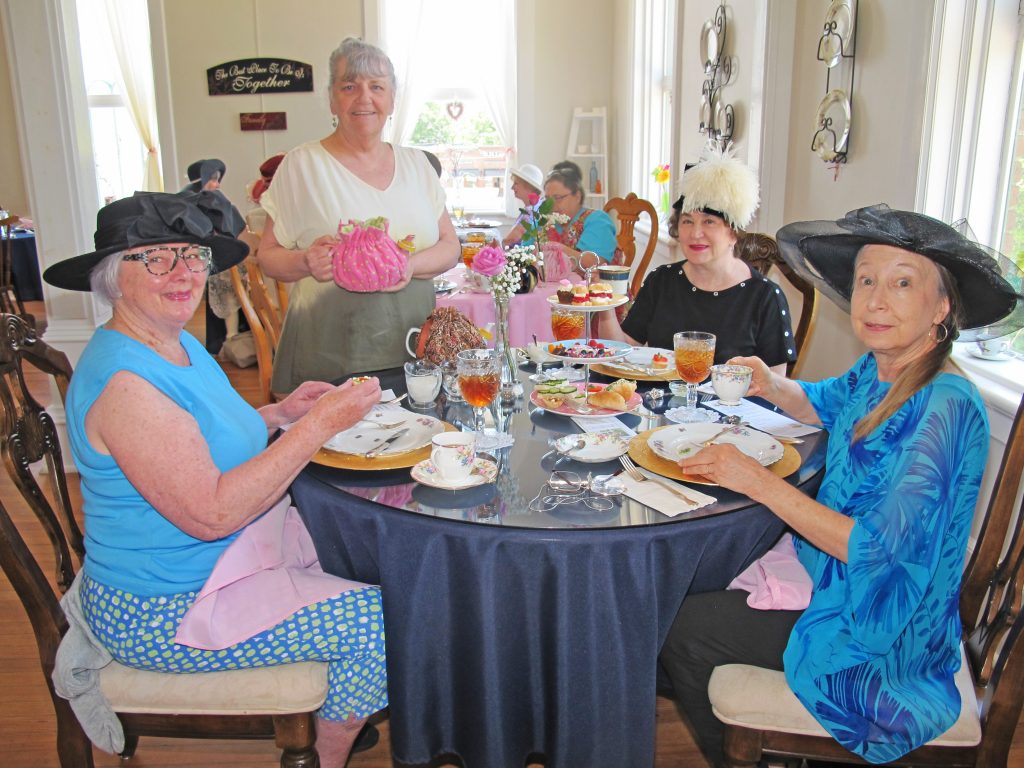
    Laura’s Tea Room’s proprietress, Carol Allen, standing, pampers her customers with fussy attention, delectable sweets and never-ending pots of tea. | Barbara Ball

    RIDGEWAY – The May 7 issue of USA Today, on newsstands Monday, featured Carol Allen’s Laura’s Tea Room in Ridgeway as one of ten tea rooms around the country that it considers perfect settings for Mother’s Day celebrations. Tea rooms in Pasadena, CA; New York City; Tampa, Florida and Salt Lake City, were among those included in the article.

    No sooner had the newspaper hit the streets on Monday, than customers and friends began calling and emailing Allen with the news. Allen said she was incredulous.

    “You saw it where?” she asked repeatedly.

    “I was shocked,’ she laughed. “But it’s been one thing after another ever since the story broke,” Allen said.

    “A British couple called saying they were vacationing in Atlanta and would be leaving for Florida that afternoon. They told Allen they had seen the story in USA Today made reservations for High Tea the next day. They arrived about 1:30 p.m. and we had a wonderful visit,” Allen said. “And they enjoyed High Tea.”

    “It’s been crazy ever since the story came out,” Allen said.

    Allen and her now 96-year-old mother, known as Gramma, started the tea room in the spring of 2008 in the former Thomas Company Mercantile Store built in 1911 at the corner of Palmer and Church Streets in downtown Ridgeway.  Laura Thomas was the last member of the Thomas family to run the mercantile before it closed in the mid 1990’s.

    “My mom, my daughter and I would visit tea rooms wherever we saw one,” Allen said.  “I had so many dishes in my house that I had to do something with them.  And I am certainly a tea drinker, so it all fell into place.

    “I was playing around with a number of names for the tea room while we were working to turn the mercantile into a restaurant.  We wanted to maintain the ambiance of this beautiful building.  Locals would stop by frequently and make the same statement over and over again – that Laura Thomas would have been so happy to see it as a tea room.  I finally decided to call it Laura’s Tea Room.”

    According to the article, Laura’s Tea Room offers customers a choice of over 150 tea cups, a large assortment of teas and as a colorful collection of hats in case a customer forgets to bring her own.

    Allen gives credit for the tea room’s success in large part to her staff who she considers extended family. “My staff really cares about their customer’s experience and it shows in everything they do,” Allen said.

    Laura’s Tea Room features high tea in an exquisite setting on the upper floor of the over 100-year-old building. Lunch is served in the downstairs Deli. A first floor gift shop offers eclectic choices related to dinning and many choices for tea. The gift shop has retained the original mercantile cabinetry, which is a walk back in time.

  • Lack of transparency still dogs JWC

    JENKINSVILLE – Transparency complaints continue to muddy the waters of the Jenkinsville Water Company.

    Continuing a dispute that arose during the JWC’s meeting in April, several members of the public contested a murky vote taken by the board last month.

    “When you vote on items, when you don’t tell us what it is, we as a member of the company have a right to know what those items are,” Donald Melton with the Broad River Campground, who is in litigation with the JWC, said during public comments Monday.

    Specifically, Melton took issue with a series of votes the JWC conducted during the April meeting.

    After a lengthy executive session, the board voted merely to accept “Item A,” “Item B” and “Item C” without specifying what those items involved.

    “The board cannot vote on just a name and a number. Will that be different tonight and here on out?” Melton asked.

    Board members remained mainly silent, responding only to say they couldn’t and wouldn’t respond to questions posed in public input.

    “We’re not going to go back and forth in meetings like that. We’ve told you that before,” Greg Ginyard, president of the JWC, stated.

    Melton took the entire three minutes allotted in public input, even though he spoke for roughly half that time.

    Ginyard did respond to Jeff Schaffer, another member of the public, who also criticized what he characterized as a lack of transparency.

    “Is it the new policy not to answer questions a member asks? Is there a policy for that?” Schaffer asked.

    “No sir, I’m giving you this because you haven’t been here in a while, but we’re not taking time to go back and forth between the board,” Ginyard said.

    Ginyard went on to say that numerous government bodies don’t respond to questions. He directed anyone desiring a response to submit written questions to the board.

    The Voice newspaper also addressed the board, cautioning members that JWC votes could be legally overturned when they’re conducted during meetings in which violations of the state’s Freedom of Information Act occur.

    In 1991, the S.C. Supreme Court upheld the invalidation of a Sumter County business license tax ordinance because the ordinance was passed following improper executive sessions, according to Supreme Court records.

    During an interview with The Voice following Monday’s meeting, Ginyard said he doesn’t think the water company is subject to FOIA.

    “We don’t feel that we are a governmental body,” he said.

    Ginyard didn’t respond to follow-up questions referencing a 2011 attorney general opinion classifying the JWC is a public body, and promptly left the building.

    That opinion stated the JWC was chartered in 1970 through a U.S. Department of Agriculture loan.

    The opinion also stated that through the years, the JWC has received government funding totaling at least $200,000 from the S.C. Budget and Control Board, as well as additional funding from Fairfield County Council.

    The council later threatened to cut off funding, citing transparency issues. Specifically, the county demanded copies of audits and federal tax records, the attorney general opinion stated.

    “Unfortunately, until you are able to provide the County with this information, the County will not be able to consider any funding requests from your organization; will discontinue and County funding to your organization; plus, will not be able to act as a pass-through for you on any grants or loans from any other governmental or charitable organizations,” the county stated in a letter cited in the attorney general opinion.

    Jay Bender, an attorney for the S.C. Press Association and expert on the FOIA, agreed with the attorney general’s opinion.

    “This organization (JWC) does not understand it is a public body and it is obligated to follow the law,” Bender said. “If it wants to act privately, what it does is give the money back. Don’t take public money if you want to act like a private corporation.”