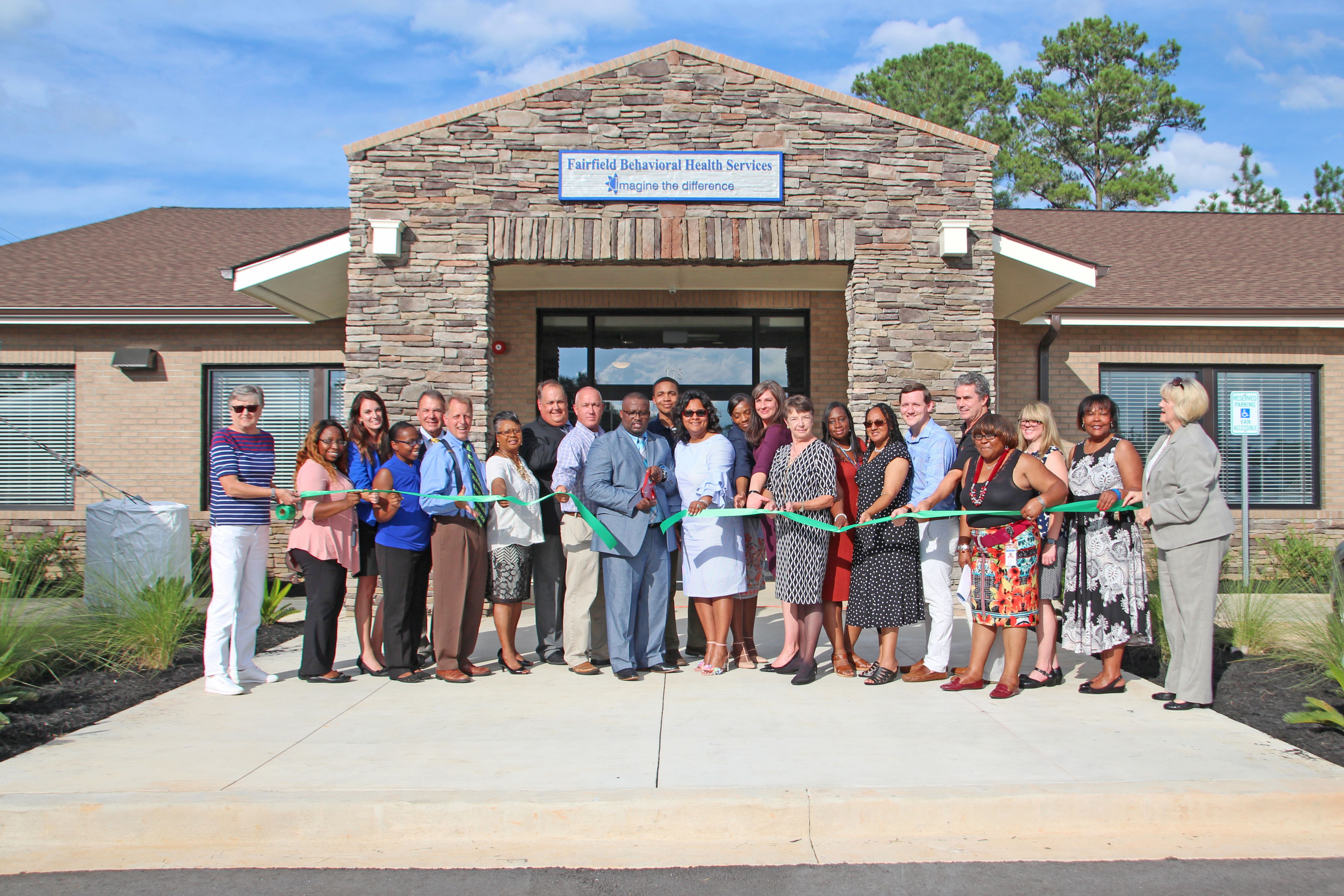
WINNSBORO – A grand opening was held on Friday, Aug. 17 for the new Fairfield Behavioral Health Services facility at 178 Highway 321 Bypass N. in Winnsboro.
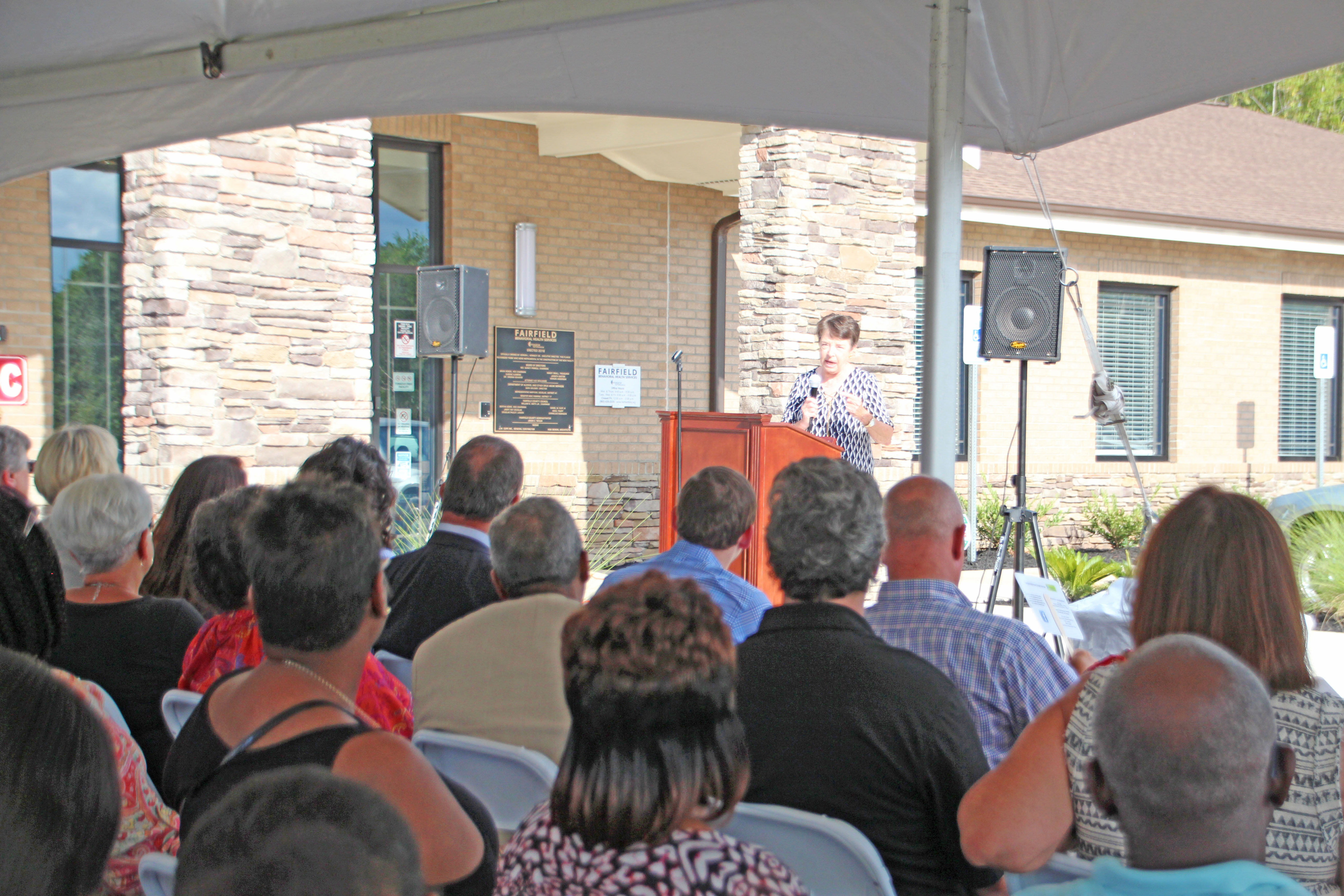
The event was hosted by the BHS Director Vernon Kennedy, Sr., and included tours of the facility, refreshments a ribbon cutting and comments from Sen. Mike Fanning, Rep. MaryGail Douglas and County Council Chairman Billy Smith. Kennedy told those who attended that the new facility would enhance the department’s service to the community.
Rep. MaryGail Douglas talked about the importance of having good behavioral health services in the community.
A new hotel brings site plans to Blythewood Planning commission.
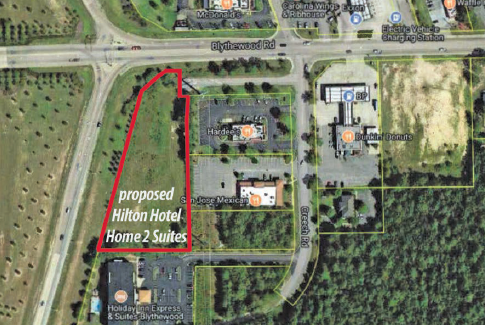
BLYTHEWOOD – Hilton Hotel’s Home 2 Suites is considering putting down roots in Blythewood. The hotel’s owners are seeking permission from the Town to build a four-story, 88-bed hotel building on a 1.93 acre vacant lot adjacent to the I-77 ramp. But without considerable adjustments to the entrance to the property, the 55,672 square foot building would have no direct access to Creech Road.
The parcel is tucked between I-77, the Holiday Inn Express & Suite, Hardees and San Jose’s Mexican restaurant. A site map shows access to the parcel off Creech Road across from the west side of the Sharpe BP Service Station.
But that access doesn’t meet SCDOT standards.
Civil Engineer Jeff Carter, of Georgia-based Carter Engineering Consultants, presented Paragon Hotels’ plans to the Blythewood Planning Commission Monday night.
Consensus of the Commission members was that it is a good project for Blythewood but the access is problematic.
Commission Chair Donald Brock addressed the lack of a traffic study and said traffic access to the site presents problems.
“Ingress and egress to the site is a problem,” he said. “I see that the right-in and right-out onto Creech Road is going to send everyone down a dead end street. What are drivers supposed to do when they get there and have no place to go?” Brock asked.
Town Administrator Brian Cook said staff has been working with SCDOT on this issue, and that SCDOT has conditionally granted access to the site using SCDOT’s right-of-way.
“The existing service road would have to be removed and replaced to enable two-way traffic,” Cook told the commissioners. “The access road would need to be a minimum of 24’ wide with an appropriately designed connection to Creech Road so as not to negatively impact Creech Road or Blythewood Road which is directly adjacent,” Cook said.
Cook said the design would need to include proper radii and an approximate median enforcement to satisfy the SCDOT requirement that this access be a right-in, right-out due to the proximity to Blythewood Road.
Carter expressed his concern that even after doing a traffic study the options would still be very limited and driven by what SCDOT would allow. He said he felt that the developer would agree to installing a turnaround at the end of Creech Road where it dead ends.
Councilman Rick McKenrick asked Carter whether the hotel owners were considering buying additional lots around the site to improve the traffic pattern. Carter said he felt they are still considering that possibility.
Councilman Marcus Taylor cited the extreme traffic problems that already exist on Blythewood Road during high traffic times and said this would significantly add to the problem.
After lengthy debate and persistent admonition by Brock that even conditional approval would not be the best way to proceed, a motion was made to defer the agenda item until the Sept. 4 Planning Commission meeting. The motion was seconded and all council members voted in favor of deferral.
Cook told the commissioners that he would continue to work with SCDOT and the engineers to address the traffic pattern concerns.
Blythewood Consultant Michael Criss announced that his services to the Town would end on Aug. 31, 2018 and expressed that he had enjoyed working with the Commission members.
BLYTHEWOOD – It has been rumored for over a year that a Taco Bell might be coming to Blythewood. A public hearing on Monday, Aug. 13, will confirm that rumor.
An application for the hearing before the town’s Board of Zoning Appeals (BZA) requests a variance to permit a reduction in the width of the buffer transition yards between adjoining commercially zoned lots at 209 Blythewood Road (Richland County TMS# R1-5112-03-01) so that a Taco Bell restaurant with a drive-thru can be built on that lot.
The permit comes to the BZA after being denied by the town’s zoning official on the grounds that the proposal would be in violation of the town’s zoning ordinance 155.384 (B) (2).
Town Council amended the town’s zoning ordinance last year to allow fast food restaurants to have drive-thru service on the front side of the buildings located along Blythewood Road between Main Street and I-77.
For the BZA to grant the variance for the proposed Taco Bell property, the board must find that the ordinance will result in an unnecessary hardship on Taco Bell. The standards for granting a variance, as set by state law, and the ordinance must meet five facts of finding.
Before the variance application can be heard by the BZA, a quazi-judicial board, all surrounding property owners must be notified by the Town and a public hearing is required.
Public testimony regarding the variance application will be held at The Manor, at 6 p.m., Aug. 13.
A public notice of the meeting states that texts and documents related to this variance application are available for public inspection in the office of the Town Clerk at Blythewood Town Hall, 171 Langford Road, Blythewood, South Carolina, during regular working hours, and also will be available at the public hearing.
BLYTHEWOOD – Further delays are expected in the closing of the Town of Blythewood’s contract for the purchase of the Doko Depot facility.
Possible defects in title in some of the underlying land have been revealed and the Town is in the process of remedying those issues. A portion of the land under contract was originally conveyed to the Blythewood Volunteer Fire Department by Charles W. Proctor in 1971. In his deed, Proctor reserved a reversion of title if the property ceased to be used for fire department or other community uses. The same parcel was conveyed to the Town after the volunteer service was discontinued but subject to the reservation by Proctor. Proctor passed away in 1976 leaving no children. His wife died shortly thereafter.
The sale of the former Proctor land for uses unrelated to fire or other community use might cause a reversion in title. Town attorneys are working to find a solution.
Smith: It’s crazy… a 25% tariff on the only TV assembler in the United States. County pressing for tariff exemption
First layoffs for Element Electronics will be Oct. 5. | Callie Sims
WINNSBORO – Just months after Element Electronics sought the county government’s help to begin looking to expand its footprint and potentially increase employment and tax revenue in the county, the company announced this week that it will be closing.
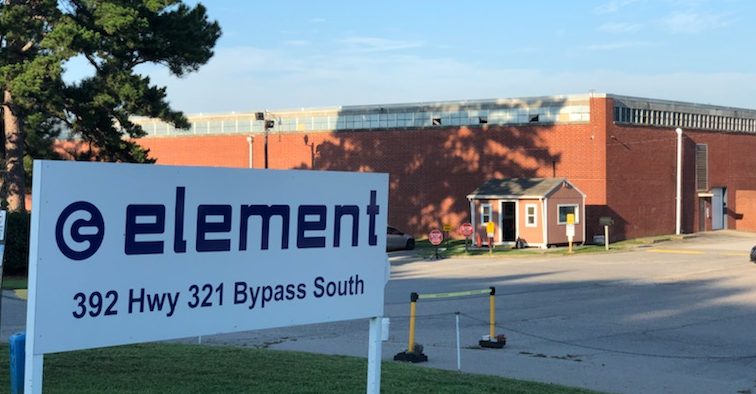
In a letter issued to employees on Monday, Element’s Vice President of Human Resources, Carl Kennedy, announced that the company would be laying off most of its employees and closing its facility located at 392 Hwy 321 South in Winnsboro.
“We hope the closure will be temporary and that we will be able to re-open in three to six months,” Kennedy said in the letter. “But we cannot predict this with any certainty at this time.”
Kennedy said the closing would begin on Oct. 5, when most of the plant’s 134 permanent, full time employees will be laid off. Smaller groups of employees will be separated on a rolling basis from then until the end of the year, Kennedy said. A skeleton crew of approximately eight employees will remain at the facility, according to Kennedy.
In a separate letter to employees, Mike O’Shaughnessy, Manager of Element, put a finer point on the situation.
“Our closure is entirely due to ongoing and increasingly difficult tariff related matters,” O’Shaughnessy wrote. “Element, the only U.S. based television assembler, will soon be subject to duties on our parts far in excess of those of any foreign importer.”
O’Shaughnessy said the tariffs would make it impossible for Element to continue its U.S. production. He said the duty inversions would cause Element’s factory to pay more in duty on its parts than foreign companies would pay on TVs built and exported from Mexico into the United States.
Fairfield County Council Chairman Billy Smith said officials in the county and Winnsboro were contacted on Tuesday by several national news outlets about the closure. Smith spoke with CNBC Tuesday afternoon. He said he took that opportunity to press for the components imported for Element to be exempt from the tariff.
“Our goal at this point,” Smith said, “is to bring attention, from the state and local level, to hopefully get the parts used by Element exempted from the tariff. It’s crazy that, first, a new 10 percent tariff and now the threat of a 25 percent tariff is effecting the only television assembler in the United States, while companies that build and import complete televisions from Mexico and other countries are facing zero increase in tariffs,” Smith said. “These companies contribute nothing to employment in the United States. Element has 134 employees and wants to expand.”
“This is especially hard to swallow when, just a few months ago we [the county] were assisting Element in finding a suitable building to expand its footprint and potentially grow its employee base more than two-fold. That was after the Administration signaled the new tariffs were going to be placed on fully assembled televisions being imported, which would have given Element a leg up on the foreign competition. That isn’t what happened though,” Smith said. “Now this.”
On July 10, the Trump administration announced a new 10 percent tariff on $200 billion of goods produced in China. Those goods, O’Shaughnessy wrote in a letter to employees, included the LCD panels and motherboards that Element uses.
Then, last week, the administration announced that it plans to raise that tariff to 25 percent.
“No tariffs were placed on fully assembled TVs arriving in the US from China or Mexico,” O’Shaunessy said. “This contrast makes it impossible to sustain our U.S. production operations.”
O’Shaughnessy said, however, that Element’s management had not given up the battle to get back the company’s ability to produce Element TVs in the United States.
It was in August, 2013 that Element Electronics, a Minnesota based company, announced its plans to relocate manufacturing operations from China back to the United States, tapping the former Perry Ellis Menswear building in Winnsboro as their new home.
Vlad Kazhdan, vice president of product for Element, said during the announcement that expected the new venture to create 500 new full-time jobs over the next five years. Purchase and Lease
As part of the agreement, Fairfield County purchased the Perry Ellis building from a Perry Ellis subsidiary for $2 million in a deal that closed on Oct. 14, 2013. But the County only ponied up $600,000 for the property, while the Department of Commerce, through an economic development grant, put up $1.25 million. Element, meanwhile, kicked in the remaining $150,000 for the purchase. An additional $50,000 in DOC grant money went toward the cost of upfitting the building, transforming it from a clothing manufacturing center into a high-tech electronics plant. Fairfield Electric Cooperative and SCANA offered to reimburse Element $100,000 each for upfit costs.
Element leased the property from the County for $1 a year for 30 years with the option to purchase the property for $1 if, by Dec. 31, 2018, it had created at least 500 new, full-time jobs and had invested at least $7.5 million in taxable property; or, if by the same date, Element had created at least 350 jobs, invested at least $5.25 million, repaid a pro rata amount of the grant money and paid to Fairfield County an additional amount based on the following formula:
400-499 jobs by Dec. 31, 2018 = $120,000;
350-399 jobs by Dec. 31, 2018 = $200,000.
Payments were due to the County by June 1, 2019. Element could also continue to lease the property for $1 a year for an additional five years, but must have created at least 250 new, full-time jobs, invested at least $2.5 million by Dec. 31, 2018, and paid to the County $600,000, plus the pro rata grant amount. Failing to have met those conditions, Element could then lease the property at market value, but still must repay the County’s $600,000 investment. Fee in Lieu of Taxes
Manufacturing property in South Carolina is taxed at 10.5 percent, while commercial and other property is taxed at 6 percent. To level the playing field and help attract industry, Tiffany Harrison, Director of Fairfield Economic Development at the time said, local governments often offer as an incentive fees equivalent to the 6 percent rate that companies may pay instead of taxes. Such an agreement is known as a Fee in Lieu of Taxes, or FILOT. Perry Ellis, however, had no such agreement and their property at 392 Highway 321 Bypass N. was listed on the tax rolls. And once a property is on the books, Harrison said, it cannot be removed. Element, therefore, did not qualify for a FILOT on the property itself, but instead was offered by the County an annual tax credit of 42.8 percent for 30 years to bring their contributions to Fairfield County coffers down to the 6 percent level. Like the lease agreement, that tax credit was contingent upon Element creating at least 500 new, full-time jobs and investing at least $7.5 million over the next five years. Otherwise, the credit decreases by the following formula:
• If, by Dec. 31, 2018, Element has created less than 500 jobs, but at least 400 and invested less than $7.5 million, but at least $6 million, tax credit = 33 percent;
• Less than 400 jobs, but at least 350 and an investment of less than $6 million but more than $5.25 million, credit = 23 percent;
• If, by Dec. 31, 2018, Element has failed to create at least 350 new, full-time jobs and has invested less than $5.25 million, the credit agreement terminates and all property taxes shall be paid retroactively.
Although the building does not qualify for a FILOT, equipment does, Harrison said, and for their equipment Element will pay a FILOT equivalent to the 6 percent property tax rate for 30 years, provided Element has met the 500 job and $7.5 million investment threshold. Otherwise:
• Less than 500 jobs, but more than 400 and less than $7.5 million, but at least $6 million = 7 percent;
• Less than 400 jobs, but at least 350 and less than $6 million but more than $5.25 million = 8 percent.
• If, by Dec. 31, 2018, Element has failed to create at least 350 new, full-time jobs and has invested less than $5.25 million, the FILOT terminates.
Typical jobs at Element will pay about $12.50 an hour, on average, Harrison said. Element plans to create 250 jobs in the initial phase of start-up. An additional 250 jobs will be added over the course of five years. Element is a main supplier of electronics to Wal-Mart, as well as Target and QVC.
WINNSBORO – Economic development discussions led a busy night at Monday’s Fairfield County Council meeting.
Council members voted to accept a $2 million grant for infrastructure improvements to the county’s megasite at I-77 and S.C. 34, as well as a series of ordinances that expand the boundaries of a regional industrial park.
Council members voted unanimously in favor of the measures.
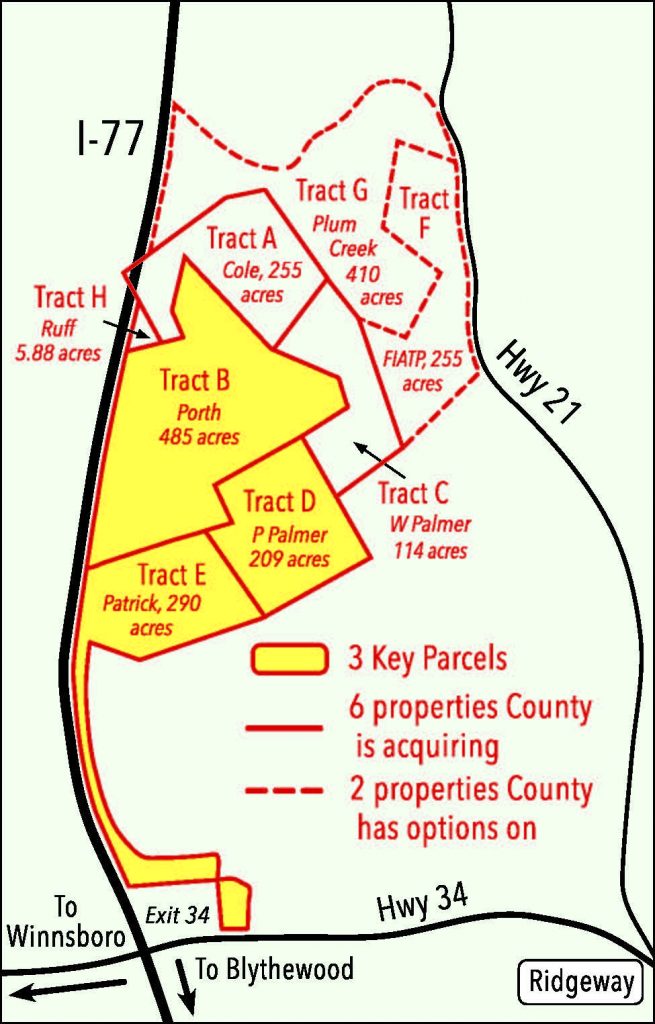
Awarded by the S.C. Department of Commerce, funds from the $2 million grant will subsidize the installation of infrastructure at the megasite, an approximately 1,000-acre site the county purchased with help from the state in 2016.
Megasite on Highway 34 and I-77
The $2 million grant is through the Department of Commerce’s LocateSC program. LocateSC is on online tool that showcases prospective industrial sites, according to the commerce department’s website.
County Administrator Jason Taylor said the county has been working closely with the Department of Commerce on the megasite. He noted the county pitched in with $3 million and the state spent about $6 million to buy the mega site property.
Getting infrastructure in place is critical to drawing large industries, such as auto manufacturers, Taylor said.
“Without infrastructure, we just have a piece of raw land,” Taylor said. “This is the first step to make this a true industrial site that would attract an industry to Fairfield County.”
Ridge Fletcher with the South Carolina I-77 Alliance com mended the county for its commitment to the megasite.
“That site, while owned by Fairfield County, has the potential to benefit the entire I-77 corridor when you land the right industry,” Fletcher said. “We’re really excited about that. We’re hopeful it’ll give a good portrait of the Fairfield County megasite. It is a regional asset.”
Fletcher added that the alliance soon plans to unveil a promotional video and website that targets Fairfield County, and the megasite, in particular.
“We’ve spent upwards of six figures on this on behalf of Fairfield County and the region,” he said.
Council Chairman Billy Smith asked about the potential impact of a possible trade war triggered by newly imposed tariffs might have on luring economic development prospects.
“Is there anything you’re doing to make sure the impact on companies along the [I-77] corridor is mitigated and backup plan on where to go to next?” Smith asked.
Fletcher responded by saying it wouldn’t have much impact on domestic companies and international companies looking to establish a footprint in South Carolina. The main impact, he said, is on international companies looking to export to the U.S.
“We don’t deal with the existing business side,” Fletcher said. “With us marketing toward the domestic side, it helps balance the fear sometimes. A lot of people are fearful about what the tariffs will do. In the international marketplace, fewer companies are thinking about coming to the U.S. to export.”
Ridgeway resident Randy Bright, a frequent speaker at council meetings, said during the public comments section that he’s also impressed by the county’s commitment of infrastructure improvements.
But he also noted the county needs a long-term plan to land permanent industry.
“Residential builders won’t come here without water and sewer,” Bright said. “With industry it’s the same thing.”
Another speaker, though, was critical of economic development efforts.
Jackie Workman of Blair said she’s concerned about high unemployment and job losses associated with reactor projects shutting down at the VC Summer Nuclear Plant.
Workman also questioned salaries paid in the county economic development office versus jobs created.
In related business, council members approved third reading of an ordinance that expands the I-77 Corridor Regional Industrial Park by 10.31 acres. The properties are located in the 1000 and 1100 blocks of Shop Road, according to council documents.
Council members also approved second reading of a second ordinance to add another 5.8 acres at 3800 West Ave. in Columbia, documents state.
The companion ordinances were similar to measures already passed by Richland County Council.
A third ordinance relating to the I-77 industrial corridor authorized the execution of the amended and restated master agreement, which involves the corridor.
Keith Loner of Blythewood and his daughter, Ashley York, take time out from shopping a previous Big Grab in downtown Blythewood to rest on a sale couch set along Highway 21. | Barbara Ball
BLYTHEWOOD – When two separate applicants appeared before the Town government’s Accommodation Tax (A-Tax) committee last week to vie for $10,000 the town council has allocated for someone to manage this year’s Big Grab yard sale, the tense, hour-long meeting erupted into a shouting match between the two applicants and their supporters until frustrated committee member Ken Shettles called a halt to the ruckus with a motion to recommend that council reduce its allocation for the event to $5,000 and also make the decision as to which group will be awarded the money.
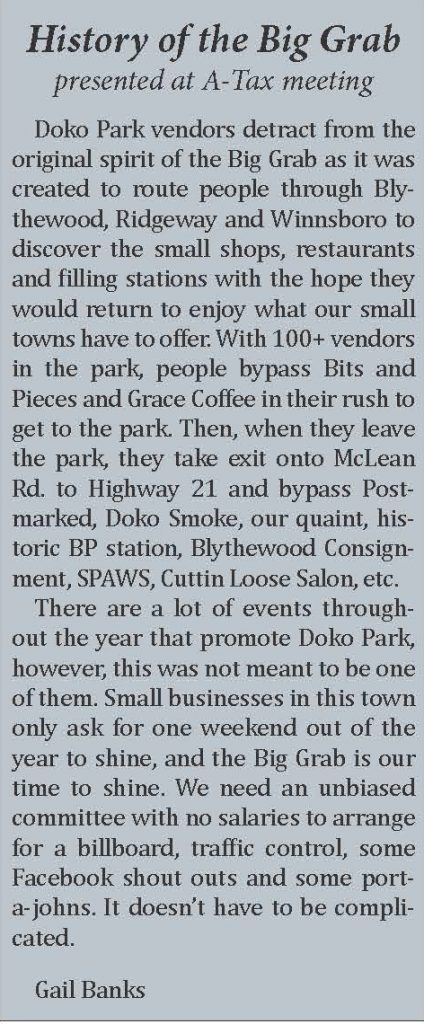
History of the Big Grab, presented at A-Tax meeting
The two applicants, Mike Switzer, Executive Director of the Greater Blythewood Chamber of Commerce and Theresa McKendrick, owner of Postmarked 29016, a gift shop on McNulty Road, each made a case as to why he/she should be awarded the $10,000.
One committee member described the tug of war as a battle for the money.
“Oh, no,” Switzer said. “It’s not a battle at all. We’re totally fine if this group of volunteers would like to take it over.”
“So you’re withdrawing? Is that what you’re saying?” Shettles asked.
“No, that’s up to the committee,” Switzer said, but reminded the committee that this would be the chamber’s third year to oversee the Big Grab if awarded the money.
According to the chamber’s records, it made a profit from last year’s Big Grab, but how much is not clear. The Chamber did not turned over to the A-Tax committee a detailed listing of vendor fees and sponsorship sales for last year’s Big Grab, just a total number for each. One report showed a total Big Grab profit of $1,432.77, while other numbers indicated a possible profit of as much as $6,144.88.
The A-tax applications submitted by Switzer and McKendrick were similar.
Switzer’s application called for Big Grab to continue as a megasite in Doko Park as it did last year under the chamber’s direction. He listed project costs for the September, 2018 event at $10,000 but the revenue and expenses sections of the application each add up to $14,500, not $10,000.
Total revenue sources include $10,000 (A-tax funds), $3000 (sponsorships) and $1,500 (food and vendor sales). A proposed total of $14,500 in expenditures includes $2,240 (park rental for 28 hours), $2,560 (Sheriff’s Deputies), $800 (portable restrooms and trash bins) $500 (misc. supplies), $400 (ROTC), $5,000 (payments to chamber and visitor center staff) and $3,000 (advertising/marketing).
While McKendrick likened the Chamber’s Big Grab in the park to a flea market atmosphere, she, too, proposed locating vendors in the park but also in the town center.
McKendrick’s revenue sources mirrored Switzer’s at $14,500, but her proposed expenditures of $15,000 included up to $3,000 (park rental), up to $4,000 (municipal and county resources), up to $4,000 (administrative/event planner) and $4000 (marketing/promotions).
McKendrick justified payments of up to $4,000 for her staff as covering an event planner and “other support staff. If we have to hire day-of-event staff, then we would have that money available. We hope to hire a social media person and may have to pay to play if we hire social media influencers. We would pay them to post,” she explained.
While McKendrick said she was speaking on behalf of the owners of the town’s consignment stores, Bits and Pieces and Blythewood Consignment, neither of the stores’ owners were happy with Switzer’s or McKendrick’s proposals.
“Let’s start from the beginning,” Liz Humphries, owner of Blythewood Consignment said. “This is about a big yard sale, a glorified selling of junk. I don’t think we need to spend all this money. I think we all need to get together and volunteer for our community.”
Joe Benini, co-owner of Bits and Pieces agreed.
“The first Big Grab was awesome and easy,” Benini said. “Then the chamber took over and the next thing I know, it’s now a $15,000 budget, for what? My wife and I had to pay $50 just to be a sponsor. I paid for all my stuff, posters, etc. and posted the map that was in The Voice on our door,” he said.
“Let the local people make the money,” Humphries said. “The Big Grab started as a way to get people in to our brick and mortar [stores]. The park has nothing to do with my store except that it’s a huge competition. My sales dropped in half last year because everyone was at the park. I’m just here to protect my business,” Humphries said. “I’m all about people selling their junk. But I don’t think people should get paid to do this. If you love Blythewood, you need to volunteer and not expect to get paid.”
Susan DeMarco, who owns Sweet Pea’s Ice Cream Parlor, is a member of the Chamber and sits on the A-tax committee, agreed.
“We can tag each other on Facebook and say, ‘We’re all merchants in Blythewood and we’re all excited about the Big Grab.’ It’s going to happen no matter what we decide today. It’s on. It’s on. What you put in to it is what you get out of it,” DeMarco said. “If we spend a bunch of money, we aren’t changing the Big Grab. All we’re doing is having a power struggle between two parties.”
“We thought we were doing a good job,” Switzer said, defending the chamber’s management of the Big Grab. “We reached out to all the merchants. We thought we were working out solutions to try to help them because we’re all about businesses succeeding and thriving in this community. As for as being paid to run the event, we cover that cost with sponsorships and vendor fees.”
“But you’re still holding it in the park,” said Gail Banks, a vendor at Blythewood Consignment. ”You’re not getting it.”
“And last year the park looked like a disaster relief area,” committee member Kris White said.
“No matter what we do today, we aren’t going to come to a conclusion,” Shettles said. “Our committee only makes recommendations to council, and these arguments need to be in front of council. We could go on here for hours.”
With Shettle’s motion on the table, DeMarco offered a second motion recommending that no organizer would get any money for the event, but that the town would foot the bills for hard expenses like sheriff’s deputies, trash receptacles, portable restrooms, etc.
“People have to stop asking the merchants for sponsorships,” DeMarco said. “I don’t want to give A-tax money to someone to run the event and who then comes to ask me for more money to sponsor it.”
The committee voted 3-0, with DeMarco abstaining, to pass Shettle’s motion.
The Big Grab 50-mile community yard sale is set for Friday and Saturday, September 7 and 8, and will include Blythewood, Ridgeway and Winnsboro.
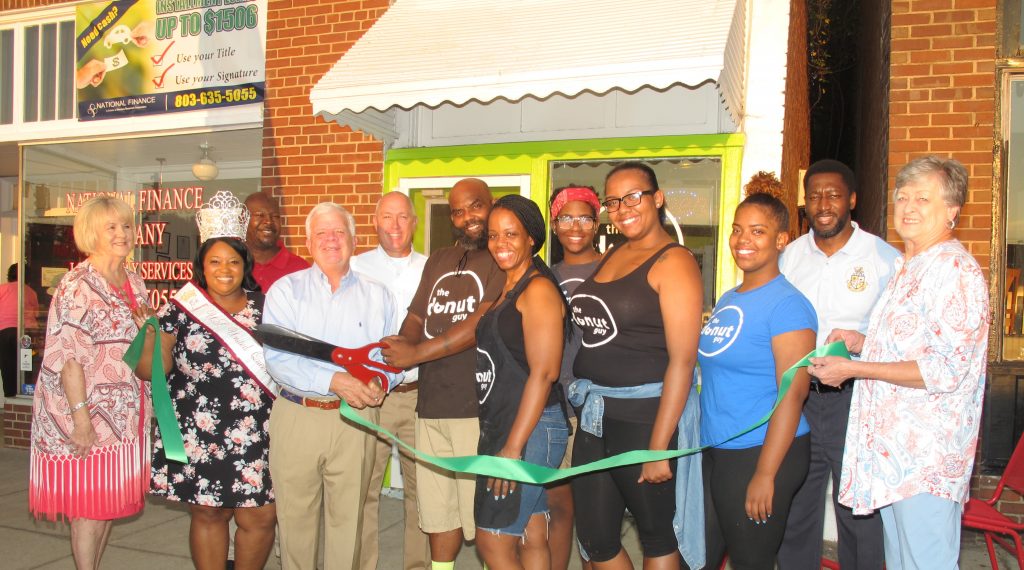
WINNSBORO – The Donut Guy owners, Shaun and Crystal Paulk, held a grand ropening Monday morning for their donut shop, located at 149 S. Congress Street. The Fairfield Chamber of Commerce celebrated the occasion with a ribbon cutting. The shop opened in January, 2017, but the Paulks say they have just now settled into regular hours and are open six days a week: Tuesday, Wednesday and Saturday, 7-4; Thursday and Friday, 7-7 and Sunday, 12-5.
Besides donuts and other sweet treats, they offer off-site catering, breakfast and a food truck for special events. Mayor Roger Gaddy and the Paulks, center, snip the ribbon assisted by, from left, Terry Vickers, chamber president; Shameika Sims, Darryel Davis, Gaddy, Douglas Pauley, the Paulks and their three daughters, Shauntae, Genesis and Imani; Dr. J. R. Green and chamber secretary Susan Yenner.
Crickentree residents fear plan to replace entire golf course with 450 homes
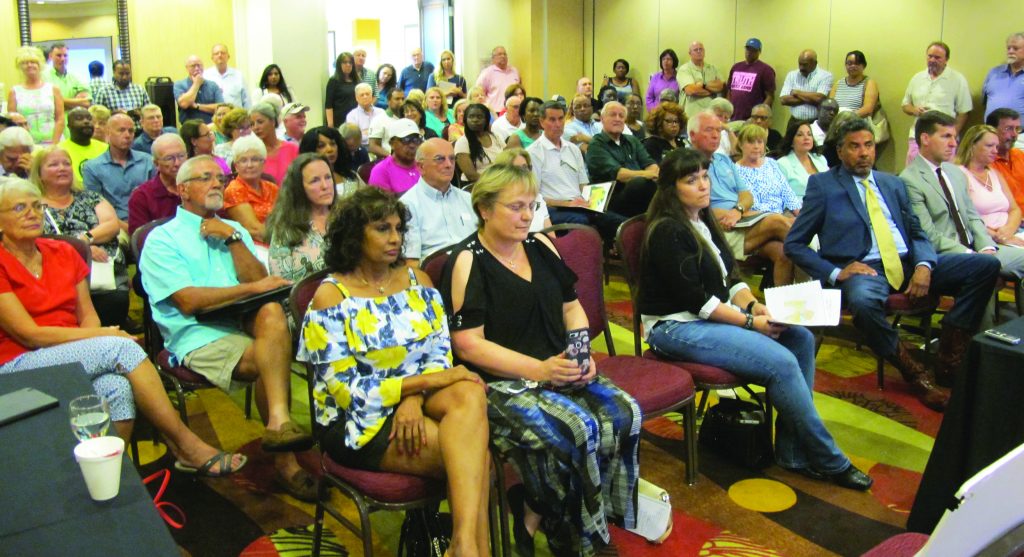
Crickentree residents heard E-Capitol’s presentation on Monday. | Barbara Ball
BLYTHEWOOD – After years of struggling financially, the Golf Club of South Carolina closed last week. The Club is entered off Langford Road and much of the golf course borders the Crickentree subdivision, which is accessed off Kelly Mill Road. One side of the golf course is the back yard to many of the 145 expensive, uniquely-designed Crickentree homes that boast large lots, some up to two acres in size.
A Texas investment company, E-Capitol, which holds the note and mortgage on the golf course property, initiated foreclosure proceedings on the course in March. Once the foreclosure is complete, E-Capital expects to purchase the course and build about 450 homes on it.
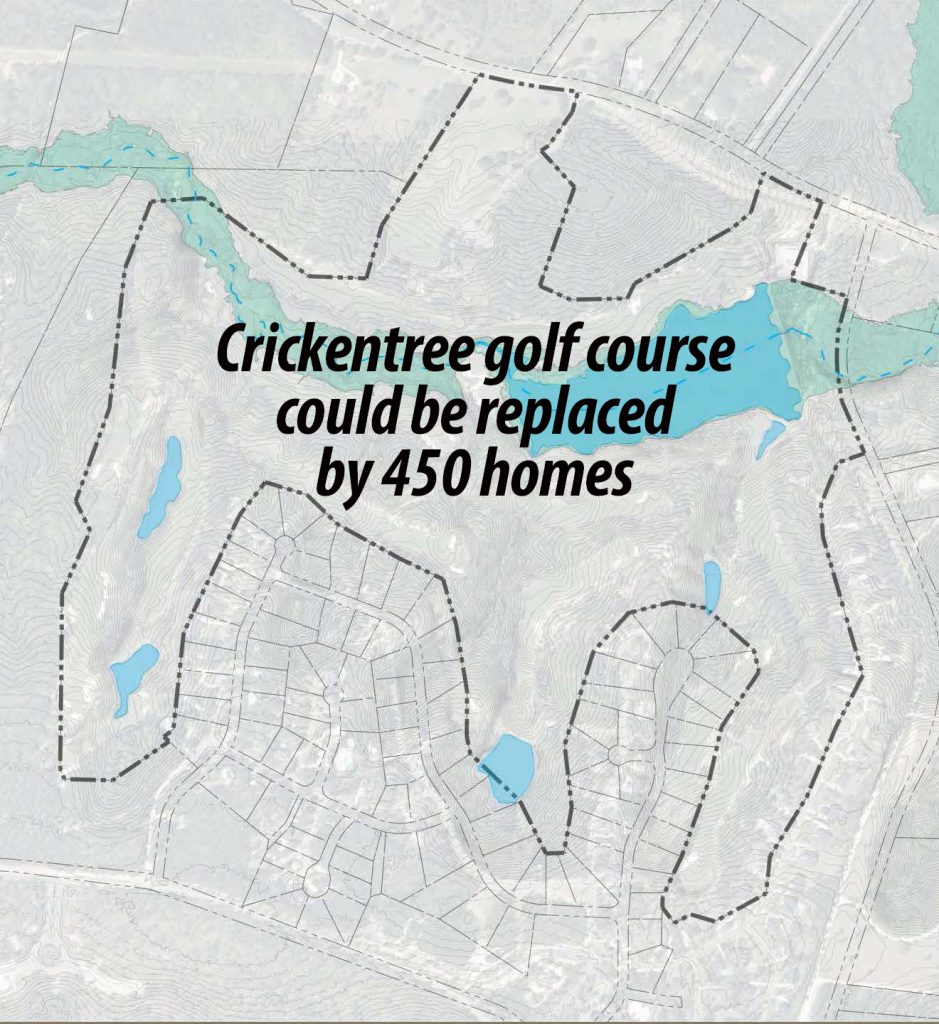
450 homes could replace Crickentree Golf Course.
This is not sitting well with the 75 or so Crickentree residents who showed up at the Hilton Garden Inn on Farrow Road Monday night to hear E-Capitol’s attorney Jake Barker, with Gaybill, Lansche and Vinzanti, explain his client’s plans for the golf course
property if they, indeed, become the purchasers.
“Once my client owns the property, they will pivot from the foreclosure process to the development process,” Barker said. “They will sell the property to a developer who will then develop it.”
But Barker was careful to explain that the golf course will be developed as residential property, not a golf course. To make that transition would require a rezoning from the current TROS (Traditional Recreational Open Space) zoning classification to a residential zoning classification.
That rezoning is where the residents feel they have a foothold to stop the development of hundreds of homes on small lots in their backyards.
The TROS zoning classification dates back to 2007 when the planning commission added a zoning classification to the Richland County land use plan to protect golf course communities throughout Richland County from becoming the victims of rampant residential development.
The question is, now, will county council vote to change the zoning to protect E-Capitol’s investment and satisfy the developer or keep the current zoning in place to protect the Crickentree property owners’ investments and quality of life they say they moved there for.
“Before the rezoning process begins,” Barker told the homeowners gathered at the Hilton Garden Inn, “we want to get feedback from the Crickentree neighborhood as to what you would like to see. The golf course was not meeting its obligations and could not continue on,” Barker said. “I understand none of this is ideal for you, but we want to have a discussion with you. We want to work with you.” Barker said.
The course, outlined in black, is partially bordered by Crickentree subdivision.
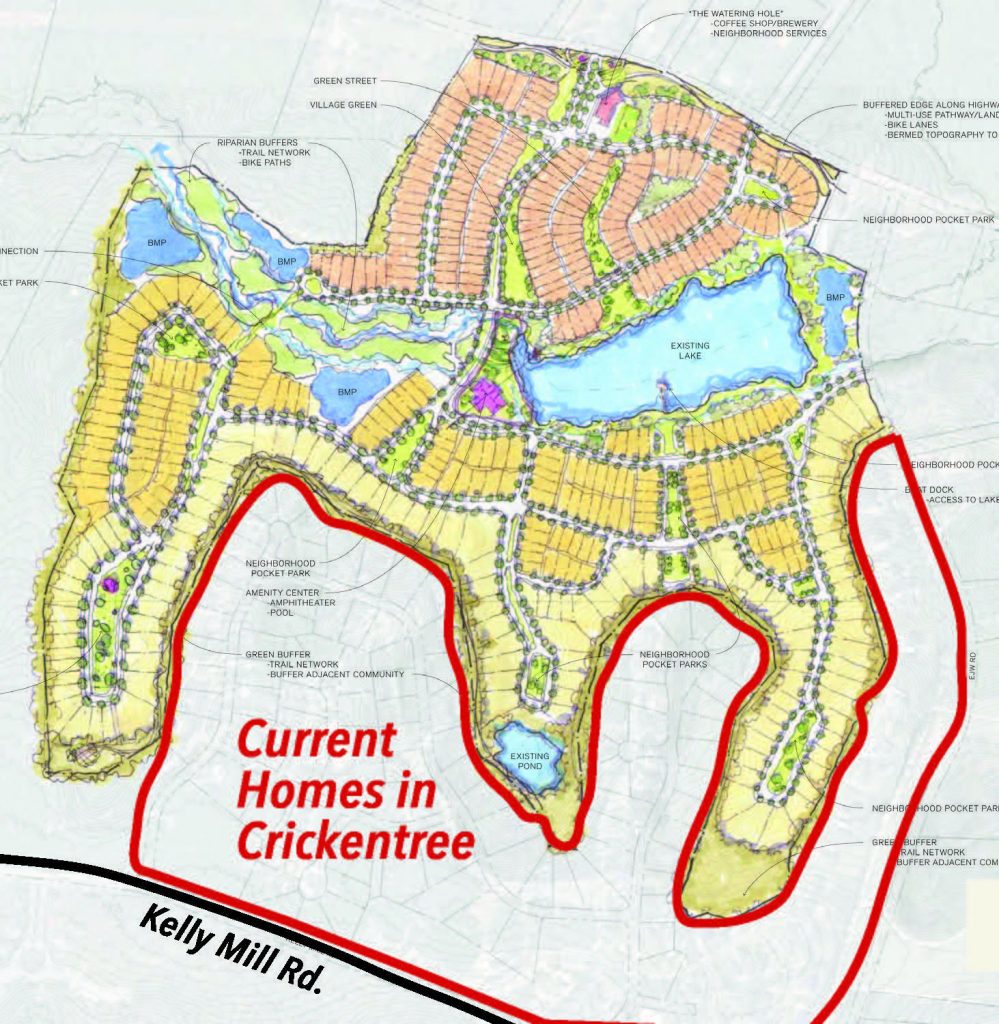
While the anxious crowd of homeowners vowed to fight any rezoning effort that would result in smaller lots and a crowding of hundreds of homes onto the golf course, as the hour-long meeting continued, Barker suggested the possibility of building fewer homes on larger lots with a buffer as wide as 100 feet separating the golf course homes from the current homes.
“That’s all possible,” Barker said. “These drawings are our initial, conceptual plans to develop it. We want feedback. We want to hear from you,” Barker insisted.
Asked about the pricing and size of the homes that would be built on the golf course, an engineer representing E-Capitol’s interest said he didn’t know. He said that would be determined by the eventual developer.
Barker said there is no timetable for the actual foreclosure and purchase of the golf course, but that it would take place in Richland County circuit court, and had been referred to Judge Strickland, the master of equity for Richland County.
“Once the foreclosure process is finished,” Barker said, “the property will be sold at auction, and any third parties can come and bid at that sale.”
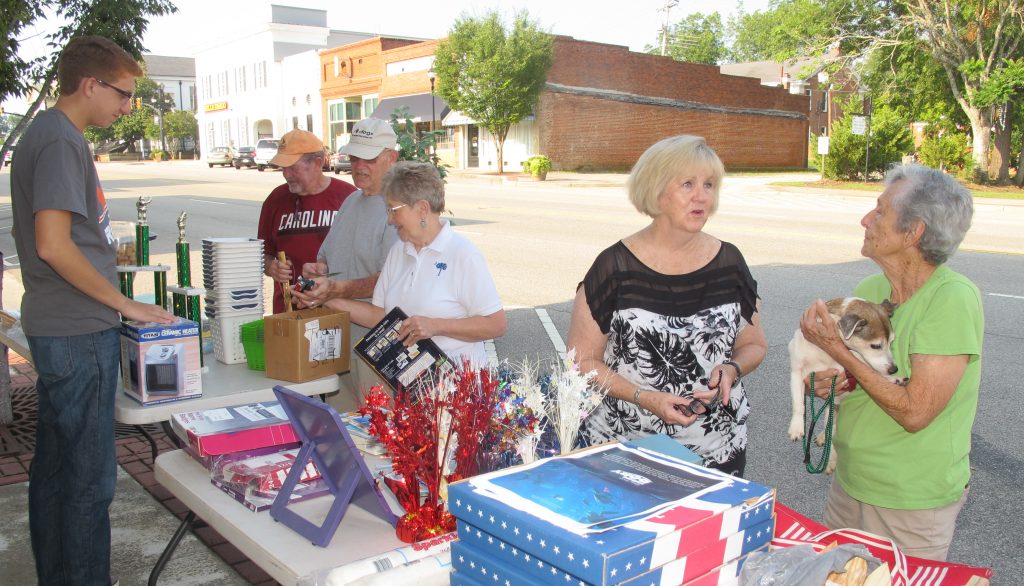
WINNSBORO – The Fairfield County Chamber of Commerce held a moving sale last Saturday in preparation of their move back to the Town Clock this week. Dillon Pullen, left, helped shoppers Tommy Richardson and Robert and Bobbie Pemberton while Betty Gutschlag, right, visited with Chamber Director Terrie Vickers. Following Saturday’s sale, the Chamber relocated to the Town Clock on Wednesday.