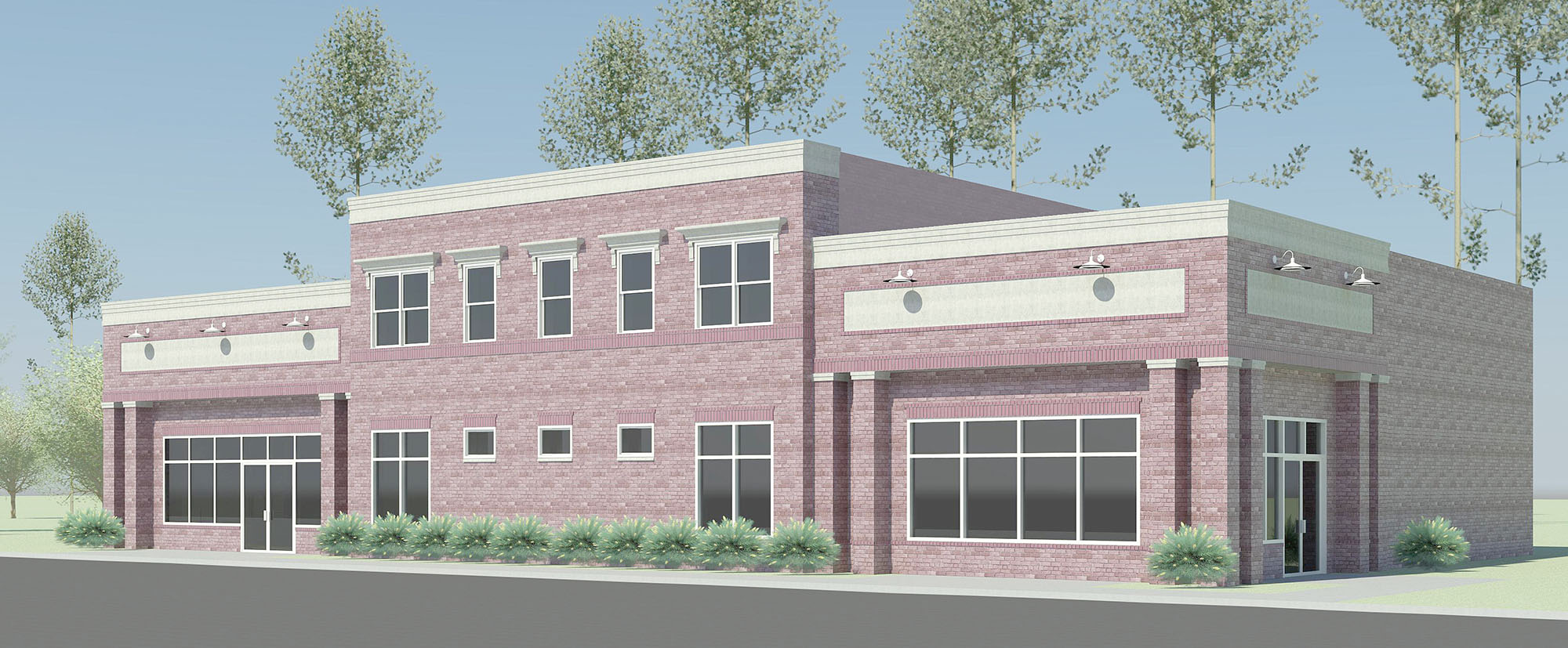
An architect’s rendition of a proposed new medical office at 121 Blythewood Road.
BLYTHEWOOD – The Town’s Architectural Consultant, Matt Davis, stepped out of that role on Monday evening during the Board of Architectural Review meeting to represent the applicants for a medical office to be located at 121 Blythewood Road, across from Companion Animal Hospital.
Designed to be shared by two private medical practices, a pediatrician and an ophthalmologist, the 7,085-square-foot building is a combination of a two-story center section with one-story wings.
Because the Town Center zoning ordinance requires all new commercial buildings to have multiple stories, the BAR voted to give the applicants a variance for the two one-story wings. And because the Department of Motor Vehicles requires that driveways (entrance/exits) must align with driveways across the street, the Board also voted to allow a shift of the building toward the east lot line to allow for that driveway match up.
The BAR voted unanimously to give partial approval for the architecture and building location. Additional architectural details (materials, colors, etc.) and the final site plan with landscaping, lighting and signage will be submitted to the BAR at the July 20 meeting for the balance of the approval.
Rimer Pond Road Residents Put Developer on the Spot
BLYTHEWOOD – No minds were changed after a June 8 neighborhood meeting at Round Top Elementary School between 50 or so residents opposing a request for the commercial zoning of 5.23 acres on Rimer Pond Road (across from Blythewood Middle School) and two Richland County government officials: Torrey Rush, County Council Chairman and representative of the district surrounding the 5.23 acres and Geonardo (Geo) Price, Richland County Zoning Administrator. Also present was the applicant for the commercial zoning request, Patrick Palmer who is the broker in charge of the sale of the property as well as Chairman of the Richland County Planning Commission that recommends zoning for the property. Palmer is also son of the owner of the property.
Palmer has listed the property for $350,000 per acre, but that price is dependent on the County rezoning it for commercial use. Palmer said at the meeting and later told The Voice that a 9,000-square-foot building is planned for the property. Asked by The Voice to verify or deny a rumor circulating that a Dollar store is planned for the site, Palmer said he didn’t know. The 5.23 acres is part of a larger 31.23-acre parcel zoned Medium Density Residential (MS-RD).
Price opened the June 8 meeting by saying he did not want to throw anyone under the bus, then proceeded to say members of the Richland County Planning Commission had not given a good enough reason at their April 6 meeting as to why they voted against staff’s recommendation that the 5.23 acres should be zoned commercial. But Suzie Haynes, Boards & Committees Coordinator for Richland County Planning & Development Services, told The Voice that the only reason the Commission is asked to give a reason for their decision when going against staff’s recommendation is so Council can better understand the Commission’s position on the issue.
“There was really nothing substantial from the Planning Commission to make us (staff) go back and look at this area,” Price insisted, pressing on. “I was not comfortable (with their reasons). It was not clear as to why they should oppose staff’s recommendation (for commercial zoning).
The Commissioners said they voted against the request because the Zoning District Summary in the zoning ordinance for Rural Commercial District (RC) was antiquated in that it stated, among other things, that the RC district was best suited for isolated agricultural and rural residential areas and so that residents located beyond the limits of service of the municipalities can receive convenience merchandising and services. Commissioners concluded that RC did not apply to the area around the 5.23 acres.
When later asked whether the Commission’s reason for recommending denial of commercial zoning on the 5.23 acres was valid, the County’s Planning Director, Tracy Hegler, said the Commission’s point was, indeed, a valid reason for voting to deny staff’s recommendation for commercial zoning.
The residents repeatedly told Rush and Price that the Rimer Pond Road area was neither isolated nor underserved and therefore the RC zoning district was not suitable for the area.
“Nobody out here asked you to bring a Papa John’s or anything else to us,” Rimer Pond Road resident Ken Queen told Palmer. “We don’t want them here.” He then turned to Rush. “If the residents, your constituents, don’t want it, that’s what counts.”
Other residents chimed in in agreement.
One unidentified resident said, “What we’re saying is that we have enough conveniences. This zoning change does not fit our area. Services are very convenient to us now – the bank, grocery store, etc.”
“But we look at how this area should grow,” Price countered.
When one resident replied to Price, “But we don’t want it,” the audience applauded.
Palmer told residents that he had been on the Planning Commission for 12 years and that he was part of the community and lived in the area. But he later recanted that statement, saying instead that he lived in the Northeast when pressed by a resident as to whether he actually lived in Blythewood.
“This is not about community,” Queen said, “It’s about greed. With all due respect, Mr. Palmer, the rest of the property (besides the 5.23 acres) is zoned Medium Density Residential. There’s plenty of money in that.”
Queen reminded Rush that Palmer had succeeded in getting the entire 31.23-acre parcel rezoned from Rural (RU) to Medium Density Residential (MS-RD) in 2011.
“None of us wanted that,” Queen said. “You (Council) voted for it in spite of the residents’ objections. Now we have to live with that. Now Mr. Palmer has changed his mind and wants zoning (on the 5.23 acres) for commercial that creates even more traffic problems and is less palatable than what he asked for in 2011.”
Price assured the group that the 5.23 acres of commercial would be limited to that intersection.
“It’s not designed to spread down the road. It will stay at the intersection,” Price said.
But Rimer Pond Road resident Michael Watts told Rush that, “If you zone one parcel commercial on this road, then the property owner beside it will want commercial too. You say you can stop it, but you can’t. The person owning the next property will go to court against you (to get commercial).”
Palmer’s rezoning request is the first item on the agenda for the Tuesday, June 23 Public Hearing to be held at 7 p.m. in Council chambers located at the corner of Harden and Hampton streets. The public hearing is the only time residents will be allowed to speak to the issue. Those wishing to speak should arrive 10-15 minutes early to sign up. To request an email of the agenda packet, call Suzie Haynes at 576-2176 or email her at HAYNESSU@rcgov.us.
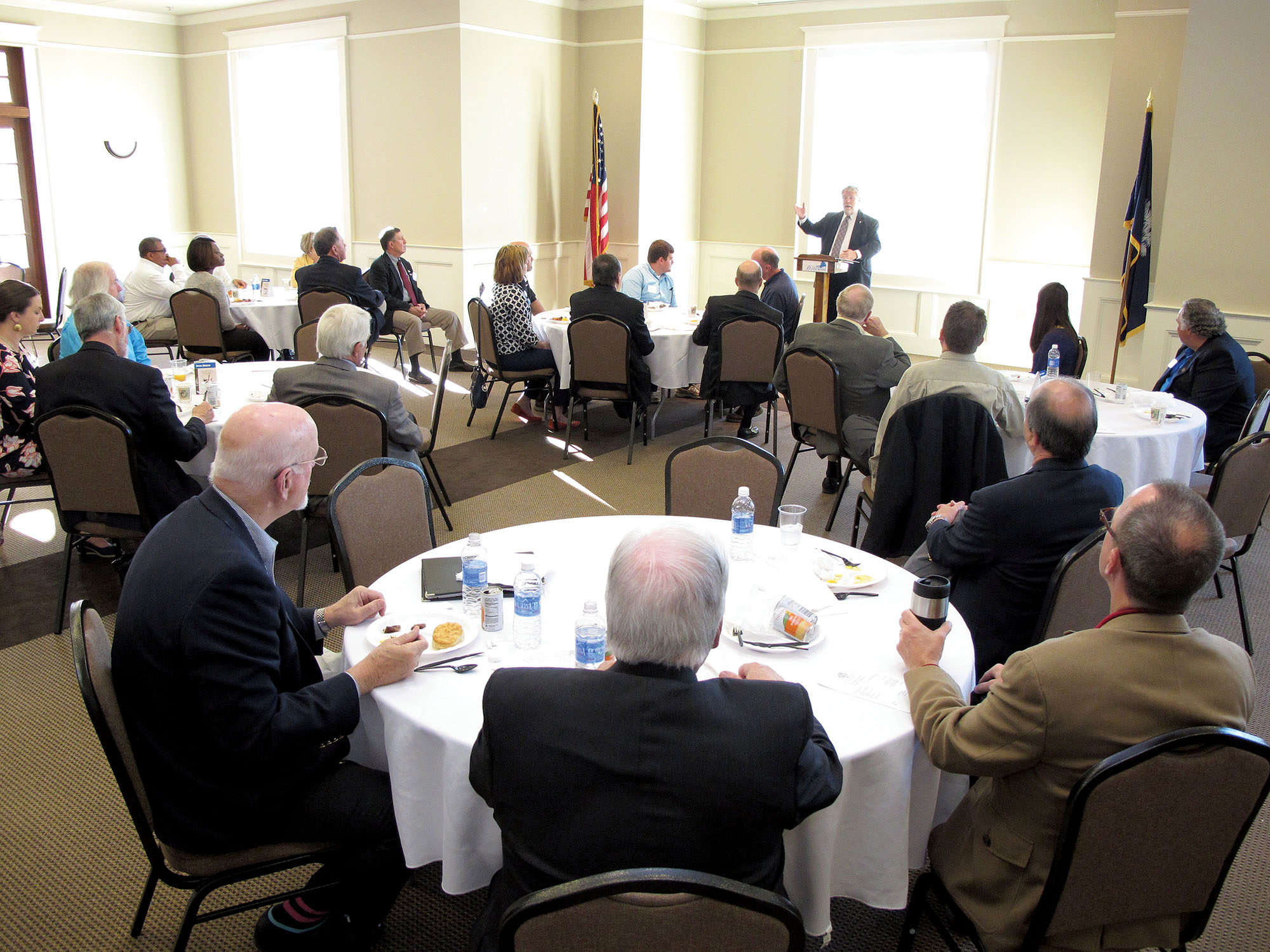
S.C. Secretary of Commerce Bobby Hitt addressed Blythewood’s first Industry Appreciation Breakfast on Tuesday at The Manor. About 40 invited guests from area industries heard Hitt warn that when industry comes knocking, towns and counties must be ready if they are to attract the jobs. He also said companies locate in communities and look first at what those communities have to offer. “If you don’t have it,” Hitt said, “they’ll move on. You must be ready, have a plan and be flexible.” Hitt added that 70 percent of industries looking for locations want a ready building to move into. “If you’re not ready,” Hitt said, “you’ll miss out.”
BLYTHEWOOD – Town Council took the first step Monday evening in a newly energized effort to bring industry to Blythewood. It passed first reading on a Limited Industrial Two (LI-2) zoning district that will allow a wider variety and greater intensity of manufacturing uses than the Town’s current Limited Industrial District (LI), Ed Parler, the Town’s Economic Development consultant told Council.
The uses allowed in the ordinance run the gamut from tire manufacturing, machine shops, textile industries and testing laboratories to public relations agencies, cafeterias, full service restaurants and business support services. But Parler said LI-2 zoning would not allow the most intense manufacturing uses of the Basic Industrial (BI) district such as foundry and smelting operations. Distribution centers have also been eliminated. Conditional uses allowed include sale of manufactured homes and motor vehicle repair garages.
While the ordinance, as written, calls for a building height limit of 35 feet, Parler asked Council to increase that to a 100-foot height limit (equivalent to 8-9 stories), adding that Richland County has no height limit for its industrial and manufacturing facilities. After some discussion, Councilman Tom Utroska made the motion to amend the ordinance to allow a height limit of 50 feet, to which Council unanimously agreed. Councilman Bob Mangone was absent.
Parler said he planned to take the request for the 100-foot limit back to the Planning Commission at its April 6 meeting. If the Commission approves the additional height the request will be sent to Council as an amendment to the second and final reading of the ordinance at Council’s April 27 meeting, Parler said. In addition to any additional height Council might approve, the Town’s Board of Appeals can grant an additional 10 feet of height as a special exception. However, in an interview with The Voice, Parler said he and Richland County will look at additional changes to the height and other restrictions before the ordinance goes back to Council.
“We want to know exactly what height we can get to in the end,” Parler said. “We need a very clear definition before the process starts.”
While the ordinance before Council is a text amendment that only establishes the zoning district on paper and does not target a particular piece of property, Parler said the text ordinance is needed for the rezoning of a specific 600-acre tract in Blythewood that Richland County has its eye on for an industry it says is interested. The tract is bordered by Northpoint Industrial Park to the south, I-77 on the east, Lorick Road on the north and Ashley Oaks subdivision on the west. The property is known locally as the Barnett property and is owned by the Barnett family.
“Be assured,” Parler told Council, “that if you establish this LI-2 zoning district, you will immediately receive a zoning request for LI-2 zoning for this 600-acre property and the applicant will be Richland County.”
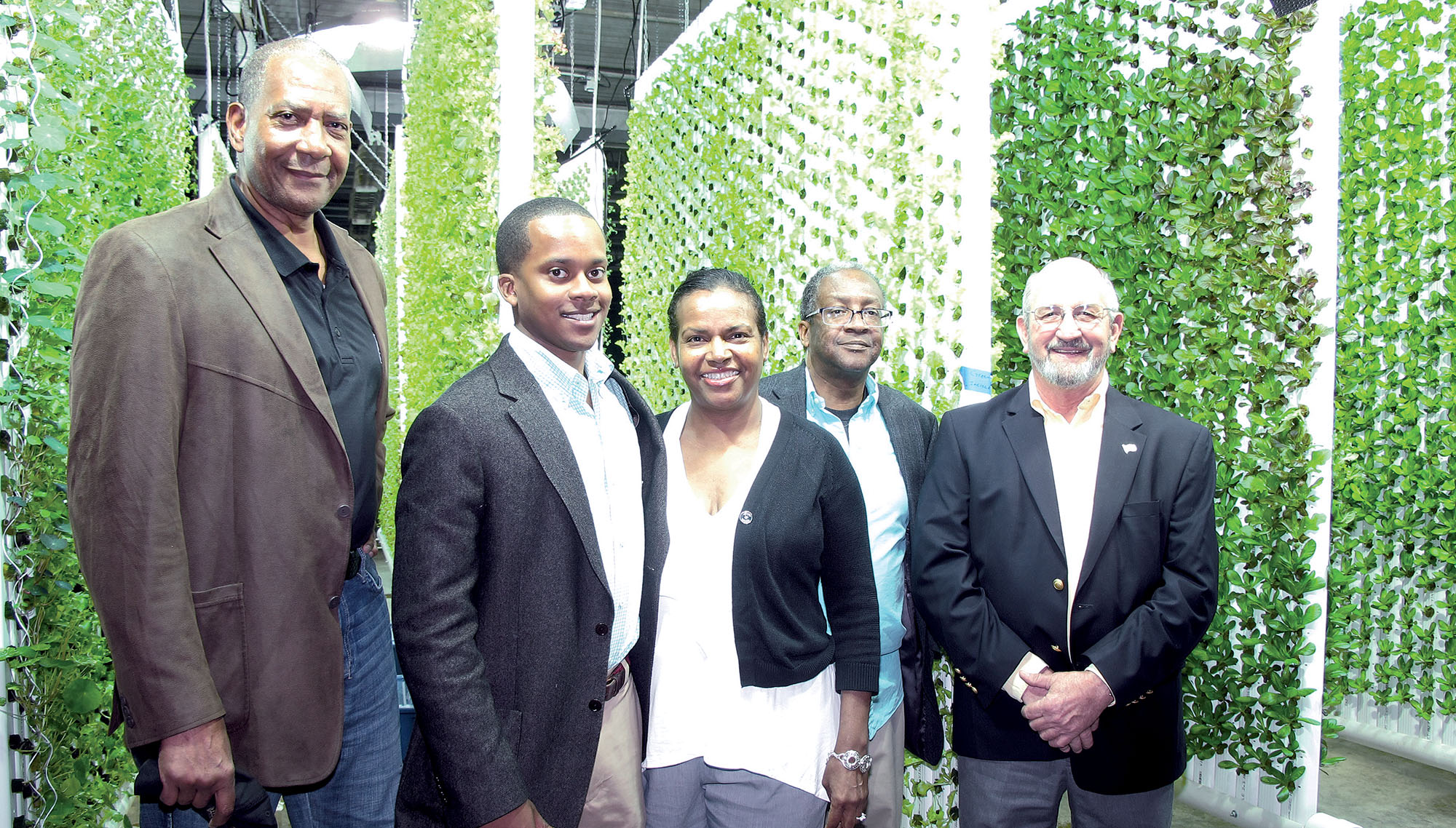
Royal Greens, Ridgeway’s new wholesale/retail hydroponic plant business, opened its doors at 200 E. Church St. last week to a huge crowd including Alex English, left, and his wife Vanessa of Blythewood and Fairfield County Councilman Marion Robinson, right. With them are manager of operations Chip Harriford, next to Robinson, and his son Scott. The Charm building, which houses the growing operation, will be the national headquarters for the business that will supply greens and other organically grown vegetables to Whole Foods, U.S. Foods, Sysco and other food stores and suppliers.
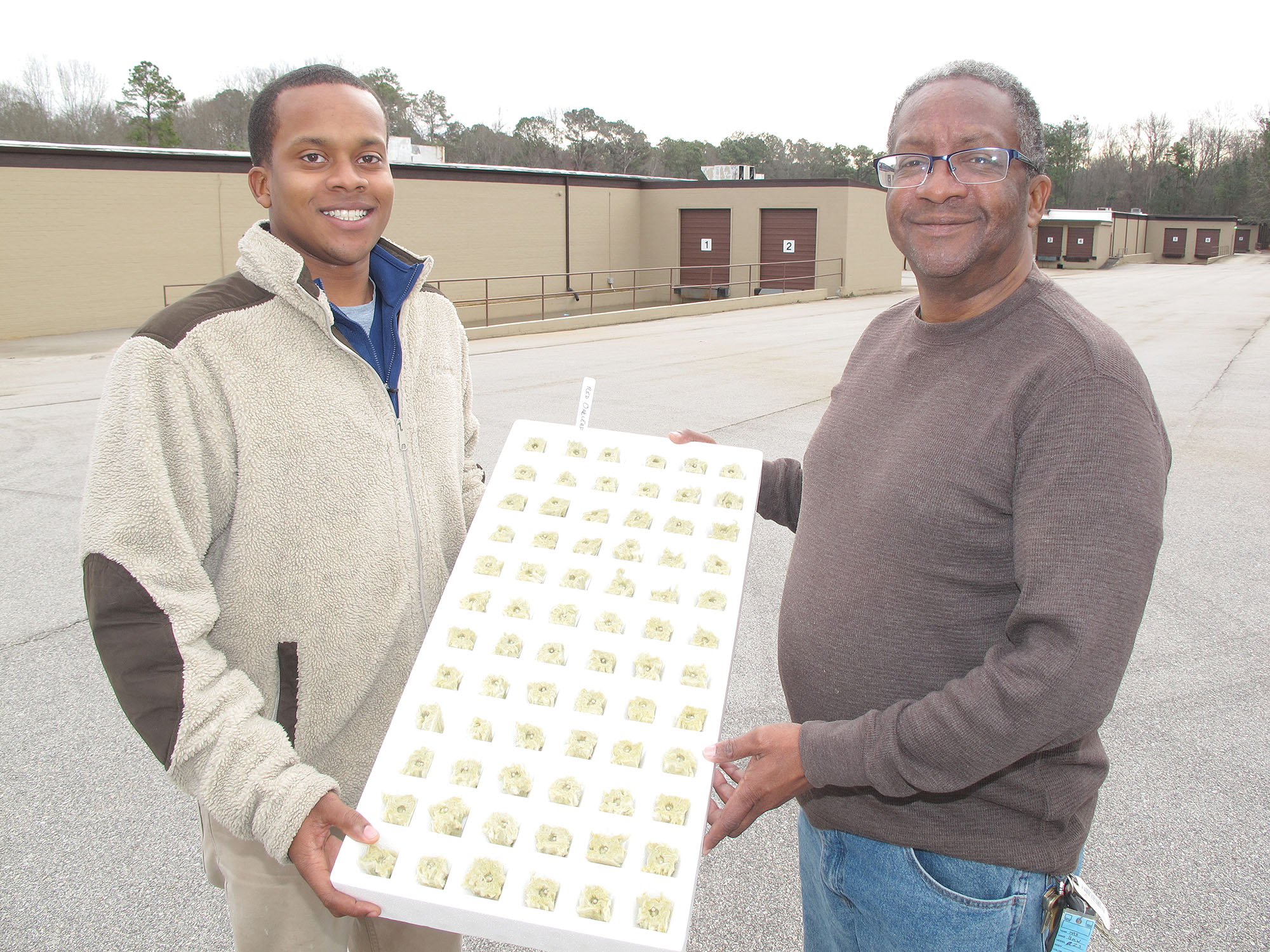
Chip Harriford, (right) manager of operations of Royal Greens, and his son, Scott, show off a freshly planted seed tray of lettuces in front of the 176,000-square-foot Charm building in Ridgeway where they will soon open to the public what will become the national headquarters of a wholesale/retail hydroponic growing operation.
RIDGEWAY –
A hydroponic growing business, Royal Greens, is setting up shop in downtown Ridgeway where it will soon headquarter a national wholesale company supplying greens and other organically grown vegetables to the likes of US Foods, Sysco and Whole Foods.
Director of Operations Chip Harriford, 52, said the hydroponic and, later, aquaponic components of the business will fill the inside of the 176,000-square-foot Charm building by next October. The grounds surrounding the building will be covered in raised-bed gardens, butterfly gardens, bee hives, chickens, and a 500-foot length of wall of the building will be covered in a vertical garden of seasonal flowering plants. Harriford said he also hopes to incorporate local artwork and yard art on the grounds among the plants.
While Royal Greens is mainly geared toward wholesale customers, it will also offer retail sales to the local public.
“Customers can purchase live lettuces, kale and other greens including 15 types of romaine and 20 types of basil,” Harriford said. “We’ve already planted 30,000 heads of lettuce and will offer over 60 varieties of lettuce when we open in March. The company will eventually offer beans, tomatoes, peppers, hens’ eggs and a variety of flowering plants.”
Harriford said an equally important offering is the economic development component of the business: jobs for people in the community – lots of jobs.
“We’re now hiring about 20 employees. We’ll hire 100 by the end of the year and 500 within five years,” Harriford said.
Plus, he said, the company is committed to providing a living wage with the lowest wage jobs starting at $12 an hour and going up to $18.
“We hope that people working here will also support businesses in Ridgeway and the surrounding communities. It’s a win-win,” he said.
Another plus for the community, Harriford said, is the business’ sustainability.
“We’re about as sustainable as we can be and that keeps prices low for customers. Nothing in the local offerings will cost more than $1 per pound, except for specially picked items that are $1.25 per pound. We incorporate numerous environmentally friendly features, like 300-gallon rooftop rain barrels to catch water for the business. And of course, as we add businesses across the country we plan to reclaim old, abandoned buildings, like this one,” he said, surveying the cavernous interior of the Charm building, “instead of building new ones.”
While Royal Greens will not be offering boat ride tours of the hydroponic facility like those at the popular ‘The Land’ hydroponic exhibit at Epcot in Disneyworld, it will offer walking tours through the facility for shoppers and tourists alike.
“It’s a great way for visitors to see people working in a hydroponic garden and to learn about the process. Our goal is to not be just a commercial facility but also an educational resource for the community,” Harriford said.
Harriford, a Columbia businessman, and his son, Scott, have been creating the Royal Greens company over the last few years, and while it’s a family business at heart, they are also poised to become a major commercial player.
It all started, Harriford said, when Scott, now 21, began studying hydroponics in 2010, as part of a high school research project, and quickly realized it as an excellent business idea. To get a feel for the different aspects of a produce supply business, he spent time working at a variety of places, such as Rosewood Market and City Roots, a 3-acre family run urban farm in Columbia.
At the time, Chip Harriford was the Chief Operating Officer of NDR Energy Group, a Charlotte-based company, and had previously worked as a business consultant for companies that worked with renewable energy.
“I knew absolutely nothing about hydroponics,” Harriford said. “But Scott convinced me, and he and I developed a business plan.”
They tried a few different avenues before attending an EngenuitySC business meeting in Columbia, a monthly gathering of entrepreneurs and tech people.
“That’s where I met Dr. Simon Hudson, a professor of Hotel, Restaurant and Tourism Management at USC,” Harriford said, “and he’s been a wonderful mentor to us.”
Through their connection with Dr. Hudson, they were able to work with graduate and undergraduate classroom teams in USC’s Colleges of Business and Information Technology, which helped the Harrifords organize an overall business model, an agri-tourism component and a social media strategy.
“The students worked with us, produced an end product, and got a grade for it. We were able to put a lot of other people’s brain power together,” said Harriford, who has a bachelor’s degree in Economics and an MBA from USC. Scott will graduate in December from USC’s College of Hospitality, Retail and Sport Management.
Harriford then secured funding from a venture capital group in Florida where he worked with investors Garry Merritt and Steve Nelson. Those and other investors, including a tribe of Delaware Native Americans in Oklahoma, initially settled on a building in the Poconos, but Harriford wasn’t thrilled with the cold, rainy weather they encountered during the inspection. He asked if he could try finding a better place for the company, and the investors agreed, as long as he could secure a suitable location within two weeks.
So Harriford opened his rolodex, and the first call he made was to Fairfield County realtor George McCutcheon, with whom he’d worked years before. McCutcheon connected Harriford with the Charm building in Ridgeway, which had been abandoned for 20 years but was in good condition.
“I was already familiar with the area so I went to the Ridgeway Town Council and they worked very rapidly to help us,” Harriford said. “Within 10 days, they convinced our investors that Fairfield County and Ridgeway were worth the gamble. So a decision was made, checks were written, and 30,000 heads of lettuce have already been planted! We had to get started quickly to meet our supplier deadlines.”
Harriford said he will be working through economic development issues with Fairfield County and the Fairfield Chamber of Commerce over the next few months.
Royal Greens is currently leasing the Charm building and hopes to make it a permanent home. It will soon function as the headquarters and training center for an expected 20 additional facilities – each over 100,000 square feet – that will be developed over the next five years, beginning with locations in New Jersey, Pennsylvania, Oklahoma and Florida.
“We use the same business strategy that Amazon does, which is to place facilities near our customers and significantly reduce transportation costs,” he said. “Our produce is delivered within 8 hours of harvest, and stays within a 200-mile radius. We do sell to restaurants and small stores, but our primary focus is the big boys – national wholesalers and regional distributors who can buy by the truckload. We’re close, we’re flexible, we can grow exactly what they want, we can promise delivery and they can come see us at any time – plus, we know that we have the best prices!”
Harriford said that a big part of building a successful business is creating a place that enhances the community and brings people together.
“We’ve got good people around us, and we’re in a good place,” Harriford said. “The building and the community of Ridgeway are great. We’re very happy here.”
Royal Greens is hosting a Grand Opening for the public on March 19 at its location in the Charm building at 200 E. Church St. Harriford promises a wonderland of organically grown lettuce greens – over 60 varieties – and a day of fun for the community. For more information email sarah@royalgreens.biz.
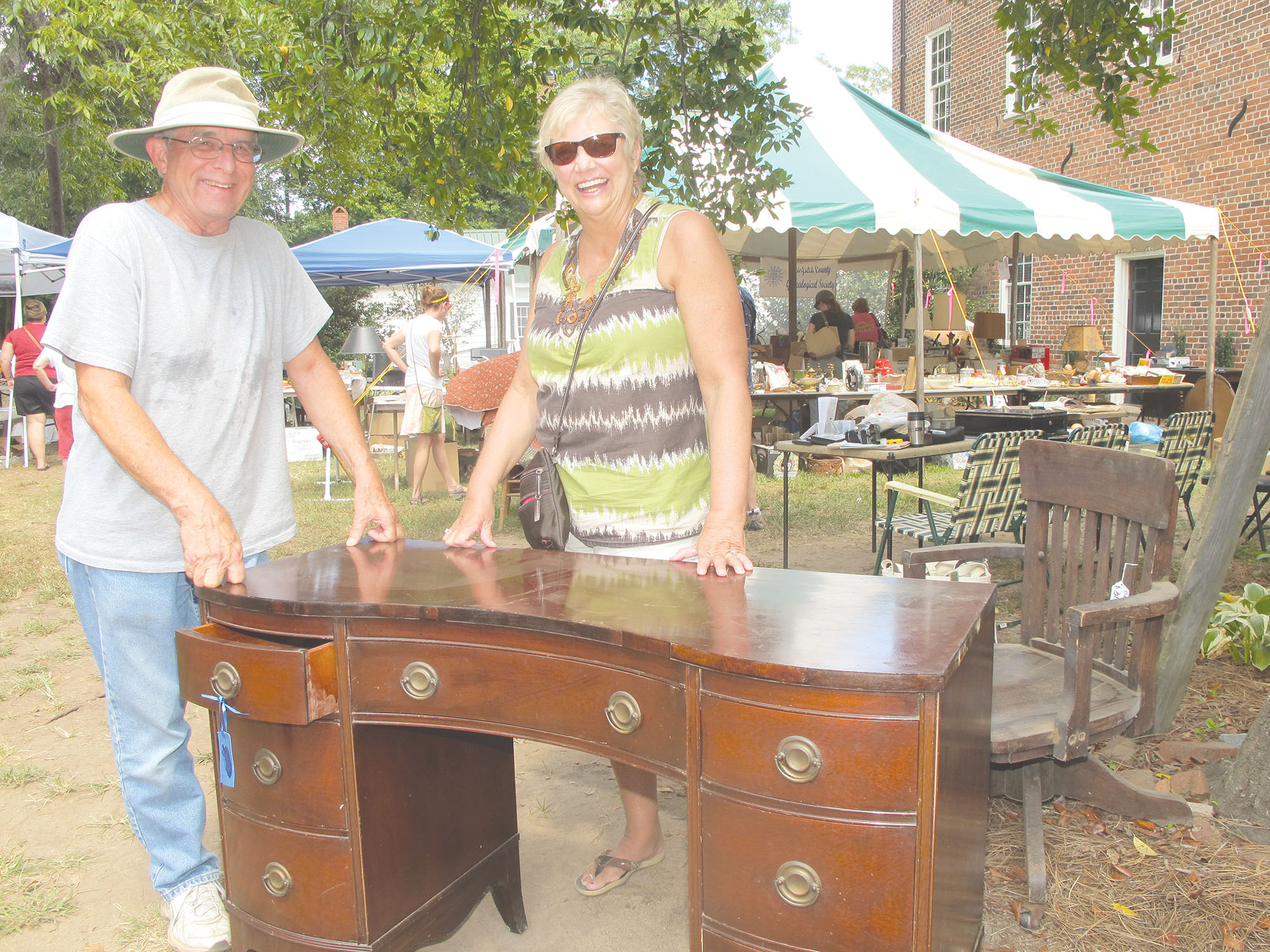
You’ve Been Grabbed – John Davis, a Fairfield County Museum volunteer, helps Janet Spires of Lexington carry her Big Grab $35 purchase (a mid-century vanity that she plans to refurbish and use as a desk) to her truck. Pelham Lyles, director of the museum, reported that the museum’s ‘back yard shade tree’ sale was a huge success.
On Shoestring Budget, Event Gives Local Merchants Shot in the Arm
BLYTHEWOOD/FAIRFIELD – Friday and Saturday were good days for the shops, restaurants, service stations, hotels and other merchants in Blythewood, Winnsboro and Ridgeway. Long lines of cars and trucks began snaking into the towns early Friday for the annual Big Grab Yard Sale. The vehicles’ occupants arrived with large amounts of cash for two days of non-stop bargaining and buying . . . and bargain and buy they did.
“It was two of the best days of the whole year for us,” said Kristen Stratton, owner of Bits and Pieces Consignment Shop in Blythewood where everything in the store was 25 percent off with some items marked down to half price.
“Us, too,” echoed Liz Humphries, owner of Blythewood Consignment. “Our store was packed both days. It was great.”
“We were slammed on Friday,” reported Christine Fair, owner of Winnsboro’s Cornwallis Tea Room. Tina Johnson, owner of Over The Top in Ridgeway, said she had multiple lines at the checkout counter most of the time both days. “It was way more than I expected. Two great days!”
One church that had a sale booth on Congress Street in downtown Winnsboro reported sales of $4,000 before the booth closed on Friday.
Louise Ruff, 10, cashed in big on the home-baked cookies, brownies and breads she sold at her little sidewalk booth in downtown Ridgeway.
“I made about $200,” she said. “I sold everything my mom and I had baked by noon on Friday, so we had to bake more that evening. And on Saturday I sold everything by mid-afternoon. It was a good day,” she said, quite pleased.
Blythewood’s hotels and fast food restaurants as well as service stations in all three towns reported a significant uptick in business.
Larry Sharpe, owner of three Sharpe Shoppes and the Bojangles in Blythewood said his business during the two days was up 25 percent more than when the Rodeo comes to town.
“Until this, the rodeo gave us our big sales days,” Sharpe said. “But there was lots of foot traffic from The Big Grab, lots of people buying snacks and Bojangles. It’s a good thing for the town’s merchants.”
The Big Grab was advertised online, on radio and in newspapers. Vendors came from as far away as Alabama, and shoppers from as far away as Ohio and Florida.
But for all the business it brings the town’s merchants, it doesn’t get the big bucks of support from the respective town governments that other events do. The Blythewood town government donates $15,000 to the rodeo and similar amounts to the Band and Baseball Tournaments each year. But merchants say those events do not bring as much business to the town during shopping hours as The Big Grab. The Town of Blythewood, which had the greatest number of vendors and shoppers over the two days, donated $1,000. Winnsboro Town government donated $300 and Ridgeway, $175. Vendors paid from $20 to $50 for sponsorships.
Terry Vickers, one of the organizers said the event’s no-frills budget is a little more than $3,000, small for such a large event.
“That has to cover insurance, advertising, portable restrooms and other expenses,” she said.
While he agreed that The Big Grab could benefit from more hands on deck to help with the planning, Blythewood Mayor J. Michael Ross said, “if the town gets all this and the organizers only need $1,000 from us, I think that is the way we want it to work.”
He said he is going to get some numbers from the restaurants, hotels and merchants for the weekend to see how much the event might have generated over regular weekends here in Blythewood.
“If the numbers come back with increases, we would certainly entertain increasing the amount if they need it,” Ross said.
The brainchild of Blythewood’s Denise Jones who co-owns the Cottonyard Market in Ridgeway, the sprawling yard sale now in its third year covers 43 miles encompassing Winnsboro, Blythewood and Ridgeway. All but the long stretch on Highway 34 from I-77 to the bypass in Winnsboro was fairly solid with yard sales. Vendor tent cities cropped up in several locations between Blythewood and Ridgeway, at times bringing traffic to a crawl.
“But when it slowed down,” said shopper Nadine Branham, “we just got out and shopped!”
Jones expressed her gratitude to the shoppers, the vendors and the sponsors who signed on with financial support.
“It’s a volunteer effort and we are dependent on volunteers for things to run smoothly,” Jones said. “The organizers try to think of ways each year to improve on the previous year.
“The Big Grab provides a big financial boost for our businesses as well as our church and resident vendors,” Jones said. “Plus, it brings a big selection of bargains for shoppers. It’s a win-win for everyone.”
WINNSBORO – In an announcement made at the Midlands Technical College QuickJobs campus Thursday afternoon, Enor Corp., a manufacturer of toys and games, was introduced as the latest addition to Fairfield County’s growing economic base. The New Jersey based company will operate out of the former Ruff & Tuff building at 1 Quality Lane, off Highway 321, in Winnsboro, with limited operations expected to begin next month. Enor Corp. is a major supplier of plastic toys, outdoor games and junior sports items for Walmart stores.
“The addition of Enor Corporation is another great win for the economy and workforce of South Carolina,” Fairfield County Council Chairman David Ferguson (District 5) said. “Fairfield County is excited to be a part of the continuous re-shoring initiative with Walmart’s supply chain and the Council is honored to have had the opportunity to work closely with Enor as they were searching for the right location to grow their business. The bounty of companies continuing to locate, build and grow within the borders of this state and in the central S.C. region is a testament to the opportunities and support available here to businesses.”
The multi-million dollar investment is expected to create 151 jobs, with 100 of those jobs coming in the first year of operation. The majority of the jobs will involve injection-molding skills. The average salary of those jobs was not available at press time. Enor Corp. will begin hiring for the new positions immediately, with readySC.org assisting with the application process. Enor said it expects to accelerate production rapidly over the next nine months, transferring the majority of its off-shore production to the new facility in Winnsboro “as quickly as practical without disrupting supply.”
“Today’s announcement represents our life-changing commitment to manufacture exclusively in the U.S. Our relationship with Walmart began more than 15 years ago, and this is a vital next step,” said Steven Udwin, CEO of Enor Corp.
Enor Corp. was drawn to Fairfield County by an incentives package, the details of which have not yet been made public, but which included a fee-in-lieu of taxes agreement ushered through County Council recently under the code name “Project Leprechaun.” Enor Corp. also received a $300,000 Rural Infrastructure Fund grant from the S.C. Coordinating Council for Economic Development. Those funds will be used to retrofit the 78,000-square-foot building.
The addition of Enor Corp. brings the total number of jobs introduced into Fairfield County over the last year to 800.
COLUMBIA – Blythewood Mayor J. Michael Ross has been named the 2013-14 Outstanding Alumnus of the University of South Carolina College of Pharmacy. He was awarded the honor on Wednesday during ceremonies at the Coliseum where he delivered the Keynote Address for the Convocation for the College of Pharmacy.
WINNSBORO – Documents made available to The Voice last week through a Freedom of Information Act (FOIA) request reveal the scope of financial incentives employed by Fairfield County and the State Department of Commerce (DOC) to lure a television manufacturing company to Winnsboro.
Element Electronics, headquartered in Minnesota, announced plans on Aug. 22 to relocate manufacturing operations from China back to the United States, tapping the former Perry Ellis Menswear building in Winnsboro as their new home. Vlad Kazhdan, vice president of product for Element, said during the announcement that the new venture would create 500 new full-time jobs over the next five years.
Purchase and Lease
As part of the agreement, Fairfield County purchased the Perry Ellis building, at 392 Highway 321 Bypass N., from a Perry Ellis subsidiary for $2 million in a deal that closed on Oct. 14. But the County only ponied up $600,000 for the property, while the Department of Commerce, through an economic development grant, put up $1.25 million. Element, meanwhile, kicked in the remaining $150,000 for the purchase. An additional $50,000 in DOC grant money will go toward the cost of upfitting the building, transforming it from a clothing manufacturing center into a high-tech electronics plant. Fairfield Electric Cooperative and SCANA have also offered to reimburse Element $100,000 each for upfit costs.
Element will lease the property from the County for $1 a year for 30 years. Element will have the option to purchase the property for $1 if, by Dec. 31, 2018, it has created at least 500 new, full-time jobs and has invested at least $7.5 million in taxable property; or, if by the same date, Element has created at least 350 jobs, invested at least $5.25 million, repaid a pro rata amount of the grant money and paid to Fairfield County an additional amount based on the following formula:
400-499 jobs by Dec. 31, 2018 = $120,000;
350-399 jobs by Dec. 31, 2018 = $200,000.
Payments would be due to the County by June 1, 2019. Element may also continue to lease the property for $1 a year for an additional five years, but must have created at least 250 new, full-time jobs, invested at least $2.5 million by Dec. 31, 2018, and paid to the County $600,000, plus the pro rata grant amount. Failing to have met those conditions, Element may then lease the property at market value, but still must repay the County’s $600,000 investment.
Fee in Lieu of Taxes
Manufacturing property in South Carolina is taxed at 10.5 percent, while commercial and other property is taxed at 6 percent. To level the playing field and help attract industry, Tiffany Harrison, Director of Fairfield Economic Development said, local governments often offer as an incentive fees equivalent to the 6 percent rate that companies may pay instead of taxes. Such an agreement is known as a Fee in Lieu of Taxes, or FILOT. Perry Ellis, however, had no such agreement and their property at 392 Highway 321 Bypass N. was listed on the tax rolls. And once a property is on the books, Harrison said, it cannot be removed. Element, therefore, did not qualify for a FILOT on the property itself, but instead was offered by the County an annual tax credit of 42.8 percent for 30 years to bring their contributions to Fairfield County coffers down to the 6 percent level. Like the lease agreement, that tax credit is contingent upon Element creating at least 500 new, full-time jobs and investing at least $7.5 million over the next five years. Otherwise, the credit decreases by the following formula:
If, by Dec. 31, 2018, Element has created less than 500 jobs, but at least 400 and invested less than $7.5 million, but at least $6 million, tax credit = 33 percent;
Less than 400 jobs, but at least 350 and an investment of less than $6 million but more than $5.25 million, credit = 23 percent;
If, by Dec. 31, 2018, Element has failed to create at least 350 new, full-time jobs and has invested less than $5.25 million, the credit agreement terminates and all property taxes shall be paid retroactively.
Although the building does not qualify for a FILOT, equipment does, Harrison said, and for their equipment Element will pay a FILOT equivalent to the 6 percent property tax rate for 30 years, provided Element has met the 500 job and $7.5 million investment threshold. Otherwise:
Less than 500 jobs, but more than 400 and less than $7.5 million, but at least $6 million = 7 percent;
Less than 400 jobs, but at least 350 and less than $6 million but more than $5.25 million = 8 percent.
If, by Dec. 31, 2018, Element has failed to create at least 350 new, full-time jobs and has invested less than $5.25 million, the FILOT terminates.
Typical jobs at Element will pay about $12.50 an hour, on average, Harrison said. Element plans to create 250 jobs in the initial phase of start-up. An additional 250 jobs will be added over the course of five years. Element is a main supplier of electronics to Wal-Mart, as well as Target and QVC.