RIDGEWAY – Town Council’s scheme to move Ridgeway’s Police Department from 160 S. Palmer St. and into the Century House at 170 S. Dogwood Ave. took a leap forward last week as Councilman Russ Brown put the question to a vote.
Council fist took the matter up at a Sept. 22 work session when Brown said the Town could save $500 a month in utility costs at the station and net as much as an additional $600 in rent. A move to the Century House would also give the Police Department access to internet, something lacking at the current station.
Half of any rent collected by leasing the police station, however, would have to go to Norfolk Southern Railway, which owns the property on which the station sits, plus the Town would be on the hook for a one-time fee of $750 for subleasing any of the buildings that currently stand on the railroad’s property.
During Council’s Oct. 8 meeting, Mayor Charlene Herring urged Council to wait another month to find out if the Fairfield County Sheriff’s Office would be interested in leasing the station for use as a substation. Councilman Donald Prioleau said Sheriff Will Montgomery was ready to make such a commitment, pending funding from County Council.
Brown then put the motion on the floor to relocate the Department to the Century House and make the station available for lease if the Sheriff’s Office was not interested in putting in a substation. Councilman Heath Cookendorfer seconded the motion.
Countering Herring’s argument touting the value of a police presence on Ridgeway’s main street, Cookendorfer said, “A building is not presence. An active police officer on duty is presence.”
“And it’s a building we can rent out for additional revenue, instead of it costing us money,” Cookendorfer added. “I would like to turn a profit instead of losing money.”
Herring cast the lone vote against the proposed move, a vote she moved to change after Cookendorfer made it clear “We’re not making any move until we hear from the County (Sheriff).”
Sheriff Montgomery, meanwhile, told The Voice Monday that his office has no interest at this time in locating a substation inside the Ridgeway police station. There is very little, he said, that deputies can do inside a static location that they cannot do in their patrol cars, and he would prefer to have officers out on the beat. Deputies already patrol Ridgeway and surrounding areas, he said.
As of press time, Ridgeway remains without a police officer. Two candidates were interviewed during executive session on Oct. 8. Herring said this week that the Town had offered the position to one of the candidates, but had not received a response when The Voice went to press.
Regarding the fee and the 50 percent of rent the Town would have to pay the railroad, as stipulated in a lease agreement Ridgeway signed with Norfolk Southern earlier this year, Brown suggested hiring an attorney to review the deal and perhaps encourage the railroad to make concessions.
“I noticed one or two things with the contract,” Brown said. “There’s a specific date in there that I was under the impression would be changed. That’s troublesome. There are some things we need to pay someone to look at.”
BLYTHEWOOD – An $8 million low-income apartment complex proposed in downtown Blythewood hit a snag at the Planning Commission meeting Monday evening when Commissioners expressed concern about increased traffic from the project and the developer’s lack of a fleshed-out plan to manage storm-water runoff.
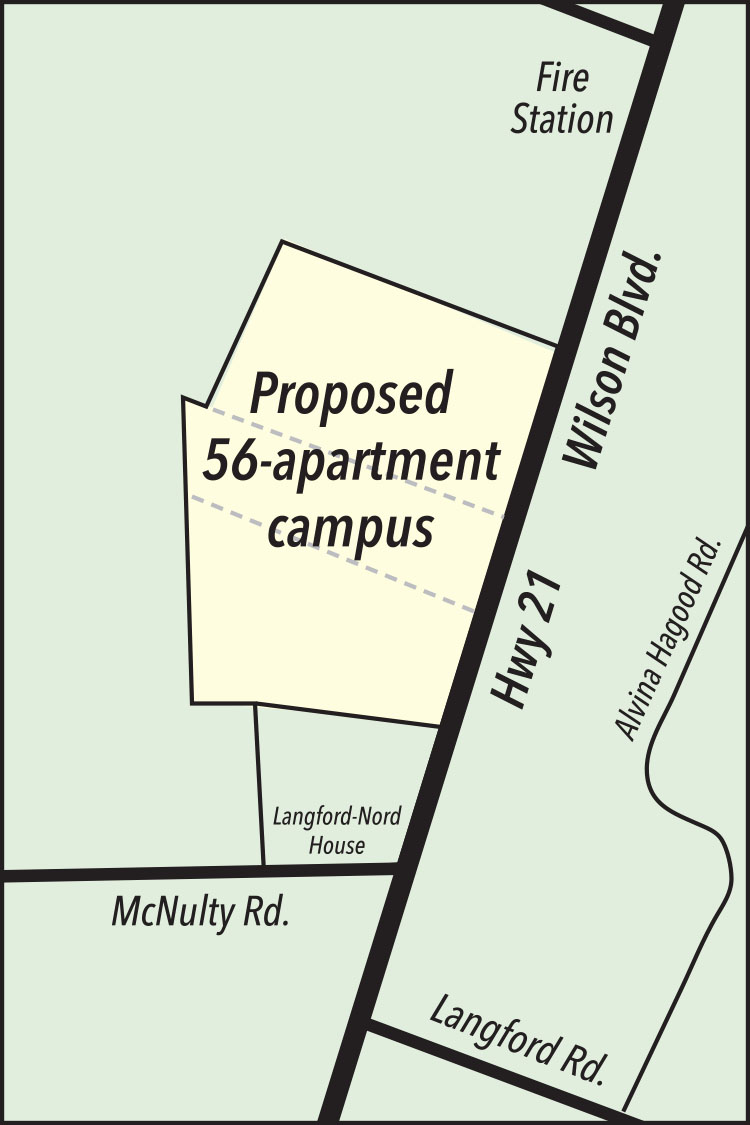
The proposed project, named The Pointe at Blythewood, is planned for Main Street behind the Langford-Nord house and across from Blythewood Consignments in the Town Center District. The developer is Prestwick Companies of Atlanta. Devin Blankenship, Senior Development Manager, told The Voice last month that while the apartments are considered affordable housing they are not Section 8 housing.
Clayton Ingram, a spokesperson for the S.C. Housing Finance Authority told The Voice that the developer will receive a federal tax credit of $699,052 each year over a 10-year period to construct the apartments. He said residents are required to have an income between 50 and 60 percent of the mean income for the area where the apartments are located.
“The property is zoned Rural (RU) and meets multi-family zoning requirements,” the Town’s Planning Consultant Michael Criss told the Commission. “The developer is only required to come before the Planning Commission for site plan approval.”
Prestwick Companies was represented at the meeting by Robert Byington Jr., an architect with Studio 8 Architecture Design, and Mark Binsz, Vice President of Engineering with Site Design, Inc. of Greenville.
Before the project’s traffic and storm water plans were met with questions from some of the Commissioners, the development was pummeled during the public comment segment by several of the 25 residents who showed up in opposition to the apartments.
“My sister and I own 2 acres next to that property,” Harold Boney told the Commissioners. “I’m not against the project. I’d like to see it come to Blythewood. But I don’t like the location.”
Cindy Shull voiced concerns about increased traffic.
“The amount of traffic already in this area is only going to get worse,” she said.
Referring to a copy of the Town’s Master Plan, Shull said, “The Master Plan was developed to accommodate new density in a way that preserves quality of life.”
She said this development does not do that.
Irene Shepard said she felt the development would take away from Blythewood’s country lifestyle.
“What you’re bringing in is low-income housing,” Shepard said. “Bringing in 56 of these apartments is bringing in crime and trouble.”
Shepard’s daughter, Danielle Andes, agreed with her mother.
“This is not what this town needs,” Andes said. “People who sit on this board have not lived here for 40-plus years. They are people from the outside who have moved here, have come with a little bit of money and ruined what we had.”
Kathy Johnson had not yet arrived at the meeting when her name was called to speak, but a man who said he was her husband, spoke on her behalf saying he “grew up in the inner city, so I’ve seen this type of housing. I want to keep Blythewood like it is. If you want big city problems, start with low-income housing and you’ll have big city problems.”
Criss said, however, that multi-family housing is not only allowed in the Town Center District, but welcomed.
“There is not an explicit density limit for multi-family housing,” Criss said, “other than what will fit on the lot with adequate landscaping, parking, buffering and up to four stories in building height.”
The proposed apartments are two-stories tall with a pitched roof. They will offer one-, two- and three-bedroom units.
Commissioner Ernestine Middleton asked if affordable housing was welcomed because of the need to add affordable housing in the community.
“Yes,” Criss answered, “and to also bring people downtown, to bring vitality and business customers to the Town Center District.”
After making a short presentation to the Commission, Binsz was asked by Commission Chairman Malcolm Gordge how the developer proposed to mitigate the effects of increased traffic on Main Street and at the intersection of McNulty Road and Main Street.
“We will get DOT’s (S.C. Department of Transportation) input on any final design plans,” Binsz said.
“What about construction traffic?” Gordge asked, “Can you mitigate that?”
Binsz said that would be the contractor’s responsibility.
When asked what the company had done to determine the amount of storm water they would be able to dispose of, Binsz answered that while the company didn’t have a final design, their initial estimates would not require a runoff pond.
“Let me speak from my own personal point of view,” Gordge concluded. “There are still significant uncertainties regarding traffic mitigation and we don’t have the recommendations from SCDOT on what they would require when faced by traffic during construction. We also don’t have the full details on the management of storm water, so I don’t feel as though we can recommend or deny approval based on what we have.”
Commissioner Buddy Price agreed.
“I like the concept, the idea that we have a project such as this, and I understand the foot traffic and bringing folks into our businesses and those kinds of things,” Price said. “My concern is that it’s in the wrong place. I’m mostly concerned about the traffic. Right now the traffic is extraordinary because of the re-routing due to the flooding, but even under normal circumstances it backs up.”
“We will comply with what SCDOT requires,” Binsz said. “They will dictate what we can and cannot do.”
In an email to the Town’s Administrator Gary Parker last week regarding whether SCDOT would require a traffic study of the developer, SCDOT Engineer Tyler Clark told Parker, “At this time we don’t have plans to require a TIS (Traffic Impact Study); however, this does not mean we will not require mitigations along US-21 as needed. We will know more after we meet with the engineer/developer.”
Gordge called for a deferral of the matter until the next meeting on Nov. 2. The vote was 3-1 with Commissioner Don Sanders voting for approval of the site plan. Commissioner Marcus Taylor was absent.
BLYTHEWOOD – On Monday evening the Planning Commission will discuss a site plan for The Pointe at Blythewood, a 56-unit apartment complex proposed on Main Street in the Town Center District (TCD); decide whether to recommend TCD zoning for a 4.56-acre parcel at 121 McLean Road and address proposed height limits and flat roofs on buildings in the TCD.
Affordable Housing
The Commission will consider whether to approve a site plan for the development of a 56-unit apartment complex on Main Street. The tenants will be low- and moderate-income residents, Town Administrator Gary Parker said.
“This will address the goal in the Town’s Comprehensive Plan of attracting affordable house to the community,” Parker said.
He said the core commercial area is the appropriate for multi-family housing. The developer, Prestwick Companies of Atlanta, has received financing approval from the S.C. State Housing Finance and Development Authority.
Rezoning is not required for the apartments according to the Town’s Planning Consultant Michael Criss.
Rezoning Request for TCD
After the owners of a 4.56-acre parcel on McLean Road requested the property be rezoned from Rural (RU) to Town Center District (TCD) at the September Planning Commission meeting, the property’s neighbors who were protesting the rezoning for commercial use agreed to talk with the realtor representing the property owners about purchasing it. With that, Commission deferred a recommendation on the request, suggesting the principals of the parcel meet with the neighbors and try to come to terms – either for the neighbors to purchase the property or for the applicant to bring the rezoning proposal back to the Commission at a later date. That matter will be heard Monday evening.
Building Heights; Flat Roofs
Mayor J. Michael Ross has proposed an amendment to the Town’s zoning ordinance that would repeal the requirement that new structures must be two stories and, instead, allow single-story structures in the TCD. One other proposed amendment of the zoning ordinance to be taken up by the Commission would prohibit flat roofs on single story buildings in the TCD while allowing them on multi-story buildings. Additionally, corner buildings at six specified intersections shall have a storefront treatment along each corresponding street. Town Council considered this proposed amendment at their Sept. 28 meeting and has forwarded it to the Planning Commission for a recommendation.
The Planning Commission meets at 6 p.m., Monday at The Manor.
At a community meeting last week at The Manor, Heins Road resident Laurie Rossdentsher discusses with neighbors a map of a proposed residential development that they fear could adversely affect the tranquility of their rural properties. (Photo/Barbara Ball)
BLYTHEWOOD – About 75 Blythewood rural property owners attended a community meeting Oct. 1 at The Manor in Blythewood to get answers to their questions about a mega housing development proposed on 202 acres off Heins Road near their homes.
Even though the developer’s team was there to answer their questions, the property owners left two hours later without the primary piece of information they came for – specifically, how many homes the developer planned for the development.
The meeting was hosted by Blythewood Mayor J. Michael Ross and facilitated by the area’s representative on Richland County Council, Councilwoman Joyce Dickerson. House Rep. Joseph McEachern, who represents the area, also attended.
Near the end of Thursday night’s meeting, McEachern weighed in on the side of the audience, telling them at one point, “This is just a proposed plan they (the developers) have. They don’t have to do this (re-zoning). If (Council) gives them this zoning, their proposal could change. Is that right?” McEachern asked, turning to Columbia attorney Robert Fuller who is representing the developer, Drapac, Inc., an Australian based real estate investment and development company.
“That’s right,” Fuller answered.
“I think you’re being short changed,” McEachern told the audience, “to be asked to support something you don’t have the numbers for. I would be adamant against supporting this (project) without this question being answered. I’m not sure I ever came to a meeting to discuss zoning when the (developer) didn’t have the numbers,” said McEachern who served as the County Council representative for the area before being elected to the House.
Drapac, Inc. has the 202 acres under contract contingent upon the rezoning of the property. The company has applied to Richland County to have the parcel rezoned from Rural (RU) zoning that would ordinarily permit about 267 homes on lots no smaller than .75-acres to Residential Estate (RS-E) zoning that could allow as many as 529 homes on lots as small as .30- or .25-acres (see box.)
“I don’t see where I am going to raise my hand to approve 500 homes,” Dickerson assured the crowd in her opening comments, referring to how she might vote on the matter. “However,” she continued, “I will be willing for you all to come together and find a compromise and see what we can do and work together to get the most out of the property for the community and for the developer.”
Joel Tew, a spokesperson for Michael Drapac, who owns the company and opened a U. S. headquarters in Atlanta three years ago, told the audience, “We aren’t trying to change the zoning because we want to build more houses. We want to change it so we can build something special. That’s the only reason we want to change the zoning.”
Asked by members of the audience if Drapac, who remained in Melbourne, Australia on business, would be content with 250 homes on the property, Tew answered, “No. Based on our preliminary analysis, we do not believe the project is economically feasible at 250 homes.”
Fuller further told the audience, “What you may not like to hear is that under the current RU zoning, by utilizing the land development regulations and the open space design standards now allowed by the County, the developer could build 334 homes right now without asking for a zoning change.”
Asked if the developer would be content with building that number (334) of homes, Fuller answered, “No.” Asked about holding the number of homes to 350, the answer was still, “No.”
“Drapac is looking for something between 334 and 500 homes that the community can live with, the County can approve and that we can make work financially,” Tew explained. But, he added, “We don’t have that silver number yet. Michael’s philosophy is that everyone in business has to have a reasonable return on their investment. That’s the rules, and there’s nothing wrong with that. He doesn’t apologize for being in business, for making a profit and a fair return for his investors,” Tew told the audience.
Fuller told the residents, “The (Richland County planning) staff has already agreed that RS-E zoning would be the appropriate way to develop the property to get the most planning into the development and maximize the opportunities for the Beha family (who owns the property) and the community as a whole.”
He also pointed out that the Planning Commission recommended the requested RS-E zoning to County Council with a 6-3 vote and that RS-E zoning complies with the Comprehensive Land Use Plan (adopted by the County Council last year) for the area.
There was criticism from the audience that the Planning Commission vote and recommendation took place during the middle of a work day when most of the people who live in the area of the proposed development had to be at work.
“You say you want to build a better community,” one unidentified resident said. “You’re talking to homeowners, not home buyers. We feel we have that community here in Blythewood already.”
After an extended applause of support for the speaker, Tew countered, “Before you were a homeowner, you, too, were a home buyer.”
“But we didn’t ask for a zoning change when we moved out here,” the speaker answered.
Residents also had questions about the effect of additional traffic the proposed development would produce. Resident Carol Ward questioned the traffic study on record for Heins Road. Planning Commissioners, at their Sept. 8 meeting, referenced a County staff report, based on a 2009 traffic study, stating that Heins Road operates at a low level of traffic, only 600 cars per day. Ward said Commissioners were asked if the traffic study could be extended further out to reflect current traffic on Langford Road that bottlenecks as it travels into Blythewood during heavy traffic hours.
“(The Planning Commissioners) said they are only required to look at the traffic on Heins Road and that Heins Road could accommodate the increased traffic,” Ward said.
Tew answered that the traffic study would, indeed, include more than Heins Road and that Drapac would adhere to the requirements of any such traffic study. But Dickerson pointed out that a traffic study for the area would not be done until the rezoning request is finalized.
McEachern told residents that they had a legitimate concern about the traffic on Langford Road.
“I can’t give you much comfort about roads,” McEachern said regarding improvements to be paid for by the state. “We haven’t even been able to get Blythewood Road taken care of.”
Lorraine Abell, who lives not far from the proposed development, addressed other areas she said would be adversely affected by that development and others it might spawn in the area – the need for more schools, which would bring higher taxes, the need for more law enforcement and an increase in the crime rate.
“These weren’t even discussed,” Abell said. “We wouldn’t have even been here tonight if we had been given more information before we got to this point.” She also pointed out the irony of a slogan written on the wall in the Council chambers – Uniquely Rural. “I think we’re losing that.”
Early in the meeting, Fuller told the audience, “We are here tonight to tell you that, at the end of the day, we will tell you what we do intend to do.”
But it was not to be at the end of that day.
Before adjourning the meeting, Dickerson told the developer’s team that she wanted them to get back to her with a final number of homes very soon so she could schedule another meeting with the residents and relay that information to them before Oct. 27, when the public hearing and the first of three votes by County Council would take place in Council’s chambers.
That meeting will be the only time residents will be allowed to address County Council about their concerns over the rezoning.
BLYTHEWOOD – After months of discussing updating the Town’s fees schedule, Town Administrator Gary Parker recommended adding fees for a landscape/tree removal plan, a tree fund and for a design review or architect’s fee to cover the cost of design reviews by the Town’s consulting architect who advises the Board of Architectural Review on matters that come before it. Parker proposed a review fee for landscape/tree removal plans – $500 for a commercial plan review, $1,000 for a subdivision plan review and an optional $550 fee for a tree fund.
Those fees did not set well with several home builders, two of whom appeared before Council to ask members to delay making a final decision on the fees. Jon Covert, representing the Building Industry Association of Central South Carolina and a local custom home builder, said he and the Association’s staff had reviewed the proposed fees.
“We are asking you to delay the second reading on this for 30 days so we can come meet with staff and talk about how this all works and how it relates to the previous landscape ordinance,” Covert said.
Home builder Earl McLeod also addressed Council, asking for a delay, “so we can talk with the Town about the fees with respect to the $550/tree fund fee and what that really means in terms of people trying to buy homes in this area.
While Council voted to defer the final vote for 30 days and meet with representatives of the Building Industry Association, Mayor J. Michael Ross reminded the speakers that the issue had been on the table for almost a year and that no one had come forward until now, just before the final vote.
“I would encourage people to not wait to start worrying about something until it comes up for last reading,” Ross said.
Council also deferred vote on an application fee for review of a zoning map amendment. Parker proposed reducing that fee from the current $5,000 to $250, closer to the Town’s actual costs.
In a related matter, Council voted to provide for fees and charges for the use of park facilities as follows: soccer field and amphitheater, $30 for residents and $35 for non-residents; multi-purpose field, $25 for residents and $29 for non-residents.
BLYTHEWOOD – A 56-unit apartment campus is planned for downtown Blythewood on 4 acres fronting on Highway 21 behind the Langford-Nord House. The developer of the project, Prestwick Companies of Atlanta, represented by Devin Blankenship, Senior Development Manager, will seek approval of the project’s site plan from the Town’s Planning Commission on Monday evening.
No rezoning is required for the property since the land is already zoned Rural (RU), according to Michael Criss, the Town’s Planning Consultant.
In a phone interview on Tuesday, Blankenship told The Voice that the campus will consist of one-, two- and three-bedroom brick apartments and include a playground, parking and a community building for residents. Pending approval from the Town Council, Blankenship said he hopes to break ground the first of January and be in full operation by fall of 2016.
While Blankenship referred to the apartments as affordable housing, he said he wanted to stress that they are not Section 8 housing.
“We are not going to be building an ugly square box in the middle of Blythewood,” Blankenship told The Voice. “We build market-rate quality type apartments and they are leased with the federal/state tax credit program as affordable housing.”
Blankenship said his company has a long history of developing affordable housing in South Carolina, North Carolina, Georgia and Texas. “We put something on the ground that we can be proud of.”
Clayton Ingram, a spokesperson for the South Carolina Housing Finance Authority, told The Voice that the company’s construction costs are offset by a $699,052 federal tax credit over a 10-year period.
“The developer is able to pass along that savings to tenants in the form of lower rental prices,” Ingram said. “Residents are required to have an income between 50 and 60 percent of the mean income for the area where the apartments are located. Rental prices are then determined on a sliding scale based on the percentage of a tenant’s income. One-bedroom apartments will range between $485 and $500.”
“It’s going to be very nice,” Blankenship said. “I think it’s something the town will be proud of.”
The Planning Commission meets at 6 p.m., Oct. 5 at the Manor.
BLYTHEWOOD – Although Town Council will not have to take any action to proceed with the construction of an investment shell building proposed by Ed Parler, the Town’s Economic Development Consultant, it did take a significant step forward with the design of the building Monday evening, voting unanimously to contract with architect Ralph Walden to design the shell, prepare construction drawings and bid out the construction at a cost of $18,900. That cost does not include construction oversight.
Since the summer, Parler has urged Council to construct a spec shell building on the Town Hall grounds with grant money the previous Council was awarded five years ago by Fairfield Electric Cooperative to construct a high end restaurant in the same location. The current Council voted to abandon those plans and, Parler said, $342,490 of the original $456,881 grant remains. He wants to see that money, which must be spent on an economic development project, used to construct the shell building. Parler said he estimates the Town will have to float about $133,000 for about 90 days to make up the difference, then pay itself back from the proceeds of the sale of the shell.
Parler said the hard construction costs (infrastructure and construction) of the shell are eligible for the grant money, but the soft costs (engineering, fill dirt, grading, survey and other associated costs) would have to be borne by the Town.
“Going forward with this project,” Parler told Council, “I suggest we contract for the architectural design and engineering (with Walden) now, so we can have bid documents ready by the end of October in anticipation of awarding a construction contract at the November meeting. In December we will send out a Request for Proposal and hope to consummate a sale by February.”
Parler told The Voice he is comfortable with the timeline and confident of the sale.
When asked by Councilman Bob Mangone to explain the difference between the previously planned restaurant and the shell project, Parler said, “The (previous) restaurant was of much greater quality than the shell we are planning now.”
In a memo to Council, Walden wrote that while the exterior of the structure will be similar in design to the town’s former train depot, it will be built on piers and will be primarily framed with common wood framing, including the roof and that the exterior siding would not be the more expensive ‘architectural’ thick wood siding appearance that had been planned for the upscale restaurant, but rather the standard Hardee horizontal siding.
Walden said the deck and railings would be made of No. 1 treated lumber and that it would be smaller than previously planned. The non-functioning chimney will be eliminated and the walk-in cooler/freezer, if provided by an end user, will be outside the building alongside the rear. The ‘box’ will be painted to match the building color. He said windows and doors will be standard ‘clad’ type units, not special order.
Walden said the 3,800-square-foot shell building would be suitable for a restaurant, professional office or a side office and small food establishment. He said the end user would have to spend another $100,000 to $125,000 for additional finish work on the building.
Parler told Council previously that the plan was not for the town to own the building but to sell it. No vote will be required of Council for the project until it contracts to sell the building.
BLYTHEWOOD – A proposed 500+ housing development in Blythewood along Heins Road will be the topic of conversation this week when Richland County Councilwoman Joyce Dickerson brings together three groups: Blythewood residents who object to the development being located across the street from their rural properties, members of the Richland County Planning staff who are recommending the rural Heins Road location for the mega development and the developer who is seeking to bring the development to fruition.
The meeting is scheduled for 6 p.m., Oct., 1 at The Manor in Blythewood and is being hosted by Mayor J. Michael Ross and Councilman Eddie Baughman.
At issue is a request by the developer, Drapac Group, represented by attorney Robert Fuller, to rezone 202 acres on Heins Road from Rural (RU) zoning to Residential Estate (RS-E) zoning, which would permit up to 529 homes, each built on lots of less than half an acre. All the surrounding property, according to a report by the Richland County Planning & Development Services Department, is zoned RU, much of it home to horses and other livestock. RU zoned districts are not permitted to have lot sizes less than three-quarters of an acre. Without the zoning change, Drapac could only build 267 Homes on the 202 acres.
When the issue came before the County Planning Commission on Sept. 8, residents from the Heins Road area pleaded with Commissioners to recommend leaving the zoning RU.
The Richland County Deputy Planning Director/Zoning Administrator Geonard Price and his staff, however, recommended the Commission approve the RS-E zoning, saying the development would not be out of character with the existing surrounding development pattern in the area. They based their recommendation on the County’s Comprehensive Land Use Plan, subtitled ‘Looking Forward to Future Growth,’ in which the Richland County Council determined in 2009 that it would be appropriate for the rural Heins Road area to have low density residential as the primary use. Neighbors in the area told The Voice they were not aware of such a plan for their area.
“These areas serve as a transition between rural and medium-density areas,” according to the staff’s report, “and are opportunities for low density traditional neighborhood development.”
The Planning Staff also determined that the proposed development would present no traffic problems for the area, pointing out in its report to the Commission that traffic information indicated only 600 average daily trips on Heins Road, a two-lane undivided road. But Heins Road residents told the Commission that the traffic bottle-necks on Langford Road as it enters Blythewood, causing long delays.
Resident Carol Ward told Commissioners, “We already have to alter our route to work and take all the back roads to be able to get through the traffic.”
Ross, also pointed to traffic as a problem.
“This development worries us from the amount of traffic that could be channeled onto Langford Road, then onto Blythewood Road into downtown Blythewood. We already have delays and congestion in the mornings and evenings on these roads,” Ross said.
The Commission, voting 6-3, recommended the rezoning to County Council, but when a number of Blythewood residents attended a public hearing earlier this month at Richland County Council on the issue, Dickerson, the area’s Council representative, called for a deferral of the rezoning request until she had time to meet with residents and the developer.
In an email to Ross, Dickerson said, “it is my unwavering desire to maintain the rural character of that community.”
RIDGEWAY – How much is Ridgeway’s police presence in a prime piece of downtown real estate worth? Perhaps not quite as much as Town Council would like, once Norfolk Southern takes its cut.
In a special called meeting Tuesday night, Council debated the pros and cons of relocating the Police Department from 160 Palmer St. (Ridgeway’s “Main Street”) to either the vacant building at 128 Palmer St. (formerly Just Around the Corner) or into the Century House at 170 S. Dogwood Ave., and then renting out 160 Palmer St.
Councilman Russ Brown put the suggestion up for discussion Tuesday night shortly after Council agreed to recommend replacing the heating and air system at the police station with a single window unit. That move, Brown said, would save the town $500 a month on utility costs at the station. Leasing the building out to a business, Brown said, could net the town an additional $600 a month. But not without a hitch.
“If we rent that building, some of that is going to have to go to the railroad,” Mayor Charlene Herring said during the debate. “The (rent) would have to be higher and I don’t know if anyone would want to pay that high a fee for that small a building.”
According to the terms of the lease the Town signed earlier this year with Norfolk Southern, which owns the land underneath the police station, half of the rent would go to the railroad company. In addition, the Town would be on the hook for a one-time fee of $750 for subleasing any of the buildings that currently stand on the railroad’s property.
“That’s the cost of doing business,” Brown said. “You (Herring) wanted that lease and now we’ve agreed to it, we’re going to have to give up some of that money.”
Herring’s biggest argument against relocating the Police Department, however, was the value she said the Palmer Street presence had.
“Sometimes when you save money, what do you give up? The visibility there is so important, especially in a small town,” Herring said. “We could move it to Just Around the Corner, but it’s just not as visible. I think it’s still the best option to keep it on (Palmer) Street.”
Councilman Doug Porter agreed with Herring’s visibility argument, as far as moving the department into the Century House, but said he would consider a move to the former Just Around the Corner location.
“I agree it’s good to have a (police) presence on Main Street,” Brown said, “but we do have two patrol cars. We could park one on (Palmer) Street and park one here.”
One benefit of moving the police station to the Century House, Councilman Heath Cookendorfer said, would finally be access to the internet for the department – something for which he has long been a proponent.
“We are so in the Dark Ages here in the town,” Cookendorfer said. “For our police officers to not have internet is a disgrace.”
The Town would also benefit from the department sharing utilities with Town Hall, Brown said.
“The most beneficial place is here (the Century House),” Brown said. “Main Street is a big draw, and right now you’ve got a building (the police station) that sits empty 90 percent of the time. Police do most of their work out on the street.”
The Century House, Cookendorfer agreed, would just be a “placed for him to do his paperwork.”
“It makes the most sense moving here,” Cookendorfer said. “But, we don’t want to make a rash decision.”
“I think it’s something we need to study,” Herring concurred. “We have some data to gather, some more research to do. We don’t have all the facts about how much we’d get if we did rent that building.”
Brown suggested renegotiating the Norfolk Southern lease in an effort to reduce their piece of the action.
“At the time we signed the contract, (renting the police station) wasn’t a consideration; now that it is they may be able to reconsider it,” Brown said. “If we’re good tenants with them they may consider making an exclusion or an amendment to the contract to reduce that expense they charge us.”
WINNSBORO – The owner of a campground near the V.C. Summer Nuclear Station in Jenkinsville, already embroiled in a legal battle with the Jenkinsville Water Company in his efforts to add campsites, has asked County Council to rezone a portion of his property there to accommodate a restaurant.
Monday night, Council held first reading and public hearing on an ordinance to rezone 3 acres at 16482 Highway 215 S. from RD-1 (Rural Residential) to RC (Rural Community), which would allow the restaurant. The property is owned by Anne F. Melton. The applicant for the rezoning is D. Melton, who operates the Broad River Campground at the same address.
While no one representing Melton spoke at the public hearing, one neighbor of the campground took to the podium in opposition.
“We’d like the community to stay as it is, and not have so much going on across the road,” Carol Keever told Council. “We’ve got enough traffic problems with the V.C. Summer plant up there and we don’t need anything adding to the traffic problems. He (Melton) knew when he put that campground over there, there wasn’t anything close by for the people to go to. No store, no laundry mat, no restaurant; and now he wants to rezone 3 acres to put in a restaurant for the campers.”
Speaking with The Voice Tuesday, Melton would not go into detail about his plans for the restaurant or what kind of feedback he has received from the community. Getting water for the enterprise from a company that has steadfastly denied the additional water necessary to expand the campground, however, would seem a bigger challenge than winning over the hearts and minds of neighboring residents. Melton said he plans to meet that challenge by drilling a well on the property.
Melton’s lawsuit against the water company, filed last September, is still pending.
First reading of the ordinance, as well as first reading of a similar ordinance to rezone 3 acres at 631 Longtown Road in Ridgeway, passed without dissent. The Longtown Road property, owned by Tom Brice Hall, is seeking rezoning to accommodate a special needs school, Councilman Dan Ruff (District 1) said Monday.
Expenditures
Council gave the unanimous OK for the purchase of three training mannequins for the County’s EMS service at a cost of $107,728.68. The purchase had been recommended to Council by the Administration and Finance (A&F) Committee from their Aug. 24 meeting.
“We have no such simulation equipment now,” Interim County Administrator Milton Pope told Council, “and the cost to send our people, a group of 15, to Palmetto Richland, which is the closest location for training on their simulation mannequins, would be approximately $5,000 for just one class. We provide six different training classes of 16 hours each, minimally each year for our people.”
The purchase of replacement radios for the Sheriff’s Office came to Council without an official recommendation from the A&F Committee, which had trouble deciphering paperwork associated with the request on Aug. 24.
“This was forwarded on to the full Council without a recommendation until we took some corrective action with the Sheriff’s Office to more clearly identify how many radios we were purchasing,” Pope said. “At this time, we are purchasing 27 radios for the approved budget amount of $117,831.”
Council approved the purchase, as well as an upgrade to the County’s 9-1-1 system, also recommended by the A&F Committee, at a cost of $528,231. Pope said 80 percent of that cost would be reimbursed to the County by the state.