Category: Business

  • Chairman: Blythewood Key to Economic Development

    BLYTHEWOOD – “As we move Richland County forward, Blythewood is definitely an important part of the process,” Richland County Council Chairman Torrey Rush said in a presentation to Blythewood Chamber of Commerce members at a breakfast meeting in Cobblestone Park Clubhouse Tuesday morning.

    He equated that forward movement with growth and touched on the three areas he sees as most important in the county’s growth – economic development, new fiscal policies and community engagement.

    Commenting on the progress the county is making with economic development, Rush said he thought it was very good considering the county only recently, in the last three or four years, designated its own department for economic development. He commended Blythewood’s town government for having the foresight to recently rezone a large parcel of land bordered by Ashley Oaks subdivision, Community Road and I-77 for an industrial park.

    “We’ve got Shop Road extension for a major industrial park,” Rush said, “and now up here on this side of town, it’s tremendous to have an industrial park here as well. It’s extremely important. And just to reassure residents, today’s industry does not mean smokestacks. It’s new technology, things you wouldn’t hear or see if you didn’t go by it. Having this industry in your city will be tremendous to this region.”

    Commenting further on the importance of preparing industrial sites, Rush said, “Everybody’s looking for the same industries, the BMW’s of the world, all the tire companies, the manufacturers. It’s important to have the infrastructure in place to make sure we’re competitive.”

    Rush said the penny tax is a necessary step to having that infrastructure in place. He also touched on the county’s tax rate, saying it’s one of the highest in the state, which can deter economic development.

    “We’re going to have to stabilize our tax rate in order to compete,” he added. He said he has some ideas that he would be putting forward later this year.

    On the initial tenants in the mega development at Killian and I-77, Rush clicked off a few of the businesses that have recently opened – Applebee’s, Panda Express, McDonalds – and those in the works – more auto dealerships including BMW Columbia and McDaniels’ Porsche and Subaru.

    “A Chick-fil-A is coming, more big box retailers, lots of things,” Rush said.

    Rush said that one of the most important aspects of moving the county forward is to have an informed citizenry.

    “The community must be engaged. It must be informed and in the know,” he said. “We saw that a couple of weeks ago when a Blythewood group showed up at a Richland County Council meeting to protest a zoning issue. It seemed like we had all of Blythewood down there,” he said with a laugh. “But that means that you care about your neighborhoods, about your community and you want to make sure we’re growing in a smart and productive way.”


  • Foundry Targets Blythewood

    BLYTHEWOOD – Approximately 150 acres off I-77 near Westwood High School may soon be the new home of an aluminum foundry, several media outlets reported last week, with Toronto-based Linamar Inc. having narrowed down its search for a new location to the North Point Industrial Park or a site in Asheville, N.C.

    The plant could create as many as 300 jobs, according to reports, with a final decision expected by Christmas. Details of the move, however, were still officially under wraps as Richland County and Asheville continue their negotiations with the factory.

    “You may have heard of an announcement a few days ago of an (economic development) win right here in your own back yard,” Richland County Council Chairman Torrey Rush told the Blythewood Chamber of Commerce at a breakfast meeting Tuesday. “I can’t speak to that right now because we’re still under a confidentiality agreement. Actually, that information wasn’t supposed to be out yet. Companies like these are saying this city, Blythewood, is a place we want to be.”

    The foundry would potentially be located just outside the Blythewood town limits and owned jointly by GF Automotive, a Swiss automobile industry supplier. Linamar would also reportedly acquire the existing Pure Power Technologies plant in Richland County as part of the plan, according to reports.

    Pure Power Technologies manufactures fuel injectors for automobiles and employs more than 200 people. Reports stated Pure Power could be used as a finishing plant for automobile components manufactured at the new Linamar-GF foundry.

    Linamar and GF Automotive announced last summer their intentions to locate a plant in the southeast for a metal die-casting operation. And even though reports describe the plant as a “foundry,” Ed Parler, Blythewood’s Economic Development Consultant, said it would be unlikely if it would fit into one’s traditional image of a foundry.

    “It may be a foundry,” Parler, who was not involved in the recruitment of Linamar, said, “but I wouldn’t think there would be any smelting done there; no obnoxious odors, no smokestacks. It may just be a stamping operation.”

    And, Parler said, pollution-belching smokestacks are prohibited in the North Point Industrial Park.

    Nevertheless, Linamar will require an air permit from the S.C. Department of health and Environmental Control (DHEC) to discharge pollution; although company representatives reportedly told media outlets last week that Linamar was committed to operating the plant cleanly.

    Linamar Inc. was founded in 1966 and employs 19,500 people in 48 plants around the world. GF Automotive is a division of the 200-year-old Georg Fischer Corp., and is one of the leading automotive suppliers in the world. Pure Power Technologies has made a name for itself for its efforts to simultaneously provide jobs and protect the environment.


  • Resolution Aimed at Developer

    BLYTHEWOOD – Town Council continued on Monday evening to keep Cobblestone developer DR Horton’s feet to the fire in an effort to hold the company responsible for implementing traffic improvements in certain areas in and around Cobblestone Park should a future traffic study warrant such improvements.

    During a year-long controversy between members of Town Council and Horton over the types and location of homes Horton planned to build in the upscale, gated community, Horton ended up reducing from 1,666 dwelling units that were allowed under Cobblestone’s then current zoning to 1,155 dwelling units. Horton representative Tom Margle said the reduction in dwelling units should also reduce traffic counts.

    But Council wanted Horton to initiate a traffic impact study/traffic signal warrant study to evaluate the effects of increased daily traffic flows into and out of the Cobblestone subdivision at the intersection of Syrup Mill and Blythewood roads where they feared traffic could increase as new dwellings are constructed and occupied, Town Administrator Gary Parker explained during a Sept. 15 Council workshop.

    Parker noted that Horton agreed to the studies and, in early 2015, implemented the traffic impact study. An ordinance amending the Cobblestone Park Planned Development District dated April 27 stipulated that Horton could continue to build up to 100 single family homes while any required traffic improvements required by the study were being implemented. Last summer, however, in a letter to Parker, the S.C. Department of Transportation (DOT) expressed satisfaction that no traffic improvements were needed as a result of the study. The DOT also agreed with Horton’s traffic engineering firm’s findings that no traffic signal was warranted. But the DOT did recommended a future traffic/signal review.

    On Monday evening, the Town’s attorney, Jim Meggs, presented a formal resolution intended as guidance for the Town’s Zoning Administrator in implementing the April 17 ordinance amendment. While that amendment became moot following the outcome of the original traffic study, the resolution states that Horton has agreed to implement a second study at a future date, between July 23, 2015 and July 23, 2018, and after the Town has issued Horton building permits for the construction of up to 200 single family homes in the Primrose section of Cobblestone.

    Should the second traffic study call for Horton to make traffic improvements, the Town agrees in the resolution to allow the Zoning Administrator to issue up to 100 additional building permits above the already-allowed 100 building permits that would continue to be issued during the study and while any recommendations from the second study are being implemented.

    Council approved the resolution unanimously. Mayor J. Michael Ross, who lives in the Primrose section of Cobblestone, has recused himself from all discussions and votes on the issue. Two other Council members, Tom Utroska and Bob Mangone, who also reside in Cobblestone Park but not in the Primrose section, were cleared by the S.C. Ethics Commission to discuss and vote on the issue.


  • Rimer Pond Road Fends Off Commercial Rezoning

    Heins Road Meets Different Fate

    COLUMBIA – It was the Eve of the Thanksgiving holiday, but already the residents of Rimer Pond Road, LongCreek Plantation, Eagles Glenn and other nearby neighborhoods had a little something extra to be thankful for.

    At a Richland County public hearing on the night of Nov. 24, a little more than a day before Thanksgiving morning, a vote by County Council landed in the corner of a group of Blythewood residents who, for almost a year, have fought a request by Hugh Palmer to rezone 5.23 acres on Rimer Pond Road from Residential Medium Density (RSMD) to Rural Commercial (RC). Had the rezoning, on property across from Blythewood Middle School, been approved, it would have been the first commercial zoning on the road.

    Thirty or so of the residents protesting the Rimer Pond Road request addressed Council for more than two hours at the public hearing with many more in attendance. More than 100 residents signed a petition that was presented to Council objecting to the rezoning.

    Palmer, representing his family’s business, Sycamore Development LLC, which owns the 5.23-acre parcel, said he was requesting commercial zoning because the property is unusable as residential property for which it is zoned.

    “It has a traffic signal at the intersection, a cell tower on the property and an access easement to the tower,” Palmer said. “No one wants to live with these things in their yard.”

    But Adams Road resident Michael Watts reminded Council that the cell tower was on the property when Palmer purchased it in 2007 and had it rezoned for residential use in 2008.

    “The fact that lots on the 5.23 acres are no longer deemed acceptable for residential development is the cost of doing business,” Rimer Pond Road resident and commercial realtor Ken Queen told Council.

    Noting that Palmer had already sold an adjacent 28 acres with 100 lots zoned for residential use, Queen added, “If you capture 100 lots out of a 28-acre parcel, and you don’t get to develop that 5 acres, I’m sorry as I can be, but you got your money out of the 28 acres and 100 lots. I do it. I know what the numbers are.”

    Palmer’s son, Patrick Palmer, a commercial realtor with NIA Avant and longtime Chairman of the Richland County Planning Commission, represents the sale of the property and previously told residents that his family asked for commercial zoning to be able to bring needed conveniences to the residents on Rimer Pond Road and Long Creek Plantation neighborhoods.

    One after another, the residents countered, saying they did not desire nor did they need any more conveniences than they already have. And most told of such horrendous traffic congestion near the proposed rezoning site now that it sometimes takes them 30 minutes to drive half a block.

    “(They) are trying to force-fit commercial on an area where there is no demand. No one living in this area wants commercial conveniences at this intersection,” LongCreek Plantation resident Jerry Rega told Council. “We have 13 gas stations, seven pizza places and more than a dozen convenience stores within a few minutes. We do not desire or need more conveniences. The retail space is already saturated here.”

    Eileen Rega added, “You can see here, tonight, that the citizens are against the destruction of our community and our quality of life just so a developer can pocket $350,000 per acre and move on. This is our rural community. It is where we live and raise our children.”

    Geroge Burley told the Council that when he and his wife moved to the area they knew where they were.

    “We can get whatever we need in 3-5 minutes. We want to keep it rural,” Burley said.

    “The first commercial zoning can cause a tumbler effect, bringing other commercial zoning on the road, eventually destroying our rural way of life,” said Rimer Pond resident David Whitner.

    Another of the road’s residents, Benjamin Montgomery, agreed with Whitner.

    “My wife and I were insulted when this person said he was doing us a favor to bring conveniences to us. We know where the stores are. In 5 to 6 minutes we can get what we need,” Montgomery said.

    “What makes this parcel unsuitable for residential all of a sudden is not really due to the cell tower,” said LongCreek Plantation resident Walter Johnson. “It’s due to the $350,000 per acre that he’s trying to sell it for.”

    Linda Galson, president of and speaking for the LongCreek Plantation property owners association, added that LongCreek Plantation residents are opposed to Palmer’s proposed commercial zoning.

    The theme of most speakers, including Liz Mull, was that they only wanted to keep what they had.

    “I can stand in my back yard and hear cows moo,” Mull said. “I can stand in my front yard and hear I-77. We have it all, and it’s fabulous. Please don’t change it.”

    Rep. Joseph McEachern (Dist. 77), who previously represented part of Blythewood on County Council, spoke for the residents.

    “They have been fighting commercial on their road for years. I admire their tenacity to continue the fight to maintain their quality of life in this community,” McEachern said. “You’ve heard their voice. Now, by raising your hand, you are their voice. Now is not the time for commercial zoning (here). The residents are anxious and you can give them comfort.”

    With that, Chairman Torrey Rush called for a motion, a second and a vote. There was no discussion. The vote was not unanimous. It was not even lopsided. It was a 5-5 tie. The room fell silent as County Attorney Amelia Lender was called forward by the Chairman to clarify the tie vote.

    Then Rush announced, “The request for rezoning is denied.”

    After a split second of stunned silence and disbelief, cheers and applause erupted from the audience. After eight months and five meetings, the residents had won. After about 10 seconds of celebration, the residents exited Council chambers, hugging and thanking each other, Rep. McEachern and Blythewood Mayor J. Michael Ross, who had stood with the residents.

    It was not an easy win, and it is probably not over. The Palmers can request rezoning again on the 5.23-acre parcel after a year. Hugh Palmer could not be reached for comment. His son, Patrick Palmer, had not returned a phone call from The Voice at press time.

    Heins Road

    The Rimer Pond Road rezoning request, along with a residential rezoning request that allows more than 500 homes on 202 acres just a few miles north on Heins Road, were both on Council’s agenda that evening. Without any discussion, Council voted unanimously and with the support of the Heins Road residents’ representative, Joyce Dickerson, to approve the rezoning request in the otherwise wooded, rural area. Both rezonings had been opposed by hundreds of the area’s residents and were the focus of several front page stories in The State newspaper and covered by two Columbia television stations.

    Dickerson said she told the Heins Road residents that the property was going to be developed anyway and that she felt she would have more control over it with the rezoning. Many residents expressed frustration that Dickerson had not held a second community meeting that she had promised before the public hearing. Dickerson approved up to 375 homes on the 202 acres, but did not specify in the meeting how the builder would be held to that number.

     

  • ‘Will of the People’ Sparks Lawsuit

    BLYTHEWOOD – Following the Planning Commission’s 3-2 vote on Nov. 9 to reject a site plan for Prestwick Development’s low-income housing project, The Pointe, on Main Street in downtown Blythewood, Prestwick CEO Jody Tucker told The Voice that he had no interest in seeking legal remedy.

    But just 14 days later, on Nov. 23, Prestwick’s attorneys filed a legal action in the 5th Circuit Court against the Town and the Planning Commission asking the Court to reverse the Commission’s decision , to mandate its members to approve the development plan and to require the Town to pay attorney’s fees, court costs and such other relief as the court deems just.

    On Nov. 30, Prestwick’s attorneys, Eppes & Plumblee, of Greenville, filed an amended complaint similar to the original complaint but with stronger language.

    Planning Commissioner Don Sanders cited “the will of the people” as the reason for not approving the plan. But Prestwick said in its complaint that the Commission’s rejection of the development plan based upon “the will of the people” serves as grounds for the appeal. Prestwick asked the Court to find that the Planning Commission is exceeding its authority and acting in contravention of the law by basing its rejection on the “will of the people.”

    “Notwithstanding the fact that the plan submitted by Plaintiff complied with all requirements of all state and local laws, regulations and ordinances, including but not limited to all building code requirements, traffic requirements and all storm-water management requirements and the City’s Comprehensive Plan,” the complaint states, “the Commission, by a three-to-two vote, refused to approve the plan.”

    “When Prestwick’s representative asked the Commission why the plan was being rejected,” the complaint continues, “the members of the Commission voting to reject the plan said that it was the ‘will of the people.’ No other reason was given for rejecting the plan.”

    Following the Nov. 9 meeting, Prestwick CEO Jody Tucker told The Voice he wanted the Town of Blythewood to follow its ordinances and vote based on (zoning) they’ve already approved for the site.

    “The City of Blythewood needs to let us know if that was a valid vote. If it wasn’t, then we’ll be back at the December Planning Commission meeting for another vote under the terms of what the law allows versus the will of the people,” Tucker said.

    But a Town official, who was not authorized to talk about the lawsuit and asked to remain anonymous, said the Planning Commission will now probably not convene for its regular December meeting while the lawsuit runs its course.

    In addition to having its site plan approved by the Planning Commission, Prestwick Development will still have to submit its plans to the Town’s Board of Architectural Review for approval of 13 variances and for a certificate of appropriateness, The Town’s Planning Consultant Michael Criss said.

    “The BAR has complete authority over the building’s appearance,” Criss told The Voice. “But that can’t happen until the site plan has been approved by the Planning Commission.”

    Town Attorney Jim Meggs and Town Council discussed the lawsuit in executive session during Council’s meeting on Monday evening, but Ross said the meeting was informational only and that no vote was taken when Council came out of the closed meeting.

    The Town has 30 days to respond to the lawsuit.

    None of the Town officials contacted by The Voice would comment on the record about the lawsuit, and no one at Prestwick Development’s Atlanta office had returned The Voice’s phone calls at press time.


  • Two Gals and a Garden

    Sisters-in-law Valerie Clowney and Katherine Bass have turned their passion for gardening into a business that is thriving during the holiday season. Standing in front of the family farm, the two prepare to pack up their garden produce and products and head out for another holiday market.
    Sisters-in-law Katherine Bass and Valerie Clowney Bass have turned their passion for gardening into a business that is thriving during the holiday season. Standing in front of the family farm, the two prepare to pack up their garden produce and products and head out for another holiday market.

    WINNSBORO (Nov. 26, 2015) – “I’ve had a vegetable garden for as long as I can remember,” Valerie Clowney said, pleasantly nostalgic, as she perused the 1-acre garden that was planted, tended and harvested by her and her sister-in-law Katherine Bass last summer. “I think everyone should have a garden.”

    To that end, Clowney’s and Bass’s garden has bloomed into a family business they call Two Gals and a Garden which provides other families with the same garden produce their own families enjoy.

    The women sell the produce from their garden as seasonal fruits and vegetables ‘picked-this-morning’ as well as preserved in jars topped with ruffled country-gingham lid covers. They also stir pumpkin, zucchini, tomatoes, pears, pecans and apples produced on the farm in to delicious home baked breads, pies, cakes and cookies – all of which they sell at their increasingly popular stand at local farmers’ markets and fall festivals. An added bonus for their customers is the Two Gals’ emphasis on chemical-free gardening and reasonable prices for their products.

    It all started last December, when Clowney and her husband, Benny, inherited, a 78-acre Winnsboro farm that has been in Benny’s family for generations. The couple call it Meadow Lou Farm after Meadow Lou Lane where the farm sits just off Newberry Road.

    “The farmhouse is 150 years old,” Clowney said, “and the property, which originally covered 480 acres, hadn’t been worked for 30 or 40 years. But the farm has some apple, pear and plum trees, Muscatine grape vines and pecan trees that are probably as old as the farm. We really wanted to do something with all of it.”

    The Clowneys, who lived in Rock Hill at the time, put their house up for sale and moved to the farm in June with their 9-year-old son, Brice. Two adult children stayed behind in York County. That’s when she and Bass, who lives on the other side of Winnsboro with her husband Johnny and their three children, hatched the idea of starting a garden-based family business.

    “We’ve both always enjoyed gardening,” Clowney said, “and we wanted to get started with the business. So I put off taking a job until September so that Katherine, who is a stay-at-home mom, and I could get the garden going over the summer.” The Gals were soon harvesting produce to sell at festivals and farmers’ markets, with bounty enough for canned and baked goods, too.

    “We worked every day, from sun up ‘til sun down, all summer,” Clowney said. “After picking the corn and beans, we’d sit under the pecan tree and shuck the corn and pop the beans, talking and having a good time.”

    The summer’s produce included several kinds of squash including yellow crookneck, straight neck, spaghetti, zucchini and pumpkins, Clowney said. They also grew several varieties of tomatoes, habanero and jalapeño peppers and watermelons…it’s a big garden!

    The canned and baked goods are just as diverse, ranging from crowd-favorite squash pickles to pear-cinnamon jam, fig-pepper jelly, pear-pecan bread, salsa, pumpkin bread, pumpkin butter and pecan pies. And they are currently experimenting with Muscadine grape juice.

    “The grape juice is still in progress,” Clowney said with a smile. “After canning, it has to sit a couple of months before it can be opened. A friend from church, Joeili Monteith, passed along the recipe from her grandmother, and I couldn’t wait to try it.”

    Bass’s 14-year-old daughter, Deanna, helps with the garden and also at the markets.

    “She has pretty much taken over the zucchini bread which is very popular,” Clowney said. “Some people come to the farmer’s market just for that.”

    As for their baked goods, Clowney said she and Bass have greatly benefited from advice offered by Benny’s uncle, Eddie Clowney, a professional chef who lives in Kingstree where he hosts a popular local television show, “Cooking on the Wild Side.”

    “He is very supportive and shares some of his recipes with us,” Clowney said. In return, the Gals offer his popular seasoning mix at their stand.

    In addition to festival and market weekends, Clowney and Bass occasionally set up a little produce stand at Meadow Lou, and they hope to eventually convert the farm’s old dairy barn into a market space. In the meantime, they’ve been asked about supplying vegetables to The Filling Station, the Monteith family’s soon-to-open produce market at Salem’s Crossroads.

    Although growing a garden business has its challenges – most of this year’s brussels sprouts, broccoli, okra and cantaloupe were unhelpfully harvested by the deer – Clowney said she loves the work.

    “Gardening is self-sustaining,” Clowney said. “It’s really satisfying to be able to provide good, healthy food for your family by your own labor.”

    It’s also satisfying for the folks in the community who are lining up to buy it. Look for Two Gals and a Garden, listed on the certified S.C. Grown website, at upcoming holiday festivals and markets in Fairfield and Richland Counties. To purchase fresh or preserved garden items and home-baked goods, contact Clowney at 803-627-0489 or Katherine Bass at 803-420-1694.


  • Council, Developer No Closer to Terms

    BLYTHEWOOD (Nov. 26, 2015) – Town Council members and Town attorney Jim Meggs continued, after a year of wrangling with DR Horton, to wring their collective hands and retreat into executive session to discuss what they say is the failure of Horton, a Cobblestone property owner and builder, to acknowledge a section of an ordinance amending Cobblestone Park’s Planned Development District (PDD) that was passed by Council last April.

    That section requires Horton to acknowledge the terms of the amendment that require the builder to make traffic related improvements that may be prescribed or recommended by a Traffic Impact Study/Signal Warrant Analysis on sections of Syrup Mill and Blythewood roads.

    But according to information provided to Town Hall by the S.C. Department of Transportation (S.C. DOT), no traffic related improvements were required after Horton commissioned both a preliminary traffic study and a Traffic Signal Warrant Analysis in July for the specified locations, Town Administrator Gary Parker told The Voice.

    “S.C. DOT has confirmed that they are satisfied that at this time that nothing needs to be done about either a traffic signal or road improvements on Syrup Mill and Blythewood roads in connection with traffic impact on Cobblestone Park due to Horton’s development of the Primrose neighborhood,” Parker said. “However S.C. DOT has asked DR Horton to commission a second TIS (Traffic Impact Study) and Traffic Signal Warrant Analysis after the builder has completed 200 homes, built from mid-2015 forward in the new Primrose section of single-family homes.”

    The homes Horton is currently building in older sections of Cobblestone Park are not affected by this traffic study requirement.

    Even though the ‘acknowledgement’ required of DR Horton in the amended ordinance may now be moot, since no traffic related improvements are required, Council still wants Horton to acknowledge in writing that the company will follow through with S.C. DOT’s requirement that Horton commission the second studies after building 200 homes in Primrose, Mangone told The Voice.

    Three of the Town’s five Councilmen – Bob Mangone, Mayor J. Michael Ross and Tom Utroska – live in Cobblestone. Over the past year, heated conversations have broken out in Council chambers with DR Horton representatives as negotiations were hammered out regarding Horton’s development of the property which has generally not been welcomed by the neighborhood.

    Residents in Cobblestone have complained that the homes built by Horton could lower their home values and suggested that the additional homes might cause traffic congestion at the neighborhood’s egress and ingress on Syrup Mill and Blythewood roads. Council approved the PDD zoning only after Horton agreed to commission the TIS/Signal Warrant Analysis and make any required improvements.

    When the matter came up at last week’s Council work session, Meggs told Ross, Utroska and Mangone – the only council members in attendance – that he was going to discuss that information with them in executive session.

    “(There are) two positions,” Meggs said. “We don’t have any acknowledgement (from Horton) and there’s been some dialog between the attorneys for DR Horton and myself. That would be the subject of the executive session.”

    Utroska asked Meggs if there had been any more discussions with Horton.

    Speaking in muffled tones that were not entirely picked up by the recorder, Meggs told the three Council members, “That’s right. There are some developments.”

    Asked by The Voice before the executive session how the state’s Freedom of Information Act provided for Council to discuss the PDD acknowledgment issue in private, Meggs replied that he would be giving legal advice.

    Asked if there was a pending legal matter, Meggs replied, “No.”

    Pressed further, Meggs said the executive session was a matter of attorney/client privilege. He said there was a disagreement with DR Horton.

    When councilmen Utroska and Mangone were asked to comment about the legality of the executive session, Mangone replied that he follows the Town attorney’s advice. Because he lives in proximity to the Primrose section of Cobblestone Park, Ross recused himself from the discussion, voting and from the executive session as required by law.

    Council’s next regularly scheduled meeting is Monday at 7 p.m. at The Manor. After conducting old business, the three newly elected councilmen will be sworn in. The public is invited to attend.


  • Pellet Plant Sparks Opposition

    Aerial shot of Enviva wood pelleting plant in Ahoskie, N.C., a facility similar, according to Emily Zucchino of Dogwood Alliance, to the plant proposed in Winnsboro. (Photo/Dogwood Alliance)
    Aerial shot of Enviva wood pelleting plant in Ahoskie, N.C., a facility similar, according to Emily Zucchino of Dogwood Alliance, to the plant proposed in Winnsboro. (Photo/Dogwood Alliance)

    WINNSBORO (Oct. 30, 2015) – A proposed wood pelleting facility ran into its second snag Monday night in its bid to construct a plant on more than 180 acres it plans to purchase on Cason Road, and this time it wasn’t because of the weather.

    Record rains and flooding scrubbed County Council’s slated first reading on Oct. 5 of an ordinance to rezone two parcels for AEC Pellet 1 USA from RD (Rural Resource District) to I-1 (Industrial District). Although Council finally got first reading in during their Oct. 12 meeting, Monday night a different kind of storm disrupted the process.

    “This company is going to get tax breaks out the ying-yang,” Darryl Harbour told Council during Monday’s public hearing on the rezoning proposal. “We, however, are probably not going to get any tax breaks, even though our home values are fixing to plummet, our land values are fixing to plummet.”

    Harbour was one of 10 neighboring landowners who signed up to speak out against the ordinance that would rezone 2.01 acres owned by Rosezenna Cason White at 137 Cason Road, and 180 acres owned by Wateree Holdings LLC c/o Forest Investment Associates also on Cason Road.

    “For them to say they’re coming in here and investing $125 million, that is false,” Harbour said. “They are going to build a building. They are going to buy land. They’re going to buy a huge investment in equipment and that equipment is going to be made overseas. That’s where the millions of dollars of money is going to be going. And then it will be transported over here, put into effect and we get to live with the results of it.”

    According to documents on file with the S.C. Department of Health and Environmental Control (DHEC), the facility would have an annual production rate of 530,000 tons, with a minimum hourly production rate of 71 tons.

    “Breaking that down in sheer weight alone,” Harbour said, “that would be 26,500 truckloads up and down the highways in Winnsboro a year.”

    Rail traffic also presents a problem, he said, in a community accessed by one-way streets.

    “They plan to unload 22 cars,” Harbour said. “Twenty-two railcars at 60-feet long is about 1,300-feet long. We’re used to that railroad car zooming through; it’s going to be a whole different ballgame when they come to a screeching stop and start transferring 22 cars at a time. If you happen to be someone back in the neighborhood trying to get physical help, having a heart attack, that ambulance comes and you ask that train that’s at least 3,000-feet long to hurry up and move out of your way – it’s not going to happen.”

    Council announced the tentative arrival of AEC Pellet 1 during their Aug. 24 meeting, when they also passed third reading and disclosed the details of the company’s incentives package.

    Interim County Administrator Milton Pope said during the Aug. 24 meeting that the terms of the Fee-in-Lieu-of-Taxes (FILOT) agreement included a $125 million investment by the company, as well as the creation of 75 new full-time jobs. AEC Pellet will be assessed at a ratio of 6 percent, Pope said, and will pay a fixed millage rate of 423.3 mills for their first 30 years. They will also receive a special source revenue credit of 60 percent per year for the first 10 years.

    But in 10 years, there may be no market for what AEC Pellet 1 produces, according to Emily Zucchino, a campaign organizer with the Asheville, N.C. environmental advocacy firm Dogwood Alliance.

    “This market is based on European policies, which we know with working with policy makers in Europe will change in the next 10 years,” Zucchino told Council. “The wood pellet industry is an extractive export market to feed power plants in Europe, and is in a transitional market until these power plants switch to wind and solar. So my question for you is what happens to Winnsboro in 10 years when there are no longer subsidies in the market for these wood pellet facilities?”

    Pollution is also a concern with wood pelleting plants, Zucchino said, with facilities generating fine particulate matter into the atmosphere. In N.C., she said, communities living near similar facilities have seen increases in respiratory illnesses, bronchitis and asthma.

    According to DHEC documents, and as first reported in The Voice on Aug. 29, emissions generated by the facility would include particulate matter (less than 10 micrometers in diameter and less than 2.5 micrometers in diameter), nitrogen oxides, carbon monoxide, sulfur dioxide, Volatile Organic Compounds (VOC) and Hazardous Air Pollutants (HAP). The notice states, “a federally enforceable facility-wide limit of less than 250 tons per year” of the particulate matters, the carbon monoxide and VOC “would be established, thereby enabling the facility to be below Prevention of Significant Deterioration (PSD) major source thresholds.”

    Federally enforceable limits of 10 tons per year would also be established “of any single HAP, or less than 25 (tons per year) of total HAPs,” the documents state.

    An air quality permit (permit number 1000-0039-CA) was issued to AEC Pellet on March 16, DHEC said.

    “I have asthma,” area resident Sylvia Beaver told Council. “I have all kinds of health problems. If they block the railroad, I can’t get out if I’m having an asthma attack or any other kind of health issues.”

    Kerry Matthews, who lives near the proposed plant site in White Oak, said the factory would destroy the rural residential character of the community.

    “We have set up zoning regulations particularly for this reason, to protect the rural areas and communities,” Matthews said, “and it is unconscionable to me that anyone would consider putting a plant with this magnitude impact on a community in an area like White Oak. Fairfield County has industrial parks.”

    Toatley Road resident Robert W. Davis said Fairfield County can afford to be more selective about what kind of industry it brings into the county.

    “Don’t get me wrong; we are for economic development,” Davis said, “but Fairfield County is in a position whereby we don’t have to accept anything and everything that comes along just because they say they’re going to bring economic development to Fairfield County.

    “Over the next year and a half to two years, we are going to have funds coming into this county from the western side of Fairfield County,” Davis continued. “Those funds will be more than enough to sustain Fairfield County for years to come. What this will do is hurt our community. Hurt is greatly.”

    When second reading finally came to the floor, Council gave it a unanimous approval – but not without strings attached.

    “The citizenry that has talked to me, some are for it some are against it,” District 3 Councilman Walter Larry Stewart said. “But we need more detailed information concerning the air quality and all the other issues citizens from District 3 have raised tonight. I think we need to delay the process, collect the rest of the data and allow the citizens to give any additional input and then move forward.”

    Pope recommended that Council pass second reading, but delay third and final reading until additional information could be collected from Zucchino and area residents. Pope also suggested another public hearing on the matter.

    While Stewart and Mary Lynn Kinley (District 6) also suggested the possibility of a work session, District 7 Councilman Billy Smith’s motion to officially include a work session into the process failed to garner a second.


  • Developer takes another stab at Rimer Pond Road rezoning

    BLYTHEWOOD (Oct. 29, 2015) – Unsuccessful in swaying residents in the LongCreek Plantation and Rimer Pond Road area to accept commercial zoning on a 5.23-acre parcel on Rimer Pond Road (across from the Blythewood Middle School) last summer, commercial realtor Patrick Palmer withdrew his rezoning request at the June 23 Richland County Council public hearing. But last week a new sign went up on the property requesting once again that Richland County rezone the property for commercial use.

    The request, which was made by Hugh Palmer, Patrick Palmer’s father, will be heard by the Planning Commission at 1 p.m., Thursday, Nov. 5. Members of the public are allowed to speak at this meeting, but must sign the speaker’s list (for or against the rezoning) before the meeting begins. Palmer is asking for the property’s current Residential (RS-MD) zoning to be changed to Rural Commercial (RC) zoning.

    Patrick Palmer, whose family owns the property, is Chairman of the Planning Commission that will be hearing and voting on the issue. Because of that conflict, he is required by law to recuse himself from taking part in the discussion and from voting on the issue.

    Last week Patrick Palmer met with three residents in the area seeking their support for the commercial zoning. He did not reveal, however, that a request for rezoning of the property would be on next week’s public hearing agenda.

    Although the RC Zoning Dostroct allows such intense uses as service stations and grocery stores, Patrick Palmer told residents last spring that he envisioned such businesses as a Papa John’s, a dry cleaners and a dance studio as end users. Last week Palmer told the residents he met with that he did not know what businesses would go on the property and that he had not had any offers.

    While the County’s administrative planning staff recommended the rezoning for commercial use last April, the Planning Commission, voted against it, saying the Zoning District Summary in the zoning ordinance for the Rural Commercial District (RC) was antiquated in that it stated, among other things, that the RC district was best suited for “isolated agricultural and rural residential areas and so that residents located beyond the limits of service of the municipalities can receive convenience merchandising and services.” Some Commissioners and residents argued that the Rimer Pond Road and LongCreek areas are neither isolated nor underserved and therefore this RC zoning was not appropriate for the area.

    The zoning public hearing is set for 1p.m., Thursday, Nov. 5, in County Council chambers located at the corner of Harden and Hampton streets. For information and updates about the rezoning (including meeting agenda and information packet), ‘like’ the Facebook page KEEP IT RURAL For information from the county, email Suzie Haynes at HAYNESSU@rcgov.us.


  • FEMA Office Boosts Business in Town

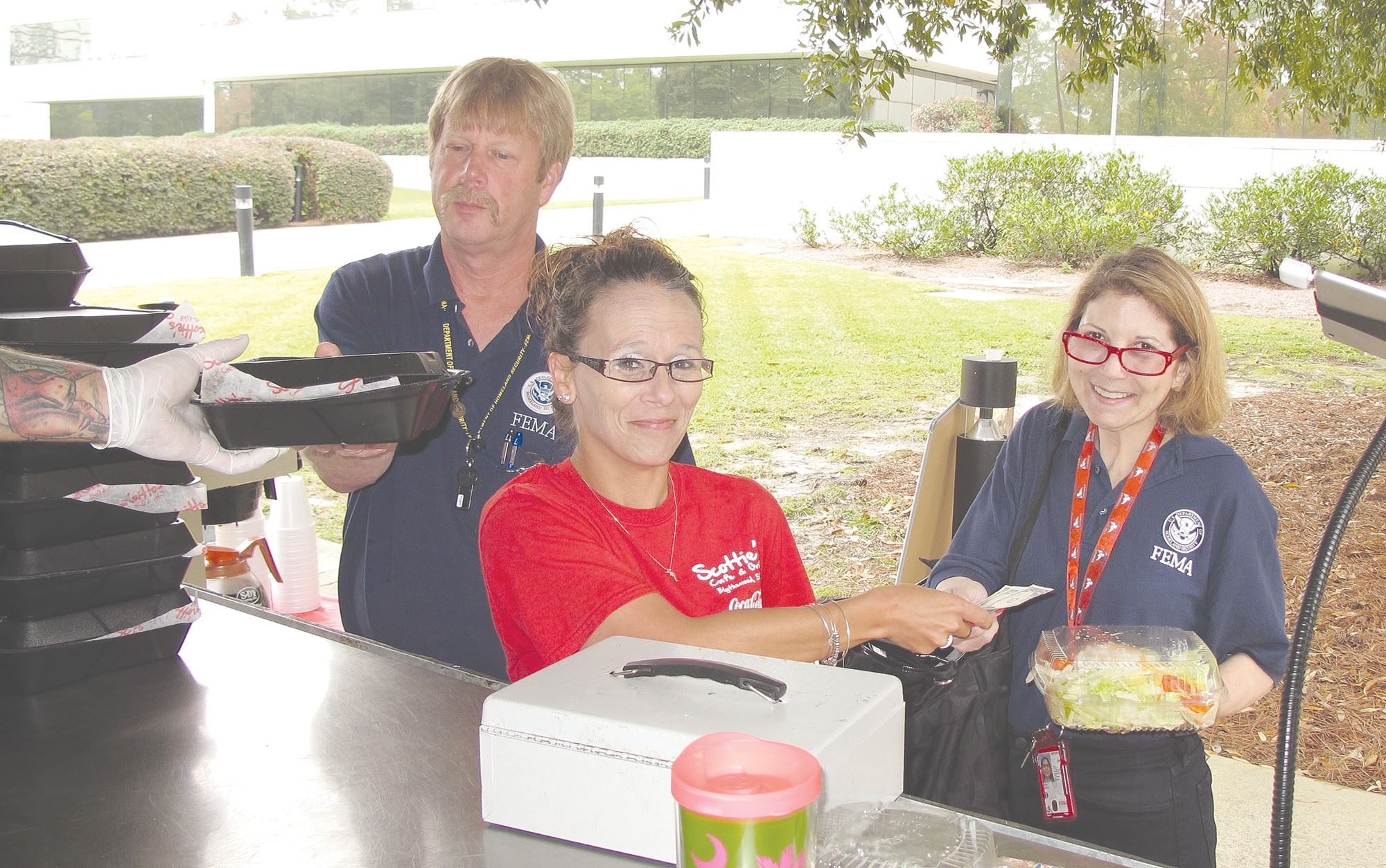
    FEMA employees temporarily headquartered at Blythewood’s CSC building order lunch from Scottie’s Café food truck, one of several Blythewood businesses enjoying a boon in business while FEMA is in town. FEMA employees Paul Peterson of Connecticut, left, and Marcie Roth of Washington, D.C., purchase lunch from Scottie’s server Melissa Letrick. (Photo/Barbara Ball)
    FEMA employees temporarily headquartered at Blythewood’s CSC building order lunch from Scottie’s Café food truck, one of several Blythewood businesses enjoying a boost in business while FEMA is in town. FEMA employees Paul Peterson of Connecticut, left, and Marcie Roth of Washington, D.C., purchase lunch from Scottie’s server Melissa Letrick. (Photo/Barbara Ball)

    BLYTHEWOOD (Oct. 29, 2015) – While severe flooding in South Carolina brought death and devastation to many parts of the state, the aftermath of recovery and rebuilding is bringing business to Blythewood. That business is the result of FEMA setting up its temporary joint field office for the entire state in Blythewood’s CSC building on Oct. 12.

    After searching the state for a location with proximity to the state government offices and enough space to house 700 employees and access to major transportation arteries, nearby hotels, restaurants and other services, the mega emergency management agency settled on Blythewood.

    Marcie Roth of Washington, D.C., and a member of the team scouting potential locations for FEMA, said Blythewood offered everything it was looking for.

    “We work through the General Services Administration to find appropriate locations and sometimes have to set up in shopping malls, vacant Wal-Mart stores and even in tents. This is the perfect location and we have this great facility,” she said, motioning toward the CSC building and its surrounding landscaped campus. “It has ample parking and plenty of space inside for internal training. It doesn’t have a cafeteria, but that’s OK. We have Scotties.”

    Scotties’ Café food truck and a number of others pull up to the building six days a week serving breakfast, lunch and snacks.

    “It’s been big business for us,” said Scott Opolyn, owner of Scotties’ Cafe whose staff serves breakfast, lunch and about 20 gallons of coffee a day to FEMA employees at the CSC location.

    And he’s not the only one benefiting from the new businesses in town. The hotels and other restaurants in town are also seeing an uptick in business from the FEMA presence. Blythewood Mayor J. Michael Ross said the town is happy that FEMA chose Blythewood for its temporary headquarters.

    “We love having them here, and we want to accommodate them in any way we can. It’s our goal that they enjoy their stay here in town while they do this very important work to help our state and citizens put their lives back in order,” Ross said.

    The FEMA field office is a state and federally coordinated operation that supports the recovery effort throughout the state in the counties where the president has declared disaster areas.

    “FEMA is a funding organization,” Harry Skinner, an external affairs employee at the CSC location explained. “But this location is not where people can come to get individual help,” he emphasized. “We do not work directly with flood survivors. We have 22 different locations in the state where flood survivors can go for individual assistance. Our employees, at this location, provide overall management of FEMA’s disaster recovery efforts for the whole state.

    “Our Operation here at CSC,” Skinner said, “is pretty much self-sufficient. We’ve brought with us all the usual departments a large company has such as IT, logistics, human resources, planning, finance and administration, accounting and staffing, all in one location. Plus,” he added, “we provide program support staff for individual assistance, public assistance and mitigation efforts out in the field.”

    Skinner said FEMA’s field office has no timeline for how long it will be in operation in Blythewood. Asked if it could be months, he said, “As long as it takes. As we move ahead our footprint here will be reduced based on the needs of the state. We are very happy to be here in Blythewood. This location seems to be handling our needs very well,” Skinner said. “Our employees have felt warmly welcomed by Blythewood and by all of South Carolina.”