Category: Business

  • Attempt to Max Out Lots Fails

    COLUMBIA (June 9, 2016) – When members of Richland County Council prepared, at their May 24 meeting, to delete verbiage from the County’s zoning law designed to ensure that developers do not stuff new projects with more houses than the community can sustain, LongCreek Plantation resident Sam Brick, a retired attorney and government watchdog, took note and then took on Goliath.

    To Brick’s credit, and to his surprise, he won the battle.

    “Council advertised the proposed deletion of critical protective language in the zoning law as ‘clarifying,” but they were not clarifying anything. They were going to change the law by taking out the phrase: ‘but in no case shall it (the individual lot) be less than…’

    “That phrase is specific to each zoning district and is included in the zoning regulations of every zoning code to specify the minimum size allowed for lots in that particular zoning district,” Brick said.

    Within his allotted three minutes before Council, Brick passionately explained how removing that phrase would virtually emasculate zoning designations in Richland County.

    “By removing this phrase, Council would make it legal to do what they have been doing illegally for years – allowing developers to skirt the zoning laws by putting more lots in a development than the law allows. “

    This illegal reduction of lots crept in, Brick said, through the Green Code provision (later called Open Spaces provision), passed several years ago by Council to allow developers the benefit of reducing the sizes of their lots on certain conditions, one of which was that the developer would set aside a certain amount of green space for parks, walking trails and other amenities in addition to the space already required for roads, buffers, rights-of-way, etc.

    Brick said he first become concerned about the reduction of lot sizes a couple of years ago when, under the guise of the Green Code provision, developers in his own neighborhood were granted more dense zoning designations by County Council than were allowed by the County’s zoning law.

    “It was a developer’s dream come true. They were turning areas designated for medium density into high density without having to ask for a zoning change,” Brick said.

    “Without that phrase, developers would be free to reduce lots and, in effect, change the zoning of a development without having to apply for rezoning,” Brick told Council members.

    Prior to appearing on the County Council agenda, the proposed amendment first appeared the month before on the Planning Commission’s agenda. Brick emailed residents in his neighborhood encouraging them to attend the Commission meeting and to speak out against removing the critical phrase.

    “I am not optimistic in my chances,” Brick wrote to his neighbors, “but someone needs to attempt to uphold the integrity of our zoning laws and, at least, in the few minutes allotted, explain the effects of what the Commission is being asked to do.”
    The only visible support Brick received at the meeting came from neighbor and friend Bernie Randolph.The task before Brick was daunting.
    In spite of Brick’s plea to save the phrase, the Commission voted unanimously to recommend that Council ‘clarify’ the zoning code by removing the phrase.

    Addressing Council on May 24, Brick explained how the County’s Planning Department has been ignoring the target phrase for some time, allowing a developer, under the Open Spaces provision, to put in as many houses as the developed area could fit by dividing the entire area by the stated minimum lot size for the relevant zone without first deducting the space needed for roads, easements, wetlands, etc.

    “This resulted in approximately 20 percent of new residential developments having lots substantially smaller than the zoning allows in spite of the legal requirement for minimum lot sizes,” Brick said.

    Brick told Council that while each zoning district gives a specific exemption for valid Open Space developments, the Open Spaces provision has a formula that must be adhered to entirely if the developer is to take advantage of the reduced lot portion of the provision, Brick said.
    After Brick’s three minutes ended, Councilwoman Joyce Dickerson, who represents much of Blythewood, moved that the proposed zoning amendment (deleting the ‘but in no case’ phrase) be adopted.

    After a long pause and no second, Chairman Torrey Rush announced that the proposed amendment had failed.

    Brick said he was happy with the vote, but was especially encouraged that, in discussions following the vote, that several Council members confirmed, verbally, that the amendment was not needed and that the Open Spaces provision should be re-examined.

    “I’m very happy with the outcome,” he said. “But the fight is far from over.”

     

  • Council OK’s Amphitheater Naming Rights

    BLYTHEWOOD (June 2, 2016) – Town Council gave the OK Tuesday morning to an agreement with the Doko Meadows Park Foundation and Palmetto Citizens Federal Credit Union to construct an amphitheater in Doko Meadows Park and naming it the Palmetto Citizens Amphitheater.

    The nearly $400,000 project is being funded with a grant and pledges from across the community, including $125,000 from the credit union for naming rights.

    “It’s exciting that we have that commitment from our new credit union that’s coming to town,” Mayor J. Michael Ross said.

    Ross said the venue will not include formal seating, but will be open and will include a stage, lighting and sound equipment. Capacity, Ross estimated, could be between 2,000 and 3,000 people. The project has not yet been put out for bid, Ross said.

    “As a community chartered credit union, we’re happy to be able to support great projects that better the communities we serve, like the Doko Meadows Park amphitheater,” Nick Wodagaza, president of Palmetto Citizens, said. “We’re excited for this opportunity to further show our support for Blythewood and look forward to opening our new office her later this year.”

    In addition to the credit union, several community members and companies have made pledges or contributions to the Foundation for the amphitheater. Those contributors will be announced later, the Foundation said.

    “We are excited about the amount of progress the foundation has made in a relatively short time in raising funds to build this new addition to Doko Meadows Park,” Jim McLean, Foundation president, said. “Our approach was to contact companies and individuals who have a presence in the community and the responses have been great. We strongly believe this new venue will further enhance our community charm for our citizens and visitors alike.”

    Construction is expected to begin soon, with the goal of opening the amphitheater early next year.


  • Family Owned –

    IMG_0603 copy

    Ridgeway Mayor Charlene Herring, center, and Town Councilman Don Prioleau presented Ridgeway’s 2016 Entrepreneur of the Year award to Larry Sharpe, left; his wife Eileen and their granddaughter, Lakyn Fowler. The Sharpes own The Farm at Ridgeway, and Fowler is the event coordinator. “Larry and his family have contributed greatly to our local economy by owning and operating several businesses in the Ridgeway area for many years,” Herring said when presenting the award last week. “But it is The Farm at Ridgeway that has won our hearts and brought people from across South Carolina to Ridgeway and Fairfield County. And we are thankful to this family for that.”


  • Manor Pulls Out of Slump

    BLYTHEWOOD (May 12, 2016) – The Town’s event center, the Doko Manor, which was once labeled by at least one Town official in a public meeting as a financial albatross, appears to be pulling out of a three-year financial nose dive with a projected revenue of $145,992 for fiscal year 2016.

    While Event Director Steve Hasterok told The Voice last week that The Manor, “is still a little ways from being full-blown profitable, we’re getting there.”

    “We’re now covering operating costs, and sales are great,” he said.

    “I think the fourth quarter this year will probably be the strongest quarter the Manor has ever had,” Hasterok reported to Council during their April 25 meeting. “I projected fourth quarter revenue at $50,800, and we’re looking at revenues now of about $60,650 for the quarter.”

    “The Manor’s busy,” Hasterok said. “We had 22 events in April, with a fourth quarter average of over 17 events per month. We average 20-50 inquiries per week now, and we’re becoming known as the place of choice, especially for Friday night parties and Saturday weddings. We have a beautiful facility, people like it and we’re very competitive in our pricing.”

    Hasterok said The Manor’s newly completed bridal dressing room is currently being furnished, as is his new office, both of which were located in The Manor after the facility’s front porch was enclosed for additional space.

    Hasterok told Council, “We are looking for a very strong FY 2017. We don’t have a weekend available from now until the end of this calendar year. “

    He said The Manor expects to accommodate 40 – 50 weddings during 2016.


  • Scrolling Sign May Scroll No More

    BLYTHEWOOD (May 12, 2016) – Having prevailed in 2011 in what the attorney representing Companion Animal Hospital called “the unpleasantness” of securing a variance for a non-compliant electronic changeable copy (ECC) sign after a long, contentious sign permitting history dating back to 2008, the hospital’s owner, Elaine Meincke, returned to the Board of Zoning Appeals (BZA) Monday evening in an attempt to keep the hospital’s non-conforming ECC portion of the sign scrolling beyond the previous variance’s January 2016 deadline.

    This time, the BZA ordered that the ECC portion of the sign must either come into compliance with the current sign ordinance or cease operation. Compliance would mean the ECC sign would change only once per hour during hours of operation and would not scroll but remain static.

    Companion’s attorney, Alexander Shissias, said the hospital’s ECC sign cannot comply. He said the ECC portion of the sign is an LED, which is subject to burn out when left static over long periods of time, and it cannot display more than one line of text with a few words at a time.

    In a letter to Town Administrator Gary Parker, Shissias wrote, “Without scrolling, the sign is limited to a display of ten characters at any one time. After working with the software, I was unable to change the size of the characters, unable to change the font to fit more characters in, and I was unable to split the text into two lines.

    “The only thing we are asking relief from is the one-hour limitation,” Shissias told the Board. “We are requesting, instead, to have three messages displayed over a nine minute period. No scrolling. That will allow the owner to display three short messages such as hours of operation and the services. And changing every three minutes will keep the sign from burning out. Without something like this, the sign will grind to a halt.”

    BZA Chairwoman Sabra Mazyck reminded Shissias that all the businesses in the town had been asked to have their signs comply with the current sign ordinance by Jan. 16.

    “If we allow you to do this, what about all these other businesses who have come into compliance?” Mazyck asked.

    Shissias reluctantly reviewed the sign’s tortured history in which Companion and many in the community felt the sign’s permit had originally been held up until a new ordinance was put in place that would not allow ECC signs.

    “The sign was purchased in 2008,” Shissias said, “but it took so long to get it permitted that the ordinance (limiting ECC signs) beat it. There was issuance of something that looked like a sign permit and then the sign was turned on and my client was immediately served for non-compliance and taken to magistrate’s court. It wasn’t until April 2009, the sign was allowed to scroll.”

    Shissias concluded his request, saying, “We’re just trying to get the life out of this sign before it dies.”

    The Board expressed sympathy for Companion’s plight and Board member Joseph Richardson offered a possible solution to give Meincke more time before taking the non-complying sign out of commission.

    “I’d like to put on the table that we (give you) a very limited-in-time extension of the right to use this sign,” Richardson said, “perhaps allowing it to change a little bit more often than every hour based on the fact that this is one time in this set of circumstances and that we’re going to limit use significantly, and then a drop-dead date after which there is no more discussion of this sign. And then it has to be gone or operated within the ordinance.”

    While Board Attorney Danny Crowe advised that the Board could, indeed, attach conditions to a variance, the variance was not to be.

    Every variance granted by the BZA must, by law, meet all of five specific findings and conclusions. While the variance met some, it did not meet all and was denied.

    “We tried to find a resolution that would work,” Board member Debra McLean said at the conclusion of the meeting.

    The BZA is a quasi-judicial board and its decisions are appealed to Circuit Court. Meincke said she does not plan to appeal the Board’s decision, but is looking at other sign options.


  • BZA Denies Abney Hills Variance

    BLYTHEWOOD (May 12, 2016) – The Board of Zoning Appeals (BZA) rejected a request Monday night for a variance that would have squeezed more homes into less space in the Abney Hills subdivision.

    About 25 residents of the Phase I section of Abney Hills subdivision packed Monday night’s BZA meeting in opposition to the request from Essex Homes, the neighborhood’s developer, for a variance to reduce the residential side setbacks from 15 feet to 10 feet in Phase II of the subdivision. With the reduced setbacks, the houses would be closer together. The side setbacks in Phase I are a combined 17-feet minimum.

    Resident Colin Murch led off a string of speakers opposing the request.

    “The variance request is more of a financial request than a request for (better) land utilization. The letter submitted with the application for the variance was, in my opinion, disingenuous and misleading in the fact that the developer states they don’t want to change the character of the development. They are reducing the lot size (in Phase II) by an average of 19 percent. There were only 47 lots in the original concept of Phase II,” Murch said, “and now Essex proposes 52 lots, an increase of five lots. If you (Essex) went back to the 47 lots, you wouldn’t need the variance to make the houses all fit in. It’s clearly a financial ploy.”

    Because the first phase of the project was designed before the subdivision was annexed into the town of Blythewood, that phase was developed to the standards of Richland County’s Open Space ordinance, which allowed more flexibility in setback metrics, said John Champoux, Vice President of Sustainable Design Consultants, Inc., representing Essex. The second phase is being developed completely under the Town’s regulations, which require the 15-foot side setback.

    “The lots in Phase I are larger than they had to be,” Town Planner Michael Criss confirmed, “and the lots proposed in Phase II are smaller than those in Phase I. But they are not smaller than the 12,000-square-foot minimum required by R-12 zoning, the subdivision’s zoning classification.”

    Champoux pointed out in the letter accompanying the variance application that, “A reduction in the side setback requirement will give (Essex) the ability to offer a comparable product (home) at a comparable price point in the second phase as they were able to offer in the first phase. The more restrictive 15-foot side setback would require Essex to offer a different, downsized product that will change the character of the neighborhood and lower property values of those who have already bought into the community.”

    Board member Joseph Richardson clarified Essex’s position for those in attendance.

    “In order to build the same size home on the smaller Phase II lots as you built on the larger Phase I lots, you are proposing to reduce the setbacks between the (Phase II) homes,” Richardson said. He pointed out that the restrictions could be eliminated if Essex went back to 47 lots.

    Champoux agreed that the reason Essex was asking for the setback was partly financial.

    “The best-selling product in Blythewood is selling in Phase I in Abney Hills Estates,” Champoux said, “so we want to offer the same size (homes) on these (Phase II) lots as we offered in Phase I. We’re asking for a variance in order to do that.”

    Chairwoman Sabra Mazyck reminded the Board that “The fact that property may be utilized more profitably, should a variance be granted, may not be considered grounds for a variance.”

    She also read from the Powers and Duties of Board of Zoning Appeals that the Board can only grant a variance if it can meet all of five findings and conclusions in a written order. After considering each of the five items, Board members concluded that all of the findings and conclusions could not be met and voted 4-0 to deny the variance request.


  • Caterpillar Announces Ridgeway Closing

    RIDGEWAY (May 6, 2016) – Caterpillar, manufacturer of construction equipment and machinery, announced the closing last week of five production facilities nationwide, including an assembly facility in Ridgeway.

    The generator set control panel assembly facility in Ridgeway is one of two S.C. Caterpillar sites slated for closure in the next 12-18 months, the company said. The company said it will also be closing down the electric power generator set packaging facility in Newberry. The closings will amount to the loss of about 75 jobs in Ridgeway and 325 jobs in Newberry.

    Nationwide, closings will result in the loss of about 820 jobs, the company said.

    Caterpillar acquired the Ridgeway facility, located at 93 Commerce Blvd., in 2015 from Elite Electronic Systems. The closure is expected to begin this year, Jamie Fox, Senior Public Affairs Manager for Caterpillar, said.

    Work at the S.C. sites will be consolidated into existing Caterpillar engine facilities in Seguin, Texas; Lafayette, Ind.; and Griffin, Ga.

    The company is also shutting down the Jacksonville, Fla. production of buckets and other work tool attachments for the medium wheel loader product line and moving production to existing suppliers. The closing will impact about 70 employees, Caterpillar said.

    Production of engine and undercarriage components at the company’s Morganton, N.C. plant will be moved to existing and outside suppliers over the next year and a half, the company said, impacting around 110 positions.

    In Oxford, Miss., the company will close its facility that produces hose couplings. Some of those operations will move to Caterpillar’s Menominee, Mich. facility, with the rest transitioning to outside suppliers. The closure is estimated to cost 240 jobs.

    In addition to the closings, Caterpillar said it plans to demolish a vacant building at its Mossville, Ill. site. The building, which has stood mostly empty since 2011, was once used to house engine manufacturing. No jobs will be lost as a result of the demolition.

    Since September 2015, Caterpillar’s restructuring process has eliminated approximately 5,300 jobs nationwide. Including these most recent closures, the company has closed or consolidated around 20 facilities.


  • Abney Hill Estates Gets Variances

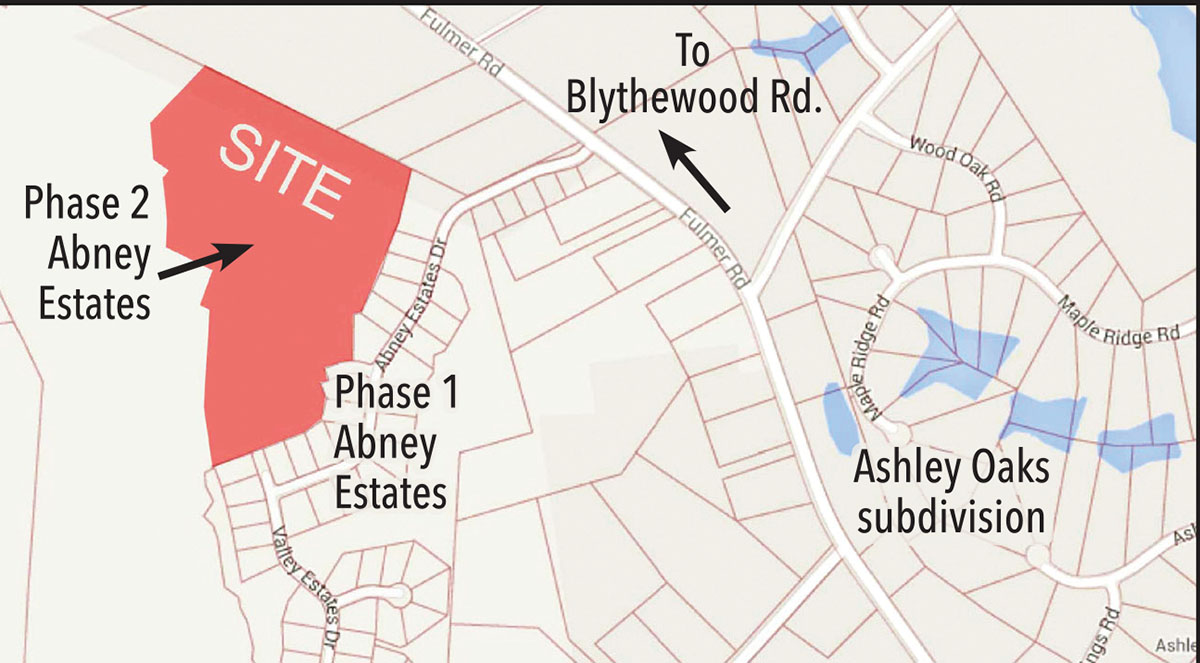
    Abney Hill map conv copyBLYTHEWOOD (May 5, 2016) – After Town Administrator Gary Parker gave administrative approval to Essex Homes earlier this month for a proposed sketch plan for Phase 2 of the Abney Hill Estates subdivision, the Town’s Planning Commission on Monday evening voted unanimously to delegate authority to Parker to issue a preliminary approval letter for the plat, but with conditions.

    The vote to approve also included a variance from the Town’s land development regulations that will allow Essex to disturb (grade) more than a third of the 90,000 square feet of designated buffered land along a stream that runs through the property. The average width of the buffer zone is 50 feet. The variance specifies, however, that the land disturbance must not intrude upon the 20 feet of land next to the stream, Parker wrote in a memo to Essex Home’s management.

    While Town Planner Michael Criss said the developer would be required to revegetate (according to submitted plans) the land area disturbed by the grading, Parker said it would take the Town’s employees time and resources to inspect and monitor the revegetated stream buffer area for erosion control now and over time.

    Town Planner Michael Criss told the Commission that while the variance will not set legal precedent for buffer land disturbance, it will set design precedent for other developers.

    “Why can you not leave the buffer undisturbed?” Commissioner Marcus Taylor asked John Champoux, Vice President of Sustainable Design Consultants, representing the developer.

    “We would lose a variable amount of land and (housing) units,” Champoux answered.

    In referencing Essex’s storm water management for the development, Criss pointed out that the 25-acre development will be the first low-impact development in the Town and could be a pilot for future developments.

    The following conditions were imposed by the Commission on the plat approval:

    • Ownership of the property being developed must be resolved to the Town’s satisfaction (presentation of a deed).
    • The plat must be reviewed by the Town’s consulting engineer and by Richland County Public Works.
    • Parker must be allowed to review the response from the S.C. Department of Transportation (DOT) to a traffic impact memo issued by the developer’s engineering firm that indicates certain intersections near the Phase 2 development (Fulmer Road at Blythewood Road, Abney Estates Drive at Fulmer Road and Mt. Valley Road at Fulmer Road) will not be significantly impacted by increased traffic from the development. Further, any improvements mandated by the DOT would be incorporated into the subsequent bond plat or final plat and not hold up construction.
    • The Town must receive the National Pollutant Discharge Elimination System permit from the S.C. Department of Health and Environmental Control. The disturbed stream buffer area must be revegetated.
    • The developer must submit confirmation of the calculations for the minimum required replacement of trees.

    Champoux told the Commissioners that the project is on schedule to begin construction in 2017.


  • Water Rate Hike Could Hit Blythewood

    BLYTHEWOOD (May 5, 2016) – A proposed increase in Columbia water and sewer rates could impact as many as 800 residential and commercial customers in the Blythewood area.

    Columbia City Council is currently considering a 4.3 percent increase in rates, which would take effect July 1. The rate hike could add between $2.26 and $12.77 to monthly bills of Blythewood customers. Although Blythewood is served by the Town of Winnsboro, the water passing through Winnsboro’s meters in Blythewood is purchased by Winnsboro from Columbia.

    “Whatever cost we incur (from Columbia) would have to be passed on to Blythewood customers,” Lorraine Abel, Winnsboro’s Assistant Town Manager, said Tuesday.

    But with the first vote on the proposed budget, which includes the rate increases, not scheduled until June 7, Abel added that it was too early to say specifically what those costs would be. Two votes are needed to pass the budget.

    If the 4.3 percent increase is approved, residential water customers outside Columbia’s city limits would pay an average of $3.80 more per month, or a little more than $93 per monthly.

    Commercial customers outside Columbia’s city limits would see an increase of $12.77 per month, which would send their monthly bill to just over $313.

    Customers inside the city limits would feel somewhat less pain, with residential customers paying an average of $2.26 more per month and commercial customers paying an average of $7.49 more per month. The average residential bill inside the city limits would increase to about $54.75 per month, while the average commercial bill would be about $184 per month.

    The 4.3 percent increase could generate more than $5 million in additional revenue for the City, all of which would go toward improvements to the water and sewer systems. The additional revenue would also reduce the amount the City will have to borrow in order to invest a planned $140 million into upkeep of and upgrades to the systems.

    City Council will meet again on May 10 to discuss the proposed rate increases. A public hearing is slated for June 7, prior to the first vote on the budget.


  • School for Troubled Teens Slated for Greenbrier

    WINNSBORO (April 22, 2016) – When the director of a new alternative school for troubled teens presented County Council with his plans during Council’s March 28 meeting, one Councilman encouraged the director to make a similar presentation to the community before opening for business.

    Cameron Tea, director of Cambio Academy, told Council his Utah-based company was already renovating a building at 1403 Greenbrier Mossydale Road in Winnsboro, and hopes to have the facility open by August.

    Cambio is a high-end, private academy, Tea said, that has partnered with S.C. Whitmore, a virtual charter school headquartered in Chapin. Cambio offers wilderness therapy, equine therapy and experiential learning therapy in a group-care environment.

    “A lot of these kids come from very affluent families (and they) need to kind of grow up a little bit and realize the world isn’t just handed to you; you have to work for it,” Tea told Council. “They’ve never pulled weeds from a garden, they’ve never had to be responsible to take care of an animal.”

    Some of them, Tea said, may even have to learn something as basic as “how to clean their room every single morning.”

    The academy recruits clients from across the U.S. as well as internationally, Tea said, and they typically come recommended by private education consultants. He estimated that Cambio would house between 48 and 72 teens who would stay at the academy for a period of eight to 14 months. The academy will have a staff to student ratio of 1:6, he said, with supervision provided around the clock.

    Following Tea’s presentation, District 4 Councilman Kamau Marcharia urged Tea to hold a meeting in the Greenbrier community to make sure citizens there felt safe about having at-risk teens housed close by. Marcharia asked Tea if some of the teens in the academy might be potentially be suffering from mental health issues, which could be cause for concern in the community.

    “A lot of these kids do have some psychological issues,” Tea replied, adding that some of them may be taking prescribed medications for those issues. “We are clinically intensive and have a therapist on staff. We do not take kids that are super high risk. We’re not a lock-down facility. We do not take kids who are coming off drugs. We take kids who are coming off their short-term rehab centers for a boot camp experience.”

    Marcharia also asked Tea if there was a history of any of these troubled teens breaking out of the facility, something that also might be of concern to the surrounding community.

    In his 10 years on the job, Tea replied, there have been two cases of teens running away from a facility.

    “That’s less than 1 percent,” Tea said. “It’s always a potential factor, but a very limited factor. There are alarms on doors and windows, but sometimes they figure out ways; but for the most part they want to graduate, grow and get back to their home life.”

    While Tea agreed to hold a community meeting before opening the doors to Cambio Academy, Interim County Administrator Milton Pope told Council that the property at 1403 Greenbrier Mossydale Road was already properly zoned to accommodate Tea’s venture.

    “There was no way we could prevent them from offering their business and that particular location,” Pope said.

    Tea had come to administration with his proposal more than a year ago, Pope said, and had coordinated the development of the site with the County’s Planning and Zoning office.

    “They have followed through with everything they said they would,” Pope said.