Category: Business

  • District Surveys Teachers on Patio Homes Plan

    WINNSBORO (Sept. 1, 2016) – Following an update by Dr. J.R. Green, Superintendent, at the beginning of the Aug. 16 School Board meeting concerning his proposal last month that the School District construct and rent out patio homes to teachers, School Board member William Frick (District 6) suggested the District first survey teachers who have left the District to determine whether, if those teachers had had viable housing options, it would have kept them from leaving the District. Frick said a survey might determine if there’s a demonstrated need for teacher housing and if it would be helpful for teacher retention.

    “That’s an interesting point,” Green said. And last week he followed up with a survey, but to current teachers, not to teachers who have left the District as Frick suggested. The surveys were email generated to individual teachers from the District office.

    Green said in the July meeting that he had spoken with the County’s strategic planners who thought providing housing for teachers was a great idea.

    David Gjertson, a planner with Landscape Architecture/Urban Design, told The Voice that while he liked Green’s idea of using housing as an incentive, he would like to see it broadened to include other Fairfield County public employees as well – fire fighters and EMS employees, for instance.

    He also questioned how the project would be funded. Gjertson told The Voice that he would like to see a combination of public and private funding including federally subsidized funding rather than the traditional funding that Green initially suggested.

    Gjertson also said he would rather see the program based on home ownership instead of patio home rentals to avoid the appearance of public housing. Gjertson also said, most importantly, that the project be developer driven.

    “We are not advocating public housing,” Gjertson said. “We are advocating home ownership, and for a broader group of County employees.”

    Green further clarified the project, saying, “We are in the research phase (of the proposal). We don’t have all the details worked out yet. A lot of issues I will be working on. I had a conversation with (State Education Superintendent) Molly Spearman last week about some assistance from the state to make this vision become a reality.”

    Green included some documentation in the Board’s packet of similar projects in North Carolina. He said he is looking at how some of those are being funded.

    “There are more options that we are exploring to make this a reality,” Green said. “When I have all the details I will present it to the Board as an action item to be approved.”

    Board member Paula Hartman (District 2) asked Green if the school could legally finance the project with school funds. Green said he did not know.

    Bus Driver Pay Increase

    “Some have asked what it will cost the School District for the 3.2 percent pay raise the state has mandated for the District’s bus drivers (discussed at the July Board meeting),” Green said at the Aug. 16 meeting.

    Green said that while most of the raise for the bus drivers will be covered by the state, he wants to also provide a 3.2 percent increase for the bus monitors, which is not covered by the state. That will bring the cost to the District to about $36,000.

    “We determined we have adequate funding in the budget for that,” Green said.

    Renovations of Kelly Miller

    Green told the Board that renovations to Kelly Miller Elementary School would allow the portables to be removed from the campus and that a six classroom addition would alleviate overcrowding. He gave as an example that the school band now has to use the stage as a ‘practice room’ while at the same time physical education classes are being conducted in the gym.


  • Doko Smoke Needs Your Vote

    Tony and Chris Crout of Doko Smoke BBQ shoot for ‘Best of the Best.’
    Tony and Chris Crout of Doko Smoke BBQ shoot for ‘Best of the Best.’

    BLYTHEWOOD (Sept. 1, 2016) – Barbecue duo Chris and Tony Crout, owners of Doko Smoke BBQ, have made the top 10 in the ribs and barbecue categories in The State newspaper’s Best of the Best contest, but Tony Crout said they will need a little help from the community to make it over the top.

    “We’re in the running for the final vote,” Crout told The Voice, “but we’ll need a lot of votes from our customers to be named the Best of the Best.”

    But voting, Crout said, is tricky. One vote won’t do it.

    “People have to vote in a minimum of 30 categories for their vote to count,” Crout explained. “They can go online and vote once a day at thestate.com/best or look for the green ‘The Best’ logo.

    While there is no prize, to win would mean a lot to the Crouts.

    “The recognition would be great and we would be able to use the Best of the Best logo in our marketing and advertising,” Crout said. “We hope it will happen.”

    The contest runs through Sunday, Sept. 11. Winners of the public opinion poll will be announced Sunday, Oct. 23. Doko Smoke BBQ is located at 408 Main St., Blythewood. For more information, call 803-730-6016.


  • Voice Ad Designer ‘Best in Show’

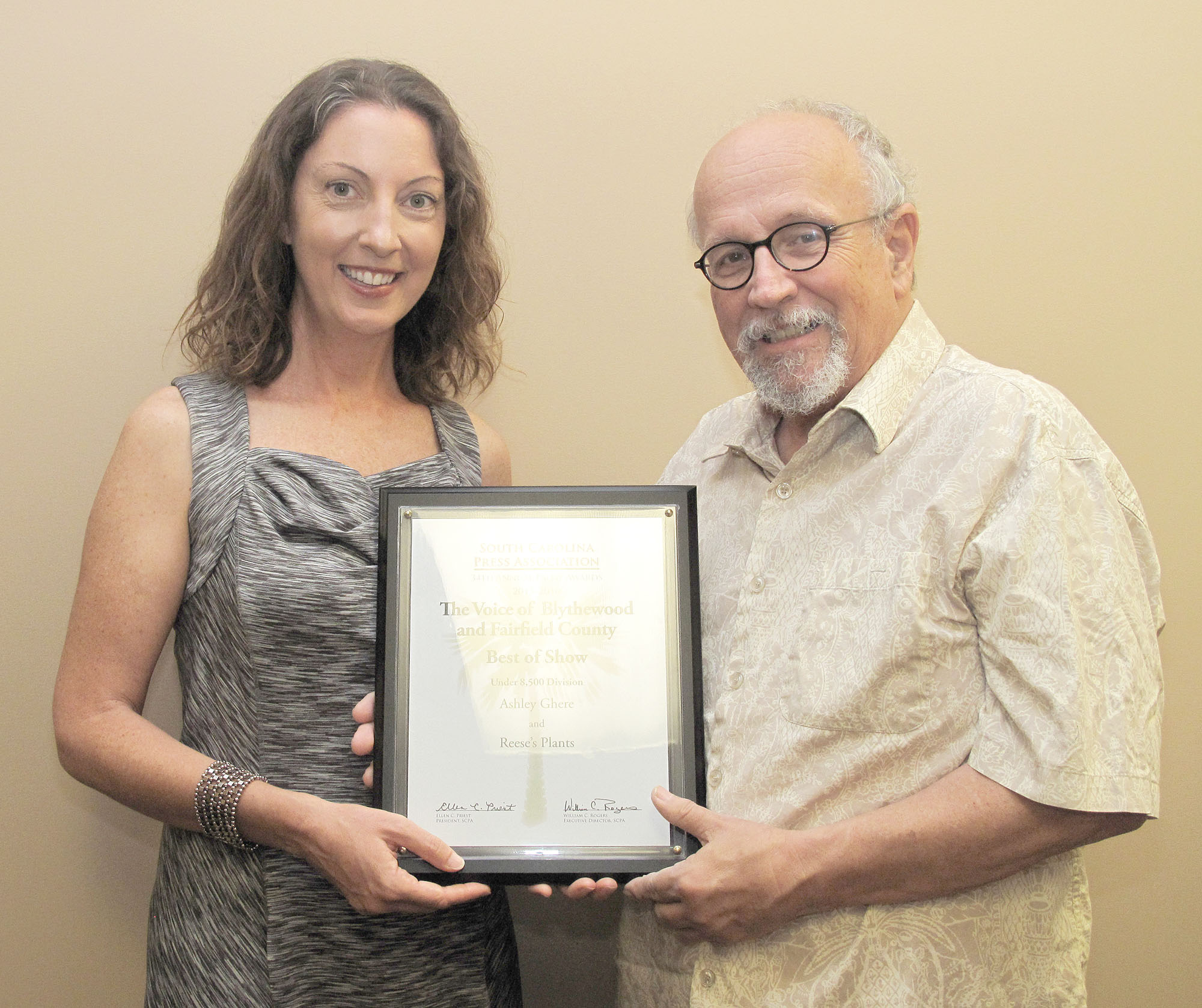
    Bill Rogers, Executive Director of the S.C. Press Association (right) presents Voice graphic designer Ashley Ghere with her fifth consecutive Best in Show PALMY Award for ad design.
    Bill Rogers, Executive Director of the S.C. Press Association (right) presents Voice graphic designer Ashley Ghere with her fifth consecutive Best in Show PALMY Award for ad design.

    BLYTHEWOOD/FAIRFIELD (Aug. 25, 2016) – Ashley Ghere, the graphic designer for The Voice who makes our advertisers look their very best, was honored for her work this month with 14 PALMY Awards from the S.C. Press Association.

    Ghere took home four first-place awards in the weekly under 8,500 circulation division, including the Best in Show Award for her Reese’s Plants ad, highlighting the garden store’s knockout roses selection. The ad also earned first place in the Professional Services category.

    This was Ghere’s fifth consecutive Best in Show win.

    “Wow. A knockout ad for knockout roses,” judges said. “Impossible to miss this ad. The message could not be more clear. Great work.”

    Ghere’s ad for Over The Top Boutique in Ridgeway took first place in the Fashion category, while her ad for the Midlands STEM Institute won first in the Half-Page or Greater category. Her ad for Emma Clifton earned first in the Miscellaneous category.

    Ghere also earned five second-place awards, including her ad for the Wings & Wheels Air Festival (Events/Cultural Entertainment category), the Blythewood Butterfly Festival (Small Space Ad), the Blythewood Merchants’ Valentine’s Day ad (Half-Page or Greater), the Holiday Entertaining Guide (Special Section) and The Voice’s ‘Thinking Inside the Box’ newspaper promotion ad.

    Her four third-place finishes include ads for The Law offices of Shannon Burnett (Professional Services), S.C. Farm Garden Wildlife (Home Furnishings), New Kirk Presbyterian (Non-Profit Community Service) and the Elaine Baker obituary ad (Miscellaneous).

    Congratulations to Ashley Ghere! Find out how good she can make your business look by calling 803-767-5711.


  • ‘Peddlers’ May Soon Need License

    Manor Tweaks Fees, Chamber OK’d for Grant

    BLYTHEWOOD (Aug. 25, 2016) – Town Council Monday night kicked around the possibility of enacting a special license for peddlers doing business inside the Town limits. Jim Meggs, the Town’s attorney, said the license would actually cover what he called “itinerate merchants” rather than peddlers. Peddlers, he said, refers more to door-to-door sales and solicitations, whereas an itinerate merchant was a temporary, mobile business.

    “We were concerned with folks who come to town, set up shop on a piece of property, in a trailer or some other kind of a setting, and offer goods and services for sale,” Meggs said, “but not from a fixed place of business and a permanent attached building with all of the required facilities that you would normally see in a qualified fixed place of business.”

    As an example, Meggs provided Council with the regulations followed by Midvale, Utah. The Midvale regulations are extensive, Meggs said, requiring everything from background checks to off-street parking and access to rest rooms. The simplest approach, he suggested, would be for Council to regulate the Town’s zoning districts and allow temporary, mobile businesses to conduct trade there.

    Michael Criss, Town Planning Consultant, suggested that Council also consider including food trucks in the regulations.

    According to documents provided by the Town, Council is considering a two-tiered licensing structure. For regular activities (more than two sale periods of more than three days each per year), Council is considering a $40 fee for the first $2,000 of sales, plus $1.45 per each $1,000 in sales over $2,000.

    For seasonal activities (not more than two sale periods of not more than three days each year, with a separate license required for each sale period), Council is considering a $40 license for the first $2,000 in sales, plus 40 cents per each $1,000 in sales over $2,000.

    But tracking sales of peddlers and itinerate merchants, Mayor J. Michael Ross said, is a trick unto itself.

    “A lot of those places come in and I don’t know if they ever report any sales,” Ross said, “whether it be to the state government or us.”

    Council took the material as information to be discussed in depth at a future meeting.

    Chamber Grant

    Council also agreed to partner with the Chamber of Commerce in applying for a grant from the S.C. Municipal Association to convert the space currently being used by the Chamber in McNulty Plaza to a shared work space for small businesses that cannot afford to rent an entire space of their own.

    Mike Switzer, Executive Director of the Chamber, said the Town’s $12,500 economic development grant already provided to the Chamber, would more than cover the 5 percent match required by the Municipal Association grant.

    Manor Report

    Steve Hasterok, Director of Doko Manor, told Council that the first quarter of fiscal year 2016-2017 was about $1,000 shy of projections, mainly because of several cancellations of events.

    Saturdays are still strong, he said, and are almost entirely sold out for the next year. Fridays and Sundays, however, were weak. In an effort to drive Friday and Sunday bookings, Hasterok said he had cut rates for those days by 20 percent.

    “Even with this 20 percent price cut I can still make a profit,” Hasterok said. “I can make a good profit.”

    To combat late cancellations, he said, he has raised the security deposit from $300 to $500. Hasterok said the Manor had employed a two-tiered security deposit structure – $300 for 100 people or less and $500 for 101 people or more – which he said was causing problems.

    “What I found with the $300 security deposit is people play games,” Hasterok said. “They would pay the $300 deposit and then all of a sudden they’d have 170 people show up.”

    People would also pay the $300 deposit to reserve the space, he said, then go out shopping for a better deal. Three weeks later, they would cancel.

    “By raising the security deposit to $500, they have to be a little more committed,” Hasterok said.

    Board Appointments

    Council also approved the appointments of Pamela Dukes to the Board of Architectural Review, and Cynthia Shull to the Planning Commission.


  • Rezoning Vote Creates Confusion

    RIDGEWAY (Aug. 18, 2016) – There was a motion. There was a second. And there was a 3-2 vote by Town Council on Aug. 11 to approve Russ Brown’s request to rezone .82 acres at the fork of Highway 21 and Highway 34 from residential to commercial.

    But as of press time, it was unclear whether or not Brown’s request actually passed.

    Just in case, Herbert Robertson and Robert E. Johnson, who live near the property, sent the Town a letter protesting the rezoning that may or may not have passed on Aug. 11.

    “Opposite side of the tracks. That’s the only thing that’s different between Russ Brown here and the rest of us in attendance,” Sara Robertson, another nearby resident, told Council during the public comment segment of the Aug. 11 meeting. “We, just like Mr. Brown, are hardworking individuals, and we’re trying to protect and maximize our return on our investment, just like he is. However, to have our own Town Council to once again entertain this request to rezone this small parcel of land for one individual at the expense of a whole neighborhood is very disturbing.”

    Robertson presented Council with a petition that she said contained the signatures of 50 people who were opposed to Brown’s rezoning request. But Brown, during his turn at the podium, said the time for opposition to his request was during the Planning and Zoning Commission’s July 12 public hearing. The Commission voted to recommend Brown’s request for C-2 zoning on a 5-2 vote.

    “There was zero opposition at that meeting. It was posted in the paper and a sign was on site,” Brown told Council. “The opportunity to come to the meeting was there.”

    But Robertson pointed out that the Commission had strayed from the Town’s zoning ordinances by recommending the C-2 classification. Indeed, according to Article 10, Section 1007, only the Council or the Commission – not an individual – can initiate a zoning change of a lot less than 2 acres. The exceptions being for the extension of existing district boundaries or the addition of C-1 zoning contiguous to existing I-1 zones.

    Patty Cookendorfer, Zoning Administrator, told Council the oversight was discovered during a Planning and Zoning workshop held two weeks after the public hearing.

    Mayor Charlene Herring said “several missteps” had occurred during the process. Those included, she said, an error on the sign posted on Brown’s property. The sign, she said, reflected a request for C-1, not C-2 zoning.

    “I know there’s been a little bit of question about the sign itself, being C-1 or whether it was C-2,” Brown said during his comments, “but at the same time, the zoning change was posted as commercial. Obviously, you knew it wasn’t a request to keep it residential.”

    Herring also noted the minimum lot size requirement of a C-2 request, as well as the petition in protest of the zoning change, both of which caused some confusion.

    According to Article 10, Section 1005, “In case of a protest against any proposed zoning change signed by the owners of 20 percent or more of the area of (a) the lots included in such proposed change, and (b) those lots contiguous to the area in question, such amendment shall not become effective except by the favorable vote of three-fourths of all the members of town council.”

    “What does this mean?” Herring asked Council. “Is it (contiguous) something that is right next to (a property)?”

    Councilwoman Angela Harrison said the Town’s ordinances indicated that the meaning of “contiguous” was “properties in the area;” however, a review of the Town’s zoning ordinances reveals no such definition. In fact, while the ordinances define many terms included within, there is no definition at all for “contiguous.”

    The ordinances do say that “Where words have not been defined, the standard dictionary definition shall prevail.”

    The standard dictionary definition for “contiguous” is “touching; in contact.” The second listed definition, meanwhile, is “in close proximity without actually touching; near.”

    “I’m a little bit confused by our own zoning ordinances,” Herring admitted. “I thought I understood them, but I don’t know that I really do.”

    Herring suggested that Council table the request until a lawyer could interpret the ordinances for them.

    Councilman Heath Cookendorfer reminded Council that the Commission’s role was only an advisory one, and he moved to approve a C-1 zoning for Brown, which he said would still fit Brown’s needs but would get around the 2-acre minimum lot size that a C-2 would require.

    Doug Porter seconded the motion, which carried 3-2. Harrison and Herring voted against the request.

    But Harrison said because there was a protest, the request needed a three-fourths vote to carry.

    “What is three-fourths of the (five-member) Council?” Herring asked.

    According to the S.C. Municipal Association, three-fourths of a five-member council is four.

    “That’s the reason I wanted to have a lawyer look at this,” Herring said.

    The protest letter sent to the Town on Aug. 12 called Council’s decision “unlawful” and said the 3-2 vote was invalid. According to the Town’s zoning ordinances, the appeal must first go to the Board of Zoning Appeals within 30 days. The Board must then hold a hearing. The appeal may also go directly to Circuit Court.

    “If they can’t see past getting this lot rezoned they might as well put a wall up around town,” Brown said this week. “Growth is coming to Ridgeway.”


  • Blythewood Feeling Growth Spurt

    BLYTHEWOOD (Aug. 11, 2016) – The latest housing boom is on. In Blythewood, at least, where Town officials say building permits for single-family homes are at a five year high.

    “The whole calendar year is higher than in prior years,” Town Administrator Gary Parker told The Voice last week. “The economy has improved. We’ve finally gotten over the real estate crash. And this particular town and this particular area is attractive to people. A lot of people are interested in relocating to a community that is right outside a major metropolitan area.”

    And, Parker added, the school system doesn’t hurt either.

    So, how fast is Blythewood growing?

    “Per capita, Blythewood is growing at a faster rate than Fort Mill,” Kirk Wilson, Director of Permits and Licenses for the Town of Blythewood, said. “We’re one of the fastest, if not the fastest, growing municipalities in the state.”

    The numbers tell the tale.

    Just six years ago, in 2010, Blythewood issued a modest 19 building permits for single-family homes. Since then, the growth has been steady and largely consistent. In 2011, the Town issued 34 building permits. A year later, that figure nearly doubled, to 58 permits. In 2013, permits more than doubled, with Blythewood stamping 123 for approval. There was a small dip in 2014, as the number of building permits decreased to 120. But last year, they were up again, to 175.

    Through July of this year, the Town has already issued 93 permits.

    “It’s not going to be slowing down anytime soon,” Wilson said.

    The growth is mainly west of I-77, Parker said, with the expansion of Cobblestone Park and the Oakhurst subdivisions. Ashley Oaks, phases 8 and 9, and Abney Hills, phase 2, are also likely to add to the number of building permits before the year’s end, Wilson said.

    But while growth is a promising sign for the economy, it can also put a strain on services, particularly in a small town like Blythewood.

    “We’re experiencing that,” Parker said. “We’ve taken a couple of steps to meet the demands. We’ve added additional personnel to our Town staff, and that will only increase if it continues to grow.”

    The first area to feel the strain of increased growth, Parker said, is in parks and recreation.

    “When you have more children, there’s a greater need for parks and recreational programs,” Parker said. “We have to think about it (growth) coming here and think about developing services, particularly in parks and recreation.”

    The local streets and roads, Parker said, will also feel the first symptoms of rapid growth.

    While proposed streetscaping projects will certainly make Blythewood’s roadways more attractive, to keep the traffic moving more practical and ambitious projects are going to have to get under way. The planned widening of Blythewood Road, Parker said, as well as the installation of traffic circles – particularly near the entrance to the Food Lion shopping center – should help alleviate some of the traffic headaches that often come hand-in-hand with rapid residential growth.

    “The Master and Comprehensive plans address some aspects of growth, foremost of which is traffic,” Parker said. “We’re working with the County and working with the Penny Tax folks to address that.”


  • County Council Races to Put Sunday Alcohol Sales on Ballot

    WINNSBORO (Aug. 11, 2016) – If County Council passes by Sept. 9 an ordinance allowing the Sunday sale of alcoholic beverages in Fairfield County, that will put it on the Nov. 8 ballot as a referendum for the people to decide if they want Sunday alcohol sales, County Administrator Jason Taylor told members of the Public Affairs and Policy Committee Monday evening.

    And with that, the Committee fast-tracked Ordinance 672, sending it to Council where members passed first reading by title only at their regular meeting less than an hour later.

    For the ordinance to be passed by Sept. 9, Taylor said Council would have to call some special meetings. Second reading is scheduled for Aug. 22, a Public Hearing on Aug. 25 and third and final reading on Aug. 29.

    The issue came to Council’s attention last month when Lake Wateree resident David Waters brought before Council a petition with about 1,000 signatures calling for Sunday alcohol sales in Fairfield County.

    The petition outlined the following reasons for Sunday sales – that Fairfield County businesses are losing sales to neighboring counties and that the increased sales tax would lower property taxes and provide funds for road paving in the County. But Committee member Carolyn Robinson said the sales tax from alcoholic beverages does not go to property tax or road repairs and that neighboring Kershaw and Lancaster counties do not have Sunday alcohol sales. She said only Newberry County currently has Sunday sales and that Chester County will have it on the Nov. 8 ballot.

    “I would also like to make it clear that this ordinance is only going to apply to the unincorporated areas in the County, not the towns like Ridgeway and Winnsboro,” Committee Chairwoman Mary Lynn Kinley told the Committee. She said the towns would have to pass similar ordinances if they want Sunday sales.

    “I’m not concerned with what folks around us are doing,” Committee member Billy Smith said. “As far as Council is concerned, we’re just offering citizens the opportunity to choose. It’s not about us (Council) choosing when it’s a referendum.”

    Taylor noted that the ordinance, as it reads currently, is a model ordinance that will need some tweaking for clarification before second reading.

    The ordinance also provides for the issuance of temporary permits for the Sunday sale of alcoholic beverages for non-profit events and for on-premises consumption, as well as beer and wine at permitted off-premises locations.

    Smith said the particulars of the ordinance will be spelled out in the posted referendum.


  • A-Tax Committee Reverses Course on Band, Chamber

    BLYTHEWOOD (Aug. 11, 2016) – The Town’s A-Tax Committee was publicly chided by Mayor J. Michael Ross at a special called meeting of the Committee on Aug. 3 for tabling last month a $10,000 funding request from Band Director James Barnes for Blythewood High School’s Band Tournament and for voting against recommending $3,000 for what the A-Tax meeting minutes referred to as salaries for the staff (Executive Director Mike Switzer and his assistant Kitty Kelly) of the Blythewood Chamber of Commerce for their work with the upcoming Big Grab yard sale.

    At its July 6 meeting, the A-Tax Committee took into consideration several reasons for tabling the Tournament’s request – the $31,000 profit from last year’s event, that half of the $31,000 goes to Ridge View High School, which is outside the Blythewood community and that the profits went to fund operations in the school’s band program to pay for such things as private lessons for students rather than being plowed back into the event.

    As for the vote against recommending the Chamber’s $3,000 funding request, the Committee questioned whether it should be funding salaries at all.

    In his remarks, the Mayor pressed the Committee to disregard profits when making recommendations. He also offered revised information, that the $3,000 for the Chamber would go to outside advertising for the Big Grab, not salaries for Switzer and Kelly. Following Ross’s remarks, Barnes and Switzer again made pleas to the Committee for funds.

    This time, the Committee, without discussion, voted to reverse both votes, recommending the full funding requested by the two applicants.

    Immediately following adjournment of the meeting, long-time Committee member George Sensor announced his resignation from the Committee.

    “It’s a long drive over here for me,” Sensor told the Committee and Town officials.

    The A-Tax Committee is only a recommending body and Town Council makes the final decision on awarding A-Tax funds. Council is not required to vote in favor of the A-Tax Committee’s recommendations. But instead of Council voting on the two issues at its regular meeting on July 25, Council asked the applicants, Switzer and Barnes, to resubmit their requests to the A-Tax Committee.

    “I think we need the A-Tax Committee to understand they need to reconvene and look at what is being resubmitted,” Ross said at the July 25 meeting.

    Opening that special called A-Tax Committee meeting on Aug. 3, Events and Conference Center Director Steve Hasterok, who facilitates the A-Tax Committee meetings, announced that there would be changes to the Committee’s meeting format, specifically that the meetings should be open to the public. While the meetings were never closed to the public, applicants frequently waited outside in a hallway while the Committee discussed and voted on funding. Hasterok was more specific in an interview with The Voice, saying that all applicants should know they are allowed to stay in the meetings throughout the Committee’s decision-making process.

    In a related issue, The Country Chronicle newspaper in a recent article appeared to take issue with the Committee addressing questions to a representative of The Voice who was sitting in the room during the July 10 meeting. However, Hasterok told The Voice that the Committee is welcome to direct questions to anyone in the audience, but said he would like for the person answering the questions to do so from the podium.

    At the Aug. 3 meeting, Ross emphasized his objection to the A-Tax Committee basing funding on whether an event made large profits or if it was used to pay salaries.

    “We have guidelines,” Ross told the Committee. “The Architectural Review Board, the Planning Commission all work under guidelines from ordinances, regulations and standards. Looking at the last (A-Tax Committee) minutes, I see there’s a lot of discussion revolving around profits an event might make, and a concern that if they make $31,000, why do they need our money.”

    While Ross later insisted that, “I’m not here to tell you what to do,” he added, “I just want to warn you that I don’t think anywhere in our guidelines – and it’s never been a concern of Council – what the profit margin might be. If the event brings people to eat at our restaurants, puts heads on pillows and buys gas at Larry Sharpe’s stations, then that’s what we want. But I don’t want to not have a function or event that might have been beneficial to not come because they made a profit, because they did real good, because they have other means or used their money. They still might need the seed money to have that event and be successful,” Ross said, warning the Committee a second time about funding an event based on its profit margin.

    At the July 25 Council meeting Ross said he didn’t care how much profit the rodeo makes if those people have a good time and spend money in the town.

    While there are no guidelines in the state statute to suggest the Committee should consider profits or salaries, there are also no guidelines to suggest that they should not.

    In later comments to the Committee, Town Administrator Gary Parker said, “There’s nothing in the state statute that requires (the Committee) to consider profit of an event they are asked to fund,” but he also allowed that consideration of profit, “could be a factor that the Committee wants to consider.”

    Parker said the statute basically just outlines the fact that when the community receives a certain level of funds from accommodation and hospitality tax revenues, that a committee be formed to represent the hospitality industry – hotels and restaurants. But Parker said the statute does not address terms. He said if the Committee wants to have bylaws, policies and procedures to follow, he would be happy to have the town attorney review them and send them to Council for approval.

    Supporting the notion that there are few guidelines to tell the Committee specifically what it should and should not consider when making decisions regarding funding, Damita Jeter, Director of the Tourism Expenditure Review Committee (TERC) at the S.C. Department of Revenue, wrote in an email to The Voice that, “Until funds are spent and reported to TERC we have no authority to comment on these expenditures. Our role is simply oversight; therefore, (until) funds are spent and the report is remitted to us (October of each fiscal year) and the public has (raised) questions/complaints regarding the expenditures, we cannot really say whether or not certain applications should (or should not) be considered.”

    Switzer has, since his original funding request, said both publicly and in an email to The Voice that the $3,000 the Chamber staff receives for salaries for their work on the Big Grab will be covered by the sale of $50 sponsorships, not A-Tax funds. An email storm subsequently erupted between Switzer and some business owners who said they oppose selling sponsorships to pay salaries to Switzer and Kelly who are the only two members of the Big Grab committee in Blythewood, Ridgeway and Winnsboro who receive salaries for their work.

    In an email to Big Grab Committee members that was provided to The Voice, Switzer said, “The Blythewood Chamber is a professional business support organization whose revenues (from all sources) go to cover the costs of the organization which understandably includes staff.”

    In addition to funds raised through sponsorships, the Blythewood Chamber is collecting revenue from Big Grab vendor rentals at the Blythewood Community Center where it is renting 10×10-foot indoor spaces for $80.12 and 15×30-foot outdoor spaces for $43.19.

     

  • County OK’s Deal for Mega Industrial Site

    County Council’s latest venture – a mega industrial park site to attract the heavy hitters.
    County Council’s latest venture – a mega industrial park site to attract the heavy hitters.

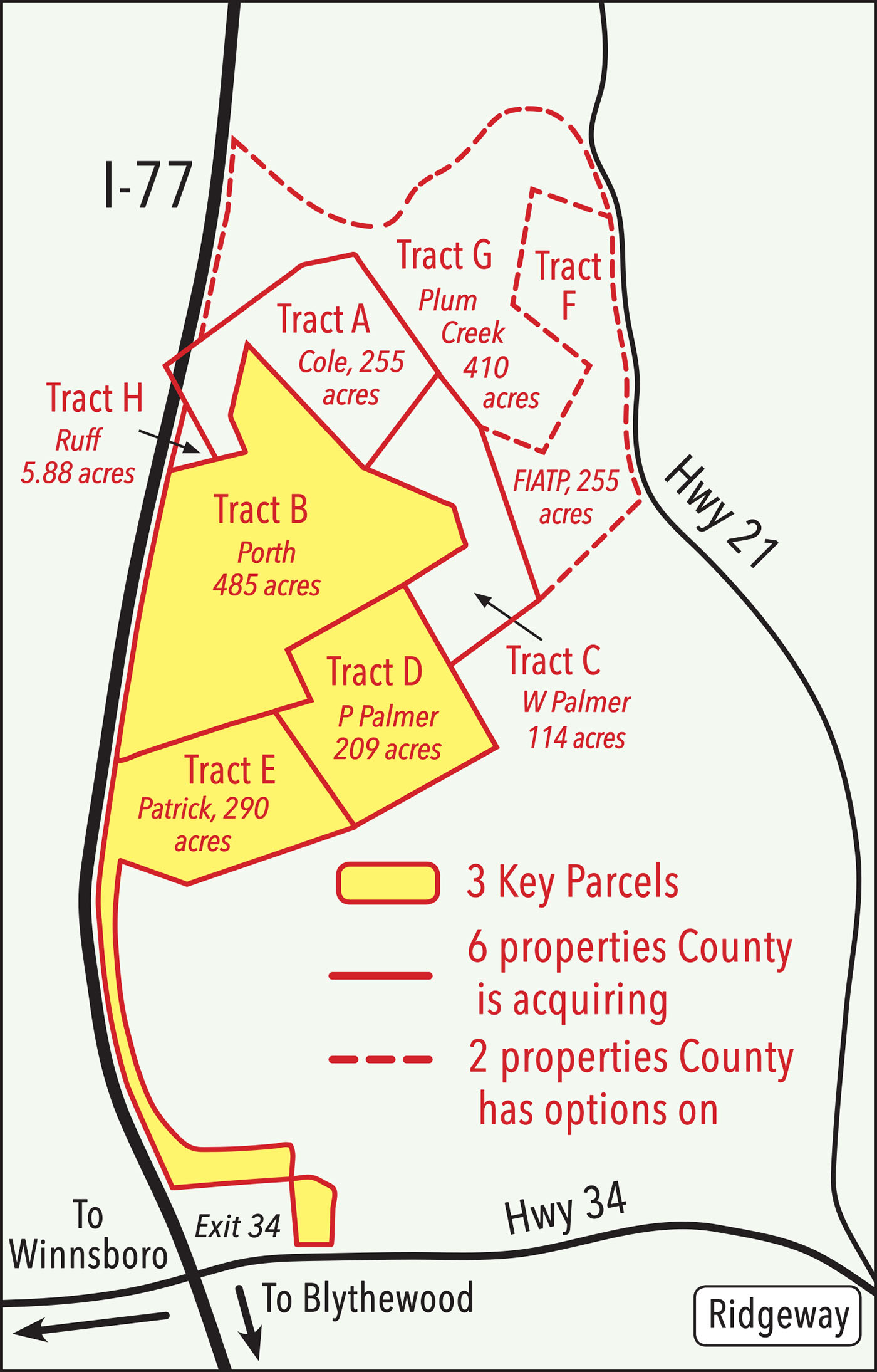
    WINNSBORO (Aug. 4, 2016) – Fairfield County Council officially embarked on a major economic development project last week, giving final authorization to an agreement between the County and the S.C. Department of Commerce to acquire more than 1,000 acres of land in Fairfield County that is located on the east side of I-77 and to the north of Highway 34. Another 800 adjoining acres are under option.

    The anticipated purchase price of the land is $8,583,669. The County will contribute $3 million with the Commerce Department raising the remaining $5.5 million. Once the properties are acquired, the County will hold the titles and will transfer the titles to the Commerce Department when it is certified that an economic development prospect intends to make a qualifying commitment on one or more of the parcels.

    “Council’s goal is to develop a mega site on this land to attract significant economic development prospects,” Ty Davenport, Fairfield County Economic Development Director, told The Voice. “This is a tremendously positive step for the County and for South Carolina. Mega projects can be transformative for communities. Our proximity to the Port of Charleston, the Charlotte International Airport, USC, Midlands Tech and to a large existing labor pool makes this site very attractive.”

    The ordinance specifies that the Commerce Department and the County will lease or buy six contiguous parcels of land that make up the site. Three of the parcels, designated as “key” parcels, meaning they are integral to the development of the mega site, comprise 984 acres and are described as the Porth Tract, the P. Palmer Tract and the Patrick Tract.

    Three other parcels are described as option parcels and include a 5.88 acre tract owned by the Ruff family. Councilman Dan Ruff (District 1) recused himself from the second reading and was not present at the special called meeting for the third reading. In total, the key and option parcels amount to just under 2,000 acres.

    Davenport said utilities and infrastructure can be extended to the site.

    “In the event that a large qualified user becomes interested in the property, funds to cover the costs of infrastructure would come mostly from the state’s resources. The commitment of these funds would be based on several criteria such as job creation, total investment, wage level, environmental compliance and other economic factors,” Davenport said. “No funds will be expended until a mega user has committed.”

    Davenport said the Commerce Department committed to actively recruiting and pursuing large economic development projects to locate on the parcels and to work with third parties in order to fund any site development costs.

    “This will not happen overnight,” Davenport said. “But I am confident that, ultimately, we will see success. Council took a very positive step in the effort to provide future jobs and long-term opportunities for Fairfield County citizens. The opportunity to partner with the State of South Carolina and the S.C. Department of Commerce as well as the I-77 Alliance and the Central Carolina Alliance is very important. Fairfield County will be marketed to significant companies around the globe.”


  • Primrose Residents: We Were Lied To

    ‘Developer Promised Green Space’

    BLYTHEWOOD (Aug. 4, 2016) – “We were lied to when we purchased our property. We were told that the green space would always be there,” said Cobblestone Park resident Lenora Zedosky during the public comment section of Monday evening’s Planning Commission meeting.

    About 30 of Zedosky’s neighbors, most of whom live on Summer Sweet Court in the Primrose area of Cobblestone Park, packed the meeting with six of them addressing the Commission.

    At issue is the residents’ recent discovery that Cobblestone Park developer D.R. Horton is planning to build six new roads in the Primrose section of the subdivision. An aerial map of the area shows that three of those roads, and 74 homes to be built along them, will cut into dense woods between Summer Sweet Court and I-77, which borders the east side of the Primrose neighborhood.

    The Town’s Planning Consultant Michael Criss explained at the beginning of the meeting that the roads were approved by Town Council in April 2015 when it revised the zoning map of Cobblestone Park, reducing the overall density of dwelling units in the Planned Development (PD) community from 1,666 units to 1,155 over the life of the project.

    “In so doing, 143 lots and the six streets were added to the overall Primrose section,” Criss said.

    That was about the time – or just before – many of the current residents moved into the Primrose neighborhood.

    “When we purchased our home in May 2015, we were specifically told by D.R. Horton sales reps that no development was going to take place in the wooded area around us. Some of us paid lot premiums of up to $17,500 to purchase lots adjacent to these beautiful woods,” Zedosky said. “Now we believe that we were deliberately misled by D.R. Horton.”

    Zedosky told Commissioners that removal of the woods to carve out three of the roads and the accompanying homes will threaten their rural-like environment that is now buffered from the noise of I-77 by the dense woods.

    Tammy Orr, who also lives on Summer Sweet Court, said she fears the disturbance of the land to build the roads and homes will increase the already poor drainage in the area that she said has left her front yard perpetually sitting in ankle-deep water.

    “This has affected our quality of life. We can’t sit outside on the patio without being eaten up by mosquitoes,” Orr said.

    Zedosky said she did not know the roads were going to be developed until she saw heavy equipment moving around her property on May 26. By June 24, she said, survey stakes were being planted in yards.

    “The surveyors told us the new roads would be built around us this fall,” Zedosky told Commissioners.

    To remedy the situation, Zedosky is asking the Town government to rescind the zoning approval it granted in April 2015.

    “If you cannot do that, then issue a cease and desist order to stop all tree cutting and construction until we explore other options,” she said. “We also want a commitment from D.R. Horton to provide a detailed walk through with representatives of the neighborhood and Town government to explain exactly what they are planning to do, what trees will be left and how much of the green space will remain.”

    Criss told the group that no major earth moving or construction should have been taking place.

    “It can’t begin until the developer brings the preliminary plat before the Planning Commission for approval. We know they are coming, but we don’t know when. That,” Criss said, “is up to the developer.”