WINNSBORO – On Nov. 21, Winnsboro Town Council voted to accept a Memorandum of Understanding (MOU) between Fairfield County and 1st & Main Development of Durham, N.C., regarding the revitalization of the Mt. Zion property.
The MOU was proposed by Councilman Billy Smith last summer, but before it could be voted on, Council was distracted for several months by the VC Summer abandonment. The MOU, which did not require Council approval, was later signed by County Administrator Jason Taylor on Nov. 11.
According to the MOU, the Town of Winnsboro would deed the 3.27-acre Mt. Zion property and buildings to 1st & Main Development for the purpose of rehabilitation. The plan, according to the MOU, is for 1st & Main to be given 180 days to come up with a plan to develop the property. There is also a provision for additional days, should the project be on track but needed a reasonable extension of time. After the property is developed, the County would begin leasing it back from 1st & Main for use as a government complex. Through the lease agreement, the County would eventually own the rehabilitated property.
The MOU states that “[Town] Council believes it is in the best interest of the citizens of Winnsboro that surplus public property with historic significance to the Community, be revitalized and put to private uses that blend with the residential neighborhoods while creating jobs and bringing quality commercial enterprise to the Town.”
While Winnsboro Town Council has voted to accept the MOU between the County and 1st & Main Development, there is a significant bump in the road before the property deed would be binding. The deed, as it has been written by the Town of Winnsboro, stipulates that if, for some reason, 1st & Main Development does not move forward with the rehabilitation of the Mt. Zion property, ownership of the property would be assumed by the County.
“That deed would have to be approved by a vote of County Council before it could be signed by the County Administrator,” Council Chairman Billy Smith said. “I don’t know what the outcome of that vote will be, but I’m not in favor of the property becoming the County’s should the project not materialize.”
Smith was said he was not sure when the matter would come to Council for a vote.
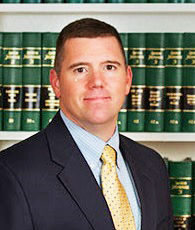
WINNSBORO – Tommy Morgan, an attorney with DuBose-Robinson Law Firm in Camden, has been contracted to serve Fairfield County on a part time basis.
Morgan
Morgan will continue with DuBose-Robinson where his practice includes a wide variety of civil litigation focusing on governmental law, defending law enforcement in civil rights’ violation cases and various other forms of civil litigation.
Morgan has represented clients in both South Carolina state and federal courts and has successfully tried numerous cases to jury verdicts. He has also appeared before multiple appellate courts, most recently successfully arguing before the United States Fourth Circuit Court of Appeals. Morgan has previously served as the assistant county attorney for both Dillon County and Kershaw County.
Before entering private practice, Morgan clerked as a Staff Attorney at the South Carolina Supreme Court. Prior to law school, he served in the United States Army, Military Intelligence Branch, where he received numerous awards for his service, including a Joint Service Commendation Medal and Global War on Terrorism Medal.
Morgan holds a Bachelor’s degree from Regents College, a Master’s degree in Public Administration and he graduated from the University of South Carolina law school.
SERBIA – Dr. Charles Kegley of Cobblestone Park in Blythewood, center, shared the stage last month with the President/Prime Minister of Serbia, Aleksandar Vucic, and moderator Dragan Simic, a Dean at the University of Belgrade, during an international conference, the Belgrade Strategic Dialogue, in Serbia.
WINNSBORO – The Fairfield County Coroner’s Office, along with the South Carolina Highway Patrol, are investigating a vehicle accident which occurred on Hwy 34 in Fairfield County at approximately 5:20 PM on Dec. 26, 2017.
Coroner Chris Hill states that 15 year old, Mykel Rodriqus Hampton Beaufort of 723 Old Chester Road, Winnsboro was the driver of a Chevrolet Malibu involved in a two car collision that resulted in his death.
The accident remains under investigation by the Fairfield County Coroner’s Office and South Carolina Highway Patrol.
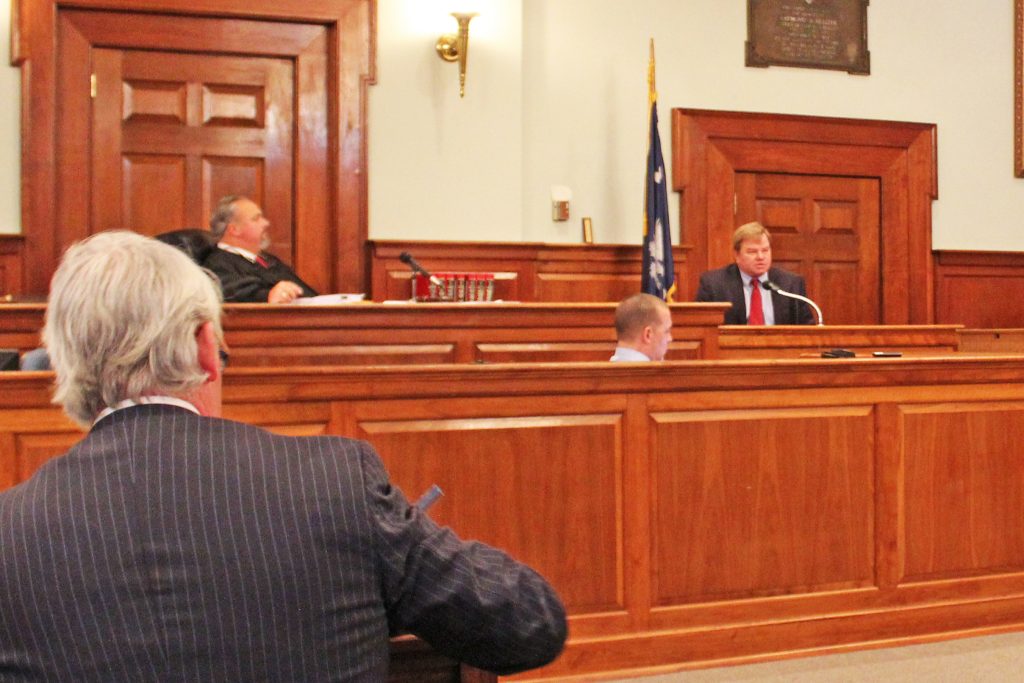
WINNSBORO – Fairfield County faced off with attorneys for South Carolina Gas and Electric (SCE&G) last week in Common Pleas Court in Winnsboro before Sixth Judicial Circuit Judge Brian Gibbons.
Lawyers for the County called for the immediate issuance of a temporary injunction against SCE&G based on what the County says is the power company’s failure to comply with the terms of the County’s fee-in-lieu contract with SCE&G. The county also asked for an immediate, temporary restraining order to prevent SCE&G from abandoning the project at V.C. Summer nuclear plant and not protecting the assets at the plant.
Fairfield County’s Director of Economic Development, Ty Davenport, explains the economic impact of the VC Summer abandonment on the County.
At the heart of the County’s concern is getting access to the plant so it can assess all aspects of the property.
Terry Richardson, Jr. of Richardson, Patrick, Westbrook & Brickman law firm, one of two law firms representing the County in the lawsuit, said the County is only asking to hold the status quo until it can assess the property. He said the County has been trying to get access but that SCE&G hasn’t responded.
Judge Gibbons determined that it is the County’s right, according the Fee-in-Lieu agreement to have full access for the purpose of assessing the property.
Richardson said the County is eager to go in the following Monday (Dec. 18) to begin the assessment. Gibbons said he planned to have a ruling on Thursday, Dec. 21, and asked Richardson to have the evaluations and assessments back to him by Wednesday, Dec. 20.
“We were ready to take our county assessor, Randy Roberts, and a team of assessors from the State Department of Revenue in with us on Tuesday,” County Administrator Jason Taylor said on Wednesday. “But even though SCE&G promised to give us access, they have not given that access yet. We don’t know when we will be allowed in. A lot of things are happening in Columbia right now. We need to talk to the attorneys to see what the outcome of this thing is going to be. We were supposed to have the information back in to Judge Gibbons today (Wednesday, Dec. 20) and be back in to court for his ruling tomorrow, so I don’t know when that’s going to happen,” Taylor said.
Richardson said there is immediate concern, as well, that SCE&G is turning in its nuclear license for the two reactors, a $9 billion issue for this county.
“That would have tremendous ramifications for the County,” Richardson told the Court. “We want to get our County people out there evaluating that property and take a look at it, inspect and evaluate it. We need all that to be done before the license is turned back, before there is complete and total abandonment of the site. There may be pollution issues, permits may be needed,” Richardson said. “We want to hold the status quo.”
According to sources who asked not to be quoted, there is speculation that SCE&G could soon be turning its license over to Santee Cooper.
“The license is a huge asset and we want to slow the process down before they turn it in,” Taylor said. “We hope to work with the governor and the state for a good outcome.”
The County’s lawsuit alleges breach of contract, fraud negligent misrepresentation, breach of fiduciary duty and unfair trade practices. The County claims that SCE&G’s expressed intention to abandon the project and dispose of the properties, plus abandon regulatory permits and licenses by year’s end in order to gain a tax advantage, deprives the County of determining what potential tax and license fees could be due from the property within its jurisdiction and may leave dangerous or potentially dangerous conditions to the County’s citizens.
Judge Gibbons told attorneys for both parties that his ruling, when it is given, will be only temporary.
The McDonald McKenzie, Rubin Miller and Lybrand law firm is also representing the County.
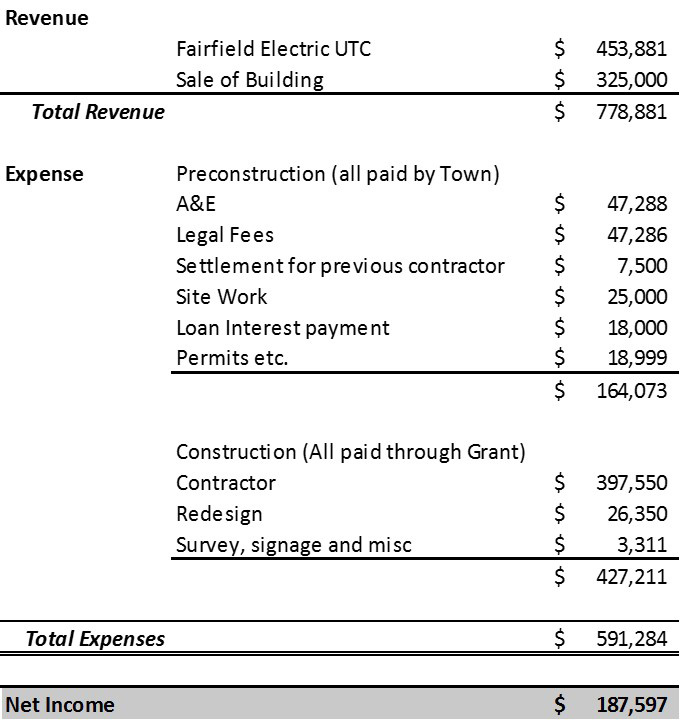
BLYTHEWOOD – Town Council finalized the sale of the Doko Depot property Tuesday evening and issued information that showed the Town had a net income of $187,597 from the sale.
“From January, 2017 until September, 2017, we were involved in serious discussions with a local restaurateur to purchase the property,” Mayor J. Michael Ross said. “Unfortunately, those negotiations did not come to pass. So we approached a Columbia developer, Wheeler and Wheeler, LLC. After much consideration, Mr. Wheeler came up with a plan as well as prospective tenants and we are in the process of accepting his contract for sale,” Ross said.
Financial Summary
The proposed sale price is $325,000 for the building and land underneath and included covenants and restrictions on the current and future uses of the property. While the property is in the Town Center District (TCD), all of the TCD uses are not available to this property.
The previous Town Council and Administration approved the concept of designating a portion of the Doko Meadows Park as a business park. The first step in development was to attract an upscale restaurant which, Council hoped, would in turn stimulate other private developers to invest and construct office and/or retail in the area.
The initial plan was to construct a 5,000 square foot building and lease the facility to Sam Kendall’s, a successful restaurant in Camden. Next, the Town approached Fairfield Electric Cooperative and requested assistance through their grant program available through the Utility Tax Credit Program. The Town would borrow the balance needed to complete the building.
The Town’s received grants totaling $456,881.29 from annual Coop allocations in 2013 and 2014. Santee Cooper loaned the Town $900,000. That brought the project revenue to $1,356,881. While Town staff began pre-construction matters and final negotiations of the lease with Same Kendall that was to cover all costs borne to include the building, improvements and all other costs absorbed by the Town, there were other costs.
The Town paid $47,286 for architectural and design, $32,000 in attorney fees for the loan and $25,500 for site work. A contractor was selected and was prepared to begin.
In early 2014, newly elected Town Council members questioned the feasibility of the Town bearing the liability owning the debt and looked to the prospective buyer to do a take out at completion. Negotiations failed, and the Town elected to abandon the project as designed.
“We repaid the Santee Cooper loan principal as well as the interest payment for the year it held funds,” Ross said. “We paid $900,000 plus the $18,000 interest payment.”
The Utility Tax Credit assigned to the Town could not be returned without a severe penalty payment. In 2016, Council decided to use the $456,881 to build a spec shell building. A survey of the community concluded that a restaurant would be the most popular choice for the building.
The size of the building was reduced to meet the new budget. Lyn Rich Construction began work in the early fall of 2016 and the building was completed in late spring, 2017 at a final cost of $397,550.
COLUMBIA – During a Richland County Council public hearing on a request for commercial zoning on Rimer Pond Road Tuesday night, a parliamentary faux pas and a bizarre motion from the Rimer Pond Road area’s own council representative resulted in a confusing deferral to Council’s Feb. 27 meeting.
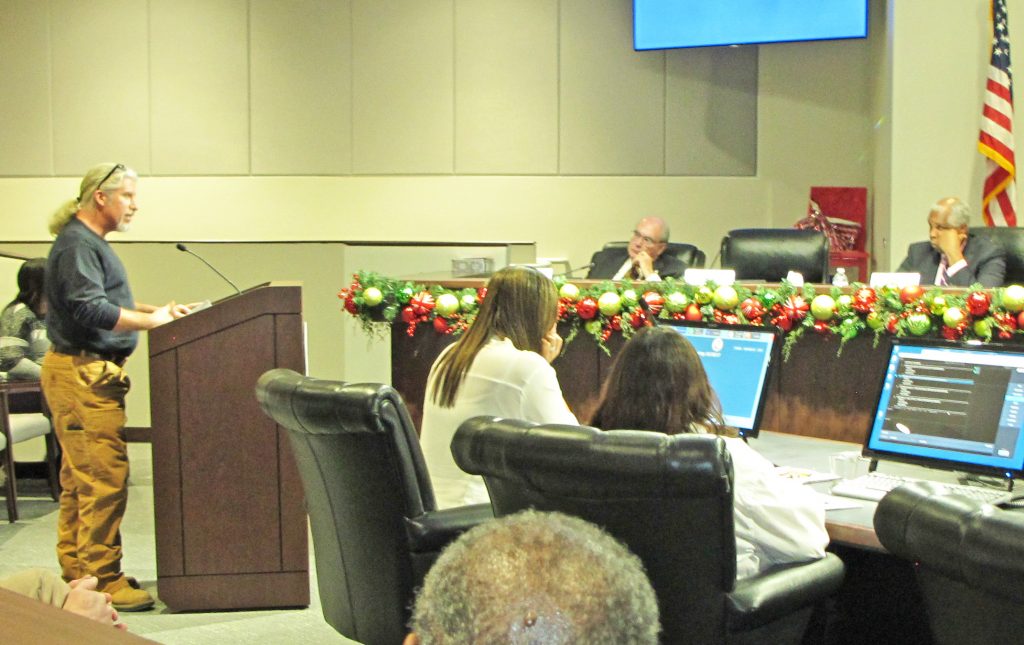
Michael Watts addresses Richland County Council members Tuesday night.
After an hour into the meeting that included testimony from Rimer Pond Road area residents streaming to the microphone to speak against Hugh Palmer’s request to rezone 5.23 acres on Rimer Pond Road for commercial use, Chairwoman Joyce Dickerson announced the public hearing closed and called on Councilwoman Gwen Kennedy, the representative for Rimer Pond Road, to make a motion.
Kennedy, who in the past has voted against her constituents and in favor of Palmer’s commercial rezoning requests, made a motion that appeared to momentarily stun the audience and council members as well.
“I’ve been listening to everything and I make a motion to deny (the rezoning request),” Kennedy said.
Another council member seconded the motion.
“The motion has been properly made and seconded,” Dickerson said. There was a pause as Kennedy looked toward the audience and appeared to exchange glances with Palmer.
“I’m sorry,” Kennedy said, “I’m making a motion to defer it.”
“You want to remove your, uh…” Dickerson said, turning to Kennedy.
“I want to find out what people in this area want. I’m going to make a motion to defer this to the next meeting, uh, so that I can hear from some more of the residents because I’ve not heard from but a few. I’d like to hear. I move to defer this,” Kennedy said.
Without revisiting the original motion and second as would be required by Roberts Rules, Council passed the deferral 7-3.
“Do you want to have another public hearing?” Tracey Hegler, Director of Planning and Zoning for Richland County, asked Dickerson.
“No, we will not have another public hearing,” Dickerson said.
“Wait,” Hegler said. “You’re not going to have another public hearing?
Dickerson then told a resident that there will be another public hearing, but that no one would be allowed to speak.
While Council would not be required to allow the public to speak at a second public hearing, multiple public hearings are allowed on an issue and could be held at the discretion of Council. A vote can be taken at that meeting without allowing the public to speak if County Council so chooses.
It was the fourth time in as many years that Palmer has requested some type of commercial zoning for the 5.23 acres at the intersection of Rimer Pond Road and Longtown Road West, across from Blythewood Middle School.
When Palmer’s third commercial rezoning request came before Council in February 2017, Kennedy left her seat at the dais during the meeting and followed the Palmers’ lobbyist, Boyd Brown, into the hallway outside the chambers. After about five minutes they returned and Kennedy made the motion in favor of Palmer’s request. She was the only member of Council to vote in favor of the rezoning, which was denied.
Approximately 60 residents from Rimer Pond Road, LongCreek Plantation and Eagle’s Glen neighborhoods attended Tuesday night’s meeting, but only 14 of the 32 who signed up to speak were allowed to address Council since total speaking time on the issue was limited to 30 minutes. The residents’ mantra was repeated by almost every speaker – “We don’t need it. We don’t want it.” None of the residents from the Rimer Pond Road area spoke in favor of commercial zoning on the road which is made up primarily of farms and large acre properties.
“We are extremely opposed to this,” said Michael Watts who said his family has lived on Rimer Pond Road for generations. “Mr. Palmer made a business decision to purchase this property in about 2007 and he has made plenty of money on it. The County even bailed him out on 35 acres of it. So, as a profit motive, he’s got his profit. How about a people motive? Maybe you could do what the people want out there, which is no commercial,” Watts said.
In 2015, the Palmers had the property listed for $350,000 per acre. After The Voice published that information, Patrick Palmer notified the newspaper to say he would no longer be listing the property.
Palmer brought along three supporters, all in the building industry – Jacob Rabon, a civil engineer from Lexington; Bill Flowers, a developer from Columbia and Earl McLeod, with the Columbia Home Builders Association – who spoke to the advantages of commercial development in the rural area.
Palmer‘s son, Patrick, told Council that numerous residents in the Rimer Pond Road area had called to tell him they are in favor of the rezoning, but he said they didn’t want to come out to a public meeting. At the February 2017 meeting, lobbyist Boyd Brown, speaking on behalf of the Palmers, said he had in his possession a petition with 125 signatures of people who supported commercial rezoning on Rimer Pond Road, but none of the alleged supporters showed up at that meeting.
“Richland School District is in favor of this (rezoning),” Patrick Palmer told Council. But LongCreek Plantation resident Jerry Rega countered that claim.
“I spoke with the administrators of both Round Top Elementary and Blythewood Middle School, and they are opposed to this commercial rezoning,” Rega said.
“If the School District supports this commercial zoning, then I would think a representative of the District would have been here to speak in support of it,” resident Michael Lacey said.
Palmers’ three supporters also urged Council to follow the guidance of the County’s planning staff who recommended the rezoning to both the Planning Commission and County Council. The three touted the staff’s professional perspective of the rezoning and their degrees.
“Your planning staff, professionals in the County, that do this for a living and have degrees in this, are in favor of this as well,” Patrick Palmer told council members.
“I urge Council to listen to your planning staff and vote in favor of this commercial rezoning,” developer Bill Flowers said.
“Neighborhood Commercial zoning was, in fact, developed for just this type of development,” McLeod said, urging Council to follow the County’s comp plan (Comprehensive Planning Guide) that he said serves as a road map for future development.
But several of the residents said the comp plan for future growth in the Rimer Pond area is out of sync with what the area is.
“We’ve been coming down here for 25 years telling you want we want and it never makes its way into the comp plan,” resident Michael Watts said.
Rega, a resident of LongCreek Plantation, also addressed the County’s comp plan, waving his copy in the air.
“The comp plan says, specifically, that it is not intended to provide site level guidance,” Rega said. “I’m tired of people coming from outside our area claiming to know what we need,” Rega said, addressing Palmers’ Columbia and Lexington supporters from the building industry.
“I moved here for the rural setting. It’s peaceful. It’s nice. It’s where we live. We simply have no need for commercial conveniences in our neighborhood,” Eagles Glen resident Chris Henchy said.
“We don’t need anything but for that corner to stay a cell phone tower,” West Lake Farms resident Elizabeth Mull said. “Please don’t let this go forward. We love where we live. We don’t need commercial coming any closer.”
Representative Joe McEachern also spoke to the quality of life the residents enjoy in their community and urged Council to consider that when they vote.
But Hugh Palmer, who was granted his request to be allowed to have his named moved down the speaker sign-up sheet which gave him the advantage of having the last word of all the speakers, encouraged Council to vote for his commercial rezoning request, saying the area is changing.
“Whether folks in the area desire that or not, the area is changing,” Hugh Palmer said.
The next public hearing on the commercial rezoning request will be held in council chambers at 7 p.m. on Tuesday, Feb. 27. To request an emailed packet for that meeting, call 803-576-2174 the week prior to the meeting.
WINNSBORO – Eleven Fairfield County residents in a lawsuit filed against SCANA/SCE&G in August, have filed a motion in the Sixth Judicial Circuit Court to have a state judge order a freeze of SCANA/SCE&G’s next dividend payment which is scheduled for Jan. 1.
“If a judge doesn’t freeze SCANA’s assets, it will pay out $87.3 million on Jan. 1 to shareholders,” Creighton Coleman, one of the attorney for the plaintiffs, said.
In their motion, the plaintiffs’ request that any dividends paid out be paid into a trust account until the plaintiffs’ lawsuit is resolved. The motion contends that the money from dividend payments to shareholders should be preserved so that sufficient assets will be available for potential liabilities.
The lawsuit also seeks to have the court freeze assets of the company related to the nuclear plant project.
The lawsuit alleges that the companies “knew years before abandoning the project that the project was not feasible; not subject to a detailed construction schedule; not a good investment of the ratepayer’s money, over budget; and failing.”
The plaintiffs allege that SCANA/SCE&G charged customers up to $1 billion over the years for its failed nuclear expansion project and seeks to recover money for all of the company’s ratepayers in the Columbia and Charleston areas.
The lawsuit alleges 11 causes of action, including waste, breach of fiduciary duty, negligence and fraud. It accuses the companies of unjust enrichment for receiving profits from the project “since the project was not completed and the plaintiffs were not provided with any value from the project.”
In addition to Coleman, other lawyers for the plaintiffs include Ed Bell of Georgetown, Greg Galvin of Bluffton and State Sen. Vincent Sheheen, D-Kershaw.
RIDGEWAY – Upon the recommendation of the Town’s interim administrator David Hudspeth, Ridgeway Town Council passed first reading (3-1) last week to amendment the 2017-18 budget to transfer $500,000 from the General Fund to create a $300,000 Capital Expenditures Fund and transfer $200,000 to the Water Fund. Hudspeth’s recommended budget would also increase the Professional Services line item from $6,000 (for the auditor) to $26,000 to include the auditor’s fee plus funds for legal fees (over $4,500 so far for attorney’s advice regarding town hall dog) and Hudspeth’s professional fees ($16,000 for 30 days of work).
The amended budget was prompted after Council had spent more than $113,000 since June, 2017, from a capital improvements fund that did not exist. Councilman Heath Cookendorfer voted against the amendment and Councilman Don Prioleau left just before the vote and did not cast a vote. Mayor Charlene Herring and Council members Andrea Harrison and Doug Porter voted for the amendment.
Other recommended amendments to the budget include adding $100,000 to the budget for grant matches and designating $100,000 of the new $300,000 Capital Expenditures Fund for fiscal year 2017-18 for projects already considered. The remaining $200,000 in the Capital Expenditures Fund is designated by Hudspeth for “Future Capital Improvements” even though it is included in the FY 2017-18 budget.
Liquidate Town’s CDs
To accommodate these and other amendments to the budget, Hudspeth recommended liquidating all the Town’s CDs, about $409,000, as they become mature and transferring the resulting cash into the unrestricted General Fund which would be $294,600 as amended.
“I think the checking account balances are pretty low,” Hudspeth said. “Liquidating those CDs will allow you to put money in your checking account.”
Referring to the $300,000 Capital Expenditures Fund, Hudspeth said, “That’s what you can spend without worrying about payroll and other things you have to pay regularly. You want to have a healthy capital fund.”
In addition to liquidating the $409,000 in CDs, Hudspeth also suggested cashing in the $55,469 Pig on the Ridge CDs and putting the cash in a separate account. However, those funds would still be in the General Fund and could be spent for anything that comes out of the General Fund.
“I don’t agree with cashing in the CDs,” Cookendorfer told Hudspeth. “Once we cash them in, they’re gone. I would like to see the Pig on the Ridge funds actually restricted. Being in the General Fund, it can be borrowed if we run short on other things. I don’t like that. We need to quite buying shutters and some of those things and concentrate on some of the expensive things like the water tower and other things that we really have to move on.”
The final vote on the amended budget will be held at the January meeting, 6:30 p.m., Jan. 11 at the Century House.
Other Business
In other business, Council passed second and final reading on an ordinance to amend the Town’s Code of Ordinances to modify Section 5-1006, Observance of Truck Routes Required: Exceptions. Council also passed the first of two votes to lease the shop behind Old Town Hall Restaurant to the Barclay School for $250.
BLYTHEWOOD/WINNSBORO – The three local high schools – Blythewood High School (BHS) and Westwood High School (WHS) in Richland 2 School District and Fairfield Central High School (FCHS) in Fairfield County School District – show varying results on the 2017 statewide, standardized tests used to determine the State Department of Education’s (SDE) annual report card scores.
ACT SCORES
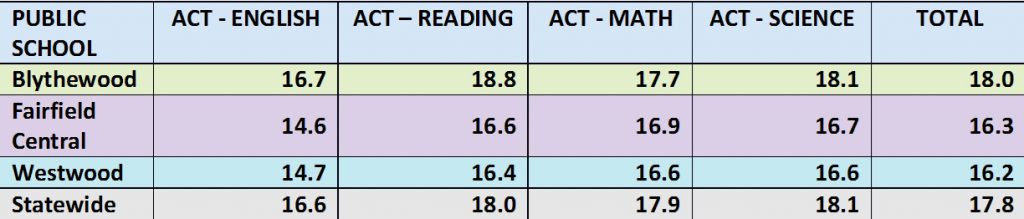
2017 Average ACT Scores
All eleventh graders were given the ACT college readiness assessment test last spring. Scores for English, reading, math and science as well as a total score for all four subjects combined can range from 1 to 36; writing scores range from 2-12. FCHS’s total ACT score improved from 15.8 in 2016 to 16.3 in 2017, BHS’s total score decreased to 18 in 2017, down from 19.2 in 2016; and WHS’s 2017 composite ACT score of 16.2 was slightly decreased from its 2016 score of 16.4.
COLLEGE READY
The report cards also show the percentage of students deemed college-ready by meeting ACT benchmark scores for each of the four subjects tested.
Benchmark score for English is 18. That score was met by 38.4 percent of BHS students; 24 percent of WHS students and 22.8 percent of FCHS students.
Benchmark score for math is 22. That score was met by 20 percent of BHS students; 9.4 percent of WHS students and 13.2 percent of FCHS students.
Benchmark for reading is 22. That score was met by 29.9 percent of BHS students; 17.5 percent of FCHS students and 16.2 percent of WHS students.
Benchmark for science is 23. That score was met by 19.5 BHS students; 8.5 percent of WHS students and 7.9 percent of FCHS students.
Not as many students met the college-ready benchmarks in all four subjects tested by the ACT. That number was 11.7 percent of BHS students; 4.9 percent of WHS students and 3.2 percent of FCHS students.
SAT SCORES
Average 2017 SAT scores
Participation in SAT test taking is on a volunteer basis. Improvements in the 2017 SAT scores over 2016 could not be determined because the SAT was redesigned for this year using a different scale. For 2017, the highest score for each individual section on the SAT is 800 and the highest total score is 1600. The following chart is based on those scores.
END OF COURSE SCORES
End of Course Tests – Percent with scores 60 or above
The End-of-Course Examination Program (EOCEP) provides tests in high school core courses and for courses taken in middle school for high school credit. The core courses are: Algebra 1 / Math for the Technologies 2, English 1, Biology 1, and US History and the Constitution. Statewide, almost 75% percent of students passed all subjects with a score of 60 or above.
ACT WorkKeys
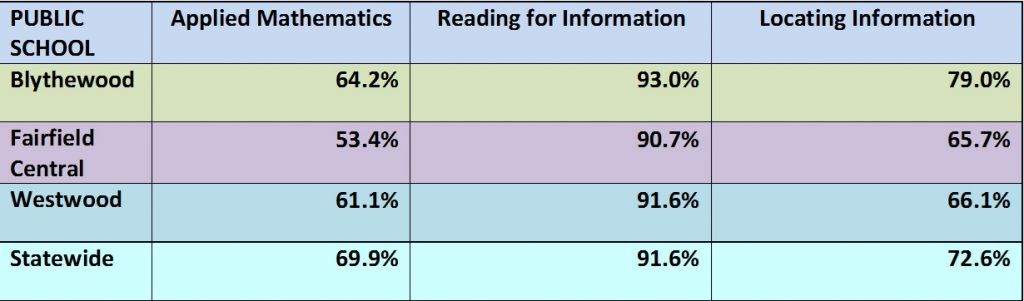
Percent of students meeting Platinum, Gold or Silver thresholds for WorkKeys, 2017
According to the SDE website, the ACT WorkKeys® is a job skills assessment system measuring «real world» skills that employers believe are critical in the workplace. Like the ACT, It is given to 11th graders. The assessment consists of three sub-tests: Applied Mathematics, Reading for Information and Locating Information. Students can earn certificates at the Platinum, Gold, Silver, and Bronze level on WorkKeys assessments.
GRADUATION RATES
The 2017 report cards show that South Carolina’s four year graduation rate increased to 84.6 percent, an all-time high and a two percent increase over the previous year. BHS’s graduation rate soared to 97.3 percent; FCHS’s graduation rate is 91 percent and WHS’s rate is 80.1 percent.
The school report card data is available on the SDE’s website and a new tool makes it very easy to see all the information for each individual district or school.
The current report cards do not give an overall district and school rating of “excellent, good, average or at-risk” for 2017. However, the 2018 report card will be revamped to meet the requirements of the Every Student Succeeds Act and the state’s new accountability system. Schools will not be rated for state accountability purposes until the fall of 2018 when the state will transition to a single accountability system.