Author: admin

  • Yow wins March Madness cash

    BLYTHEWOOD – Joshua Yow, 15, of Blythewood has been named the winner of The Voice’s $200 March Madness Bracket Challenge. While no contest entry chose Virginia to win the Championship, Yow and one other entry, Yow’s neighbor Bobby Armentrout, placed Virginia in the Championship game.  To break the tie, Yow got 43 picks right and Armentrout was one pick short with 42.

    This was not Yow’s only Bracket Challenge win this year. He also won the Challenge at his dad’s place of business which he won last year as well.

    Asked if his picks were guided by his basketball expertise, Yow, a 6’ 3’’ Blythewood High School freshman, said he doesn’t play basketball. He attributes his win, instead, to “dumb luck” and a few bracket predictions he viewed online. So far those skills have paid off, winning three out of three Bracket Challenges.

    Yow said the $200 will come in handy.

    “I’ll probably pay off my cell phone with it,” he said.

    Aside from Yow and Armentrout, only four entries chose Virginia to play in the Final Four, and only one picked Texas Tech to make it to the semifinal round. No other entries chose Texas Tech or Virginia for the Championship bout.

    But never fear, March Madness maniacs, there’s always next year and the hope of an unbusted bracket.

  • Free job training for construction work

    Training Targets Disadvantaged Women, Minorities in Fairfield

    WINNSBORO – “We’re looking to provide free training for 10 Fairfield County individuals over 18 who are interested in careers in highway construction,” Larry Salley with the Benedict Allen Community Development Corporation said in his address to Council Monday evening.

    “But for the last eight weeks we’ve been working with the County’s WIOA, DSS, the Fatherhood Coalition, the Good Samaritan House and we’ve sent 85 letters to churches, and we have only gotten three applications. We need someone to help us get the word out,” Salley said.

    “We are targeting counties with high unemployment rates, and we’re looking for individuals – women and minorities – who traditionally would not be in these kinds of jobs,” Salley said. “We’re looking for current residents of Fairfield County who are economically disadvantaged.

    The training is being offered through the Corporation’s Transportation Careers Training Program and will be conducted at the Fairfield Central High School’s adult education facility.

    The training, Salley said, consists of three phases:

    1. appointment or pre-employment training (soft skills, resume writing, flagger training, etc.),
    2. commercial driver’s license (CDL) training – permit only and
    3. heavy equipment operator training for bulldozers, back hoes, etc.

    Applicants must have a high school diploma or a GED and a valid driver’s license. The training lasts 8 – 9 weeks and, upon the successful completion of the program, Salley said the program’s staff will help the graduates find employment.

    “We work with a number of SCDOT contractors to help place our graduates” Salley said.

    “We pay for all the training except for the pre-employment drug screening,” Salley said. “We pay for physicals, materials, safety equipment and training.”

    Salley said individuals with a criminal history may apply for the program, but applicants must be unemployed or underemployed (part time or temporary).

    “We are trying to get the first training classes filled by the second week in May,” Salley said. “So we are really pressed to find at least 25 applicants.”

    While Salley said that transportation is a problem for applicants in Fairfield County, County Administrator Jason Taylor offered the County’s transportation system to help get individuals in the program to and from training classes.

    Applications can be completed online, however, all submissions must include the requested documentation at the time of application to determine eligibility for the program.

    For more information, contact Venus Sabb at 803-705-4631 or via email at venus.sabb@benedict.edu or Salley at 803-705-4682 or email at larry.salley@benedict.edu.

  • Be sure you’re counted in 2020 census

    BLYTHEWOOD – Doris Green, a representative from the U.S. Census Bureau in Atlanta, addressed Blythewood Town Council members at their March 25 meeting, outlining why citizens need to be encouraged to participate in this year’s census.

    Green said that participating is critically important for several reasons.  The results determine Blythewood’s share of the $675 billion of federal funds available to states and communities. The data from census results are used to ensure public services and funding for schools, hospitals and fire departments, and census results determine how many seats each state is allocated in the House of Representatives.

    She also said that registering for the 2020 census will be easy, since online and phone options are available for the first time, in addition to mailing options.

    The U.S. Constitution requires the tallying of America’s population every 10 years. The census collects basic information about the people living in each household. When completing the census, everyone who is living in a household on April 1, 2020 should be counted.

    Green added that census workers will never ask for social security numbers, bank or credit card account numbers, money, donations or anything on behalf of a political party. She emphasized that all responses and personal information related to census questions are securely protected by strict federal law and robust cyber security practices.

    She said that over the next few months, the community will hear and see a lot of information about the upcoming census. April 1, 2020 is census day, and every person in every household should be included in order to have that most accurate count. Green said the census workers are in the process of building an accurate address list and automating field operations.

    Green said there are many temporary employment opportunities within the census program, as well. For more information or to apply, visit www.2020census.gov/jobs or call 1-855-JOB-2020. Additional information about the 2020 census can be found online at census.gov.

  • Truck fire damaged fuel pumps, canopy at Bojangles

    Fire engulfs truck, fuel pumps and canopy over Bojangles restaurant in Blythewood on Saturday. | Barbara Ball

    BLYTHEWOOD – “It wasn’t all bad,” businessman Larry Sharpe said on Saturday after a vehicle fire torched two diesel fuel pumps and the overhead canopy of the Blythewood Bojangles restaurant that he owns on Blythewood Road.

    “No one was injured,” Sharpe said, with a grateful tone in his voice.

    It all started Saturday about 5 p.m. when a 2017 Ford F350 truck burst into flames moments after it pulled up to the diesel fuel pump behind Bojangles.

    Tim Mancini and his wife Libee had stopped off I-77 to refuel. They were returning home to New York after a trip to Georgia to pick up a utility trailer that they were towing behind their truck.

    Mancini later told The Voice that he had replaced the truck’s defective oil filter early the morning they left for Georgia, but learned too late that the problem with the filter continued.

    “When I got out of the truck at Bojangles,” Tim Mancini said, “I smelled fuel.  I opened the hood, saw fuel on the new filter, then got back in the truck and turned the ignition on to locate the leak. Gas instantly spewed into the air, first showering the engine, then igniting it,” Mancini said.

    Mancini said that when his fire extinguisher had no effect on the blaze, two men helped him unhook and push the new trailer back from the truck.

    Sharpe later praised his employees inside the restaurant for their quick, perhaps life-saving, actions.

    “As soon as they learned what was happening, they immediately hit the emergency shut-off button to block fuel from escaping the underground fuel lines,” Sharpe said.

    Flames and black smoke engulfed the truck within minutes, shooting into the air and burning the end of an overhead canopy.

    Fire trucks were dispatched from the Crane Creek, Bear Creek and other surrounding stations.

    Sharpe said he estimates the damage to the restaurant and fuel pumps to be about $150,000.

    While Mancini’s truck was destroyed, he didn’t leave with any hard feelings toward Blythewood. Instead, he expressed his gratitude for the two strangers who helped him save the trailer. And he had praise for Sharpe as well.

    “Larry took my wife over to the Dollar Store to get a pair of shoes – hers were burned up with the truck. And he put us up in the Comfort Inn for the night and insisted on paying the tab,” Mancini said. “The next morning, he took us to the U-Haul place to pick up a truck for our trip home. He didn’t have to do all that,” Mancini said, then paused. “You don’t find many people like that anymore.”

    “When you write this story,” Mancini told The Voice reporter, “be sure you say something nice about Larry Sharpe.”

  • R2 board OKs stricter conduct for teachers

    COLUMBIA – Weeks after brushing aside adopting greater accountability measures for their own conduct, the Richland Two school board voted 6-0 for similar conduct rules for district staff.

    On March 26, board members combed through the five-page policy, which lists numerous behaviors classified as “misconduct.” Many behaviors focus on teacher-student interactions.

    Board vice-chair Monica Elkins-Johnson said she thought the staff conduct policy might discourage students from confiding with teachers who they trust.

    “Not all students have a relationship with school counselors,” Elkins-Johnson said. “This [policy] is stating that they can only have these conversations with a school counselor.”

    Superintendent Dr. Baron Davis said the district always encourages dialogue between students and staff. He said the policy is aimed at students in crisis situations, such as suicide.

    “Advice is absolutely not counseling,” Davis said. “We just want to encourage a student, [who] for example is having suicidal [thoughts] or harming themselves, we need to immediately get that student to a trained professional to de-escalate that situation.”

    Board member Teresa Holmes expressed another definition of misconduct, which includes “refusing to follow a supervisor’s instructions and directions.”

    “It’s too subjective that you have to follow instructions without them being clarified,” Holmes said. “You could tell me to go down the hall and if I don’t go, I didn’t follow your instructions. It’s too subjective.”

    Discussion of staff conduct comes on the heels of an ethics controversy involving a quorum of the board.

    At least three members have been fined by the S.C. Ethics Commission. Board chair Amelia McKie owes the most at $51,750.

    In February, board members voted 4-3 against the policy revision that would’ve authorized stripping board members of officer titles “for cause,” provided a supermajority approves.

    Board members found in violation would still retain their elected post.

    Those voting in the majority to reject the measure took issue with the phrase ‘for cause,’ calling it vague.

    Board member James Shadd III, who was fined $13,000 by the ethics commission in 2014, took issue with the proposed misconduct policy’s “for cause” terminology, voting against the proposed policy on Feb. 12.

    He suggested the policy proposal was reactionary, saying sanctions for legal troubles some board members face already exist in state law.

    “What does ‘just cause’ mean?” Shadd III asked.

    A search for the phrase “probable cause” in the state ethics statute generated 19 results. The phrase “just cause” appeared three times.

    Many of the board members voting down the policy were themselves in violations of various state ethics laws.

    “Because of recent events, I have made sure that I’m a stickler to policy now. I’ve become a policy guru,” McKie said in February.

    McKie would’ve been impacted by the policy change had it passed.

    “I would greatly shun having a nebulous policy,” she said. “If you want a policy that tightens things up a bit, I’ve got that.”

    Richland Two board members voted against the policy revisions following an investigation by The Voice that numerous board members violated state law by going months, and in some cases, years without filing campaign finance and/or conflict of interest forms.

    Also at the March 26 meeting, the board discussed language of the district’s profanity policy.

    Elkins-Johnson, the board’s vice-chair, asked if the policy applies to coaches. District staff said it does.

    Violations of the policy are “grounds for placing an employee on administrative leave, with pay, pending an investigation and possible recommendation for termination of employment,” the policy states.

    Ironically, Elkins-Johnson is facing a disorderly conduct charge following an obscenity-laden outburst after a recent school board meeting.

    At the Feb. 22 board meeting, while reading from a prepared statement, Elkins-Johnson apologized “for the language that I used” during an altercation at the Jan. 22 board meeting.

    A Richland County Sheriff’s Department incident report states that Elkins-Johnson cursed and made threatening comments during a dispute involving McKie’s husband and the sister of state Sen. Mia McLeod.

    Elkins-Johnson was charged with disorderly conduct. She’s tentatively scheduled to appear back in court later on April 29, according to Richland County court records.

  • The Voice takes one of three top Press Association awards

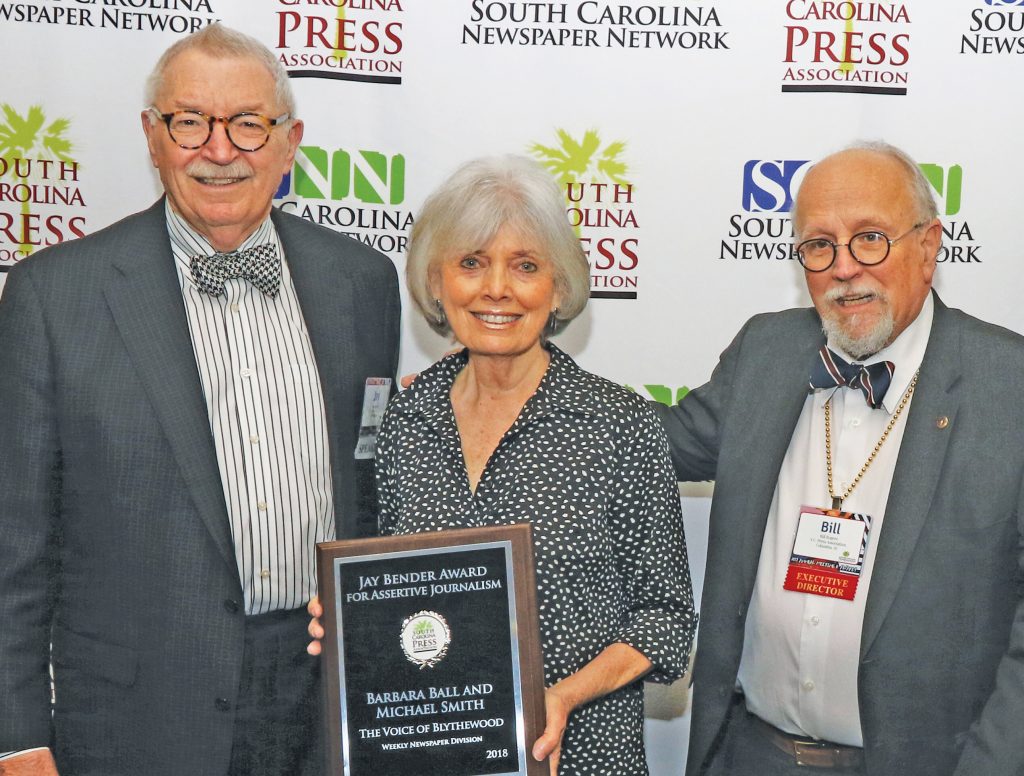
    Media Attorney Jay Bender, left, and Executive Director of the S.C. Press Association Bill Rogers present the Jay Bender Award for Assertive Journalism to The Voice Publisher Barbara Ball.

    COLUMBIA – The 7th annual Jay Bender Award for Assertive Journalism was presented to The Voice’s publisher, Barbara Ball, and reporter Michael Smith at the South Carolina Press Association’s annual meeting in Columbia on April 6. This is the second year in a row that the newspaper has received the honor.

    The award recognizes one daily and one non-daily journalist in the state who stands up to authority in the public’s interest. As one of the top honors presented by the SCPA each year, it includes a prize of $250 and is named for media attorney Jay Bender, whose 30-year career has been dedicated to preserving open government and First Amendment freedoms.

    “Very often you hear football coaches say that it’s not the size of the dog in the fight, it’s the size of the fight in the dog,” Bender said in a telephone interview. “And it’s not the size of the paper, it’s the size of the fight in the paper. Barbara and Michael demonstrate what journalism is about in protecting the community from chicanery, fraud and misconduct. They do a great job.”

    The judges’ comments, which were read during the presentation, made note of Ball and Smith’s thorough reporting.

    “They exhibited great persistence in exposing a problem that likely occurs statewide with secrecy in the expenditure of accommodations tax money,” the judges wrote. “Ball and Smith reported on issues from every angle. This newspaper does a good job of holding public officials accountable.”

    “This top award shows that small newspapers can make a big difference in their reporting on community issues,” said Bill Rogers, executive director of the SCPA. “Mrs. Ball and Mr. Smith both have a strong history of investigative reporting and this award is a fitting tribute.  Well done.”

    The Voice also received a number of other awards at the annual meeting. The 2018 Fall Sports Preview won first place for all weekly newspapers in the Sports Section/Magazine category, with the judges commenting, “Wow! Epitome of what a fall sports preview should be.” The 2018 Holiday Entertaining Guide received second place (to The Post and Courier) in the Entertainment Section category, an open category that included daily newspapers. Reporter Michael Smith received second place in the Sports Enterprise Reporting category, second place for Reporting-in-Depth and third place for Series of Articles. Ball’s additional awards included second place for Profile Feature Writing and third place for Reporting-in-Depth.

  • Council ‘retreats’ to Lake Wateree Hideaway

    WINNSBORO – It’s called The Hideaway at Lake Wateree.

    Situated on the secluded shores of Lake Wateree, 22 miles east of downtown Winnsboro, the 3,513-square-foot Airbnb get-a-way sleeps nine, has over 200 feet of lake frontage, and its own boat dock

    “The sun neither rises nor sets facing the front,” a listing on www.zillow.com states. “It’s a very quiet neighborhood. Most nearby homeowners only visit on weekends in the summer.

    The home is an idyllic setting for a summer getaway. It’s also the site Fairfield County Council Chairman Neil Robinson has decided on for the county’s annual budget retreat.

    Officially, the retreat meeting, which is open to the public, is scheduled for Saturday, April 13, from 10 a.m. – 2 p.m.

    However, because the home requires a minimum three-night stay, reserving the home will cost Fairfield County taxpayers about $900 [with a possible $150 refund upon departure]. This prompted protest from at least one council member.

    “The County owns plenty of facilities where we could hold whatever meetings we need to at no cost,” Councilman Douglas Pauley said in a prepared statement at Monday night’s council meeting.

    “The expenditure of over $900 to rent the house for the weekend, in my opinion, is not a prudent use of our citizens’ money,” he said.

    Pauley also worried the retreat’s time and location would make it inaccessible for constituents who may wish to attend. “Meetings like this should be held in locations familiar to the general public and citizens who regularly attend our meetings,” he said. “Holding meetings like this in locations that people aren’t familiar with is a barrier to them attending.”

    Robinson said he worked with county administration to find a location that’s affordable and accessible.

    He said the intent is to meet in a setting “without a shirt and tie on,” and discuss county business openly in a relaxed setting.

    “Sometimes we have writer’s block, so to say,” Robinson said. “Sitting here behind this desk, you may not have the idea at this time.”

    Robinson said he’s paying for the food, which consists of a cookout for attending council members. Citizens attending will be on their own for lunch. As for the $900, Robinson didn’t see any issues with the expenditure.

    “It is only money council members have not gone to class to educate themselves that we’re using,” Robinson said.

    For those attending the meeting, the address is 1253 Westshore Drive (Lot 4-B), Ridgeway.

    In other business Monday, council members postponed third reading of an ordinance authorizing a lease agreement between the county and the Community Health Foundation of Fairfield County.

    According to a draft ordinance, the foundation would lease some of the former Fairfield Memorial Hospital property from Fairfield County. The county purchased several parcels in 2018.

    County Attorney Tommy Morgan said the foundation contacted the county a few hours before Monday’s vote, saying they’d like to include additional provisions in the lease agreement.

    Morgan said delaying the vote would give council members more time to review the foundation’s proposed changes.

    Provided both sides agree to proposed changes, the lease agreement could come back to the council for a vote later this month.

  • JWC attorney threatens to sue councilwoman over water criticisms

    WINNSBORO – Bertha Goins is used to being in hot water with the Jenkinsville Water Company.

    A frequent critic of the organization, the Fairfield County Council vice-chair has called out the JWC on a variety of issues, ranging from finances to transparency.

    Goins has also publicly stated she thinks the JWC should be absorbed by a recently formed joint Fairfield County-Town of Winnsboro water authority.

    And recently, in interviews in The Voice and The State about JWC’s water woes, she’s taken aim at Jenkinsville water quality.

    A JWC attorney is fighting back, challenging her assertions that there’s sediment in the water and issuing a cease and desist order to block Goins from further criticizing the water company.

    On March 28, T. Jeff Goodwyn, an attorney with the Goodwyn Law Firm, which represents the JWC, issued the cease and desist letter threatening to sue Goins.

    “If you continue to make such false and defamatory statements, I have been instructed to take all legal steps to enforce my client’s rights including filing suit against you, for injunctive relief, slander and defamation seeking all damages allowed by law,” the letter states.

    At Monday night’s Fairfield County Council meeting, Goins said the letter is an attempt at intimidation. Speaking via speakerphone, Goins was defiant and doubled down on her criticisms of the JWC.

    “I’m going to send a copy of this letter to many people, but I’m going to first send it to the attorney bar association to find out if this is an ethics violation,” Goins said. “Is this a freedom of speech violation to stifle my rights or is it a personal threat?”

    Goins went on to say her husband has been ill for two months, and questioned whether Jenkinsville water quality might be to blame. As for the cease and desist letter, she said it only emboldens her.

    “I want to thank you because you’ve given me a megaphone,” she said.

    Jeff Schafer, a Fairfield County resident speaking during public input at Monday evening’s Council meeting, also questioned the logic of threatening litigation.

    “He [Board chairman Greg Ginyard] is an elected official and our elected officials [the JWC board] have a monopoly on the town of Jenkinsville,“ Schafer said. “We all have a constitutional right to free speech.”

    Jay Bender, an attorney with the S.C. Press Association, said it’s it illegal to take public bodies like the Jenkinsville Water Company to task over issues of public importance.

    “You can criticize a governmental body all you want without being subject to liability,” Bender said.

    The JWC has routinely claimed it’s not a public body despite being formed by an act of the state legislature and receiving hundreds of thousands of dollars from the local, state and federal governments.

    In a 2010 opinion, S.C. Attorney General asserted that the JWC is a public body. In recent court filings, the Jenkinsivlle Water Authority has claimed that it’s not a public body.

    “They’ve been confused for years up there,” Bender said.

    The JWC pushback comes following dual investigative reports in The Voice and The State newspapers.

    According to public records obtained by The Voice, the JWC was cited three times in a five-year period by the S.C. Department of Health and Environmental Control.

    In a letter to its members, the JWC disputed media reports about water quality, saying that Jenkinsville water is among the best in the state.

    The letter also pushed back on the recently created joint Fairfield County, Town of Winnsboro water authority.

    It accuses government officials of trying to jack up water rates by 100% to 150%, and says further that Jenkinsville will never join the authority.

    “JWC has no interest in being absorbed by a bigger water system,“ the letter says. “When smaller water companies are taken over by a larger water system, that historically results in rate increases between 100% and 150%. We are committed to not letting this happen to JWC members.”

    County and town officials have never stated any desire to absorb the JWC. The authority’s stated purpose is to enhance infrastructure at the I-77 mega site as a means to attract more major industry.

    As for water rates, growing the water authority would actually cause them to decrease, Goins said.

    “That is a foolish thing that anybody could say,” Goins said. “The more people involved, the lesser the cost and the better the benefits.”

    Story was updated 4/10/19 at 2:49 p.m.

  • DMV Director urges residents to obtain REAL IDs

    COLUMBIA – With the deadline a little more than a year away, South Carolina residents should not wait to get their REAL IDs.

    That’s the message from Kevin Shwedo, executive director of the S.C. Department of Motor Vehicles.

    Shwedo has been making the rounds in 2019, a year before a critical REAL ID deadline arrives Oct. 20, 2020.

    At meetings around the state, Shwedo tells folks that their local DMV could quickly fill up with procrastinators seeking REAL IDs

    “The idea is to get your REAL ID as rapidly as possible so that you don’t have to wait in line for six hours,” he said. “If the line is six hours [in Columbia], guess where they’re coming? To your DMV.”

    Adopted in 2005, the federal REAL ID law “set standards for the issuance of sources of identification, such as driver’s licenses,” according to the U.S. Department of Homeland Security. IDs can be identified by a gold star in the top of the card.

    Passed in the wake of the 9/11 terror attacks, REAL IDs are not mandatory for all citizens. They aren’t required to drive a car or vote in elections.

    But they will be required to board airplanes, to enter military bases and certain federal buildings, such as federal courthouses.

    U.S. passports or military IDs will also allow a person to board flights, though driver’s licenses remain the most common form of ID most people carry. That’s why Shwedo says he’s worried so few South Carolinians have upgraded to a REAL ID.

    Shwedo implored people to update their ID card now. He outlined various hypothetical scenarios where delaying could cause major headaches.

    “If you have a death in the family and you have to go to Tacoma, Washington on Sept. 30, 2020, you’ll get on a plane and make it out there,” Shwedo said. “But if you don’t have a passport, a military ID or a REAL ID, you’re going to be hitchhiking your way back. It is just that serious.”

    Shwedo said another reason for acting now is the sheer volume of documentation required to obtain a REAL ID.

    Persons are required to bring proof of identity, proof of Social Security number, two proofs of a current physical South Carolina address and proof of all legal name changes, if applicable.

    It’s the fourth requirement that Shwedo said could be problematic, especially for women.

    Calling REAL ID a “sexist law,” he noted that women who’ve divorced and remarried must provide proof of every past and present name change when applying for a REAL ID. Widowers who’ve changed their names face similar dilemmas, he said.

    There is an alternative. Shwedo said the DMV can accept valid passports as the final name for women choosing that option.

    “If you don’t do it, you’re going to have to make multiple trips to the DMV,” Shwedo said. “I don’t want to see you in the DMV any more than you have to be there.”

    Many South Carolina residents can avoid long DMV lines and order a REAL ID online. Shwedo said this applies to anyone who obtained a driver’s license for the very first time after November 2010.

    “I’ve got everything that I need from you,” he said. “I’ve got a million people that fall into that category.”

    The state DMV website can be accessed at www.scdmvonline.com.

  • WDPS captures bank robber

    WINNSBORO – Five months after Winnsboro’s First Citizen’s Bank was robbed, the Winnsboro Department of Public Safety has arrested a Connecticut man for the robbery.

    Hart

    It was the result of diligent police work and cooperation with other law enforcement agencies around the country that led to the capture and arrest of Stuart Hart, 35, for the bank heist, WDPS Police Chief Seibles said.

    “Hart’s identity was confirmed after WDPS officers collected DNA and finger prints from the crime scene after the robbery,” according to WDPS Investigator Michael Carroll.

    “We ran it through the State Law Enforcement Division (SLED) to confirm the ID,” Carroll said, “then worked with the U. S. Marshall’s service to track Hart to New Haven, Connecticut where the Marshall’s service made the arrest on Tuesday, March 26.”

    Captain John Durham and Carroll then traveled to New Haven on Saturday to transfer Hart back to the Fairfield County Detention Center where he is being held on charges of ‘Entering a financial institution with intent to deprive it of funds’ and ‘Strong arm robbery.’

    Wearing a Batman hat and a Bob Marley t-shirt, Hart entered the bank shortly before 6 p.m., on Oct. 12, and handed a bank teller a note demanding money, according to a report on the incident.

    The report stated that the teller said she had observed the suspect standing outside the bank for a while, talking on a cell phone.

    Witnesses in the bank during the robbery reported that the suspect left the bank on foot and turned to the right. A video on the outside of the bank showed the suspect walking through the drive-thru area outside the bank.

    Hart is being held without bond.