Author: admin

  • County defers action on incinerator plan

    WINNSBORO—Fairfield County’s plans to replace a wood chipper with an incinerator is leaving some area residents feeling burned.

    On Monday night, the Fairfield County Council voted unanimously to postpone final reading of an ordinance to rezone 11 acres of county-owned property off Old Airport Road that would allow for the installation of an incinerator.

    County Administrator Jason Taylor said the incinerator option comes with less cost than the current wood chipping facility.

    Fairfield resident Shirley Seibles and others spoke against replacing the chipper with an incinerator. | Michael Smith

    “Some time back we had examined what we were doing out at the chipper site and determined it would be more cost effective to put an incinerator in as opposed to the chipping,” Taylor said.

    The rezoning vote is now tentatively scheduled for July 8.

    Councilman Moses Bell requested the postponement so council members could tour a Richland County facility that utilizes a much larger, but otherwise similar incinerator.

    Bell said he also wanted residents to have an opportunity to tour the facility. A date for the tour hasn’t been set.

    “Could we get a delegation of council to go look at the one in Richland County so we can make sure that we understand all the implications of this piece of equipment so as we vote, we’ll be inclined to know what we are voting for?” Bell asked.

    The council’s vote came following spirited comments from nearby residents, all of whom opposed the incinerator.

    Several residents complained that smoke from burning debris posed a health hazard. They also thought the machinery added blight that would drag down property values.

    “I am so afraid for our community. I feel that our health is at risk,” said Winnsboro resident Shirley Seibles. “Burning releases ashes and hot cinders into the atmosphere. Ash settles and it settles where it may, on porches, vents, shingles, flowers, cars and trucks, children’s toys and lungs. There is a small playground next to where you want to put this incinerator.”

    Seibles said the debris pile has become an eyesore.

    There will be “a mountain of wooden debris across from our homes,” she said. “How long is it going to take to put a dent into this mountain? How are we allowing Fairfield County to be a dumping ground for every surrounding county?”

    Others thought the incinerator posed a public safety threat.

    “I’m in the business of fighting fires and we haven’t been able to control smoke yet,” said John Seibles, police chief for the Winnsboro public safety department and a resident who lives near the chipper site. “How are you going to control that smoke with an open heater? I don’t want to wake up every morning smelling fire, smelling smoke.”

    Brad Caulder, the county’s public works director, sought to assure residents that the incinerator was actually safer, more strictly regulated and less costly than wood chipping.

    “If I wasn’t confident of the results of the machine, it certainly wouldn’t be something I’d be pushing myself. It is a far cleaner process than the chipping now,” Caulder said. “You have carcinogens released every time that you chip. We have more pollutants in the air with the grinding. You have far fewer DHEC restrictions with the grinding than you do with the incinerator.”

    The rezoning request proposed changing the zoning from RD-Rural Resource District, to I-1, Industrial District.

    The wood chipper site sits on 11.32 acres the county purchased off Old Airport Road. The final sale price was unavailable, though the land has a fair market value of $780,000, according to Fairfield County property records.

    Taylor said the county acquired additional property to further increase the buffer zone between residents and the incinerator.

    “The machine is small, no larger than a tractor trailer,” he said.

  • Senate reappoints Fairfield magistrates

    WINNSBORO – On Tuesday, state senators reappointed the four Fairfield magistrate candidates – Jannita Gaston, Danielle Miller, Katina Capers-Washington and Vanessa Hollins – who were nominated by Sen. Fanning and initially appointed by the Senate on May 20 and May 21.

    The reappointment was ordered by Gov. McMaster after it was learned that none of the Fairfield appointments had passed the required examinations when they were originally appointed in May, according to legislative records.

    Election Commission

    Fanning posted on the county website Feb. 7 and again on Feb. 26 for applicants to apply for the Fairfield election commission. The deadline to apply was March 15.

    Fanning’s office reported that only the six sitting commissioners applied after the first post and that only the six and one other applied by the March 15 deadline. There is no word yet whether Fanning will be appointing any new members to the commission.

    Fairfield County Councilman Douglas Pauley asked if there were efforts to replace the county’s election commissioners. He said if revamping the board is the goal, phasing people out over a period of time is preferable to cleaning house all at one time.

    “I would say keep some experienced people, maybe put some new people on there,” he said. “Over time, if you wanted to replace all of them, as people get more experience, then you can replace them.”

    Pauley’s remarks came moments after Monday night’s council meeting, where he publicly raised concerns about costs associated with replacing experienced magistrates with untrained ones.

    “Do we have any idea what this magistrate situation is going to cost us?” Pauley asked during council remarks.

    County Administrator Jason Taylor replied that he planned to meet with Fanning on Wednesday to discuss budgeting issues. That meeting was scheduled after The Voice went to press.

    “He [Fanning] thinks he has some ideas. He thinks he can help us in that respect,” Taylor said.

    Pauley also raised concerns that the new magistrates would be paid retroactively.

    When the Fairfield magistrate candidates were first approved in May, they were appointed to serve four-year terms retroactive to April 30, 2018, according to Senate Journal records.

    Taylor said the county would follow state recommendations on pay, but couldn’t say definitively how pay would be structured or if pay would be retroactive.

    Taylor previously told The Voice that part-time magistrates would likely earn about $25,000 a year, with full-time judges making a little more than twice that amount.

    “Once they’re appointed, they start getting paid,” Taylor said.

    After methodically plowing through budget vetoes for nearly two hours Tuesday, senators breezed through magistrate approvals, finalizing the appointments of Gaston, Miller, Capers-Washington and Hollins.

    Though initially approved May 20 and May 21, none of the candidates took two required exams until at least May 23, according to documents The Voice obtained through the Freedom of Information Act.

    Applicants are required to pass the tests before they’re appointed, according to state law.

    S.C. Gov. Henry McMaster, following recent reports in The Voice newspaper, asked the Senate to reconfirm the magistrate candidates during Tuesday’s special session.

    The governor’s office has also begun requiring proof that magistrate candidates have passed their exams before senators can vote on them, McMaster spokesman Brian Symmes told The Voice.

    “We will now require the Senate delegation to confirm to our office, along with the nomination of these individuals, that they have taken their tests,” Symmes previously said. “That way, we will not have this particular issue arise again.”

    The legislative do-over became necessary following news reports by The Voice that some Fairfield and Chester magistrate applicants failed to achieve passing scores on exams all magistrate appointees must take.

    Documents further show that some nominees took the tests multiple times and one candidate was tested as late as June 10. According to reliable sources, one candidate passed the test last week.

    S.C. Court Administration Ginny Jones has said the department cannot release scores of individual test takers, nor can the agency specify who has passed or failed.

    While reliable sources told The Voice that at least one magistrate took the test at least three times, finally passing it last week, that information could not be independently verified through the administrative court before press time.

    On Tuesday, Jones said the agency had no updates on Fairfield candidates, but noted Chester County magistrate Jeffery Garris took the exams on June 10. Garris was not among the four Chester applicants who had already taken the tests, Jones said.

    State law requires magistrate applicants to meet only minimum requirements to be appointed.

    They must possess a bachelor’s degree and pass the two exams that quiz candidates on basic knowledge on par with a sixth grade education level.

    Newly appointed magistrates aren’t required to possess a law degree provided they observe at least 10 trials conducted by a sitting judge.

    In 2016, the S.C. House of Representatives passed a bill that would have significantly strengthened the magistrate screening process.

    House Bill 4665 would have required magistrate candidates to follow the same screening process as circuit court judges, which must be interviewed by state lawmakers in a public setting, according to legislative records.

    The vote passed 82-24, but the bill died in the Senate and hasn’t been brought back, records show.

  • Council sends Red Gate back to PC

    BLYTHEWOOD – Approximately 60 residents filled the Blythewood Town Council chambers Monday night in Doko Manor to protest myriad aspects of a proposed rezoning of 143 acres, referred to as the Red Gate property, located along Blythewood Road between Syrup Mill and Muller Roads. The property lies across Syrup Mill Road from Cobblestone Park and in an area of horse farms and large acre residential properties.

    The rezoning was recommended to Town Council for approval by the Planning Commission on June 3.

    Originally zoned PDD (Planned Development District) in 2007 under the jurisdiction of Richland County, the property was subsequently annexed into the Town of Blythewood as a PD (Planned Development) zoning designation. That PD, which is still in place, allows for 232 single family units, 300 multi-family apartment units and 36 acres of general commercial.

    Before it was developed, the property went into foreclosure, and is currently owned by Arthur State Bank. Hoping to now develop the property, developer Harold Pickrel has requested an amendment to the property’s current zoning map that would actually reduce the density – from 232 to 138 single family homes, from 36 to 28 acres of commercial use and eliminate the 300 multi-family dwellings.

    But even that density seemed, Monday evening, to be a world away from what surrounding rural residents said they feel is appropriate for the area.

    Fifteen of those neighbors attending the meeting came to the microphone to ask council to send the rezoning request back to the planning commission for a re-do that would be more in character with rural properties in the area. In general, they called for ‘smart planning’ that would better transition the housing development to the rural area around it. Specifically, they asked for minimum 20,000 square foot lots, thus reducing the housing density further than 138 homes. They also asked for the addition of buffering around the development to protect the privacy of the surrounding properties.

    George Walker

    “We’ve been blessed with [large acre neighborhoods] like Surrey Woods, High View Farms, Camry Farms, Birch Springs and Center Creek that value trees and set the stage to create the kind of environment that makes people want to keep coming back,” Persimmon Fork Road farm owner George Walker said, addressing council.

    “We aren’t opposed to development and we appreciate that this developer has already made concessions in regard to multi-family units,” Walker said. “We aren’t trying to drive him [Pickrel] away, but we are trying to come up with a plan that is farsighted and works for everybody.”

    Walker reminded council that they had set a 20,000 square-foot minimum on lots in the town, and he urged them to honor that in the PD as well.

    “Backing homes on 10,000 square-foot lots up to a property that the town annexed under a Rural (RU) designation is overly aggressive,” Walker said.

    Another Persimmon Fork resident, Attorney Stuart Andrews, said he counted 15 areas of discretion in the project that are open to the developer.

    “He could make modifications on the plans that are presented with regard to boundaries and actually in changing the density of houses without any input from town council, the planner or the community,” Andrews said. “I suggest having a thorough study of this proposal before the plans are adopted, and then have the plan and the rezoning meet [requirements] that would be consistent with the rural character of the community.”

    John Moore, a resident of Cobblestone Park and a former planning commissioner, said the plan was one of the poorest he had seen.

    “There’s no mention of price points or the homes’ square footage,” Moore said. “Why are the 10,000 square foot lots even in this document?” Moore asked. “There should be a traffic study before the development is approved and it should be conducted during the school year when school is in session,” he said.

    Rue, who owns a horse farm in the area, asked council to protect her “little slice of heaven.”

    Mayor J. Michael Ross defended the planning commissioners’ decision to recommend approval of Pickrel’s rezoning request, noting that the current zoning allowing 232 homes, 36 acres of commercial and 300 apartment units could be built today without town council’s consent.

    “The commissioners probably thought they were doing a pretty doggone good thing to get the 300 apartments taken out and get some 20,000 square foot lots,” Ross said. He also said he empathized with the residents.

    “I thank all of you for coming, and I hear your passion,” Ross told the crowd, “and I understand it. I’m just like you. I used to live on Dennis Lane. So if I was there now and this [development] was coming in, I would be one of you sitting out there, too. But this land has been there since 2007, and it has been zoned so that if [a developer] came in, he could build on 5,000 and 8,000 square-foot lots. That’s what’s approved right now,” Ross said. “So there is a risk that if somebody else came in here and wanted to develop this property as it is now, then that is how it is zoned. This requested zoning is a new PD. The old PD that was established in 2007 is still on the books,” he added.

    “That being said, we don’t want that either, so we hear you. I do think a lot of the things you said are very important – a traffic study before action is taken, traffic and other safety issues,” Ross said.

    Council voted unanimously to send the rezoning request back to the planning commission for reconsideration.

  • CAB plans expansion

    BLYTHEWOOD – Christian Assistance Bridge filed paperwork with the Town Hall on April 23 requesting a Certificate of Appropriateness from the Board of Architectural Review (BAR) to expand its facilities to accommodate a food pantry.

    On Monday evening, the Board, along with the Town Administrator Brian Cook and two town employees convened at the Manor to hear the request.

    But the applicant did not attend, so the Board was unable to get answers to questions and therefore could not make any approvals, according to BAR Vice Chairman Jim McLean.

    The Board did, however, review notes made by the town’s architect, Ralph Walden who noted the following suggestions for items on the project that would need tweaking in order for it to meet the COA requirements for approval.

    • Be sure handicap ramp meets all codes
    • Be sure new shingles match existing shingles
    • Be sure the frieze is the same size all around the building
    • Be sure the new brick is the same as the existing brick

    McLean consulted Board member Alisha Coleman, also an architect, who agreed with Walden’s assessment. She also pointed out the need for adjustments to the proposed retention pool.

    The proposed expansion, which is to the rear of the existing building, is eligible for BAR consideration based on its location in the Town Center portion of the Architectural Overlay District, Cook wrote in a memo to the Planning Commissioners.

    Under the Town’s code, any new construction in the Town Center District must meet the approval of the BAR if it constitutes a major visual impact.

    Cook also reported that the food pantry must reflect the style and material of the principal structure.  The pantry will be constructed of a red semi-smooth brick. The existing building, located at 126 Blythewood Road, is built with similar brick.

    McLean and Cook said the applicant’s representative would also need to bring samples of shingles, brick and other materials to the July meeting.

  • RC Council to vote on golf course zoning

    BLYTHEWOOD – Tuesday night’s Richland County Council meeting could be a turning point for the residents of Crickentree concerning a rezoning request they oppose for the 183-acre golf course property that adjoins their neighborhood.

    The meeting will include a public hearing on the issue and the first of three votes to deny or approve a request from the property’s owner, E-Capital Management, to rezone the property from Traditional Recreational Open Space (TROS) zoning to Low Density Residential (RS-LD) zoning.

    While the council has three votes, the first vote – yay or nay – more often than not portends the final outcome. If council members vote against the rezoning on the first vote, that’s the final vote. If council votes to approve the rezoning, it will have two more votes. If the second is a vote for approval, the third vote will determine the outcome.

    If, like the last time it came before council, E-Capital pulls the request before it is considered, the request could return as another zoning classification, perhaps Rural (RU), and re-enter the rezoning cycle.

    The residents and the rezoning applicant will only be allowed to express their concerns prior to the first vote.

    Tuesday will be the second time around the block for a rezoning request. It was initially recommended earlier this year by the county staff for Medium Density Residential (RS-MD) zoning, but subsequently recommended for denial by the Planning Commission. On April 23, E-Capital’s attorney Robert Fuller pulled the item from council’s agenda before it came up. After a new zoning request for RS-LD was recommended by the county planning staff in the Spring, the Planning Commission balked again, recommending on June 3 in a 5-2 vote that Council deny the rezoning request.

    The ball is now back in council’s court. The issues are still myriad.

    Some residents say TROS is not subject to rezoning.

    Resident Russ St. Marie said chapter 26 of the county’s zoning ordinance directs that TROS zoned properties and their current uses are to be preserved and protected.

    Planning Commissioner David Tuttle, one of the two Commissioners who voted for the rezoning, disagreed. He explained that TROS is just like any other zoning classification that comes before council.

    “Prior to the creation of TROS zoning,” Tuttle said, “golf course properties within neighborhoods were subject to being reverted to their previous zoning without coming before council. The purpose of TROS was to insure that the property would go before council before it could be rezoned.” He said that process served as a protection for adjoining property owners, that it gave the neighbors a say in the rezoning process.

    Fuller reasoned that the RS-LD zoning, allowing 3.63 homes to the acre, is the same as the current Crickentree property zoning, Low Density Residential.

    County zoning administrator Geonard Price pointed out, however, that Crickentree lots are actually larger with 1.04 homes to the acre, possibly making Low Density zoning of the golf course property incompatible with surrounding properties.

    “In RS-LD zoning, lots would be restricted to no less than 1,200 square feet,” Fuller told the panel. “We would restrict the number of homes to 207 with a 150-foot buffer between the golf course property and the Crickentree neighborhood. This is the only way the owner can make anything of it.”

    The issue will go before County Council at 7 p.m., Tuesday, June 25 for first reading and a public hearing.

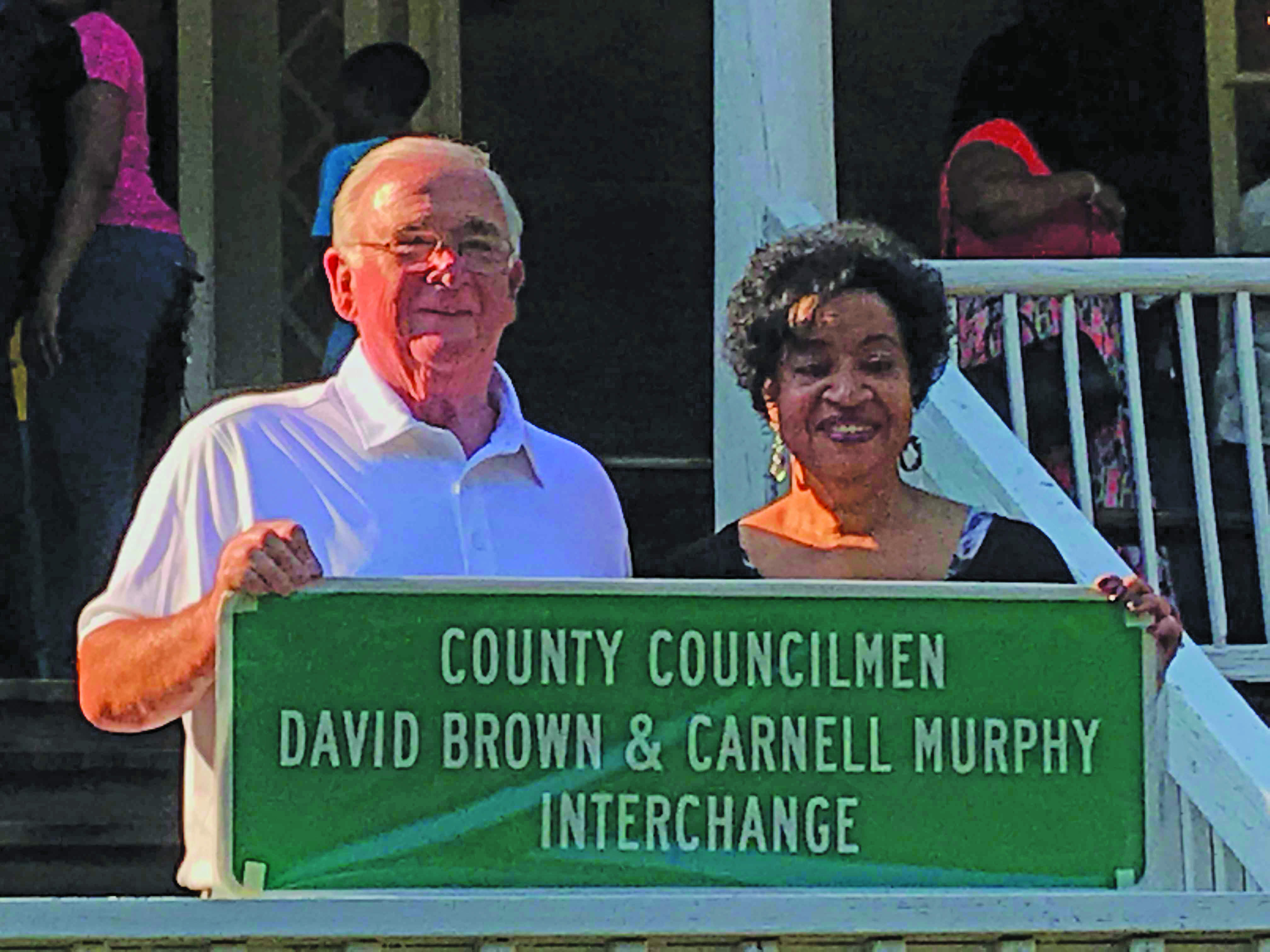
  • Exit 32 named for David Brown, Carnell Murphy

    WINNSBORO – Last month, two former Fairfield County Councilmen, David Brown and the late Carnell Murphy, were recognized for their success in bring industry to Fairfield County. The route to that success began with the two Councilmen’s plan to create an interstate access to a proposed industrial park in the county – that access would eventually became Exit 32 at Peach Road off I-77.

    Former Fairfield County Councilman David Brown and Elizabeth Davis Murphy, widow of the late Fairfield County Councilman Carnell Murphy, accepted a sign that was placed at Exit 32 off I-77 naming the interchange after the two councilmen.

    To honor the two men, the South Carolina legislature saw fit to place a sign bearing Brown’s and Murphy’s names at the exit earlier this month. The unveiling was held at a reception at Mt. Hope, Brown’s home in Ridgeway. He and Murphy’s widow, Elizabeth Davis Murphy, posed for pictures with the sign, and Brown recalled how it all began.

    “It was about 1992, and we were beginning to bring industry into the county. We had brought in the gold mine (in Ridgeway) and a Right Aid distribution center (where Breakthru Beverage is now located on Highway 34) and we were looking to bring in Mack Truck over on Highway 321,” Brown recalled. “But we knew we had to be closer to Interstate I-77 if we were going to bring in a lot of industry. We were able to buy land on Cook Road for $1,400 an acre – it was closer to the interstate than Mack Truck and Rite Aid. That property eventually became Walter Brown Industrial Park.”

    Brown said the future of industrial growth was ripe at the time with manufacturers Lang Mekra and Isola coming to the Cook Road industrial park in rapid succession, but access to the park was a problem. Exit 34 was just up the interstate, but added an extra five miles for northbound travelers on I-77.

    “There was also a problem that we weren’t allowed to put an exit within three miles of another exit,” Brown said.

    “We needed an exit closer to the industrial park, something to connect Peach Road to the interstate,” Brown said. “We were looking for ways to make that happen. We got Senator Fritz Hollings and Congressman John Spratt involved and things started moving.”

    As the collaborative effort began to take hold, Ridgeway Mayor Laura Thomas weighed in as well, Brown said. She, too, wanted an exit at Peach Road but for a different reason. It would be the first road coming into Ridgeway off the interstate north of Blythewood.

    “Soon Strom Thurmond was involved and everybody was working together to open up a Peach Road exit off the interstate,” Brown said. “But when we finally got it funded in the early 2000’s, the state sat on the money. It was about that time that we opened up the second industrial park, this time on Peach Road. We finally got the state to release the funds, and in 2010, Exit 32 was completed and opened, bringing a more direct access to our industrial area.”

    Brown still has the copy of The State newspaper that featured him and Murphy looking up at the exit.

    Today, the Commerce Park on Peach Road and the Walter Brown Park on the adjacent Cook Road are home to seven industries, and Brown said the future is bright for more to come.

    “If we were going to help the County, we had to develop industry before we could do anything else,” Brown said. “But we had to have access to the interstate, and we were glad to get it.”

  • Magistrate appointments bungled

    WINNSBORO – State senators will reconvene next week, in part to reconsider four controversial magistrate appointments in Fairfield County, according to S.C. Gov. Henry McMaster’s Office.

    Specifically, Jannita Gaston, Danielle Miller, Katina Capers-Washington and Vanessa Hollins must go through the reappointment process again. That process includes verification of whether they have passed two required eligibility examinations, said McMaster spokesman Brian Symmes.

    Senators were already scheduled to head back into session Tuesday to finalize the state budget, though lingering issues over Fairfield magistrate appointments will also be addressed.

    “The Senate recognizes that those appointments are not effective because of the status of the tests,” Symmes said. “They [senators] are going to take up these appointments.”

    McMaster and the Senate pressed the reset button on the magistrate appointments following an investigation by The Voice, which found multiple candidates had to take the exams more than once, that none of the four had taken the exams prior to their appointment and that at least one nominee had reportedly not passed the exams at all.

    Due to the exam debacle, Symmes said magistrate nominees are now going to have to provide proof of having passed the tests before appointments can move forward.

    “Because of this issue that was pointed out to our office by Court Administration, there have been changes put in place in our boards and commissions appointment process to make sure that this doesn’t happen again.” Symmes said. “We will now require the Senate delegation to confirm to our office, along with the nomination of these individuals, that they have taken their tests. That way, we will not have this particular issue arise again.”

    Magistrate shortage

    Fairfield County could potentially see a magistrate shortage for months, while also putting a strain on the county budget.

    State law prohibits new magistrates who don’t possess a law degree from hearing cases unless they first observe another judge preside over at least 10 cases. It could take six to nine months for the new magistrates to fulfill that requirement, said Fairfield County Administrator Jason Taylor.

    During that time, the county would have to hire interim magistrates in addition to paying the salaries of the county’s four magistrates in training.

    Taylor said he has not seen any signs yet of the magistrate’s office experiencing any backlogs.

    However, he fears it’s a possibility, noting that the office advised him that operations previously became “strained” with two vacancies.

    “I’m working with our chief magistrate, Paul Swearingen, on scheduling issues and such to see how we can manage to do this while they are still in training,” Taylor said. “I’ve got to look at our budget and see what we can do.”

    In the recently adopted 2019-2020 budget, Fairfield County appropriated $559,114 for the magistrate’s office.

    Taylor said part time magistrates make about $25,000 year, and estimated full-time magistrates make a little more than twice that amount. The magistrate budget covers other operational expenses as well.

    Strain on County Budget

    If the county has to utilize interim magistrates, which are unbudgeted, the money would have to come from elsewhere. How much money depends on from which county the interim magistrates come, Taylor said.

    “We may have to borrow [magistrates] from surrounding counties,” Taylor said. “Obviously Richland County magistrates make a lot more than ours do.”

    The Fairfield magistrate vacancies occurred when Sen. Mike Fanning, D-Great Falls, who represents Fairfield County, opted not to reappoint two experienced incumbent magistrates. He also filled two additional vacancies due to retirements.

    None of the four candidates Fanning nominated took their required exams until after he announced their appointment on social media, teeing up the magistrate appointment do-over.

    Fanning couldn’t be reached for comment.

    In announcing the appointees, Fanning in a May 21 Facebook post called them “outstanding individuals” who he said would “bring a wealth of diverse experiences to the position.”

    Fanning’s post said the magistrates would begin serving May 22. However, the earliest a candidate had even taken the test was May 23, according to documents obtained from Court Administration through a Freedom of Information Act request. At least one candidate hadn’t taken the tests until June, documents show, and it is reported that another still had not passed the tests after multiple tries.

    State law requires magistrate nominees to pass two exams – the Wonderlich Personnel Test and the Watson-Glaser Critical Thinking Appraisal II – before they can be appointed.

    “A senatorial delegation must use the results of these eligibility examinations to assist in its selection of nominees,” the law reads. “No person is eligible to be appointed as a magistrate unless he receives a passing score on the eligibility examination.”

    Candidates are expected to be capable of reading at a sixth grade reading level. They must also know how to tell time, know the days and months of the year and understand basic skills in math, measurements and monetary units, according to Court Administration.

    Magistrates have numerous responsibilities. They issue arrest warrants, conduct bond hearings, preside over misdemeanor cases and hear small claims civil cases.

  • Winnsboro Fibers expanding

    WINNSBORO – The former DuraFiber Technologies mill in Winnsboro is getting another shot at life.

    Fairfield County Council recently approved an ordinance certifying the Maple Street property as an abandoned textile mill. The vote passed unanimously on June 10.

    County Administrator Jason Taylor said Winnsboro Fibers, the facility’s current owner, plans to refurbish parts of the property, and wants to use state tax credits to help accomplish that. The abandoned designation allows the company to apply for those credits that will be reinvested into the property.

    In time, the company hopes to add some new facilities and make additional hires, Taylor said.

    “The state tax credits will allow them to invest in the facility to get it back to where it’s productive,” Taylor said.

    At second reading on May 24, Ty Davenport, the county’s economic development director, explained the ordinance in greater detail.

    Davenport said Winnsboro Fibers approached the county, seeking support for the company’s rehabilitation plans.

    Winnsboro Fibers plans to invest upwards of $6 million in the facility. The company currently employs about 19 workers, though Davenport remained optimistic more jobs could be created.

    “Hopefully in the future they’ll be able to add a second and third shift and add more people,” he said. “That [would] be a good thing for the county and for the town of Winnsboro.

    Winnsboro Fibers’ plans call for demolishing part of Plant 1 and leaving the weave room intact. Davenport said the company plans add ons to the building, though the additions wouldn’t be readily visible.

    Plant 2 and the administration building would remain intact. There are also plans to rehabilitate the plant’s iconic clock tower.

    “The facility was in fact a textile facility,” Davenport said. “All we’re doing is confirming and support their intent to rehabilitate the facility.”

    In addition to jobs, reinvigorating the plant could also help boost utility revenue, Davenport said.

    Winnsboro utility officials previously estimated the plant’s closure would cost the town between $400,000 and $441,000 in lost revenue per year, including $256,247 in lost gas revenues, according to a July 20, 2017 story in The Voice.

    Winnsboro Fibers acquired the mill from DuraFiber Technologies, paying $839,000 for the property in October 2017, according to Fairfield County property records.

    DuraFiber Technologies declared Chapter 7 bankruptcy in 2017. It operated three plants, including the Winnsboro facility. It employed around 800 people at all three locations, including 220 in Winnsboro.

    More than a century old, the Winnsboro property has housed several companies, including Uniroyal Goodrich Tire, Michelin North America and Invista.

  • QuaLex LLC investing $2M in Fairfield

    WINNSBORO – Another manufacturing company is coming to Fairfield County that isn’t asking the county for incentives.

    Ty Davenport, Economic Development Director for Fairfield County, announced last week that QuaLex Corporation, LLC will be investing $2 million in a new steel stamping manufacturing plant in Fairfield County. It will be located in an existing building across from the former Caterpillar facility.

    The Georgetown, KY based company is expected to hire up to 40 workers to staff the new plant. QuaLex supplies materials to Trane Manufacturing which announced two years ago that they would be doubling the size of their existing manufacturing facility on Two Notch Road.

    Davenport said he would share more information about the plant as it is available, conduct bond hearings, preside over minor misdemeanor cases and hear small claims civil cases.

  • Ramblin’ Road to wind down July 3 Fireworks

    Ramblin’ Road band members, from left, Ethan McChesney, Evan Purday, Andrew Moak, and Jonathan Douglas, will take the stage following the July 3 Fireworks in Doko Park.

    BLYTHEWOOD – When four guys from Blythewood, Ridgeway and Winnsboro signed up separately over the last five years for music lessons at Freeway Music, little did they expect to eventually become a locally popular southern rock band.

    But, sure enough, that’s what happened.

    Performing under the name Ramblin’ Road, the four will play their biggest gig yet at the July 3 Blythewood Fireworks bash in the Palmetto Citizens Credit Union Amphitheater in Doko Park. While they aren’t the headliner or even the opener, they have a place on the stage as the ‘after-fireworks’ performance – and they’re getting paid.

    When the fireworks end at about 10 p.m., Ramblin’ Road will take the stage. If the crowd sticks around for the after-show, it’s likely the group could be performing in front of 4,000 to 5,000 people.

    “Things are moving much faster than we ever imagined,” Jonathan Douglas, one of the group’s guitarist/singers, said.

    The band first consisted of Douglas and Ethan McChesney, a bass guitarist from Blythewood.

    “Then a little while later, Evan Purday, a drummer from Ridgeway, joined us. About a year and a half ago, Andrew Moak of Blythewood, also a guitarist and vocalist, became our fourth member,” Douglas said.

    The group’s music is a mix of southern rock and country.

    “Not a lot of people our age play stuff that was good way back and continues to be good,” Douglas said. “We play everything from Merle Haggard and Johnny Cash to Charley Daniels and Lynyrd Skynard.”

    While everyone in the group is in or just out of high school – Moak is 16, Douglas is 17, McChesney is 18 and Purday is 20 – Douglas said they all have a background in music.

    “I mean, all of us at some time picked up a guitar,” he added. The group is an unabashed advertisement for Freeway Music, and Douglas is quick to give the music company credit for Ramblin’ Road’s burgeoning success.

    “A lot of kids go to Freeway to learn music,” Douglas said. “We went there to get better. After we started performing as a group, we still depended on the studio for a place to practice and for equipment for performances, but we now practice at each other’s homes and we have enough equipment that we can pretty much roll out an entire show with our own stuff.”

    Douglas said the group performs about twice a month, and he and Moak handle the bookings.

    “We have a pretty good following of people who enjoy what we play. We love to perform. We play till they make us stop,” Douglas said with a grin.

    Douglas said the group hopes to make a career out of their music.

    “If it happens, it happens,” he said. “If not, we’ll be fine.”

    For now, Douglas said the band is enjoying what they do and are looking forward to performing in the town’s amphitheater.

    “We hope everyone will stay and hear our music,” Douglas said.

    The park opens at 4 p.m., Wednesday, July 3, with Eboni Ramm performing from 5 – 5:45 p.m., A. J. Sanders from 6 – 6:30, Blues Deluxe from 6:45 – 7:30 p.m., DB Bryant from 8 – 9:30 p.m. (fireworks from 9:30 – 10 p.m.) and Ramblin’ Road from 10 – 11 p.m.

    More than 20 food vendors will be on site. Bring the kids, lawn chairs, a blanket and enjoy.