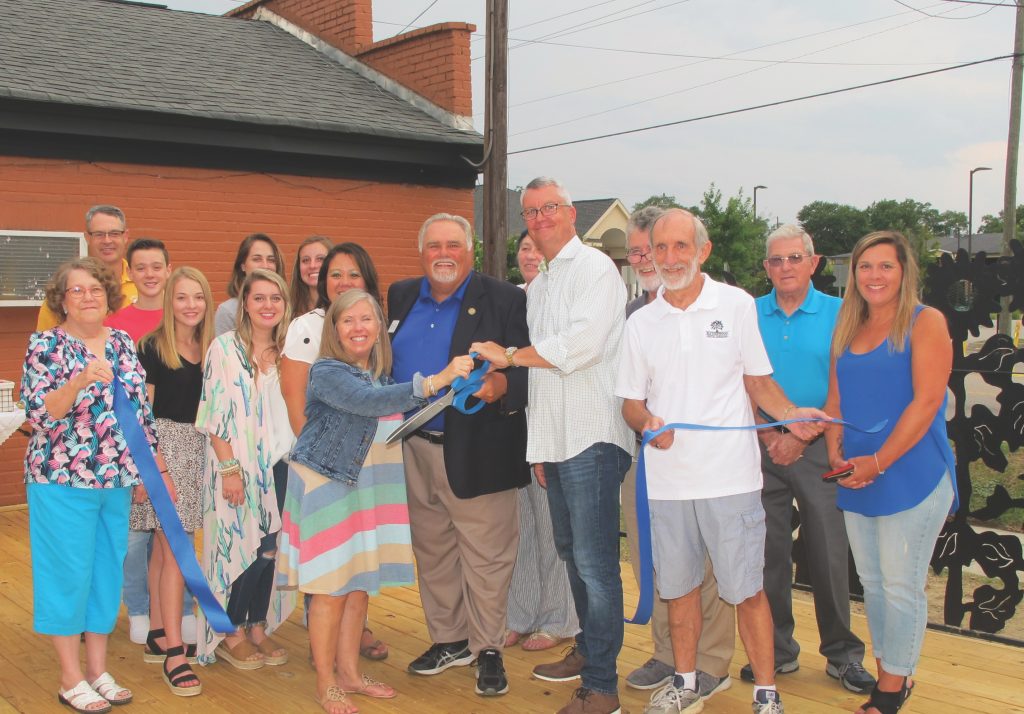
BLYTHEWOOD – Mayor J. Michael Ross, center assisted by Theresa and Rich McKendrick cut the ribbon Friday for their new consignment shop, 212 Main Consignment, in Blythewood.
Holding the ribbon at left is the co-owner of the building, Duane Walker. At right is Kristen Bennini, former owner of Bits & Pieces at the same location. Blythewood Town Councilman Malcolm Gordge is holding the ribbon on the right.
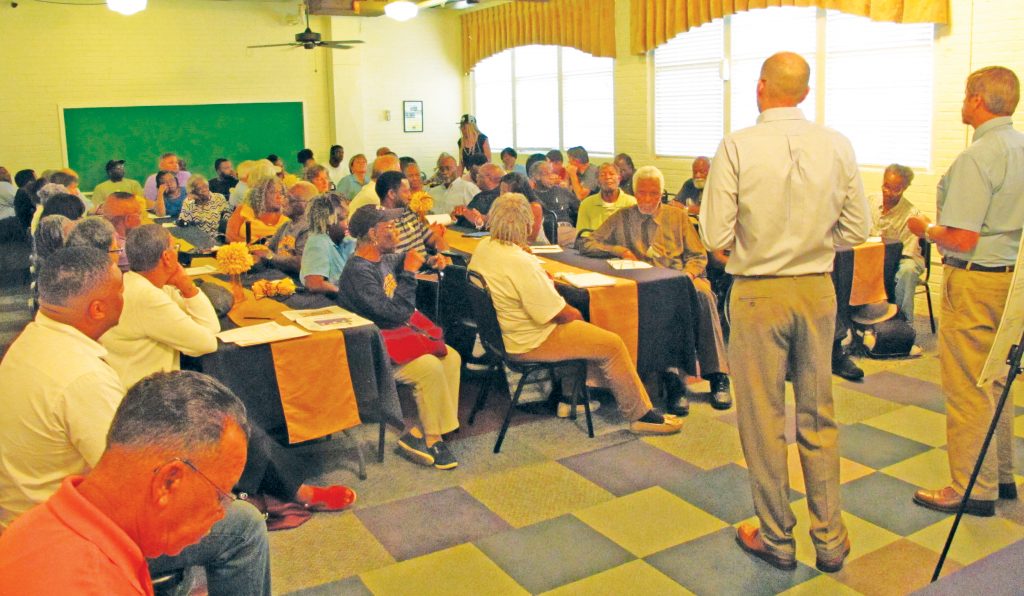
Officials from the County, Winnsboro and Central Midlands Council of Government discuss revitalization with Zion Hill and Fortune Springs area residents. | Photos: Barbara Ball
WINNSBORO – “If we don’t get something done here tonight,” Robert Davis told a crowd of Zion Hill and Fortune Springs Park area residents, “it’s our own fault. Officials from the town, county and the Central Midlands Council of Government (CMCOG) are here to help us.”
Davis was speaking to residents who had been asked by county officials to gather in the renovated Fairfield High School building for the purpose of contributing information that CMCOG could use to create a master plan for Winnsboro.
For some in the community, the mention of yet another plan for the town immediately caused skepticism to ooze.
“I have three or four folders at home where officials have come to my area with a plan, started work, tore down a few houses, then left. Will this be a designated plan?” Betty Gunthorpe, a resident of the Cemetery Street neighborhood across town from Zion Hill, asked. She also wanted to know, “Why Zion Hill?” and “How did Winnsboro get like this?”
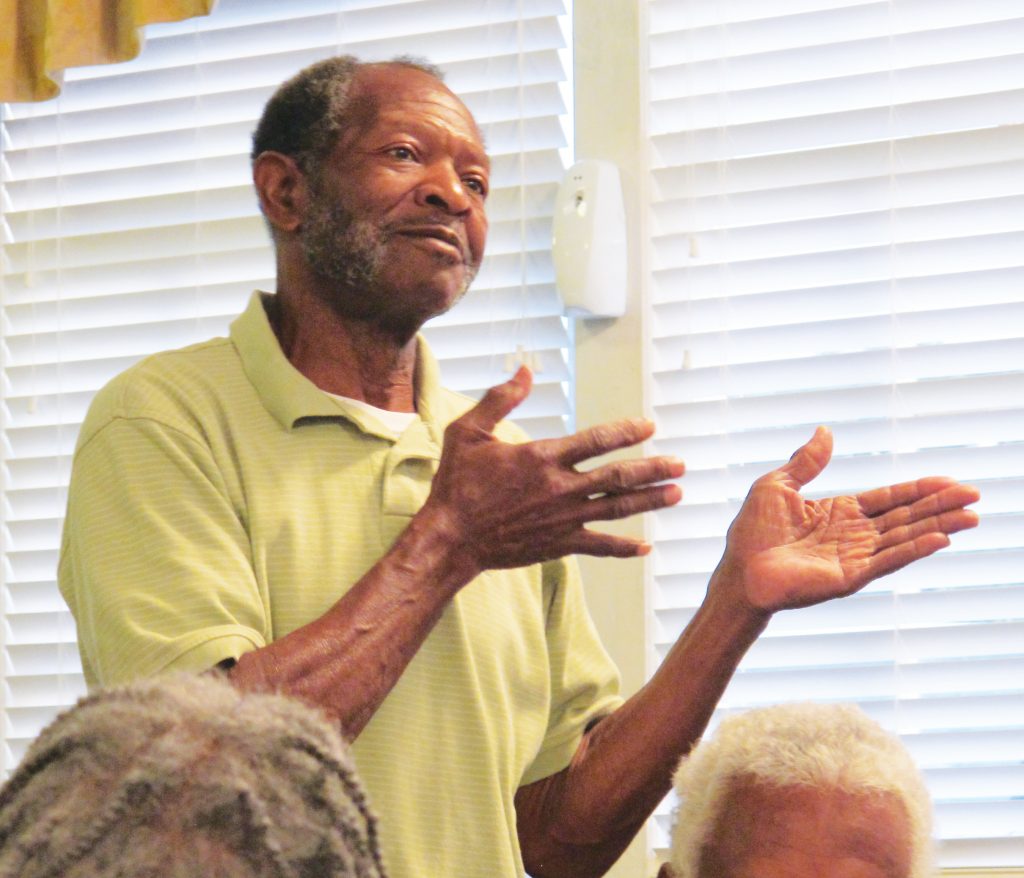
Resident Robert Pinkney recalls how Zion Hill used to be.
Chris Clauson, Fairfield County Community Development Director, answered Gunthorpe’s first question, explaining that this particular plan would, indeed, be different. He said the creation of the master plan is a required first step for the county and town to apply for thousands of dollars in Community Development Block Grants (CDBG’s) that can then be used to revitalize areas in neighborhoods overcome with blight caused by such things as dilapidated houses, crime, neglected parks and crumbling infrastructure.
Gregory Sprouse, Director of Research, Planning and Development for CMCOG answered Gunthorpe’s second question.
“I appreciate what you’re saying,” Sprouse, said. “To your point, we want this [Zion Hill] to be a starting point for how we can move similar types of projects into other areas of the town that need the same type of commitment. CDBG funds must be spent to benefit low to moderate income populations based on census data, and Zion Hill and the Fortune Springs area fit that criteria.”
While Gunthorpe’s third question stumped the planners, Clauson set conversation in motion as to how things could be turned around.
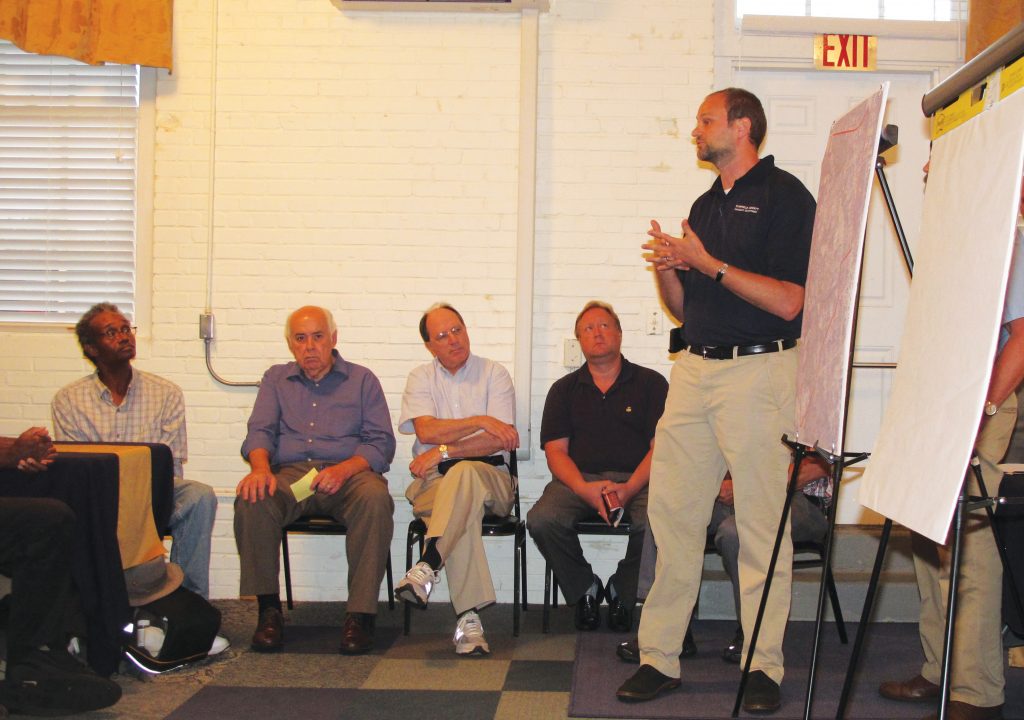
“Tonight is the first phase,” Clauson said. “We’ve been out in the community talking to residents and gathering data. We’ve seen some things. Now we’ve called this meeting to get input from you about what you think is wrong in your neighborhood and what you want changed. We want to know what’s going on, what are the issues, the opportunities, the challenges. We want to hear about traffic issues, infrastructure, lighting, town services, transportation (transit), public safety and issues with health and education, so we can pair them up with potential grant funds to fix the problems.
“The point tonight is to determine what the potential projects are and to set priorities for them,” Clauson said. “The problem we’ve heard the most about is dilapidated houses and other structures that are deserted and falling in. They’re eye sores,” Clauson said. “But we have to create the master plan for revitalization before we can apply for the funds to deal with the houses.”
During the course of the evening, residents began to pour out their worries and frustrations, including what they perceived to be poor code enforcement, the inaccessibility of Zion Park, poor responses from the Sheriff’s department and town hall and nothing being done about houses falling into disrepair.
Chris Clauson, director of the County’s community development, leads revitalization discussion.
“It can be a very arduous process to condemn these houses and clear them out,” Mayor Roger Gaddy explained. “The laws are on [the property owner’s] side. It’s a very costly process. Before we can do anything, we have to find the property owner, who frequently lives in another state, and send two registered letters,” Gaddy said. “Then, after they open the first letter, they won’t sign for the second one. It’s extremely frustrating. But if you don’t go through the process, you put the town at risk of being sued.”
But solutions were also presented. Clausen explained that the County is making some headway in eliminating blight by tearing down those dilapidated structures that have come under the county’s ownership through tax forfeiture.
County Administrator Jason Taylor explained that the county has acquired more than 100 structures over the years through the forfeiture land trust, and has begun tearing those structures down. He said the county is also trying to acquire others that it doesn’t own that need tearing down.
“But you have to have the money to do this or it’s just a dream,” Taylor said. “A CDBG will give us $500,000 to work with to get property owners to sign the properties over to us so that we can tear them down.”
Taylor’s plan includes more than just tearing down the houses. He said the lots that remain after the houses are torn down could be leveraged to accommodate new affordable homes in the neighborhood.
“Once we tear the houses down, we have all these empty lots throughout the town with water, sewer, electricity, sidewalks and roads ready to be built on. When you build a new subdivision, you spend most of your money on roads, sewer, water, those kinds of things that these lots already have,” Taylor explained. “So we have reached out to Habitat for Humanity. Once we get ownership of all of this, we hope to bundle the lots and work with Habitat or some other developer to come in and put new houses on them.”
Other discussion centered around problems at Fortune Springs Park – lack of tree pruning, soil erosion, sidewalk needs and more.
There were also poignant testimonies of a once thriving neighborhood that is now at the mercy of crime.
“I grew up on Zion Hill and nothing’s the same anymore,” Robert Pinkney told the planners. “You used to know everybody and feel safe. My house has been broken into five times and I finally had to go find the thieves myself and get my own things back – three TVs, two lawn mowers, two weed eaters and more,” he said. “We don’t get any help.”
While some of the complaints residents relayed to the planners were raw and difficult for city and county leaders to listen to, it was what the organizers had come to hear.
“I’ve been to these community meetings all over the state,” Newman told the 60 or so residents in appreciate of their participation, “and the turnout here is amazing. Haven’t seen anything like it.”
“We have some competitive projects here,” Sprouse said, “and we will be submitting our application for a neighborhood revitalization grant in September.”
According to Taylor, together, the town and county are eligible to apply for four $500,000 CDBG grants each year, one each for the county and the town for infrastructure in the spring and one each for the county and town for community revitalization and enrichment in the fall.
“Working together,” Taylor said, “we can do a lot”
Asked by one resident, what MCOG’s track record is for getting CDBG money,” Sprouse answered with a smile, “it’s good.”
“We are committed to getting some of that money in here,” Clauson said. ”And we will be having more meetings like this one for future projects if we are successful with this.”
Before the crowd dispersed, Ridgeway Town Councilman Don Prioleau, who is also the president of the Fairfield High School Alumni Association, invited those attending to take a tour of the renovated school building to see first-hand what revitalization can do.
After the meeting, Prioleau pointed out that the school has been almost totally restored to its original state through the efforts of its former students and with no government help.
“The building is now beautiful and useful. It offers meeting space for community meetings such as this one,” Prioleau said. “It’s a wonderful asset to the community now. The renovation of our school is something we worked long and hard to accomplish and we are very proud of it,” Prioleau said. “I’d like to see that for this whole Zion Hill community, for the whole Town of Winnsboro.”
WINNSBORO – The body of a woman who appeared to have been stabbed was discovered along Highway 200 at about 8:40 on the morning of Wednesday, July 24, according to the Fairfield County Sheriff’s Department.
Thelma Alejandra Villegas Rios, 21, of Charlotte, was reportedly found face down in a ditch next to Highway 200 in the area of Hook Road. The body was discovered by a person mowing along the highway. A K-9 unit was brought to the scene and the surrounding area was searched, the report stated.
The woman appeared to have been stabbed by a knife or sharp object in the right upper chest area. She also had a laceration to her right knee, according to officials.
The victim was positively identified as the person who had recently been reported missing in the Charlotte area.
The incident is being investigated by The Fairfield County Sheriff’s Department, the Charlotte Mecklenberg Police Department and the South Carolina Law Enforcement Division (SLED).
The Fairfield County Sheriff’s Department is asking that anyone with information about the incident to contact them at 803-635-4141.
Senator John Scott welcomes the Kinslers to Blythewood. | Photos: Barbara Ball
BLYTHEWOOD – A line of cars with license plates from New York, Georgia and beyond slowly turned off Kinsler Road on the western edge of Blythewood 29016 and through an open farm gate into a 400-acre horse farm where rolling fields, manicured to the nines, glistened green in the bright afternoon sunshine as far as the eye could see.
As the cars parked in the grassy field, the folks stepping out of them laughed quietly and hugged each other, then walked somberly toward a clump of tall pines that shaded a circle of ground marked with tiny grey stones topped with small vases of flowers. The visitors milled about in the shade, pausing reverently at each stone.
The stones marked the graves of their ancestors – slaves who died hundreds of years ago on the land where they are now buried. The cool, shaded cemetery, in its simplicity, was as breathtaking as the contrasting sunny green pastures that surrounded it, dotted with giant cross-country jumps and riding arenas – a horseman’s paradise.
Mary Burnside, the farm’s owner, greeted the visitors one by one and welcomed them warmly. It was apparent there was already a strong bond between Burnside and her guests.
Except for Burnside, the people buried and the people visiting the buried – both white and African-American – belonged to one family – the Kinsler family.
They had gathered for a family reunion and to honor their ancestors.
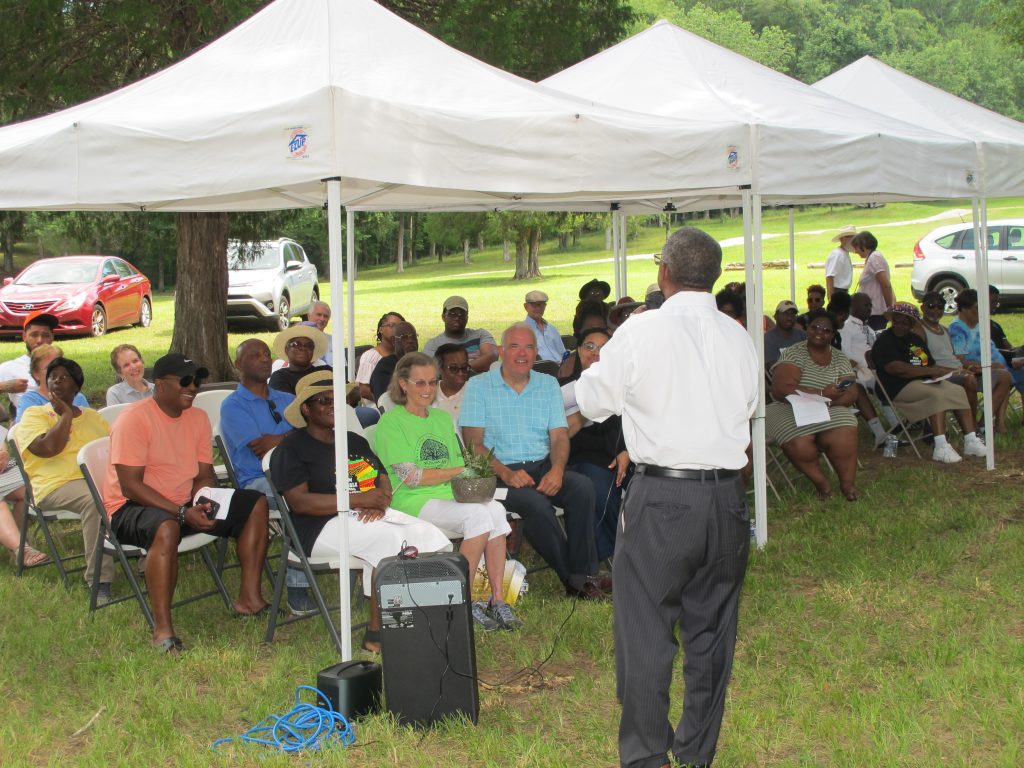
At 2:30 p.m. last Thursday, everyone took their seats beneath white tents. Bobby Clark, Chairperson for the 2019 Kinsler family reunion, welcomed the 60 or so family members.
Burnside then spoke, recalling how her late husband, Richard (Dick) Burnside, accidentally discovered the graves when he was bush hogging the land some 50 years ago.
In the disturbed soil, there were many small stone columns driven into the ground as grave markers, Burnside said as she related how her husband felt an obligation to repair the stones he had hit and to mark them clearly so that they would not be hit again. While Dick Burnside didn’t know who the people were that were buried on his property, he began caring for the cemetery, something he would continue to do until his death last year. He did not, at the time, know if anyone would ever be able to tell him just who, exactly, these people were.
Fast forward about 30 years when Brenda Kinsler (who is African-American) of Washington, D.C. and Charlie Smith (who is white) of Charleston, S.C., met online while researching their separate family histories.
“It didn’t take long before we realized that our ancestors were the same family – the Kinsler family – who had lived on the Burnside property since the 17th century, until it was purchased by the Burnsides in the 1970’s,” Kinsler said.
In their research, they learned that prior to the Burnsides owning the land, it was owned by Smith’s great, great, great grandfather, John Herman Kinsler, a signer of the South Carolina Ordinance of Secession, State Senator, State Legislator, Chairman of the Senate Education Committee and Chairman of the Board of the South Carolina College, now the University of South Carolina.
They also learned that Brenda Kinsler was a descendent of African slaves owned by John Herman Kinsler and, therefore, bore his name.
Brenda Kinsler’s and Charles Smith’s remarkable story did not end with the discovery that their families were the same. Their story went on to reunite all the descendants of John Herman Kinsler – both his African-American descendants and his Swiss German descendants.
In 2004, Kinsler and Smith traveled to the Cedar Creek community where the Burnside farm is located. They wanted to see where their ancestors had been enslaved. During that first trip, they visited a few related properties in the area looking for clues as to where the Kinsler slaves were buried.
“I was hoping to find the cemetery of my ancestors,” Brenda Kinsler said. At her urging, she and Smith pulled up to Burnside’s house and knocked on the door to ask if any old cemeteries were on the property.
“His face lit up,” Smith wrote in a memoir, “and he said, ‘Give me a minute and I’ll get my truck and show you right now.’ It was a toss-up who was more excited at that moment, Brenda and I who had information and no cemetery or Mr. Burnside who had a cemetery and no information,” Smith recalled.
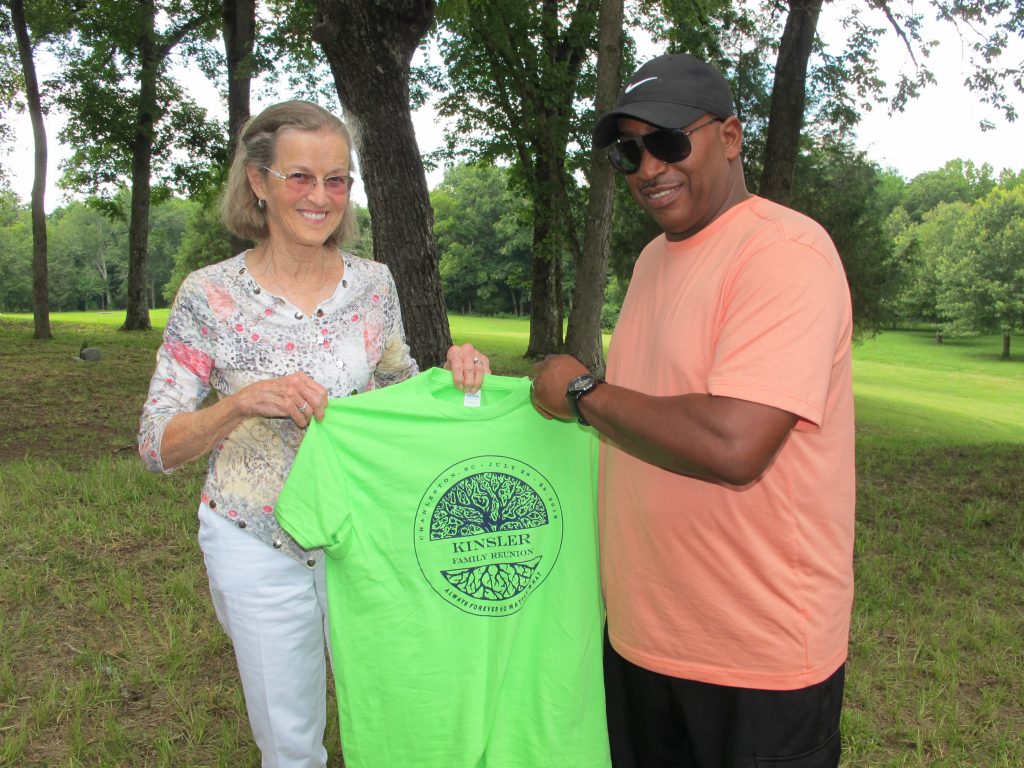
Keith Kinsler presents a Kinsler family shirt to Mary Burnsides, making her an official member of the Kinsler family.
That chance meeting on the internet more than a decade ago has since changed the entire dynamic of a family born into the South Carolina slave-holding culture, and it gave the man who had tended that sacred space an answer to the question of just who these people were who were buried on his land.
After Burnside’s death, the care and keeping of the slave cemetery has been continued by his wife, Mary, a longtime horsewoman in the Blythewood community who keeps a stable of horses across the road from the cemetery.
To show their gratitude for what the Burnsides have done for their ancestors’ graves, slave descendent Keith Kinsler presented Mary Burnside with a Kinsler family t-shirt, declaring her an official member of the Kinsler family.
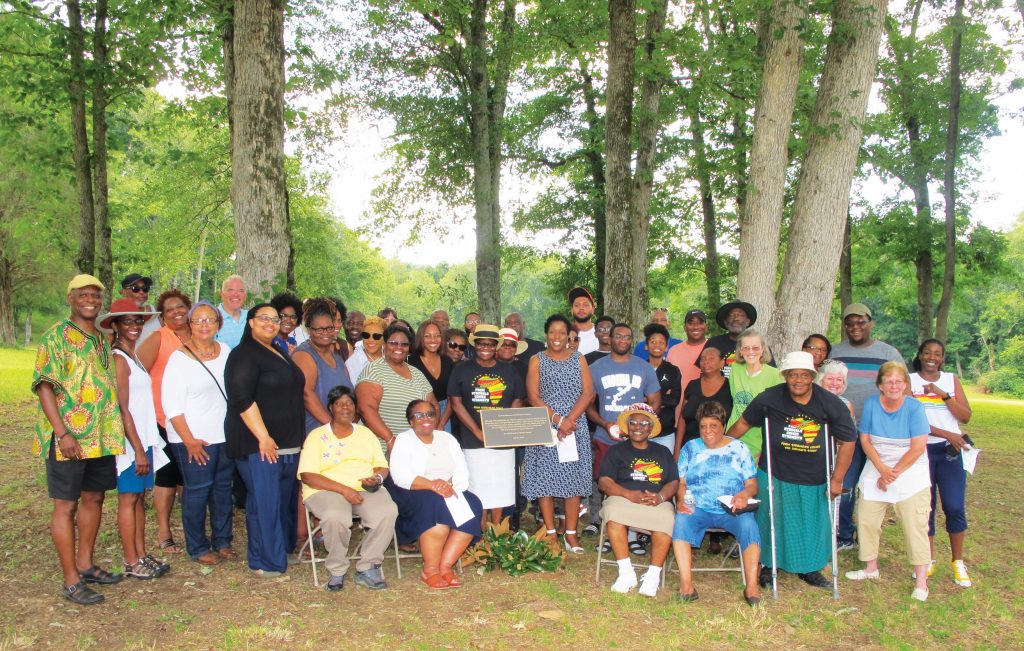
A plaque, donated by Burnside, was then unveiled to commemorate the cemetery and the Kinsler slaves buried there.
Following the ceremony, the family traveled to Charleston where they joined the Swiss-German Kinsler descendants for a continuation of the Kinsler family reunion on July 26 – 28.
A book about the Kinsler family and their ancestors, by Cynthia White, titled ‘From Whence We Came – a history of the African-American Kinslers’ is available online from Amazon books.
“We would love to help others do what we have done, to find our ancestors and to know where they lived and where they are buried,” Brenda Kinsler said.
For more information about the Kinslers and how they traced their ancestry, contact Brenda Kinsler at 1-202-407-3290.
The Kinsler family gathered around the plaque donated by Mary Burnside to commemorate the graves of their enslaved ancestors who are now buried beneath the trees behind them.
COLUMBIA – On July 10, 2019 the South Carolina Ethics Commission filed a $51,750 Judgment in Richland County Common Pleas Court against the immediately previous Richland Two School Board Chairwoman Amelia McKie.
This Judgment is to collect the $51,750 in fines and fees that McKie owes the Ethics Commission under Decision & Order No. 2017-023, which was issued on July 3, 2019.
That Decision was based on McKie’s failure to file numerous required documents between 2015 and 2018, including Campaign Disclosure Reports and Statements of Economic Interests Reports.
A 2018 Decision & Order informed McKie that, if she didn’t make payments as scheduled on Dec. 31, 2018, and later on June 30, 2019, the Judgment would be entered.
Another Deadline Passes
In addition, another deadline has passed with McKie failing to publicly declare campaign contributions and expenditures, a procedure required by state law.
McKie filed her quarterly campaign disclosure report on July 18, eight days after the July 10 deadline, the S.C. Ethics Commission said.
As of 12:13 p.m. July 18, McKie had not filed the report. The Voice left a message for McKie and within an hour, the Ethics Commission website said the report had been filed on July 18.
McKie said via email last week that she filed on time.
“My campaign disclosures were prepared in advance of July 10 and were ‘saved’ until the July 10th date,” McKie wrote. “The saved disclosure has been ‘filed.’ If a screen shot of the same would be helpful, please let me know. The [ethics commission] can attest to the same.”
Meghan Walker, executive director of the ethics commission, said McKie started the online application process on July 10, but didn’t complete it until Thursday [July 18].
“Ms. McKie saved her report on July 10. It was saved and not filed,” she said.
McKie also missed the April 10 quarterly deadline, not filing those documents until May 9, and not until after The Voice contacted her then.
Walker said McKie has paid a $100 fine for that violation.
Other Richland Two board members either filed their July 10 forms on time or have filed a final report, closing their accounts and negating the need to file, ethics records show.
In a related development, fellow trustee Teresa Holmes was recently fined for failing to file Statements of Economic Interest forms before taking the oath of office, according to documents obtained by The Voice.
Holmes paid a $100 fine to settle the matter, the June 21 order states.
Richland County resident Gus Philpott, who has spoken out against Richland Two ethics violations in past board meetings, filed the complaint in April.
Philpott also asked the commission to invalidate any votes Holmes took while in violation and to remove her from office. The agency declined to do so.
“The Act contains no provisions which would allow the Commission to invalidate a public official’s votes or remove him from office,” the order states.
In a 2008 opinion, the S.C. Attorney General’s Office opined that only school boards and boards of trustees can remove a member “for cause.”
The opinion contains a lengthy definition of “for cause.” In part, it says “cause is a flexible concept that relates to an employee’s qualifications and implicates the public interest.
“Neglect of duty, inefficiency, and the good faith abolition of a position for valid reasons are all legally sufficient causes for removal,” the order continues.
Philpott said he didn’t want to discuss the Holmes case. Regarding McKie, he said the former board chair should be sanctioned for her latest missed filing.
“The Ethics Commission should fine her,” Philpott said. “She’s not attending to her responsibilities.”
This is the 15th time since July 2015 that McKie has failed to file campaign disclosure reports on time. She only met the deadline once, filing her January 2019 statement Jan. 9, 2018, one day early, according to online ethics filings.
Ethics records also show that McKie went three years – from 2015 to 2018 – without filing Statements of Economic Interest forms. She did not file forms for those years until December 2018.
SEI forms must be submitted by March 30 every year. They list a candidate’s income sources and other positions they hold that may pose a potential conflict.
Section 8-13-1110 of state law says no public official “may take the oath of office or enter upon his official responsibilities” unless an SEI form is filed.
Richland Two trustees were sworn in Nov. 13, 2018, according to a Richland Two news release. Neither McKie nor Holmes filed file SEI forms until Dec. 4, 2018, ethics filings show.
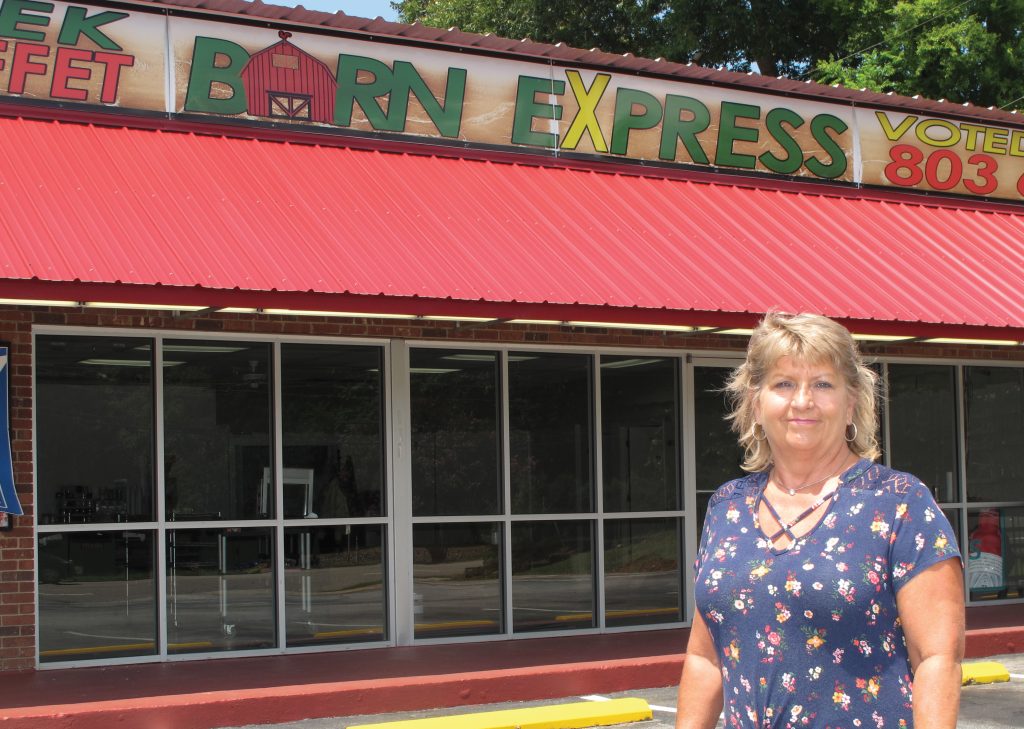
WINNSBORO – Answering the prayers lifted up by many folks in Fairfield County the last two months, Jennifer Boone has re-opened the popular Barn Express. It opened Thursday morning at 10 a.m.
It’s going to be the same, but different, the longtime co-owner of the restaurant told The Voice earlier in the week.
Jennifer Boone, co-owner of Barn Express. | Barbara Ball
“It will no longer have the convenience store component,” Boone said. “It’s just going to be a restaurant. I got rid of all the booths – sold ‘em yesterday. We will have tables and chairs in both the dining room and in the front area,” Boone said, running through a list of changes customers will see. “We’ll still have the buffet, but no more busboys. I’m going to have waitresses instead,” she said.
A new ordering system will take orders straight to the kitchen and make everything more efficient, Boone added.
“We’ll have a couple of people on the floor to assist the customers so they won’t have to be running back and forth to get a drink,” Boone said. “I’ve bought new kitchen equipment and added another fryer to keep us from running out of fried chicken. We’re also adding subs and some additional sandwiches, and we’re adding to our grill menu.
“I’m trying to do better. I want our customers to have a better experience,” Boone said.
One thing longtime customers may not like better is that Boone will no longer be open for breakfast but will be open for an early dinner.
“We will be open from 10 a.m. until 6 p.m., seven days a week,” Boone said. “But no breakfast.”
After 24 years running the restaurant, starting in 1995 with her dad, the late Jackie Mincey, and later with her sister Julie Haynes, Boone said she has come back refreshed.
“We intended to just be taking a vacation and closed for a week when my husband had knee surgery the end of May,” Boone said. “But during the same week, Julie became a grandmother for the first time. Plus my mom was not well, so we just shut the place down and decided to sell it. I realized that the welfare of my husband and mom were more important to me than the store. Julie felt the same about her new grandbaby. But, you know, when my husband got well and my mom was feeling better, I didn’t have anything to do! I began missing all our customers. So I decided to open back up, but with changes,” she said.
Haynes, on the other hand, decided to continue on playing with her new grand, and will not be rejoining her sister in the business. The two purchased the business from their dad in 2003.
“While we were closed, we started to hear from our customers. I didn’t realize how important the restaurant was to the town and how much our customers missed us,” Boone said. “It makes me feel really good that we apparently did the right thing all these years to have so many loyal customers. With the changes, I’m looking forward to opening back up.”
The Chamber of Commerce is planning a ribbon cutting for the grand re-opening sometime in mid-August, Boone said.
“But I’m going ahead and opening now so we have time to get used to the new way we’ll be doing things. It will give us time to adjust,” Boone said. “I’m looking forward to seeing everyone again, and I think the customers will like everything better.”
Everything except, maybe, the part about ‘no breakfast.’
COLUMBIA – South Carolina’s annual sales tax-free weekend is set for Friday, Aug. 2 through Sunday, Aug. 4.
What’s tax free? A variety of back-to-school essentials are exempt from the state’s 6 per cent sales tax and any applicable local taxes. Three other categories are also included: clothing (including diapers), accessories and shoes; computers and bed and bath items.
Not everything is included, however. For instance, computer keyboards are only exempt if they are included in a computer package. Listed here are some common exemptions. For a complete list of tax-free items, go to https://dor.sc.gov/taxfreeweekend.
SCHOOL SUPPLIES
Art supplies
Binders and folders
Books
Book bags
Calculators
Daily planners and organizers
Glue, tape, staplers, staples
Highlighters and markers
Lunch boxes
Musical instruments
Notebooks, paper
Pencils, sharpeners, erasers
Pens
School uniforms
Scissors
Sport uniforms
COMPUTERS
Computers
Computer parts and accessories (i.e. monitors, keyboards, and scanners) when sold as a package with a computer
Computer software and service contracts (sold in conjunction with software)
Printer supplies, including replaceable ink cartridges
JENKINSVILLE – Contamination has been reported again in Jenkinsville water.
In July, the S.C. Department of Health and Environmental Control, or (DHEC) issued a new notice of violation against the JWC, the fourth such violation in five years, and fifth since 2010, according to public records.
The latest violations occurred at Well 15 on Clowney Road. Other wells are in compliance.
JWC exceeded Gross Alpha radiation levels on two occasions in 2018 — July to September, and October to December, DHEC records show.
Gross Alpha is a test that measures radioactivity levels in water, according to the Environmental Protection Agency, or EPA.
During the October to December testing period, Gross Alpha levels peaked at 34 pCi/L (picoCuries per liter). July to September radioactivity levels came in at 23 pCi/L.
The state legal limit for drinking water is 15 pCi/L, according to DHEC.
Samplings taken since then have been in compliance.
From January to March, radioactivity was 11 pCi/L. From April to June, it was 12 pCi/L, documents show.
JWC chairman Greg Ginyard said he couldn’t explain the 2018 measurements found in violation. He said the JWC has done nothing different in the past 12 months, yet radioactivity levels dropped to acceptable levels.
“It doesn’t make sense to me. Was it a blip in the lab somewhere? I don’t know,” Ginyard said. “They had two that were bad that were a year ago. I don’t have any answers.”
In 2010, DHEC issued a notice of violation when uranium was found in a JWC water storage tank in Blair. Radium has been found on multiple occasions at the Clowney Road well, records show.
“Effects of Exposure to Radium”
DHEC spokeswoman Laura Renwick said Jenkinsville water customers should not worry about ill effects from short time exposure.
“Over a long period of time and at elevated levels, ingestion of radium increases the risk of bone cancer and uranium increases the risk of kidney damage,” Renwick said via email. “There are no immediate short-term health risks or symptoms from drinking water that contains gross alpha radiation.”
No fines or penalties had been imposed as of press time. An enforcement conference will be held at a later date.
Renwick said the JWC must submit to DHEC a corrective action plan that addresses the violation. The JWC must also publicly notify customers within 30 days of the violation, which is dated July 23.
The latest violation is the fourth in five years that DHEC has issued against the Jenkinsville water provider, agency records state.
It also comes amid pushback and threats of litigation from the JWC and its attorneys against Fairfield County Councilwoman Bertha Goins, who’s publicly criticized the authority over its water quality. No lawsuits had been filed as of press time, according to the Fairfield County Public Index.
In June, the JWC went as far as to issue an ultimatum demanding Goins retract her statements. She refused, saying publicly and through her attorney that the JWC’s threats are meant to intimidate and silence her.
In one of its letters to Goins, the JWC called its water “award winning,” asserting that no contaminants above DHEC levels have been detected in seven years.
Legal Victory for JWC
The violations reported in July overshadow a legal victory for the JWC, which succeeded in having one of two pending lawsuits partially dismissed.
In 2014, D. Melton of Broad River Campground sued the JWC for breach of contract after the body rejected his request for increased capacity.
Melton later amended his suit to include JWC chairman Greg Ginyard and vice-chairman Joseph McBride individually as defendants. The amended suit also alleged violations of the S.C. Unfair Trade Practices Act, or SCUTPA.
In February, a circuit judge dismissed the SCUTPA claim as well as individual suits against Ginyard and McBride while allowing the breach of contract litigation to continue.
Circuit Judge Brian Gibbons wrote in his order that he found no evidence the JWC was guilty of unfair trade practices.
“Plaintiff BRC failed to prove that Mr. Ginyard and/or Mr. McBride acted with reckless, willful, wanton, or gross negligence,” Judge Gibbons wrote. “To the contrary, the evidence shows that Defendant JWC acted in accordance with the advice and recommendation of its third-party engineers, and no evidence showed, or even inferred, that Mr. Ginyard or Mr. McBride attempted to undercut, disregard, or deviate from those recommendations.”
Ginyard declined to comment on the pending litigation, but did say he doesn’t see the partial dismissals as legal victories.
“To me it’s not a victory because I didn’t do anything wrong. I knew all the time that there was going to be vindication,” Ginyard said. “I took a polygraph. I passed it.”
NOTE: This story has been corrected to say customers should not worry about ill effects from short term exposure.
BLYTHEWOOD – The Town of Blythewood does not currently charge fees for vendors who participate in town-sponsored events such as the annual July 3 Rockin’ Red White & Blue fireworks celebration. But that’s about to change if council passes an ordinance it is framing for temporary vendor fees.
While the discussions are in the initial stages, Steve Hasterok, Director of Events at Doko Mannor and Doko Park, suggested council should be looking ahead.
Mayor J. Michael Ross told council members Monday evening that they are leaving money on the table by not charging vendor fees.
“While the July 3 event is our signature event, the park keeps growing and there’ll probably be more opportunities to have vendors in the park,” Hasterok told council. He outlined three major areas he said council needs to look at.
How much to charge food, drink, arts and crafts and other categories of vendors such as churches, non-profits and military organizations?
What priority criteria should be used to deter mine what vendors and what type of vendors would be allowed to participant in town events?
How to prioritize vendors who sell the same products, such as beer or hotdogs?
Hasterok also suggested council should decide whether to charge flat fees or percentage of sales.
“Charging a flat fee can be unfair if they are all charged the same fee. A beer vendor might sell $7,000 in beer while an arts and crafts vender might bring in $1,000,” Hasterok said. “But percentages are hard to track. You basically have to be on an honor system. A flat fee is easier.”
Hasterok suggested possibly charging large vendors one price ($150), small specialty vendors another price ($100) and 501(c)3’s and mom and pops selling brownies, another price ($75).
“I agree that we should cut a break for folks like small mom and pops and charities,” Councilman Malcolm Gordge said. “We could start off with the market rate and see how that goes.”
“Most vendors expect to be paying a fee, but we don’t want to knock out the small vendors,” Hasterok said.
“I think we’ve been missing an opportunity for years,” Ross said. “If we had charged $100 per vendor for the July 3 event, we would have made $2,100. That offsets the cost of those fireworks or we could have bought more fireworks,” Ross said. “I don’t think any vendor would mind having the opportunity to be able to sell to 4,000 – 5,000 people and to get the kind of money I believe they generate. And maybe we could discount further for smaller vendors or charities.”
Hasterok said it’s also important to be sensitive to duplication of products sold by vendors.
“We don’t want too many vendors selling the same thing,” he said. He also asked council if they wanted to give priority to in-town vendors who have brick and mortar business over outside vendors.
“Are we going to grant exclusivity to certain vendors?” Hasterok asked. “There are other businesses here in town besides McNulty’s Taproom that may want to sell beer. We need to have a plan.”
But Hasterok said 21 is just about the limit for the space in the park.
“I know you can’t put anymore vendors in there,” Councilman Eddie Baughman said, “but the lines are really long, and we don’t want people waiting 45 minutes to get something to eat.”
“We’re getting lots more vendors who want to sell at our park events,” Hasterok said. “They search the web for events and call us, and we really need a policy on what we’re going to do.”
“Can we, within our rights, give preference to brick and mortar businesses in Blythewood for vendor space?” Ross asked Town Attorney Jim Meggs.
“I don’t know,” Meggs said. “Local preferences can be problematic.”
“We have a few months to work on this,” Ross said. “But I think we’ve let money get away from us that we could have gotten that is very fair. A hundred dollars is not going to scare anyone off. But there are some other things we need to have Mr. Meggs to check on.”
BLYTHEWOOD – Last December, town council awarded $17,360 in hospitality tax revenue to Bravo Blythewood to organize a four-night Spring concert series with the purpose of bringing visitors to the town. During Monday night’s town council meeting, Mayor J. Michael Ross presented Bravo Blythewood’s final report on the series. It revealed that the concerts not only failed to bring many visitors to town, but that Bravo Blythewood lost $18,140.53 on the four concerts.
And if that wasn’t enough to raise the mayor’s and council’s ire, there was more. No one showed up at the meeting to answer for the loss.
The four concerts were performed in the Palmetto Citizens’ Credit Union Amphitheater in Doko Park April 27, May 3, 10 and 17.
In the application requesting hospitality funds, event manager Sara Ballard projected revenues of $46,054: $17,360 from H-Tax funds; $11,000 from sponsorships; $1,500 from food vendors, $14,560 from beer/wine sales and $1,634 from juice and water sales.
Besides the town’s contribution, the event only brought in $8,618 ($3,568 from beer/wine sales, $2,000 from sponsorships, $2,000 from Martha Jones, president of Bravo Blythewood and $1,050 from vendor fees).
The projected revenue fell short $7,000 on sponsorships, $450 on food vendors; $10,992 on beer/wine sales and $1,634 on juice and water sales.
“I’ll just say I hope this wasn’t their major fundraiser,” Ross joked, then turned serious.
“Why is no one from Bravo Blythewood here tonight?” Ross asked. Buddy Price, a Bravo Blythewood board member, had been in the audience but left before the agenda item came up.
“It doesn’t take a rocket scientist to see where their projections were way off,” Ross said. “And some expenses I would question. I’m not an event planner, but there are some things that, well, I can see where they lost some money,” he continued.
“I see Sara Ballard [the event planner] is not here,” Ross said, scanning the audience. “But I would have thought someone would be here. I don’t understand why they aren’t here to answer our questions. Gosh! We gave this money for them to bring people [to town]. So who do we ask?”
“This is not good,” Councilman Eddie Baughman interjected
According to Ballard’s report, she was paid $8,000 to organize the event. She was not paid (according to the final budget) a $1,000 bonus that was listed in the projected budget. Ballard was paid $1,000 for Facebook promotion – $900 to her company Broadstreet Consulting, LLC, for Facebook advertising and $100 for Facebook ad management. No breakdown or receipts were provided for any of the Facebook costs.
In addition to lower than expected attendance, expenses ran amok in several areas, including $9,200 for sound system and lighting equipment that had not been included in the projected $46,054 event budget, and $4,315 for hired staff that was projected to cost $640.
Ross ran through the list of losses, focusing on beer and wine sales and sponsorships.
“But the one that is mind boggling to me is the sound costs. Sound was not even budgeted, yet they spent $9,200 on it,” Ross said, raising his voice.
“You add these three losses up and that’s $26,000,” Ross said. “And they still haven’t paid the town the $3,000 they owe us for the venue (amphitheater).”
“We have an unbelievable facility out here and the sound has been great for other events,” Ross said.
“Their expenses were astronomical – $10,000 per night plus expenses,” Baughman commented. “It could have been done for half that cost.”
“When they applied for this money, what were we thinking,” Councilman Larry Griffin asked. The audience and council laughed.
“They were projecting a much larger audience,” Baughman said.
Ross laid partial blame for the lack of attendance squarely on Ballard’s advertising choices.
“They spent $1,100 on advertising in the Northeast News!” Ross grimaced. “I don’t know what the answer is, but I’m very disappointed that Sara Ballard is not here for us to at least be able to ask her some questions,” Ross said.
Ballard stated in her final report that Bravo Blythewood took the hit for the loss.
Bravo’s contribution to the event, Ballard stated in the final report, had been budgeted at $4,000; however, $20,140.65 was ultimately required to cover total expenses. Consequently, Bravo anted up $16,140.65 to cover that loss.
A note on Bravo’s ‘budget to actual’ report states that Jones donated $2,000 in personal funds to cover certain checks written.
Despite the five-digit financial losses, Ballard stated in her report to Council that Bravo Blythewood overwhelmingly believes the event contributed positively to the quality of life in the Blythewood community and has committed to hosting another series next year.
That same commitment was not forthcoming from Council.
“It would be hard for me to approve this kind of money for them again,” Baughman said.
 In the disturbed soil, there were many small stone columns driven into the ground as grave markers, Burnside said as she related how her husband felt an obligation to repair the stones he had hit and to mark them clearly so that they would not be hit again. While Dick Burnside didn’t know who the people were that were buried on his property, he began caring for the cemetery, something he would continue to do until his death last year. He did not, at the time, know if anyone would ever be able to tell him just who, exactly, these people were.