New Owner Aims To Bring Former Windermere Club Back To Glory Days
BLYTHEWOOD – The Windermere Club is being purchased by a
Snellville GA company, L&J Acquisitions, and is now called Blythewood
Country Club. Under the new ownership, the Club will be managed by Fred Layman
who said the name change is the tip of the iceberg of what’s new at the Club.
“We’re renovating not only the facilities but its services
as well,” Layman said. “We have a new 3,000 square-foot state-of-the-art
fitness center that overlooks a breathtaking view of the lake. There will also
be new events for members such as sunset socials on Friday and Saturday
nights,” he said.
The golf course has also undergone extensive renovations.
“We’re bringing this Pete Dye course back to its former
glory,” Layman said. “We’ve converted our greens to a top Bermuda grass –
Champion G-12,” The newly converted front nine green will be available starting
Friday morning at reduced rates.
“We have also initiated an outstanding junior program for
young golfers, tennis players and swimmers. We have other offerings as well,
including a semi-private atmosphere for members that includes an
open-to-the-public golf course and dining area, but members will have first
rights to tee times,” Layman said.
Layman said the Fitness center, pool, indoor and outdoor
tennis center and overall amenities are still for members only, but members may
bring a guest.
“I don’t know if
people in the community realize that this club offers more amenities than any
other club in the area. Plus, we offer significantly lower rates than other
clubs in the area,” he said. ”Current Windermere Club memberships are being
grandfathered in.”
The Club’s new owner, management and other principles will
be on hand at an open house at the Club on Friday, Aug. 23 from 6 to 9 p.m.
Complimentary beer, hamburgers and hot dogs will be available. Those planning to attend are asked to phone
in reservations to allow for sufficient food preparation. Layman said special
membership discounts will also be available at the open house.
The Blythewood Country Club is located at 1101 Longtown Road
East in Blythewood. For more information
or to make a reservation for the open house, call 786-6088.
“We have a great new future here,” Layman said. “Our goal is
to bring the club back up to its glory days.”
L&J Acquisitions also owns The Country Club of Gwinnett
(GA) and is looking to purchase two others. Jorge Martinez is President and
Principal Partner of the Blythewood Country Club. David Biscan is the COO of
L&J Acquisitions.
WINNSBORO – Fairfield County Council recently approved
salary increases for the county administrator and clerk to council, though
votes to do so were not unanimous.
At the Aug. 12 meeting, council members voted 4-2 to
increase the pay of County Administrator Jason Taylor by 5 percent. In 2018,
Taylor received a 3.44 percent increase.
The council also voted to give Davis a 2 percent raise.
Council members Douglas Pauley and Moses Bell voted against
the increases. Councilman Mikel Trapp left the meeting prior to the vote.
There was no discussion after the votes and the meeting
adjourned.
Reached by phone this past Monday, Pauley said his nay vote
was not a reflection on either Taylor or Davis.
Pauley said they’re both excellent employees, but noted
Taylor and Davis already had received a 3 percent cost of living adjustment, or
COLA, along with most other county employees in the 2019-2020 budget.
The only exception was the sheriff’s office, whose employees
received 6 percent.
“I don’t like that they [Taylor and Davis] were compensated
in the COLA raise, and then the council chose to vote for an additional raise,”
Pauley said. “Last year we did a merit based system. That’s what I wanted to do
this year.”
Taylor’s base pay prior to July 1 was $129,297.52. The
combined COLA and merit raises totaling 8 percent translates to $10,343.80,
which would elevate Taylor’s pay to $139,641.32.
Taylor’s base pay is slightly below the U.S. median of
$142,674 for county administrators, according to a 2019 survey conducted by the
International City/County Management Association, or ICMA
The ICMA study found that the median salary rose 2.3 percent
from 2018, and that more than 81 percent of county administrators received a
merit raise, COLA or combination of both.
Hartman: Proposed Policies are Attempt to Control Information, Shut Down Dissent
WINNSBORO – The Fairfield County School District is taking
steps some trustees say are designed to muzzle anyone offering alternative
viewpoints.
At Tuesday night’s monthly meeting, the Fairfield board
passed first reading of a pair of policies – one a revision and one a new
policy – addressing board member communications.
An amendment to Policy BEDB restricts questions board
members can ask during meetings. The other, BEDL, is a new policy crafted by
Board Chairman William Frick that prohibits board members from using electronic
devices to communicate with others during meetings.
The vote to amend BEDB passed 5-1-1. Paula Hartman voted in
opposition and Joe Seibles abstained
The new policy, BEDL, passed 6-1 with Hartman opposing.
Hartman often casts the lone opposing vote on a board that
typically votes in lockstep. She vehemently objected to the policy changes.
“This is an attempt by the chair, by the superintendent to
control information that the public has a right to hear,” Hartman said. “This
is simply an attempt to control information and board members you don’t agree
with. The amendment is abuse of power to shut out dissent.”
Hartman continued by asking if the district’s legal counsel
had reviewed the policies. Frick said they had not.
A revision to policy BEDB would compel trustees to present
any questions about an agenda item to the superintendent before the meeting.
“Requests for additional information shall be specific and
relevant to the topics on the agenda,” the revised policy states. “Onerous
requests or ‘fishing expeditions’ shall be denied.”
Board member Joe Seibles also voiced concerns about policy
BEDB, saying he fears that legitimate questions could be perceived as
capricious.
“My knowledge base may not be at a point where it needs to
be,” he said. “What criteria are we using to determine what’s real and what’s
phishing?”
The new policy titled BEDL would bar trustees from
communicating electronically with the public during board meetings.
The impetus for that policy started with a recent claim by
board chairman William Frick.
In an email obtained by The Voice, Frick wrote — without
providing any factual evidence for his claim — that “some board members are
engaging in electronic communication with members of the public, including
media,” during public meetings.
Asked after the meeting if he had attempted to confirm these
accusations, Frick said he had not.
“This conduct will no longer be tolerated,” the email says.
“Such behavior is disruptive, inappropriate and likely violates public
participation in meetings and receiving information requests from the media.”
The policy, however, permits board members to communicate
with family members during meetings.
Frick did not say how he would discern who a board member
was texting or emailing with. He also did not say what the consequences would
be for violations.
Board members are also encouraged to use devices to conduct
research, provided they are “limited to purposes of the meeting.” Examples
include viewing board materials or polices, according to BEDL.
Frick also said during the meeting and afterwards in an
interview with The Voice that Hartman had stood up to take a picture during the
July meeting, and that it disturbed him.
The Voice didn’t observe Hartman stand up. She said she took
a photo of the audience with an iPad. The District’s video of the meeting is no
longer available for viewing on YouTube.
The S.C. Freedom of Information Act specifically allows
anyone at a public meeting to record the proceedings. It doesn’t exempt elected
officials.
Section 30-4-90(c ) states: “All or any part of a meeting of
a public body may be recorded by any person in attendance by means of a tape recorder
or any other means of sonic or video reproduction” except during executive
session.
The law defines the threshold of a disturbance as being
“active interference with the conduct of the meeting.” The Voice did not
observe any discernable interference due to photography.
Jay Bender, a media law attorney with the South Carolina
Press Association, of which The Voice is a member, said board members are
allowed to take photos during meetings and disputed whether raising an iPad
from the dais constituted a disruption or interference.
Relating to Policy BEDL, the policy prohibiting board member
electronic communications, Bender said it likely violates First Amendment
protections.
“I cannot imagine how that [policy] would be legitimate.
That’s a classic First Amendment problem,” Bender said. “It’s the substance of
the communication that the government wants to block here, which makes it
suspect constitutionally.”
Frick said – again, without presenting evidence to support
his claim – that the use of electronic devices has become a distraction. He also said several school boards in the
state have similar policies.
As to policy BEDB, which relates to board agendas, Bender
didn’t think requiring trustees to request information in advance violated any
laws.
However, he does think such policies make it easier for
public bodies to avoid accountability.
“The superintendent is probably afraid somebody is going to
ask a question he can’t answer and will make him look bad,” Bender said. “What
the chair and superintendent are trying to do is limit the information that can
come to the one engaged board member.”
Frick acknowledged the policy originated after Hartman asked
about the cost of the Honors Chorus’ recent trip to Italy.
Frick said he considered that to be a surprise question.
“What we’re saying is
you can’t ask a surprise question,” Frick said.
The “surprise question” Hartman asked was an inquiry at the
July meeting about how much the Italy trip cost and how many people went on the
trip. Superintendent Dr. J.R. Green said at the meeting that he was unable to
say.
Green said it’s unreasonable to expect him to know on
command the cost of any district expense, calling Hartman’s questions part of a
“gotcha game.”
“If you ask me a question for a specific dollar figure, it
would be unreasonable to suggest I have these figures off the top of my head,”
Green said. “There was no expectation that we were even going to discuss the
Italy trip.”
Discussion of the Italy trip, however, was actually
initiated by the Superintendent’s Report portion of the agenda, in which Green
and other board members discussed and praised the Honors Chorus’ trip.
Hartman’s financial question came up during that discussion.
At Tuesday night’s meeting, Green said the trip cost
$77,102.
In January, the board kicked in $30,000 to help defray costs
of the trip, leaving $47,102 from students and their families, Green said.
BLYTHEWOOD – Trinity United Methodist Church has received
approval from the town’s Board of Architectural Review to build a picnic
shelter on the church’s campus. The Board voted unanimously to award a
Certificate of Occupancy (COA)
“The 30-foot by 60-foot shelter will be constructed just
south of the Church’s Youth Building which is located across McNulty Road from
the Blythewood Library,” Town Administrator Brian Cook explained to the Board.
Cook said the project is designed with a burnished slate
metal roof to blend with the compatibly designed Youth building nearby.
Architect Ralph Walden, who designed the shelter, said it
meets all the Town’s building requirements.
“It’s a clean, simple, utilitarian building,” Walden said. He
explained that the lighting would be up in the ceiling of the structure to
shine down, not out.
Walden also stated that no trees would be removed for the
construction to begin work.
CHESTER – The process of Chester County paying Magistrate
Angel Underwood $39,000 in back pay for time she was suspended from the bench
began with a request from Underwood herself and ended with an agreement that
upon receiving payment, she would not sue the county.
The payment made to Underwood in early 2017 is among the
items Chester County Council is requesting be investigated by the State
Attorney General’s Office and the South Carolina Ethics Commission. Members of
the council allege that Chester County Supervisor Shane Stuart improperly
authorized that expenditure (along with others) outside his powers as
supervisor and without bringing the matters before them.
The impetus for the lump sum payment appears to have come
from a memorandum sent from Underwood to Stuart on Nov. 15, 2016 that was
recently obtained by the News & Reporter following a Freedom of Information
Act request.
“On May 8, 2015, the South Carolina Supreme Court placed me
on interim suspension. On September 14, 2016, the S.C. Supreme Court lifted
this suspension and I was reinstated. I resumed my responsibilities on
September 21, 2016. My pay continued until September 18, 2015. My last payroll
check was issued on September 28, 2015. I did receive $6,000.00 in unemployment
compensation during my interim suspension period. I am respectfully requesting
back wages from September 18, 2015 to September 14, 2016. If you have any
questions or concerns, please contact me,” she wrote in an email to Stuart.
Coincidentally, that letter was written exactly one week
after the 2016 General Election during which Underwood’s husband Alex was
reelected as Chester County Sheriff. It came five days after Alex Underwood
(who is currently suspended from office pending a trial on multiple federal
indictments) sent a letter to Cindy Goettsch, (the since-retired county
director of human resources) requesting raises for four of his deputies–and
one of those deputies sent Goettsch a letter requesting a raise for the
sheriff. Stuart has admitted to signing off on those raises without the
approval of the council, though he has argued it fell within the sheriff’s
budget and did not require a vote of council.
The suspension from the bench for Magistrate Underwood came
because of the alleged conflict of interest involved in her hearing cases out
of the office of her husband. The suspension was enforced after the Office of
Disciplinary Council filed a petition with the State Supreme Court. The court
issued the order of suspension. The court’s order said the county was under no
obligation to pay Underwood during her suspension and that “respondent is
directed to immediately deliver all books, records, bank account records,
funds, property and documents relating to her judicial office to the Chief
Magistrate of Chester County. Respondent is enjoined from access to any monies,
bank accounts and records related to her judicial office.”
Underwood’s “judge code” was entered as having handled 101
traffic citations, arrest warrants and bond hearings in Chester County
Sheriff’s Office cases. The court administration went to the Chester County
Magistrate’s Office and obtained a sampling of cases which corroborated
Underwood’s involvement in cases involving the Chester County Sheriff’s Office.
The final opinion on the matter stated that “in mitigation, (Underwood) states
she attempted to follow the remittal of disqualification process on many of the
matters, but now recognizes she did so incorrectly after having reviewed
Section 3F of Canon 3 of the Code of Judicial Conduct…(Underwood) asserts she
thought that she was complying with remittal requirements by announcing her
conflict before the court and proceeding when no objections were voiced. She
now recognizes that remittal requires that the disclosure be made on the record
to each defendant, that each defendant be given time to consider the matter
with counsel and that the defendant’s decision on the matter be placed on the
record.”
The finding said a public reprimand was warranted “for her misconduct.” Some
time after her reinstatement, she was appointed chief magistrate of Chester
County, a distinction she still holds.
Her back pay was discussed via emails exchanged between
Stuart and Chester County Treasurer Tommy Darby (also obtained through open
records requests). For his part, Darby appears to question whether payment
should have been made at all and whether it should be signed off on by the
council.
“Which account did you prefer me to us(e) with regards to
back paying Angel Underwood?” Stuart wrote to Darby.
“Shane, Cindy had spoken to me about this and I thought we
weren’t obligated? In my opinion this would have to be a council action because
it is not budgeted and an appropriation would need to be made from fund balance
due to its significance. Previous budgeted funds were used to bring in Palmer
(an interim magistrate) to fill in, therefore no budgeted funds were left unexpended,”
Darby replied.
Stuart answered by saying “it’s true, we weren’t obligated
based on the Supreme Court order. However, I’ve taken the position that we are
obligated since this issue was not her fault. Will be glad to bring this to
council if you think it’s needed.” Darby said that would be his suggestion
since it would impact the county’s fund balance. That exchange took place in
early December of 2016. On January 4, Stuart sent the following email to Darby.
“I’ve met with Joanie to discuss the back pay of Angel
Underwood. She didn’t see anything that would hinder us from back paying Angel
at this point and I’ve cc(‘d) her with this correspondence. In regards to over
budgeting, since I already have to sign off on other over budgeted items, I
certainly would be willing to do so with this as well. The amount is a bit
more, however I believe if we pushed this to county council we could end up in
a legal battle. I have reached out to the Senator Mike Fanning and explain(ed)
all the circumstances. He is seeking any type of state reimbursements that
could be available. I’m doubtful the state has anything, but we are checking
out of abundance of caution. So I’d like to back pay Angel and submit a check
request. In addition, we would have (County Attorney) Joanie Winters draft a
release of liability memo to protect the county, as a result of (then) Senator
Coleman’s miss-steps,” Stuart wrote.
The issue was not brought before the council for a vote of
approval but a “waiver and release” was signed by Stuart and Underwood the next
day. That agreement documents that Underwood was off the payroll for 52 weeks
and two days, a time during which she “was ready, willing and able to perform
her duties as Chester County Magistrate.” It states that the county would pay Underwood
the full amount she would have earned during her suspension minus the
unemployment benefits she received during that time period. On her end,
Underwood acknowledged she was fully compensated for the relevant period and
agreed not to bring related legal action against the county.
“Ms. Underwood intends to and does hereby release and
covenant not to sue Chester County, Chester County’s past and present council
members, past and present employees and agents, and any other persons,
agencies, firms, or corporations affiliated with Chester County, of and from
any and all causes of action and claims, from the beginning of time to the date
this agreement is executed, which she may have on account of or in any way
arising out of or in connection with her suspension or the payment of wages
during the relevant period,” the document reads.
Stuart addressed the reasoning behind and need for the
waiver and release with the News & Reporter last week.
“Basically, it was to protect the county, because her
position was suspended by then-Senator Creighton Coleman (Underwood was
suspended by Chief Justice of S.C. Supreme Court) due to an investigation that
was launched and pushed by the former Senator. They suspended her, went through
that process,” said Stuart.
Stuart characterized the waiver and release as a “blanket
thing that is because you want to make sure that you protect the county. She
was suspended for so long, and at the time I wasn’t privy to all the details of
the findings (of the investigation by the S.C. Judicial Department) I just knew
that we had to try to correct the wrong. I did that based on the precedent that
county council set when they paid the former Clerk to Council,” said Stuart.
Stuart said at the time he wrote that email and started the
process to get Underwood her back pay, he was not aware of the details of
Underwood’s public reprimand. He said he was under the impression at the time
that the suspension was not due to anything that she did or failed to do.
“With the reinstatement, I only acted on the fact that the
Supreme Court said ‘you can come back to work,’” Stuart said.
Stuart said he felt there were a lot of political reasons
why Underwood was suspended in the first place. He declined to comment on the
record as to what mis-steps he believed Coleman made in connection with this
issue.
Stuart said as supervisor he determined the county would pay
Judge Underwood the salary she was owed while suspended based on the precedent
set by Chester County Council where they did the same with former Clerk to
Council Carolyn Clayton. Clayton actually held two positions before her
dismissal in 2015, that being Clerk to Council and an administrative position.
Stuart said he terminated Clayton from the administrative position and that she
was suspended as Clerk to Council by the council (that position serves at the
pleasure of Chester County Council) and still paid her back salary. Stuart said
Clayton was escorted off the property when she was terminated after allegedly
tampering with a public document.
“Based on that precedent, I said to protect the county (from
a possible lawsuit) we had to make sure we did the same thing with the
magistrate,” Stuart said.
A review of stories from Clayton’s firing reveal that the
county itself did not actually compensate her for back pay. The council did, in
fact, vote to suspend her with pay following the allegation she tampered with
an official county meeting tape. That was in April of 2015. Stuart said a few
months later that Clayton “retired at her own request” in June. She then
brought a lawsuit against the county seeking back pay and the return of her old
job, which was settled out of court just days before a trial was set to begin.
Winters said the county itself did not choose to settle, but its insurance
company did, as is its right and that the county was set to move forward on the
case with confidence, if it had made it to court.
“Shane was not in favor of settling, but when you sign on
with an insurance company, they have the right to settle when they so choose,”
Winters said at the time.
The particulars on the financial settlement were not
disclosed.
Stuart said he ran his request to pay Underwood through the
county’s human resources department to determine what her pay would be, minus
any unemployment benefits she received while on suspension. Stuart maintained
that county council members were not informed when he determined that Judge
Underwood needed to be given her back pay because they had set the precedent
when they agreed to pay the Clerk to Council, and deciding to treat Judge
Underwood’s situation the same fell under the day-to-day operations of a county
supervisor as set down in S.C. Code Section 4-9-420. He said his position as
supervisor gives him the ability to withdraw funds from the individual department
and while he cannot transfer funds from one department to another, he can
utilize the funds in the department how he sees fit and do it without notifying
council.
“It happens all the time, because we have to use our
contingency fund to cover stuff,” he said.
Stuart did say he told council he was authorizing the back
pay for Underwood during the hearings on the budget that year. After his
initial interview with the News & Reporter, Stuart said he checked with the
county’s accounting firm and the budget information (including the back pay for
Underwood) was presented to council during their budget deliberations and
“discussed at the time of the meeting” Chester County Councilman Alex Oliphant
said Stuart has already admitted he made the payment without the approval of
council and that any assertion that the council was informed that same year “is
simply not true.”
Regarding the issue of Judge Underwood’s back pay surfacing
now, especially when the actions of the supervisor are under intense scrutiny
and some are calling for a change in the form of county government, Stuart
concluded, “I hate that it has come to this,” and maintains “this is coming up
now because of Judge Underwood’s last name,” and maintains that members of the
council bringing up the issue now is an ad hominem attack on him, “attacking my
character but not attacking the actual facts,” Stuart said.
Next week: Fanning supports back pay for Underwood
BLYTHEWOOD – The Town of Blythewood has vacancies on three
government boards and is seeking volunteers to fill the positions.
“It’s a great way to serve your community,” Mayor J. Michael
Ross said. “We have many individuals who, each year, dedicate their time and
expertise to shape the future of boards and commissions and nonprofit
organizations in our town through board service. Board members provide the
critical intellectual capital and strategic resources necessary to strengthen
communities,” Ross said.
The current vacancies include: Planning Commission – 1
vacancy; Board of Zoning Appeals – 2 vacancies and Board of Architectural
Review- 1 vacancy.
The planning commission makes recommendations to Town
Council on zoning and annexation issues; reviews and approves all new
subdivisions and is involved in comprehensive planning to improve the health
and welfare of the public.
The board of zoning appeals reviews land use issues,
including proposed variations from the Town’s zoning ordinance; special uses
that require review to determine compatibility with adjacent properties and
appeals of decisions made by the zoning administrator.
The board of architectural review reviews applications for
certificates of appropriateness in the Town Center and Architectural Overlay
zoning districts.
To express interest in serving on a Blythewood board, email
contact information along with the board being applied for to:
cowanm@townofblythewoodsc.gov.
WINNSBORO – Fairfield County and the Fairfield County school
district still have some homework to finish before a plan allowing students to
attend college at no cost takes effect.
County Council on Monday approved its version which would
cover college costs for qualifying Fairfield County students enrolling in
Midlands Technical College’s Winnsboro campus.
The vote was 5-1 with Councilman Douglas Pauley opposing.
Councilman Mikel Trapp left the meeting before the vote, which followed a
60-minute executive session.
However, it is not clear exactly what the council actually
approved.
Council members voted to “approve the Promise Program
agreement as amended,” according to the motion to approve.
It was not disclosed in public session what those amendments
are.
Council Chairman Neil Robinson wouldn’t release a copy of
the agreement or even a summary of the new amendments, saying after the meeting
that the county’s attorney needed time to draft the formal document.
The S.C. Freedom of Information Act states that negotiations
incident to proposed contracts can be discussed behind closed doors, but
contracts themselves become public once entered into.
“These documents are not exempt from disclosure once a
contract is entered into,” the law reads.
The Promise Program’s reception has been mixed since the
school district announced the proposal in May.
A majority of school board and council members have touted
the Promise Program as an opportunity for Fairfield students to receive a
college education that otherwise would remain out of reach. They also see it as
a way to facilitate economic development.
Critics have raised concerns about cost, lack of course
offerings and accountability.
On Monday night, Ridgeway resident Randy Bright said while
he supports the Promise Program’s general premise, the lack of course offerings
at MTC concern him.
“We need to leverage MTC. We need to offer enough classes to make this a viable situation for our Fairfield County students,” Bright said. “The last time I looked the Fall schedule had 12 entire classes. Most of them were germane to basic studies. It needs to be a more robust program.”
Differences between the agreement signed by the school
district last month and what some council members say they want to approve for
the Promise Program were enough to concern Councilman Moses Bell, but not
enough for him to vote against the deal.
“Let me discuss my reservation to the new agreement. At this
point we do not know whether they [school board members] agree. Do we give them
a courtesy review?” Bell asked. “We may be looked upon as a group that can’t
keep its word. Yes, I definitely want the promise program to educate the
students of Fairfield County, regardless of circumstance.”
While one council member told The Voice that the school
district jumped the gun by signing an agreement last month that the county had
not yet agreed to, Bell said he thought the school district should have been
allowed to view the county’s modifications before it gave final approval on
Monday night.
Robinson said the county would share its version of the
contract [with the school district] now that it is approved.
“The reason they haven’t got any copies is because this is
the official [document] we’ve agreed upon now … I’m sure they will view it and
make notes as they see fit.”
However, at least one council member disagrees that the
council has actually approved an agreement at all.
Councilman Jimmy Ray Douglas told The Voice that council’s
vote was only ‘approving’ that the Promise Program is a good thing, not a vote
for approval of the agreement that was presented to them in executive session.
The agreement that was included in the school board packet
and voted on was identified as a Memorandum of Understanding.
Councilwoman Bertha Goins said it is only natural that the
agreement the council approved Monday night would evolve from the Memorandum of
Understanding that was signed in July. But the July 8 MOU ‘agreement’ signed by
representatives of the council, school board and Midlands Tech was half a page
long and lacked specifications that were included in the three-page agreement
approved later in July by the school board.
“It’s my understanding this began with the [July 8] MOU to
understand the process,” Goins said. “Both parties have the discretion of
choosing their own avenue of how to do the proceeds.”
The Fairfield County school board’s meeting is scheduled for
Tuesday, Aug. 20. It will be held at the District Office Auditorium, with
executive session starting at 6 p.m. and the regular meeting following.
An agenda for the meeting had not been published as of
Tuesday, though the Promise Program is likely to be discussed.
At Monday night’s council meeting, Demetria Holmes, director of the Fairfield County Transit System (seated), prepares to deliver a report about agency improvements. | Michael Smith
WINNSBORO – Demetria Holmes wants to put Fairfield County in
the driver’s seat when it comes to mass transit.
Holmes, director of the Fairfield County Transit System,
said at Monday night’s council meeting that the agency is launching a marketing
plan to take back its role as public transportation for the county population
as a whole. She plans to accomplish this by linking to more routes, expanding
existing ones and partnering with The COMET, short for the Columbia Midlands
Regional Transit Authority.
Holmes told The Voice that, over the years, the public
perception has developed that the county’s transit system is primarily intended
for Medicaid patients.
“That’s not the case,” Holmes said. “It is the county bus
system for everyone in the county.”
To change the public’s perception and the transit system’s
image, Holmes has launched a plan to extend some routes and touch all areas of
the county and beyond. That plan includes the joint venture with the COMET,
called the Killian Road Express, that will link Fairfield routes with Richland
and Lexington county routes.
Holmes has also hired a marketing firm to come up with a new
logo, perhaps a catchy phrase and even design a colorful wrap for at least some
of the buses.
Reviving Funding
Holmes said expanding public transit is vital to the
Fairfield system, which has faced federal funding roadblocks.
Formed in 1988, the county system has traditionally relied
on a combination of federal grants and state funds to keep operations rolling.
In 2012, the agency started providing Medicaid
transportation services, which have quickly loaded up passenger counts.
Holmes said Medicaid passengers have accounted for 300,000
miles a year while public transit makes up only 34,000 miles. Medicaid
passengers account for about 1,500 trips per month compared to a few dozen
public passenger trips, she said.
As public transit dropped off, so did the federal rural
transportation grant that Fairfield had received, with funding dropping from
$300,000 to $129,000.
In addition, Medicaid revenues have been relatively flat,
fluctuating between $318,000 and $360,000 the past three years. Expenses,
however, have continued to rise, causing Medicaid transportation to operate at
a deficit the last two years, Holmes said.
“It’s not paying for itself,” she said. “But it’s a service that I do think that residents need. That’s why we’re turning it back to public [transit] so we can draw more money from the [federal] grant. That’s why we’re rebranding the system so it’s not just Medicaid.”
COMET Connection
On Aug. 5, Fairfield County launched its Killian Road
Express (COMET) service. Buses leave Fairfield County Transit and stop at 10
locations around town before proceeding to the Killian Road Superstop. The Killian Superstop is located in Walmart
parking lot. From there, passengers can transfer to The COMET bus or patronize
businesses in the surrounding areas.
Fairfield County pickups start at 7 a.m., and include
locations such as the Bi-Lo Plaza, the old Walmart Plaza, Winnsboro Plaza, and
other spots around Winnsboro.
Fares are $3 one-way and busses operate Monday, Wednesday,
and Friday.
County Administrator Jason Taylor said partnering with The
COMET doesn’t come with any additional costs while also increasing
transportation opportunities.
“I think we’ve come up with a very good solution,” Taylor
said.
In coming days, Fairfield County Transit plans to accelerate
marketing of the new services.
“It’s really just getting started,” Holmes said.
Councilwoman Bertha Goins praised Holmes and the agency for
pursuing a partnership with The Comet.
“Kudos, that’s all I can say. Any time you can connect with
someone to make quality of life better, that’s a good thing,” Goins said.
“That’s what the future is all about. Never be afraid to partner with other
people to try new ideas.”
Transit-Go Route
Another new service, Holmes said, is the Transit-Go route, a
demand response service, which also launched Aug. 5.
“Transit-Go is a general public dial-a-ride service that
offers curb-to-curb transportation beyond the usual routes, but within specific
areas of the county and beyond,” Holmes said.
Fees are based on mileage, starting at $5 for zero to 10
miles, and increasing incrementally by $5 every 10 miles. All the fares are
one-way rates.
Transit-Go will operate Monday through Friday from 8 a.m.
until 5 p.m., excluding certain holidays.
New Winnsboro Local Route
Also new is a deviated fixed-route service that operates
around the Town of Winnsboro and outlying areas.
The route is an extension of the regular Winnsboro Local
service’s hours of operation and coverage area. It will operate on a fixed
schedule, but offers up to a two miles deviation off a route, Holmes said.
“If residents want a deviation from the service on their
route, they will need to call the transit office ahead of time,” Holmes said.
“Because of the deviation of service and because the drivers
are required to operate the lift for mobility aid securement for some riders,
this can cause some delays.” Holmes said.
The new fare for the extended service is $1, and deviations
are .25 for the first mile and .50 for the second mile.
Future Routes Planned
Holmes said she plans to initiate more new routes throughout
the county during the next three to six months. Those routes include a Ridgeway
Express, Greenbrier Express, White Oak/Blackstock/Woodard Express,
Blair/Jenkinsville/Monticello Express and a revised Columbia 1X (will go to
Providence Northeast, Providence Downtown, Prisma Health Richland, Prisma
Health Baptist, and the Dorn VA Hospital.)
A full list of pickup locations, fares and departure times
can be found online at www.fairfieldsc.com/residents/transit-system.
WINNSBORO – The shortage of experienced magistrates in
Fairfield County is not currently causing a case backlog despite sweeping
changes in magistrate posts, County officials say.
As it stands, only two Fairfield magistrates are qualified
to preside over cases – Paul Swearingen and newly appointed Chief Magistrate
Russell Feaster.
State Sen. Mike Fanning, D-Great Falls appointed four new
magistrates in May, but they can’t handle cases on their own because none hold
a law degree, according to their resumes.
Jannita Gaston, Danielle Miller, Katina Capers-Washington
and Vannessa Hollins must observe 10 cases before they can oversee cases, a
six- to nine-month process.
County Administrator Jason Taylor says he recently conferred
with Swearingen and Feaster, and he said each one said they could handle their
current caseloads.
“Both Paul and Russell said they are okay, and as long as
their workload is not overwhelming them, I think we’re fine,” Taylor said.
In June, the county feared it might need to enlist temporary
magistrates while the appointees receive training, potentially pinching the
county budget since temporary judges were unbudgeted.
Fairfield County appropriated $559,114 for the magistrate’s
office in its 2019-2020 budget. Taylor initially thought temporary magistrates
could cause the county to exceed that total, but now he doesn’t foresee any
immediate problems.
“At this point we have coverage without having to hire
outside judges,” Taylor said.
The Fairfield County Magistrate Office has seen extensive change.
In addition to Fanning appointing apprentices to the bench – Hollings has
experience as a magistrate for the Town of Winnsboro – another Fanning
appointee was appointed chief magistrate.
S.C. Supreme Court Chief Justice Donald Beatty appointed
Swearingen to serve as chief justice on June 28. Two weeks later, in a surprise
move on June 12 – the day after the county was notified that one of the newly
appointed magistrates could not be bonded through the county’s bonding company
– Beatty nullified the order to appoint Swearingen as chief justice, and
replaced him with Feaster who was appointed magistrate by Fanning last year.
The new order installs Feaster as chief magistrate through Dec. 31.
“The provisions of this Order are effective immediately and
shall remain in effect unless amended or revoked by subsequent Order of the
Chief Justice,” the order states.
An S.C. Court Administration representative couldn’t provide
an exact reason for the switch.
“Chief Magistrate appointments are made at the discretion of
the Chief Justice, who issues an order appointing Chief Magistrates every six
months,” agency spokeswoman Ginny Jones said via email. “The Chief Justice also
makes interim appointments as needed for the continued operation and efficiency
of the Unified Judicial System.”
Former Fairfield Magistrate Will Pope said it’s highly
unusual for the magistrate office to experience such sweeping changes.
“Why Paul was removed, I don’t know,” he said. “I didn’t
understand it. I don’t know that being there a year, if Judge Feaster truly
knows a lot about the system, about what goes on.”
Pope spent 27 years working as a magistrate in Fairfield
County, including 17 as chief magistrate. He retired April 30.
Also retiring from the bench this year was Carol Tolen.
William Robinson and Johnny Dewese were replaced by Fanning. Both Robinson and
Dewese were subsequently hired by the Town of Winnsboro to serve as magistrates
for the Town.
Pope said he’s perplexed by Fanning’s decision to replace
Robinson and Dewese, two trained and experienced judges.
“He (Fanning) says the good old boy system is gone,” Pope
said. “There’s no rhyme or reason why he did what he did.”
Problems have peppered the appointment of Fairfield
magistrates since the appointment of the four new judges earlier this year.
Fanning announced the appointments of Gaston, Miller,
Capers-Washington and Hollins via Facebook in May, calling them “outstanding
new appointees” and touting their experience in doing so.
“Our 4 new Fairfield County Magistrates bring a wealth of
diverse experiences to the position,” the post said.
However, public records reviewed by The Voice have called
the appointment process and some candidate qualifications into question.
A screening committee that interviewed magistrates likely
violated the state’s Freedom of Information Act, or FOIA, by failing to provide
the required 24-hour notice of its meeting.
The committee itself also included controversial members,
such as Chester Chief Magistrate Angel Underwood, who the S.C. Supreme Court
suspended in 2015. She was reinstated a year later.
Her husband, former Chester County Sheriff Alex Underwood,
now under indictment in a pending excessive use of force case, participated in
at least some of the interviews too, according to two candidates speaking with
The Voice.
Alex Underwood was not under indictment when the interviews
took place but was being investigated.
Fairfield magistrates who were appointed had to be
reappointed because at the time, none of them had taken a basic skills exam
that state law requires magistrate candidates to pass prior to appointment.
When the magistrates were tested, some of them required
multiple attempts to pass the exam, according to public records.
Most recently, Judge Miller’s credit history nearly
prevented her from being bonded, a requirement of magistrates.
Public records obtained through the FOIA show that Miller
was initially denied bonding, but later secured bond through alternative means.
County’s $26M Blythewood Land Purchase Hinges on Rezoning of 1,300 Acres
BLYTHEWOOD – In a cliff hanger vote Monday night, the Blythewood planning commission failed in its effort to make a recommendation to town council regarding a request from Richland County to rezone 163 acres west of I-77 to Limited Industrial Two (LI-2) zoning. The three parcels that make up the 163 acres are currently zoned Development District (D-1).
The 163 acres are part of 1,300 acres that Richland County
is proposing to purchase for about $26 million for use as an industrial park it
has dubbed ‘Blythewood Industrial Park.” Three years ago, Blythewood council
rezoned about 600 of the 1,300 acres from LI-1 zoning to LI-2 at the county’s
behest. Approximately two-thirds of the 1,300 acres is located in the town
limits of Blythewood and one-third in Richland County.
Because the vote ended in a 3-3 tie, the motion by
Commissioner Rich McKendrick to recommend approval of the rezoning failed and
the issue will now go forward to council with no recommendation for or against
the rezoning.
McKendrick’s motion followed a motion by Commissioner Ed
Kesser to defer the issue until town officials could sit down with Richland
County officials and determine what he called appropriate restrictions and
traffic patterns for the park that would be beneficial to Blythewood.
That motion died for lack of a second.
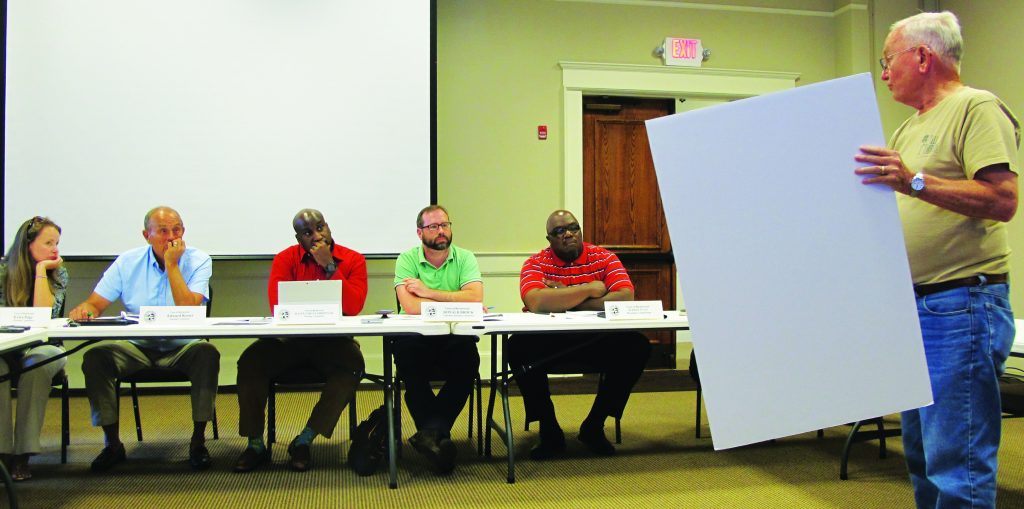
Cobblestone resident Philip Martin holds the schematic of the planned industrial park (see below) as he questions proposed traffic patterns into the industrial park that would affect the proposed traffic circle on Blythewood Road at the entrance to Cobblestone Park. | Barbara Ball
Tim Duerr, Manager of Research for the County’s Economic
Development Department, addressed the rezoning Monday night, saying the county
has been working to bring an industrial park to this site for several years.
“This is one of the last untapped labor-draw areas in the
state for OEMs (Original Equipment Manufacturers),” Duerr said. “If this is not
developed, there are two other counties that will capitalize on it.”
A statement released by Richland County simultaneously with
the Planning Commission meeting said the proposed industrial site is one of the
largest in the area and would give the county a competitive advantage in
attracting big-name companies.
Duerr said the park, as proposed, would accommodate 5.9
million square feet of office and class A technology and manufacturing space.
The press release went further, saying the Blythewood Business Park could be
transformative for the Columbia region – creating jobs, providing controlled
growth and increasing tax revenue.
Ed Parler, the town’s Director of Economic Development, said
that while he believes the industrial park is the highest and best use for the
property, he pointed out that only the county would benefit from the tax
revenue, since the Town of Blythewood does not have a millage.
The statement issued by Richland County said the park has
been 20 years in the making. Lucent Technology considered it for a premier
campus beginning in about 1999.
“For reasons not related to the site, the project did not
advance, but the state and region knew that this was an asset that should be
pursued when the time was right,” the statement said. “The right time arose
several years ago and the Richland County Economic Development Office began
working to gain control of the property and perform the critical due diligence
necessary to evaluate the merits of the site…the site remains a premier
location for businesses and industry because of rapid residential growth in
Northeast Columbia, robust infrastructure, availability of large tracts of land
and success of other business and industrial parks in and around Blythewood. It
is accessible from two interchanges on Interstate 77,” according to the
statement.
Duerr said the park is fully master planned, incorporating
green spaces, natural areas and large buffers between it and the Ashley Oaks residential
neighborhood.
Kesser asked why the county prefers LI-2 zoning over LI-1
for the proposed industrial park.
“The LI-2 zoning district allows a wider variety and greater
intensity of manufacturing uses than the LI-1 zoning district,” Town Administrator
Brian Cook said.
It is those more intense uses that Kesser and several
citizens expressed concern about Monday night.
“You open it up to LI-2 and you’re opening it up to lots of
kinds of manufacturing,” Kesser said.
Attorney Stuart Andrews, who lives in the Middlefield Lane
area, was one of seven members of the community who addressed the
commissioners.
“There is not general opposition to the park from my
neighbors if it has lots of green space and heavy buffers,” Andrews said. “But
I would urge you to exercise care about many of the uses listed. Let’s not just
open the door to everything. Some of those allowed [uses], we don’t consider
good neighbors – textile mills, steel fabrication, wood product manufacturing,
copper recovery, sheet metal, small arms manufacturing, aircraft manufacturing
…”
Andrews suggested the zoning content of LI-2 should be
changed to eliminate the more intense manufacturing uses.
“To be a first class project, it has to have a first class
process,” Andrews said. “Richland County has not been open with you. At the
January, 2019 county council retreat, Jeff Ruble, Director of Richland County’s
Office of Economic Development, was a lot more specific and informative than
they have been in either of their presentations to you,” he told the
commissioners. “It’s really a disservice. At the retreat, Ruble identified the
Blythewood Industrial Park as the signature project for Richland County for the
last 5-10 years. And it’s going to be in our back yards.”
The issue was tabled by a 4-2 vote in July after
commissioners and the public complained that while the county’s economic
development staff had presented detailed plans for the industrial park to town
council in executive session, it had failed to adequately apprise the commissioners
and public of those details.
Commission Chairman Donald Brock asked Town Administrator
Brian Cook to pull Ruble’s retreat speech up on the overhead screen. In the
12-minute clip, Ruble likened the prospects of the park to Volvo – a company
with 4,000 employees in two million square feet of office space.
“If we’re looking at six million square feet of office space
[in the Blythewood Industrial Park]
, we could be looking at even more
employees,” Andrews said. “You can’t have that kind of impact on an area
without it effecting everywhere else. We want to be involved in the process. We
think it’s important to be at the table.”
Andrews said he wants the town government to look at ways to
protect the community’s interest.
“The property should not be rezoned, then have negotiations
about restrictive covenants afterwards,” he said. Andrews also recalled the
incentive-rich Mack Truck deal in Winnsboro.
“After all the incentives were used up, Mack Truck walked
away. I understand that Richland County would like to have an ideal list of
recruitment targets. But if we change the zoning and then try to restrict
covenants, Richland County doesn’t have to participate,” Andrews said.
Duree insisted that the kind of manufacturing the county
wants to recruit is smart, clean manufacturing with high paying, technical
jobs.
“All these jobs are what most communities are trying to
recruit,” Duree said. “
“Industrial parks can
be done in a first class way if that expectation is built in to it,” Andrews
said. “Let’s not chase industry we don’t want.”
Sandy York of Ashley Oaks neighborhood questioned whether
the alternative to the industrial use of the 1,300 acres would be another 3,000
homes.
“Get the town’s tax base up first, then a commitment from
Richland County,” Roberta (Bobbie) Young said. “We have to make sure the rules
and regulations are in place.” Young said she would like to see the commission
slow the process down for now.
“I’m in favor of LI zoning, but before I’m ready to commit
to a specific zoning,” Kesser said, “I think there needs to be some more work
done on the front end with regard to convenants, restrictions, traffic, etc.
I’m fearful that if we don’t, we’ll get in a position where, yes, we go to the
table, but we’re not the 800 pound gorilla here in Blythewood.”
An unidentified woman said she moved to Blythewood from
Summerville, about 10 miles from the Volvo plant.
“You would not believe the explosion of houses and road
deterioration, four-story storage units on every corner and houses all over the
place. Please, be careful in making a decision that could turn Blythewood into
Summerville,” she said. “Backed up traffic at 9 and 10 in the morning and at 2
in the afternoon.”
After Kesser’s motion failed to get a second, Rick
McKendrick made a stand for the rezoning.
“I think there’s a
level of comfort doing nothing. But until we rezone this, to a zoning it is
contiguous with and that Richland County has spent time and treasure studying,”
McKendrick said, “I think there is a flip side to ‘pump the break’ and ‘make
sure we have a seat at the table.’ We have a seat at the table. This is a
fantastic opportunity that might take 30 to 40 years to build out. But if we
don’t rezone the property, we might be here a year from now fending off D.R.
Horton that wants to put a lot of houses here.”
“So I’m going to make the motion to recommend approval of
the rezoning,” he said.
The nays rolled out first – Erica Page, Ed Kesser and Sloan
Griffin. The yays came from the other end of the table from Brock, Derrek Pugh
and McKendrick.
Town Council will take the first of two votes on the rezoning on Monday, Aug. 6, at The Manor.